
Colombia's digital nomad visa is one of the cheapest in the world to obtain and one of the more expensive to actually use, and almost nothing ranking for it says the second half out loud. The visa costs about $232 in government fees. Two years of living on it, if you behave like a resident, can hand you a Colombian tax bill of $15,000 or more on a $70,000 income, because Colombia taxes its tax residents on worldwide income at up to 39%.
For a freelancer or founder earning $50k to $300k a year, that gap is the whole decision. A $232 permit that triggers a five-figure annual liability is not a cheap visa; it is an unpriced one.
So I read the instrument rather than the agency pages: Article 46 of Resolución 5477 de 2022 for the visa, Article 23 for what it does and does not accumulate, Article 15 of Resolución 2357 de 2020 for the fine nobody quotes, and Colombia's 2026 tax brackets for the number at the end. Two things fell out that the top results miss entirely — the income threshold is currently set by a transitional decree because a court suspended the real one, and the 180-day tourist allowance and the 183-day tax test run on different clocks, which lets a scrupulously compliant visitor become a Colombian taxpayer by accident.
Key takeaways
- The income threshold is COP 5,252,715 a month in 2026 — three times the COP 1,750,905 minimum wage, about $1,364. Pages still quoting COP 4,270,500 are using the 2025 wage and are 23% low.
- That number is sub judice. The Consejo de Estado suspended Decreto 1469 de 2025; Decreto 0159 de 2026 fixes the wage transitionally pending judgment, so the threshold can move.
- Government fees run about $232 for the visa plus roughly $76 for the cédula de extranjería — trivial next to the tax exposure.
- 183 days in any 365 makes you tax resident on worldwide income, up to 39%. On $70,000 that is about COP 59.4 million (~$15,400) before deductions.
- It accumulates nothing. Article 23 counts only Migrante (M) visas toward settled residence, and only after three continuous years. Two years here leaves you at zero.
- Miss the 15-day registration and the fine ceiling is 210.50 UVT — about $2,862, more than ten times the visa fee.
SafetyWing — health cover for the one requirement Colombia spells out peril by peril
What the Colombia digital nomad visa actually is
The legal name is the Visa V de Nómadas Digitales, created by Resolución 5477 de 2022 — the Ministry of Foreign Affairs resolution that rebuilt Colombia's entire visa system in July 2022. It sits in the V (Visitante) class, and everything that follows in this article is downstream of that single classification.
Article 46 is short, and it is worth having the requirements next to the clauses they come from rather than paraphrased through three layers of agency marketing.
| Requirement | What Article 46 says |
|---|---|
| Income | Bank statements showing ≥ 3 SMLMV over the last 3 months |
| Maximum validity | Up to 2 years |
| Family | Beneficiaries of the principal holder permitted |
| Work restriction | No paid work for any person or company domiciled in Colombia |
| Insurance | Cover valid in Colombia, minimum perils listed, for at least the stay requested |
| Eligibility | Non-restricted nationalities only |
| Processing | 30 calendar days for study, 10 business days to issue |
Two of those lines do more work than the rest. The work restriction means your clients or employer must sit outside Colombia — this is a permit to be in Colombia while earning elsewhere, not a licence to trade locally. And "non-restricted nationalities" quietly excludes a set of passports that must apply through a consulate in their country of residence instead, so check your own classification before planning around the timeline above.
The V classification is also why this visa has a ceiling rather than a ladder, which we come back to below.
The income threshold, and why the number is under judicial review
Here is the part every competing page gets either stale or incomplete.
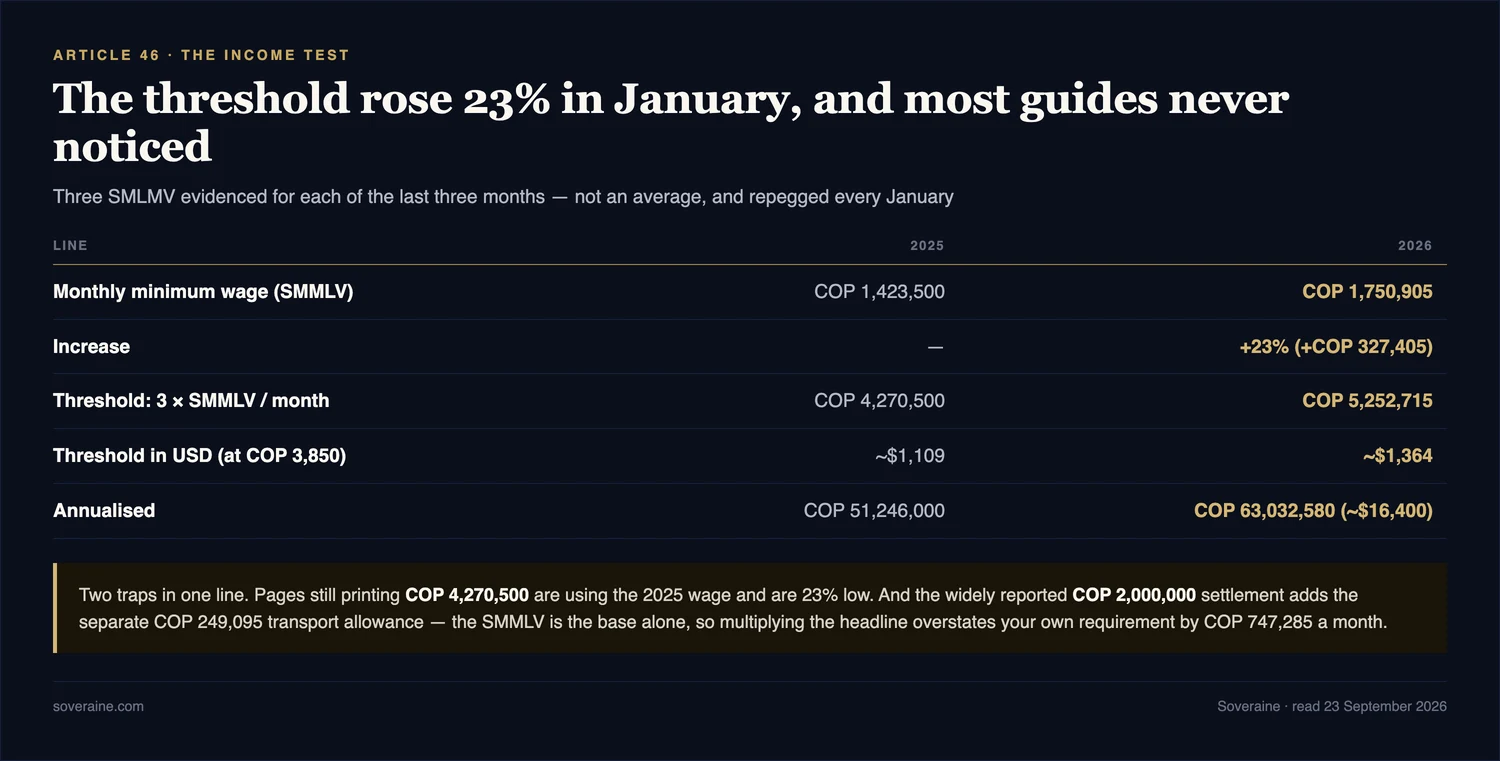
The test is three SMLMV — three current legal monthly minimum wages — evidenced for each of the last three months. It is not an average, and it is pegged to a number the government resets annually, so the visa's price of entry moves every January without the rule changing a word.
| 2025 | 2026 | |
|---|---|---|
| Monthly minimum wage (SMMLV) | COP 1,423,500 | COP 1,750,905 |
| Increase | — | +23% (+COP 327,405) |
| Threshold: 3 × SMMLV / month | COP 4,270,500 | COP 5,252,715 |
| Threshold in USD (at COP 3,850) | ~$1,109 | ~$1,364 |
| Annualised | COP 51,246,000 | COP 63,032,580 (~$16,400) |
That 23% jump is the most out-of-date figure on the Colombia nomad-visa SERP. Several well-ranked guides still print COP 4,270,500 or "about $1,100 a month" — correct for 2025, low by nearly a quarter for anyone filing today.
There is a second trap in the same line. Colombia's 2026 wage settlement is usually reported as COP 2,000,000, because press coverage adds the separate COP 249,095 transport allowance to the base. The SMMLV is the base alone. Multiply the headline instead and you overstate your own requirement by COP 747,285 a month — and might talk yourself out of a visa you qualify for.
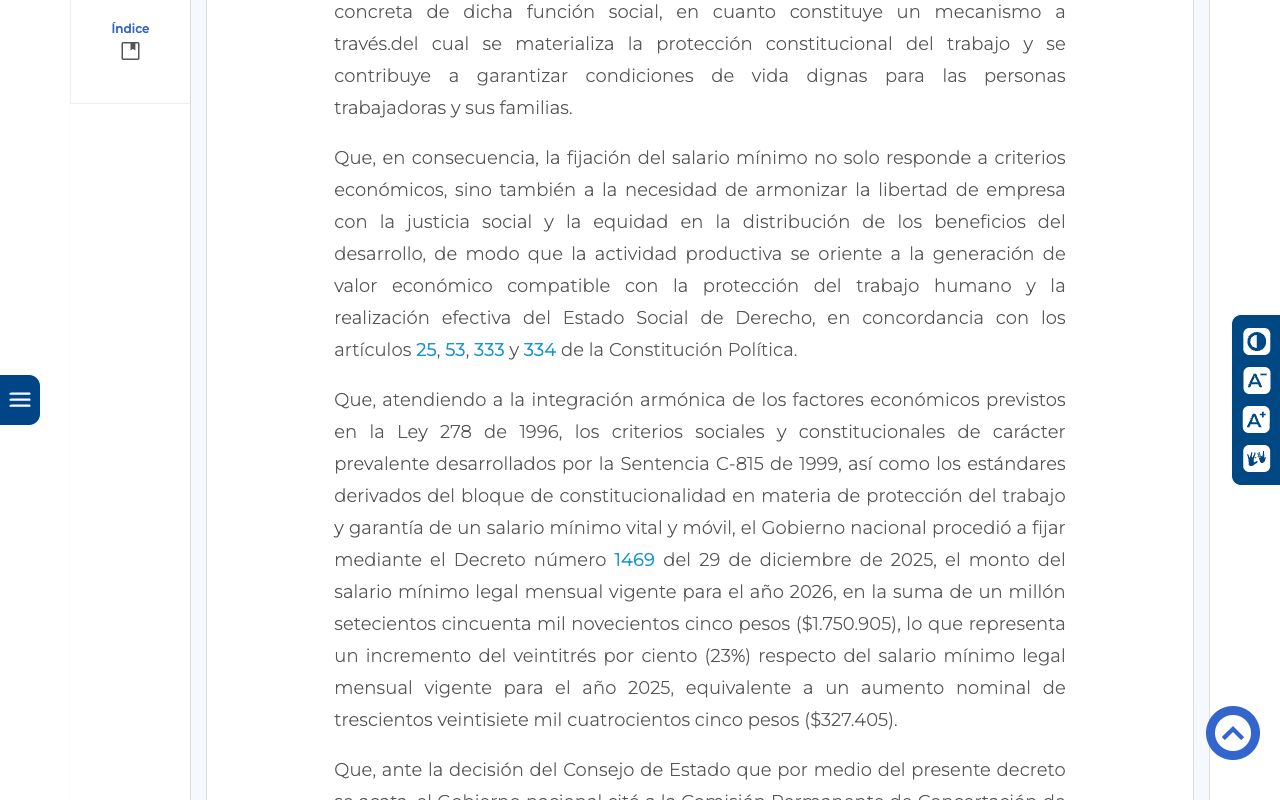
And the base itself is contested. The Consejo de Estado provisionally suspended Decreto 1469 de 2025, the decree that set the 2026 wage, holding that the statutory criteria behind the figure were not verifiable. The government answered with Decreto 0159 de 2026 of 19 February 2026, which fixes the SMMLV transitionally at COP 1,750,905 until judgment in nullity case 11001-03-25-000-2026-00004-00. That is a provisional suspension, not an annulment — but it means the number your application is measured against is currently a court-supervised placeholder. Verify it on the day you file, rather than trusting any guide, this one included.
What it costs, end to end
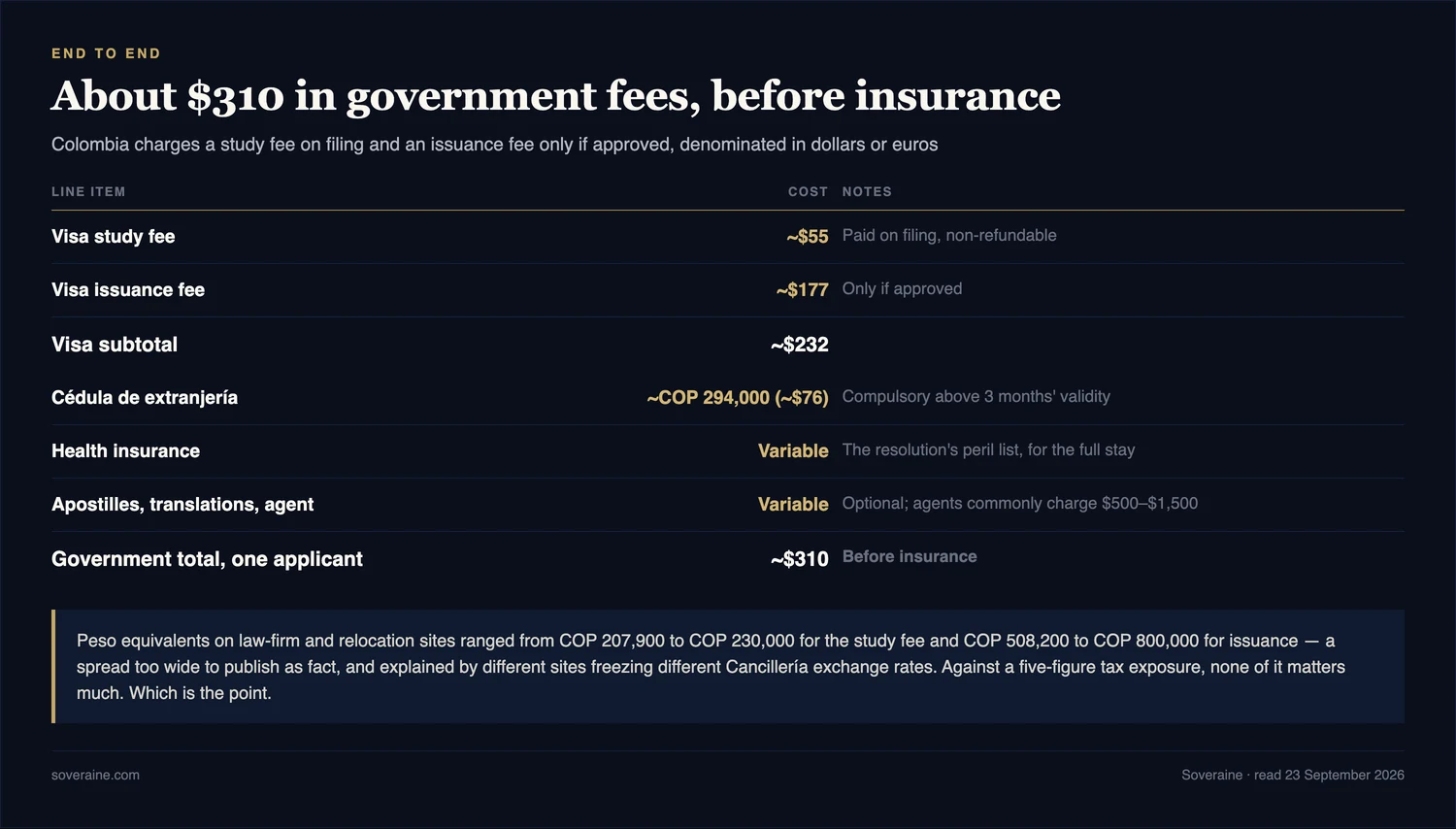
Colombia charges in two stages: a study fee on filing, and an issuance fee only if approved. Both are denominated in dollars or euros and converted to pesos at a rate the Cancillería resets periodically — which is why peso figures across the web disagree while the dollar ones roughly agree.
| Line item | Cost | Notes |
|---|---|---|
| Visa study fee | ~$55 | Paid on filing, non-refundable |
| Visa issuance fee | ~$177 | Only if approved |
| Visa subtotal | ~$232 | |
| Cédula de extranjería | ~COP 294,000 (~$76) | Compulsory above 3 months' validity |
| Health insurance | Variable | The resolution's peril list, for the full stay |
| Apostilles, translations, agent | Variable | Optional; agents commonly charge $500–$1,500 |
| Government total, one applicant | ~$310 | Before insurance |
I quote the dollar figures rather than pesos deliberately. The peso equivalents on law-firm and relocation sites ranged from COP 207,900 to COP 230,000 for the study fee and COP 508,200 to COP 800,000 for issuance — a spread too wide to publish as fact, and explained by different sites freezing different Cancillería exchange rates. Check the ministry's own cost table for the rate in force when you pay.
Against a five-figure tax exposure, none of this matters much. Which is the point.
The 15-day clock, the cédula, and the fine nobody quotes
Approval is not the finish line. Under Article 3 of Resolución 5477, a cédula de extranjería — the foreigner ID card — is issued to holders of any visa valid for more than three months, principal or beneficiary. A two-year nomad visa is comfortably inside that, so the cédula is not optional.
The deadline is the part that catches people. You must register the visa with Migración Colombia within 15 calendar days of entering the country — or of the visa's issuance, if it was granted while you were already in Colombia — and request the cédula off the back of that registration.
You will find guides claiming nomad visa holders get a mobility card instead of a cédula. Read Article 3 against your own grant: the test is validity over three months, not visa class, and a two-year V visa meets it.
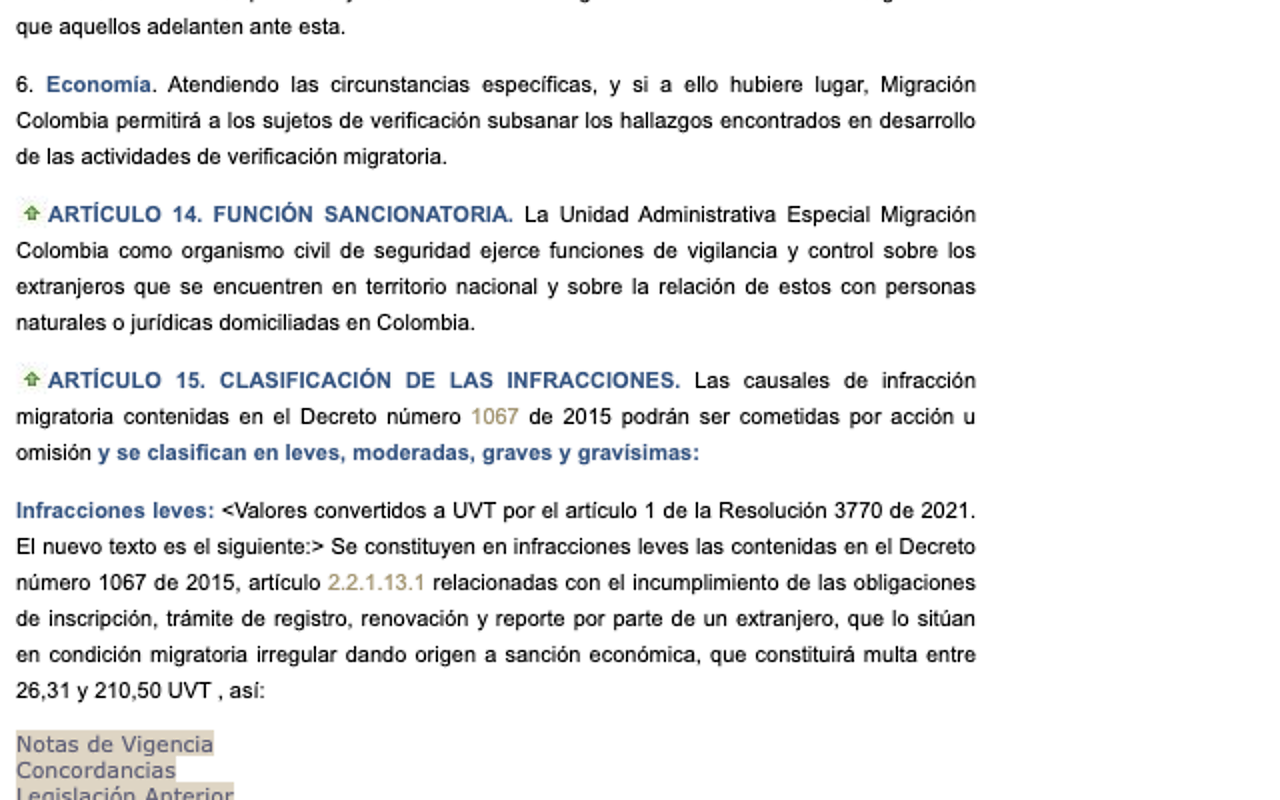
Miss the window and it is a fineable infraction with a published band.
| Value | |
|---|---|
| Legal basis | Art. 15, Resolución 2357 de 2020 (Migración Colombia) |
| Classification | Minor (leve) infraction, item 4 |
| Fine range | 26.31 – 210.50 UVT |
| 2026 UVT | COP 52,347 |
| In pesos | COP 1,377,250 – COP 11,019,044 |
| In dollars (at COP 3,850) | ~$358 – ~$2,862 |
The ceiling is worth sitting with: $2,862 is more than twelve times the visa fee, for the administrative sin of sightseeing for a fortnight before filing a form. Colombia grades infractions from minor to extremely serious, and late registration is the mildest band. Do it in week one.
The cédula is also the practical key to ordinary life — local leases and Colombian bank accounts generally want one. If you would rather not wait on a Colombian bank, a multi-currency account holding pesos alongside your billing currency covers most of what a nomad needs, and we have looked at Wise's business account for people invoicing from abroad.
The 183-day problem: what this visa really costs
Now the number that dwarfs everything above.
Colombia treats you as a tax resident once you have spent 183 days, continuous or not, within any 365 consecutive days. If that run straddles two tax years, residency attaches in the second. Residents are taxed on worldwide income; non-residents only on Colombian-source income. The visa neither causes this nor prevents it — presence does.
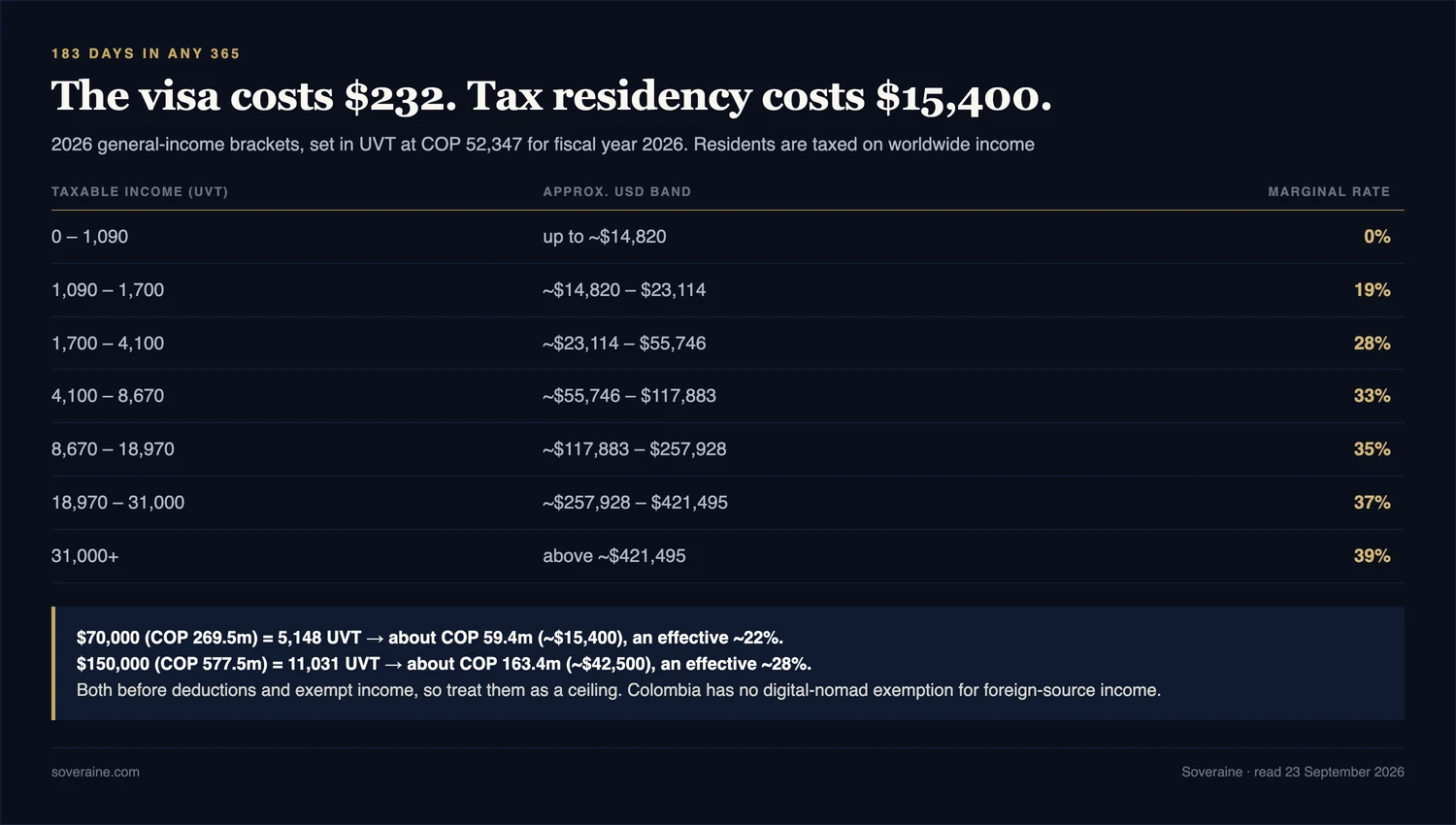
The 2026 general-income brackets are set in UVT, the indexed tax unit, worth COP 52,347 for fiscal year 2026.
| Taxable income (UVT) | Approx. USD band | Marginal rate |
|---|---|---|
| 0 – 1,090 | up to ~$14,820 | 0% |
| 1,090 – 1,700 | ~$14,820 – $23,114 | 19% |
| 1,700 – 4,100 | ~$23,114 – $55,746 | 28% |
| 4,100 – 8,670 | ~$55,746 – $117,883 | 33% |
| 8,670 – 18,970 | ~$117,883 – $257,928 | 35% |
| 18,970 – 31,000 | ~$257,928 – $421,495 | 37% |
| 31,000+ | above ~$421,495 | 39% |
Run this site's income band through it. Both rows below are before deductions and exempt income, so treat them as a ceiling, not a bill — Colombia allows health expenses up to 16 UVT a month, dependants up to 32 UVT a month and mortgage interest up to 1,200 UVT a year for FY 2026, among others, so a real return comes in lower.
| Worldwide income | In UVT | Tax before deductions | Effective rate |
|---|---|---|---|
| $70,000 (COP 269.5m) | 5,148 | ~COP 59.4m (~$15,400) | ~22% |
| $150,000 (COP 577.5m) | 11,031 | ~COP 163.4m (~$42,500) | ~28% |
That is the real price of a two-year Colombian permit used as a two-year home. Note what is absent from Colombia's rules: there is no digital-nomad exemption for foreign-source income. Croatia, Malaysia's DE Rantau and Barbados all carve nomad visa holders out of local tax on foreign earnings — Colombia does not, and the digital nomad visas by nationality comparison is worth reading for that contrast.
If you hold a US passport, none of this replaces your filing obligation either; it stacks, and the foreign tax credit and foreign earned income exclusion are how you stop paying twice.
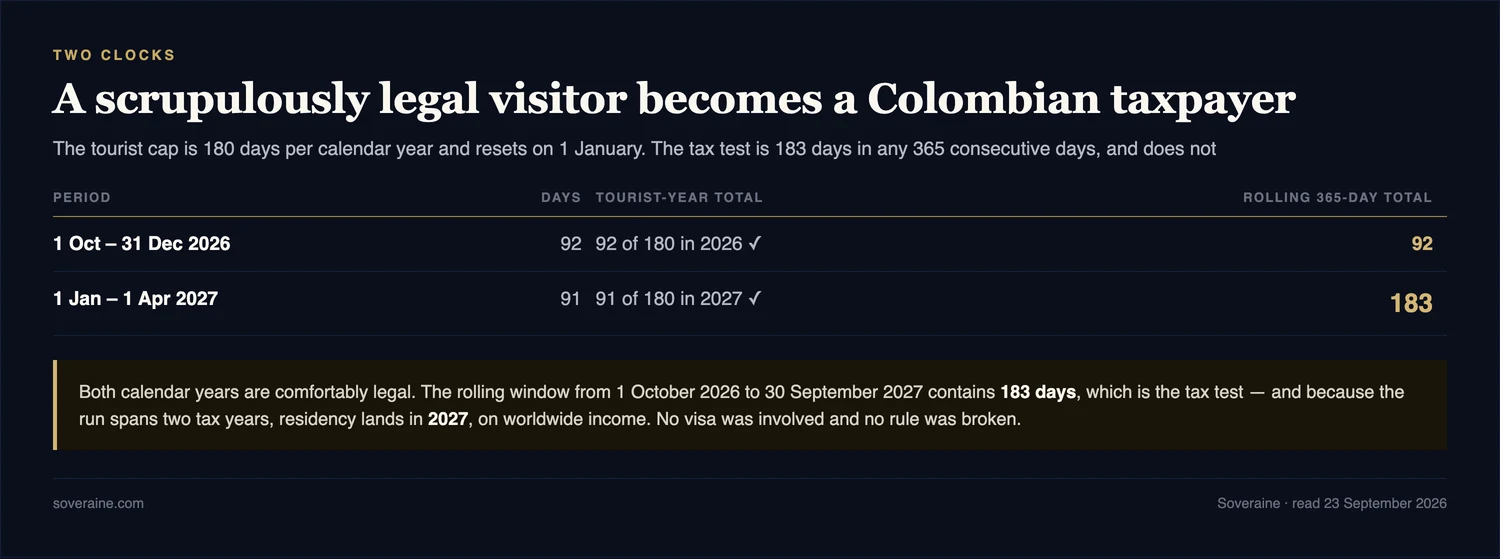
Tourist days and tax days run on different clocks
Here is the mismatch I have not seen written down anywhere, and it catches the careful more than the careless.
Most nationalities get 90 days on arrival free, extendable online by another 90, capped at 180 days per calendar year — Migración Colombia's tariff put the extension at COP 150,000 for 2026, with EU/Schengen and Ecuadorian nationals reported as exempt. That cap resets on 1 January.
Tax residency does not. It is measured over any 365 consecutive days. So consider a visitor who never once breaches the tourist rules:
| Period | Days | Tourist-year total | Rolling 365-day total |
|---|---|---|---|
| 1 Oct – 31 Dec 2026 | 92 | 92 of 180 in 2026 ✓ | 92 |
| 1 Jan – 1 Apr 2027 | 91 | 91 of 180 in 2027 ✓ | 183 |
Both calendar years are comfortably legal. The rolling window from 1 October 2026 to 30 September 2027 contains 183 days, which is the tax test — and because the run spans two tax years, residency lands in 2027, on worldwide income. No visa was involved and no rule was broken.
Nomad visa holders carry the same exposure without the 180-day guardrail, because the permit lets you stay continuously. If you are planning presence around either threshold, the failure modes are in tax resident nowhere, and the Schengen 90/180 rule is the European analogue of the same arithmetic.
It accumulates nothing toward permanent residency
Article 23 of Resolución 5477 is blunt: only Visas de Migrante constitute proof of residence with intent to settle, and only where held continuously for at least three years.
The digital nomad visa is a Visitante. Two full years on it therefore contribute nothing toward a Resident (R) visa or, further out, naturalisation. You can spend 24 months living in Medellín, paying Colombian tax on worldwide income, and arrive at the end with the same standing as on day one.
That is a design choice rather than a defect, and Colombia is not unusual in making it — Estonia's nomad visa is a long-stay visa for the same reason. But it means the visa answers one question and not the other. If a settled path is the goal, the M categories are where to look, and our guide to digital nomad visas that lead to permanent residency sorts the world's programmes on this exact line. For cost, speed and days required across the routes that do accumulate, see second residency options ranked.
The insurance requirement is unusually specific
Most nomad visas ask vaguely for "adequate health cover". Colombia lists the perils, and this is one requirement where reading the text pays.
The policy must be valid in Colombian national territory and expressly cover, at minimum: accidents, illness, maternity, disability, hospitalisation, death and repatriation. It must run for at least as long as the stay you request and be current when you apply.
Repatriation and maternity are the two that trip ordinary travel policies, and "valid in Colombian territory" rules out plans that exclude your country of long-term residence once Colombia becomes exactly that. Take the list to your insurer as a checklist rather than assuming a nomad policy covers it — we walk through what one such policy does and does not cover in our SafetyWing review. Whether a consulate accepts a given policy is its call, not ours.
Who the Colombia digital nomad visa is actually for
Three profiles, and the visa sorts them cleanly.
It works well for the person who wants 6 to 18 months in Colombia and has priced the tax. Fees are trivial, family comes along, processing takes weeks, and Colombia is cheap to live in. If you have modelled the worldwide-income charge and it still beats your current position, this is a good permit.
It works badly for the person who wants a low-tax base. A 22% to 28% effective rate on worldwide income is not optimisation — it is a European-grade tax bill in a warmer place. If that was the appeal, the honest comparisons are Georgia's 1% regime, Panama's Friendly Nations visa and the zero-percent tax residencies — or Mexico's temporary resident visa for Latin America with a four-year route to permanence.
It works badly for anyone building toward a passport, for the reason in Article 23. Two years, zero accumulation.
And for a surprising number of readers the right answer is no visa at all: 180 tourist days a year, deliberately kept under the rolling 183, costs nothing and triggers nothing. Just count on the correct clock.
Related guides
- Digital nomad visas by nationality — the programme-by-programme table, including which countries exempt foreign income where Colombia does not.
- Digital nomad visas that lead to permanent residency — the settlement test Colombia's V visa fails, applied across the field.
- Second residency options ranked — cost, speed and days required for the routes that do accumulate.
- Tax resident nowhere — why a permit does not settle tax residency, and how day-counting goes wrong.
- Mexico's temporary resident visa — the closest Latin American comparison, with a four-year path to permanence.
- Spain's digital nomad visa — a European alternative with a special tax regime rather than plain worldwide taxation.
FAQ
What is the income requirement for Colombia's digital nomad visa in 2026?
Article 46 of Resolución 5477 de 2022 requires bank statements showing at least three current monthly minimum wages for each of the last three months. The 2026 minimum wage is COP 1,750,905, so the threshold is COP 5,252,715 a month — roughly $1,364 at COP 3,850 to the dollar, or about $16,400 a year. Two cautions: the test is on the base wage, not the COP 2,000,000 headline that includes the separate transport allowance; and many pages still quote COP 4,270,500, which is three times the 2025 wage and 23% low for 2026.
Is the Colombia digital nomad visa income threshold about to change?
It might. The Consejo de Estado provisionally suspended Decreto 1469 de 2025, the decree that set the 2026 minimum wage, and the government responded with Decreto 0159 de 2026 of 19 February 2026, which fixes the wage transitionally at COP 1,750,905 until judgment in nullity case 11001-03-25-000-2026-00004-00. Because the visa threshold is a multiple of that wage rather than a fixed sum, an annulment would move it. Nothing about the visa rule itself is in question — only the number it multiplies.
How much does the Colombia digital nomad visa cost in total?
The visa itself is about $232: roughly $55 to study the application and roughly $177 to issue it if approved. Add the cédula de extranjería at about COP 294,000, around $76 in 2026, since any visa valid over three months triggers it. Insurance meeting the resolution's peril list is the variable line and usually the largest. Budget $310 or so in government fees for one applicant and price the insurance separately.
Does time on Colombia's digital nomad visa count toward permanent residency?
No, and the reason is structural. Article 23 of Resolución 5477 de 2022 counts only Migrante (M) visas as proof of residence with intent to settle, and then only when held continuously for at least three years. The digital nomad visa is a Visitante (V). Two full years on it accumulate nothing toward a Resident (R) visa, so if permanent residency is the point, this is the wrong document — look at an M category instead.
Will the Colombia digital nomad visa make me a Colombian tax resident?
The visa does not, but living there will. Colombia treats you as tax resident once you spend 183 days, continuous or not, in any 365 consecutive days, and residents are taxed on worldwide income at rates up to 39%. A two-year permit used as a two-year home crosses that line in year one. On roughly $70,000 the charge before deductions is about COP 59.4 million, near $15,400 — far more than the visa, cédula and insurance combined.
Do I even need the visa if I only want a few months in Colombia?
Probably not. Most nationalities get 90 days on arrival at no cost and can extend online for another 90, capped at 180 days per calendar year. If your plan is a season rather than a life, the entry permit does the same job for a fraction of the paperwork. The visa earns its keep when you want more than 180 days in a year, a cédula, a local lease or bank account, or family on the same permit.
What happens if I miss the 15-day registration deadline in Colombia?
It is a fineable migration infraction, not a paperwork nicety. Article 15 of Resolución 2357 de 2020 makes failure to register within 15 calendar days of entry a minor infraction carrying a fine of 26.31 to 210.50 UVT. At the 2026 UVT of COP 52,347 that is roughly COP 1.38 million to COP 11.0 million, about $358 to $2,862 — a ceiling over ten times the visa fee. Register first, sightsee after.
Sources
- Cancillería de Colombia — Resolución 5477 de 2022 — the visa regime, and the source for Article 46 (the 3 SMLMV test over three months, the two-year maximum, beneficiaries, the ban on work for Colombian-domiciled persons, the insurance schedule), Article 23 (only Migrante visas prove settled residence, after three continuous years) and Article 3 (the cédula for any visa valid over three months).
- Cancillería de Colombia — Resolución 2357 de 2020, Migración Colombia — Article 15, the minor-infraction band of 26.31 to 210.50 UVT, and item 4: failure to register within 15 calendar days of entry or issuance.
- Cancillería de Colombia — Decreto 0159 de 2026 — the transitional 2026 SMMLV of COP 1,750,905, fixed 19 February 2026 pending judgment in nullity case 11001-03-25-000-2026-00004-00, after the Consejo de Estado suspended Decreto 1469 de 2025.
- Cancillería de Colombia — Costos de trámites de visa — the official fee table, the nationality-specific exemptions, and the reset exchange rate used when paying in pesos.
- PwC Worldwide Tax Summaries — Colombia, individual residence — the 183-day test over 365 consecutive days, and the rule that residency attaches in the second year where the run straddles two tax years.
- PwC Worldwide Tax Summaries — Colombia, taxes on personal income — worldwide taxation of residents, the 2026 brackets from 0% to 39%, and the FY 2026 UVT of COP 52,347.
- Brigard Urrutia — The digital nomad visa and other changes to the immigration system — the 30-calendar-day study and 10-business-day issuance windows, and the restriction to non-restricted nationalities.
Figures are current as of September 2026 and USD conversions use COP 3,850 to the dollar, the rate the Cancillería applied for early 2026 — the peso moves, and so do these numbers. The minimum wage setting the income threshold is subject to a pending Consejo de Estado judgment, so verify it and the fee table on the day you file. Whether a particular policy or nationality qualifies is the consulate's determination, not something a guide can settle. Tax outcomes depend on facts this page cannot know, including your other income, residence history and treaty position. This is editorial research, not legal, immigration or tax advice.