
Every ranking of second residency programmes you will read this year was written against a table that stopped being true in May. Portugal's Golden Visa — for a decade the default answer, on the strength of 7 days a year for 5 years and then an EU passport — still has the same price, the same presence rule and the same renewal cycle. What it no longer has is the five-year finish line. Lei Orgânica n.º 1/2026, in force since 19 May 2026, moved naturalisation to 10 years for most applicants, and started the clock later.
That one change reorders the whole comparison, because almost everyone shopping for a second residency is really shopping for one of three things and has not separated them: a cheap legal foothold, a fast one, or a passport. Those three goals point at different countries, and in 2026 they point at them more sharply than they did in 2024.
This guide ranks the realistic routes on the three axes that actually decide the choice — all-in cost, time from filing to card, and days you must physically spend on the ground — with every figure dated and sourced. We ran the numbers on the presence rules in particular, because that is the column the brochures leave out.
Key takeaways
- Portugal's residency is unchanged; its citizenship is not. Naturalisation now needs 10 years for most third-country nationals and 7 for CPLP nationals, counted from the date on your first residence card (Lei Orgânica n.º 1/2026, in force 19 May 2026).
- The cheapest genuine routes are not golden visas. Paraguay's permanent residency costs roughly $2,000–$6,000 in fees with no investment; Latvia's business route publishes a €50,000 threshold, the lowest in the EU.
- Zero-stay and citizenship are mutually exclusive. Greece, Hungary, Bulgaria and the UAE ask for no minimum stay — and every one of them requires roughly 183 days a year before naturalisation time counts.
- Speed ranges by two orders of magnitude. UAE Golden Visa decisions run 2–4 weeks; Portugal's have run 12–36 months through the AIMA backlog.
- None of this is a tax plan. Residency and tax residency are different tests, and the low-presence programmes are engineered so you never trigger the second one.
On this page: What a second residency actually buys you · The three axes: money, months, days · Ranked by days on the ground · What Portugal's 2026 nationality law actually changed · Ranked by speed · Residency is not tax residency · Which route fits which reader · Related guides · FAQ · Sources
SafetyWing — Private health cover, which nearly every residency application makes a hard requirement
What a second residency actually buys you
A second residency is a residence permit issued by a country you are not a citizen of. That is the whole definition, and it is worth being pedantic about it, because three adjacent things get sold under the same name.
It is not citizenship. A permit does not give you a passport, voting rights, or the unconditional right of return that citizenship carries. It can be revoked, and it expires unless renewed.
It is not a tax status. Tax residency is decided by a separate statutory test in each country — usually day-counting, sometimes centre-of-interests. Holding a Greek permit while living in Berlin makes you a German tax resident with a Greek card in your wallet.
It is not visa-free travel. An EU residence permit lets you stay in the issuing state and move within Schengen for up to 90 days in any 180; it does not turn your passport into a better one.
What it does buy is a legal right to enter, live and re-enter a second jurisdiction on terms you control rather than terms a border officer decides on the day — plus, in the programmes that require real presence, a naturalisation clock. Those two benefits pull in opposite directions, which is the single most useful thing to understand before comparing prices.
The three axes: money, months, days
Rank programmes on any one axis and you get a different winner. Rank on all three and the trade-off becomes obvious.
| Programme (2026) | Minimum investment | Time to first card | Presence to hold/renew |
|---|---|---|---|
| Paraguay — ordinary permanent residency | None (fee-based) | Weeks to a few months | Effectively none; visit periodically |
| Paraguay — Investor Pass (launched Apr 2026) | $70,000 (productive) / $150,000 / $200,000 | Weeks | None published |
| Panama — Friendly Nations | $200,000 property or CD, or qualifying employment | Provisional in days; permanent after 2 years | Visit roughly every 2 years |
| Mexico — temporary resident | None; income ~$4,400/mo or savings ~$72,000 | Weeks (consulate + INM) | Real presence expected; 4 years to permanent |
| UAE — Golden Visa | AED 2,000,000 capital or property; or AED 30,000/mo salary | 2–4 weeks | None; six-month absence rule waived |
| Latvia — business route | €50,000 | Not published | None |
| Greece — Golden Visa | €250,000 / €400,000 / €800,000 by zone | 4–9 months | None |
| Hungary — Guest Investor | €250,000 fund | ~30 days (visa decision); 2–3 months total | None |
| Italy — Investor Visa | €250,000 / €500,000 / €1m / €2m | 3–4 months | Intent to reside |
| Cyprus — permanent residency | €300,000 property | 2–3 months | Visit once every 2 years |
| Bulgaria — fund route | €512,000 | 6–8 months | None |
| Portugal — Golden Visa | €500,000 fund | 12–36 months (AIMA backlog) | 7 days year 1; 14 days per 2-year renewal |
| Spain — non-lucrative | None; income €28,800/yr (2026 IPREM basis) | 1–3 months | Cannot be absent more than 183 days a year |
Figures are 2026 published minimums and typical processing ranges from programme operators and legal summaries; European thresholds and timings follow IMI Daily's 2026 survey of open European programmes. Government fees, due diligence, legal work and — for fund routes — annual management charges sit on top, commonly adding €25,000 to €60,000 over the life of an EU investment programme. Treat every headline number as the floor.
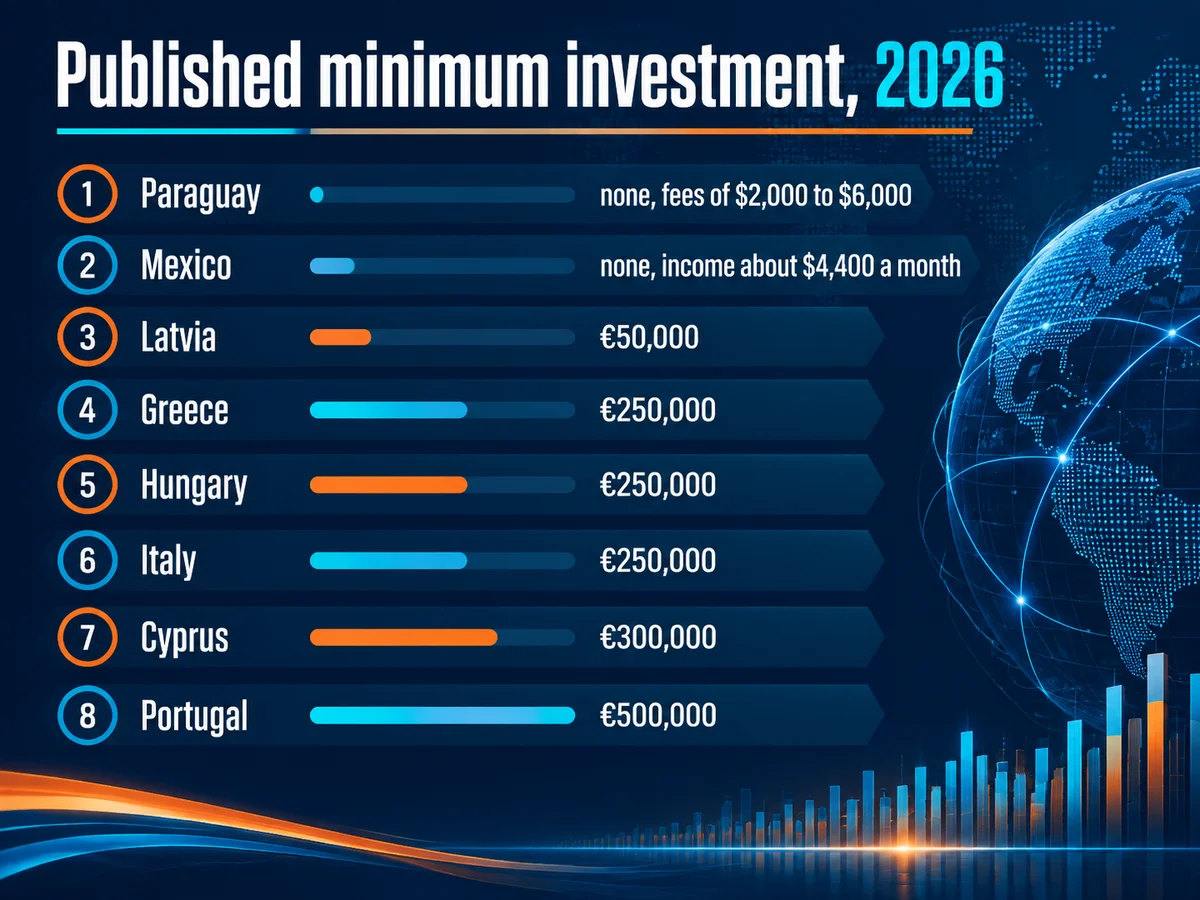
Read the last two columns together and the structure of the market appears. The programmes that ask nothing of your calendar are asking a lot of your bank balance, and vice versa. Our map of every country with a golden visa covers the investment side in more depth; what follows is the part that is harder to find.

Ranked by days on the ground
This is the column that decides whether a residency is a lifestyle or a filing cabinet, and it is the one most comparison pages either omit or quietly conflate with the citizenship requirement.
| Country | Days required to hold/renew | Days required for the citizenship clock |
|---|---|---|
| Greece | None | ~183/year for 7 years (plus language, history and culture exams) |
| Hungary | None | Ordinary naturalisation residence, 8 years standard |
| Bulgaria | None | 5 years permanent residence, ordinary route |
| UAE | None — six-month absence rule waived | No general naturalisation route |
| Latvia | None | 10 years, with language and history exams |
| Cyprus | Visit once every 2 years | 7–8 years of actual residence |
| Panama | Visit roughly every 2 years | 5 years of residence, in practice with real presence |
| Paraguay | Effectively none | 3 years of permanent residence, plus Spanish or Guaraní |
| Portugal | 7 days year 1; 14 days per 2-year renewal | 10 years (7 for CPLP nationals) from card issue |
| Italy | Intent to reside | 10 years for non-EU nationals |
| Mexico | Real presence expected | 5 years of residence (2 for spouses, some Latin American nationals) |
| Spain | No absence over 183 days/year | 10 years (2 for Ibero-American, Andorran, Filipino, Equatorial Guinean, Portuguese nationals and Sephardic Jews) |
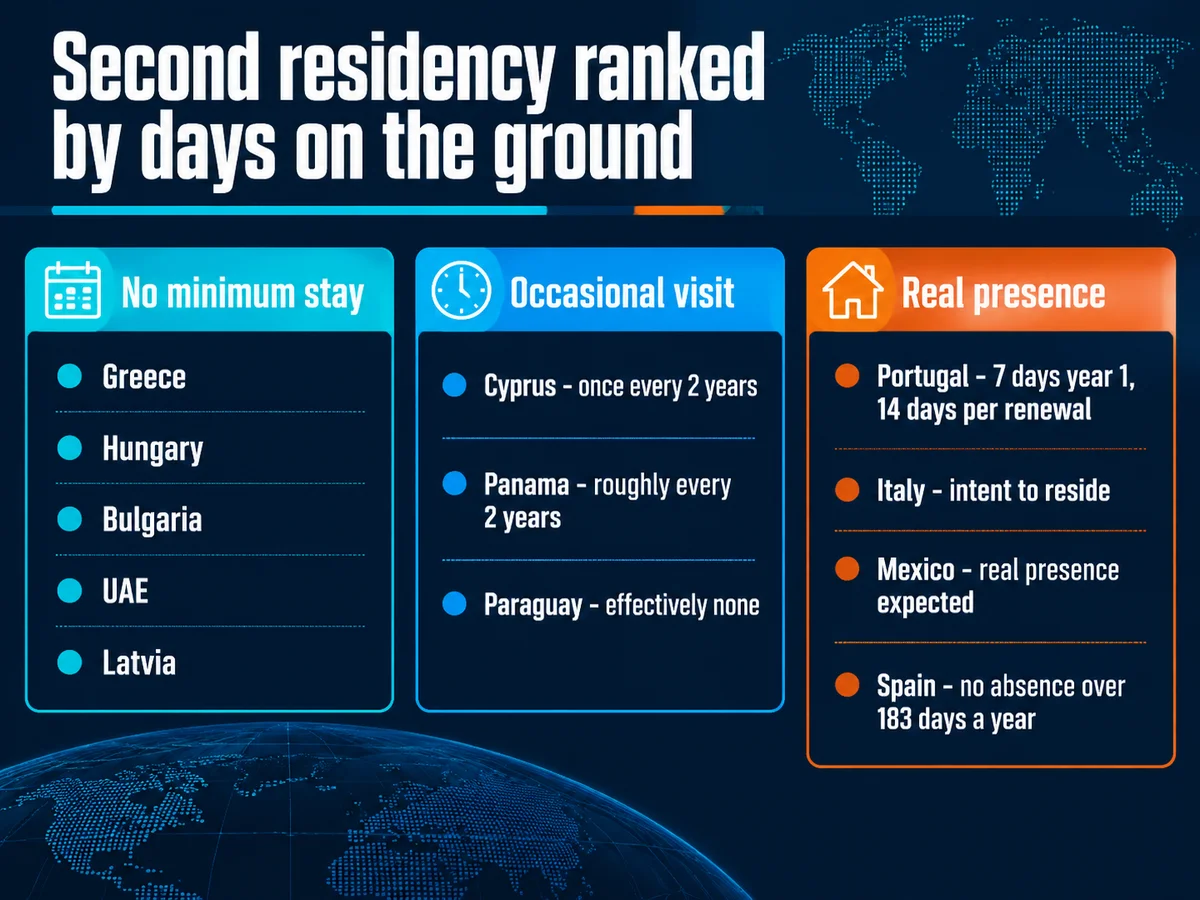
The pattern is not a coincidence. A country that lets you hold a permit on zero days is a country whose naturalisation law counts residence, not permits, and those are different words in every statute that matters. Buying a zero-stay residency and expecting it to mature into a passport is the most common and most expensive misreading in this market.
Portugal was the famous exception, and it is the exception that just narrowed. The 7-days-a-year rule bought a full year of the naturalisation clock, which is why the programme priced at €500,000 while its neighbours priced lower. That arbitrage still exists — it now runs for ten years instead of five.
What Portugal's 2026 nationality law actually changed
Worth separating carefully, because a lot of coverage has run the two things together.
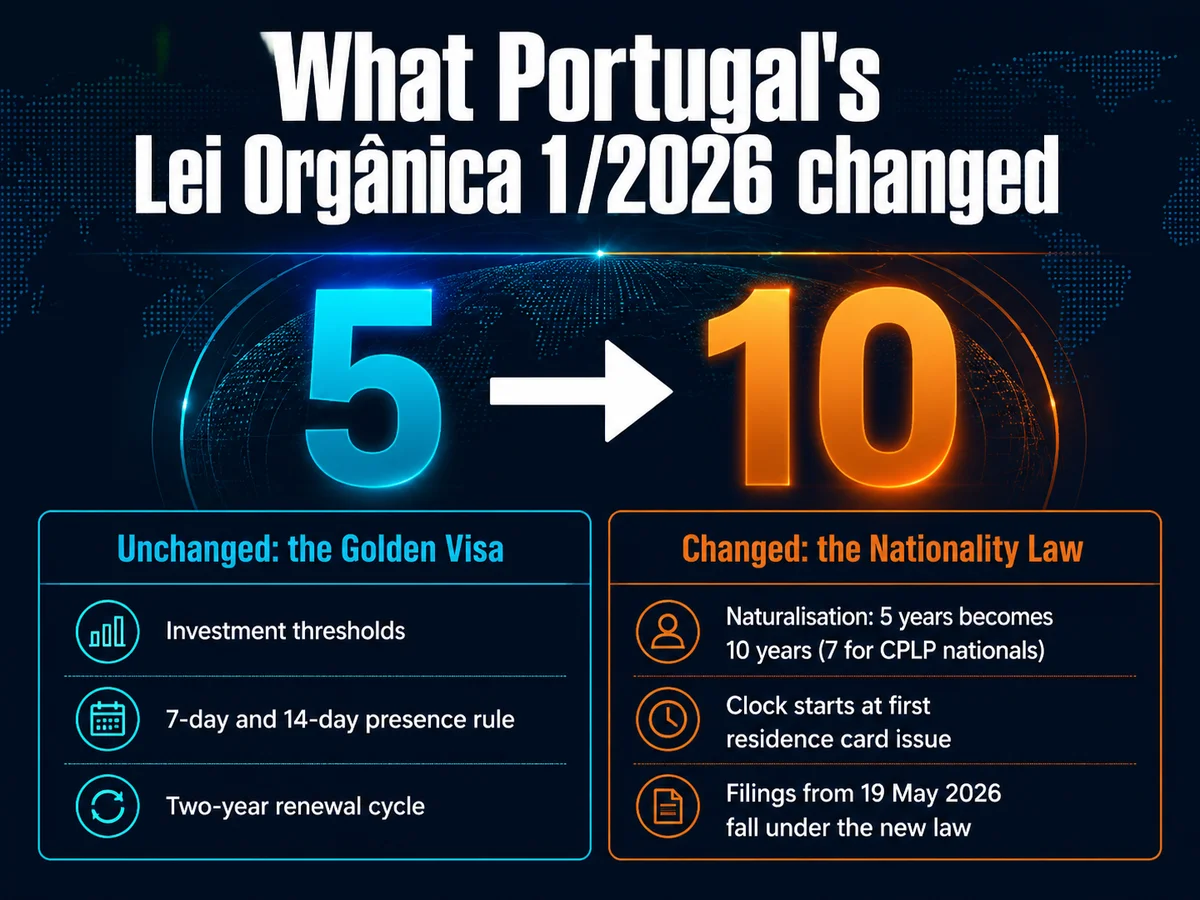
Unchanged: the Golden Visa (ARI) itself. Investment thresholds, the 7/14-day presence rule, the two-year renewal cycle, family inclusion and renewal rights all stand as they were.
Changed: the Nationality Law, Lei n.º 37/81, as amended and republished by Lei Orgânica n.º 1/2026, published in Diário da República on 18 May 2026 and in force from 19 May 2026. Three things moved:
- The qualifying period. The universal 5 years became 10 years for most third-country nationals and 7 years for CPLP nationals. (Secondary coverage differs on whether EU/EEA nationals sit in the 7-year band; the point is not settled in the commentary we could verify, so do not plan on it.)
- When the clock starts. The period is counted from the issue date of the first residence card, not from the date the application was filed. Under a backlog that has run past two years, that is a materially different number.
- Which law applies to you. Applications filed up to 18 May 2026 remain under the previous regime. Filings from 19 May 2026 fall under the new one, so the filing date, not the residence date, decides.
For a reader who started a Portuguese file in 2024 and expected a passport around 2030, the honest recalculation is closer to the late 2030s. The residency is as good as it was. The prize at the end of it is a decade away. Our Portugal Golden Visa guide covers the programme mechanics; treat any timeline in older coverage of it as pre-May-2026.
The practical consequence for anyone still choosing: if the goal is an EU passport, Portugal's remaining advantage over Greece or Italy is now much smaller, and the low-presence route to a European citizenship — the thing Portugal uniquely sold — is close to gone.
Ranked by speed, and why the fast ones are fast
If the requirement is a card in hand this quarter, the ranking inverts almost perfectly.
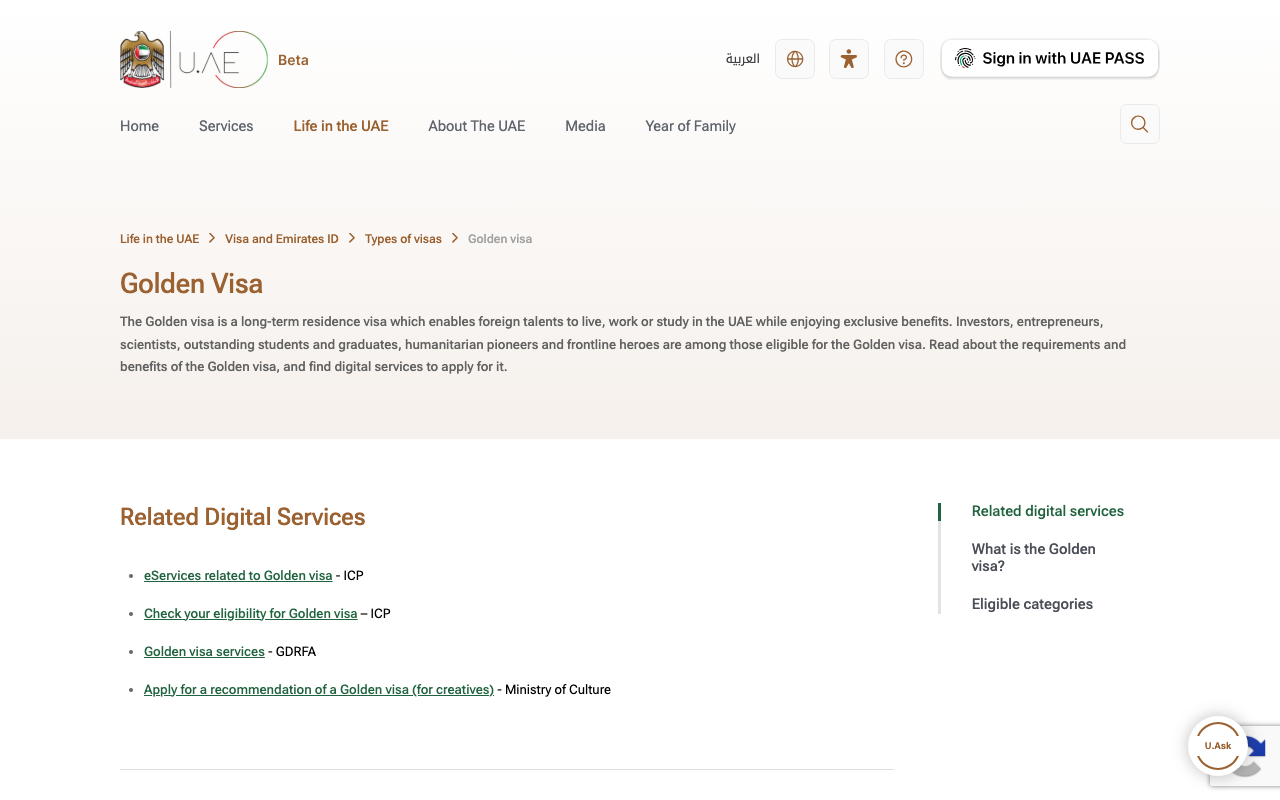
The UAE Golden Visa is the fastest serious option, with decisions commonly issued in two to four weeks. The official UAE government portal describes it as a renewable residence visa valid for 5 or 10 years, self-sponsored, with qualifying categories including investors with minimum capital of AED 2 million, property owners, exceptional talent and high earners — and confirms holders may "stay outside the UAE for more than the usual period of six months" without losing status. That last clause is the whole product for a non-resident holder, and it is why the UAE dominates the speed column. It is also why there is no naturalisation story attached: the UAE has no general route from residence to citizenship. We cover the mechanics and the 9% corporate tax that comes with actually operating there in the Dubai Golden Visa guide.
Panama's Friendly Nations Visa is the fastest Western-hemisphere option for the roughly 50 eligible nationalities, producing provisional status very quickly once filed in country, with permanent residency following after two years. The qualifying routes are a $200,000 property purchase, a $200,000 three-year bank certificate of deposit, or professional employment with a Panamanian company that meets local labour-quota rules. The Panama Friendly Nations Visa guide has the full country list and document set.
Hungary's Guest Investor Programme targets around 30 days for the visa decision at a €250,000 fund subscription, and Italy's Investor Visa Committee pre-approves in roughly 30 days.
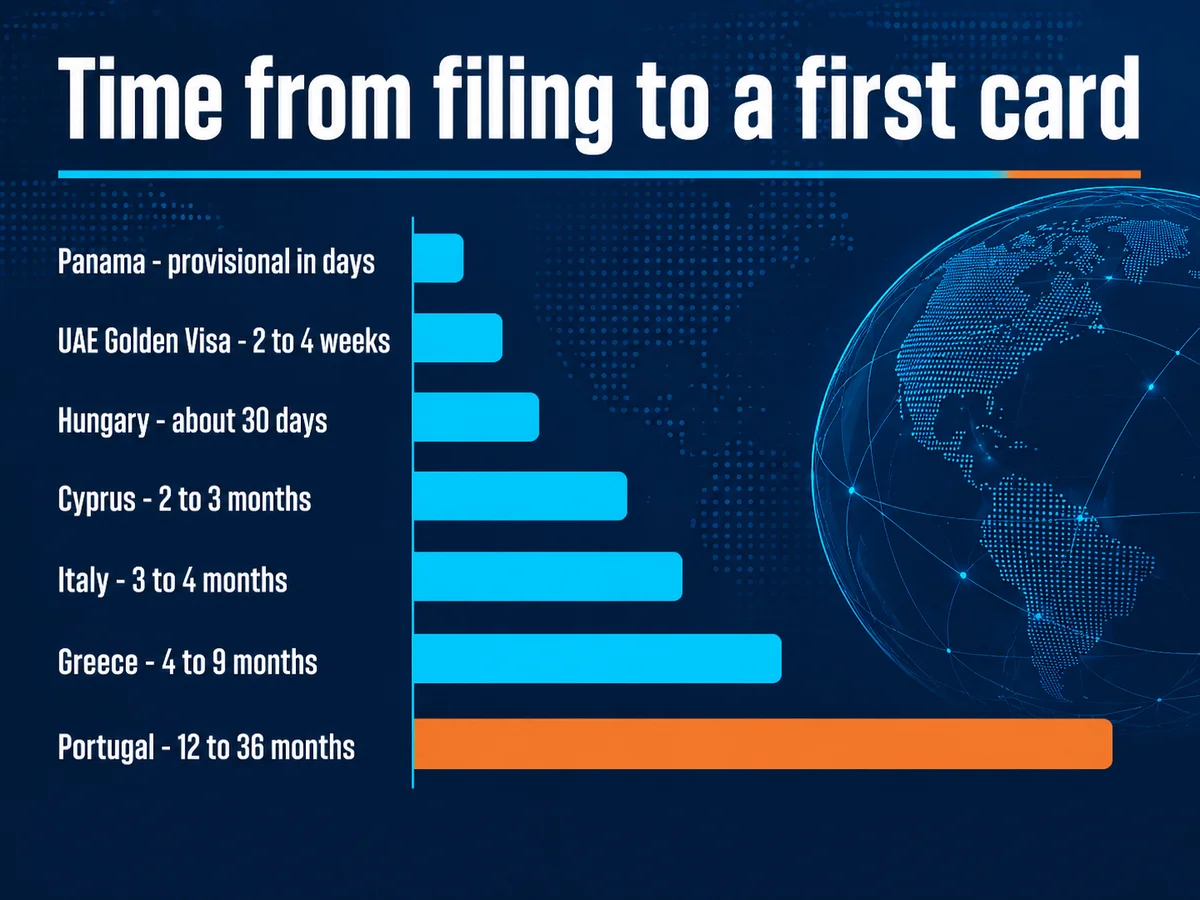
The slow end is almost entirely Portugal, where the AIMA backlog has produced 12-to-36-month waits on initial decisions. Greece sits in the middle at four to nine months depending on how clean the file is.
There is a general rule buried in that list: programmes decide fast when the decision is administrative and slow when it is discretionary. Nothing about paying more makes a discretionary process quicker.
Residency is not tax residency
This is where the money is actually won or lost, and it has nothing to do with which card you hold.
Every country in the table above decides tax residency by its own statutory test, not by your permit. The common triggers are 183 days of physical presence, a permanent home available to you, or a centre of vital interests. Greece's individual residence rules, for instance, are set out plainly in PwC's Worldwide Tax Summaries and turn on presence and permanent-home tests — the Golden Visa is not mentioned, because it is irrelevant to the question.
So the zero-stay programmes are, by construction, tax-neutral. You cannot get a Greek permit, spend no days in Greece, and become a Greek tax resident. What you get is a permit and the same tax bill you had before.
Where people go wrong is the reverse direction: assuming that leaving is enough. If you keep a home, a family and an economic centre in Germany, Spain or the Netherlands, those states will keep taxing you, and the treaty tiebreaker in Article 4 of the OECD Model Convention will likely agree — it runs through permanent home, centre of vital interests, habitual abode and nationality in that order. We went through the failure modes in detail in tax resident nowhere, and they apply to people who very much are resident somewhere.
If the actual goal is a lower rate rather than a second address, the realistic routes are covered in zero-percent tax residencies — and they all require you to genuinely move.
For US persons, none of this moves the needle at all. The United States taxes citizens and green-card holders on worldwide income wherever they live. A second residency does not end Form 1040, FBAR on aggregate foreign accounts over $10,000, or FATCA reporting. It can support a foreign earned income exclusion or foreign tax credit claim if you genuinely live abroad. That is the entire benefit.
Which route fits which reader
Working backwards from what you actually want, rather than forwards from a price list:
You want an EU passport and can live in Europe. Greece, at 183 days a year for 7 years plus language and culture exams, is now a more honest proposition than Portugal at 10 years — and the entry price is lower in most zones. Italy at 10 years is comparable. If you have Ibero-American, Portuguese, Andorran, Filipino or Sephardic ancestry, Spain's 2-year naturalisation route beats every investment programme on the table by a distance; see easiest EU citizenship before spending anything.
You want an EU foothold and will not relocate. Greece, Hungary or Bulgaria. Zero presence, permit renewable, and no pretence about a passport. Do not pay Portugal's premium for a citizenship clock you have no intention of running.
You want speed and a base outside Europe. UAE for two-to-four-week decisions and no stay requirement; Panama if you hold one of the fifty eligible passports and want a Western-hemisphere time zone.
You want the cheapest legal foothold that exists. Paraguay. Fees of roughly $2,000 to $6,000, no investment on the ordinary route, and a three-year naturalisation window that is among the shortest anywhere — though it expects real residence and a working knowledge of Spanish or Guaraní.
You want to live somewhere cheaper and warmer. Mexico's temporary resident visa remains the most-used option for exactly this, at roughly $4,400 a month of evidenced income or around $72,000 in savings under 2026 consular guidance, converting to permanent residency after four years. Details in the Mexico temporary resident visa guide.
You want a lower tax rate. Then this is the wrong article. Pick the residency after you have decided where you will actually live 183 days a year, not before.
Related guides
- Countries with a golden visa: the 2026 map — every active investor-residency programme, with what closed and when.
- Easiest European countries to get citizenship — naturalisation, descent and what is left of the investment routes.
- Digital nomad visas: a 2026 guide by nationality — the lighter-touch alternative when you do not need permanence.
- Portugal Golden Visa — thresholds, fund routes and the AIMA backlog.
- Spain's non-lucrative visa — the 183-day route for people who genuinely intend to move.
- Cyprus non-dom in 2026 — what an EU residency looks like when the tax side is the point.
FAQ
What is a second residency?
A second residency is a legal right to live in a country other than the one you hold citizenship in, granted as a residence permit rather than a passport. It is not citizenship, it is not a visa-free travel document, and in most cases it does not by itself change where you pay tax. What it does give you is the right to enter, stay and re-enter a second country on your own terms, plus in most programmes a clock that eventually runs toward naturalisation if you actually live there.
What is the cheapest second residency in 2026?
On money actually spent rather than money parked, the cheapest routes are the ones with no investment requirement at all. Paraguay's ordinary permanent residency runs roughly $2,000 to $6,000 in agent, legal and government fees. Mexico's temporary resident visa costs a few hundred dollars in consular and INM fees but requires you to evidence income of roughly $4,400 a month or savings near $72,000 under 2026 consular guidance. Among investment routes, Latvia's business route at €50,000 and Greece's €250,000 conversion tier are the lowest published thresholds in the EU.
Which second residency requires the fewest days in the country?
Several require none at all. Greece, Hungary, Bulgaria and Malta's residency programme publish no minimum stay to hold or renew the permit, and the UAE Golden Visa exempts holders from the standard six-month absence rule that cancels an ordinary UAE residence visa. Portugal's Golden Visa requires 7 days in the first year and 14 days per subsequent two-year period. Cyprus and Panama are effectively "show up once every two years". The catch is uniform: a permit you can hold on zero days is a permit that will never mature into citizenship.
Did Portugal's Golden Visa change in 2026?
The Golden Visa itself did not. Investment thresholds, the 7-days-a-year presence rule, renewal cycles and family inclusion are unchanged. What changed is the destination. Lei Orgânica n.º 1/2026, published on 18 May 2026 and in force from 19 May 2026, amended the Nationality Law so that naturalisation now requires 10 years of legal residence for most third-country nationals and 7 years for CPLP nationals, up from a universal 5. The qualifying period is also counted from the issue date of the first residence card rather than from the application. Applications filed up to 18 May 2026 stay under the old regime.
Does a second residency reduce my tax bill?
Not on its own. Holding a residence permit and being tax resident are separate things, and the low-presence programmes are specifically designed so that you never trigger tax residency in the host country. If you keep your home, family and economic centre in a high-tax state, that state will continue to tax you, and a treaty tiebreaker under Article 4 of the OECD Model Convention will usually agree with it. Tax outcomes change when you genuinely move, not when a card arrives in the post.
Can a US citizen use a second residency to stop filing US taxes?
No. The United States taxes its citizens and lawful permanent residents on worldwide income regardless of where they live. A second residency anywhere — Portugal, Dubai, Paraguay — does not end Form 1040, FBAR on aggregate foreign accounts over $10,000, or FATCA reporting on Form 8938. It can help you qualify for the foreign earned income exclusion or foreign tax credits if you actually live abroad. Only formal renunciation ends US filing obligations, and it triggers the exit tax under IRC §877A for covered expatriates.
How fast can you get a second residency?
Weeks, if you pick for speed. UAE Golden Visa decisions are commonly issued in two to four weeks. Hungary's Guest Investor Programme targets around 30 days for the visa decision, Panama's Friendly Nations route can produce provisional status within days of filing in country, and Italy's Investor Visa Committee pre-approves in roughly 30 days. At the other end, Portugal's Golden Visa has run 12 to 36 months through the AIMA backlog. Speed and passport value are inversely correlated almost everywhere.
Is a second residency worth it if I never move?
Sometimes, but for narrower reasons than the marketing suggests. A permit you never use gives you a place to land if your home country becomes unpleasant, a base for banking and business registration, and in some cases a Schengen-area right of stay. It does not give you a passport, it rarely gives you tax relief, and the low-presence programmes deliberately keep the naturalisation clock from ever starting. If the goal is a second passport, buying a residency you do not intend to live in is the slowest and most expensive way to not get one.
Paying foreign fees without losing 4% to the spread
Every route above involves paying government fees, legal retainers and deposits in a currency you do not earn in — often across two or three countries before a card exists. Wise holds and converts at the mid-market rate, which keeps the conversion cost from quietly becoming the third-largest line in your budget.
Sources
- Diário da República — Lei Orgânica n.º 1/2026, de 18 de maio (amends and republishes the Nationality Law, Lei n.º 37/81): https://diariodarepublica.pt/dr/detalhe/lei-organica/1-2026-1123539996 — official text: https://files.diariodarepublica.pt/1s/2026/05/09500/0000200020.pdf
- Government of the UAE — Golden Visa, official portal: https://u.ae/en/information-and-services/visa-and-emirates-id/residence-visas/golden-visa
- PwC Worldwide Tax Summaries — Greece, individual residence: https://taxsummaries.pwc.com/greece/individual/residence
- PwC Worldwide Tax Summaries — Portugal, individual residence: https://taxsummaries.pwc.com/portugal/individual/residence
- IMI Daily — Every Golden Visa Still Open in Europe in 2026: https://www.imidaily.com/analysis/every-golden-visa-still-open-in-europe-in-2026/
- Boletín Oficial del Estado — Ley Orgánica 1/2025 (closure of Spain's investor residency): https://www.boe.es/eli/es/lo/2025/01/02/1
Figures are as published in 2026 and change without notice. Verify fees, thresholds and timelines with the issuing authority or a qualified adviser in both your home and target jurisdictions before committing money.