
Almost every list of "digital nomad visas that lead to permanent residency" is built on a category error. It treats the fifty-odd programmes now marketed under that name as variations on one product, differing mainly in price and weather. They are not. Roughly a dozen of them issue a renewable residence permit that a permanent residency application can eventually be built on, and the rest issue something that looks identical in the brochure and is legally incapable of accumulating into anything.
The difference is not a detail you discover at renewal. It is written into the enabling statute of each programme, usually in a single clause, and it is knowable before you spend a euro on an apostille. Estonia's runs out at 548 days by arithmetic. Croatia's requires you to leave for six months before you may reapply. Hungary's ends at two years and says so.
This guide separates the two groups for 2026, gives the rule that causes each dead end, and dates every figure. We read the permit conditions rather than the marketing pages, because the answer is in the permit conditions and it is almost never in the marketing pages.
Key takeaways
- The status matters more than the country. A long-stay visa cannot accumulate toward permanent residency; a renewable residence permit can. Estonia and Croatia fail on this test before any other consideration.
- Five years is the European floor, and it is set by EU law. Portugal, Spain, Italy and Greece all converge on 5 years because the EU long-term residence directive sets the period. Mexico is faster at 4 years.
- Portugal's citizenship clock moved; its residency clock did not. Naturalisation is now 10 years (7 for CPLP and EU nationals) under Lei Orgânica n.º 1/2026, in force 19 May 2026. Permanent residence is still 5 years.
- Four programmes are dead ends by design. Estonia (548 days maximum), Croatia (6-month mandatory gap before reapplying), Hungary (2-year ceiling), Malta (€42,000 income, no settlement route).
- Presence is the hidden condition. The EU long-term residence rule tolerates absences of no more than 6 consecutive months and 10 months total across the five years.
On this page: What "leads to permanent residency" actually means · The one question that predicts the answer · The nomad visas that do count in 2026 · The dead ends, and the rule behind each one · Portugal and Spain in detail · What Portugal's 2026 law changed · The presence requirement nobody budgets for · Which route fits which reader · Related guides · FAQ · Sources
SafetyWing — Private health cover, which every digital nomad visa on this page makes a hard filing requirement
What "leads to permanent residency" actually means
Permanent residency is granted for time served, and the time only serves if the status you held was the qualifying kind. Every country's rule has the same three-part shape: a required number of years, a definition of which statuses count toward them, and a limit on how long you may be absent without resetting the total.
Most comparison pages report the first part and skip the other two. That is where the misreading starts, because the second part is what disqualifies half the programmes on the market and the third part is what disqualifies half the applicants on the qualifying ones.
Within the EU there is a further wrinkle worth knowing early. Two different things are both translated as "permanent residency" in English: the national permanent residence permit each member state issues under its own law, and EU long-term resident status under Directive 2003/109/EC, which is portable to other member states. Both usually require five years. They are not the same document, and a programme can qualify you for one and not the other.
The practical upshot is that "does this visa lead to permanent residency" is really three questions, and a programme has to pass all three.
The one question that predicts the answer
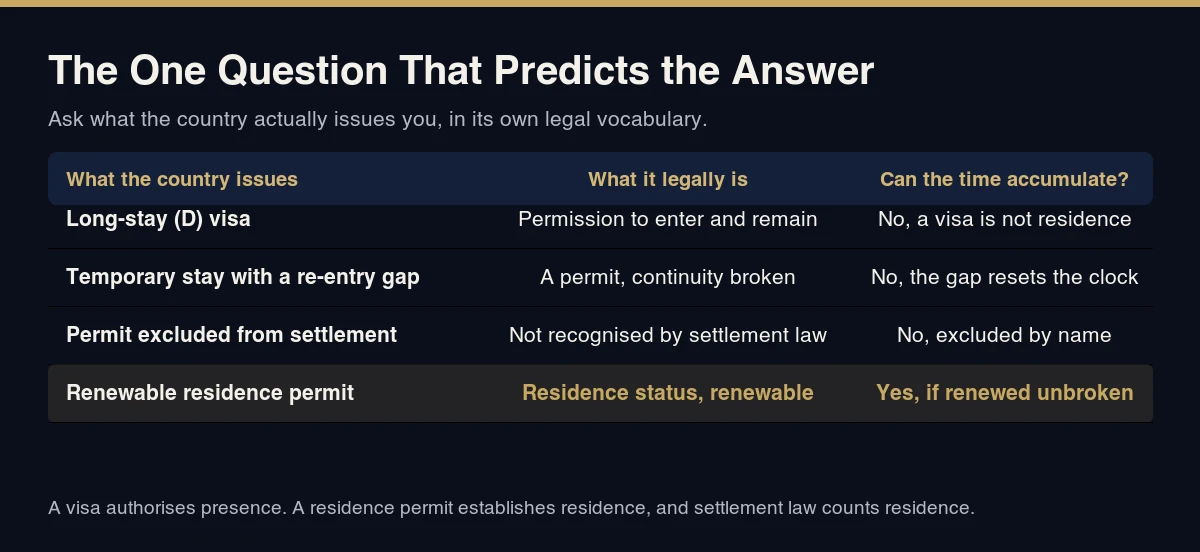
Ask what the country actually issues you, in its own legal vocabulary, and you can predict the outcome without reading anything else.
| What the country issues | What it legally is | Can the time accumulate? |
|---|---|---|
| Long-stay (D) visa | Permission to enter and remain for a capped period | No — a visa is not residence |
| Temporary stay with a mandatory re-entry gap | A permit, but continuity is broken by statute | No — the gap resets the clock |
| Permit explicitly excluded from settlement rules | A permit the settlement law does not recognise | No — excluded by name |
| Renewable residence permit or authorisation | Residence status, renewable indefinitely on conditions | Yes — if renewed without a qualifying break |
The distinction is not pedantry. A visa authorises presence; a residence permit establishes residence, and settlement law counts residence. When Estonia issues a digital nomad visa it is issuing a D visa under its visa law, and no amount of renewal turns that into the residence its Aliens Act requires for permanent residency. When Portugal issues a D8 it grants a consular visa that you then convert, in country, into a autorização de residência — a residence permit — and it is the permit, not the visa, that starts counting.
This one test sorts the market cleanly, and it is the reason the two tables below look the way they do.
The nomad visas that do count in 2026
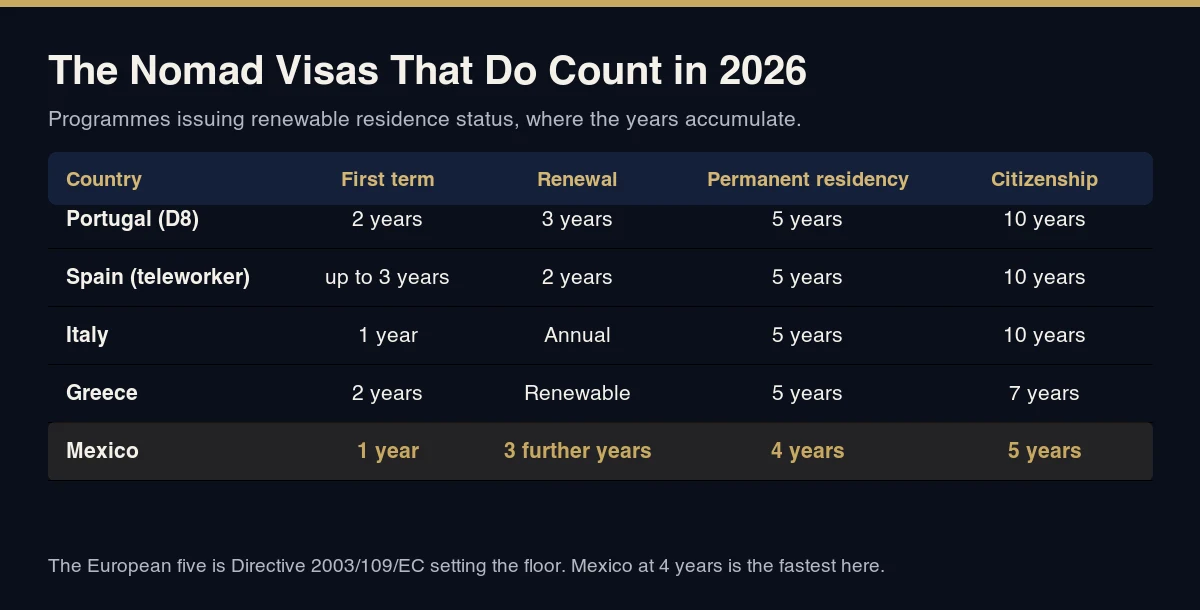
These programmes issue renewable residence status, and the years accumulate toward permanent residency provided the presence conditions are met.
| Country | Status issued | First term | Renewal | Permanent residency after | Citizenship after |
|---|---|---|---|---|---|
| Portugal (D8) | Residence permit via AIMA | 2 years | 3 years | 5 years | 10 years (7 CPLP/EU) |
| Spain (teleworker) | Residence authorisation | Up to 3 years in country; 1-year visa route | 2 years | 5 years | 10 years (2 Ibero-American) |
| Italy | Residence permit | 1 year | Annual | 5 years (EU long-term, B1 Italian) | 10 years |
| Greece | Digital nomad residence permit | 2 years | Renewable | 5 years (long-term residence) | 7 years |
| Mexico | Temporary resident | 1 year | Up to 3 further years | 4 years | 5 years |
Durations and thresholds are the 2026 published rules from each country's immigration authority and consular network; see the sources below. Government fees, legal costs, apostilles and certified translations sit on top of every route and commonly run €1,500 to €5,000 for a single applicant.
Two things stand out. The European five is not a coincidence — it is Directive 2003/109/EC setting the floor, which is why four different programmes with four different renewal cadences all land on the same number. And Mexico is genuinely faster, at four years, which is the shortest credible route in this table for anyone whose work does not require a European base.
Greece deserves a caveat. Its digital nomad residence permit is renewable and time on it counts as lawful residence toward the five-year long-term residence application, but the ordinary presence standard of roughly 183 days a year applies, and Greece is stricter than most about documenting it. Our guide to digital nomad visas by nationality covers the application mechanics for each of these; what follows is the group that cannot get you there at all.
The dead ends, and the rule behind each one
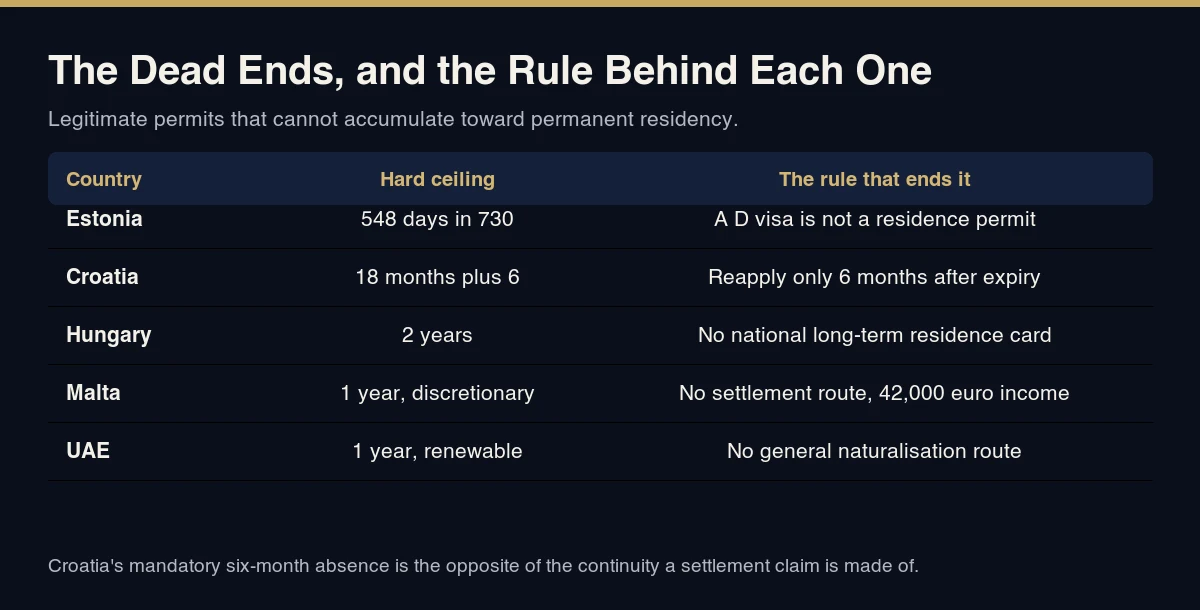
Every programme below is a legitimate, useful permit. None of them accumulates toward permanent residency, and in each case a specific published rule is the reason.
| Country | Status | Hard ceiling | The rule that ends it |
|---|---|---|---|
| Estonia | Long-stay (D) visa | 548 days in 730 | A D visa is not a residence permit; max 365 days per 12 months, 548 per 730 across two consecutive visas |
| Croatia | Temporary stay, digital nomads | 18 months + 6-month extension | A new application may only be filed 6 months after the previous stay expires |
| Hungary | White Card | 2 years | Holders cannot be granted a national long-term residence card; time does not count toward settlement |
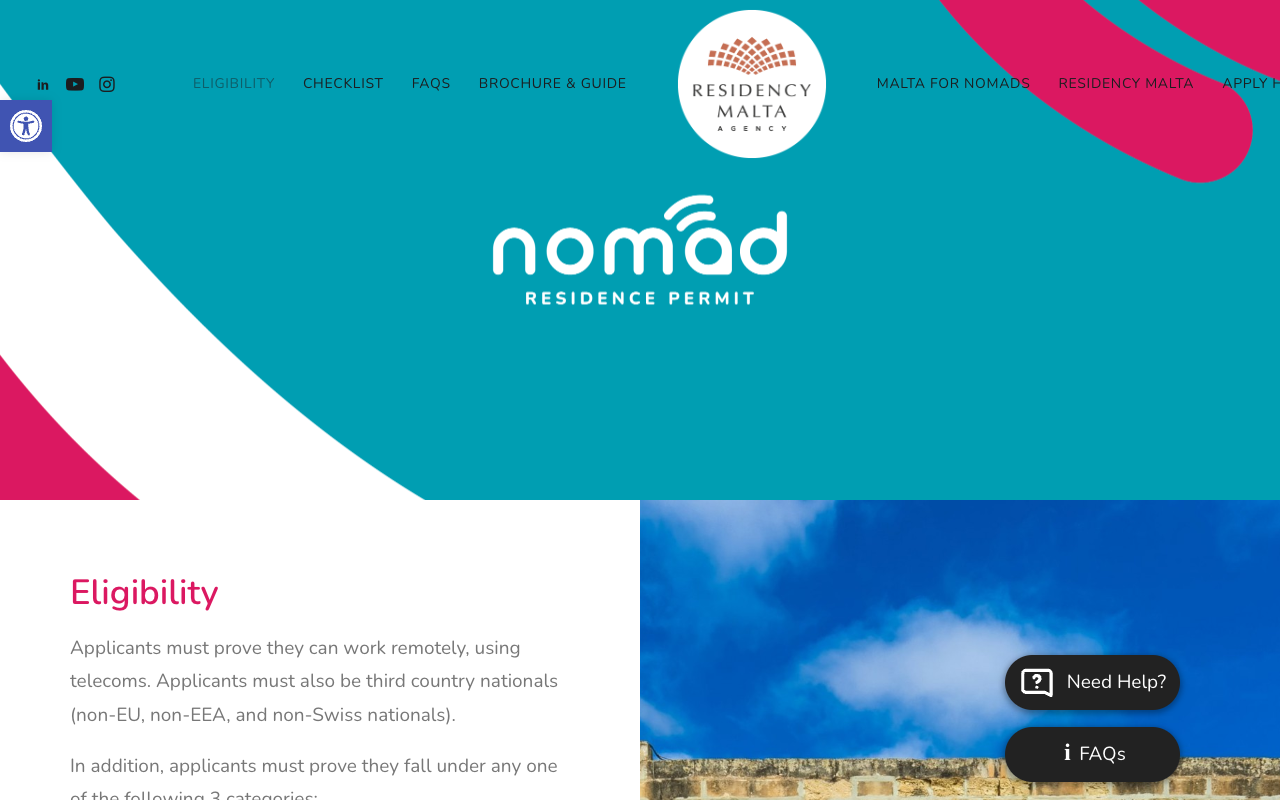
| Malta | Nomad Residence Permit | 1 year, renewed at the agency's discretion | Route does not lead to permanent residence or citizenship; €42,000 minimum gross annual income |
| UAE | Virtual work residency | 1 year, renewable | No general naturalisation route exists for ordinary residents |
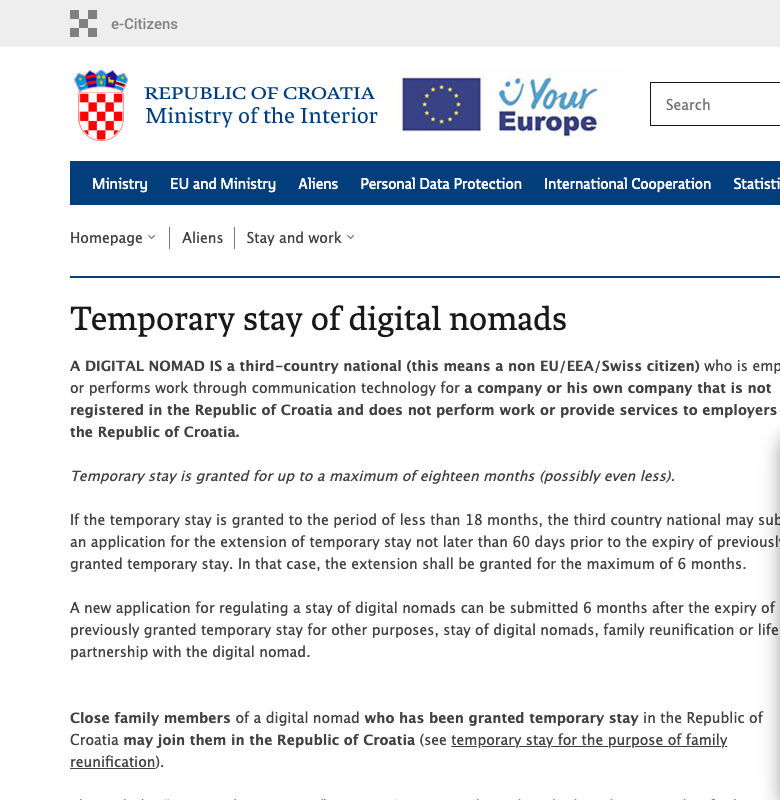
Croatia's is the most instructive, because it is the one people misread most often. The permit itself is generous — up to eighteen months, extendable by six. The killer is in the reapplication rule: Croatia's Ministry of the Interior states that a new application for digital nomad stay can be submitted only six months after the previous grant expires. Continuity is what a permanent residence application is made of, and a mandatory six-month absence is the opposite of continuity. Croatia has a five-year permanent residence route, but it runs through a different category of temporary stay entirely.
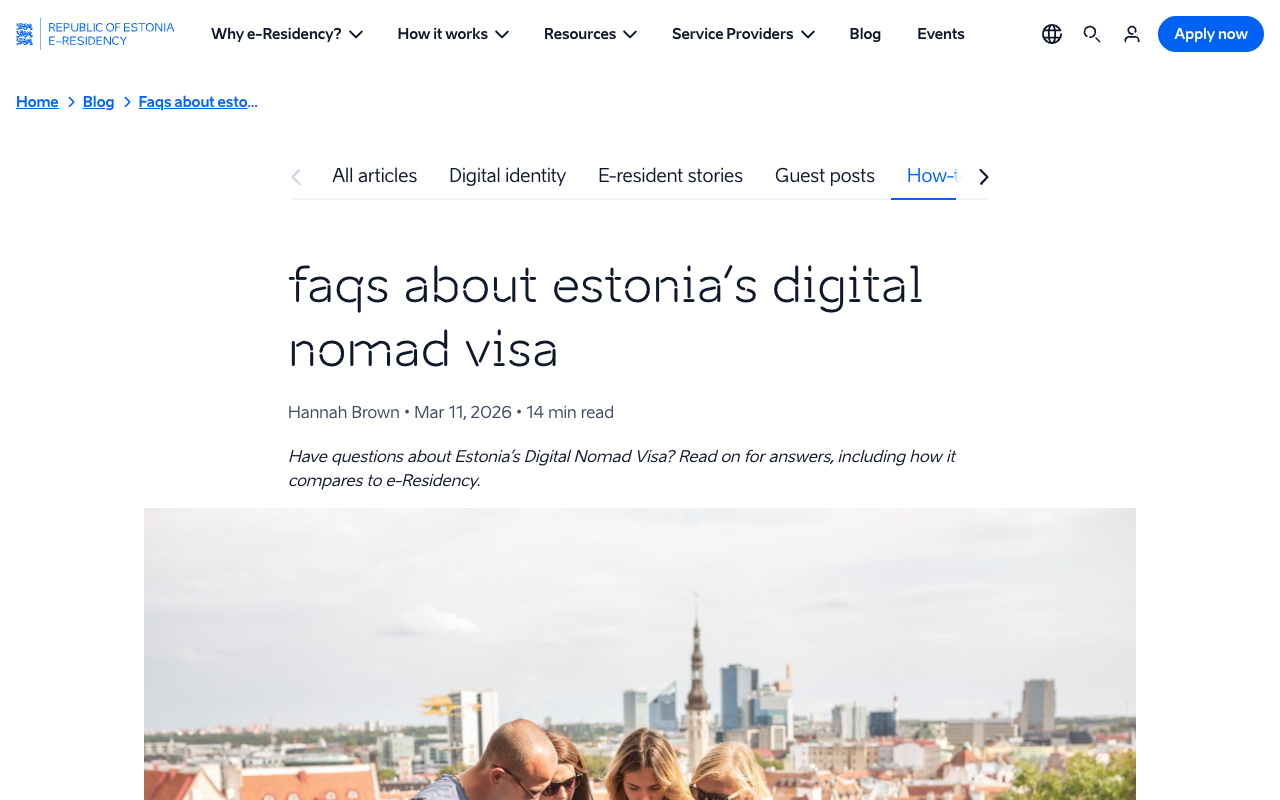
Estonia's is the cleanest. The programme is a long-stay visa, and Estonia's official e-Residency guidance states plainly that staying on the digital nomad visa does not confer a right to Estonian citizenship or permanent residency. Even setting the legal category aside, the arithmetic forecloses it: Estonian permanent residency needs five years of legal residence, and the visa caps out at 548 days within any 730. If Estonia is the draw, the e-Residency programme is a different and more honest proposition — it is a business identity, not a residency, and it has never claimed otherwise.
Malta is worth flagging separately because it is expensive to get wrong. The Nomad Residence Permit requires a minimum gross yearly income of €42,000 for applications from 1 April 2024, up from €32,400 for earlier applicants, and it does not lead to settlement. Readers who want Maltese residency that does something durable should look at the Malta Global Residence Programme instead.
Portugal and Spain in detail
These two absorb most of the search traffic on this topic and they work differently enough to matter.
Portugal's D8 is a two-stage instrument. You apply at a consulate for the visa, enter, and then apply to AIMA for the residence permit, which is issued for two years and renewed for three. The five-year permanent residency application under Article 80 of the foreigners' law requires five years of temporary residence plus basic Portuguese. Renewal carries a real presence expectation — broadly, around sixteen months of presence within each two-year permit period, or eighteen consecutive months — which is the condition most likely to catch someone treating the permit as a flexible base.
Spain's international teleworker route comes from Ley 28/2022, which inserted the category into Ley 14/2013. It is unusual in offering two doors: a consular visa valid for up to one year, or, if you are already legally in Spain, an in-country residence authorisation for up to three years, renewable for two. That three-plus-two cadence means many applicants reach five years having filed only twice. The 2026 income threshold is 200% of the Spanish minimum wage, which works out to roughly €2,849 a month or €34,188 a year following the SMI increase to €1,221 monthly across fourteen payments. A spouse adds about €1,068 a month to the requirement and each dependent child about €356. No more than 20% of income may come from Spanish sources.
Our deeper treatments sit at Portugal's digital nomad visa and Spain's digital nomad visa, including the tax positions, which differ sharply between the two and are not addressed here.
What Portugal's 2026 law changed, and what it did not
This is the single biggest 2026 development in this niche and most pages covering nomad visas have not absorbed it.
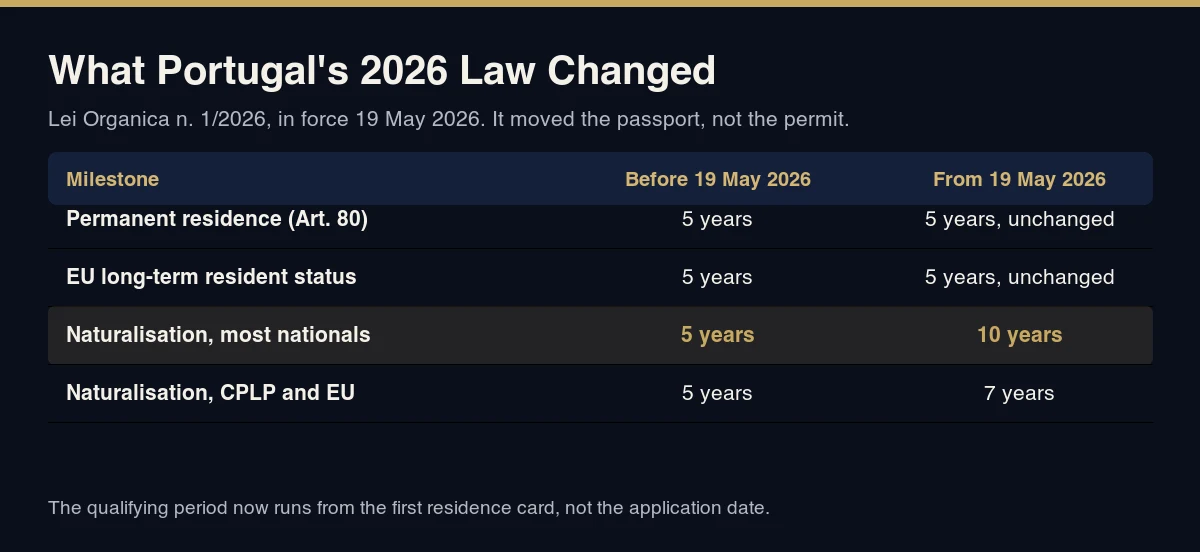
Lei Orgânica n.º 1/2026 was approved by parliament on 1 April 2026, published in Diário da República on 18 May 2026 and entered into force on 19 May 2026. It amended the Nationality Law so that naturalisation requires ten years of legal residence for most third-country nationals and seven for CPLP and EU nationals, up from a universal five. The qualifying period now runs from the issue date of the first residence card rather than from the date of application. Nationality applications filed on or before 18 May 2026 remain under the previous regime.
What it did not touch is the residency ladder. Portugal's permanent residence permit still sits at five years of temporary residence, and EU long-term resident status still sits at five. So a D8 holder who arrived in 2026 reaches permanent residency on the same timetable they always would have, and reaches a passport five years later than they would have.
| Milestone | Before 19 May 2026 | From 19 May 2026 |
|---|---|---|
| Permanent residence (Art. 80) | 5 years | 5 years — unchanged |
| EU long-term resident status | 5 years | 5 years — unchanged |
| Naturalisation, CPLP and EU nationals | 3–5 years | 7 years |
| Naturalisation, other nationalities | 5 years | 10 years |
| Clock starts | Application | First residence card issued |
The strategic consequence is that permanent residency in Portugal is now worth more relative to citizenship than it was, because it arrives at the same time it always did while the passport recedes. For many D8 holders the sensible plan is to take permanent residence or long-term resident status at five years and treat naturalisation as a separate, later decision. Our second residency comparison works through the same trade-off across investment routes.
The presence requirement nobody budgets for
Every qualifying route above has a presence condition, and it is the condition people discover late.
| Route | Presence to keep the permit | Presence for the residency clock |
|---|---|---|
| Portugal D8 | ~16 months per 24-month permit period | Same residence, over 5 years |
| Spain teleworker | Not absent more than 6 months in a year | 5 years; EU absence limits apply |
| Italy | Continuous lawful residence | 5 years plus B1 Italian |
| Greece | Ordinary standard, ~183 days a year | 5 years of lawful residence |
| Mexico | Real presence expected at renewal | 4 years |
The EU long-term residence directive is the binding constraint for the four European routes: absences may not exceed six consecutive months, nor ten months in total across the five-year qualifying period. That is a meaningful limit for someone who chose a nomad visa precisely because they did not intend to stay put.
Read it together with the previous tables and the shape of the market becomes clear. The programmes that ask nothing of your calendar — Malta, the UAE, and the capped ones — are also the programmes whose time does not count. The programmes whose time counts want you actually living there. That is not an accident of drafting; it is what settlement law is for. If you want the guide to the routes that deliberately ask for nothing, our countries with a golden visa map covers the investment side of the same trade.
Which route fits which reader
You want a European base and a passport eventually. Spain, if you are an Ibero-American, Andorran, Filipino, Equatorial Guinean or Portuguese national or a Sephardic Jew — two years to citizenship after permanent residency is the fastest credible route in Europe. Portugal otherwise, accepting ten years for the passport and five for the card.
You want permanent residency as fast as possible and Europe is not essential. Mexico's temporary resident route at four years, covered in our Mexico temporary resident visa guide.
You want to live somewhere for one or two years and then move on. Any of the dead ends is fine, and Estonia, Croatia and Malta are genuinely good at what they do. Just do not build a ten-year plan on them.
You want the permit without the presence. No nomad visa does this and leads anywhere. That is the investment-residency market, not this one.
You are a US citizen. None of the above changes your filing obligations. Worldwide taxation follows the passport, and only renunciation ends it — see our note on the foreign earned income exclusion for what actually reduces the bill while you live abroad.
Related guides
- Digital nomad visas: a 2026 guide by nationality — requirements, taxes, costs and timelines across the whole market.
- Portugal's digital nomad visa (D8) — thresholds, the AIMA conversion and the tax position.
- Spain's digital nomad visa — the teleworker authorisation, income maths and Beckham Law question.
- Second residency ranked 2026 — the investment routes, ranked on cost, speed and days required.
- Mexico's temporary resident visa — the four-year route to permanent residency.
- Easiest European countries to get citizenship — what the naturalisation timelines actually look like after 2026.
FAQ
Do digital nomad visas lead to permanent residency?
A minority of them do. Of the roughly fifty programmes marketed as digital nomad visas in 2026, only a handful issue the kind of status that a permanent residency application can be built on. Portugal, Spain, Italy, Greece and Mexico all issue renewable residence permits whose time accumulates toward the five-year mark (four in Mexico). Estonia, Croatia, Hungary, Malta and the UAE issue statuses that are capped, non-renewable past a fixed ceiling, or explicitly excluded from the settlement rules.
Which digital nomad visa is the fastest route to permanent residency?
Mexico's temporary resident visa, at four years rather than five. It is issued for one year initially and renewed for up to three more, after which the holder can apply for permanent residency. Within Europe the floor is five years everywhere, because the EU long-term residence directive sets it, so Portugal, Spain, Italy and Greece all converge on the same number. The difference between them is not speed but how many days you must physically spend in the country.
Does time on Estonia's digital nomad visa count toward residency?
No, and the reason is structural rather than discretionary. Estonia's digital nomad visa is a long-stay (D) visa, not a residence permit, and Estonia's official e-Residency guidance states that staying on it does not give the right to obtain Estonian citizenship or permanent residency. The cap makes it arithmetically impossible in any case: a D visa allows up to 365 days in any twelve consecutive months, and two consecutive long-stay visas cannot exceed 548 days within 730 consecutive days.
Did Portugal's 2026 nationality law change the D8 route to permanent residency?
It changed the citizenship end of it, not the residency end. Lei Orgânica n.º 1/2026, published 18 May 2026 and in force from 19 May 2026, raised naturalisation from a universal five years to ten years for most third-country nationals and seven for CPLP and EU nationals, counted from the issue date of the first residence card. Portugal's permanent residence permit under Article 80 still requires five years of temporary residence plus basic Portuguese.
Can you get permanent residency in Croatia as a digital nomad?
Not on the nomad route itself. Croatia grants digital nomads temporary stay for a maximum of eighteen months, extendable by up to six, and the Ministry of the Interior states that a new application can only be submitted six months after the previous temporary stay expires. That mandatory gap breaks the continuity a permanent residence application depends on. Croatia does have a five-year route to permanent residence, but it runs through a different, qualifying category of temporary stay.
How many days a year do you have to spend in the country for the residency clock to run?
Enough that the low-presence programmes and the residency-building ones are effectively different products. Portugal's D8 renewal expects roughly sixteen months of presence in any twenty-four-month permit period. Greece works on the ordinary standard of around 183 days a year. Across the EU, the long-term residence directive tolerates absences of no more than six consecutive months and ten months in total across the five years.
Does a digital nomad visa lead to citizenship?
Only indirectly, and only on the routes that build residency first. Citizenship timelines sit well beyond the permanent residency ones: ten years in Portugal for most applicants under the 2026 law, ten in Spain and Italy, seven in Greece, five in Mexico. Every one of those also carries language and integration requirements. Treat a nomad visa as the first of three or four steps rather than as a passport application, and check whether your home country permits dual nationality before you start.
Is Spain or Portugal better for a nomad visa that leads to permanent residency?
Spain if you want fewer renewal cycles, Portugal if your nationality gets you the shorter citizenship track. Spain's in-country authorisation runs up to three years and renews for two, so many applicants reach five years having filed twice. Portugal issues two years then three. Spain's citizenship rule is ten years, dropping to two for Ibero-American, Andorran, Filipino, Equatorial Guinean and Portuguese nationals and Sephardic Jews, which for a large share of applicants is the fastest route in Europe.
Paying consular fees in a currency you do not earn in
Every route on this page bills you in euros or pesos across two or three stages — consulate, apostille, in-country permit, renewal — usually over several years. Wise holds and converts at the mid-market rate, which stops the spread quietly becoming a line item of its own on a five-year residency plan.
Sources
- Lei Orgânica n.º 1/2026, Diário da República — the 2026 amendment to the Portuguese Nationality Law, in force 19 May 2026.
- Pedir a autorização de residência permanente — gov.pt, the five-year temporary-residence condition under Lei n.º 23/2007.
- Temporary stay of digital nomads — Croatian Ministry of the Interior, duration, extension and the six-month reapplication rule.
- FAQs about Estonia's Digital Nomad Visa — Republic of Estonia e-Residency, on the visa not leading to permanent residency.
- Long-term visa — Estonian Police and Border Guard Board, the 365/548-day limits.
- Nomad Residence Permit eligibility — Residency Malta Agency, the €42,000 income threshold from 1 April 2024.
- Teletrabajadores de carácter internacional — Spanish Ministry of Inclusion, Social Security and Migration, Art. 74 bis of Ley 14/2013.
- Ley 28/2022, de 21 de diciembre — BOE, the startups law that created Spain's teleworker category.
Figures are current as of September 2026. Immigration rules change, and consulates apply them inconsistently; this is editorial research, not legal advice. Confirm any figure with the relevant consulate or a licensed immigration lawyer before you file.