
The Schengen 90/180 rule is the most-explained and least-understood number in European travel. Almost everyone who spends serious time in Europe can recite it — 90 days in any 180-day period — and a surprising share of them are quietly miscounting, because the rule is a rolling calculation and human beings are very bad at rolling calculations.
Until recently that ambiguity was survivable. Enforcement depended on a border guard reading ink stamps, and faded stamps, missing exit stamps and unreadable dates did a lot of quiet work in travellers' favour. That era ended on 10 April 2026, when the EU's Entry/Exit System became fully operational across every Schengen external border crossing point. The days are now counted by computer, and the computer does not squint at a smudged stamp.
This guide sets out what the rule actually says, how the rolling window is calculated, what the EES changed and what it did not, where ETIAS genuinely stands as of September 2026, and what an overstay now costs you. Every figure below is taken from the governing regulations or the European Commission's own pages rather than from the travel press, because this is a topic where the secondary sources are unusually stale — a large share of the first page of results still quotes an ETIAS launch date the Commission no longer publishes.
Key takeaways
- The rule itself did not change. It is still 90 days in any rolling 180-day period, shared across all 29 Schengen countries collectively rather than per country.
- Enforcement changed completely on 10 April 2026. The EES replaced passport stamps with a digital entry/exit record and an automated calculator. In its first six months it logged over 52 million crossings and 27,000+ refusals of entry.
- ETIAS is still not running. The Commission states it is not in operation and that the start date will be announced several months in advance. The fee is set at €20, up from €7.
- An overstay follows you for five years. Where no exit record exists after your stay expired, EES keeps the data for 5 years instead of the usual 3 — and warns member states 3 months before erasure.
- ETIAS ≠ permission to enter. Article 36(6) is explicit: an authorisation confers no automatic right of entry, and it is valid 3 years or until your passport expires.
On this page: What the rule says · How the rolling window works · What changed in April 2026 · EES vs ETIAS · Where ETIAS stands · What an overstay costs · Which countries count · Staying longer, legally · Related guides · FAQ · Sources
SafetyWing — Cover that does not assume you are home every 90 days
What the Schengen 90/180 rule actually says
The rule is a limit on short stays by non-EU nationals: no more than 90 days inside the Schengen area in any 180-day period. It applies whether you are visa-free or travelling on a Schengen visa, and it is the same limit the EES automated calculator is built to enforce.
| Element | What it means in practice |
|---|---|
| 90 days | Total days of presence, counting the day of entry and the day of exit as full days |
| any 180-day period | A rolling window recalculated daily, looking backwards — not a fixed calendar period |
| Where it applies | The 29 Schengen countries collectively, not 90 days per country |
| Who it applies to | Non-EU nationals on short stays, visa-free or visa-holding |
| What it is not | Not a tax rule, and not a right of entry — border guards still apply entry conditions |
Two of those lines cause nearly all the trouble. The first is that the 90 days are pooled: moving from France to Portugal to Greece does not restart anything, because all three draw down the same allowance. The second is the word rolling, which deserves a section of its own.
How the rolling window actually works
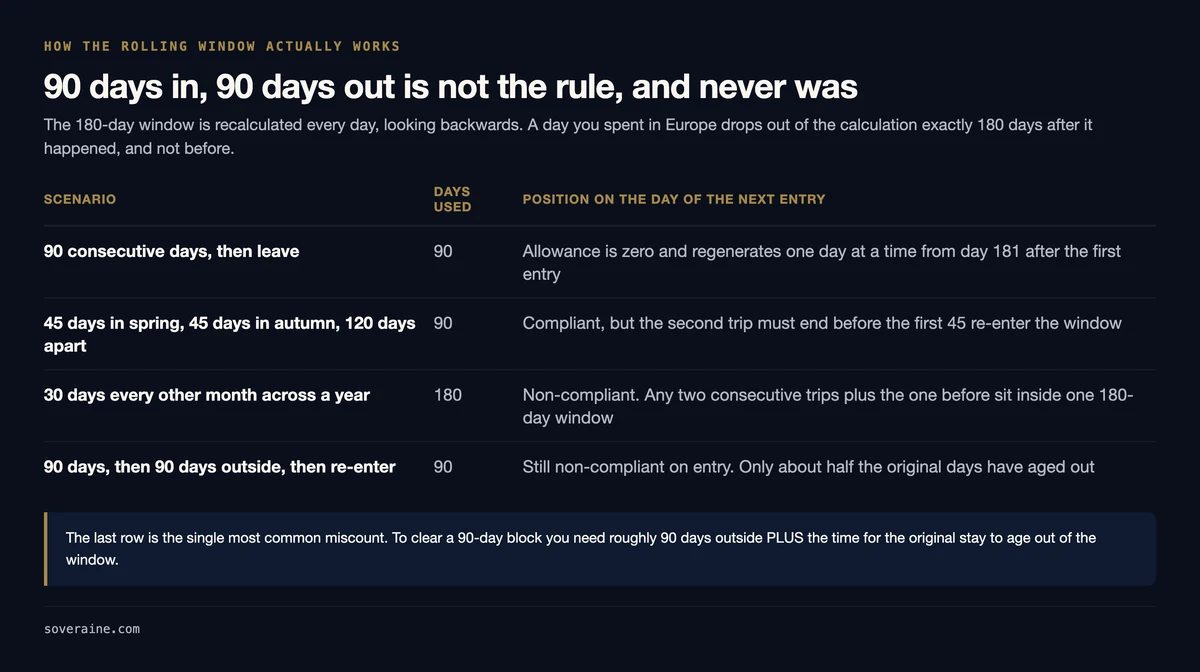
The 180-day window does not reset on a fixed date. It is recalculated every day, looking backwards. On any given day you must be able to say that your total presence across the previous 180 days was 90 days or fewer.
The practical consequence is that your allowance regenerates gradually rather than all at once. A day you spent in Europe drops out of the calculation exactly 180 days after it happened, and not before. Worked through a calendar, it behaves like this:
| Scenario | Days used | Position on the day of the next entry |
|---|---|---|
| 90 consecutive days, then leave | 90 | Allowance is zero and regenerates one day at a time from day 181 after the first entry |
| 45 days in spring, 45 days in autumn, 120 days apart | 90 | Compliant — but the second trip must end before the first 45 re-enter the window |
| 30 days every other month across a year | 180 | Non-compliant. Any two consecutive trips plus the one before sit inside one 180-day window |
| 90 days, then 90 days outside, then re-enter | 90 | Still non-compliant on entry — only about half the original days have aged out |
That last row is the single most common miscount, and it is worth being blunt about it: "90 days in, 90 days out" is not the rule and never was. It is a folk simplification that happens to be wrong in the traveller's disfavour. To fully clear a 90-day block you need roughly 90 days outside plus the time for the original stay to age out of the window — which is why people who follow the folk version arrive at the border with a deficit they did not expect.
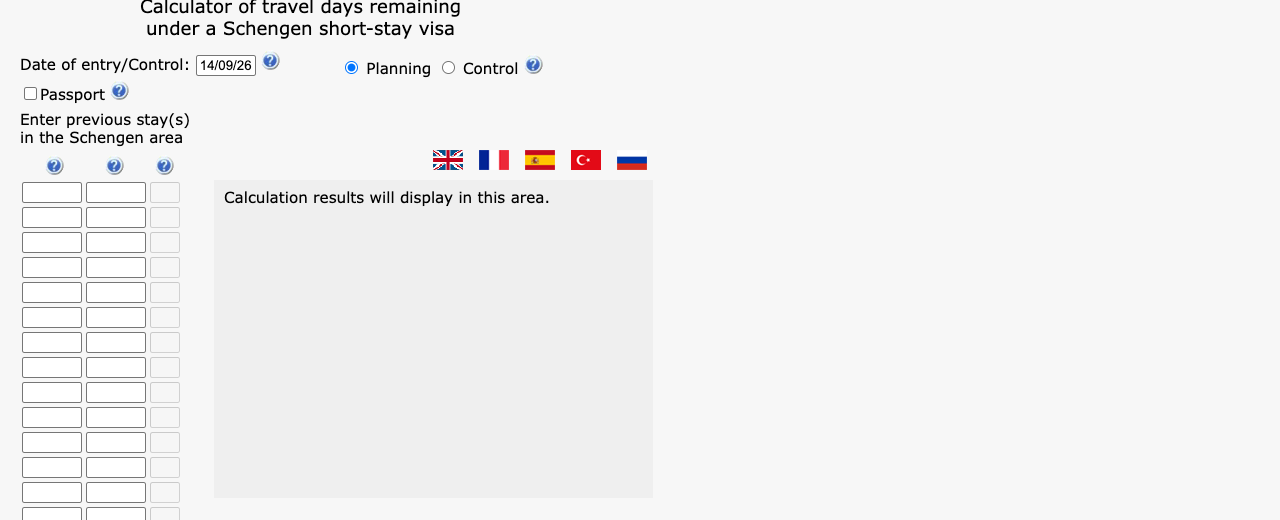
The safe habit is to stop doing this arithmetic by hand. The European Commission publishes a short-stay calculator, and since April the EES does the same calculation at the border whether you have done it or not.
What actually changed on 10 April 2026
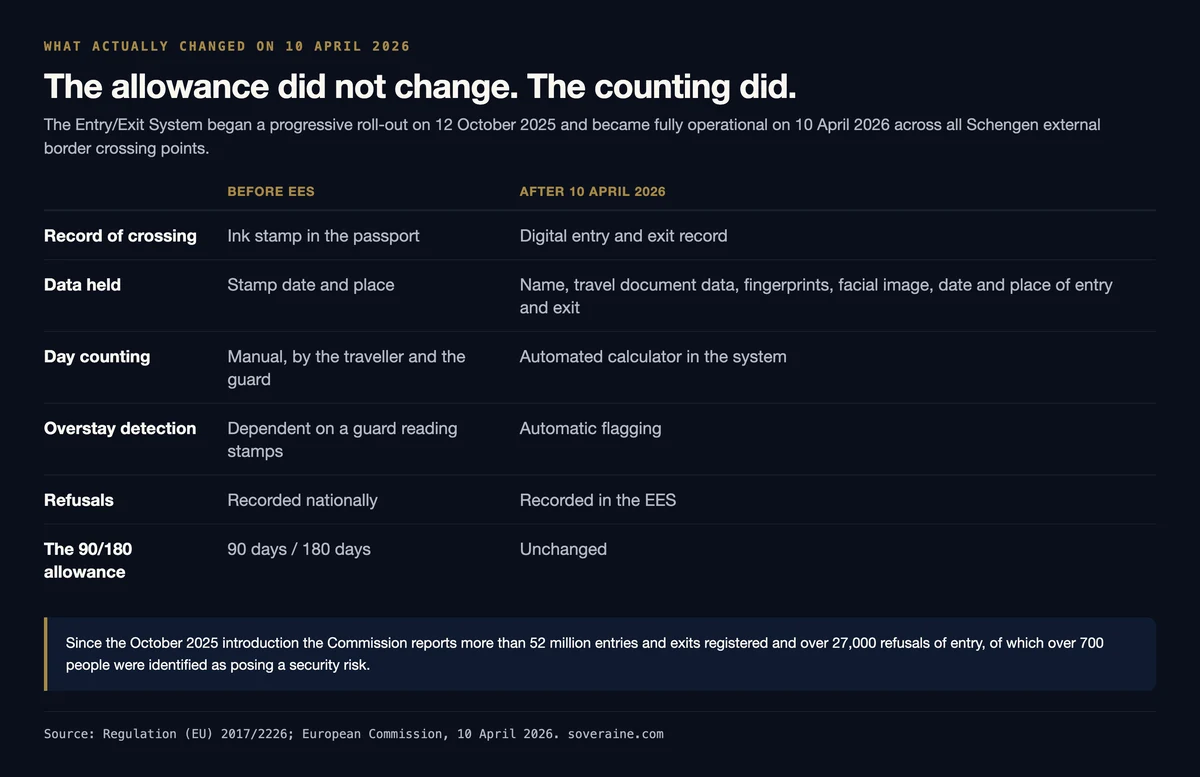
The Entry/Exit System began a progressive roll-out on 12 October 2025 and became fully operational on 10 April 2026 across all Schengen external border crossing points. It is worth being precise about what it did and did not change, because a lot of coverage blurred the two.
| Before EES | After 10 April 2026 | |
|---|---|---|
| Record of crossing | Ink stamp in the passport | Digital entry/exit record |
| Data held | Stamp date and place | Name, travel document data, fingerprints, facial image, date and place of entry and exit |
| Day counting | Manual, by the traveller and the guard | Automated calculator in the system |
| Overstay detection | Dependent on a guard reading stamps | Automatic flagging |
| Refusals | Recorded nationally | Recorded in the EES |
| The 90/180 allowance | 90 days / 180 days | Unchanged |
Regulation (EU) 2017/2226 is explicit that the system "should replace the obligation to stamp the passports of third-country nationals." The automated calculator, per recital 12, exists specifically "for the calculation of the overall limit of 90 days in any 180-day period."
The early numbers give a sense of scale. In the Commission's 10 April announcement, Commissioner for Internal Affairs and Migration Magnus Brunner reported that since the October 2025 introduction more than 52 million entries and exits had been registered, with over 27,000 refusals of entry, of which over 700 people were identified as posing a security risk.
One small practical note that has been widely missed: pre-registration of your data via a mobile app, where a member state offers it, is possible within 72 hours of crossing. It does not change your allowance — it just shortens the queue.
EES vs ETIAS: two systems people keep merging
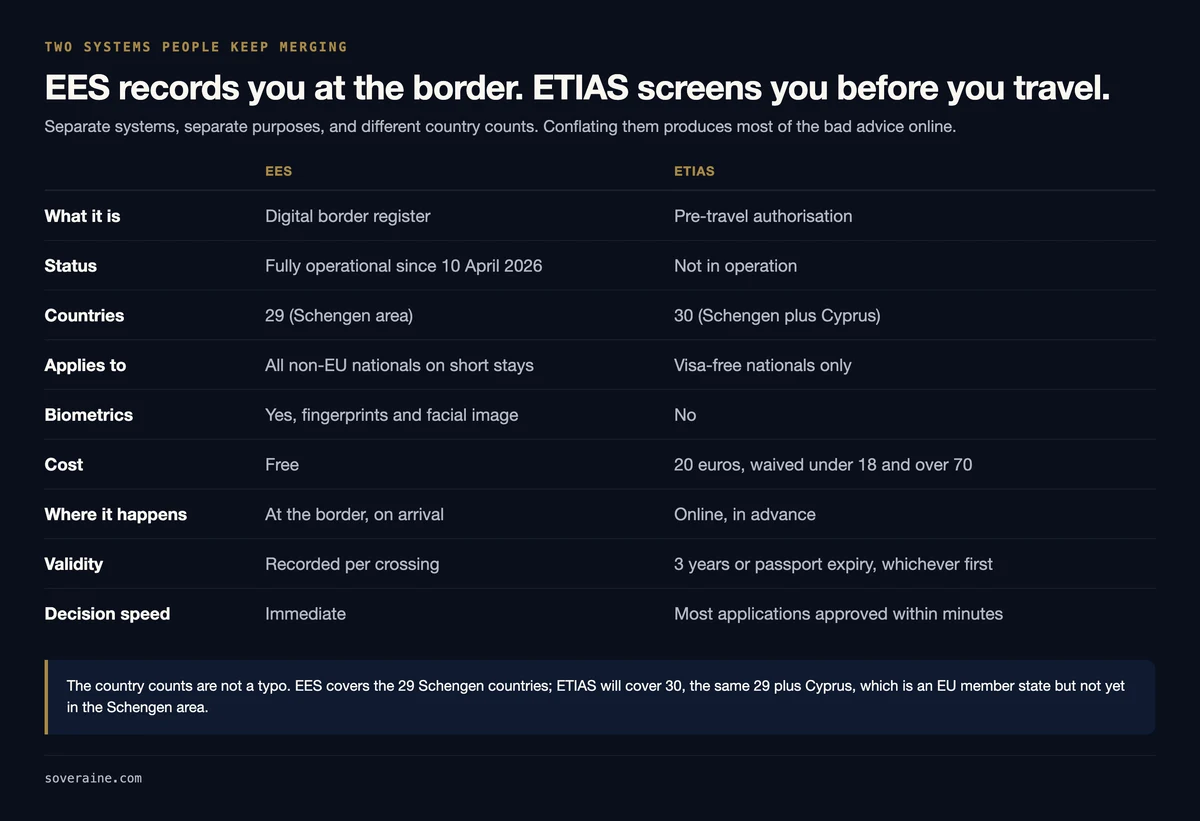
These are separate systems with separate purposes, and conflating them produces most of the bad advice circulating online. The cleanest way to hold them apart: EES records you at the border; ETIAS screens you before you travel.
| EES | ETIAS | |
|---|---|---|
| What it is | Digital border register | Pre-travel authorisation |
| Status | Fully operational since 10 April 2026 | Not in operation |
| Countries | 29 (Schengen area) | 30 (Schengen + Cyprus) |
| Applies to | All non-EU nationals on short stays | Visa-free nationals only |
| Biometrics | Yes — fingerprints and facial image | No |
| Cost | Free | €20 (waived under 18 / over 70) |
| Where it happens | At the border, on arrival | Online, in advance |
| Validity | n/a — recorded per crossing | 3 years or passport expiry, whichever first |
| Decision speed | Immediate | Most applications approved within minutes |
The country counts are not a typo, and the gap between them is the detail most guides get wrong. EES covers the 29 Schengen countries. ETIAS will cover 30 — the same 29 plus Cyprus, which is an EU member state but not yet in the Schengen area. So Cypriot days sit outside the EES count today, while Cyprus will still demand an ETIAS authorisation once that system starts.
Where ETIAS actually stands in September 2026
Here is the part worth reading carefully, because it is where the search results and reality diverge most sharply.
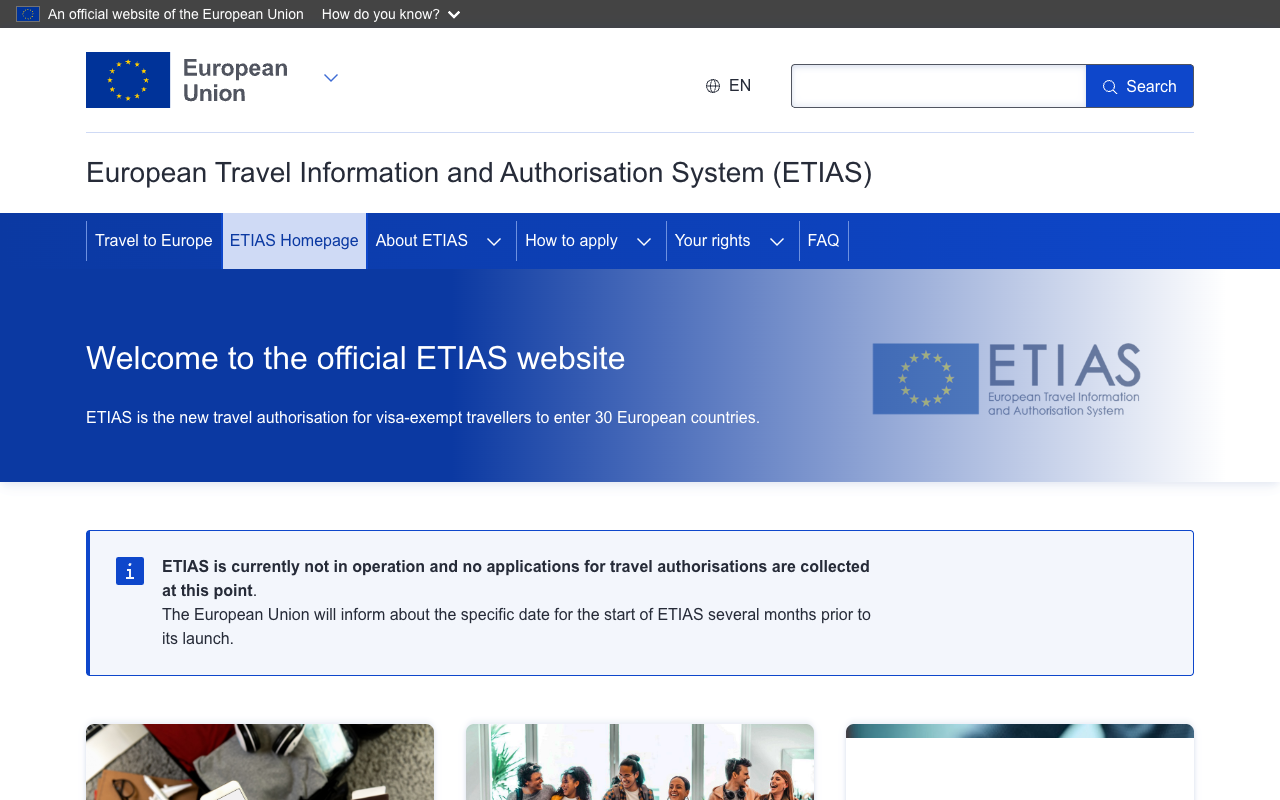
The European Commission's own ETIAS page carries an unambiguous notice: the system "is currently not in operation and no applications for travel authorisations are collected at this point," and "the European Union will inform about the specific date for the start of ETIAS several months prior to its launch."
That is the whole official position. There is no published launch date. A widely-cited "last quarter of 2026" target circulated through 2025 and into 2026, and it no longer appears on the Commission's page — so any guide still presenting it as settled is quoting a target that has been withdrawn rather than a date that has been set. Reporting through mid-2026 suggests a slip into 2027, but that is inference, not an announcement, and we are not going to state it as fact.
Two things are already fixed in the regulation and are safe to plan around:
- The fee is €20, up from the €7 written into Article 18 of Regulation (EU) 2018/1240. The Commission attributes the rise to inflation since 2018 and to new technical features, and it takes effect as soon as ETIAS is operational. Article 18(2) waives it for applicants under 18 or above 70 at the time of application.
- Validity is three years or until your passport expires, whichever comes first, under Article 36(5). And Article 36(6) states that an authorisation "shall not confer an automatic right of entry or stay."
The practical advice for the next few months is simply this: there is nothing to apply for. Sites collecting ETIAS "applications" or fees in September 2026 are not processing anything, because the system is not accepting applications. When it does launch, applications will go through an official EU website or mobile app.
What an overstay costs now that the record is digital
The consequences split into two layers, and they behave very differently. The record is EU-wide and governed by regulation. The penalty is national and varies.
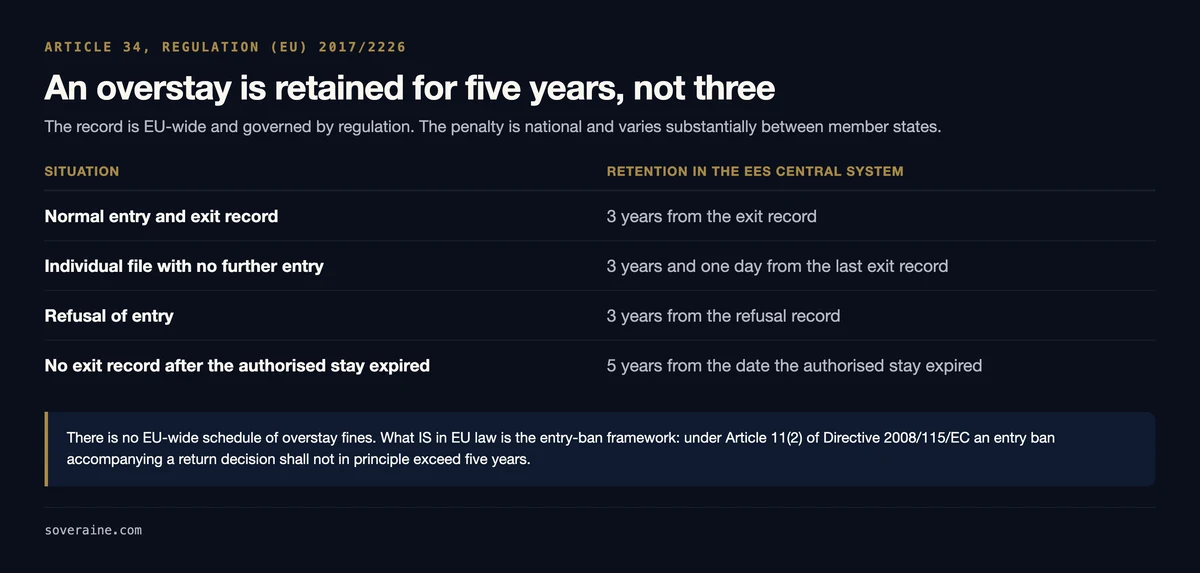
On the record, Article 34 of Regulation (EU) 2017/2226 sets the retention periods:
| Situation | Retention in the EES Central System |
|---|---|
| Normal entry/exit record | 3 years from the exit record |
| Individual file with no further entry | 3 years and one day from the last exit record |
| Refusal of entry | 3 years from the refusal record |
| No exit record after the authorised stay expired | 5 years from the date the authorised stay expired |
That fourth row is the one that matters, and it is almost never mentioned in consumer guides. An overstay is retained for five years, not three. The regulation adds that the EES "shall automatically inform the Member States three months in advance of the scheduled erasure of data on overstayers in order to enable them to adopt the appropriate measures" — so the record is not merely sitting there, it actively surfaces before it expires.
On penalties, we are going to be careful where most pages are not. There is no EU-wide schedule of overstay fines. Sanctions are set by national law and differ substantially between member states, and the widely-circulated ranges you will find online are not traceable to a published EU source. What is in EU law is the entry-ban framework: where a return decision is issued, Article 11(2) of Directive 2008/115/EC provides that an accompanying entry ban "shall not in principle exceed five years," and may exceed it only where the person represents a serious threat to public policy, public security or national security.
The honest summary: the fine is a lottery decided by which country catches you and how long you overstayed; the digital record, and a possible multi-year ban across the whole area, are the parts you should actually plan around.
Which countries count, and which quietly do not
The Schengen area, the EU, and the ETIAS zone are three different maps, and they are routinely treated as one.
| Grouping | Count | Notes for day-counting |
|---|---|---|
| Schengen area / EES | 29 | These are the days that consume your 90 |
| ETIAS zone | 30 | The 29 plus Cyprus, once ETIAS launches |
| EU but outside Schengen | Ireland, Cyprus | Days do not draw down the Schengen allowance |
| Recent full members | Bulgaria, Romania | Now full Schengen members — their days do count |
Three practical points fall out of that table. Ireland runs its own immigration regime and is outside Schengen entirely, so time in Dublin does not touch your allowance. Bulgaria and Romania are now full members, which catches out travellers working from older guidance that treated them as a convenient overflow. And Cyprus currently sits outside the EES, so its days are counted separately from the Schengen pool — while still being inside the future ETIAS requirement.
Non-EU European countries such as the UK, Albania, Serbia, Montenegro, Turkey and Georgia are outside the area too, which is why they feature so heavily in nomads' plans for the gap between Schengen blocks.
How to stay longer than 90 days, legally
If your genuine requirement is more than 90 days in any 180, the answer is not clever routing. It is a permit. The 90/180 rule governs short stays; the moment you need more, you need a national long-stay visa or residence permit, and holding one takes you out of the short-stay count for that country.
| Route | Typical fit | Where it leads |
|---|---|---|
| National digital nomad visa | Remote employees and freelancers with foreign-source income | A residence permit, and in several countries a clock toward permanent residency |
| Passive-income visa (e.g. Portugal D7, Spain non-lucrative) | Pensions, rental income, dividends | Renewable residence, real physical-presence requirements |
| Residency by investment | Capital available, low presence wanted | A permit with little or no minimum stay — and usually no naturalisation clock |
| Long-stay national visa (type D) | Study, work, family | Country-specific, outside the 90/180 count |
Which one fits depends far more on where your income comes from than on which country appeals. We have written the detail up separately: start with digital nomad visas for the overview of what is actually available in 2026, and second residency ranked if you are comparing programmes on cost, speed and days required on the ground.
If a passport rather than a permit is the eventual goal, the decisive variable is physical presence — which is exactly what the low-stay programmes are designed to avoid. Digital nomad visas with a path to permanent residency covers which routes actually mature into something, and the Greece golden visa piece shows the trade-off in its clearest form: no minimum stay, and therefore no naturalisation clock.
One more thing worth saying plainly, because it comes up constantly: a residence permit is not a tax plan. Where you pay tax is decided by where you actually live and where your economic centre sits, not by which card is in your wallet. Tax resident nowhere sets out why the popular version of that idea rarely survives contact with a treaty tiebreaker.
Related guides
- Digital nomad visas — the 2026 overview of what exists, what it costs and who qualifies.
- Second residency ranked 2026 — cost, speed and days required, across the main programmes.
- Digital nomad visas with a path to permanent residency — which routes actually lead somewhere.
- Spain's non-lucrative visa — the passive-income route, and its presence requirements.
- Portugal's D7 visa — income thresholds and what the permit really demands.
- Nomad travel insurance — what cover actually needs to do across long multi-country stays.
FAQ
What is the Schengen 90/180 rule?
It is the limit on short stays for non-EU nationals: no more than 90 days inside the Schengen area in any rolling 180-day period. The 180-day window is not a calendar period that resets on a fixed date — it is recalculated every day, looking backwards, so on any given day your total presence over the previous 180 days must be 90 days or fewer. The 90 days are shared across all 29 Schengen countries collectively, not per country.
Did the 90/180 rule change in 2026?
No. The allowance is the same 90 days in any 180-day period it has been for years. What changed is enforcement: the Entry/Exit System became fully operational on 10 April 2026 across all Schengen external border crossing points, replacing passport stamps with a digital record and adding an automated calculator that works out your remaining days. The rule is unchanged; the chance of a miscount going unnoticed has effectively gone.
What is the EES and what data does it collect?
The Entry/Exit System is the EU's digital border register for non-EU nationals making short stays. It records your name, travel document data, biometric data in the form of fingerprints and a facial image, and the date and place of each entry and exit. It also records refusals of entry. It began rolling out on 12 October 2025 and became fully operational on 10 April 2026. Under Regulation (EU) 2017/2226 it replaces the obligation to stamp passports.
Is ETIAS required in 2026?
Not yet. As of September 2026 the European Commission's page states that ETIAS is not in operation and that no applications are being collected, and that the EU will announce the specific start date several months before launch. A lot of live content still quotes a "last quarter of 2026" target that no longer appears on the official page. Treat any site charging you for an ETIAS application today as a warning sign — there is nothing to apply for.
How much will ETIAS cost?
The fee has been set at €20, up from the €7 written into Regulation (EU) 2018/1240. The Commission attributes the increase to inflation since 2018 and to new technical features, and it takes effect as soon as ETIAS becomes operational. Under Article 18(2) of the regulation the fee is waived for applicants under 18 or above 70 at the time of application.
How long is an ETIAS authorisation valid?
Article 36(5) of Regulation (EU) 2018/1240 sets it at three years, or until the travel document registered in the application expires, whichever comes first. Article 36(6) is the part worth remembering: an authorisation does not confer an automatic right of entry. It is a pre-screening clearance to travel, and border guards still apply the entry conditions on arrival.
What happens if you overstay in the Schengen area?
The EES flags it automatically, and the record is durable. Under Article 34(3) of Regulation (EU) 2017/2226, where there is no exit record after the authorised stay has expired, the data is kept for five years rather than the usual three, and the system warns member states three months before erasure. The penalties themselves are national and vary considerably. Where a return decision is issued, Article 11(2) of Directive 2008/115/EC says an accompanying entry ban should not in principle exceed five years.
Does the 90/180 rule apply to Ireland, Cyprus, Bulgaria or Romania?
Ireland is outside the Schengen area entirely and runs its own immigration rules, so time there does not consume Schengen days. Bulgaria and Romania are now full Schengen members, so their days do count. Cyprus is the awkward case: it is not yet in the Schengen area, so it sits outside the EES and its days are counted separately — but it is one of the 30 countries that will require ETIAS once that system launches.
Cover that survives a 90-day block and the gap after it
Counting days properly usually means a longer trip split across several countries, often with a non-Schengen stretch in the middle. That pattern is exactly what ordinary annual travel policies handle worst — many are written around a home country you return to, and quietly stop working once you have been away too long. SafetyWing is built for people whose itinerary does not include going home every 90 days, and it bills monthly rather than per trip.
Sources
- Entry/Exit System (EES) — European Commission, DG Migration and Home Affairs: the 29 countries, the data collected, and automatic detection of overstayers.
- Entry/Exit System (EES) is fully operational — European Commission, 10 April 2026: full operation across all Schengen countries, and the 52 million crossings / 27,000 refusals figures.
- European Travel Information and Authorisation System (ETIAS) — European Commission: the notice that ETIAS is not in operation, and the €20 fee.
- Main differences between the EES and ETIAS — European Commission, 28 April 2026: the 29-versus-30 country split, biometrics, validity and application speed.
- Regulation (EU) 2017/2226 — the EES Regulation: Article 34 retention periods, the automated calculator (recital 12) and the replacement of passport stamping (recital 8).
- Regulation (EU) 2018/1240 — the ETIAS Regulation: Article 18 on the fee and its waivers, Article 36(5) on validity and Article 36(6) on the absence of an automatic right of entry.
- Directive 2008/115/EC — the Return Directive: Article 11(2) on the length of entry bans.
Figures are current as of September 2026. Border rules change, ETIAS has no announced start date, and overstay penalties are set by national law and vary between member states; this is editorial research, not legal or immigration advice. Confirm your own day count with the European Commission's short-stay calculator and any specific case with the relevant national authority.