
A digital nomad visa is a residence permit that lets you live in a country while working remotely for clients or an employer based elsewhere. As of 2026, more than 60 countries run such programmes, and the rules vary widely on income thresholds, tax treatment and whether the time counts toward permanent residency. This guide is written for three distinct readers: US citizens and green-card holders, EU tax residents, and everyone else. The tax outcome of the same visa can differ dramatically across these groups, so we have segmented the guidance throughout rather than offering one-size-fits-all advice. This is editorial reporting, not legal advice — consult a qualified professional in both your home and target jurisdictions before you move money or file paperwork.
SafetyWing — Nomad insurance with recurring 364-day cookie
What a digital nomad visa actually is
A digital nomad visa is a temporary residence permit issued to remote workers whose income comes from outside the host country. Most run for one year and can be renewed once or twice. Some, like Spain's, can be extended up to five years and converted into permanent residency.
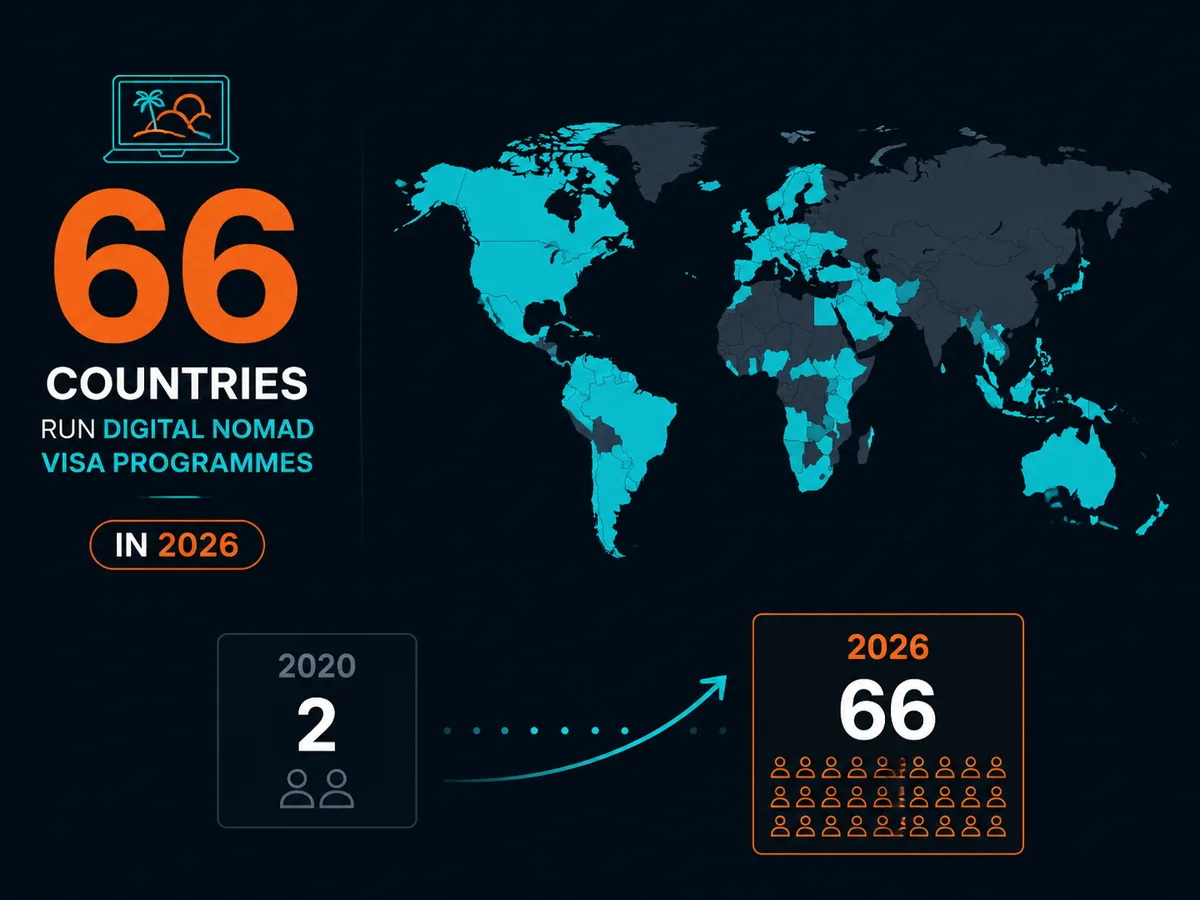
The category emerged in 2020 when Estonia and Barbados launched the first formal programmes. By 2026, the European Commission has tracked more than 25 EU member-state schemes alone [source: TODO — EURES or EU Commission page summarising member-state digital nomad routes], and Forbes counts 66 countries with active programmes globally.
The label "digital nomad visa" is marketing. Legally, these are residence permits with foreign-income conditions. That distinction matters because once you hold a residence permit and spend enough time on the ground, you usually become a tax resident — which is where most readers get caught out.
Who this guide applies to
The rules below apply differently depending on the passport in your pocket. Read your section first.
US persons (citizens and green-card holders)
You owe US tax on worldwide income regardless of where you live. This is citizenship-based taxation, and only the United States and Eritrea operate it. No digital nomad visa changes this. You will continue to file Form 1040, and if your foreign accounts exceed $10,000 in aggregate at any point in the year you must file an FBAR (FinCEN Form 114). Holdings above the Form 8938 thresholds add another filing.
The legal levers available to you are the Foreign Earned Income Exclusion (currently $126,500 for tax year 2024, indexed annually) and foreign tax credits. Both require you to qualify under the physical-presence test or bona fide residence test. A digital nomad visa helps you build the case for bona fide residence, but only if you genuinely live there.
EU freelancers and tax residents
You are taxed where you are resident, and EU member states broadly apply the 183-day rule plus the "centre of vital interests" test set out in OECD Model Tax Convention Article 4. Spend more than half the year somewhere else and your home country may stop treating you as resident — or may not, if your spouse, home and bank accounts stay put.
Most EU countries also enforce controlled foreign company (CFC) rules under the Anti-Tax Avoidance Directive (ATAD), so incorporating in Dubai while living in Berlin will not work the way Instagram says it does. Some countries — France, the Netherlands, Germany — apply exit taxes on unrealised gains when you break tax residency.
Non-US, non-EU readers
You have the most freedom. Most of your home jurisdictions tax on a residence basis, and many (Singapore, Hong Kong, Malaysia, much of the Gulf) apply territorial taxation. CFC enforcement outside the OECD is patchy. The optimisation strategies sold online generally work best for this segment — which is part of why so much nomad content quietly assumes a non-US, non-EU reader without saying so.
Digital nomad visa requirements
The core checklist is similar across programmes. Specific numbers vary; the structure does not.
- Proof of remote income above a monthly threshold, usually €2,500–€3,500 in Europe, US$1,500–US$3,000 elsewhere
- Employment or contracts outside the host country — bank statements, client contracts, employer letter
- Private health insurance valid in the host country for the duration of the permit
- Clean criminal record from your country of current residence, apostilled
- Valid passport with at least six months' remaining validity, often more
- Proof of accommodation — a rental contract or hotel booking for the initial period
- Application fee — typically €60–€500 depending on the country
Documents almost always need apostille under the Hague Convention and certified translation into the host country's language. Budget two to six weeks for this paperwork alone — it is where most applications stall.
Digital nomad visa taxes
This is the section that separates serious guidance from clickbait. The headline "tax-free" promises you see on YouTube are almost never accurate for US or EU readers.
How the host country taxes you
Three patterns exist:
- Express exemption for foreign income. Croatia, Malaysia (DE Rantau), Barbados and Bermuda exempt digital nomad visa holders from local tax on foreign-sourced income for the duration of the permit. Croatia's tax authority confirms the exemption in Article 5 of the Income Tax Act amendments [source: TODO — link to Croatia Income Tax Act English summary].
- Special reduced-rate regime once resident. Spain's digital nomad visa channels holders into a modified Beckham Law regime — a flat 24% on Spanish-source income up to €600,000 for up to five years. Portugal replaced the NHR regime in 2024 with the IFICI ("NHR 2.0") [source: TODO — Portuguese Finance Ministry page on IFICI], which is narrower and aimed at scientific and qualifying professional roles.
- Standard residence taxation after 183 days. Most other programmes treat you as a normal tax resident once you cross the threshold. Greece, Italy and Latvia fall here.
How your home country taxes you
For US persons: nothing the host country does removes your IRS filing obligation. You may owe nothing after applying the FEIE and credits, but you still file. The IRS has been increasing enforcement on non-filers abroad since 2023 [source: TODO — IRS bulletin on streamlined / non-filer enforcement].
For EU residents: if you remain tax resident at home, your home country taxes your worldwide income, with a credit for tax paid abroad under the relevant double-tax treaty. If you genuinely break residency, your home country stops taxing — but expect questions, and in France, Germany and the Netherlands, possibly an exit tax.
For everyone else: check whether your home country uses territorial taxation. If yes, foreign income earned while abroad is often outside the net. If no, the EU logic above applies.
We will say it plainly: nobody should make a residence decision based on a blog post, including this one. Run the numbers with a tax adviser qualified in both jurisdictions before you book the flight.
Which country is best for a digital nomad visa
The honest answer is "it depends on your passport and your goals." Here is how we would think about it.
If you want a path to EU permanent residency and eventually citizenship: Portugal's D8 or Spain's digital nomad visa. Both count toward the five-year residency clock if you maintain genuine presence. Spain's is faster to apply for from inside the country.
If you want a low income threshold and quick processing: Croatia (around €2,540/month required, processed in weeks) or Costa Rica ($3,000/month, decent processing times).
If you want territorial tax treatment and warm weather: Malaysia's DE Rantau (RM 36,000/year minimum), Panama's Short-Stay Visa for Remote Workers, or the UAE's virtual work residency.
If you want minimal bureaucracy and beach access: Barbados's Welcome Stamp ($2,000 fee, one year, no local tax). It does not lead to residency, but the process is genuinely simple.
We rank by editorial fit, not commissions. Where we mention specific service providers later, we will say if a link is affiliate.
What is the fastest digital nomad visa to get
Speed depends on the consulate and the completeness of your file. Realistic timelines:
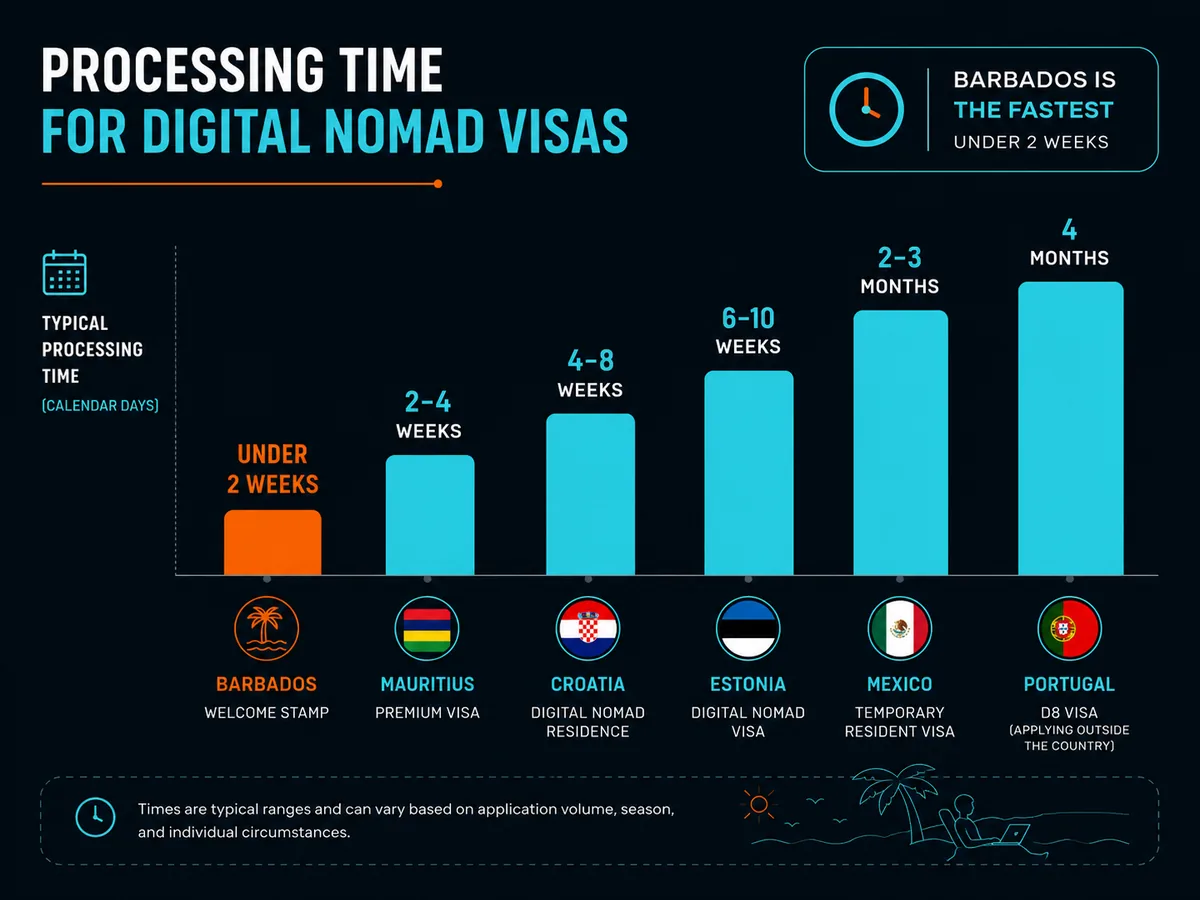
- Barbados Welcome Stamp — under two weeks, online application
- Estonia digital nomad visa — around 30 days at the consulate
- Croatia — three to six weeks from a complete file
- UAE virtual work residency — two to four weeks
- Spain (from inside Spain) — 20 working days statutory; in practice four to eight weeks
- Portugal D8 — two to four months from outside Portugal
Anything quoted as faster than two weeks for a residence permit (as opposed to a stamp) is usually optimism. Apostille and translation alone eat two to four weeks before you submit.
How do you qualify for a digital nomad visa
Beyond the document checklist above, three things separate clean applications from rejections:
- Demonstrable foreign income. Three to twelve months of bank statements showing consistent inflows from foreign clients or employers. One-off payments do not convince consular officers.
- A clean employment or contract structure. Salaried employees show an employer letter. Freelancers show signed client contracts, ideally with non-host-country counterparties. Founders of their own companies show incorporation documents and a director's salary or distribution history.
- Genuine health insurance. Travel insurance is not enough for most programmes. You need a policy that covers inpatient care in the host country, usually with a minimum coverage limit (€30,000 in Schengen-aligned countries).
Realistic costs, fees and timelines
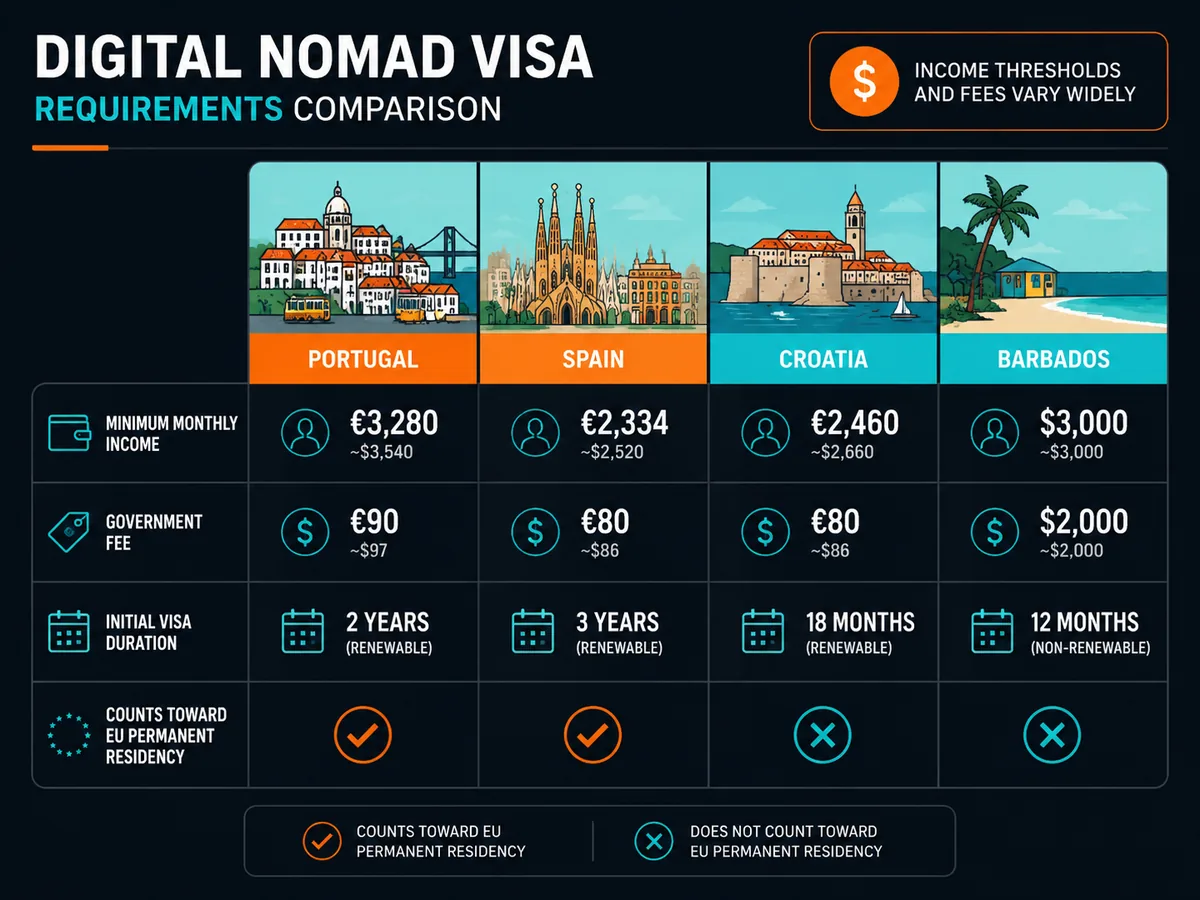
| Country | Income threshold (per month) | Government fee | Typical processing | Path to PR |
|---|---|---|---|---|
| Portugal (D8) | ~€3,480 | ~€90 + ~€170 residence card | 2–4 months | Yes, 5 years |
| Spain | ~€2,762 | ~€80 | 4–8 weeks | Yes, 5 years |
| Croatia | ~€2,540 | ~€60 | 3–6 weeks | No (does not count toward PR) |
| Estonia | €4,500 | €80–€100 | ~30 days | No |
| Greece | €3,500 | ~€75 | 1–2 months | Yes, after conversion |
| Italy | ~€2,700 | ~€116 + permit costs | 1–3 months | Yes, 5 years |
| Barbados | $50,000/year | $2,000 single | <2 weeks | No |
| UAE virtual work | $3,500 | ~$611 | 2–4 weeks | No |
| Malaysia DE Rantau | RM 36,000/year (~$7,600) | RM 1,000 | 4–8 weeks | No |
| Costa Rica | $3,000 | ~$200 | 1–3 months | After conversion |
| Mexico (temporary resident) | ~$2,600 | ~$50 + card fees | 2–6 weeks | Yes, 4 years |
All figures are correct to the best of our research at time of writing. Fees and thresholds change frequently — verify on the relevant immigration authority's page before applying. [source: TODO — verify each row against official immigration page]
Add real-world costs beyond the government fee: apostille and translation (€200–€600), private health insurance (€60–€200/month), legal or immigration adviser fees if used (€800–€3,000), and the cost of flights and initial accommodation.
Common mistakes and how to avoid them
Confusing a visa with tax residency. Holding a Croatian digital nomad permit does not make you a Croatian tax resident — and being tax-exempt in Croatia does not make you tax-exempt at home. The two systems are separate. Map both before you move.
Assuming the visa breaks your home tax residency. It does not. Your home country's residency rules are the only thing that breaks your home residency. For most EU countries, this means physically leaving, deregistering, closing the obvious ties (long-term rental, family) and being able to prove a new centre of vital interests. For US persons, only renunciation works — and renunciation is a major life decision with its own exit tax under IRC §877A for covered expatriates.
Using a "ghost" residency address. Address-only residency claims — paying a service to use their address while you live somewhere else — fail under any serious audit and can constitute fraud. Do not do this.
Incorporating offshore as a US person to "avoid" US tax. This does not work. The US has CFC rules, GILTI under IRC §951A, and Subpart F. Income earned by a foreign company you control flows back to your 1040 in most cases. The legal levers are the FEIE, foreign tax credits and (if you are an employee) genuine compensation arrangements — not paper structures.
Ignoring the social security question. Many EU programmes require enrolment in the host country's social security system or proof of equivalent home-country coverage via an A1 certificate or bilateral totalisation agreement. Missing this is a common reason renewals get rejected.
Buying private health insurance that does not meet the spec. Schengen-aligned programmes require specific coverage levels and inpatient care. A generic travel policy will not pass.
When to consult a qualified professional
Before any of the following, get advice from a tax adviser qualified in both your home and target jurisdictions:
- You are a US person earning over the FEIE limit (currently $126,500)
- You hold equity, stock options or crypto with significant unrealised gains
- You run a company, in any structure, that generates more than incidental income
- You have a spouse or children whose tax position will be affected
- You are leaving a country with exit taxes (France, Germany, the Netherlands, Norway, Canada)
- You hold foreign financial accounts above the FBAR or Form 8938 thresholds
A good adviser costs €500–€2,500 for an initial consultation and will save you multiples of that. A bad one costs the same and produces a memo full of disclaimers. Ask for references from clients with your nationality and roughly your income.
The editorial position of this site is straightforward: there is no clever structure that legally lets a US person stop filing with the IRS short of renunciation, and there is no clever structure that lets an EU resident stop being taxed where they actually live. Everything else is optimisation, and optimisation is legitimate. Anyone selling you something more aggressive is selling you risk.
Ready to act on this?
SafetyWing — Nomad insurance with recurring 364-day cookie. Soveraine readers go to the front of the line through our partner link, and you fund independent editorial in the process.
FAQ
Which country is best for a digital nomad visa?
There is no single best country — the right choice depends on your passport, income, family situation and tax goals. For EU access and a path to permanent residency, Portugal and Spain are the strongest options. For low income thresholds and fast processing, Croatia and Costa Rica stand out. For territorial tax treatment, Malaysia's DE Rantau and Panama are attractive. US persons should remember that no visa removes the obligation to file with the IRS, so the question is less about the visa and more about combining it with the Foreign Earned Income Exclusion or foreign tax credits.
What is the fastest digital nomad visa to get?
Croatia's digital nomad residence permit is among the fastest, with decisions often issued within a few weeks once the file is complete. Estonia's digital nomad visa is processed within roughly 30 days at a consulate. The UAE's virtual work residency and Barbados's Welcome Stamp are also fast, often inside a month. Speed depends on the consulate, the completeness of your file (apostilled documents, clean criminal record, valid health insurance) and the season. Anything routed through a slow embassy can take far longer regardless of the official service standard.
How do you qualify for a digital nomad visa?
Most programmes require four things: proof of remote income above a country-specific threshold (typically €2,500–€3,500 per month in Europe), private health insurance valid in the host country, a clean criminal record from your country of residence and a valid passport with sufficient remaining validity. You must also show that your work is performed for clients or an employer outside the host country. Some programmes add a minimum savings balance or proof of accommodation. Documents usually need apostille and certified translation, which is where most applications stall.
Do I pay taxes on a digital nomad visa?
It depends on the country and how long you stay. Many programmes — Croatia, Malaysia DE Rantau, Barbados — exempt visa holders from local income tax on foreign-sourced income. Others, including Spain and Portugal, tax you under a special regime once you become tax resident, typically after 183 days. US citizens and green-card holders owe US tax on worldwide income regardless of where they live, though the Foreign Earned Income Exclusion and foreign tax credits can reduce the bill. Always check the host country's double-tax treaty with your home country.
What country can Americans move to easily?
For Americans, the lowest-friction options in 2026 are Portugal (D8 visa), Spain (digital nomad visa under Law 28/2022), Mexico (temporary resident visa, not strictly a nomad visa but widely used), Costa Rica (Rentista or digital nomad visa) and the UAE. Portugal and Spain offer a path to permanent residency and eventually citizenship. Mexico and Costa Rica are geographically convenient and have large American communities. None of these remove your US filing obligations — you will still file Form 1040, FBAR if you hold over $10,000 abroad, and potentially Form 8938.
Which digital nomad visas lead to permanent residency?
Portugal's D8, Spain's digital nomad visa, Greece's digital nomad residence permit, Italy's digital nomad visa, Latvia's programme and Estonia's e-residency-linked routes can all count toward permanent residency if you maintain tax resid