
The Dubai Golden Visa is a 10-year renewable UAE residence permit aimed at investors, entrepreneurs, specialised talent and high-earning professionals. It was introduced in 2019 and substantially expanded in 2022. For the right reader it is a genuinely useful long-term residency option — predictable, renewable, with no minimum stay requirement. For the wrong reader it is an expensive way to acquire a residence permit that does not solve the tax problem they thought it would.
SPC Free Zone (Sharjah) — UAE free-zone formation with a public referral programme
This article covers what the visa actually is, who qualifies under each route, what it really costs in 2026, and — critically — what it means for your tax position depending on your nationality. We will not promise outcomes, and we will flag where the marketing diverges from the law.
What the Dubai Golden Visa actually is
The Golden Visa is a long-term residence permit issued under UAE federal law. It is administered nationally by the Federal Authority for Identity, Citizenship, Customs and Port Security (ICP) and, in the Emirate of Dubai, by the General Directorate of Residency and Foreigners Affairs (GDRFA). The official UAE government portal describes it as a five- or ten-year renewable residence visa with several benefits not available on standard residency.
Three things set it apart from a normal UAE work visa:
- No employer sponsorship. You sponsor yourself, and you can sponsor your spouse, children and household staff.
- No six-month absence rule. Standard UAE residency lapses if you stay outside the country for more than six consecutive months. The Golden Visa does not.
- Length and renewal. Five or ten years, renewable automatically if you still meet the underlying criteria.
It does not grant citizenship, it does not give visa-free entry to other countries beyond what your existing passport already provides, and it does not, by itself, change your tax residency in your home country.
Who this applies to — by nationality
Before going further, sort yourself into one of three buckets. The visa works very differently depending on which one you are in.
US persons (citizens and green card holders)
You are taxed by the United States on worldwide income regardless of where you live, under 26 U.S.C. § 1 and confirmed in IRS Publication 54. A Dubai Golden Visa does not change that. You continue to file Form 1040, FBARs (FinCEN Form 114) for non-US accounts over USD 10,000 aggregate, and Form 8938 where FATCA thresholds apply.
You may benefit from the Foreign Earned Income Exclusion (USD 126,500 for 2024, indexed annually per IRS Rev. Proc. 2023-34) if you meet the physical presence or bona fide residence test. But "no UAE income tax" plus "still owe US tax" is the honest summary, not "tax-free in Dubai."
EU freelancers and digital nomads
You can use the Golden Visa to relocate, but moving your tax residence away from an EU member state requires more than a UAE visa. Most EU countries apply some combination of the 183-day rule, centre of vital interests, habitual abode and nationality tie-breakers, as codified in their domestic law and in OECD Model Tax Convention Article 4.
Several EU countries — Germany, France, Spain, the Netherlands — also operate exit taxes on unrealised capital gains when high-net-worth residents leave. Some apply extended tax liability rules for nationals moving to low- or no-tax jurisdictions; Germany's Außensteuergesetz § 2 is the classic example. CFC rules under the EU Anti-Tax Avoidance Directive (ATAD) may attribute UAE company income back to you personally if you do not establish genuine substance.
Non-US, non-EU readers
Readers from countries with territorial taxation (Singapore, Malaysia, Hong Kong, much of Latin America, parts of Africa and Southeast Asia) or weak enforcement of CFC and worldwide income rules have the most room. Many countries simply stop taxing you once you are no longer tax-resident, and the UAE Golden Visa provides the residency anchor to demonstrate that.
You still need to formally exit your home country's tax system on its terms — deregistration, tax clearance certificates, proof of foreign residence — not just leave.
Eligibility categories in detail
The ICP lists the qualifying categories. The ones most readers ask about:
Real estate investors
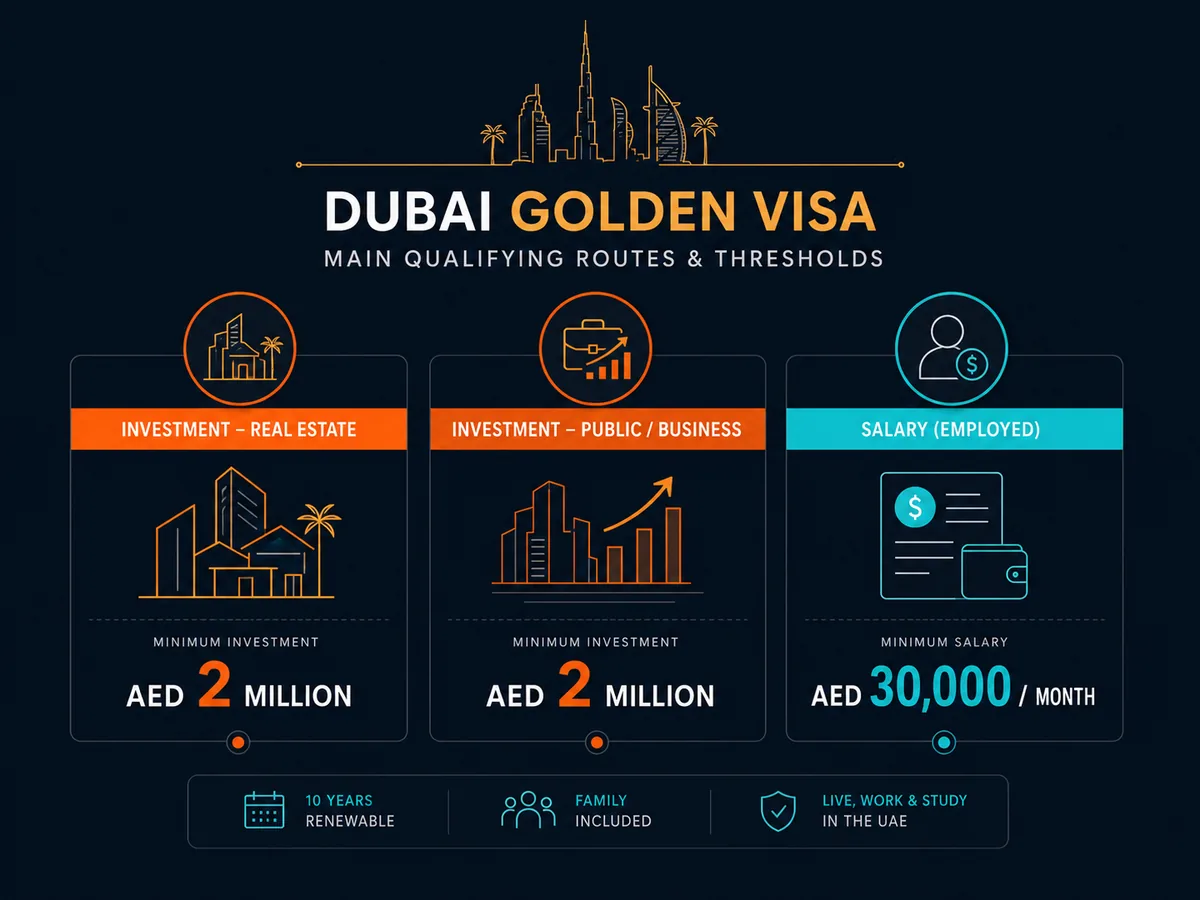
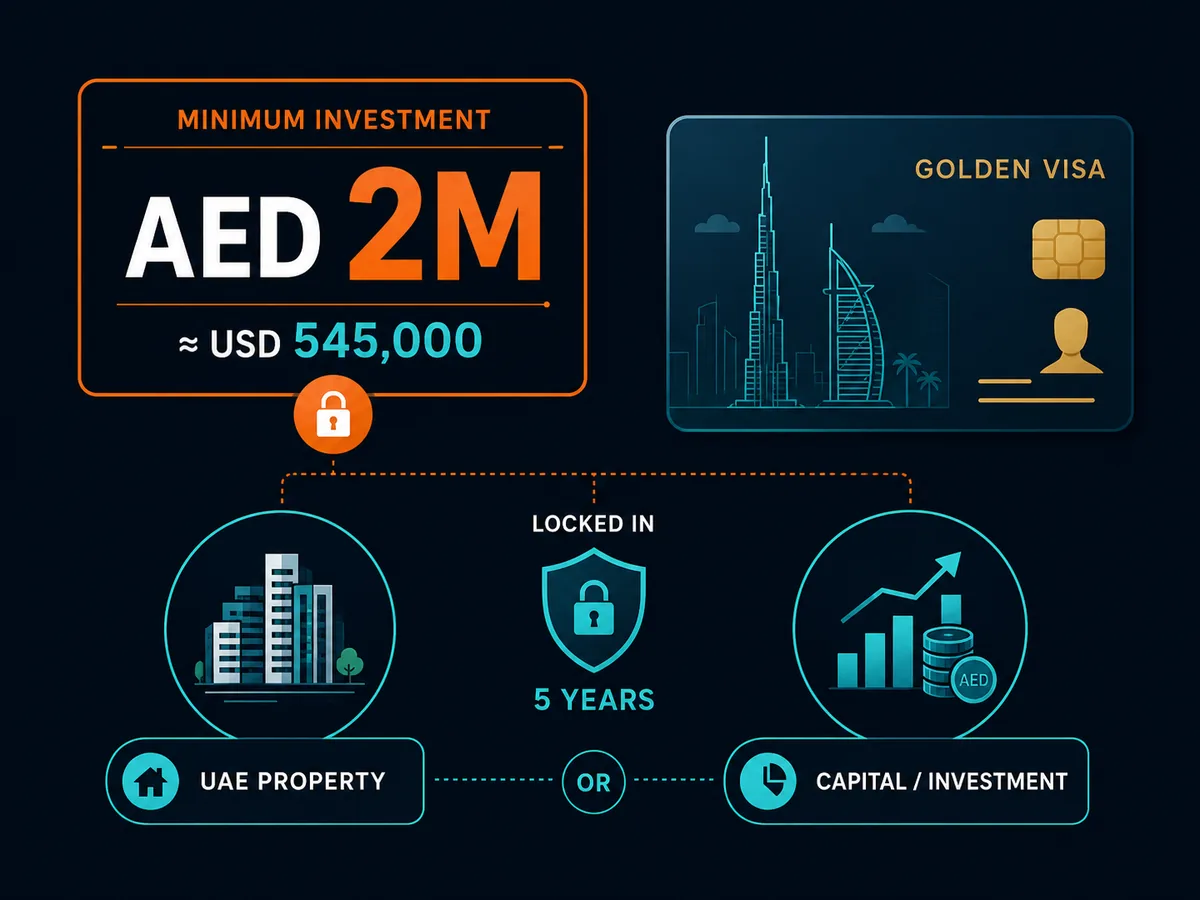
Own UAE property worth at least AED 2 million (approximately USD 545,000). Per the Dubai Land Department, this can be:
- A single property valued at AED 2 million or more
- Multiple properties totalling AED 2 million
- Off-plan property purchased from approved developers
- Mortgaged property, provided the mortgage is from an approved local bank and the buyer has paid at least AED 2 million
The property must be retained for the visa to remain valid. Joint ownership with a spouse is permitted.
Public investment investors
Invest AED 2 million in an accredited UAE investment fund, or hold capital of at least AED 2 million in a licensed UAE company, per the Ministry of Economy. The investment must not be borrowed, and proof of tax payment of at least AED 250,000 annually to the UAE government is required in some sub-routes.
Entrepreneurs
Own or be a partner in a startup classified as a small or medium-sized enterprise registered in the UAE, generating annual revenues of at least AED 1 million, or have obtained approval for a previous entrepreneurial project from an accredited business incubator. Details on the Ministry of Economy page.
Specialised talents and professionals
Doctors, scientists, engineers, IT specialists, creatives, athletes and certain executives. Skilled professionals qualify with a valid employment contract, a position classified at occupational level 1 or 2 by the Ministry of Human Resources, and a monthly salary of at least AED 30,000, with a bachelor's degree or equivalent.
Outstanding students and graduates
Top high-school students nationally, and university graduates from accredited universities with a GPA of 3.5 or higher, subject to additional criteria set by the Ministry of Education.
Humanitarian pioneers and frontline heroes
Distinguished humanitarian workers and frontline workers who served during exceptional circumstances (the category was expanded during COVID-19).
Key benefits, honestly assessed
The benefits marketed everywhere:
- 10-year residence, renewable automatically.
- Self-sponsorship — no employer required.
- Family sponsorship — spouse, children of any age, parents and household staff.
- No six-month absence rule, so the visa survives long stays abroad.
- Multi-entry with no maximum visit limit.
- Access to UAE bank accounts, property purchase, business licences and the local school and healthcare system (paid for separately).
The benefits not marketed:
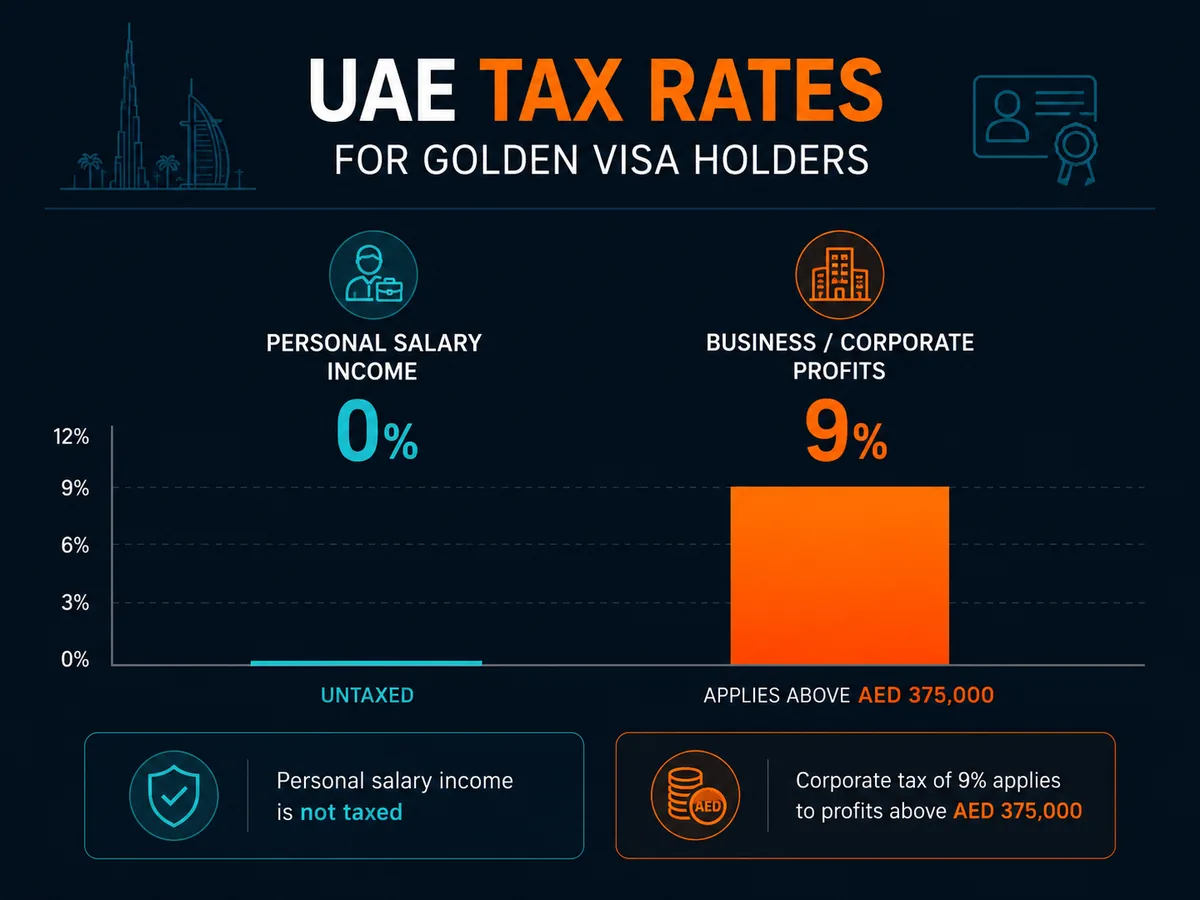
- No personal income tax on salary in the UAE itself — this is true and has been since the country was founded. It is not a Golden Visa benefit, it is a UAE benefit, available equally on a standard work visa.
- Federal corporate tax of 9% applies to business profits above AED 375,000, introduced June 2023 under Federal Decree-Law No. 47 of 2022. Free zone companies meeting "qualifying income" rules can still access a 0% rate, but the bar is real.
- VAT of 5% applies to most goods and services.
- The visa does not confer EU- or Schengen-area access.
Realistic costs, fees and timeline
Numbers below combine official fees with typical administrative costs observed in 2025–2026. Government fees are sourced from the ICP and GDRFA; other costs are market estimates and should be verified at application. For per-route line items beyond this summary, the dedicated cost tables at uaegoldenvisacost.com break down the 10-year Golden Visa fees and the cost per dependant in more detail.
| Item | Approx. cost (AED) | Approx. cost (USD) | Notes |
|---|---|---|---|
| Real estate route — minimum investment | 2,000,000 | ~545,000 | Property must be retained |
| Public investment route — minimum | 2,000,000 | ~545,000 | Fund or company capital |
| Skilled professional route — qualifying salary | 30,000/month | ~8,170/month | Plus degree + level 1/2 role |
| Government issuance fee (10-year) | ~2,800–4,000 | ~760–1,090 | Per applicant |
| Medical fitness test | ~320–750 | ~90–205 | Mandatory |
| Emirates ID (10 years) | ~1,150 | ~315 | Mandatory |
| Typing centre / processing fees | ~500–1,500 | ~135–410 | Varies by centre |
| Agent / PRO service (optional) | 5,000–25,000 | ~1,360–6,800 | Wide spread; shop around |
| Dependant visa (per dependant) | ~3,000–6,000 | ~815–1,635 | Spouse, child or parent |
Timelines once documents are complete: typically 2–4 weeks for nomination categories (talent, professionals) and 30–60 days for investor routes that require property registration or fund verification. Real estate purchase itself adds weeks if you are buying from scratch — Dubai Land Department transfer and title deed issuance are separate processes.
Be sceptical of agencies advertising "guaranteed Golden Visa in 5 days." The government processing window is what it is; the only thing an agent can compress is your own paperwork.
What happens after 10 years
The Golden Visa renews for another 10 years if the underlying condition still applies. Real estate investors must still own qualifying property; public investors must still hold the investment; salaried professionals must still earn the threshold and hold a qualifying role; talent-route holders must still be active in their field.
There is no path to automatic citizenship. The UAE introduced a discretionary naturalisation route in January 2021, available by nomination only to investors, doctors, scientists, intellectuals, artists and their families. It is not something you can apply for; you must be nominated by a Ruler's Court, Crown Prince Court or Executive Council. Numbers granted have been small.
The Golden Visa is, in practical terms, a long-term residence solution, not a citizenship pathway.
Common mistakes and how to avoid them
Assuming the visa changes your tax residency. It does not. Your home country decides whether you are still tax-resident there, based on its own rules. Get a tax clearance or formal deregistration from your home authority. If you are a US citizen, accept that this never ends short of renunciation under 26 U.S.C. § 877A, which carries its own exit tax.
Buying property purely for the visa, in the wrong area, at the wrong price. Dubai's property market is cyclical and segmented. A AED 2 million off-plan unit from a marketing-led developer can be very different in resale value from a AED 2 million completed unit in an established community. The visa is a side benefit, not a reason to overpay.
Using "address-only" residency claims. Several promoters still advertise schemes where you "become a UAE resident" without actually living there. If your home country audits and finds your centre of vital interests is still there — family, business, where you actually sleep — the UAE visa will not protect you. Soveraine will not link to providers offering this.
Underestimating UAE corporate tax. If you set up a UAE company to receive freelance or consulting income, you are inside the 9% corporate tax regime above the AED 375,000 threshold unless you qualify as a free zone "qualifying" person on qualifying income — a narrower category than most marketing implies. Read Ministerial Decision No. 139 of 2023 on qualifying activities before assuming you are at 0%.
Ignoring CFC rules at home. If you are EU-resident and set up a UAE company while still tax-resident in, say, France or Germany, ATAD CFC rules can attribute the company's passive income back to you personally. Substance matters: real office, real staff, real decisions made in the UAE.
Skipping the exit-tax check. Before you leave Germany, France, the Netherlands, Spain or several other EU jurisdictions, check whether you owe exit tax on unrealised gains in shareholdings. This is settled before you go, not after.
Where to apply, and whether to use an agent
You can apply directly through:
- ICP smart services — federal route, covers all emirates.
- GDRFA Dubai — for applicants based in Dubai.
- Dubai Land Department — for the real estate investor route specifically.
Agents and PRO services are common and not necessary for straightforward cases. They are useful if you do not speak Arabic, are applying from outside the UAE, or have document complexity (foreign degrees needing attestation, prior visa cancellations, name discrepancies between documents). Fees range widely.
Soveraine does not currently have an affiliate relationship with any UAE immigration provider. If we add one, it will be disclosed inline as per our affiliate disclosure.
When to consult a qualified professional
Before you commit capital or relocate, talk to:
- A tax adviser in your current country of residence — to confirm what it takes to break tax residency cleanly, and what exit-tax or trailing liabilities apply.
- A UAE tax adviser — to model corporate tax exposure if you intend to run a UAE company, and to confirm free zone qualifying-income status if relevant.
- A US tax adviser, if you are a US person — to plan FEIE, foreign tax credit and FBAR/FATCA filings around the move. None of these go away because you have a UAE visa.
- An immigration consultant or lawyer, if your case has complications — past UAE visa cancellations, criminal record issues, complex family structures, or document attestation problems.
The cost of a half-day with each of these is trivial compared to the cost of getting the structure wrong. See our editorial policy and disclaimer — this article is journalism, not advice.
Ready to act on this?
SPC Free Zone (Sharjah) — UAE free-zone formation with a public referral programme. Soveraine readers go to the front of the line through our partner link, and you fund independent editorial in the process.
FAQ
Who is eligible for the Dubai Golden Visa?
Investors, entrepreneurs, scientists, doctors, engineers, top-ranked students, outstanding specialists in fields like culture and sport, frontline humanitarian workers and certain skilled professionals earning at least AED 30,000 per month. Real estate investors qualify by owning UAE property worth at least AED 2 million. Public investment investors qualify with AED 2 million deposited in an approved fund or licensed UAE company. Each category has its own documentary requirements set by the Federal Authority for Identity, Citizenship, Customs and Port Security (ICP) and, in Dubai, the GDRFA.
How much money is required for a Dubai Golden Visa?
The two main investment routes require AED 2 million (around USD 545,000). For real estate, that is the minimum property value, which can be a single unit or a portfolio, and can be mortgaged through approved local banks. For public investments, AED 2 million must sit in an accredited investment fund or be held as capital in a licensed UAE company. Government processing fees themselves are modest — typically a few thousand dirhams — but medical tests, Emirates ID, typing centre fees and (if you use one) agent fees usually push the total administrative cost to AED 4,000–10,000.
What happens after 10 years of Golden Visa in Dubai?
The Golden Visa renews automatically for another 10 years as long as the qualifying conditions still apply — you still own the property, still hold the investment, still earn the qualifying salary, or still meet the talent criteria. There is no minimum stay requirement to keep it active, unlike standard UAE residency which lapses after six months outside the country. The Golden Visa does not lead automatically to UAE citizenship; naturalisation is a separate, discretionary process introduced in 2021 and rarely granted.
What are the disadvantages of a Dubai Golden Visa?
The capital requirements are real money locked into UAE assets or property. Property values in Dubai are cyclical and AED-pegged to the US dollar, which exports US monetary policy into your investment. The visa does not, by itself, change your tax residency — your home country still decides that. US citizens remain fully taxable on worldwide income regardless. The UAE introduced a 9% federal corporate tax in June 2023, ending the country's headline "zero corporate tax" status. Healthcare and schooling in Dubai are private and expensive.
What is the AED 3,000 rule?
There is no single rule called the "3,000 dirham rule" in UAE immigration law. The phrase circulates on social media and usually refers to one of three things: the minimum monthly salary thresholds for certain standard work visas (historically around AED 3,000–4,000), the minimum salary tier for sponsoring family members, or older immigration fines. None