
"Golden visa" is shorthand for an investor-residency programme — a residence permit issued in exchange for a qualifying investment, typically convertible to permanent residency and eventually citizenship through ordinary naturalisation. It is not a passport-for-cash scheme; that market is called citizenship-by-investment, and after the Court of Justice of the EU's judgment of 29 April 2025 in Commission v Malta (C-181/23) it no longer exists inside the European Union. Spain closed its investor visa the same month under Organic Law 1/2025. The 2026 map of golden visa countries looks materially different from the 2020 one, and several of the largest advisory sites have not caught up.
This guide is the hub. It maps every active programme worldwide, prices them honestly, flags the closures, and links out to Soveraine's country-specific pillars where you need to go deeper.
Henley & Partners — Largest RBI/CBI advisory firm in the world
What "golden visa" actually means — and what changed in 2024-2025
The vocabulary matters because the products matter.
Residency-by-investment (RBI). You make a qualifying investment — a fund subscription, a property purchase, a capital transfer into a company, sometimes a government bond holding — and receive a renewable residence permit. The permit lets you live, work and travel in the issuing country (and inside the Schengen Area, if the country is in Schengen), with modest minimum-stay requirements that vary by programme. After five to ten years of genuine residence — physical presence, tax residency, language acquisition — you can apply for citizenship through ordinary naturalisation. All current "golden visas" are RBI products.
Citizenship-by-investment (CBI). You make a qualifying donation or investment and receive a passport directly, usually within four to twelve months and without any residency requirement. CBI inside the EU is closed. The remaining CBI programmes are Caribbean (Antigua, Dominica, Grenada, St Kitts, St Lucia) plus Vanuatu, Egypt, Jordan and a few others.
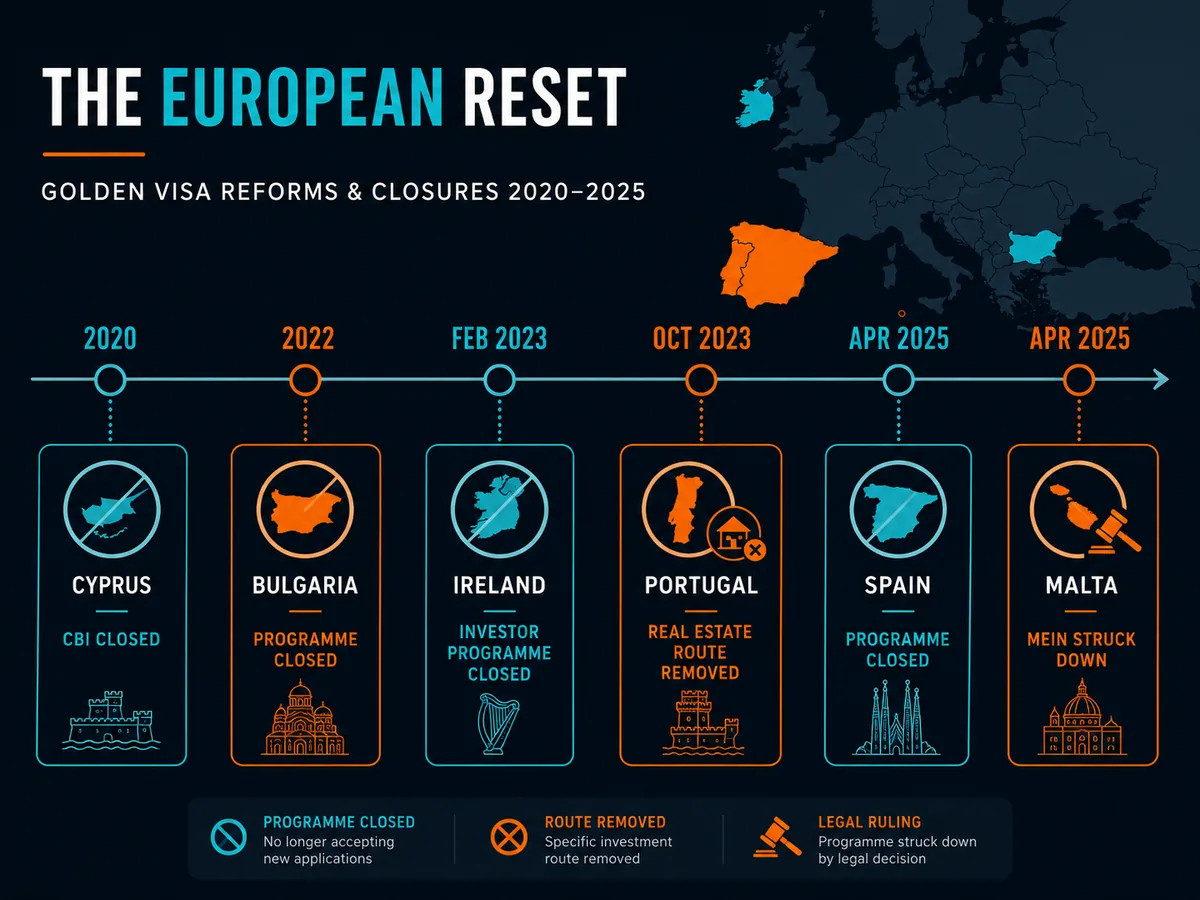
Three regulatory shifts in 2023–2025 reshaped the European map:
- Portugal's October 2023 reform. Lei n.º 56/2023 (Mais Habitação) abolished the residential and most commercial real-estate routes that had powered the programme since 2012. Investment funds, capital transfers and job creation remain. Detail in Soveraine's Portuguese Golden Visa pillar.
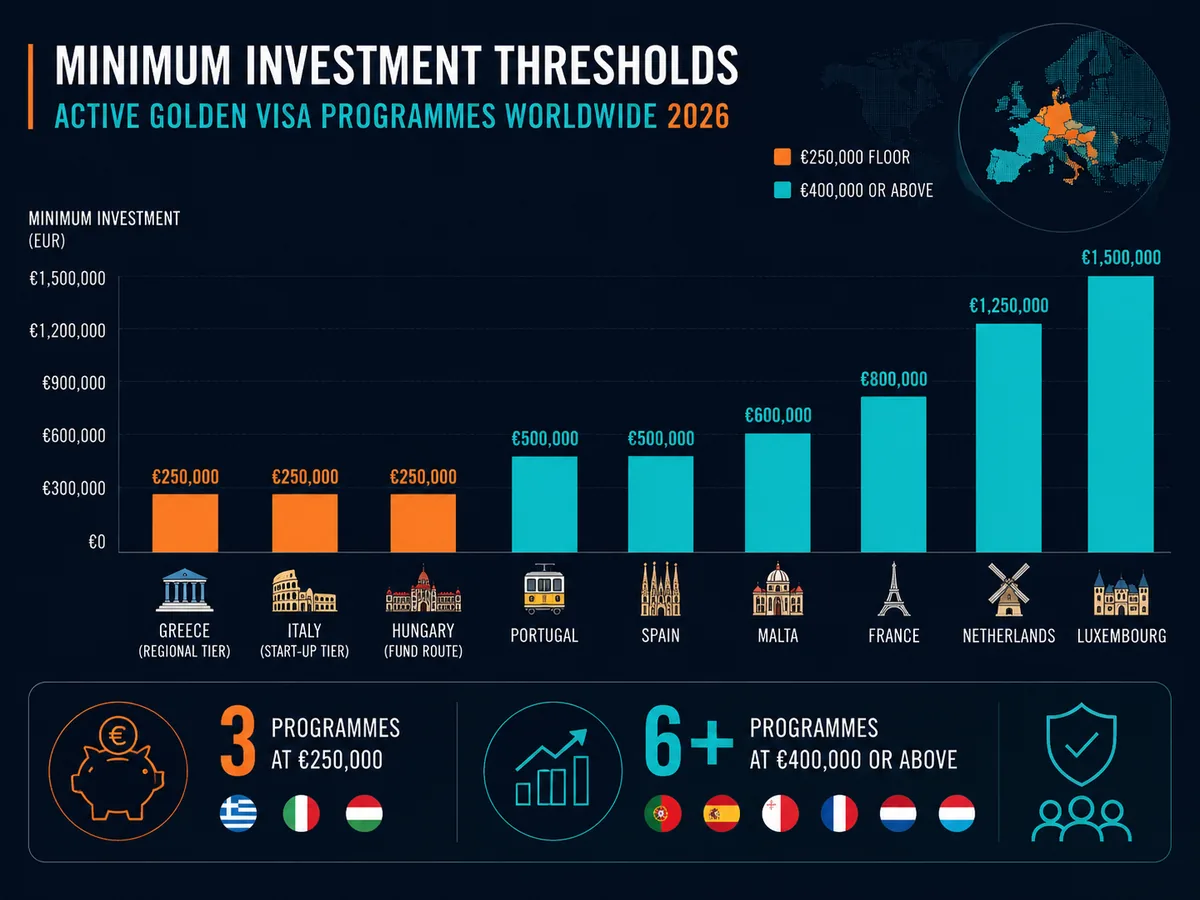
- Greek tiering, September 2024. Law 5100/2024 raised the minimum from a uniform €250,000 to a three-tier structure — €250,000 in low-density regional municipalities, €400,000 in most of the country, €800,000 in Athens, Thessaloniki and the islands of Mykonos and Santorini (Ministry of Migration and Asylum).
- Malta investor citizenship struck down, April 2025. The CJEU's Grand Chamber ruled in Case C-181/23 that the Citizenship by Naturalisation for Exceptional Services by Direct Investment (MEIN) breached Article 4(3) TEU and Article 20 TFEU; Malta suspended the scheme. The judgment hit CBI, not RBI — but it has chilled investor-residency policy across the EU.
Two further closures matter:
- Spain, April 2025. Organic Law 1/2025 of 2 January 2025 repealed the investor-residency provisions of Law 14/2013, in force from 3 April 2025. New applications stopped that day.
- Hungary, reopened July 2024. The Guest Investor Programme (Vendégbefektetői Programme) replaced the suspended Hungarian Residency Bond scheme on 1 July 2024, with €250,000 in a registered real-estate fund or €500,000 in a residential property as the qualifying investments (Hungarian Government).
Who this applies to — read this first
The same product produces very different practical advice depending on the passport you already hold.
US persons
US citizens and lawful permanent residents are eligible for every active golden visa programme. The constant is the tax position: the United States taxes its citizens on worldwide income regardless of residence (IRS, International Taxpayers). Acquiring residency through a fund subscription or a property purchase in Portugal, Greece, Italy, the UAE or anywhere else does not end Form 1040 filing, FBAR reporting on FinCEN Form 114 for foreign accounts above USD 10,000, or Form 8938 reporting under FATCA.
Investing through a non-US fund usually triggers PFIC reporting on Form 8621 — administratively painful and worth modelling with a cross-border CPA before subscribing. US persons sometimes pursue a golden visa specifically as a foundation for a later EU naturalisation followed by renunciation; if that is the plan, model the IRC §877A exit tax in advance. Soveraine's renouncing American citizenship guide covers the mechanics.
EU residents
If you already hold an EU nationality, you have free movement under Article 21 TFEU and you do not need a golden visa to live, work or invest in any other Member State. The reason an EU citizen might still want one is narrow and specific: as a non-dom or tax-residency planning lever paired with a regime in a third country, or as a vehicle to relocate genuine tax residence under the OECD Model Tax Convention tie-breaker tests. See Soveraine's non-doms guide and non-dom meaning for the underlying mechanics.
Non-US, non-EU readers
This is the primary audience for golden visas — Indian, Chinese, Russian, Middle Eastern, sub-Saharan African and Latin American applicants for whom an EU or UAE residency adds travel, banking, schooling and optionality that the home passport does not provide. Most of these jurisdictions tax on residency rather than citizenship, so acquiring a second residence does not by itself create new tax obligations at home (Eritrea and a few other outliers tax citizens abroad). The practical question is which programme aligns with where you can plausibly spend time if you also want eventual citizenship.
The European golden visa map in 2026
Country by country, the active programmes and the closures.
Portugal — fund, capital and cultural routes only
The Autorização de Residência para Atividade de Investimento (ARI), launched under Law 29/2012 and administered by AIMA since October 2023, remains active. The October 2023 Mais Habitação reform removed residential and most commercial real estate. Qualifying investments are now:
- €500,000 subscription in a qualifying Portuguese venture capital or private equity fund.
- €500,000 capital transfer for research at accredited institutions.
- €250,000 capital transfer for arts or cultural heritage.
- €500,000 for incorporation or capital increase of a Portuguese company plus five permanent jobs for three years.
- Creation of ten permanent jobs with no minimum capital.
Minimum stay: seven days in year one and fourteen days per two-year renewal — the most lenient in the EU. Citizenship eligibility kicks in at five years of legal residence under Law 37/81, though a 2025 reform proposal would extend that to ten years if enacted. AIMA backlog remains the binding constraint. Full detail: Portuguese Golden Visa.
Greece — €250,000 to €800,000 tiered
The Greek Golden Visa under Law 4251/2014 was reformed by Law 5100/2024, effective 1 September 2024. Three real-estate tiers now apply:
- €800,000 in Attica (Athens), Thessaloniki, Mykonos, Santorini and islands with populations above 3,100.
- €400,000 elsewhere in mainland Greece and on smaller islands.
- €250,000 in any region, restricted to (a) conversion of commercial buildings to residential use or (b) restoration of listed buildings.
The property must be a single asset of at least 120m² in the higher tiers; short-term rental is restricted in some categories. Alternative investments — €500,000 in Greek company shares, government bonds or mutual funds — remain. No minimum stay to maintain the permit. Citizenship at seven years of physical residence under the Code of Greek Nationality. Official portal: Ministry of Migration and Asylum.

Italy — Investor Visa with the €200,000 flat-tax companion
Italy operates the Investor Visa for Italy (visto per investitori) under Article 1, paragraphs 148–149 of Law 232/2016, administered by the Ministry of Enterprises and Made in Italy through the Investor Visa portal. Four qualifying investments:
- €250,000 equity in an Italian innovative start-up.
- €500,000 equity in an Italian limited company.
- €1,000,000 philanthropic donation supporting culture, education, immigration management, scientific research or the recovery of cultural and landscape heritage.
- €2,000,000 in Italian government bonds with at least two years remaining maturity.
Pre-approval by the Investor Visa Committee runs around 30 days; the visa is issued for two years and converts to a renewable residence permit. Italy's draw, especially since the UK abolished the non-dom regime in April 2025, is the parallel Article 24-bis flat-tax regime on foreign-source income — €200,000 a year for new electors from 10 August 2024 onwards, with a 2026 Budget Law proposal to raise it to €300,000. Naturalisation at ten years (or four years for EU nationals, three for those of Italian descent). Full detail: Italian Golden Visa.
Spain — CLOSED April 2025
The Spanish investor visa under Law 14/2013 of 27 September on support for entrepreneurs was repealed by Organic Law 1/2025 of 2 January 2025, in force from 3 April 2025. New applications are not accepted. Existing investor-residency holders retain their permits and can renew under the prior regime. The political driver was housing-affordability pressure, not the CJEU ruling; the closure is bipartisan and there is no serious proposal to reopen.
Any advisor website listing Spain as an active golden visa destination in 2026 is out of date. Spain still offers the Non-Lucrative Visa for passive-income retirees and a digital-nomad visa, but neither is an investor-residency programme.
Malta — MEIN closed, standard residence permit available
The Malta Citizenship by Naturalisation for Exceptional Services by Direct Investment (MEIN) — the EU's last direct investor-citizenship programme — was struck down by the CJEU in Commission v Malta, Case C-181/23 on 29 April 2025. The Court held that granting EU citizenship in exchange for predetermined payments, without a genuine link to the Member State, breached Article 4(3) TEU and Article 20 TFEU. Malta suspended the programme via Identità Malta.
The Malta Permanent Residence Programme (MPRP), an investor-residency product, remains open: a non-refundable government contribution plus a property purchase or rental commitment, currently €150,000 contribution plus property thresholds varying by region. It grants permanent residency, not citizenship, and does not put you on a fast-track to a Maltese passport — naturalisation takes the standard five-year route with Maltese-language requirements.
Hungary — Guest Investor Programme reopened July 2024
Hungary's Guest Investor Programme (Vendégbefektetői Programme), administered by Hungary's National Directorate-General for Aliens Policing, reopened on 1 July 2024 to replace the earlier Residency Bond scheme that was suspended in 2017. Two qualifying investments:
- €250,000 in a registered Hungarian real-estate fund regulated by the Hungarian National Bank, held for at least five years.
- €500,000 in residential property held for at least five years.
The visa is issued for up to ten years and renewable for another ten. Naturalisation in Hungary requires eight years of residence; spouses of Hungarian citizens and descendants of Hungarian nationals have shorter routes. The fund route is the cheapest entry into EU residency in 2026 alongside Greece's regional tier and Italy's start-up tier.
Cyprus — permanent residency by investment
Cyprus operates the Category F fast-track permanent residency programme administered by the Ministry of Interior. The headline route requires a €300,000 investment in new-build residential property (plus VAT), an annual income of at least €50,000 from foreign sources, and confirmation of no employment in Cyprus. Alternative routes include €300,000 in shares of a Cyprus-incorporated company or in collective-investment fund units.
This is permanent residency, not a Schengen-area permit — Cyprus is an EU member but not part of Schengen until full accession (currently expected in stages). Naturalisation at seven years of residence under the Civil Registry Law. The investor-citizenship programme that ran until November 2020 was closed permanently after the Al Jazeera "Cyprus Papers" investigation and is not coming back.
Beyond Europe
The non-European programmes solve different problems — UAE for tax residency under a treaty network, Turkey for fastest citizenship, the US for those who actually want to be in America.
UAE Golden Visa
The UAE Golden Visa is a 10-year renewable residence permit administered nationally by the Federal Authority for Identity, Citizenship, Customs and Port Security (ICP) and in Dubai by the GDRFA. Eligibility categories include:
- Real-estate investors — owning UAE property worth at least AED 2 million (roughly USD 545,000), mortgaged or unmortgaged.
- Public investors — AED 2 million deposited in an accredited investment fund or held as capital in a licensed UAE company.
- Specialised talents — scientists, doctors, engineers, executives.
- Entrepreneurs — founders of approved start-ups.
- High-salary professionals — AED 30,000+ monthly salary in qualifying roles.
No minimum stay requirement keeps the visa active, unlike standard UAE residency which lapses after six months outside the country. The UAE does not levy personal income tax but introduced a 9% federal corporate tax in June 2023 on business profits above AED 375,000. Full detail: Dubai Golden Visa and Taxes in Dubai.
Turkey — citizenship by real estate
Turkey is the cheapest citizenship-by-investment programme outside the Caribbean. The Turkish Citizenship by Investment programme under Regulation 2018/7613 grants citizenship in roughly six to nine months for:
- USD 400,000 in residential or commercial real estate held for at least three years, or
- USD 500,000 in fixed capital investment, government bonds, or a Turkish bank deposit held for three years.
The Turkish passport gives visa-free or visa-on-arrival access to around 110 jurisdictions and is the only programme of this size that delivers a passport (not residency) for under USD 500,000. The trade-off is Schengen access — Turkish citizens still need a Schengen visa — and the volatility of the Turkish lira denominator on the underlying investment. Administered by the Republic of Türkiye Ministry of Interior.
Mauritius — Premium Visa and Real Estate Scheme
Mauritius operates two relevant tracks. The Premium Visa is a renewable one-year residence visa for digital workers and retirees with passive income, no investment required. The headline investor route is the Permanent Residence Permit obtained by purchasing residential property worth at least USD 375,000 in an approved Integrated Resort Scheme (IRS), Real Estate Scheme (RES), Property Development Scheme (PDS) or Smart City development, administered by the Economic Development Board.
Mauritius taxes residents on Mauritius-source income at 15% with a partial exemption regime; foreign-source income is generally not taxed in Mauritius unless remitted. Naturalisation takes five years of residence under restrictive conditions.
Thailand — Long-Term Resident Visa
Thailand's Long-Term Resident (LTR) Visa, introduced in September 2022 and administered by the Board of Investment, is a ten-year visa for four categories: wealthy global citizens, wealthy pensioners, work-from-Thailand professionals, and highly skilled professionals. The wealthy-global-citizens category requires personal assets of USD 1 million and personal income of USD 80,000 per year for the past two years, plus an investment of USD 500,000 in Thai government bonds, Thai property or Thai foreign direct investment.
The LTR is not a citizenship programme — naturalisation requires ten-plus years of permanent residency, which is separate again — but it is one of the cleanest long-term visas in Asia, with a 17% personal-income-tax cap for foreign professionals in qualifying categories.
USA EB-5 Investor Visa
The US Immigrant Investor Programme (EB-5) under Section 203(b)(5) of the Immigration and Nationality Act was reauthorised and reformed by the EB-5 Reform and Integrity Act of 2022. Current minimums:
- USD 1,050,000 standard investment in a new commercial enterprise.
- USD 800,000 investment in a Targeted Employment Area (TEA) — a rural area or an area of high unemployment.
Each investment must create or preserve ten full-time US jobs for qualifying workers within two years. EB-5 grants conditional lawful permanent residency (a "green card") for two years, removable upon proof that the job-creation requirement was met. Permanent green-card holders can apply for naturalisation after five years of physical presence. EB-5 is the only major Western programme that delivers a path to citizenship in a top-tier economy at this price point — but US citizenship-based taxation begins the day you become a lawful permanent resident.
Comparison table
| Country | Programme | Min investment | Investment type | Years to permanent residency | Years to citizenship | Best for |
|---|---|---|---|---|---|---|
| Portugal | Golden Visa (ARI) | €250,000 | Cultural / fund (€500k) / jobs | 5 | 5 (10 if reform passes) | Schengen access, low stay |
| Greece | Golden Visa | €250,000 | Real estate (tiered) / fund / bonds | 5 | 7 | Lowest EU entry, no stay |
| Italy | Investor Visa | €250,000 | Start-up / company / bonds / donation | 5 | 10 | HNW + flat tax stack |
| Hungary | Guest Investor | €250,000 | Real-estate fund / property | 3 (after 10y visa) | 8 | Cheapest fund route |
| Cyprus | Cat. F PR | €300,000 | New-build property / fund | Immediate PR | 7 | Permanent residency in 2 months |
| Malta | MPRP | €150,000 + property | Government contribution + property | Immediate PR | 5 (standard naturalisation) | English-speaking PR |
| UAE | Golden Visa | AED 2M (~USD 545k) | Property / fund / talent | 10y renewable visa | Discretionary, rare | Tax residency, no stay |
| Turkey | Citizenship by Investment | USD 400,000 | Real estate / deposit | n/a (direct citizenship) | 6–9 months | Fastest non-EU passport |
| Mauritius | PR by Real Estate | USD 375,000 | Property (IRS/RES/PDS) | Immediate PR | 5 (restrictive) | English common law, treaty network |
| Thailand | LTR Visa | USD 500,000 + USD 1M wealth | Bonds / property / FDI | n/a (10y visa) | 10+ | Asia base, 17% tax cap |
| USA | EB-5 | USD 800,000 (TEA) | Targeted-area enterprise | Immediate conditional PR | 5 | US PR + citizenship at the price |
Closed in 2022–2025: UK Tier 1 Investor (Feb 2022), Bulgaria (Mar 2022), Cyprus CBI (Nov 2020), Ireland IIP (Feb 2023), Portugal real-estate route (Oct 2023), Spain investor visa (Apr 2025), Malta MEIN (Apr 2025).
The Caribbean alternative — CBI, not RBI
For applicants whose objective is a second passport rather than EU residency, the Caribbean citizenship-by-investment programmes remain the fastest path to a new nationality. Five programmes are active in 2026:
- Antigua and Barbuda — USD 230,000 non-refundable donation to the National Development Fund for a family of up to four, or USD 300,000 in approved real estate. Citizenship in 6–9 months. See Soveraine's Antigua and Barbuda CBI guide.
- Dominica — USD 200,000 donation to the Economic Diversification Fund or USD 200,000 in approved real estate. 6–9 months.
- Grenada — USD 235,000 donation or USD 270,000 in approved real estate. Grenadian passport gives E-2 treaty-investor access to the US.
- St Kitts and Nevis — USD 250,000 contribution to the Sustainable Island State Contribution. The oldest CBI programme, established 1984.
- St Lucia — USD 240,000 donation to the National Economic Fund, USD 300,000 in real estate, or USD 300,000 in approved government bonds.
The Caribbean passports give visa-free or visa-on-arrival access to 130–150 jurisdictions, including the Schengen Area — though after April 2025 the European Commission has tightened visa-free reviews of countries running CBI programmes accepting Russian and Belarusian nationals. The Schengen visa-waiver status of these passports is no longer guaranteed in perpetuity.
For the cheapest island passport outside the Caribbean, see Soveraine's Vanuatu CBI guide and the broader country with easy citizenship hub.
The cost reality
Headline minimums hide the real cost. Budget for the full stack.
Government fees. Application fees, biometrics, permit issuance, family-member fees. Portugal: roughly €5,300 main applicant plus €2,650 per dependent in initial and renewal fees combined. Greece: about €2,000 main applicant. UAE: AED 4,000–10,000 across medical, Emirates ID and typing-centre fees. Caribbean CBI processing and due-diligence fees: USD 10,000–50,000 per family on top of the donation.
Legal and agency fees. USD 15,000 to USD 50,000 is typical for a competent law firm handling the application end to end. Larger advisory firms charge more; local boutiques charge less. Be wary of "free" consultations that turn into property-developer commissions baked into above-market unit prices.
Annual costs. Fund management fees of 1–2% per annum on subscription routes (Portugal, Hungary). Property maintenance, taxes and HOA fees on real-estate routes. Tax-residency certificate renewals if you use the residency for tax planning. Annual residency-permit renewal administrative fees.
The substance question. Most programmes now enforce minimum physical presence at some level — even Portugal's nominal seven-day rule is checked at biometric appointments and renewals. To convert residency into citizenship you generally need to satisfy the country's full naturalisation residency: 183-plus days a year for the full qualifying period, with tax residency and a documented life on the ground. "I bought the visa but I live elsewhere" works for the permit; it does not work for the passport.
A realistic all-in budget for an EU golden visa in 2026:
- Headline investment: €250,000–€800,000
- Government fees (family of four, full cycle): €15,000–€25,000
- Legal and agency fees: €20,000–€40,000
- Annual fund or property costs: €5,000–€20,000
- Tax and accounting (cross-border): €5,000–€15,000
Total cash out of pocket beyond the qualifying investment itself: typically €45,000–€100,000 over the first five-year cycle.

The 2025 closures and reforms — what is permanent
A summary of the closures that reshaped the market, with the legal basis for each:
- UK Tier 1 Investor — closed 17 February 2022. Home Office Statement of Changes HC1118 closed the £2 million investor visa with immediate effect, citing concerns about illicit Russian capital.
- Bulgaria fast-track naturalisation — closed March 2022. Repealed by amendments to the Bulgarian Citizenship Act, ending the two-year investor route to a Bulgarian passport.
- Ireland Immigrant Investor Programme — closed 15 February 2023. Then-Minister for Justice Simon Harris announced closure citing programme integrity concerns.
- Portugal real-estate route — closed 7 October 2023. Law 56/2023 (Mais Habitação) removed residential and most commercial property from qualifying investments.
- Spain investor visa — closed 3 April 2025. Organic Law 1/2025 repealed the investor provisions of Law 14/2013.
- Malta MEIN — struck down 29 April 2025. CJEU Case C-181/23 found Malta's investor-citizenship route incompatible with EU law.
The pattern is consistent. The €250,000-to-€500,000 entry-level real-estate route into EU residency is largely gone; the new floor is roughly €400,000 in property or €250,000 in regulated fund subscriptions. Investor-citizenship inside the EU is over. The remaining EU programmes are residency products administered with steadily tighter due diligence, and the political climate makes further restrictions more likely than relaxations.
What is not changing: the underlying demand. Henley & Partners' annual surveys continue to record record interest from US, UK, South African, Indian and Middle Eastern applicants. Supply has compressed; the price of remaining options is structurally up.
When to consult a professional
A residency-by-investment decision touches immigration law in the host country, tax law in both countries, succession law, and investment due diligence on whatever fund, property or bond you are subscribing to. The right team is typically three professionals:
- An immigration lawyer in the target country.
- A tax adviser in your current country of residence — and a second one in the target if you are also relocating tax residence.
- An investment due-diligence reviewer for the underlying asset, especially for fund subscriptions that lock capital for five-plus years.
For US persons, add a cross-border CPA familiar with PFIC reporting, FEIE, foreign tax credits and the §877A exit tax. Soveraine's editorial policy and affiliate disclosure cover how we work with advisory partners. Country-specific deep dives: Portuguese Golden Visa, Italian Golden Visa, Dubai Golden Visa, Easiest EU Citizenship and Malta Global Residence Programme (where present).
Ready to act on this?
Henley & Partners — Largest RBI/CBI advisory firm in the world. They handle every active golden visa programme covered in this guide. Soveraine readers go to the front of the line through our partner link, and you fund independent editorial in the process.
FAQ
Which countries still have a golden visa in 2026?
Inside the EU, the active investor-residency programmes are Portugal (fund, capital, cultural and job-creation routes after the October 2023 reform), Greece (€250,000 to €800,000 tiers after the September 2024 reform), Italy (Investor Visa at €250,000 / €500,000 / €1 million / €2 million), Hungary (Guest Investor Programme reopened July 2024 at €250,000 in a fund or €500,000 in property) and Cyprus permanent residency (€300,000 plus). Outside the EU, the headline programmes are the UAE Golden Visa, Turkey's citizenship-by-real-estate, the Mauritius Premium Visa, the Thailand Long-Term Resident Visa and the US EB-5 investor visa. Spain closed its investor visa in April 2025 and Malta's investor-citizenship route was struck down by the CJEU the same month.
What is the cheapest golden visa in 2026?
On headline minimums, the cheapest active programmes are Greece's regional Golden Visa at €250,000 in approved low-density municipalities, Italy's Investor Visa start-up tier at €250,000 and Hungary's Guest Investor Programme at €250,000 in a registered real-estate fund. Below €250,000, the realistic options are not golden visas at all but Caribbean citizenship-by-investment donations (around USD 230,000 to USD 250,000 for Antigua, Dominica, St Lucia or Grenada). Beware total cost: government fees, due-diligence fees, legal fees and (for fund subscriptions) annual management fees can add €25,000 to €60,000 on top of the headline figure.
Did the EU really shut down golden visas?
Not all of them. The Court of Justice of the EU's ruling of 29 April 2025 in Commission v Malta (Case C-181/23) struck down Malta's investor-citizenship programme, not investor-residency programmes. The legal reasoning targeted granting EU citizenship without a genuine link to the Member State. Residency-by-investment programmes — Portugal, Greece, Italy, Hungary — are unaffected by the judgment itself, though several Member States have tightened or closed their own schemes politically. Spain closed its investor visa by Law 1/2025 in April 2025 for housing-policy reasons, not because of the CJEU ruling.
What is the difference between a golden visa and citizenship by investment?
A golden visa is residency-by-investment: you receive a residence permit in exchange for a qualifying investment, and you can apply for citizenship only after meeting the country's standard naturalisation timeline (typically five to ten years) with genuine residence, language tests and integration requirements. Citizenship-by-investment (CBI) gives you a passport directly, usually within six to fourteen months, for a non-refundable donation or qualifying investment. Active CBI programmes today are concentrated in the Caribbean — Antigua and Barbuda, Dominica, Grenada, St Kitts and Nevis, St Lucia — plus Vanuatu, Egypt, Jordan, Turkey and a handful of others. No EU Member State currently operates a CBI scheme.
Can a US citizen get a golden visa?
Yes. Every active golden visa programme accepts US citizens. The catch is unchanged by any of them: the United States taxes its citizens and lawful permanent residents on worldwide income regardless of residence, under 26 U.S.C. § 1 and § 61. Acquiring residency or even citizenship elsewhere does not end US filing obligations, FBAR reporting on FinCEN Form 114, or FATCA reporting on Form 8938. Only formal renunciation ends US tax obligations, and it triggers an exit tax under IRC §877A for covered expatriates. Many US clients pursue a golden visa years before any planned renunciation specifically so the act does not leave them stateless.
How long does a golden visa take to get?
Application-to-permit timelines vary widely. Portugal's AIMA backlog ran 18 to 36 months on initial decisions through 2024 and 2025, though new resourcing has started to reduce it. Greece typically issues the permit in 4 to 8 months. Italy's Investor Visa Committee is unusually fast — pre-approval in around 30 days, full permit in 3 to 6 months. UAE Golden Visa decisions are issued in 2 to 4 weeks. Hungary's Guest Investor Programme targets 30 days for the visa decision. Caribbean CBI runs 4 to 12 months. The "EU passport in 30 days" marketing of the 2018–2022 era is no longer accurate for any legitimate programme.
Will I have to live in the country?
It depends on the programme and what you ultimately want from it. To hold and renew most golden visas, the physical-presence requirements are modest: Portugal requires only 7 days in year one and 14 days per two-year renewal period; Greece, Hungary and Cyprus require no minimum stay; the UAE Golden Visa has no minimum stay. To convert residency into citizenship — the bigger prize — you generally need to satisfy the country's actual naturalisation residency, which means 183-plus days a year for five to ten years, plus tax residency, language and integration. The two-tier reality is what makes the "fast EU passport" pitch misleading.
Is the Spanish Golden Visa really closed?
Yes. Organic Law 1/2025 of 2 January 2025, in force from 3 April 2025, repealed the investor-residency provisions of Law 14/2013 on support for entrepreneurs. Spain stopped accepting new investor-visa applications from that date. Applications filed before the cut-off continue to be processed under the old regime, and existing investor-residency holders retain their permits and renewal rights. Spain remains one of the few EU countries with no active golden visa, alongside Ireland (closed February 2023) and the UK (closed February 2022). Many advisory websites still list Spain as available — they are wrong.
Sources
- Court of Justice of the EU — Commission v Malta, Case C-181/23 (29 April 2025). https://curia.europa.eu/jcms/jcms/p1_4525893/en/
- Spain — Organic Law 1/2025 of 2 January 2025. https://www.boe.es/eli/es/lo/2025/01/02/1
- Portugal — Law 29/2012 (Golden Visa legal basis). https://diariodarepublica.pt/dr/detalhe/lei/29-2012-179516
- Portugal — Law 56/2023 (Mais Habitação). https://diariodarepublica.pt/dr/detalhe/lei/56-2023-223429532
- Portugal — AIMA (Agency for Integration, Migrations and Asylum). https://aima.gov.pt/
- Greece — Ministry of Migration and Asylum. https://migration.gov.gr/en/
- Italy — Investor Visa for Italy (Ministry of Enterprises). https://investorvisa.mise.gov.it/
- UAE — Golden Visa, official government portal. https://u.ae/en/information-and-services/visa-and-emirates-id/residence-visas/golden-visa
- UAE — Federal Authority for Identity, Citizenship, Customs and Port Security (ICP). https://icp.gov.ae/en/services/golden-residency/
- Hungary — National Directorate-General for Aliens Policing. https://oif.gov.hu/
- Cyprus — Ministry of Interior, Civil Registry and Migration Department. https://www.moi.gov.cy/moi/crmd/crmd.nsf/index_en/index_en?OpenDocument
- Malta — Identità Malta. https://identita.gov.mt/
- Mauritius — Economic Development Board. https://edbmauritius.org/
- Mauritius — Premium Visa, Passport Office. https://passport.govmu.org/passport/?page_id=614
- Thailand — Long-Term Resident Visa, Board of Investment. https://ltr.boi.go.th/
- USA — EB-5 Immigrant Investor Programme, USCIS. https://www.uscis.gov/working-in-the-united-states/permanent-workers/eb-5-immigrant-investor-program
- Turkey — Republic of Türkiye Ministry of Interior. https://www.icisleri.gov.tr/
- IRS — US citizens and resident aliens abroad. https://www.irs.gov/individuals/international-taxpayers/us-citizens-and-resident-aliens-abroad
- FinCEN — Report of Foreign Bank and Financial Accounts (FBAR). https://www.fincen.gov/report-foreign-bank-and-financial-accounts
- IRC §877A — Tax responsibilities of expatriation. https://www.law.cornell.edu/uscode/text/26/877A
- OECD Model Tax Convention on Income and on Capital. https://www.oecd.org/tax/treaties/model-tax-convention-on-income-and-on-capital-condensed-version-20745419.htm