
"Easiest" hides three questions. Which European country has the shortest naturalisation timeline? Which makes a descent claim simplest? And — until April 2025 — which would sell you a passport outright? The CJEU struck down Malta's citizenship-by-investment scheme in Commission v Malta (Case C-181/23) on 29 April 2025, ending the only remaining "buy an EU passport" route inside the bloc. This guide ranks the realistic paths to an EU passport in 2026 — naturalisation, ancestry and what is left of the investment market — sourced to primary government and court documents.
Henley & Partners — Largest RBI/CBI advisory firm in the world
Why "easiest" is misleading — three different questions
The keyword easiest European countries to get citizenship compresses three distinct legal questions.
1. Shortest naturalisation timeline. How many years of lawful residence, and what conditions? The EU statutory minimum sits at five years in a cluster of states. The Council of Europe's Convention on Nationality, ETS No. 166 caps the maximum at ten years for signatories.
2. Easiest descent claim. Which country offers jus sanguinis or restoration without a residency requirement, and what generational depth? Ireland reaches grandparents born on the island. Italy historically reached unlimited generations on the male line, though 2025 reforms narrowed this. Germany restores citizenship under Article 116(2) of the Basic Law for descendants of those denaturalised 1933–1945.
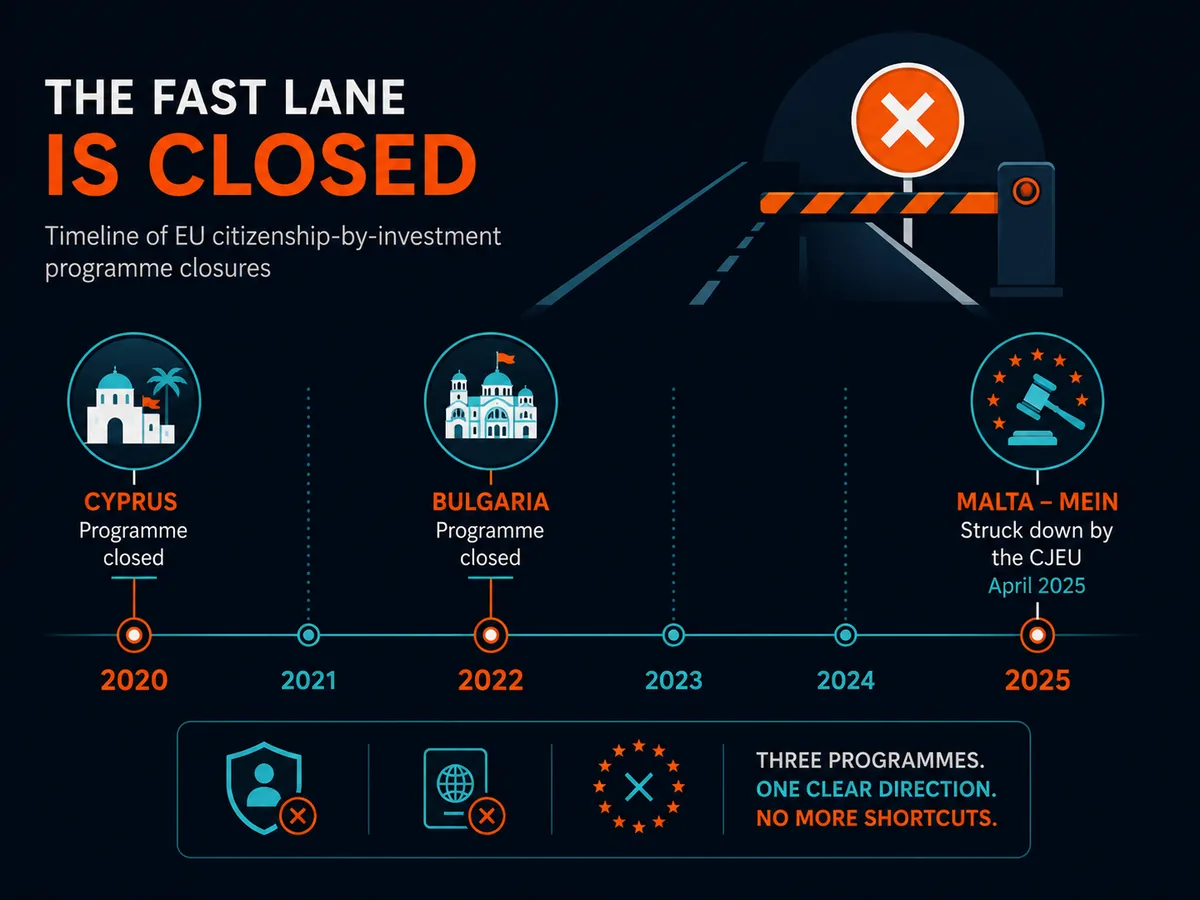
3. Remaining investment paths. Until 29 April 2025, Malta's MEIN issued passports for a EUR 690,000+ contribution after a notional 12-month residency. The CJEU struck it down. Cyprus closed its scheme in 2020; Bulgaria in 2022. The investment market for EU citizenship is effectively closed.
None of the remaining routes is a shortcut, and several of the "easy" ones carry conditions — language tests, civic integration exams, physical-presence audits — that are tightening, not loosening.
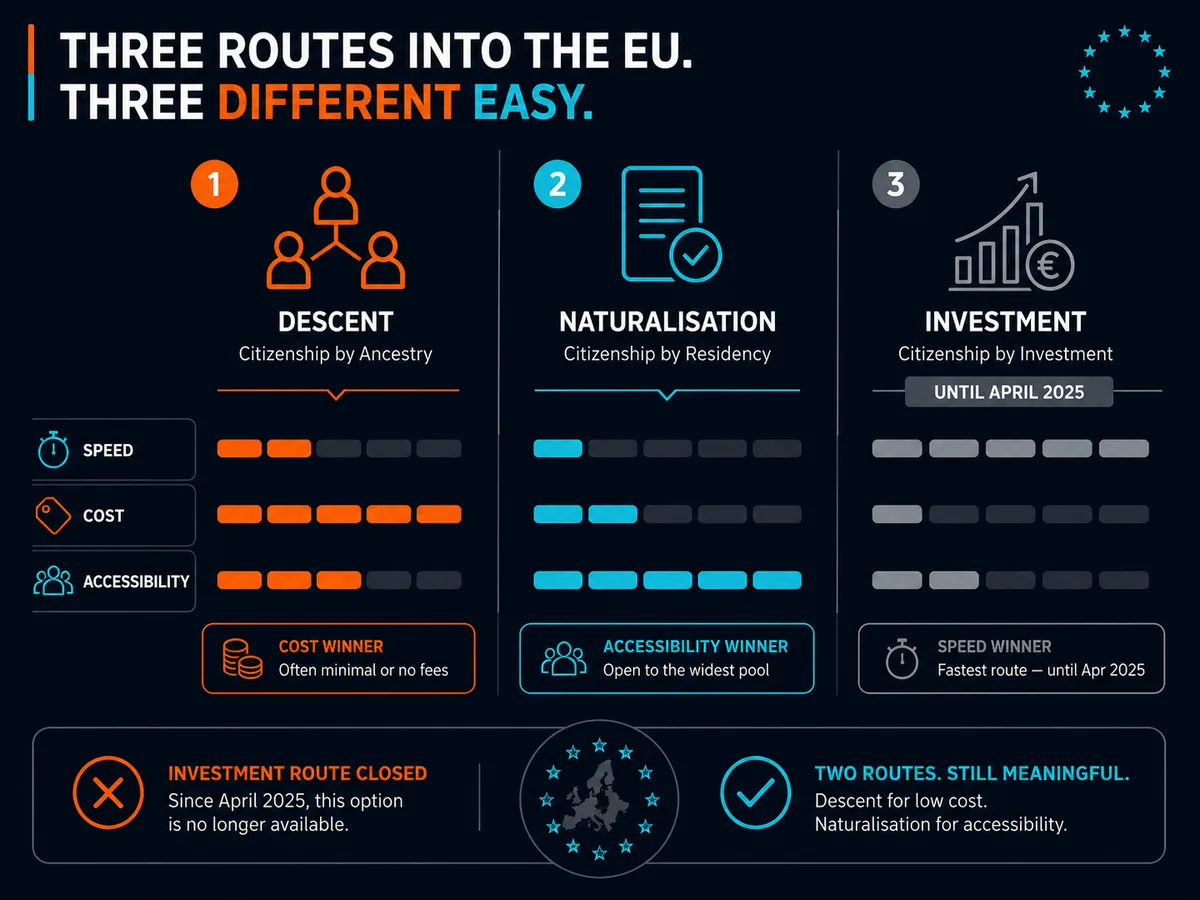
The 2025 reset — CJEU strikes down Malta golden passports
On 29 April 2025, the Grand Chamber of the CJEU ruled in Commission v Malta, Case C-181/23 that Malta's investor citizenship programme breached EU law. The Court's reasoning, in summary:
- EU citizenship under Article 20 TFEU carries rights against every Member State — free movement, residence and consular protection.
- The principle of sincere cooperation under Article 4(3) TEU requires that conferral of nationality — where it triggers EU citizenship — rests on a genuine link with the Member State.
- Granting citizenship for predetermined payments, without a real connection evidenced by residence, employment, family or cultural ties, is incompatible with that framework.
Malta suspended the Citizenship by Naturalisation for Exceptional Services by Direct Investment (MEIN) (Identità Malta). A narrow discretionary route for "exceptional services" remains, but it is no longer the off-the-shelf investor pathway it was 2014–2025.
Cyprus closed its investor programme in November 2020 after the Al Jazeera "Cyprus Papers" investigation; Bulgaria repealed its scheme in March 2022. Malta was the last EU state offering direct citizenship for investment. Anyone marketing "EU passport in 12 months" in 2026 is either selling a residency programme dressed in misleading language or operating outside the law.

Who this applies to — read this first
The same EU rule produces very different practical advice depending on the passport you already hold.
US persons
US persons — citizens and lawful permanent residents — are taxed by the US on worldwide income regardless of where they live or what additional passports they hold. Naturalising in an EU country does not change that: Form 1040, FBAR (FinCEN 114) on foreign accounts above USD 10,000 (FinCEN) and Form 8938 under FATCA continue.
The only way to end US citizenship-based taxation is renunciation, which triggers the IRC §877A exit tax for covered expatriates. Many US persons acquire an EU passport years before renunciation so the act does not leave them stateless. See Soveraine's guide to renouncing American citizenship for the procedure and exit-tax modelling.
EU residents
If you already hold one EU nationality, you already have the rights this article is about — free movement, residence and establishment in the other 26 Member States under Article 21 TFEU. A second EU nationality matters at the margins: family reunification, voting in domestic elections, certain public-sector posts. The common 2026 reason is to secure easier descent claims for children.
Non-US, non-EU readers
This is the audience for whom the question matters most. A non-EU national acquiring an EU citizenship gains the full bundle of rights — free movement, residence, work, banking, schooling. Most non-EU jurisdictions tax on residency rather than citizenship, so a second EU passport does not by itself create new tax obligations at home (Eritrea and a few others do tax citizens abroad).
The practical question is not which country is easiest in the abstract but which one aligns with where you can plausibly live and integrate for the qualifying period. Address-only residency does not survive modern physical-presence audits.
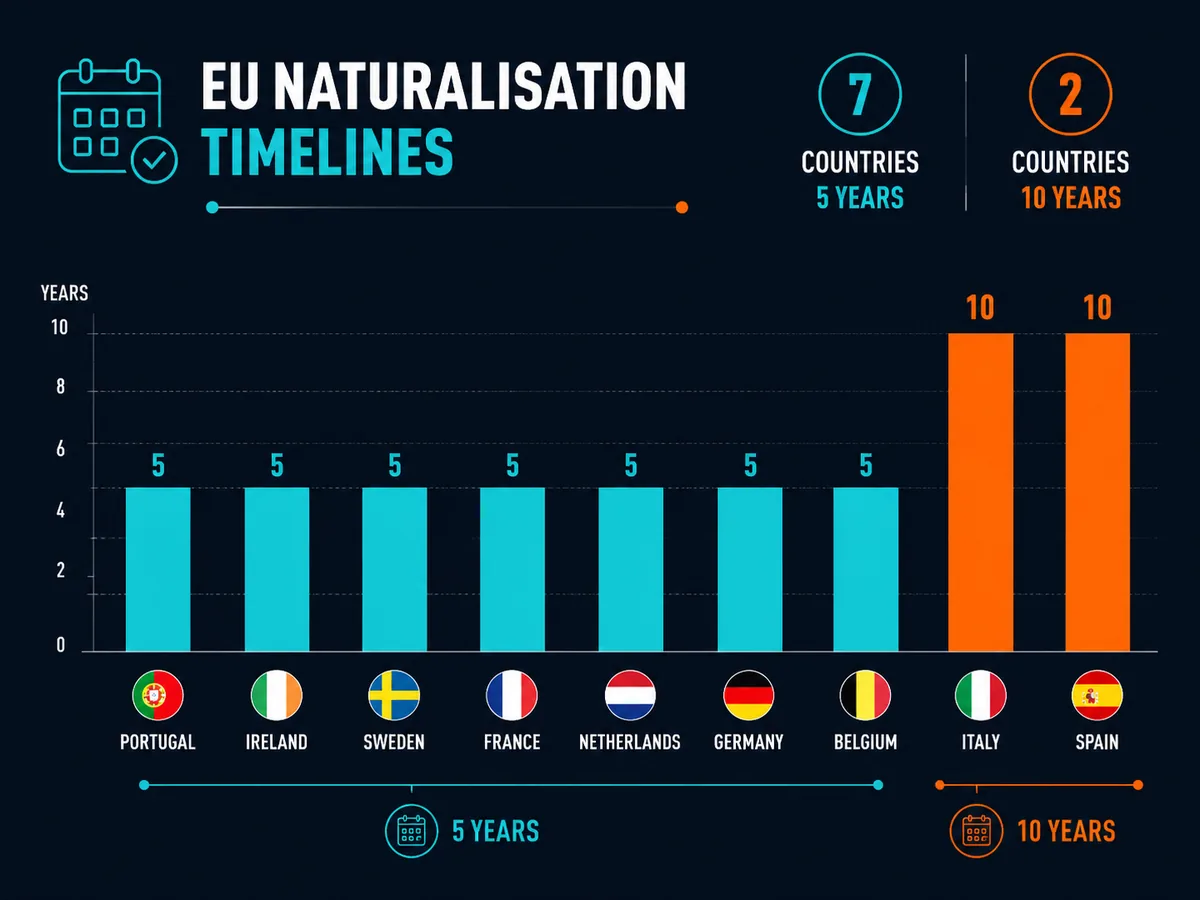
Ranked by naturalisation timeline (shortest first)
Figures below are statutory minimums for ordinary naturalisation. Spouses, refugees and descendants typically have shorter routes. Conditions — language, civic integration, clean record, income — are stated where they materially differ.
Portugal — 5 years
Lei n.º 37/81 requires five years of lawful residence, an A2 Portuguese certificate, no criminal conviction carrying a sentence of three years or more, and a "link to the national community" (IRN). The clock starts from the first residence permit, including time on a D7, D8 or Golden Visa. An AD government reform proposal would extend the qualifying period to ten years; as of mid-2026 it remains under parliamentary discussion.
Ireland — 5 of last 9 years + 1 continuous
The Irish Nationality and Citizenship Acts require five years of reckonable residence in the previous nine, with the final year continuous physical residence (Irish Immigration Service). No formal language test; applicants declare loyalty at a ceremony. Naturalisation is a discretionary act of the Minister for Justice — refusals carry no automatic right of appeal beyond judicial review.
Sweden — 5 years (with 2025 language test)
Five years of permanent residence under the Citizenship Act (2001:82), reduced for refugees and spouses. From 1 January 2025 applicants must pass a B1 Swedish language test (CEFR) and a civic knowledge test (Migrationsverket). The substantive bar rose materially even though the timeline did not.
France — 5 years
Under the Code civil, Articles 21-15 to 21-27, five years of habitual residence (the stage), B1 French, assimilation into the national community, a clean record and stable resources. The period drops to two years for applicants who completed two years of French higher education or rendered "important services" (Ministère de l'Intérieur).
Netherlands — 5 years (with civic integration)
Five years of uninterrupted lawful residence, the inburgeringsexamen (civic integration exam, including Dutch at A2), and generally renunciation of the prior nationality unless an exemption applies (IND). Spouses of Dutch nationals living abroad can naturalise after three years of marriage.
Cyprus — 7 years
Seven years under the Civil Registry Law (2002), the final year continuous, an A2 Greek test (from 2023) and a clean record (Ministry of Interior). The investor scheme that ran until 2020 is closed.
Italy — 10 years (4 for EU, 3 for descent)
Law 91/1992: ten years for non-EU nationals, four for EU citizens, three for descendants without unbroken jure sanguinis paperwork, two for spouses resident in Italy (Ministero dell'Interno). B1 Italian required since 2018. The long timeline drives so many applicants to descent instead.
Spain — 10 years (2 for Iberoamerican/Sephardic descent)
Código Civil Article 22: ten-year default, five for refugees, two for nationals of Iberoamerican states, Andorra, the Philippines, Equatorial Guinea, Portugal and Sephardic Jews, one for spouses (Ministerio de Justicia). Spain generally requires renunciation of the prior nationality, with exceptions for the same historical-ties categories.
Germany — 5 years (post June 2024 reform)
The Staatsangehörigkeitsgesetz reform of 22 March 2024 (in force 27 June 2024) cut residency from eight years to five (three for "outstanding integration") and allows dual citizenship without restriction. B1 German and the Einbürgerungstest civic exam apply (BMI).
Belgium — 5 years
Five years of legal residence plus proof of social and economic integration — employment, an A2 certificate in one of the three official languages, or completion of an integration programme (SPF Justice). The "declaration" route runs parallel and is the more common path.
Easiest by descent
For applicants with European ancestry, descent (jus sanguinis) is the cheapest and often the fastest route. No residency, no language test in most cases, only documentation.
Italian jure sanguinis — narrowed by 2025 reform
Jure sanguinis historically had no generational limit on the paternal line; the maternal line was restricted to descendants of women who gave birth after 1 January 1948 until Court of Cassation rulings clarified equal treatment. A March 2025 decree-law tightened the rules: applicants must now generally show the qualifying ancestor was born in Italy and that the line was not interrupted by an intervening naturalisation before the next descendant's birth. Consular processing is backlogged across the Americas; judicial recognition in Italian courts is often faster (Ministero degli Affari Esteri).
Irish citizenship by descent — grandparent rule
The Foreign Births Register grants citizenship to anyone with a grandparent born on the island of Ireland — no residency, no language test. Registration costs EUR 278 (Department of Foreign Affairs). Great-grandparent claims are possible only if the parent registered as Irish before the applicant's birth — a frequently missed planning step. Processing runs 12–24 months.
Polish citizenship by descent — confirmation
Polish nationality law recognises continuous transmission from any citizen who held nationality after 31 January 1920 and did not lose it under specific historical statutes. Applicants do not "acquire" citizenship; the voivode confirms it (MSWiA). No residency, no language test. Original Polish birth, marriage and military records are routinely required.
Hungarian simplified naturalisation
Since 2011, Hungary grants citizenship to applicants who demonstrate Hungarian ancestry and pass a Hungarian language interview (Kormány). No residency required; the language requirement is the operative filter.
Spanish Sephardic Jewish descent — closed 2019
Law 12/2015 granted naturalisation to descendants of Sephardic Jews expelled in 1492 without residency, subject to Spanish language and civic tests. The window closed on 1 October 2019. Spanish courts have largely upheld the cut-off; for new applicants in 2026 the route is effectively closed.
German Article 116 restoration
Article 116(2) of the Basic Law restores citizenship to former German citizens deprived of their nationality between 30 January 1933 and 8 May 1945 on political, racial or religious grounds, and to their descendants in any generation. No residency, no language, no fee for consular processing (Bundesverwaltungsamt).
Remaining investment paths (post-April 2025)
After the CJEU judgment in C-181/23, the EU citizenship-by-investment market is closed. The remaining "golden" routes are residency-by-investment, not citizenship. They can lead to naturalisation after the standard qualifying period, but only on the strength of genuine residence — language tests, civic exams and physical-presence audits apply on the back end.
| Programme | Type | Lead time to passport | Status 2026 |
|---|---|---|---|
| Malta MEIN | Was: investor citizenship | 12–36 months | Suspended after CJEU C-181/23 (Apr 2025) |
| Cyprus investor citizenship | Was: investor citizenship | 6 months | Closed Nov 2020 |
| Bulgaria fast-track | Was: investor naturalisation in 2 years | 2 years | Closed Mar 2022 |
| Greece Golden Visa | Residency only | 7+ years of residence to apply for citizenship | Active; thresholds raised 2024 |
| Portugal Golden Visa | Residency only | 5 years of residence to apply for citizenship (under current rules) | Active; real-estate route closed Oct 2023 |
| Italy investor visa | Residency only | 10 years of residence to apply for citizenship | Active |
| Spain investor visa | Residency only | 10 years of residence to apply for citizenship | Closed to new applicants Apr 2025 |
| Hungary Guest Investor Programme | Residency only | 8 years of residence to apply for citizenship | Reintroduced 2024 |
The bottom line: there is no longer a meaningful "buy an EU citizenship" route. The closest legitimate path is residency-by-investment in Portugal, Greece or Hungary, followed by years of actual residence, language acquisition and civic integration before naturalisation.
Comparison table
| Country | Years to citizenship | Dual citizenship | Investment route | Descent route | Language test | Government fees |
|---|---|---|---|---|---|---|
| Portugal | 5 (10 if reform passes) | Yes | Golden Visa (residency) | Sephardic closed | A2 Portuguese | EUR 250–1,000 |
| Ireland | 5 of 9 + 1 continuous | Yes | None | Grandparent (EUR 278) | None | EUR 175 + 950 cert |
| Sweden | 5 | Yes | None | None | B1 Swedish (2025) | SEK 1,500 |
| France | 5 (2 with study) | Yes | None | None | B1 French | EUR 55 + dossier |
| Netherlands | 5 | Conditional | None | None | A2 Dutch + integration | EUR 1,091 (2025) |
| Germany | 5 (3 outstanding) | Yes (post 2024) | None | Article 116 restoration | B1 German + civics | EUR 255 |
| Belgium | 5 | Yes | None | None | A2 (one official lang.) | EUR 150 |
| Cyprus | 7 | Yes | Closed 2020 | None | A2 Greek (2023) | EUR 500+ |
| Italy | 10 (3 descended) | Yes | Investor visa (10y route) | Jure sanguinis (narrowed) | B1 Italian | EUR 250 + court |
| Spain | 10 (2 Iberoamerican) | Restricted | Closed Apr 2025 | Sephardic closed Oct 2019 | A2 Spanish + DELE | EUR 100 + legal |
| Hungary | 8 | Yes | Guest Investor (2024) | Simplified naturalisation | Hungarian | HUF 30,000+ |
| Malta | 5 (standard) | Yes | MEIN suspended Apr 2025 | None | Maltese or English | EUR 450+ |
Sources: each country's interior ministry, linked above. Legal advisory costs typically run EUR 2,000–8,000 for an ordinary naturalisation file and EUR 5,000–25,000 for descent claims requiring document recovery or court proceedings.
The traps
Physical-presence audits. Portugal, Greece, Italy and Spain have stepped up audits of the residence requirement. Border records, utility bills, school enrolment and tax returns are routinely compared. An applicant who acquired residence through an investment programme but spent most of the qualifying period elsewhere will be refused. The Council of Europe's European Convention on Nationality, Article 6 requires a genuine link.
Language tests are tightening. Sweden introduced the B1 test in January 2025. Germany retained B1 in its 2024 reform. Portugal's A2 test, administered by CAPLE, is non-trivial for adult applicants without prior exposure.
Tax residency and citizenship are different. EU citizenship does not by itself make you tax-resident there, nor does it end tax residence in your prior country. Residency is determined by physical presence, centre of vital interests and similar tests under domestic law and OECD-model treaties (OECD MTC). Plan in parallel.
Dual citizenship loss. Spain (for non-Iberoamerican applicants), the Netherlands (with limited exceptions), India and Japan require renunciation of either the prior or acquired nationality. The Netherlands also imposes automatic loss after ten years abroad holding another nationality, with exceptions. Check both sides.
US exit tax on renunciation. A US person who naturalises in an EU country and then renounces may trigger the IRC §877A exit tax if they are a covered expatriate — net worth at or above USD 2 million, or average annual net income tax liability above an indexed threshold (USD 201,000 for 2024). The tax is calculated as if all assets were sold the day before renunciation.
The "12-month EU passport" market is closed. Any advisor offering EU citizenship in twelve months in 2026 is selling something that does not legally exist. Residency programmes leading to naturalisation after five-to-ten years are real; Caribbean CBI is real — but those passports are not EU passports.

When to consult a professional
EU citizenship law is national law operating inside an EU framework. Consult before:
- Filing a descent claim, especially Italian jure sanguinis after the March 2025 reform.
- Acquiring residency in a Member State you do not plan to live in for the full qualifying period.
- Naturalising while holding a citizenship (Spain, Netherlands, India, Japan) that may be lost.
- Renouncing US citizenship after naturalising in an EU country — model the §877A exit tax first.
- Relying on any "fast-track EU passport" offer; these do not exist post C-181/23.
The right team is two lawyers: a nationality lawyer in the target Member State and a tax adviser in your current country of residence. US persons should add a cross-border CPA familiar with FEIE, FATCA and exit-tax mechanics. See Soveraine's editorial policy and affiliate disclosure.
Ready to act on this?
Henley & Partners — Largest RBI/CBI advisory firm in the world. Soveraine readers go to the front of the line through our partner link, and you fund independent editorial in the process.
FAQ
What is the easiest European country to get citizenship in 2026?
There is no single answer — it depends on whether you are asking about naturalisation, descent or investment. On naturalisation timelines, Portugal, Ireland, Sweden, France, Germany, Belgium and the Netherlands all sit at the five-year floor, though each adds a language test, an integration exam and a clean-record requirement. On descent, Ireland's grandparent rule and Italian jure sanguinis are the most accessible. On investment, the picture changed in April 2025: the Court of Justice of the EU struck down Malta's citizenship-by-investment scheme in Commission v Malta (C-181/23), and there is no longer a meaningful "buy an EU passport" route inside the bloc.
Did the EU really ban golden passports?
The Court of Justice of the European Union, in judgment of 29 April 2025 in Case C-181/23, ruled that Malta's Citizenship by Naturalisation for Exceptional Services by Direct Investment (MEIN) breached the principle of sincere cooperation under Article 4(3) TEU and the rules on EU citizenship under Article 20 TFEU. The Court found that granting citizenship in exchange for predetermined payments, without a genuine link to the Member State, was incompatible with EU law. Malta announced suspension of the programme. No other EU Member State currently operates a direct citizenship-by-investment scheme; Cyprus closed its programme in 2020 and Bulgaria in 2022.
What is the fastest path to an EU passport without ancestry?
The shortest statutory naturalisation periods in the EU are five years, available in Portugal, Ireland, France, Sweden, Germany (after the June 2024 reform), Belgium and the Netherlands. Of these, Portugal has historically been the most accessible because of the modest A2 language threshold and a clean-record requirement that does not include an integration exam — though a reform proposal tabled by the AD government in 2024 would lengthen the qualifying period to ten years if enacted. Ireland's "five out of nine years" rule requires the final year to be continuous physical residence.
Can I claim EU citizenship through a grandparent?
Yes, in several Member States, but the depth of generational reach varies. Ireland grants citizenship to anyone with a grandparent born on the island of Ireland, with no residency requirement, by registration on the Foreign Births Register. Italy historically had no generational limit on the paternal line under jure sanguinis, though a March 2025 decree-law and subsequent Constitutional Court rulings have narrowed the scope. Hungary, Poland, Lithuania and Germany operate descent or restoration routes with their own criteria. Spain offers a two-year naturalisation route for descendants of Iberoamerican nationals and for Sephardic Jewish descendants.
Does naturalising in an EU country make me a non-US taxpayer?
No. The United States taxes its citizens and lawful permanent residents on worldwide income regardless of where they live or what other passports they hold. Acquiring an EU citizenship does not change US filing obligations. Only formal renunciation of US citizenship ends them, and renunciation triggers an exit tax under IRC §877A if you are a covered expatriate (net worth at or above USD 2 million or average annual US tax liability above an indexed threshold). FATCA and FBAR reporting continue regardless of where you live.
Which EU countries allow dual citizenship?
Most do, but several apply conditions. Ireland, France, Italy, Portugal, Belgium, Sweden, Finland, Cyprus, Greece, Hungary, Poland, Luxembourg, Malta and Germany (since the June 2024 reform) all permit dual citizenship outright. Spain restricts dual citizenship to nationals of Iberoamerican states, Andorra, the Philippines, Equatorial Guinea, Portugal and a few others; for everyone else, naturalisation requires renouncing the prior nationality, though enforcement is uneven. The Netherlands generally requires renunciation with exceptions for spouses of Dutch citizens and naturalisation that would result in statelessness.
Is there any remaining investment route to an EU passport?
Not a direct one. After the CJEU judgment of 29 April 2025 in C-181/23, Malta's investment route is closed. The remaining residency-by-investment programmes — notably Greece's Golden Visa, Spain's investor residency (closed to new applicants in April 2025), Portugal's Golden Visa (restructured in October 2023 to remove real estate routes) and Italy's investor visa — grant residency only. They can lead to citizenship by naturalisation after the country's standard qualifying period of seven to ten years of genuine residence, but there is no fast-track citizenship-for-investment route in any EU Member State.
How does Council of Europe's Convention on Nationality affect EU citizenship?
The 1997 European Convention on Nationality, ETS No. 166, sets minimum standards for nationality law across signatory states. It limits the maximum residency requirement for naturalisation to ten years, prohibits discriminatory nationality rules, requires due process in decisions affecting nationality, and protects against arbitrary loss of nationality. Twenty-one Council of Europe states have ratified it. The Convention does not harmonise EU citizenship — that remains a competence of each Member State under Article 9 TEU — but it constrains the outer limits of what they can require.
Sources
- Court of Justice of the EU — Commission v Malta, Case C-181/23 (29 April 2025). https://curia.europa.eu/jcms/jcms/p1_4525893/en/
- Council of Europe — European Convention on Nationality, ETS No. 166 (1997). https://www.coe.int/en/web/conventions/full-list?module=treaty-detail&treatynum=166
- Treaty on European Union, Article 4(3) and Article 9. https://eur-lex.europa.eu/legal-content/EN/TXT/?uri=CELEX%3A12012M%2FTXT
- Treaty on the Functioning of the EU, Articles 20 and 21. https://eur-lex.europa.eu/legal-content/EN/TXT/?uri=CELEX%3A12012E%2FTXT
- Portugal — Instituto dos Registos e Notariado, Nacionalidade portuguesa. https://justica.gov.pt/Servicos/Nacionalidade-portuguesa
- Ireland — Department of Justice, Irish Immigration Service citizenship. https://www.irishimmigration.ie/citizenship/
- Ireland — Department of Foreign Affairs, Foreign Births Register. https://www.dfa.ie/citizenship/born-abroad/
- Sweden — Migrationsverket, becoming a Swedish citizen. https://www.migrationsverket.se/English/Private-individuals/Becoming-a-Swedish-citizen.html
- France — Code civil, Articles 21-15 to 21-27. https://www.legifrance.gouv.fr/codes/section_lc/LEGITEXT000006070721/LEGISCTA000006149816/
- France — Ministère de l'Intérieur, naturalisation par décret. https://www.demarches.interieur.gouv.fr/particuliers/naturalisation-decret
- Netherlands — IND, Dutch citizenship. https://ind.nl/en/dutch-citizenship
- Germany — Staatsangehörigkeitsgesetz (StAG). https://www.gesetze-im-internet.de/stag/
- Germany — BMI, citizenship reform 2024. https://www.bmi.bund.de/EN/topics/migration/citizenship/citizenship-node.html
- Germany — Basic Law, Article 116. https://www.gesetze-im-internet.de/englisch_gg/englisch_gg.html#p0681
- Cyprus — Ministry of Interior, Civil Registry and Migration Department. https://www.moi.gov.cy/moi/crmd/crmd.nsf/index_en/index_en?OpenDocument
- Italy — Ministero dell'Interno, cittadinanza. https://www.interno.gov.it/it/temi/cittadinanza-e-altri-diritti-civili/cittadinanza
- Italy — Ministero degli Affari Esteri, cittadinanza. https://www.esteri.it/it/servizi-consolari-e-visti/italiani-all-estero/cittadinanza/
- Spain — Ministerio de Justicia, nacionalidad. https://www.mjusticia.gob.es/es/ciudadania/nacionalidad
- Spain — Ley 12/2015 (Sephardic Jewish descent). https://www.boe.es/eli/es/l/2015/06/24/12
- Belgium — SPF Justice, nationalité. https://justice.belgium.be/fr/themes/nationalite
- Malta — Identità Malta. https://identita.gov.mt/
- Poland — Ministerstwo Spraw Wewnętrznych, obywatelstwo polskie. https://www.gov.pl/web/mswia/obywatelstwo-polskie
- IRC §877A — Tax responsibilities of expatriation. https://www.law.cornell.edu/uscode/text/26/877A
- FinCEN — Report of Foreign Bank and Financial Accounts (FBAR). https://www.fincen.gov/report-foreign-bank-and-financial-accounts
- OECD Model Tax Convention on Income and on Capital. https://www.oecd.org/tax/treaties/model-tax-convention-on-income-and-on-capital-condensed-version-20745419.htm