
Cyprus spent 2025 rewriting its tax code, and most of the coverage led with the corporate rate going up. For anyone reading this site, that is the least interesting part. The reform that took effect on 1 January 2026 left the non-dom regime — the reason foreign founders move to Limassol in the first place — almost entirely intact, and added something genuinely new at the far end of it: a way to buy your way past the 17-year expiry for €250,000 per five years.
This guide covers what Cyprus non-dom status actually exempts, the two routes to Cyprus tax residency including the 60-day rule, what the 2026 reform changed and did not change, and the contribution nobody puts in the headline that stops the rate being a true zero.
Wise — Multi-currency account for euro rent, foreign dividends and cross-border invoicing
What "non-dom" means in Cyprus specifically
Domicile and residence are different things, and Cyprus is one of the few EU states that still builds a tax regime on the gap between them. The broader concept, and how it survives in Ireland, Malta and Greece, is covered in our guide to what non-dom actually means. Cyprus is the version most relevant to a working founder, so it is worth taking on its own terms.
Cyprus levies two separate taxes on personal income. Personal income tax applies to employment income, business profits and rents. The Special Defence Contribution, usually shortened to SDC, applies to passive income — dividends, interest and, until this year, rents.
Dividend and interest income received by individuals is already exempt from Cyprus personal income tax. So the SDC is the only tax standing between a Cyprus tax resident and untaxed investment income. Non-dom status removes it.
That is the whole mechanism. It is narrower than the marketing suggests and more durable than most regimes of its kind, because it is not a negotiated deal or a capped-numbers scheme — it is a classification you either fall into or you do not.
Who falls into it. An individual is treated as domiciled in Cyprus if they hold a Cyprus domicile of origin, or if they have been a Cyprus tax resident for at least 17 of the last 20 years. Everyone else who becomes Cyprus tax resident is non-dom by default. There is no application queue and no minimum investment.
What is actually exempt, and what is not
| Income type | Cyprus tax resident, non-dom | Cyprus tax resident, domiciled (2026) |
|---|---|---|
| Dividends (Cyprus or foreign) | No income tax, no SDC | No income tax; SDC 5% on profits earned from 1 Jan 2026 |
| Interest | No income tax, no SDC | No income tax; SDC applies |
| Rental income | Income tax at normal rates; no SDC | Income tax at normal rates; no SDC from 1 Jan 2026 |
| Employment income | Income tax at normal rates | Income tax at normal rates |
| Trading profits | Income tax at normal rates | Income tax at normal rates |
| Gains on securities | Exempt | Exempt |
| Foreign immovable property gains | Exempt | Exempt |
Two things fall out of that table that are worth saying plainly.
Non-dom does nothing for earned income. If you invoice clients personally or take a salary, you pay Cyprus income tax on it at rates running to 35%. The regime rewards a specific shape: profits taxed once inside a company, then extracted as dividends. Founders who arrive still billing as a sole trader are not using the thing they moved for.
Rental SDC is gone for everybody. The 2026 reform abolished SDC on rents entirely, which quietly removes one of the few places domiciled and non-domiciled residents used to diverge on property income.
The 2.65% that stops it being zero
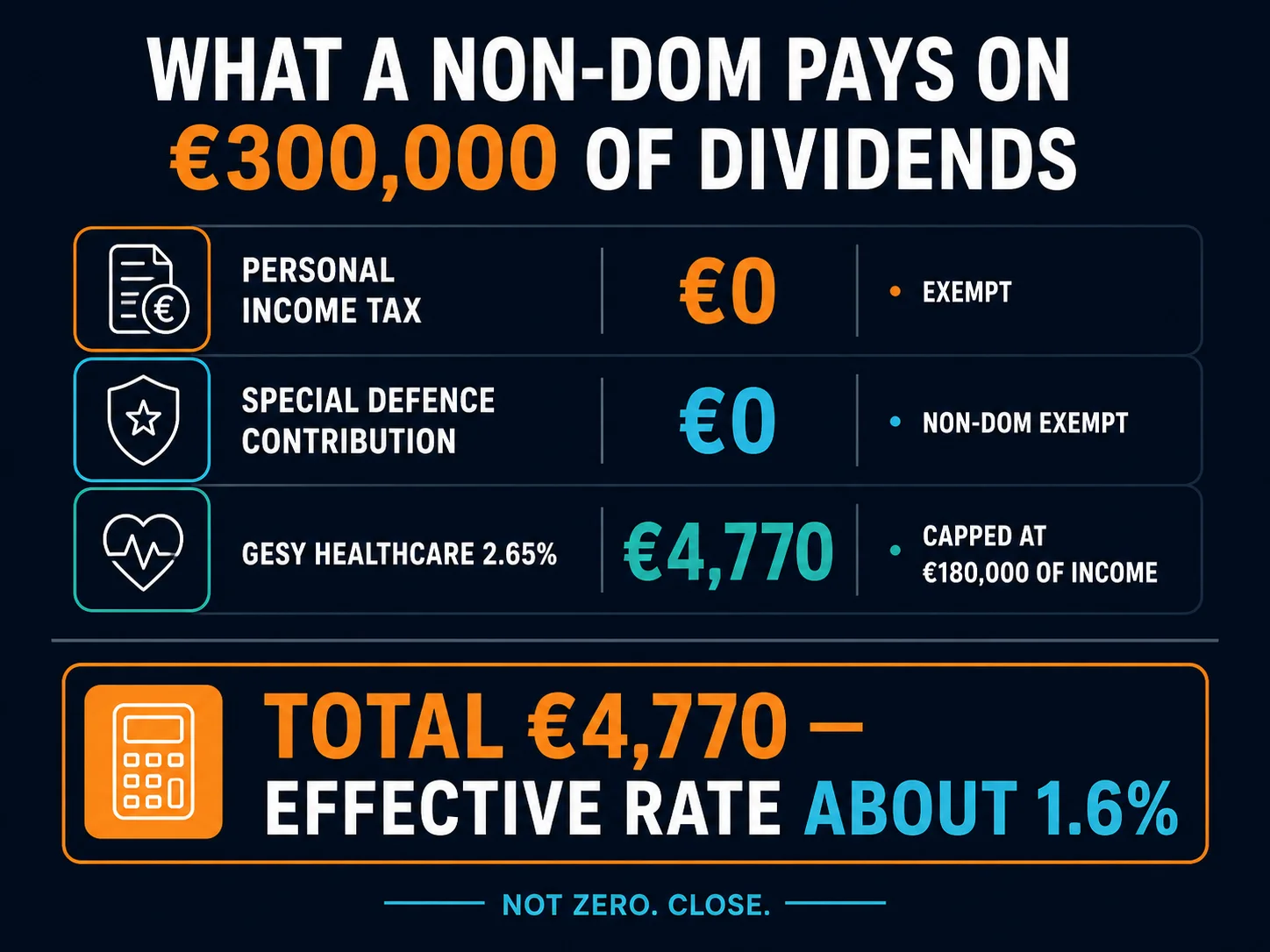
Here is the line that gets left out. Cyprus tax residents contribute to the General Healthcare System, known locally as GESY, and the contribution is charged on dividend and interest income as well as on salary. The rate on that passive income is 2.65%, and contributions are calculated on income up to an annual ceiling of €180,000.
So the true position for a non-dom drawing dividends is not 0%. It is 2.65%, capped in absolute terms at roughly €4,770 a year once income passes the ceiling.
For a founder taking €300,000 in dividends, that is a total Cyprus charge on those dividends of about €4,770 — an effective rate near 1.6%, falling as income rises. That is still an excellent number. It is simply not the number on the brochure, and knowing the ceiling exists changes how the arithmetic scales.
Getting Cyprus tax residency: 183 days, or 60
Non-dom status is worthless until you are actually Cyprus tax resident, and there are two ways in.
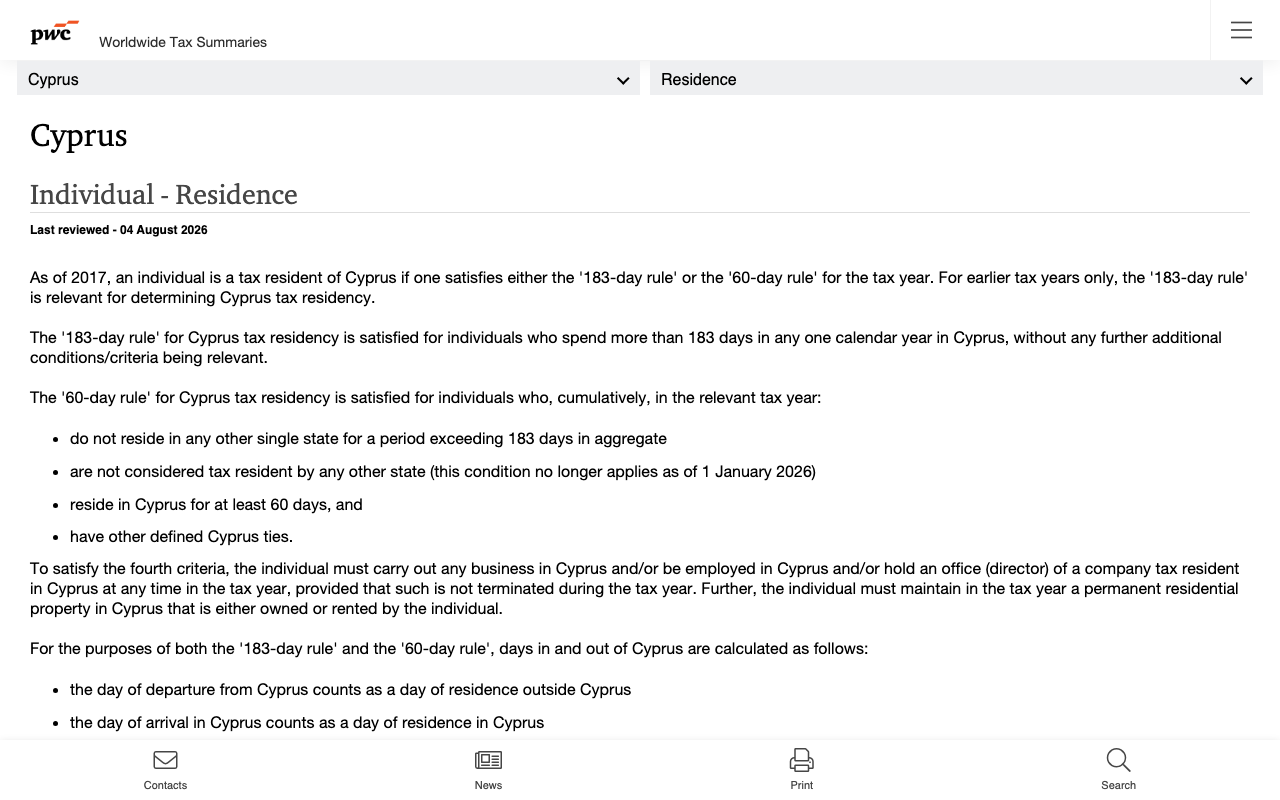
The 183-day rule. Physical presence in Cyprus exceeding 183 days in a calendar year makes you Cyprus tax resident, with no further conditions. Simple, and demanding.
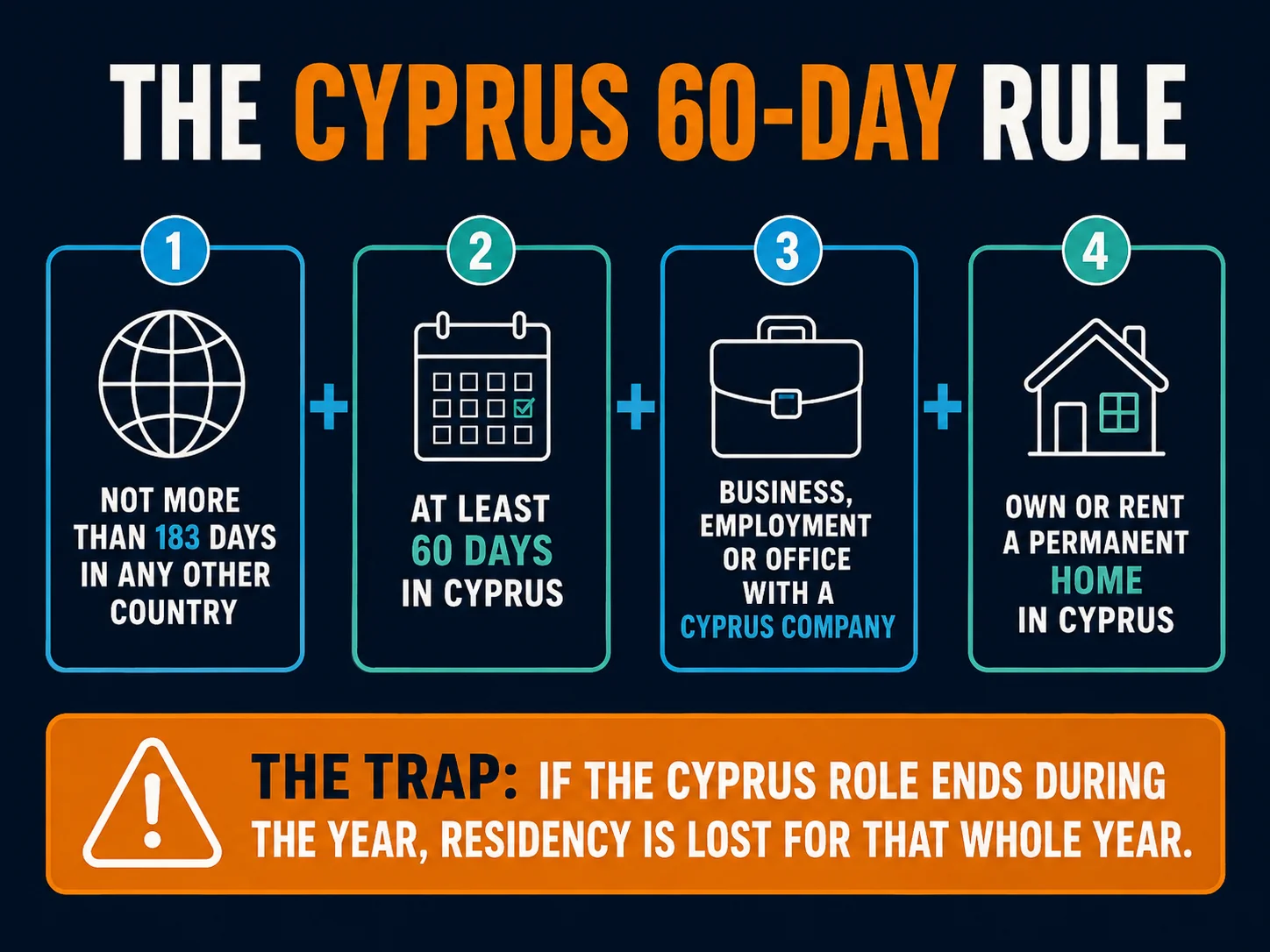
The 60-day rule. Cyprus is unusual in the EU for offering a genuine low-presence route. You qualify if you do not stay in any other single country for more than 183 days in aggregate in the tax year, and all of the following are met together:
- You spend at least 60 days in Cyprus in the tax year.
- You carry on a business, hold employment, or hold an office with a Cyprus tax resident company at any time during the year.
- You own or lease a permanent home in Cyprus.
Days are counted with a specific convention: the day of arrival counts as a day in Cyprus, the day of departure counts as a day outside, and arriving and departing on the same day counts as a day in.
The rule has a sting most summaries omit. If the Cyprus business, employment or office is terminated during the year, the 60-day residency does not apply for that year at all — even if you met every other condition. Resigning a directorship in November can retrospectively cost you the residency for the whole year.
This is also where the 60-day route stops being a paperwork exercise. It requires a real home you own or rent for the year and a real role in a Cyprus company. It is lighter than 183 days. It is not a mailbox.
What the 2026 reform changed
The reform was passed by the Cyprus parliament on 22 December 2025, published in the Official Gazette on 31 December 2025, and took effect on 1 January 2026. The changes that matter to an individual or small company:
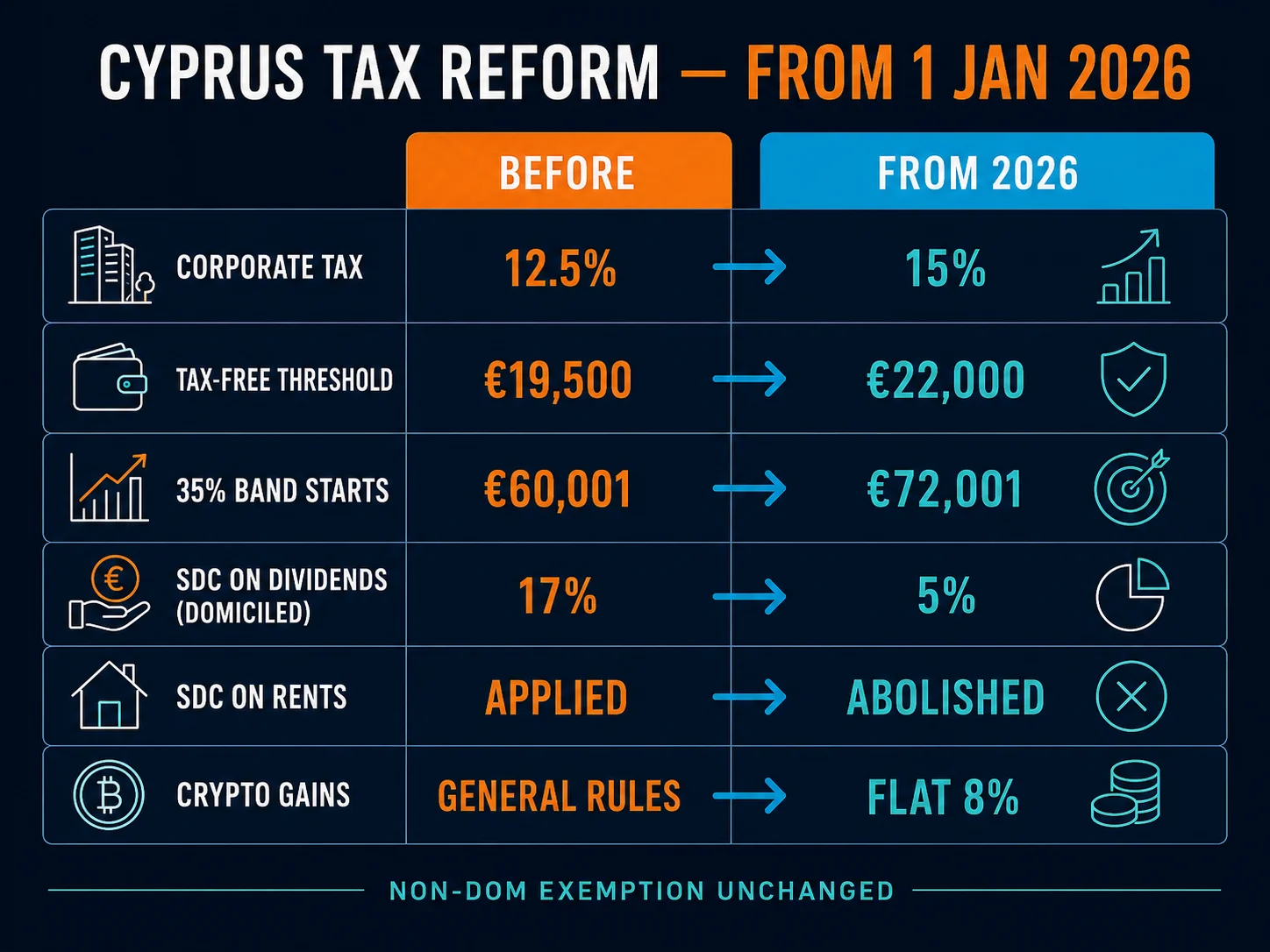
| Change | Before | From 1 Jan 2026 |
|---|---|---|
| Corporate income tax | 12.5% | 15% |
| Personal tax-free threshold | €19,500 | €22,000 |
| Top 35% band starts at | €60,001 | €72,001 |
| SDC on dividends (domiciled residents) | 17% | 5% on profits earned from 2026 |
| SDC on rental income | Applied | Abolished |
| Deemed dividend distribution | Applied | Abolished for profits from 2026 |
| Stamp duty | Applied | Abolished for most transactions |
| Crypto-asset gains | General rules | Flat 8% |
| Tax loss carry-forward | 5 years | 7 years |
The 2026 personal income tax bands now run: nothing to €22,000, 20% to €32,000, 25% to €42,000, 30% to €72,000, and 35% above that.
The direction is worth noting. Cyprus made itself more attractive to individuals — a higher tax-free threshold, a wider 30% band, dividends taxed at 5% rather than 17% even for the domiciled, no more SDC on rents, no more deemed distribution, no more stamp duty — and less attractive to companies, by putting the corporate rate up 2.5 points. If you were choosing Cyprus purely on the 12.5% corporate rate, that specific argument is now weaker. The individual side is stronger than it was.
The corporate increase is presented as alignment with the OECD Pillar Two global minimum. Note that Pillar Two itself only applies to groups with consolidated turnover of at least €750 million. A small Cyprus company is nowhere near that and simply pays 15% because the headline rate moved.
The new €250,000 extension past 17 years
This is the one direct change to the non-dom regime, and it is genuinely new.
Under the pre-existing rule, 17 years of Cyprus tax residency out of the last 20 makes you deemed domiciled, and the exemption ends. There was no appeal and no extension. The 2026 amendments to the SDC Law introduce an alternative mode of taxation for individuals who have become deemed domiciled and want to keep the benefit.
The mechanics: an election covering a five-year period, available for a maximum of two consecutive periods, at a lump sum of €250,000 per period. It extinguishes SDC liability on both Cyprus and foreign dividend and interest income, and — the important part — it does so irrespective of the level of that income. Applications go to the Tax Commissioner, with an application deadline of 30 June in the first year of the relevant period.
So the maximum window becomes 27 years, at a total cost of €500,000 for the last ten.
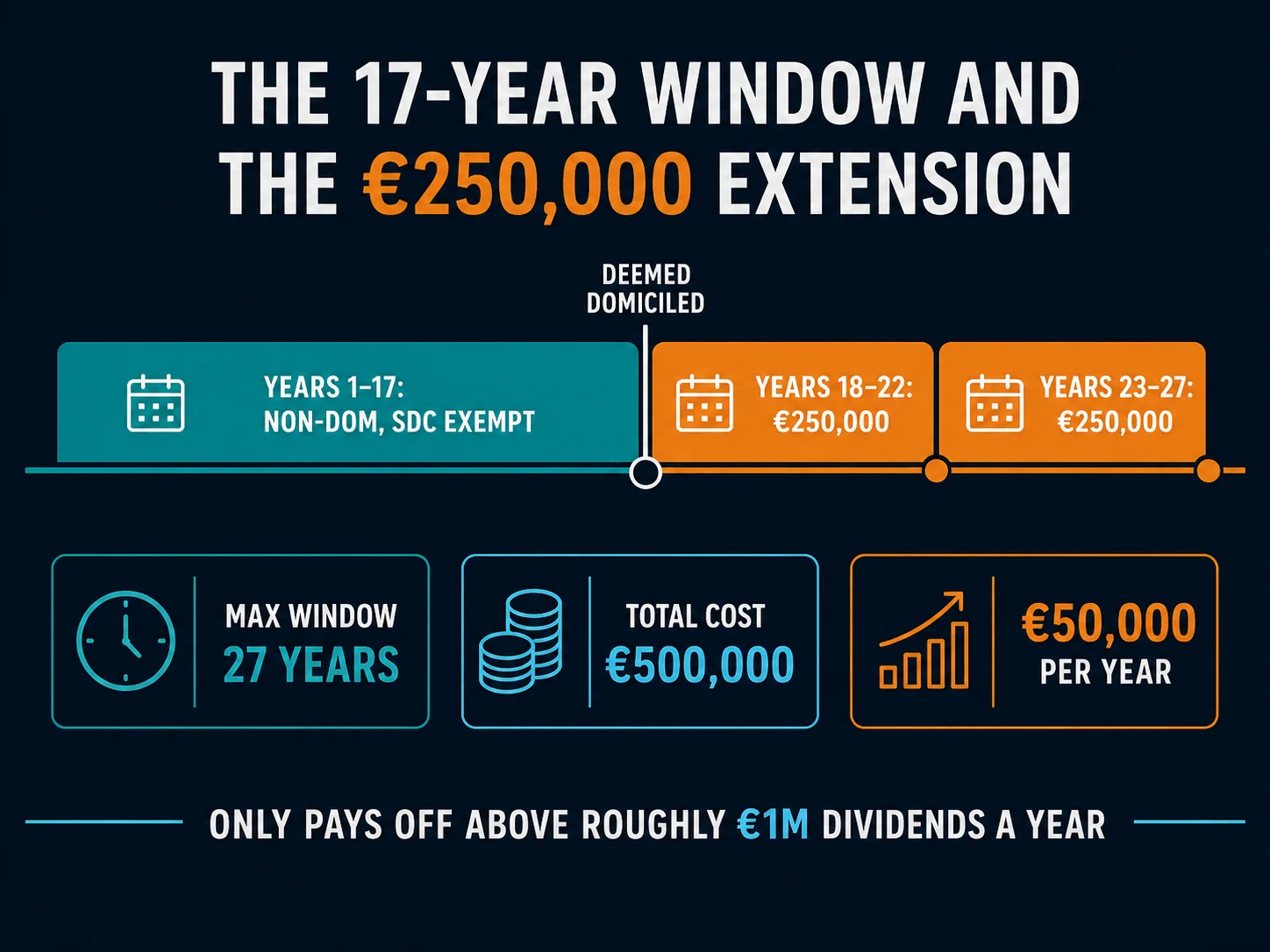
Who should care. Almost nobody reading this. €250,000 over five years is €50,000 a year, so the election only pays for itself if it displaces more than that in SDC annually. Work backwards through the reduced 5% dividend rate and you need dividend income above roughly €1 million a year before the election beats simply paying the tax. Below that, the honest answer at year 17 is either to pay the 5% or to move.
It is a high-net-worth instrument, and it is being marketed rather more broadly than its arithmetic justifies. Worth knowing it exists; worth knowing it is not for you at $50k–$300k.
The first-employment exemptions, if you take a salary
Because non-dom does nothing for employment income, Cyprus runs separate reliefs for people arriving to work. Three sit alongside each other and you take one, not several:
- The 50% exemption. For individuals with annual employment income above €55,000 taking up first employment in Cyprus, who have not been Cyprus tax resident for at least 15 consecutive years beforehand. It runs for 17 years.
- The 25% exemption. For individuals commencing professional activity in Cyprus after 1 January 2025 with income above €30,000, capped at €25,000 of exemption a year, for 7 years, subject to conditions on prior non-residency and prior foreign employment.
- The 20% exemption. For those who qualify for neither of the above: 20% of employment income or €8,550, whichever is lower, for 7 years.
The 50% relief is the one that changes the shape of a package. On a €120,000 salary it removes €60,000 from the tax base entirely — and it stacks with non-dom status on the dividend side, which is why the combination is attractive for a founder who wants both a salary and distributions.
Do not forget the contributions underneath. Social insurance runs at 8.8% employee and 8.8% employer on earnings capped at €68,904 a year for 2026, with the employer paying further amounts to the redundancy, training and social cohesion funds, and GESY on top at 2.65% employee and 2.9% employer.
Where this falls apart
Cyprus non-dom fails in the same places every residency-based plan fails, and one specific to it.
Your old country may not release you. Getting a Cyprus tax residency certificate does not by itself end another state's claim. Where a treaty exists, the tiebreaker in Article 4 runs through permanent home, centre of vital interests, habitual abode and nationality in order — and a 60-day resident with a family, a house and clients still in Germany or the Netherlands will lose that analysis. We covered the mechanics in tax resident nowhere, and they apply just as much to a person who is very much tax resident somewhere.
Controlled foreign company rules travel. If the trading company generating your dividends is somewhere else and you are running it from Cyprus, place-of-effective-management and CFC rules in the company's jurisdiction are live questions. The dividend exemption is at the individual level and does not reach back up the chain.
US persons get a much smaller benefit than they expect. Citizenship-based taxation does not care where you live, and a Cyprus dividend taxed at nothing generates no foreign tax credit. The comparison sites listing Cyprus among zero-tax residencies rarely make that distinction, and it is the whole distinction for an American.
17 years arrives. It is a long time, but it is a cliff rather than a taper, and the €250,000 exit ramp only makes sense at income levels most readers will not reach.
So is it worth it in 2026
For an EU-passport freelancer or founder who genuinely wants to live in an EU member state, take profits as dividends and pay something close to nothing on them, Cyprus is still one of the best structures available — and the 2026 reform, on the individual side, improved it. An effective rate near 1.6% on dividends inside the EU, with a functioning banking system, English-language professional services and a 60-day presence floor, has no real peer among the alternatives. The comparison against a UAE setup is genuinely close, and it turns mostly on whether you want to be in Europe.
What is different after this reform is the emphasis. The corporate rate is no longer the headline argument, and anyone still selling Cyprus on 12.5% is quoting a rate that expired. The argument now is the individual side: the dividend treatment, the 60-day route, and 17 years of runway before you have to think about it again.
Get the classification right at the start, keep the presence evidence, and keep the money movement clean — a multi-currency account covering euro rent and foreign-currency dividends removes a lot of the friction. Then take advice in both countries before you move anything, because the part that goes wrong is almost never the Cyprus part.
Moving money in and out of Cyprus
A Cyprus non-dom position usually means euro costs on the island and income arriving in other currencies. Wise holds and converts both at the mid-market rate, which is the least interesting problem to solve badly.
Sources
- KPMG Cyprus — Cyprus Tax Residency and Non-Dom Rules, April 2026: https://assets.kpmg.com/content/dam/kpmgsites/cy/pdf/2026/cyprus-tax-residency-and-non-dom-rules-04-26.pdf.coredownload.inline.pdf
- PwC Worldwide Tax Summaries — Cyprus, Individual residence: https://taxsummaries.pwc.com/cyprus/individual/residence
- PwC Worldwide Tax Summaries — Cyprus, Taxes on personal income: https://taxsummaries.pwc.com/cyprus/individual/taxes-on-personal-income
- PwC Worldwide Tax Summaries — Cyprus, Income determination: https://taxsummaries.pwc.com/cyprus/individual/income-determination
- PwC Worldwide Tax Summaries — Cyprus, Taxes on corporate income: https://taxsummaries.pwc.com/cyprus/corporate/taxes-on-corporate-income
- BDO — Cyprus tax reform includes corporate tax rate increase: https://www.bdo.global/en-gb/insights/tax/world-wide-tax/cyprus-tax-reform-includes-corporate-tax-rate-increase
- Dixcart — Cyprus tax reform: key changes effective from 1 January 2026: https://www.dixcart.com/cyprus-tax-reform-key-changes-effective-from-1-january-2026/
- Cyprus Ministry of Finance — Tax Department: https://www.mof.gov.cy/mof/tax/taxdep.nsf