
Portugal's Golden Visa is the best-known residency-by-investment programme in Europe. It is also the most misunderstood in 2026 — the real estate route is gone, the citizenship clock has been stretched, and AIMA processing times are measured in years rather than months. This guide explains what the Portuguese Golden Visa actually delivers today, what it costs, who it suits, and where the friction lies. We segment the guidance by nationality because the answer changes materially depending on whether you hold a US, EU or other passport. This is editorial analysis, not legal advice — consult a qualified Portuguese immigration lawyer and a tax adviser in your home jurisdiction before acting.
La Vida Golden Visas — UK-based golden-visa specialist
What the Portuguese Golden Visa is
The Portuguese Golden Visa — formally the Autorização de Residência para Atividade de Investimento (ARI) — is a residence permit issued to non-EU nationals who make a qualifying investment in Portugal. It was launched in October 2012 under Law 29/2012 and is administered today by AIMA, the Agency for Integration, Migrations and Asylum, which replaced SEF in October 2023.
The permit gives the holder and their immediate family the right to live, work and study in Portugal, visa-free travel inside the Schengen Area, and — after meeting the legal residency period and language and integration requirements — the right to apply for permanent residency or Portuguese citizenship. The programme is, at its core, a route to EU residency for non-EU passport holders. It is not a citizenship-for-cash scheme, and it never has been.
Who this applies to
Eligibility is defined by nationality, not by wealth. The tax and reporting consequences of using the programme, however, vary sharply by passport.
US persons
US citizens and green-card holders can apply. Demand has been strong, and several Portuguese fund managers now market USD-denominated structures at Americans. The catch is unchanged by Portuguese residency: the United States taxes its citizens on worldwide income regardless of residence (IRS, International Taxpayers). FATCA reporting on Form 8938 and FBAR filings on FinCEN Form 114 continue. Investing through a Portuguese fund can trigger PFIC reporting on Form 8621, which is administratively painful — discuss the structure with a US tax adviser before subscribing.
EU freelancers and digital nomads
EU, EEA and Swiss citizens cannot apply for the Golden Visa — they already have the right to live in Portugal under EU free movement. If you hold an EU passport, the relevant routes are simple registration as a resident at your local câmara and tax registration with the Autoridade Tributária. For EU-resident non-EU nationals (for example a Brazilian living in Spain), the Golden Visa is open, but be aware of exit-tax exposure on your current EU residency and the 183-day rule when planning the move.
Non-US, non-EU readers
This is the segment for whom the Golden Visa works most cleanly. A South African, Indian, Brazilian or Emirati applicant typically faces no citizenship-based tax issues at home, can structure the investment without PFIC-style penalties, and gets the cleanest version of the deal: Portuguese tax residency optional, Schengen access included, citizenship achievable on the legal timeline.
The investment routes that still qualify
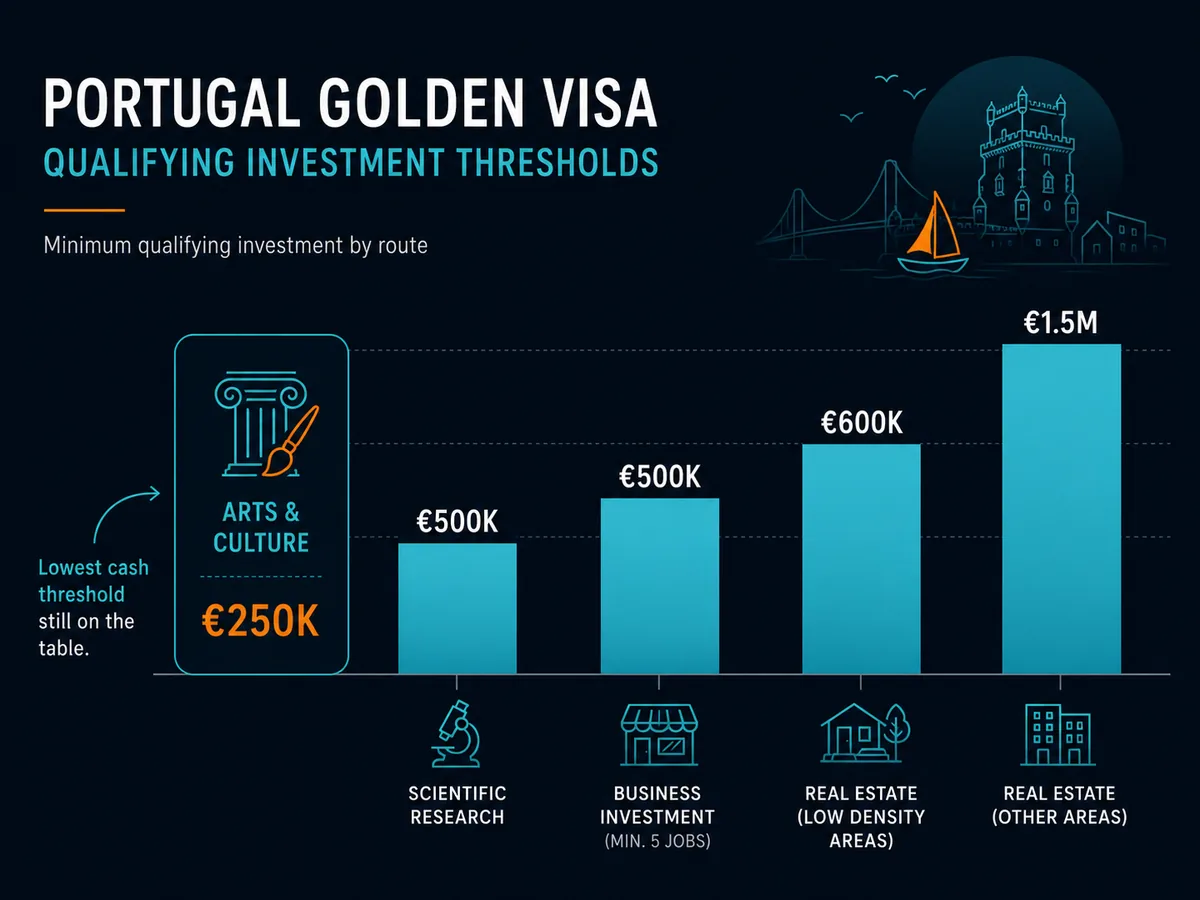
The real estate route — the engine of the programme from 2012 to 2023 — was abolished by the Mais Habitação law (Lei n.º 56/2023). Residential property and most commercial property purchases no longer qualify. The remaining qualifying investments, as published by AIMA, are:
- €500,000 subscription in a qualifying Portuguese venture capital or private equity fund, with at least 60% of the fund's assets invested in Portuguese companies.
- €500,000 capital transfer for research activities at accredited public or private institutions.
- €250,000 capital transfer in support of artistic production or the recovery of national cultural heritage.
- €500,000 for the incorporation or capital increase of a Portuguese company, combined with the creation of at least five permanent jobs for three years.
- Creation of ten permanent jobs in Portugal, with no minimum capital requirement.
The fund route accounts for the majority of new applications in 2025–26. It is the simplest to execute and the easiest to exit at the end of the lockup period.
Benefits the Golden Visa actually delivers
Strip out the brochure language and the real benefits are these:
- Schengen access. Visa-free travel across the 29 Schengen states for the holder and dependents.
- Right to live, work and study in Portugal for the five-year duration of the permit, renewable.
- Minimal stay requirement — seven days in Portugal during the first year, and fourteen days in each subsequent two-year period. The Golden Visa is uniquely undemanding on physical presence among EU residency programmes.
- Family inclusion. Spouse, dependent children, and dependent parents over 65 can be included on the same application.
- Pathway to permanent residency and citizenship after meeting the legal residency period (more on which below).
- No requirement to become Portuguese tax resident. You hold residency rights; you become tax resident only if you actually spend 183+ days a year in Portugal or establish your centre of vital interests there.
That last point is what separates the Golden Visa from most other residency programmes. You can hold the permit and remain tax resident elsewhere.
Requirements in detail
To qualify you must:
- Be a non-EU/EEA/Swiss citizen aged 18 or over.
- Have a clean criminal record from your country of origin and any country where you have lived for more than a year.
- Hold valid Schengen-area travel documents.
- Be able to document the legal source of the invested funds — bank statements, tax returns, sale-of-business documents.
- Hold a Portuguese taxpayer number (NIF) and a Portuguese bank account.
- Make and maintain one of the qualifying investments for a minimum of five years.
- Meet the minimum stay requirements during each renewal period.
The criminal background and source-of-funds checks have tightened materially since 2023 and are the most common cause of delays beyond the AIMA processing backlog itself.
Procedure and realistic timeline
The process runs roughly as follows:
- Obtain NIF and open a Portuguese bank account — typically through a fiscal representative if you are not yet in Portugal. Two to four weeks.
- Execute the qualifying investment — fund subscription, capital transfer, or business setup. Two to eight weeks depending on the route.
- Submit the Golden Visa application to AIMA with supporting documents, biometrics scheduled separately.
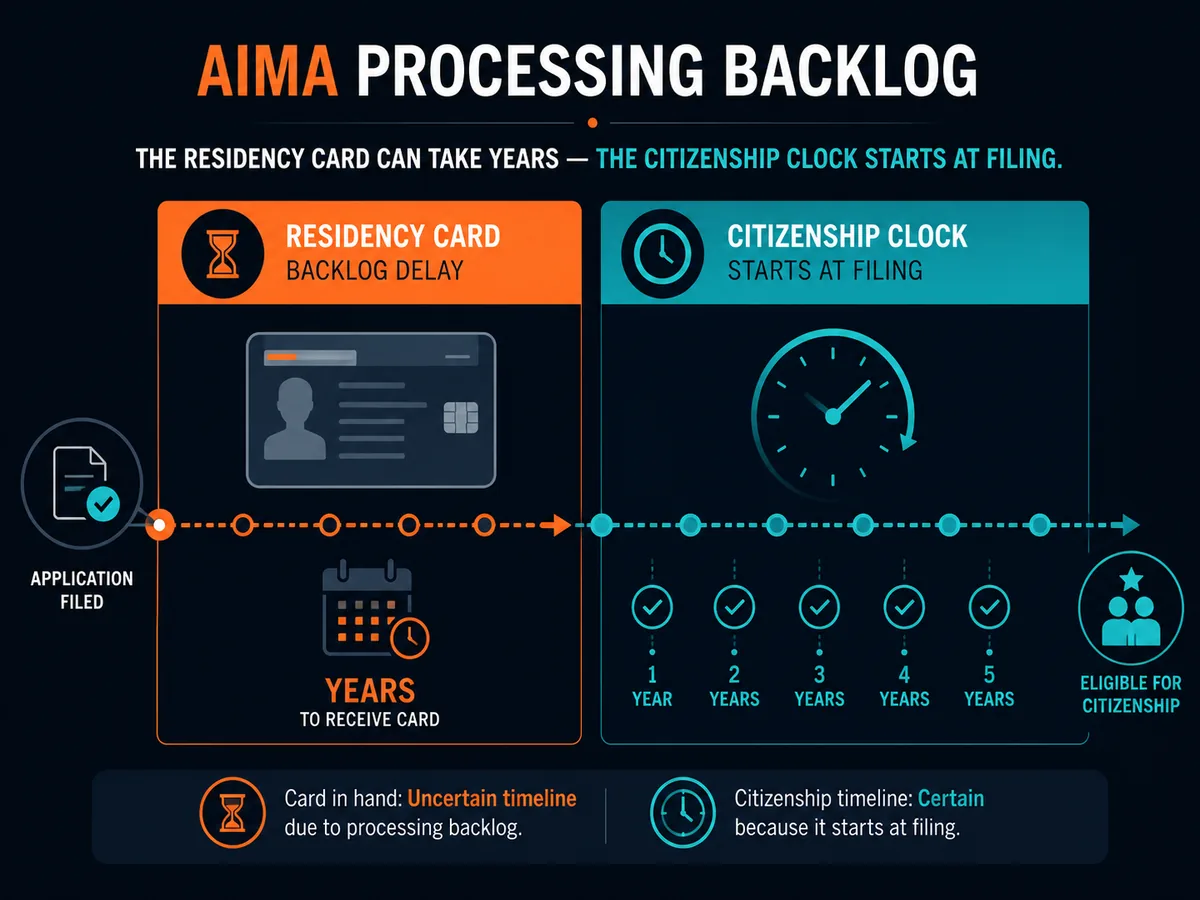
- Pre-approval and biometrics appointment — this is where the queue sits. AIMA has been running multi-year backlogs.
- Initial residence permit issued, valid for two years.
- Renewal every three years thereafter, until you apply for permanent residency or citizenship.
Forbes reported in December 2025 that AIMA was taking two to four years to process residence permits. A Portuguese constitutional court ruling in late 2025 confirmed that the residency clock for citizenship begins on the application submission date — not the date of card issuance — which materially mitigates the backlog impact for citizenship purposes, but does not accelerate when you actually receive the physical card.
Realistic costs and fees
The headline investment figure is not the total cost. A representative budget for a single applicant choosing the €500,000 fund route in 2026 looks like this:
| Item | Typical cost (EUR) |
|---|---|
| Fund subscription | 500,000 |
| Government application fee (per applicant) | ~605 |
| Initial residence permit issuance fee (per applicant) | ~6,045 |
| Renewal fee (per applicant, each cycle) | ~3,020 |
| Legal fees (full family) | 10,000–20,000 |
| Fund subscription/structuring fees | 1–2% of investment |
| Annual fund management fee | 1–2% per year |
| NIF, bank account setup, translations, apostilles | 1,500–3,000 |
| Biometrics and miscellaneous | ~500 |
Government fee figures are based on AIMA's published 2025 schedule [source: TODO — confirm current AIMA fee table for 2026]. Add the same residence permit issuance fee per dependent. Over a five-year hold, a family of four can expect total non-investment costs in the €40,000–€70,000 range, before tax on any fund gains.
Citizenship in Portugal — what changed in 2025
This is the headline change of the last two years. Under the previous Nationality Law, Golden Visa holders could apply for Portuguese citizenship after five years of legal residency. In 2025 the Portuguese government enacted reforms extending the residency requirement to ten years for most non-EU nationals (with a seven-year carve-out for citizens of CPLP — Community of Portuguese Language Countries — states, which includes Brazil, Angola, Mozambique, Cape Verde and others) [source: TODO — link to the 2025 amendment to Law 37/81, the Portuguese Nationality Law].
A Portuguese constitutional court decision in December 2025 upheld the ten-year rule but clarified that the clock begins ticking on the date the residency application was submitted, not the date the card was issued. That matters given AIMA's backlog: applicants who filed in 2023 are credited from 2023 even if their card arrives in 2026.
In addition to the residency period, citizenship applicants must demonstrate A2-level Portuguese, knowledge of Portuguese civic life, and continued ties to the country.
The practical implication: the Golden Visa is no longer a five-year fast-track to an EU passport for most applicants. It remains a clean route to EU residency. If your goal is the passport, plan for a decade.
How Portugal now compares across Europe
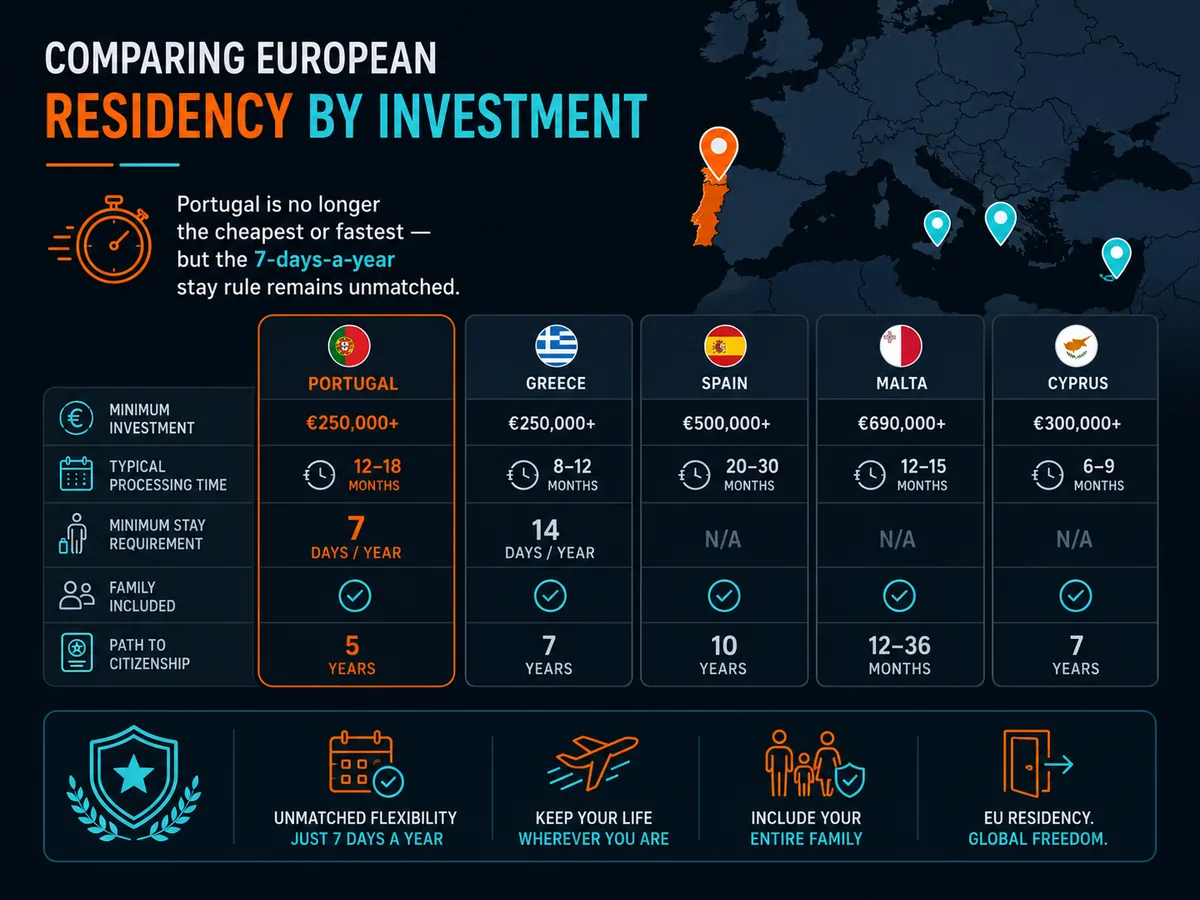
With the ten-year citizenship clock and a €500,000 minimum, Portugal is no longer the cheapest or fastest residency-by-investment programme in Europe. Greece's Golden Visa starts at €250,000 in low-density regions and retains a real estate route. Italy offers a €250,000 startup investor route. Spain ended its Golden Visa in April 2025. Malta's residency-by-investment is more expensive but faster on citizenship. Where Portugal still wins: minimal stay requirement, family inclusion at no extra investment threshold, transparent fund route, and the optionality of not becoming Portuguese tax resident.
Common mistakes to avoid
- Assuming residential property still qualifies. It does not. Any provider offering a "Golden Visa apartment" in 2026 is either selling you the wrong product or relying on a narrow commercial exception you should verify directly with AIMA.
- Choosing a fund on the size of the manager's marketing budget. Read the offering memorandum. Check the manager's track record, the fund's actual portfolio, the lockup, the redemption mechanics, and the exit strategy at year five to eight.
- Ignoring PFIC exposure if you are a US person. A Portuguese fund is almost certainly a PFIC under US tax law. The annual Form 8621 reporting and the punitive default tax treatment can erode returns. Have a US CPA model the after-tax outcome before subscribing.
- Treating the seven-day-a-year stay as the full picture. You also need to maintain the investment, keep your NIF and address current, file Portuguese tax returns if applicable, and attend biometrics renewals in person.
- Conflating residency with tax residency. Holding a Golden Visa does not make you a Portuguese tax resident. Becoming one is a separate decision with its own consequences, including loss of any prior tax-residency status.
- Assuming the NHR regime is available. The original Non-Habitual Resident regime closed to new entrants in 2024. A successor regime — the Tax Incentive for Scientific Research and Innovation (IFICI) — is narrower and targets specific high-skill activities
[source: TODO — link to the IFICI legislative reference].
When to consult a qualified professional
Before subscribing to any fund or transferring any capital, retain:
- A Portuguese immigration lawyer registered with the Ordem dos Advogados. Confirm membership directly on the Ordem's portal. Avoid agents who are not lawyers for the core application work.
- A tax adviser in your home jurisdiction to model the consequences. For US persons this is a US CPA or tax attorney familiar with PFIC, FATCA and FBAR. For EU residents, an adviser who understands exit taxes and centre-of-vital-interests tests.
- A Portuguese accountant if you plan to become Portuguese tax resident or hold the investment through a Portuguese structure.
Soveraine does not provide legal or tax advice and has no fiduciary relationship with any reader. See our editorial policy, disclaimer, and affiliate disclosure for how we handle this.
FAQ
Who qualifies for a Portugal Golden Visa?
Any non-EU/EEA/Swiss national over 18, with a clean criminal record and proof of legal source of funds, who makes one of the qualifying investments and keeps it for five years. EU citizens already have the right to live in Portugal and cannot apply. Family members — spouse, dependent children, dependent parents — can be included on the same application. As of October 2023, residential real estate purchases no longer qualify; eligible routes are mainly regulated investment funds, capital transfers into research or culture, and job creation.
How much money is required for a Portugal Golden Visa?
The most common route in 2026 is a €500,000 subscription in a qualifying Portuguese venture capital or private equity fund. Other routes include €500,000 into approved research activities, €250,000 into arts and cultural heritage, or creating ten jobs. Budget another €15,000–€25,000 on top for government fees, legal fees, fund subscription costs and biometrics across the family. Maintenance fees on renewals and annual fund management fees (typically 1–2%) should also be factored in.
Did Portugal get rid of the Golden Visa?
No. Portugal scrapped the real estate route in October 2023 under the Mais Habitação law, but the programme itself continues. Investment funds, capital transfers, job creation and donations to arts or research remain valid routes. Separately, in 2025 Portugal lengthened the residency period required to apply for citizenship from five years to ten for most nationalities — that change affects the citizenship timeline, not the Golden Visa itself. The residency permit still grants the same rights: live, work, study and travel inside the Schengen Area.
What is the disadvantage of a Portugal Golden Visa?
Three things. First, processing is slow — AIMA has been running backlogs of two to four years on initial decisions. Second, the citizenship clock was extended to ten years for most new applicants in 2025, so the fast-track-to-EU-passport pitch is no longer accurate. Third, the cheapest credible route is now around €500,000 in an illiquid fund with a five-to-eight-year lockup — you bear market risk on the investment itself. For US persons, ongoing US tax filing obligations do not disappear.
Can I get residency in Portugal if I buy a house?
Not through the Golden Visa. Residential property purchases were removed as a qualifying investment in October 2023. You can still buy a house in Portugal as a foreigner, and you can pursue residency through other routes — the D7 (passive income), D8 (digital nomad), or D2 (entrepreneur) visas — but property ownership alone is not a path to a Portuguese residence permit. Some commercial real estate in low-density interior regions may still qualify under narrow conditions; verify any provider's claim against AIMA's current published rules.
Is Portugal still welcoming American expats?
Yes, in policy terms. Americans remain eligible for the Golden Visa, the D7 and the D8 visas, and Portugal has not signalled any intent to close these to US citizens. Demand from the US has risen sharply since 2024, and several fund managers have launched USD-denominated structures aimed at American investors. Practical friction has grown — AIMA processing delays, the longer citizenship timeline, and the end of the NHR tax regime in its original form — but the door is open. US persons retain worldwide US tax filing obligations regardless of where they live.
Ready to act on this?
La Vida Golden Visas — UK-based golden-visa specialist. Soveraine readers go to the front of the line through our partner link, and you fund independent editorial in the process.
Sources
- Lei n.º 29/2012, the original framework for the ARI residence permit — https://diariodarepublica.pt/dr/detalhe/lei/29-2012-179516
- Lei n.º 56/2023 (Mais Habitação) abolishing the real estate route — https://diariodarepublica.pt/dr/detalhe/lei/56-2023-223429532
- AIMA — Agência para a Integração, Migrações e Asilo — https://aima.gov.pt/
- IRS, US Citizens and Resident Aliens Abroad — https://www.irs.gov/individuals/international-taxpayers/us-citizens-and-resident-aliens-abroad
- Forbes, "Portugal Golden Visa — Court Upholds Ten-Year Rule But Questions Remain," 19 December 2025 — https://www.forbes.com/sites/alexledsom/2025/12/19/portugal-golden-visa-court-upholds-ten-year-rule-but-questions-remain/
- Ordem dos Advogados — https://portal.oa.pt/
- Portal das Finanças (Autoridade Tributária) — https://info.portaldasfinancas.gov.pt/
[source: TODO — 2025 amendment to Law 37/81, Portuguese Nationality Law, extending residency requirement to 10 years][source: TODO — current AIMA fee schedule for ARI applications and renewals, 2026][source: TODO — legislative reference for the IFICI tax regime replacing NHR]