
Greece is the only digital nomad programme I have looked at where the headline benefit in almost every guide is one the visa's own paperwork appears to forbid. Search for the Greece digital nomad visa and you will be told, usually in a coloured box near the top, that it comes with a 50% income tax exemption for seven years. It does not come with one. The exemption those pages are describing is Article 5C of the Greek Income Tax Code, and Article 5C wants you working for a Greek entity — which the digital nomad permit specifically requires you not to do.
For a freelancer or founder billing $50k to $300k from abroad, that is not a footnote. It is the difference between an effective rate near 14% and one near 28% on the same €60,000, and the 2026 version of the rule set changed underneath both numbers.
So I read the instruments rather than the guides: the state's own Work From Greece portal for the thresholds and fees, Law 5275/2026 for the procedural change that landed on 5 February, Article 5C as a Greek tax firm states its conditions, and Law 5246/2025 for the income tax scale that took effect on 1 January 2026. Three things fall out that the pages ranking for this query get wrong or skip: you can no longer apply from inside Greece, the 50% break is at best an open question and for employees almost certainly a no, and the 44% top rate now starts at €60,000 instead of €40,000.
Key takeaways
- €3,500 a month net for a single applicant, €4,200 with a spouse, plus about €525 per child — so €4,725 for a couple with one child.
- The in-country route is gone. Law 5275/2026, from 5 February 2026, forces every applicant through a Greek consulate for a Type D visa before travelling.
- Government fees are about €1,225 for one person: €75 plus a €150 administrative fee for the visa, then €1,000 for the two-year residence permit.
- The 50% exemption is not part of this visa. Article 5C requires employment with a Greek legal entity or the Greek permanent establishment of a foreign company; the permit requires a declaration that you will not work for Greek employers or clients.
- Cross 183 days and Greece taxes worldwide income at the new 2026 scale — roughly €16,700 on a €60,000 profit, before social security.
- The real tax play is staying under 183 days, which is also the pattern that stops the five-year residency clock.
SafetyWing — the consular file needs insurance covering the whole stay, and it needs it before the interview, not after
What the Greece digital nomad visa actually is in 2026
It is two documents, and conflating them is the commonest mistake in this niche. The Greece digital nomad visa proper is a national Type D entry visa, valid for twelve months, issued by a Greek consulate. The digital nomad residence permit is the separate, longer instrument you apply for once you are in Greece, granted for two years and renewable.
The route was introduced by Law 4825/2021, folded into the Immigration Code by Law 5038/2023, and amended again by Law 5275/2026. Eligibility is narrow and deliberately so: you must be a non-EU, non-EEA, non-Swiss national, working remotely for employers or clients established outside Greece, and you sign a declaration that you will not take work from a Greek employer or provide freelance services into the Greek economy.
| Type D digital nomad visa | Digital nomad residence permit | |
|---|---|---|
| Issued by | Greek consulate or embassy abroad | Ministry of Migration and Asylum, from inside Greece |
| Validity | 12 months, not renewable as a visa | 2 years, renewable |
| Fee | €75 + €150 administrative | €1,000 (+€150 per additional family member) |
| Required since 5 Feb 2026 | Yes, for everyone | Only reachable via the visa |
| Counts toward EU long-term residence | Entry document, not residence | Yes, if you genuinely reside |
If you only want a season in Greece, the visa alone does the job and you never touch the permit. The permit is what turns a twelve-month experiment into a residency track — and, as the tax sections below show, that is precisely where the cost appears.
Law 5275/2026 closed the in-country route on 5 February
This is the change that dates every guide, and a fair number of them are still wrong about it. Until 5 February 2026 there were two ways in. You could obtain the national entry visa from a consulate, or you could skip that stage entirely: enter Greece on a uniform short-stay visa or visa-free, and file directly for the initial grant of the residence permit from inside the country.
Law 5275/2026 abolished the second route entirely. As a Greek immigration firm puts it, applicants "are required to obtain a national entry visa as digital nomads (Visa Type D) in order to enter the country and submit an application for the granting of a residence permit as digital nomads." There is no in-country first application any more.
Three practical consequences follow, and none of them is cosmetic.
The consulate is now a single point of failure. Your file is assessed abroad, by a post whose document list and pace you do not control. Official guidance is acknowledgement within ten days and issue within about a month; practitioner reports of one to three months are common at busy posts.
You cannot test-drive it. The old route let people arrive as tourists, decide they liked Greece and then file. That option is closed, so the decision now happens before you have spent a day there.
Your criminal record certificate and contracts need apostilles and sworn Greek translations before you leave, not after you arrive — a four-to-six week lead time in several countries, and the step that most often delays an otherwise clean file.
If you are an EU or EEA national reading this, none of it applies to you — you have freedom of movement, and the question for you is tax residency, not immigration. The Schengen 90/180 rule is the constraint that actually bites for short non-EU stays.

What you must earn: €3,500 net, and the family uplifts
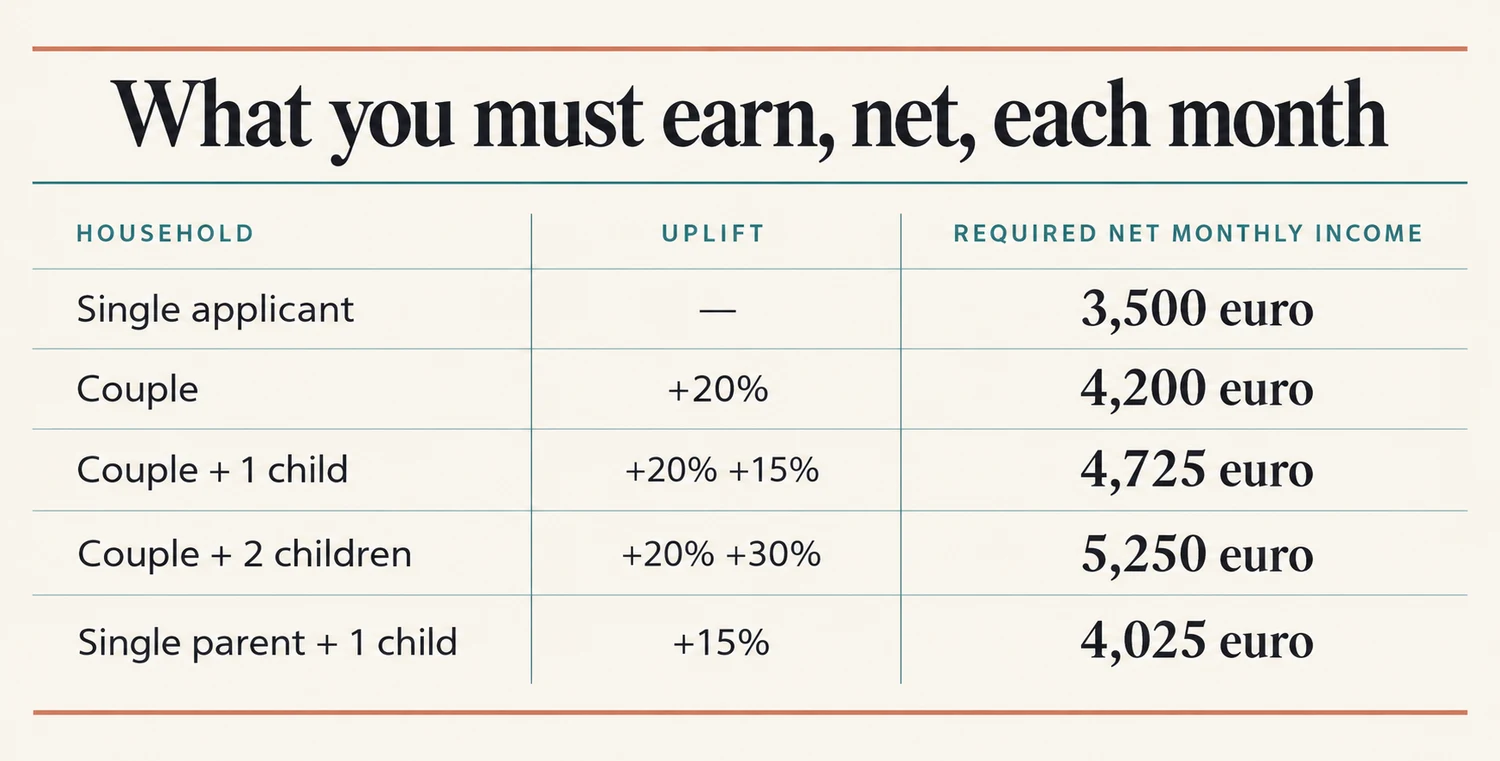
The threshold is €3,500 a month after taxes for a single applicant. That "after taxes" wording matters and is the quiet trap for the self-employed: a freelancer invoicing €4,200 a month gross is not necessarily showing €3,500 net, and the consulate is looking at the net figure.
The uplifts are proportional: +20% for a spouse or partner and +15% for each dependent child.
| Household | Uplift | Required net monthly income | Annualised |
|---|---|---|---|
| Single applicant | — | €3,500 | €42,000 |
| Couple | +20% | €4,200 | €50,400 |
| Couple + 1 child | +20% +15% | ≈€4,725 | ≈€56,700 |
| Couple + 2 children | +20% +30% | ≈€5,250 | €63,000 |
| Single parent + 1 child | +15% | ≈€4,025 | €48,300 |
Evidence is the usual set: an employment contract and payslips if you are employed, or client contracts, invoices and bank statements if you are not. Consulates want a pattern, not a peak — several months of consistent receipts rather than one strong quarter. Compared with its neighbours the bar is high: Greece asks materially more than Croatia's digital nomad visa and sits above Spain's and Italy's thresholds too, which is worth weighing before you commit to the apostille bill.
The full fee stack, which nobody totals
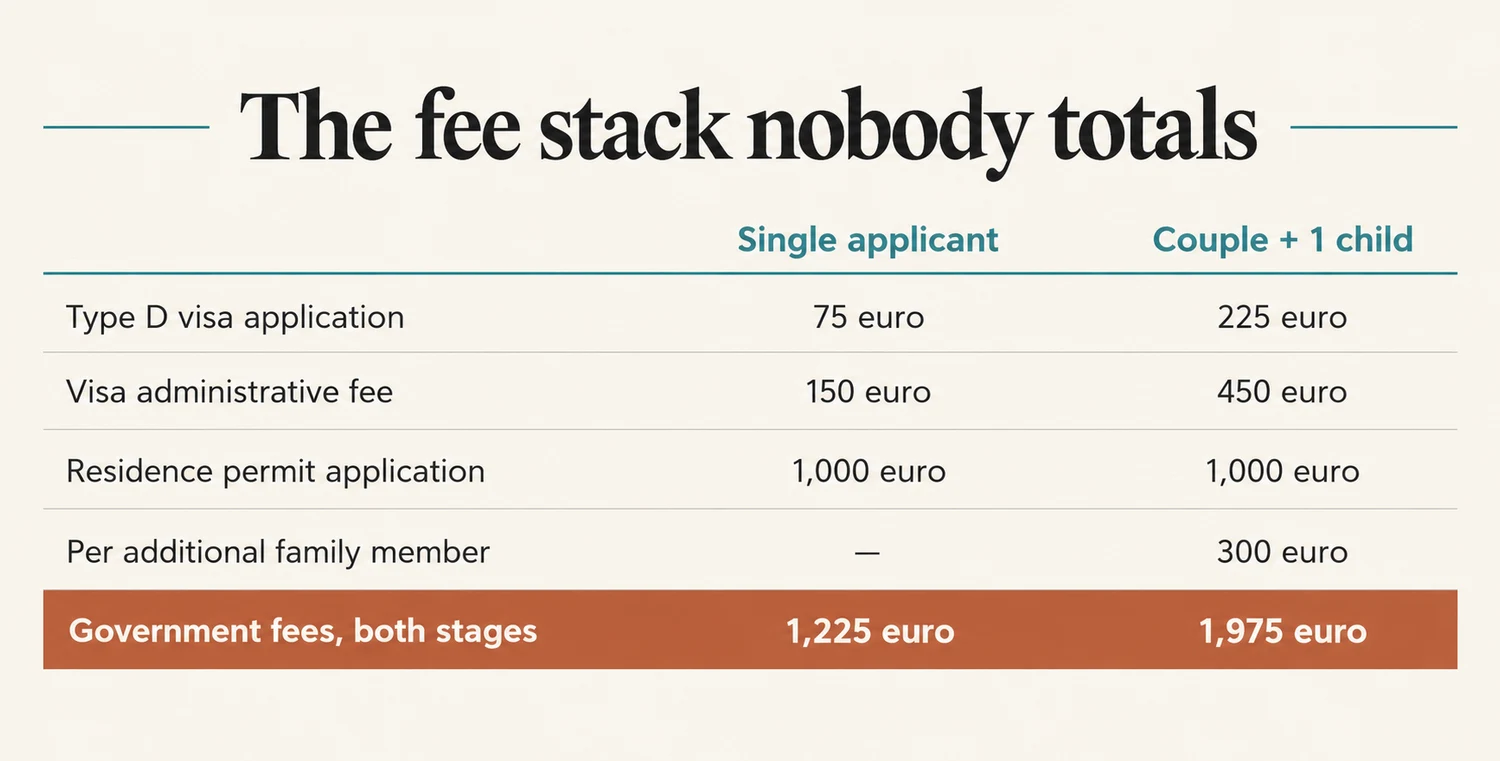
Government fees for this route come in two instalments, and the second one is the large one. The Work From Greece portal states €75 for the visa application plus a €150 administrative fee, and €1,000 for the residence permit application, plus €150 for each additional family member.
| Item | Single applicant | Couple + 1 child |
|---|---|---|
| Type D visa application | €75 | €225 (€75 each) |
| Visa administrative fee | €150 | €450 |
| Residence permit application | €1,000 | €1,000 |
| Permit fee per additional family member | — | €300 |
| Government fees, both stages | ≈€1,225 | ≈€1,975 |
| Apostilles + sworn Greek translations | €150–€500 | €400–€1,200 |
| Health insurance, 12 months | €500–€1,500 | €1,500–€4,000 |
| Realistic all-in | ≈€1,900–€3,200 | ≈€3,900–€7,200 |
The two fee lines are quoted from the state portal and are the firm part of that table. Everything below them is my estimate, and varies by nationality and consulate. I found no published minimum for the insurance cover on the official portal; €30,000 of medical cover is the figure that circulates and matches general Schengen national-visa practice, so treat it as the floor to ask your consulate about rather than a confirmed rule.
The 50% tax exemption almost certainly is not yours
Here is the claim, and it is on the top-ranking page for this keyword: hold the digital nomad visa, become a Greek tax resident, and 50% of your income escapes Greek income tax for up to seven years.
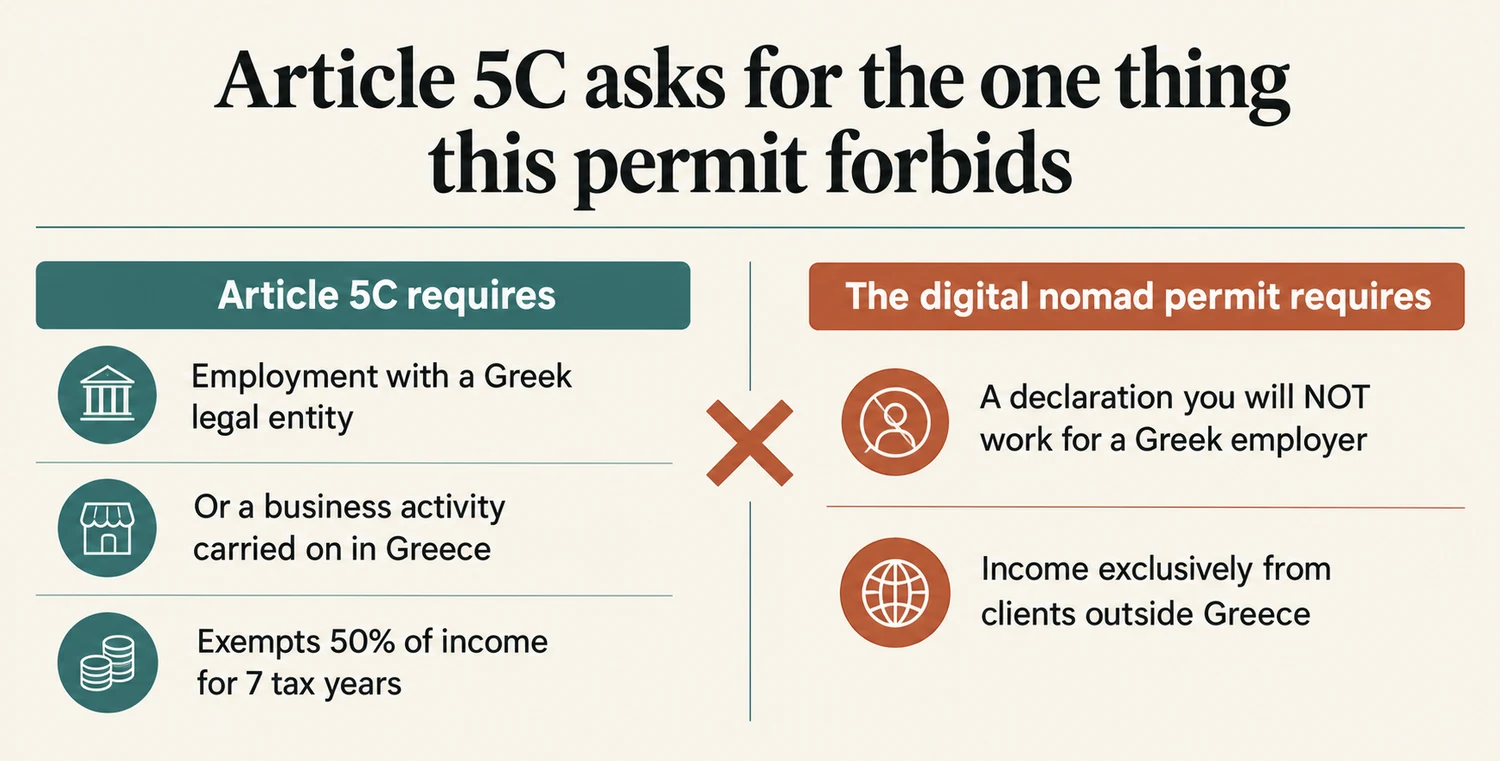
The exemption is real. It is Article 5C of the Income Tax Code (Law 4172/2013), introduced by Law 4758/2020, and it does exempt 50% of income from employment and business activity earned in Greece for up to seven consecutive tax years. The conditions, as a Greek tax firm states them, are the problem.
| Article 5C requires | The digital nomad permit requires |
|---|---|
| Services in Greece under an employment relationship with a Greek legal entity, or the Greek permanent establishment of a foreign company | A declaration that you will not work for a Greek employer |
| Or a business activity carried on in Greece | Income exclusively from clients established outside Greece |
| Not a Greek tax resident for 5 of the 6 preceding years | No equivalent condition |
| A declaration you will remain in Greece at least two years from 1 January of the first year | Compatible, but it makes you a Greek tax resident |
| Exempts 50% of qualifying income, 7 tax years maximum | — |
Read the two columns together and the incompatibility is structural, not a technicality. If you are employed by a foreign company with no Greek presence, Article 5C's employment limb excludes you outright. That is not a close call; the statute names the counterparty.
The self-employed case is genuinely open rather than closed. Article 5C's business-activity limb turns on income "earned in Greece", and some advisers argue that fees from foreign clients for work physically performed in Greece fall inside that, while others read it strictly. I could find no Greek circular, ruling or tribunal decision resolving it either way — and the pages asserting the 50% figure do not cite one, because there is not one to cite.
One related point where the internet is genuinely out of date in the other direction: 5C used to apply only to newly created posts. That condition was removed in 2025, retroactively for applications pending on 28 July 2025. PwC's summary still carries the old "exclusively for the filling of new jobs" wording, so if you are checking this yourself you will hit the stale version first.
The honest summary: the 50% exemption is a question for a Greek tax adviser about your specific structure, not a feature of this visa. If the 50% figure is why you are applying, get the answer before you pay for apostilles. Our non-dom regimes explainer covers what these special regimes do and do not do more generally.
What you actually pay if you cross 183 days
Greek tax residency attaches above 183 days in any twelve-month period, or earlier if your centre of vital interests — permanent home, habitual abode, personal and economic ties — moves to Greece. Residents are taxed on worldwide income; non-residents on Greek-source income only.
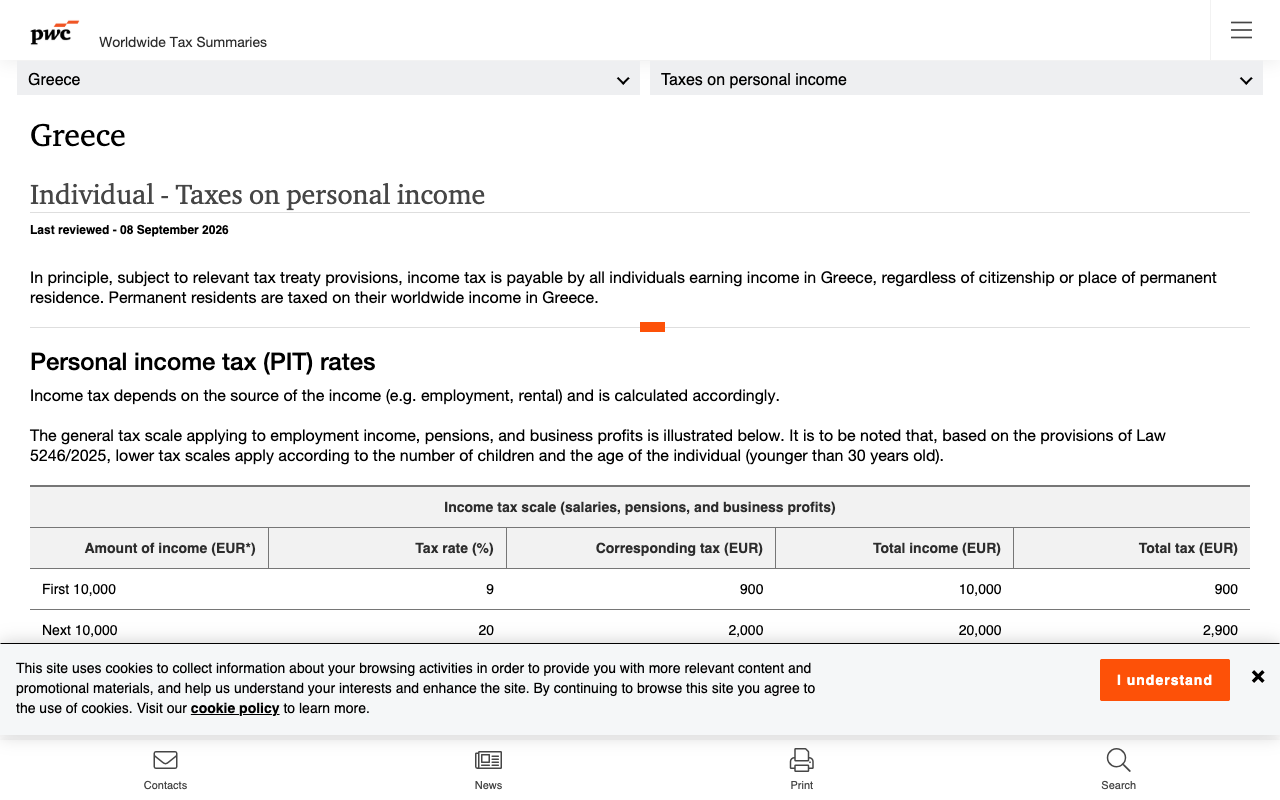
The scale itself changed this year, which is the fact almost every competing guide gets wrong. Law 5246/2025 applies from 1 January 2026: the middle rates came down, a new 39% band appeared, and the 44% top rate now starts at €60,000 instead of €40,000.
| Band | Rate from 1 Jan 2026 | Previous rate |
|---|---|---|
| First €10,000 | 9% | 9% |
| €10,001–€20,000 | 20% | 22% |
| €20,001–€30,000 | 26% | 28% |
| €30,001–€40,000 | 34% | 36% |
| €40,001–€60,000 | 39% | 44% |
| Above €60,000 | 44% | 44% |
The scale covers employees, pensioners and the self-employed alike. Two carve-outs matter for this audience: under-25s pay 0% on the first €20,000, and 26 to 30 year-olds pay 9% on it — and there are further per-child reductions, reaching 0% on €10,001–€20,000 for households with four or more children.
Run it on real numbers, on business profit, before social security:
| Annual profit | Income tax, 2026 scale | Effective rate | On the old scale |
|---|---|---|---|
| €42,000 (the visa minimum, annualised) | €9,680 | 23.0% | €10,380 |
| €60,000 | €16,700 | 27.8% | €18,300 |
| €100,000 | €34,300 | 34.3% | €35,900 |
| €60,000, applicant aged 24 | €13,400 | 22.3% | — |
Those figures exclude social security. Greek EFKA contributions for the self-employed are a separate and substantial liability, and with a foreign employer the question of which country's system you belong to turns on coordination rules and any A1 certificate, not on the visa. I am not quoting EFKA numbers: I could not verify a current 2026 schedule from a primary source, and an unverified contribution figure is worse than an absent one.
The plan the guides do not write down: stay under 183 days
If your income is foreign-sourced and your goal is tax efficiency rather than a Greek passport, the rational use of this visa is to not become a Greek tax resident at all. The Type D visa runs twelve months. Spend fewer than 183 days of any twelve-month period in Greece, keep your centre of vital interests demonstrably elsewhere, and Greece taxes you on Greek-source income only — which for a compliant digital nomad is nothing.
That is the version of this visa that actually delivers a low rate, and it is the version nobody sells, because it does not need a service provider.
Two cautions, and both are the reason we keep writing the same warning on this site. Leaving Greece under 183 days does not make you tax resident nowhere — you remain resident somewhere, usually where you were before, and that country's rules, not Greece's, set your bill. Tax resident nowhere covers why that plan fails more often than it works. And the centre-of-vital-interests test can find you resident on well under 183 days if your home, family and economic life are visibly in Greece.
Does it lead to permanent residency or a Greek passport?
Slowly, and with a contradiction at its heart.
| Milestone | Requirement | Realistic timing from first arrival |
|---|---|---|
| Type D visa | Consular application | Month 0 |
| First residence permit | 2 years, from inside Greece | Year 1 |
| Renewal | 2-year increments | Year 3, Year 5 |
| EU long-term residence permit | 5 years continuous legal residence | Year 5 |
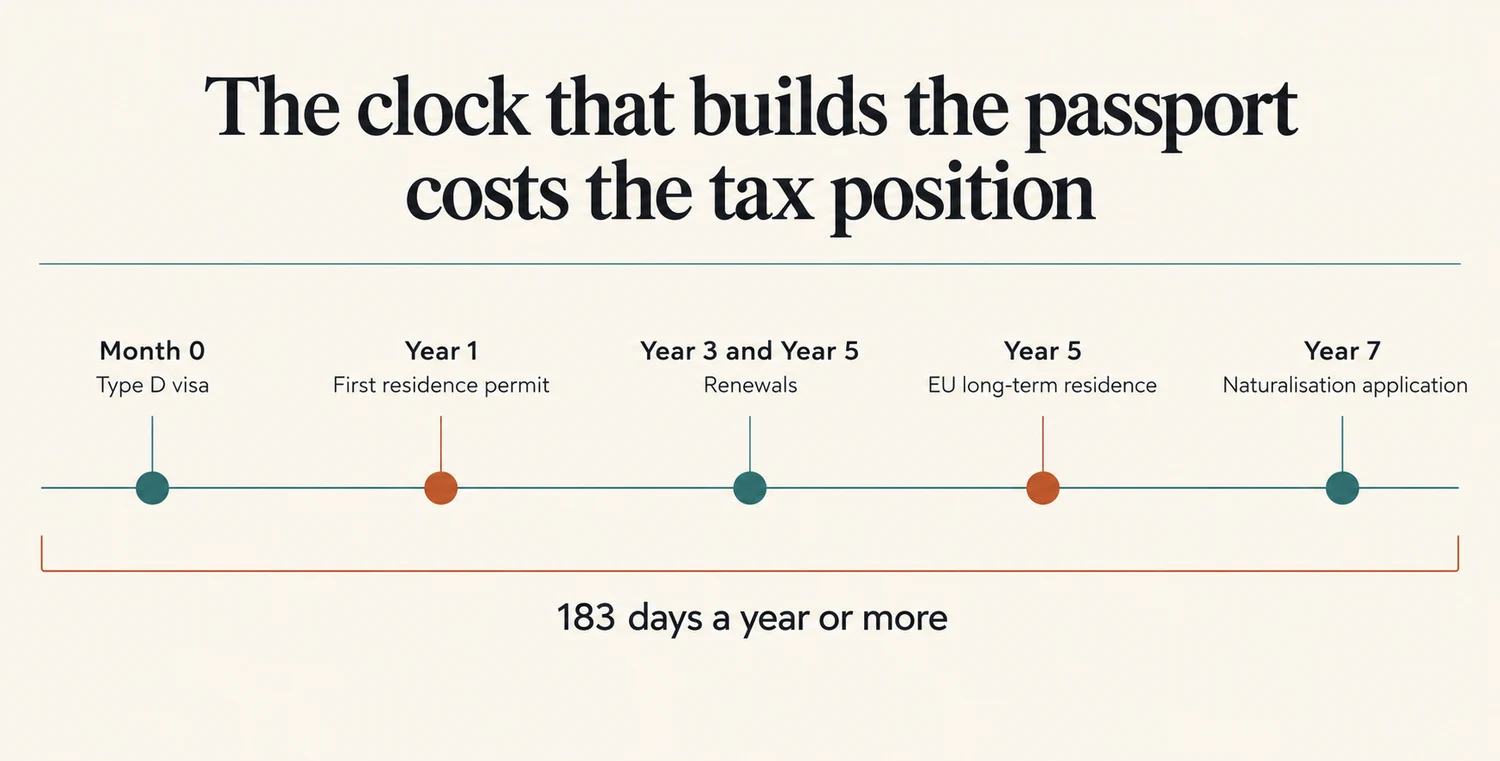
| Naturalisation application | 7 years legal residence + language and civics exam | Year 7 |
Naturalisation sits under the Greek Citizenship Code (Law 3284/2004, as amended) and now requires seven years of lawful residence for standard applicants, alongside the citizenship knowledge examination. Practitioners take the view that digital nomad permit time counts toward both milestones provided you genuinely resided — roughly 183 days a year or more.
Which is the contradiction. The residence pattern that builds the clock is the pattern that makes you a Greek tax resident, and therefore taxable on worldwide income at 9% to 44% with the 50% exemption unavailable on the analysis above. You can have the passport track or the tax position. Not both.
I have not been able to confirm from a primary Greek source that digital nomad years count toward naturalisation specifically, as opposed to long-term residence, so treat the year-7 row as the practitioner view rather than settled. If an EU passport is the actual objective, the easiest EU citizenship routes and digital nomad visas with a path to permanent residency compare the field on exactly this axis, and Greece's golden visa buys the residence permit without the physical-presence requirement — at €250,000 to €800,000.
Who this visa is actually for
It works well for a seasonal remote worker on €3,500+ net who wants a legal twelve months in Greece, stays under 183 days, keeps tax residency where it already is, and treats the permit stage as optional. That person gets a clean, cheap, low-friction year for about €1,200 in government fees.
It works badly for the tax optimiser. The 50% exemption that draws people here is, on the statute, built for someone working for a Greek employer — the one thing this permit forbids. If the plan was "move to Greece, halve my tax", the plan needs a Greek adviser's opinion before it needs a visa appointment. Cyprus's non-dom regime and Georgia's 1% regime reach a low rate by mechanisms that do not depend on an unresolved reading of a statute.
It is unresolved for the self-employed on the 5C question specifically. That is a paid opinion, not a blog post.
And it is slow for the passport buyer. Seven years, an exam, and a presence requirement that costs you the tax position along the way.
Related guides
- Digital nomad visas compared — the full table of thresholds, durations and tax treatment across every programme.
- Digital nomad visas with a path to permanent residency — which programmes actually build a residency clock, and which are dead ends.
- Greece golden visa — the €250,000 to €800,000 alternative, with no physical-presence requirement.
- Spain's digital nomad visa — the closest comparison on threshold, and the one with a working tax regime attached.
- Italy's digital nomad visa — same region, different evidence burden.
- Schengen 90/180 rule — the constraint that applies before any of these permits do.
FAQ
What is the income requirement for the Greece digital nomad visa in 2026?
€3,500 a month after taxes for a single applicant, per the state's own Work From Greece portal. A spouse or partner raises it 20% to €4,200, and each dependent child adds 15%, roughly €525, so a couple with one child needs about €4,725 a month. The threshold is a net figure, which catches out freelancers who quote gross invoicing. Consulates ask to see it evidenced over several months, not in a single good month.
Can I still apply for the Greek digital nomad permit from inside Greece?
No. Law 5275/2026, in force from 5 February 2026, abolished the in-country route. Until then you could enter on a short-stay visa or visa-free and file for the residence permit from Greece, skipping the consular stage entirely. Now you must obtain the national Type D digital nomad visa from the Greek consulate or embassy in your country of residence before you travel. Guides written before February still describe the old route.
Does the Greece digital nomad visa give me a 50% tax exemption?
Probably not, despite what most pages ranking for this query say. The 50% exemption is Article 5C of the Income Tax Code, and Article 5C requires employment with a Greek legal entity or the Greek permanent establishment of a foreign company, or a business activity carried on in Greece. The digital nomad permit requires the opposite: you sign a declaration that you will not work for a Greek employer or client. For the self-employed the position is genuinely unresolved rather than clearly negative, and no Greek circular or ruling settles it. Treat the 50% figure as a question for a Greek tax adviser, not a feature of the visa.
How much does the Greece digital nomad visa cost in fees?
The visa application is €75 plus a €150 administrative fee, and the later residence permit carries a €1,000 application fee, with €150 for each additional family member, per the Work From Greece portal. So a single applicant's government fees run about €1,225 across both stages. Apostilles, sworn Greek translations of your criminal record certificate and contracts, insurance and any legal help are extra and often exceed the government fees.
When do I become a Greek tax resident, and what happens then?
Above 183 days in Greece in any twelve-month period, or earlier if your centre of vital interests moves there. At that point Greece taxes you on worldwide income at the 2026 scale, which runs 9% to 44%, so a €60,000 profit attracts roughly €16,700 of income tax before social security. Below 183 days, and with your centre of vital interests still abroad, only Greek-source income is in scope, which for a compliant digital nomad is normally nothing.
Did Greek income tax rates change for 2026?
Yes, and most guides still quote the old scale. Law 5246/2025 applies from 1 January 2026: the middle rates fell to 20%, 26% and 34%, a new 39% band covers €40,000 to €60,000, and the 44% top rate now starts at €60,000 rather than €40,000. Under-25s pay 0% on the first €20,000 and 26 to 30 year-olds pay 9% on it, and there are further reductions per dependent child. It applies to employees, pensioners and the self-employed alike.
Does time on the digital nomad permit count toward permanent residency or Greek citizenship?
Five years of continuous legal residence is the threshold for the EU long-term residence permit, and naturalisation under the Greek Citizenship Code needs seven years plus a language and civics exam. Practitioners say digital nomad permit time counts provided you genuinely resided, which in practice means roughly 183 days a year or more. That is the catch: the residence pattern that builds toward a passport is the one that makes you a Greek tax resident, so you cannot have the clock and the tax position at the same time.
Sources
- Work From Greece — the digital nomad visa — the Greek state's own portal: €3,500 after taxes, €4,200 with a spouse, €525 per child, the declaration not to work for a Greek-based employer, the twelve-month visa, the €75 + €150 visa fees, the €1,000 permit fee, and the ten-day acknowledgement.
- Dafni I. Siopi — what changes under Law 5275/2026 — the abolition of the in-country application and the requirement to hold a Type D visa before entering.
- Iason Skouzos TaxLaw — the 5C regime — Article 5C's conditions: services in Greece for a Greek legal entity or the Greek permanent establishment of a foreign company, the five-of-six-years test, the two-year stay declaration, 50% over seven tax years, and the "new job" requirement removed retroactively for applications pending on 28 July 2025.
- PwC — Greece, other tax credits and incentives — 5C as 50% of income "earned in Greece" and the filing deadlines. Still carries the superseded "new jobs" condition.
- WTS Global — Law 5246/2025 key tax reforms — the 2026 scale of 9/20/26/34/39/44, 0% for under-25s and 9% for 26-30 year-olds on the first €20,000, the per-child reductions, and that the scale covers the self-employed.
- PwC — Greece, taxes on personal income — the 2026 bands as applied.
- PwC — Greece, individual residence — the 183-day test and the centre-of-vital-interests test.
- AADE — tax incentives for new tax residents (5A, 5B, 5C) — the tax authority's own landing page. It refused automated requests at the time of writing (HTTP 403), so 5C is cited above from PwC and Iason Skouzos rather than from AADE directly.
Figures are current as of September 2026. Fee and income figures are quoted from the Greek state's Work From Greece portal; the apostille, translation and insurance ranges are my estimates. Whether any document set satisfies a Greek consulate is that post's determination. The Article 5C analysis reads the statute's stated conditions against the permit's stated conditions; it is not a ruling, no Greek circular resolves the self-employed case, and only a Greek tax adviser can answer it for your structure. Tax outcomes depend on facts this page cannot know, including your other income, residence history, social security position and treaty situation. This is editorial research, not legal, immigration or tax advice.