The Croatia digital nomad visa went up by roughly €330 a month in early 2026, and a good share of the guides still ranking for it are quoting last year's number. One of the top commercial results as I write calls itself a 2026 guide and states €3,295; the Ministry of the Interior's own page states €3,622.50, and a file built against the wrong figure does not clear the means test.
That gap costs more here than on most visas, because Croatia is the one European programme where clearing the bar buys a statutory 0% rate on foreign work income — not a reduced rate, not a remittance rule, an outright exemption written into the Income Tax Act. Roughly €12,000 to €20,000 a year of Croatian tax, on the bands below, turns on getting the paperwork right.
So I read the MUP page rather than the guides, priced every application route off its published fee list, pulled Croatia's 2026 income-tax bands from PwC's country summary to work out what the exemption is actually worth, and checked the US–Croatia treaty status at the US Treasury. Where the popular pages disagree with the ministry — and on the family income uplift nearly all of them do — I have said which is which.
Key takeaways
- The 2026 floor is €3,622.50 a month, or €43,470 banked for 12 months and €65,205 for 18. It is 2.5× the previous year's average net salary, so it resets annually.
- The family uplift is €144.90 per person, not €362.25. MUP says 10% of the average monthly net salary, not 10% of the threshold. A couple needs about €3,767.40, not the €3,984.75 widely published.
- Government fees run €87.59 to €148.74 depending on route — far narrower than the "€60 to €100" ranges in circulation.
- The 0% applies to foreign work income only. Dividends, interest, rent and gains on assets held under two years are taxed at 12%.
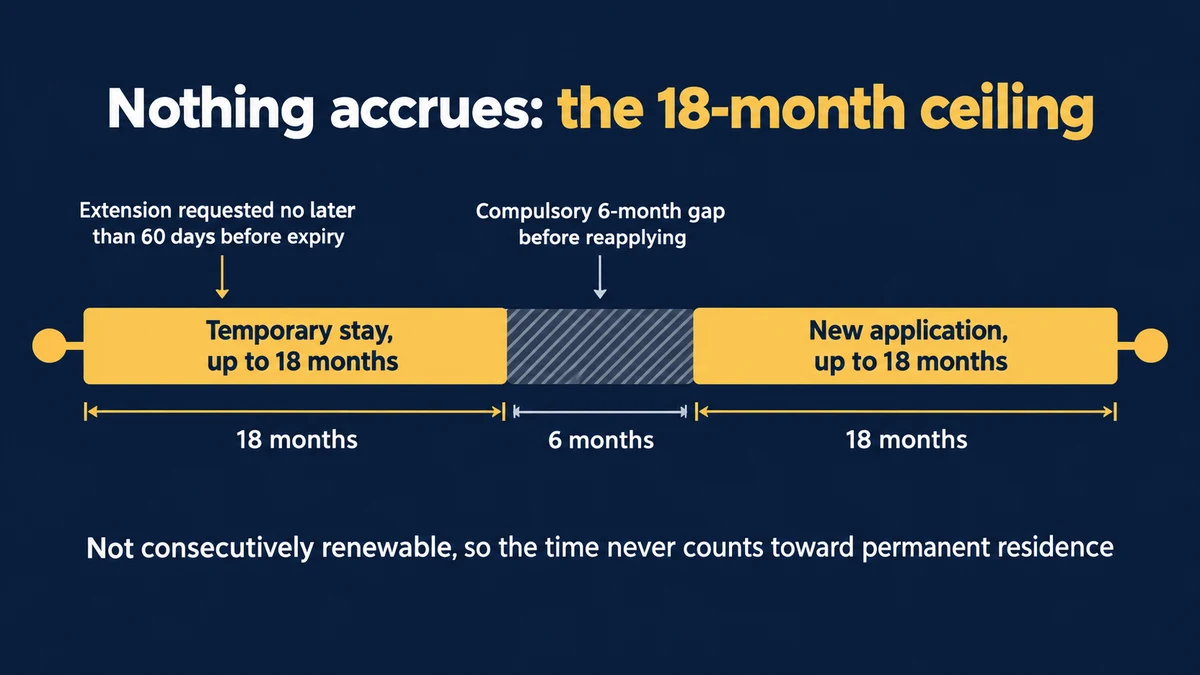
- Nothing accrues. Up to 18 months, no consecutive renewal, and a compulsory six-month gap before you can reapply — which is precisely why the time never counts toward permanent residence.
SafetyWing — nomad medical cover, for the applicant still missing the insurance document
What the Croatia digital nomad visa actually is
Two vocabulary problems cause most of the confusion, and they are worth clearing before the numbers.
The first is that "visa" is the wrong word. What Croatia grants is temporary stay on the basis of digital nomad status — a residence permit. Nationals who need a visa to enter get a long-stay D visa alongside it; nationals who do not, never touch a visa at all and collect a biometric residence card instead. That single distinction decides which fee column applies to you.
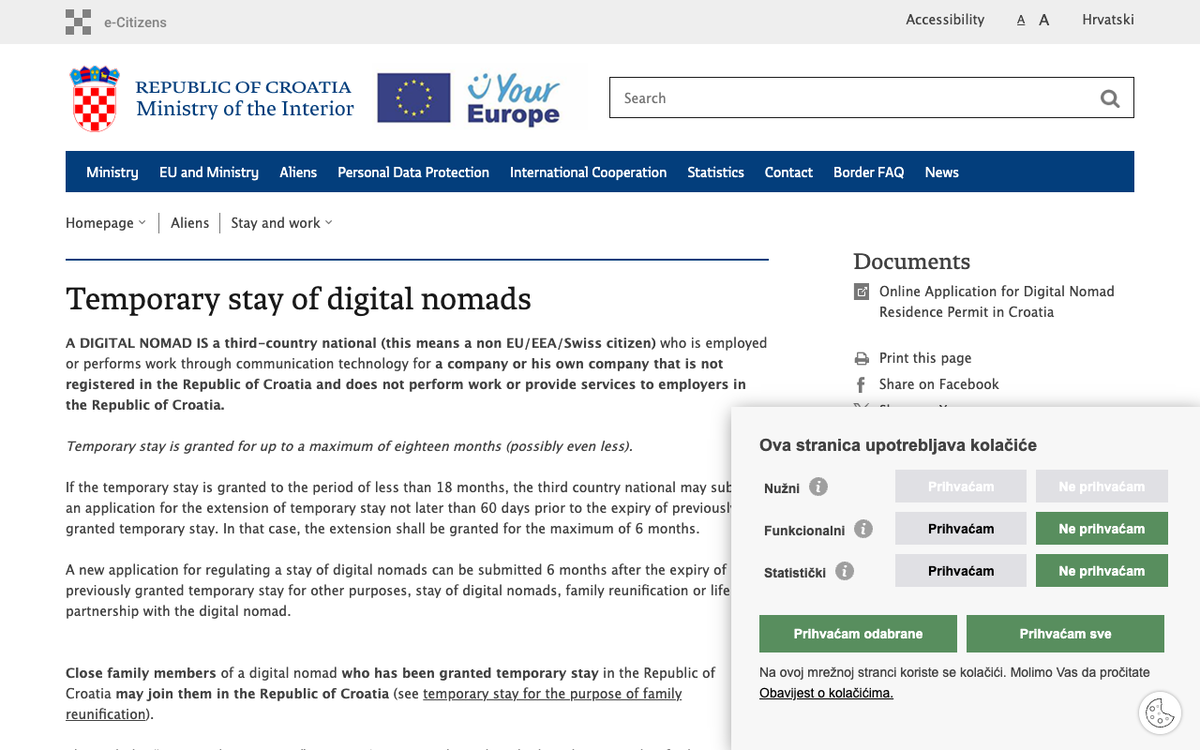
The second is scope. MUP defines a digital nomad as a third-country national who "is employed or performs work through communication technology for a company or his own company that is not registered in the Republic of Croatia and does not perform work or provide services to employers in the Republic of Croatia." Two conditions there, not one: the employer must be foreign, and the work must not be supplied into the Croatian market.
That excludes EU, EEA and Swiss citizens entirely, who have free movement and do not need a permit. The tax consequence is the part almost nobody states: the exemption is attached to the status, so an EU national living in Zagreb and invoicing a German client cannot use it. If you hold an EU passport, this page is a comparison exercise, not an application guide — start with digital nomad visas compared instead.
The 2026 income threshold, and the family number nearly everyone gets wrong
The requirement is set by formula: means of subsistence of at least 2.5 average monthly net salaries paid in the previous year. MUP converts it for you and currently publishes €3,622.50 per month, which implies a salary base of €1,449. Proof is either a bank statement showing regular income or payslips for the last six months — up from three in earlier guidance, which is the second thing stale pages get wrong.
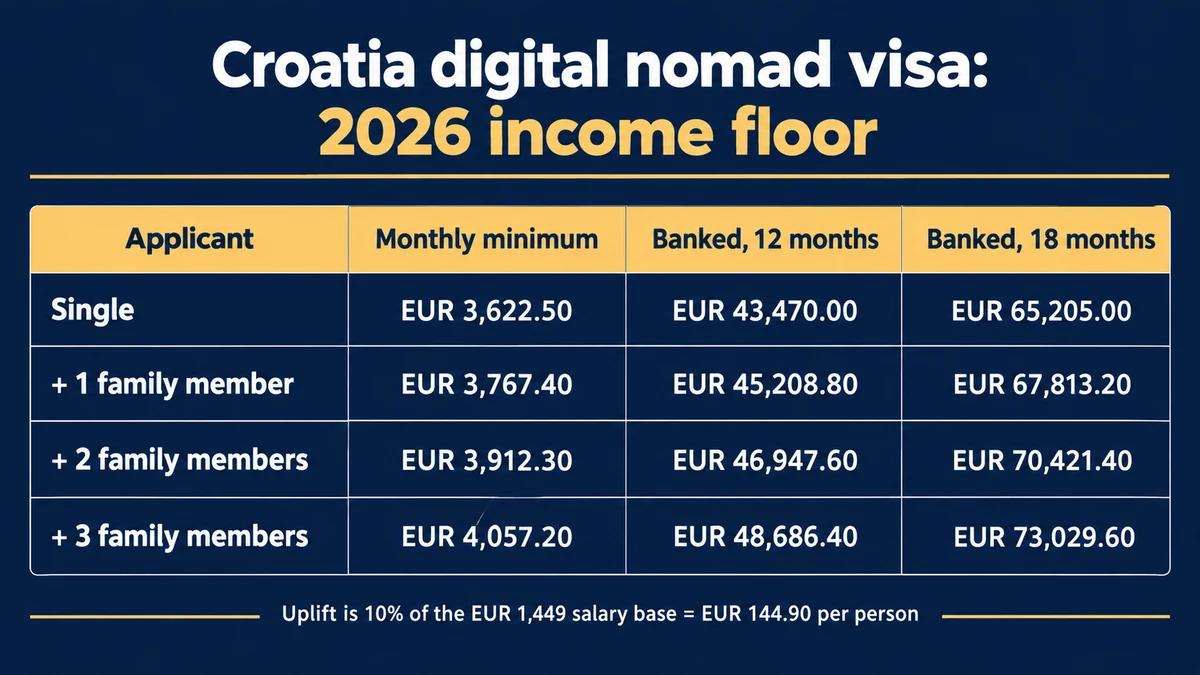
You may substitute a lump sum already sitting in the account: €43,470 for a 12-month stay, €65,205 for 18 months.
Now the part worth the price of the page. For family members, MUP's wording is that the amount "is increased by 10% of the average monthly net salary for each additional family member or life partner or informal life partner." Ten percent of the €1,449 salary base — €144.90 — not ten percent of the €3,622.50 threshold. Several 2026 guides, including ones written by immigration practices, publish €3,984.75 for a couple and about €4,347 for a family of four. Both are computed off the wrong base.
| Applicant | Monthly minimum | Banked, 12 months | Banked, 18 months |
|---|---|---|---|
| Single | €3,622.50 | €43,470.00 | €65,205.00 |
| + 1 family member | €3,767.40 | €45,208.80 | €67,813.20 |
| + 2 family members | €3,912.30 | €46,947.60 | €70,421.40 |
| + 3 family members | €4,057.20 | €48,686.40 | €73,029.60 |
MUP publishes only the single-applicant row; the rest is the ministry's own formula applied arithmetically, and a consulate is entitled to compute it as it likes. The practical point is the direction of the error: a couple told they need €3,984.75 is being told to clear a bar €217 a month higher than the ministry's wording sets, which is enough to talk a genuinely eligible applicant out of filing.
Since the base is a published statistic, the figure changes every year. Treat any number you read — including this one — as needing a check against MUP on the day you file.
What it costs: every fee, by route
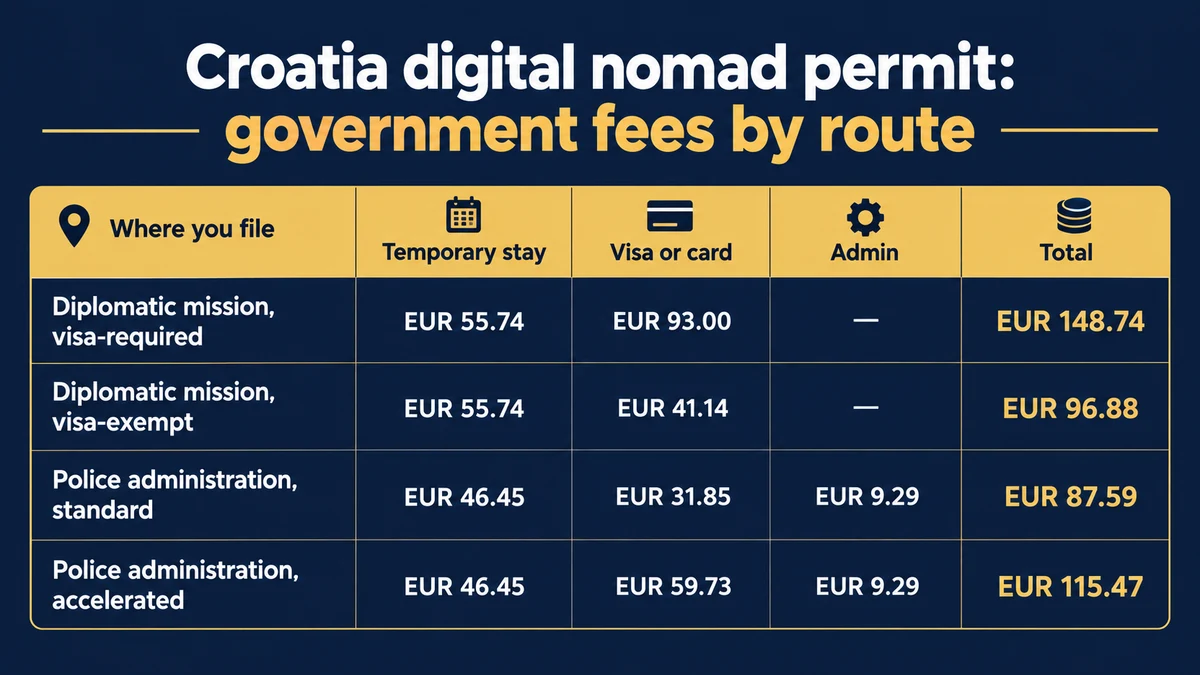
The ranges in circulation ("€60 to €100", "around €46") are not wrong so much as incomplete, because they price one route and not the others. MUP lists the components, and they add up cleanly.
| Where you file | Temporary stay | Visa or card | Admin | Total |
|---|---|---|---|---|
| Diplomatic mission, visa-required national | €55.74 | €93.00 (D visa) | — | €148.74 |
| Diplomatic mission, visa-exempt national | €55.74 | €41.14 (biometric card) | — | €96.88 |
| Police administration in Croatia, standard | €46.45 | €31.85 (biometric card) | €9.29 | €87.59 |
| Police administration in Croatia, accelerated | €46.45 | €59.73 (accelerated card) | €9.29 | €115.47 |
Everything else is on you and is not small: a legalised criminal-record certificate from your home country and from anywhere you lived more than a year before arriving, certified translations, and health insurance covering Croatian territory for the whole intended stay. An FBI Identity History Summary plus apostille, for an American, runs to roughly $50 and several weeks of calendar time.
MUP states no decision deadline, which is the honest answer to "how long does it take" — the 30-to-60-day figure quoted around the web is market observation, not ministry policy. Once in country you must register your address within three days of entry and appear in person at a police station for biometrics.
The tax exemption: what Article 9 covers, and what it does not
The exemption is real and unusually clean. Article 9(1)(26) of the Personal Income Tax Act, in force since 1 January 2021, provides that a person who has acquired digital nomad status is not taxed on income derived from employment or self-employment performed for an employer not registered in Croatia. There is no remittance test, no cap, and no requirement to stay under 183 days. This is the thing Croatia has that Portugal, Spain and Italy do not.
What it is not is a general exemption from Croatian taxation. It is drafted around one income type. Everything else lands in Croatia's separate schedule of final taxes on capital income, all charged at 12%.
| Income | Treatment while holding digital nomad status |
|---|---|
| Salary from a non-Croatian employer | Exempt under Art. 9(1)(26) |
| Freelance fees from non-Croatian clients | Exempt under Art. 9(1)(26) |
| Work for a Croatian-registered employer or client | Taxable, and inconsistent with the permit's purpose |
| Dividends and profit shares | 12% final tax |
| Interest | 12% final tax |
| Capital gains on financial assets sold within 2 years of acquisition | 12% final tax |
| Capital gains on financial assets held more than 2 years | Outside the charge |
| Rental income from property | 12% final tax |
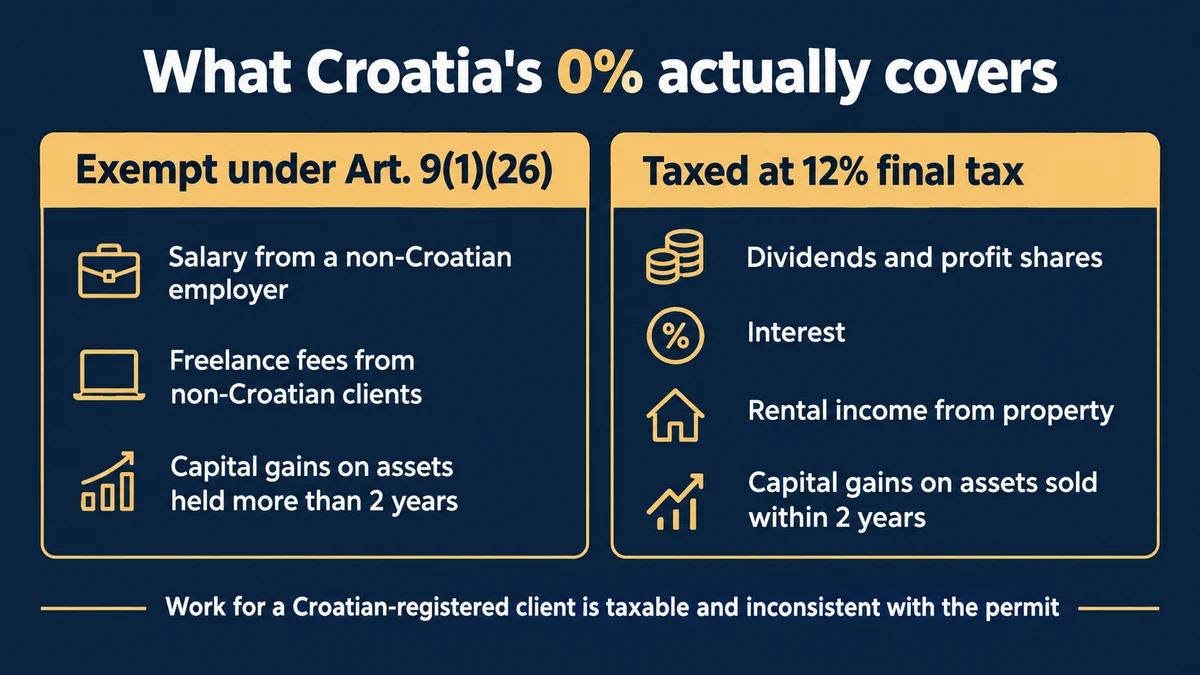
Two practical readings follow. If your income is a salary or invoices, Croatia is genuinely 0% and the schedule above never bites. If a meaningful share of your money is portfolio income, the picture is a 12% flat charge on that slice — still low by European standards, but not the headline, and worth modelling before you move. The two-year rule also means a buy-and-hold investor is treated very differently from an active trader, and that distinction is not in any nomad guide I read.
Whether you become Croatian tax resident at all, and how a treaty would allocate rights if you did, depends on facts this page cannot see. The exemption removes the Croatian charge on work income; it does not decide your residence position, and it certainly does not remove your home country's.
What you would otherwise pay: Croatia's 2026 income tax
Quantifying the exemption requires the counterfactual, and Croatia's is unusual. The old national rates plus municipal surtax were replaced from 1 January 2024 by a two-bracket system where each local authority sets its own rates within statutory ranges, annually. The bracket boundary is €60,000 of annual income.
| Local authority type | Rate up to €60,000 | Rate above €60,000 |
|---|---|---|
| Municipality | 15–20% | 25–30% |
| Town | 15–21% | 25–31% |
| City / county seat | 15–22% | 25–32% |
| City of Zagreb | 15–23% | 25–33% |
| Any that does not set rates by 30 November | 20% (default) | 30% (default) |
On the default rates, a freelancer billing €80,000 would face 20% on the first €60,000 and 30% on the remaining €20,000 — about €18,000 before allowances and before self-employment contributions. That is the number the permit removes, and it is why the six extra months of bank statements are worth assembling properly.
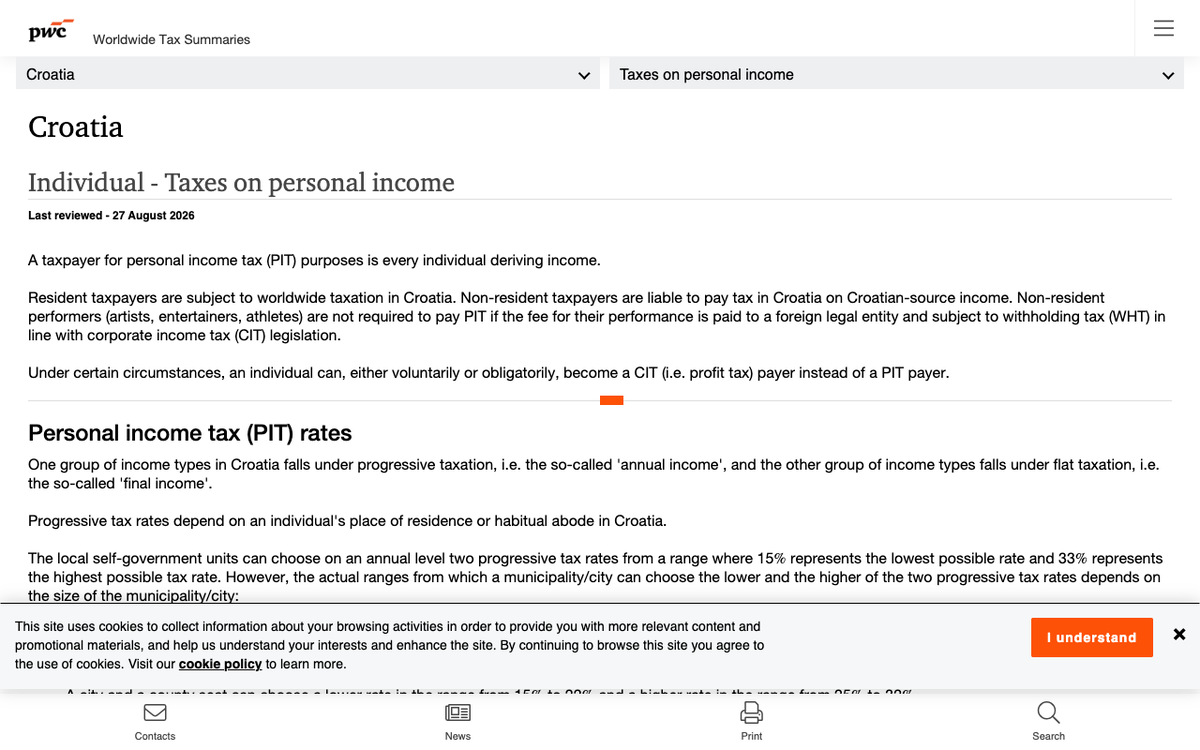
It also explains why where you register matters in Croatia in a way it does not in most countries. Zagreb sits at the top of both ranges; a smaller municipality can be five points lower in each bracket. That is irrelevant while the exemption holds and highly relevant the moment it stops.
Americans: the treaty that still is not in force
Croatia was, for years, the largest EU economy with no income tax treaty with the United States. That has been close to changing for a while without actually changing.
The two countries signed their first income tax treaty on 7 December 2022. It has never been ratified. On 28 April 2026 they signed a protocol amending it, so that the treaty and protocol could be transmitted to the US Senate together for advice and consent — the Treasury's own release describes the protocol as the step that "will allow" that transmission. Until the Senate acts and both governments exchange notifications, there is no treaty in force: no reduced withholding, no treaty tie-breaker on residence, no mutual agreement procedure.
For someone on this permit the practical effect is mostly benign, because Croatia is charging nothing on the work income anyway and there is no double tax to relieve. The trap is the mirror image: a 0% Croatian result means no foreign tax credit to claim, so the US charge is not offset by anything. The foreign earned income exclusion does most of the work instead, subject to its own physical-presence or bona-fide-residence tests, and self-employment tax is not covered by it at all. Americans file on worldwide income regardless; Croatia's exemption changes the Croatian column only.
The 18-month ceiling and the six-month gap
The permit is granted for up to 18 months, replacing the older 12-months-plus-6-month-extension structure that many guides still describe. If you were granted less than the full 18, you can request an extension up to that ceiling, no later than 60 days before expiry.
What you cannot do is roll it over. MUP is explicit: "A new application for regulating a stay of digital nomads can be submitted 6 months after the expiry of previously granted temporary stay."
That single sentence is the whole answer to the permanent-residency question, and it is worth being blunt about because commercial pages hedge it. Permanent residence and naturalisation are built on continuous lawful residence. A mandatory six-month absence from the status is a deliberate break in continuity, and the Aliens Act does not treat digital nomad stay as qualifying time in any case. Eighteen months here, six months elsewhere, eighteen months back: after four years you have accrued nothing at all.
That is a design choice, not an oversight — Croatia built a rotating-guest programme, not a settlement route. It is the right instrument for a defined stay and the wrong one for a five-year plan. If the clock is the point, nomad visas that lead to permanent residency sets out which permits actually accrue.
One upside does come free: Croatia has been in Schengen since 1 January 2023, so the residence card carries the usual right to move in the rest of the area within the Schengen 90/180 rule. Your Croatian days are not Schengen days; everywhere else's still are.
How Croatia compares on price of entry
Croatia is often written up as the cheap option. On income floor it is nothing of the sort — it sits at the top of the European field, within €60 of Portugal's D8.
| Programme | Monthly income floor, 2026 | Tax on foreign work income | Time counts toward PR? |
|---|---|---|---|
| Portugal D8 | ~€3,680 (4× minimum wage) | Ordinary IRS; IFICI narrow | Yes |
| Croatia | €3,622.50 | Exempt | No |
| Greece | €3,500 | Ordinary; 50% break for qualifying new residents | Yes |
| Spain | ~€2,762 (200% SMI) | 24% flat to €600k under the Beckham regime | Yes |
| Italy | €24,789–€28,000/yr (~€2,066–€2,333) | Ordinary; forfettario under €85,000 | Yes |
Peer figures are as published on our country guides for 2026 and move with each country's minimum wage. Read down the columns rather than across: Croatia asks the second-highest entry income in the group and is the only one that then charges nothing, while every cheaper programme leaves you inside an ordinary tax system and, in exchange, lets the residence clock run.
The trade is legible once you put it that way. You are buying eighteen months of zero tax and paying for it in accrual. Whether that is good value depends entirely on whether you wanted the clock.
Who this actually suits
Four conditions, and you want all four rather than three.
You hold a non-EU passport, because the status and the exemption are closed to EU, EEA and Swiss nationals. Your income is active — salary or invoices — because the exemption covers work income and stops there. You are earning comfortably above €3,622.50 a month, since the floor is a formula that rises with Croatian wages and you do not want to be renewing against a moving target. And you want a defined stay rather than a foothold.
Break the last one and Croatia turns expensive. The taxes you saved for eighteen months are real, but you emerge with no residence history, a compulsory six-month gap, and the same decision to make from the same starting line. Someone optimising for an EU passport should be reading about second residency options and putting Croatia in the "nice interval" column, not the "plan" column.
Break the second one — a founder taking dividends rather than salary, an investor turning a portfolio — and the headline mostly evaporates into a 12% flat charge. Still competitive; not the thing you came for. If zero is genuinely the objective rather than low, the honest comparison set is zero-percent tax residencies, and the hardest part of that strategy is set out in tax resident nowhere.
For the reader it does fit — a non-EU freelancer or remote employee, active income, above the floor, who wants a year and a half of Adriatic coastline with a clean tax answer — Croatia is one of the few programmes in Europe that delivers exactly what the brochure claims. That is rarer than it sounds.
Related guides
- Digital nomad visas compared — the full programme-by-programme table Croatia sits inside.
- Nomad visas that lead to permanent residency — which permits accrue time, and which, like Croatia's, do not.
- Spain's digital nomad visa and the Beckham Law — the cheaper entry with a flat 24%.
- Italy's digital nomad visa — the lowest income floor in the group, and three tax regimes to choose between.
- Portugal's D8 — the closest comparable on price, without the exemption.
- Second residency ranked 2026 — cost, speed and days on the ground across the alternatives.
FAQ
What is the income requirement for the Croatia digital nomad visa in 2026?
€3,622.50 per month for a single applicant, stated directly on the Ministry of the Interior's page. It is a formula rather than a fixed number — 2.5 times the average monthly net salary paid in Croatia the previous year — so it moves annually, and the current figure implies a base of €1,449. Instead of monthly income you may show a lump sum already banked: €43,470 for 12 months or €65,205 for 18. Proof is a bank statement showing regular income, or payslips for the last six months.
How much more income do you need for a spouse or child?
Less than most guides say. MUP's wording is that the amount "is increased by 10% of the average monthly net salary for each additional family member" — 10% of the €1,449 base, which is €144.90 a head, not 10% of the €3,622.50 threshold. A couple therefore needs about €3,767.40 a month, not the €3,984.75 several 2026 guides publish. Read the ministry page before you conclude your file is short.
Do digital nomads pay income tax in Croatia?
Not on qualifying foreign work income. Article 9(1)(26) of the Personal Income Tax Act, in force since 1 January 2021, exempts income from employment or self-employment performed for an employer not registered in Croatia, for holders of digital nomad status. The exemption is income-specific rather than a blanket non-residence: dividends, interest, rent and gains on assets held under two years fall under Croatia's 12% final tax on capital income.
Can EU citizens get the Croatia digital nomad visa?
No. The permit is defined for third-country nationals, and EU, EEA and Swiss citizens have free movement rights that make it unnecessary. The consequence people miss is the tax one: because Article 9(1)(26) is tied to holding the status, an EU national living in Croatia and invoicing a foreign client cannot use it and is taxed under ordinary rules once resident. The 0% headline is for non-EU nationals only.
How much does the Croatia digital nomad visa cost?
Between roughly €87.59 and €148.74 in government fees, depending on route. Filing in Croatia at a police administration costs €46.45 for the temporary stay, €9.29 administrative and €31.85 for the biometric card — €87.59, or €115.47 with the €59.73 accelerated card. Filing at a diplomatic mission costs €55.74 plus €93.00 for the D visa, or €55.74 plus €41.14 if you are visa-exempt. Legalised criminal-record checks, translations and insurance are extra.
Does the Croatia digital nomad visa lead to permanent residency?
No, and the structure makes that close to impossible rather than merely hard. The permit runs up to 18 months, is not consecutively renewable, and MUP states a new application "can be submitted 6 months after the expiry of previously granted temporary stay". Permanent residence and naturalisation are built on continuous lawful residence, and a compulsory six-month gap breaks continuity by design.
Is there a US–Croatia tax treaty?
Signed, but not in force as of September 2026. The two countries signed their first income tax treaty on 7 December 2022, and on 28 April 2026 signed a protocol amending it so the package could be transmitted to the US Senate for advice and consent. Until the Senate acts and both sides exchange notifications there is no treaty relief and no treaty tie-breaker. Americans on this permit still file a US return on worldwide income.
Can you work for Croatian clients on the permit?
No. MUP defines the category as working for a company not registered in Croatia that "does not perform work or provide services to employers in the Republic of Croatia". A Croatian-registered client is both a tax problem — that income sits outside Article 9(1)(26) — and a status problem, because it cuts against the purpose the permit was granted for.
Sources
- Ministarstvo unutarnjih poslova (MUP) — Temporary stay of digital nomads — the €3,622.50 threshold and the €43,470 / €65,205 lump sums, the "10% of the average monthly net salary" family wording, six months of payslips, the full fee list by route, the 18-month ceiling, the 60-day extension deadline and the six-month reapplication gap.
- PwC Worldwide Tax Summaries — Croatia, taxes on personal income — the 2026 two-bracket system, the €60,000 boundary, the statutory ranges by local authority type and the 20%/30% default.
- PwC Worldwide Tax Summaries — Croatia, income determination — the 12% final tax on dividends, interest, rental income and capital gains, and the two-year holding rule.
- US Department of the Treasury — United States, Croatia sign protocol to income tax treaty — the 28 April 2026 protocol and the statement that it allows transmission of the 2022 treaty to the Senate for ratification.
- Kluwer International Tax Blog — Croatia: a new (tax-free) promised land for digital nomads? — the Article 9(1)(26) exemption, its 1 January 2021 commencement and its inapplicability to EU/EEA/Swiss nationals.
Figures are current as of September 2026. The income threshold is a statistic-linked formula that MUP revises annually, and local income tax rates are re-set by each Croatian authority every year, so check both against the primary sources above on the day you file. Tax outcomes depend on facts this page cannot know, including your other income, your residence history and your treaty position. This is editorial research, not legal, immigration or tax advice.