
Italy took until April 2024 to open a digital nomad visa, years after Portugal, Spain and Greece, and the guides written since have settled on a set of numbers that mostly do not appear on any official page. The most-repeated of them, the €28,000 income requirement, is higher than the figure any Italian consulate I checked actually publishes — and the consulates do not agree with each other either.
That matters, because the income floor is the test most applications are planned around. Below it you are not applying; above it you are choosing between three different Italian tax regimes that produce effective rates from roughly 23% to nearly 45% of revenue, and almost nothing written about this visa runs those numbers.
This guide does. I read the decree's requirements as four Italian consular missions state them, pulled the 2026 IRPEF brackets from the Ministry of Economy and Finance, and worked the effective tax at €60,000, €85,000 and €100,000 of billings under the regime forfettario, ordinary IRPEF and the impatriate regime. Where sources disagree, I have said so rather than picked the convenient one.
Key takeaways
- There is no single income number. New York states €24,789, London and Pristina €25,500, Toronto publishes none, and advisers quote €28,000. The decree sets a formula — three times the healthcare cost-sharing exemption level — not a figure.
- Processing is slower than advertised. London says applications "may require up to 120 days" with no exceptions. The widely-quoted 30–60 days is not what the consulates say.
- The 2026 Budget Law cut the second IRPEF bracket from 35% to 33% for income between €28,000 and €50,000, and withholds the cut above €200,000. Most pages on this visa still show 35%.
- The forfettario wins under €85,000. Roughly 23.2% of revenue in the first five years and 29.0% after, against about 31% under the impatriate regime and 44.7% under plain IRPEF at €100,000.
- The impatriate regime carries a four-year lock-in with full clawback, on a permit that is renewed every twelve months.
SafetyWing — nomad medical cover, for the applicant still shopping for a policy
What the Italy digital nomad visa actually is
The legal basis is the interministerial decree of 29 February 2024, published in the Gazzetta Ufficiale on 4 April 2024, which brought Article 27-quater of Legislative Decree 286/1998 into operation. It creates two adjacent categories, and the distinction decides which consulate page applies to you:
| Digital nomad (nomade digitale) | Remote worker (lavoratore da remoto) | |
|---|---|---|
| Who it covers | Self-employed — freelancers, consultants, independent professionals | Employees of a non-Italian company working fully remotely |
| Extra document required | Proof of professional qualification | Employer declaration of no convictions in the last five years |
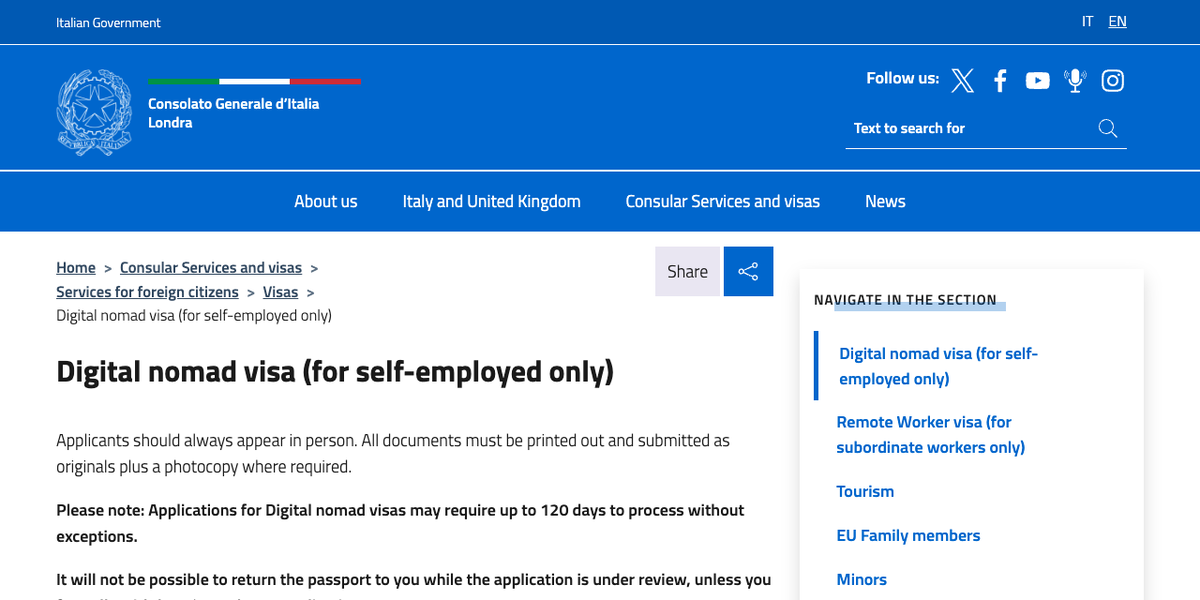
| Accepted everywhere? | Yes | No — London states the route is for self-employed applicants only |
The decree's headline benefit is that this route sits outside the decreto flussi quota system and needs no employment clearance, which is what makes it usable at all. The visa is issued for up to 365 days and renewed annually.
One point the marketing pages soften: this is a residence route, not a tax route. Italy taxes residents on worldwide income once you pass 183 days in a calendar year, and nothing in the decree changes that. If you are shopping for a low-tax base rather than a life in Italy, read zero-tax residency options before you read the rest of this page.
The income floor nobody states the same way
The decree requires annual income from lawful sources of at least three times the minimum level for exemption from participation in Italian healthcare costs. It does not name a euro figure, and that is why the published numbers differ:
| Mission | Stated minimum income | How it is worded | Stated processing time |
|---|---|---|---|
| Consulate General, New York | €24,789 | "three times the minimum necessary to pay healthcare taxes in Italy" | not stated |
| Consulate General, London | €25,500 | "at least triple the prevailing minimum amount level (€8,500.00)" | up to 120 days, no exceptions |
| Embassy, Pristina | €25,500 | "not less than three times the minimum amount (€8,500)" | not stated |
| Consulate General, Toronto | no figure published | formula only, with a link to the health ministry threshold | 45–90 business days for certain visa types |
| Immigration advisers, 2026 practice | €28,000 | market convention | commonly quoted as 30–60 days |
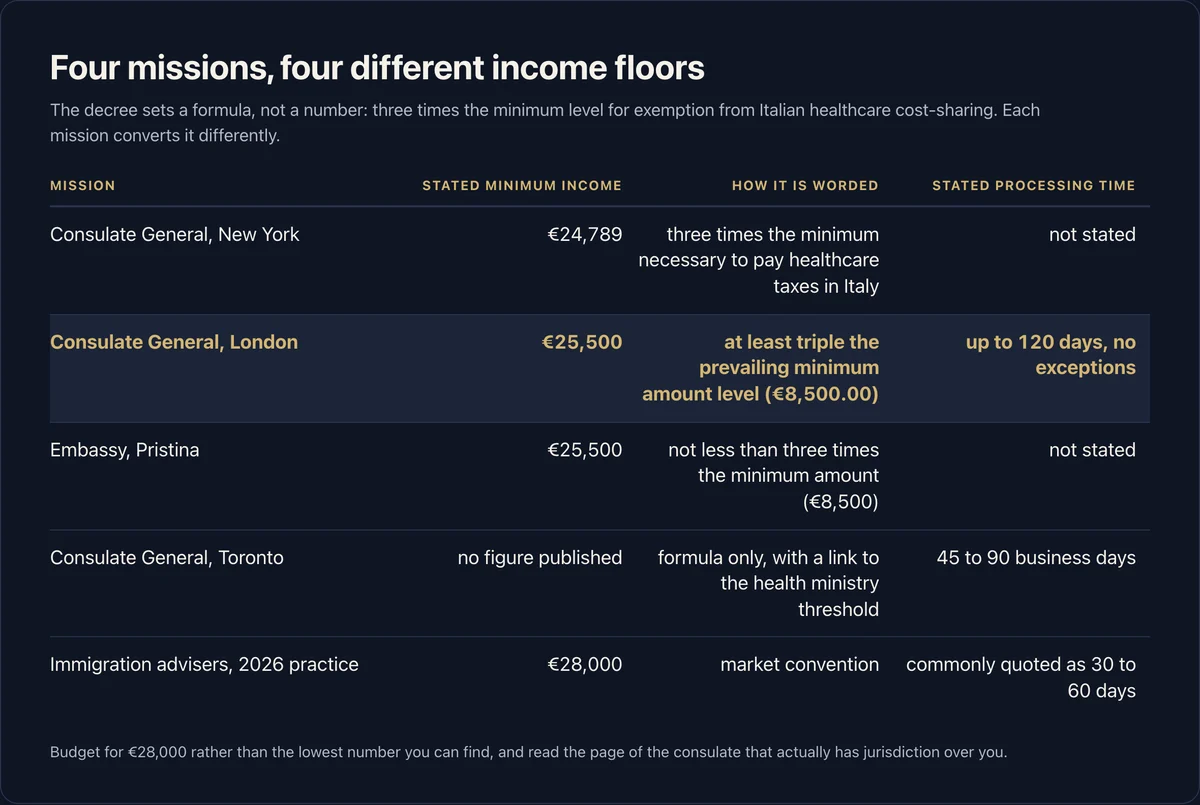
Three official missions, three different answers, and the number most people plan around is not one of them. The honest reading is that the decree fixes a formula whose input is revised, and each mission converts it on its own schedule — so the applicable figure is whatever your own consulate publishes on the day you file.
Practically: build the file to €28,000 of gross annual income. It clears every published threshold, it costs nothing to exceed, and it removes the argument. Income must come from work you will actually perform, evidenced by tax returns, contracts and bank statements; passive income — dividends, rent, capital gains, pensions — does not count. Dependants add roughly €780 per month each to the requirement.
Who counts as "highly qualified"
This is the requirement that quietly disqualifies people, because the decree borrows the "highly qualified worker" test rather than inventing a softer one. You satisfy it with any one of four things:
- A tertiary qualification of at least three years;
- Certification in a regulated profession;
- Five or more years of professional experience judged comparable to a degree;
- Three or more years of relevant ICT experience gained within the last seven, for IT and senior management roles.
Separately, you need at least six months of documented experience working as a digital nomad or remote worker — this is a second test, not a restatement of the first, and it is what stops the visa being used to start a freelance career from a standing position.
The friction is documentary rather than substantive. Qualification evidence generally has to be an authenticated copy, apostilled by the competent authority in the issuing country and accompanied by an Italian translation, and some consulates additionally expect a CIMEA declaration of value for foreign degrees. Start that chain early; it is the step that adds weeks.
What it costs and how long it really takes
The visa itself is cheap. Everything around it is not.
| Item | Typical 2026 cost | Note |
|---|---|---|
| National visa (type D) fee | €116 | Consular fees are revised quarterly — 1 Jan, 1 Apr, 1 Jul, 1 Oct |
| Postal / service fee | ~€30 | Varies by mission |
| Health insurance, minimum cover | €30,000 (NY: or $50,000) | New York calls inadequate cover "the number one reason for visa rejections" |
| Residence permit kit and card | ~€70–€100 | Paid in Italy, at the post office and Questura |
| Apostilles, sworn translations, CIMEA | €200–€600 | The genuinely variable line |
| Registered rental contract | first month + deposit | Must be registered with the Agenzia delle Entrate |
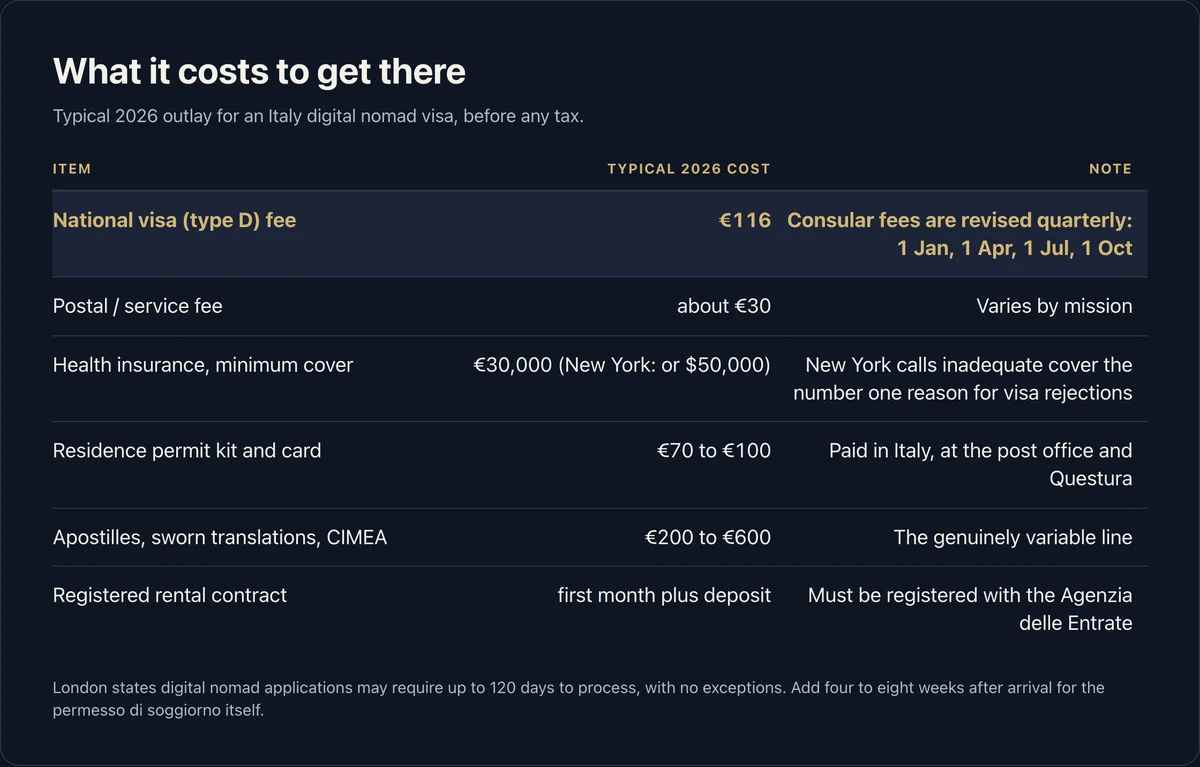
On timing, take the consulates at their word rather than the guides: London says up to 120 days, Toronto quotes 45–90 business days for certain visa types, and the 30–60 day figure repeated across the affiliate SERP is not sourced to any mission I could find. Then add the in-country leg — the residence permit application is due within eight working days of arrival, and the card itself commonly takes four to eight weeks after biometrics, longer in Rome and Milan.
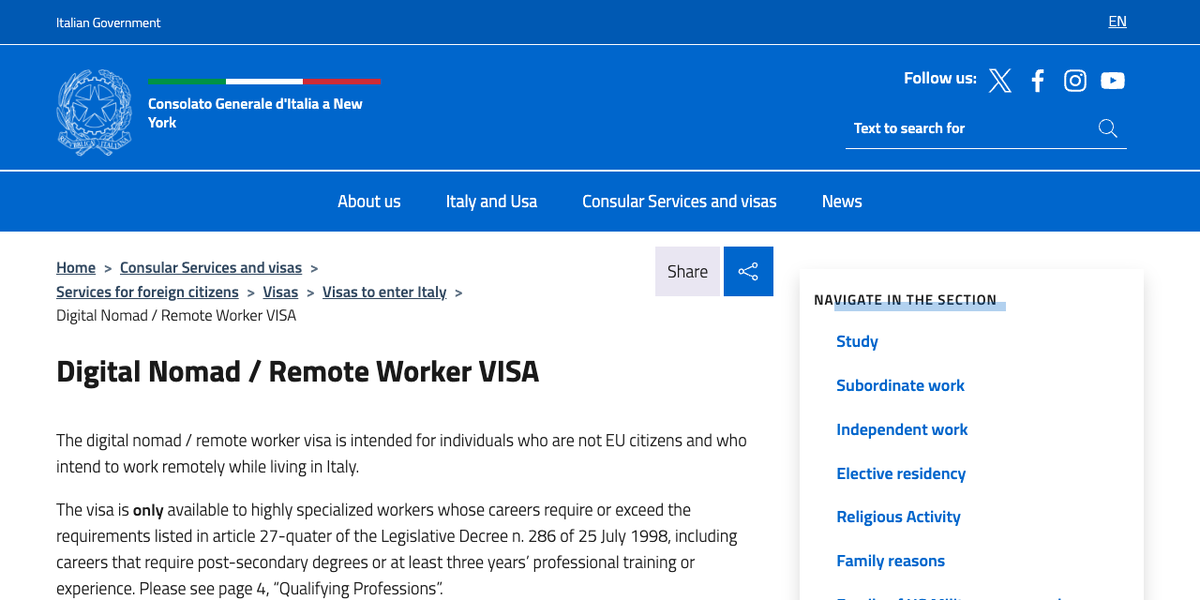
The insurance line deserves its own sentence. A policy that reads adequately to you can still be refused for excluding hospitalisation, capping repatriation, or not covering the full permit period. Compare it against the wording your own consulate publishes, and if you are weighing products, our nomad travel insurance comparison and expat health insurance guide set out where the cheap policies stop.
The tax question: three regimes, not one
Cross 183 days and you are an Italian tax resident on worldwide income. From there you are choosing between three regimes, and the choice is worth more than everything else on this page combined.
| Regime forfettario | Ordinary IRPEF | Impatriate regime (impatriati) | |
|---|---|---|---|
| Legal basis | Law 190/2014 as amended | TUIR, rates set annually | Art. 5, D.Lgs 209/2023 |
| Revenue ceiling | €85,000 | none | income cap €600,000/yr |
| How income is measured | fixed coefficient — 78% for most professional codes | actual revenue less documented costs | actual income, 50% exempt (60% with a minor child) |
| Headline rate | 15%, or 5% for the first five years of a new activity | 23% / 33% / 43% (2026) | IRPEF rates on the reduced base |
| Duration | until you breach the cap | indefinite | 5 years |
| Social contributions | INPS Gestione Separata 26.07%, not reduced | same | same — the exemption does not touch INPS |
| Lock-in | none | none | 4 years' residence, full clawback with interest |
Three details do most of the work here.
First, the 2026 Budget Law cut the second IRPEF bracket from 35% to 33% for taxable income between €28,000 and €50,000, and expressly withholds the cut from incomes above €200,000. Pages written before this year still quote 35%.
Second, INPS is the largest single line for a self-employed nomad and no regime reduces it. Gestione Separata runs at 26.07% for professionals with no other mandatory pension fund, and it applies under the forfettario and the impatriate regime alike.
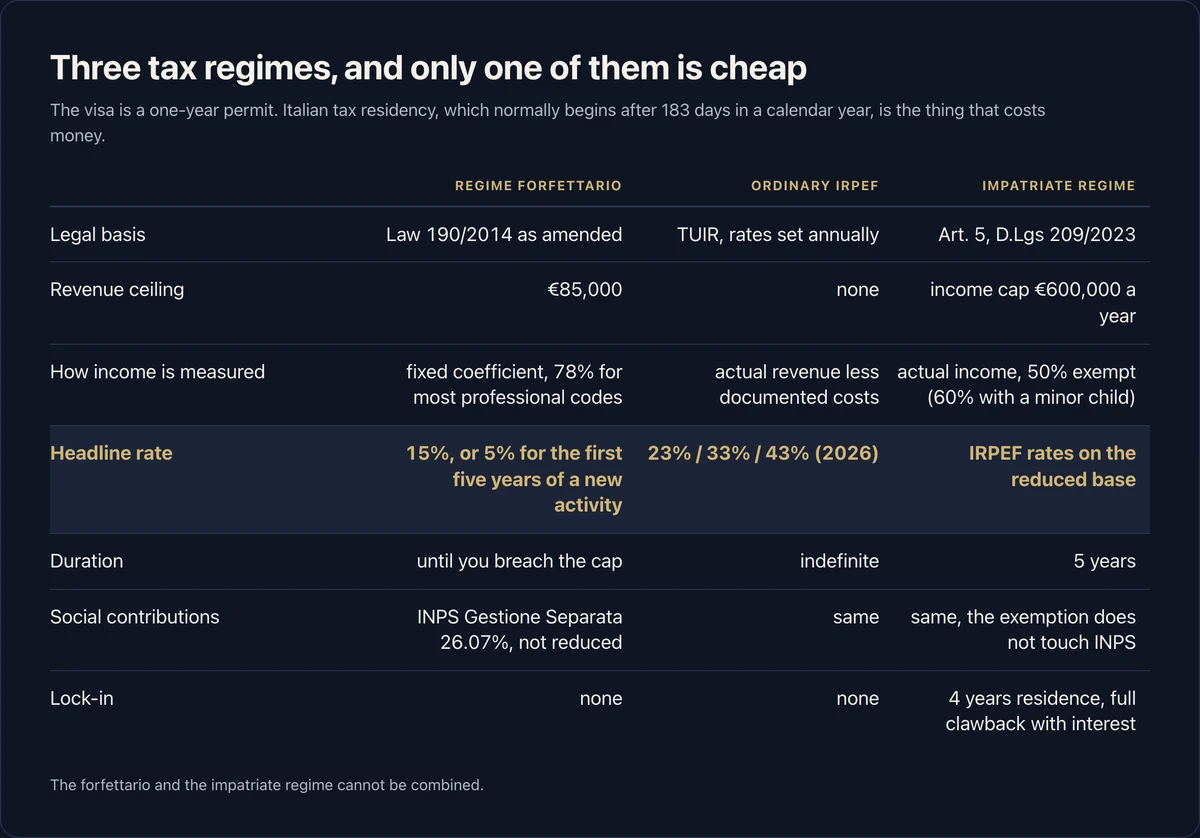
Third, the forfettario and the impatriate regime cannot be combined. You pick one. And the impatriate regime has entry conditions the forfettario does not: three tax years of prior non-residence (six or seven if you keep working for the same employer group), the same high-qualification standard as the visa, and income from a profession rather than a sole-trader business — business income from a ditta individuale was removed from the regime in the 2024 rewrite.
Running the numbers at €60,000, €85,000 and €100,000
Assumptions, stated so you can disagree with them: a solo professional on a 78% coefficient code, INPS Gestione Separata at 26.07%, 2026 IRPEF brackets, regional and municipal surcharges taken together at an illustrative 2.5% — they genuinely range from about 1.2% to 3.3% regionally plus up to 0.9% municipally — and, in the ordinary-regime rows, documented business costs of €12,000 at the €100,000 level and €10,000 at €85,000.
| Billings | Regime | INPS | Income tax + surcharges | Total | Effective rate |
|---|---|---|---|---|---|
| €60,000 | Forfettario, 5% (years 1–5) | €12,201 | €1,730 | €13,931 | 23.2% |
| €60,000 | Forfettario, 15% | €12,201 | €5,190 | €17,391 | 29.0% |
| €85,000 | Forfettario, 15% (at the cap) | €17,284 | €7,352 | €24,637 | 29.0% |
| €85,000 | Ordinary IRPEF + impatriati 50% | €19,553 | €7,070 | €26,622 | 31.3% |
| €100,000 | Ordinary IRPEF, no relief | €22,942 | €21,802 | €44,743 | 44.7% |
| €100,000 | Ordinary IRPEF + impatriati 50% | €22,942 | €8,748 | €31,690 | 31.7% |
Read down the effective-rate column and the conclusions are unusually clean.
The forfettario is a flat effective rate. Because both the coefficient and the substitute tax are proportional, the percentage does not move with revenue — 29.0% at €60,000 and 29.0% at €85,000. Nothing else on this list behaves that way.
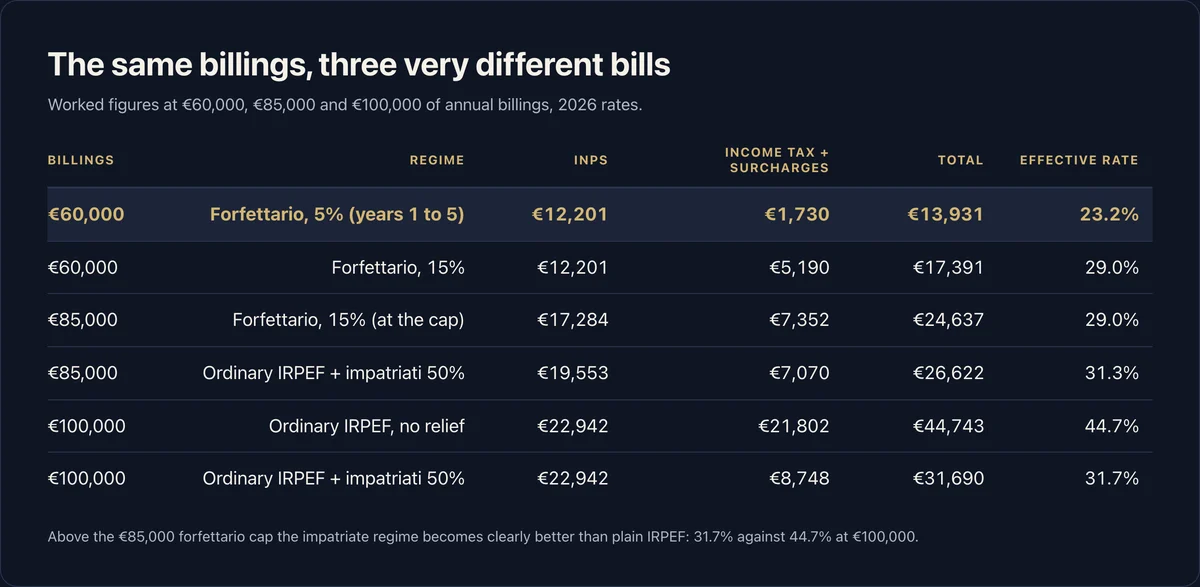
Under the cap, the forfettario beats the impatriate regime — 29.0% against 31.3% at €85,000 — and beats it without a four-year commitment or a clawback risk. In the first five years of a new activity, at 23.2%, it is not a close contest.
Above the cap, the impatriate regime is the only thing standing between you and 44.7%. At €100,000 it saves about €13,000 a year. That is when the lock-in starts to look like a price rather than a trap.
Where Italy stops making sense
The €85,000 forfettario ceiling is the cliff edge of this visa. Breach it and you land in ordinary IRPEF, where the top bracket starts at €50,000 — low, by European standards — and the effective rate on €100,000 of billings is close to 45% before you have considered VAT administration or the cost of the accountant you now need.
The impatriate regime softens that, but it is a five-year benefit with a four-year residence commitment attached, claimed on a permit that is re-decided every twelve months. If your work, your clients or your family situation might move you inside four years, you are underwriting a retroactive clawback with interest. That is a real risk on a one-year renewable permit, and no page I read while researching this mentioned the mismatch at all.
So the shape of the reader Italy actually suits is narrow and worth stating plainly: a qualified freelancer billing roughly €30,000 to €85,000, who wants to live in Italy for its own sake, and who can use the forfettario. Above that band, compare honestly — Spain's digital nomad visa and the Beckham Law run a flat 24% on employment income to €600,000, and the Italian golden visa is a different instrument for a different balance sheet. Below it, you will not clear the income floor.
The permesso and what happens after year one
The visa gets you in; the permesso di soggiorno is what lets you stay. You apply within eight working days of entry, usually via the post office kit and then a Questura appointment for biometrics, and the card typically arrives four to eight weeks later. Renewal is annual and runs on the same evidence as the original application — income, insurance, registered accommodation — so the file never really closes.
Two longer horizons are worth keeping in view. Five years of continuous legal residence opens the EU long-term residence permit, and ten years opens naturalisation by residence for non-EU nationals. Neither is automatic, and both are sensitive to gaps: a failed renewal, or too much time spent outside Italy, can reset the clock. If the ten-year path is the actual objective rather than a bonus, read which nomad visas lead to permanent residency before you commit to Italy specifically.
And if you are still deciding whether to become resident anywhere at all, the arithmetic of staying mobile is set out in the Schengen 90/180 rule and in tax resident nowhere — the second of which explains why that state is harder to hold than it looks.
Related guides
- Digital nomad visas compared — the full programme-by-programme table Italy sits inside.
- Spain's digital nomad visa and the Beckham Law — the closest comparable, and a flat 24% alternative.
- Thailand's digital nomad route — the non-EU comparison for the same income band.
- Nomad visas that lead to permanent residency — which permits count toward the five- and ten-year clocks.
- Second residency ranked 2026 — cost, speed and days on the ground across the alternatives.
- The Italian golden visa — the investor route, for a different balance sheet.
FAQ
What is the income requirement for the Italy digital nomad visa?
The decree does not set a number. It requires annual income of at least three times the minimum level for exemption from Italian healthcare cost-sharing, and consulates convert that formula differently. New York states €24,789; London and the Embassy in Pristina both state €25,500, calculated as three times €8,500; Toronto publishes no figure and links to the health ministry's current threshold. Advisers in 2026 tend to quote €28,000, which is above every published consular figure. Budget for €28,000 and read the page of the consulate with jurisdiction over you.
How long does the Italy digital nomad visa take to process?
Longer than most guides say. The Consulate General in London states that digital nomad applications "may require up to 120 days to process" with no exceptions, and Toronto quotes 45 to 90 business days for certain visa types. The widely repeated 30-to-60-day figure is optimistic. Add four to eight weeks after arrival for the residence permit card, because the permesso di soggiorno is a separate process that begins once you are in Italy.
Who counts as a highly qualified worker for this visa?
Any one of four things: a tertiary qualification of at least three years, certification in a regulated profession, five or more years of professional experience comparable to a degree, or three or more years of relevant ICT experience gained in the last seven. You also need six months of documented prior experience working remotely. Qualification documents generally have to be authenticated, apostilled and translated into Italian.
Do digital nomads pay tax in Italy?
Yes, once you become an Italian tax resident, which normally happens after 183 days in a calendar year. Italy then taxes worldwide income, not only Italian-client earnings. The visa is a one-year permit, but tax residency is the thing that costs money, and the two are decided by different rules. Treaties allocate taxing rights between Italy and your home country; they do not make income untaxed.
Can a digital nomad visa holder use the regime forfettario?
Generally yes, with an Italian VAT number and annual revenue under €85,000. The regime applies a fixed profitability coefficient — 78% for most consulting and professional codes — then a substitute tax of 15%, or 5% for the first five years of a genuinely new activity. INPS Gestione Separata is charged separately at 26.07% and is not reduced. That combination is what makes the forfettario the cheapest route for most people on this visa.
Is the impatriati regime better than the regime forfettario?
Only above the forfettario's cap. The impatriate regime exempts 50% of qualifying income, rising to 60% if you relocate with a minor child, up to €600,000 a year for five years. On the figures above, a professional billing €85,000 pays about 29% of revenue under the forfettario against about 31% under ordinary IRPEF with the impatriate exemption. Above €85,000 the forfettario is unavailable and the impatriate regime becomes clearly better than plain IRPEF. The two cannot be combined.
What happens if I leave Italy after claiming the impatriati regime?
You lose it retroactively. The regime requires Italian tax residence for at least four years, and leaving earlier triggers a full clawback with interest. That is a genuine problem here, because the digital nomad permit is issued for up to 12 months and renewed annually — you are committing to four years on the strength of a permit re-decided every year. Take advice before electing the regime.
Does this visa lead to permanent residency or citizenship?
It can. Legal residence counts toward the EU long-term residence permit at five years and toward naturalisation by residence at ten years for non-EU nationals, provided residence is continuous and the income, integration and language conditions are met. Nothing is automatic, and gaps from a failed renewal or long absences can reset the clock.
Sources
- Consolato Generale d'Italia, London — Digital nomad visa (for self-employed only) — the €25,500 figure as three times €8,500, the self-employed-only scope, and the 120-day processing statement.
- Consolato Generale d'Italia, New York — Digital Nomad / Remote Worker visa — €24,789, the €30,000/$50,000 insurance minimum, and insurance as the leading refusal ground.
- Ambasciata d'Italia, Pristina — Digital nomad and remote worker visa — the decree of 29 February 2024, Article 27-quater, the four qualification routes, 365-day validity and the eight-working-day permit deadline.
- Consolato Generale d'Italia, Toronto — Digital Nomad and Remote Worker National Visa — the formula stated without a euro figure, and the 45–90 business day range.
- Ministero dell'Economia e delle Finanze — Main measures of the 2026 Budget Law — "Reduction of the second IRPEF bracket (income between €28,000 and €50,000) from 35% to 33%", not applying above €200,000.
Figures are current as of September 2026 and consular requirements are revised without notice — the mission with jurisdiction over your residence is the only authority on its own thresholds, fees and processing times. Tax outcomes depend on facts this page cannot know, including your other income, your prior residence history and your treaty position. This is editorial research, not legal, immigration or tax advice.