
The Greece golden visa is still marketed on a number that stopped being generally available two years ago. Search the programme and the figure €250,000 comes back from most of the first page, when a standard apartment purchase has needed €400,000 or €800,000 since 1 September 2024, depending on where it sits on a map.
The gap between the marketing and the statute is not academic. It is the difference between a plan that clears and one that fails at the notary, and for a buyer in Athens it is a €550,000 difference. Greece raised the price, restricted the shape of the asset, and banned the rental income that used to justify the purchase, all in one law.
This guide gives the 2026 rules as they are actually written, the full cost stack rather than the headline, and the structural catch that the firms selling the service have no reason to lead with. Every figure below is dated and sourced to the governing legislation or the Greek authorities, because on this programme the secondary sources are unusually unreliable.
Key takeaways
- The €250,000 tier is a carve-out, not a floor. Since 1 September 2024 the general thresholds are €800,000 in Attica, Thessaloniki, Mykonos, Santorini and islands over 3,100 inhabitants, and €400,000 elsewhere.
- One property, 120 square metres minimum. Combining smaller units to reach the threshold no longer qualifies, which raised the effective entry price more than the headline change did.
- Short-term letting is banned on qualifying properties, with revocation and administrative fines for breach. The yield argument for buying in prime zones is gone.
- The conversion route is now the busiest one. Most new applications arrive through the €250,000 commercial-to-residential carve-out rather than the standard tiers.
- Zero stay is the feature and the trap. The permit needs no presence, but the €100,000 non-dom regime and the 7-year naturalisation route both require you to live in Greece.
On this page: What it actually buys · The three price tiers · The 120 sqm and single-property rules · The conversion route · Routes without property · What it actually costs · The rental ban · The presence paradox · Greece vs Portugal, Italy and the UAE · Who it suits · Related guides · FAQ · Sources
SafetyWing — Private health cover, a documented filing requirement on every Greek golden visa application
What the Greece golden visa actually buys in 2026
The programme sits in Article 100 of the Greek Migration Code, Law 5038/2023, as amended by Article 64 of Law 5100/2024. It grants a third-country national a five-year residence permit in exchange for a qualifying investment, renewable for as long as the investment is held.
| Parameter | 2026 position |
|---|---|
| Legal basis | Article 100, Migration Code (Law 5038/2023), amended by Law 5100/2024 |
| Permit term | 5 years, renewable while the investment is maintained |
| Minimum stay | None |
| Family | Spouse and dependent children included |
| Schengen | Visa-free travel in the Schengen Area |
| Work rights | Not granted by the permit itself |
| Route to citizenship | 7 years of actual residence, B1 Greek, civics examination |
| Government fee | €2,000 main applicant, €150 per adult family member, €16 card |
Two lines in that table do most of the work. The absence of a minimum stay is why the programme sells, and the absence of work rights is why it is a wealth-holding instrument rather than a relocation route. The permit lets you keep a European base without living in it, and that is the whole product.
The three price tiers and the zone that decides yours
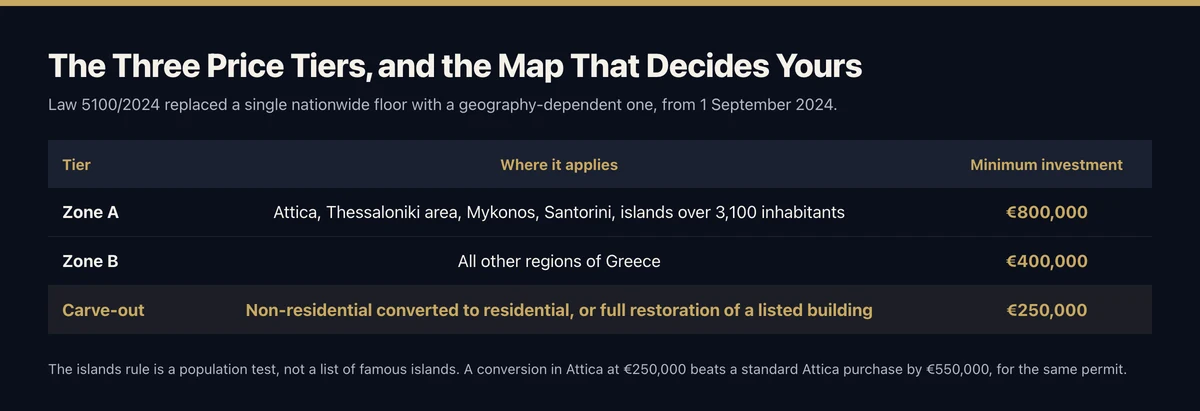
The 2024 reform replaced a single nationwide €250,000 threshold with a geography-dependent one. Where the property sits now determines the price of entry more than what it is.
| Tier | Where it applies | Minimum investment |
|---|---|---|
| Zone A | Attica (Athens and Piraeus), the Thessaloniki area of Central Macedonia, Mykonos, Santorini (Thira), and islands with over 3,100 inhabitants | €800,000 |
| Zone B | All other regions of Greece | €400,000 |
| Carve-out | Conversion of a non-residential building to residential use, or full restoration of a listed or historic building | €250,000 |
The thresholds took effect for transactions from 1 September 2024, and the full amount must be paid before the application is submitted. Permits issued under the older frameworks remain valid on their original terms, so a holder from 2019 is not retroactively caught by any of this.
The islands rule catches people out. It is not a list of famous islands but a population test, so a great many Aegean and Ionian islands that nobody would describe as prime sit in the €800,000 band because they cross 3,100 residents. Confirm the classification of a specific municipality before you make an offer, not after.
The 120 square metre rule and the single-property rule
Two structural conditions sit underneath the price tiers, and between them they moved the real entry price far more than the headline numbers did.
The investment must be a single property. Assembling three small apartments to reach a threshold was standard practice before the reform and no longer qualifies. One asset must clear the bar by itself.
That property must have a main living area of at least 120 square metres, for the €400,000 and €800,000 tiers. Auxiliary spaces — storage, parking, terraces — may count toward the property's value but do not reliably count toward the living-space minimum. Undeveloped land and plots are exempt from the size requirement, and so are the conversion and restoration carve-outs.
Put the two together and the Zone B buyer is not looking for €400,000 of Greek property. They are looking for a single 120-square-metre-plus home priced at €400,000 or more, outside Attica, Thessaloniki and the larger islands. That is a much narrower search than the number implies, and in several regional markets the qualifying stock is thin enough that buyers overpay to clear the threshold rather than because the asset is worth it. Our golden visa programme roundup sets the same test against the other active European schemes.
The cheapest route is now the conversion route
The €250,000 carve-out was written as a niche provision for urban regeneration. It has become the main entrance. Most new applications now arrive through the commercial-to-residential conversion route rather than through either standard tier, which is a striking outcome for a rule designed to be an exception.
The logic is simple arithmetic. The carve-out is nationwide, so it applies in Athens as readily as in Thrace, and it escapes the 120 square metre floor. A conversion in Attica at €250,000 therefore beats a standard Attica purchase at €800,000 by €550,000, for the same permit.
The conditions are strict and worth stating plainly:
- The change of use must be completed before the application is submitted, not promised. A property that is still legally commercial on filing day does not qualify.
- A converted property cannot be used as a company headquarters or a branch office.
- The restoration variant requires full restoration of a listed or historic building, which is a construction project with the cost overruns that implies.
The risk is concentrated in the first condition. You are buying a commercial asset and carrying the planning, permitting and construction risk of converting it before you have any immigration outcome at all. That is a different risk profile from wiring money for a finished apartment, and it explains why the route is cheap.
The routes that do not involve property
Greece also grants the permit for financial investments. They are rarely used — comfortably under a tenth of applications — but they suit anyone who wants the permit without becoming a Greek landlord.
| Investment | Threshold |
|---|---|
| Mutual fund or AIF shares, Greece-focused | €350,000 |
| Shares or corporate bonds on a regulated market | €500,000 |
| Real estate investment company (REIC) shares | €500,000 |
| Closed-end investment company or mutual fund shares | €500,000 |
| Greek government bonds, 3+ years to maturity | €500,000 |
| Fixed-term deposit in a Greek credit institution, 1 year minimum | €500,000 |
| Mixed portfolio of listed shares, corporate and government bonds | €800,000 |
The €350,000 fund route is the cheapest way into the programme outside the conversion carve-out, and it carries none of the construction risk. The trade-off is that your capital sits in Greece-focused securities chosen for immigration reasons rather than investment ones, and the fixed-term deposit route in particular means parking half a million euros at deposit rates for as long as you want the permit.
What it actually costs once the fees land
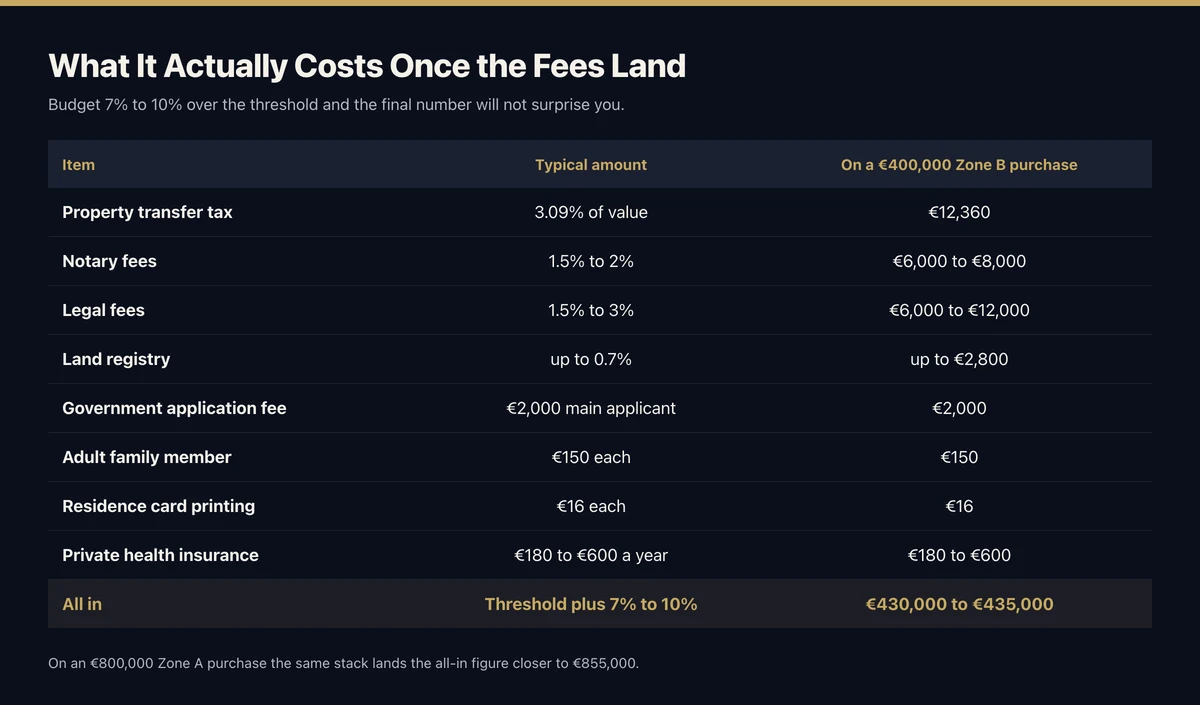
The threshold is not the price. Greek property transactions carry a stack of statutory and professional costs that a first-time buyer routinely underestimates by five figures.
| Item | Typical amount |
|---|---|
| Property transfer tax | 3.09% of value |
| Notary fees | 1.5% to 2% |
| Legal fees | 1.5% to 3% |
| Land registry | up to 0.7% |
| Government application fee | €2,000 main applicant |
| Adult family member | €150 each |
| Residence card printing | €16 each |
| Private health insurance | €180 to €600 a year |
On a €400,000 Zone B purchase that stack comes to roughly €27,000 to €33,000, so the all-in figure lands around €430,000 to €435,000. On an €800,000 Zone A purchase it is closer to €855,000. Budget 7% to 10% over the threshold and you will not be surprised.
One line deserves emphasis for anyone converting from outside the eurozone. Every one of these payments is denominated in euros and they land in stages across six to twelve months, so the exchange spread is charged repeatedly rather than once. On a purchase this size a two-percent retail margin is a five-figure cost that never appears in any fee table.
The short-term rental ban that breaks the yield case
Under the current rules a qualifying property cannot be let through short-term rental platforms. Breach exposes the holder to revocation of the permit and administrative fines.
This is the change that most damages the investment case, and it gets the least attention. The pitch for buying in Attica or on a popular island was never purely immigration — it was that the asset would generate holiday-letting income against the purchase. Law 5100/2024 raised the Zone A price to €800,000 and simultaneously removed the income stream that was supposed to service it.
What remains is long-term letting, at long-term yields, on an asset bought at a price set by immigration demand rather than rental demand. Anyone modelling this as an investment with a residency bonus should re-run the numbers as a residency purchase with a modest income offset, because that is what the statute now describes. Treat the permit as the thing you are buying and the property as the thing you must hold to keep it, and the decision gets clearer.
The presence paradox at the centre of the programme
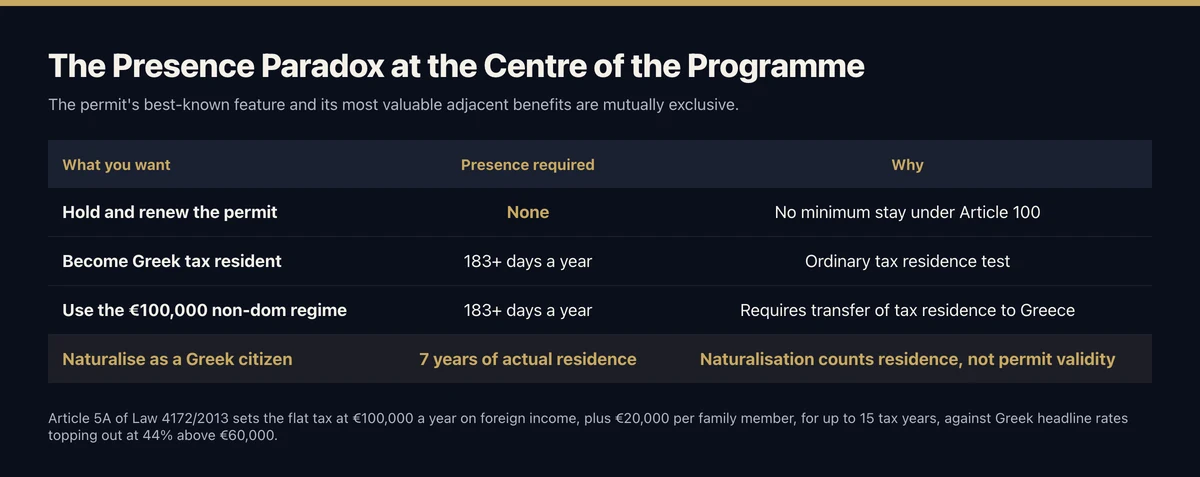
Here is the structural point that the sales pages will not organise a section around. The Greek golden visa's headline feature is that you never have to come. Its two most valuable adjacent benefits both require you to move.
| What you want | Presence required | Why |
|---|---|---|
| Hold and renew the permit | None | No minimum stay under Article 100 |
| Become Greek tax resident | 183+ days a year | Ordinary tax residence test |
| Use the €100,000 non-dom regime | 183+ days a year | Requires transfer of tax residence to Greece |
| Naturalise as a Greek citizen | 7 years of actual residence | Naturalisation counts residence, not permit validity |
Greece's alternative taxation regime under Article 5A of Law 4172/2013 lets a qualifying individual pay a flat €100,000 a year on all foreign-source income, with €20,000 per additional family member, for up to 15 tax years. To qualify you must not have been a Greek tax resident in seven of the previous eight years, and you must invest at least €500,000 in Greece within three years of applying — a condition a golden visa purchase can satisfy on its own. Against Greek headline rates that top out at 44% above €60,000, the flat tax is transformative for a high earner. Our non-dom regimes explainer sets it beside the Italian, Maltese and Cypriot versions, and the Cyprus non-dom guide covers the closest regional alternative.
But the regime requires transferring tax residence to Greece, which means 183 days a year. The same is true of citizenship: naturalisation requires seven years of legal residence, measured as actual residence with B1 Greek and a civics examination, and holding a permit for seven years while living in London does nothing toward it. Our guide to the easiest European citizenship routes sets out how unusual that is not — almost every European naturalisation rule works the same way.
So decide which product you are buying before you wire anything. A zero-presence Schengen base is a real and useful thing. A flat-tax relocation is also a real and useful thing. They are not the same purchase, and only one of them is what the permit gives you by default.
How Greece compares with Portugal, Italy and the UAE
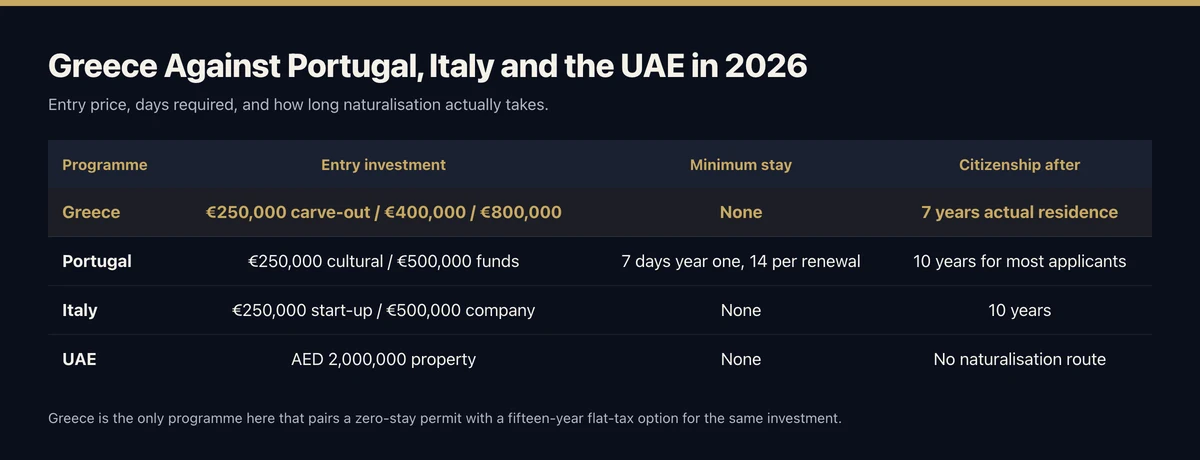
Greece is no longer the cheap option it was, but the comparison is closer than the headline suggests once the other programmes' own reforms are counted.
| Programme | Entry investment | Minimum stay | Citizenship after |
|---|---|---|---|
| Greece | €250,000 carve-out / €400,000 / €800,000 | None | 7 years actual residence |
| Portugal | €250,000 (cultural) / €500,000 (funds) | 7 days year one, 14 per renewal | 10 years for most applicants |
| Italy | €250,000 (start-up) / €500,000 (company) | None | 10 years |
| UAE | AED 2,000,000 property | None | No naturalisation route |
Portugal's residency clock is the most generous in the table on presence and the least generous on citizenship since the 2026 nationality law took naturalisation to ten years. Italy matches Greece on the zero-stay point and beats it on entry price through the start-up tier. The UAE is the cleanest zero-tax outcome and a dead end on passports. Our Portuguese golden visa guide and Italian investor visa guide run each of those in full.
Greece's distinguishing feature in this group is the non-dom regime sitting next to it. No other programme here pairs a zero-stay residence permit with a fifteen-year flat-tax option for the same investment — provided you accept that using the second one means giving up the first one's main appeal.
Who the Greek programme actually suits
You want a Schengen base and will not be living in it. Greece works, and the conversion carve-out at €250,000 is the cheapest credible entry in the EU today. Accept that the property is an entry ticket, not an income asset.
You are relocating and earn well from outside Greece. This is the strongest case in the whole programme. Buy the qualifying asset, move properly, elect Article 5A, and the €100,000 flat tax against 44% headline rates does the heavy lifting. See our zero and low tax residency overview for how it compares with the alternatives.
You want an EU passport as fast as possible. Greece is a poor choice. Seven years of genuine residence plus B1 Greek is a real life change, and other routes described in our second residency ranking get there with less.
You want rental yield. Look elsewhere. The short-term letting ban removed the reason this ever worked.
You are a US citizen. None of this reduces your US filing. Worldwide taxation follows the passport regardless of where you live or what permit you hold.
Related guides
- Every active golden visa in 2026 — the full programme-by-programme comparison after the CJEU Malta ruling.
- Portugal's golden visa — the fund routes and what the 2026 nationality law changed.
- Italy's investor visa — the €250,000 start-up tier and the flat-tax regime beside it.
- Second residency ranked 2026 — cost, speed and days required across the investment routes.
- Easiest European countries to get citizenship — what naturalisation timelines actually look like.
- Dubai's golden visa — the zero-tax comparison, and why it ends at residency.
FAQ
How much does the Greece golden visa cost in 2026?
The qualifying investment is €800,000 in Attica, the Thessaloniki area, Mykonos, Santorini and islands with more than 3,100 inhabitants, and €400,000 everywhere else. A €250,000 tier survives for two narrow cases: a property converted from non-residential to residential use, and a listed or historic building undergoing full restoration. On top of the purchase price, budget roughly 7% to 10% of the property value in transfer tax, notary, legal, registration and application fees.
Is the Greece golden visa still €250,000?
Only through the two carve-outs, not as a general minimum. Law 5100/2024 replaced the old nationwide €250,000 floor with the €400,000 and €800,000 zone tiers from 1 September 2024. The figure still tops a lot of marketing pages because it is the most attractive number available, but a standard apartment purchase has not qualified at that price for two years.
What is the 120 square metre rule?
For the €400,000 and €800,000 tiers, the qualifying investment must be a single property with a main living area of at least 120 square metres. Auxiliary spaces such as storage, parking and terraces may count toward value but do not reliably count toward the living-space minimum. The rule does not apply to the conversion and restoration carve-outs, and undeveloped land is exempt from size requirements.
Can you combine two properties to reach the threshold?
No. The single-property rule introduced by Law 5100/2024 ended that. Assembling several small apartments up to the threshold was common before the reform and is no longer accepted. One property must clear the bar on its own, which pushed the effective entry price up more than the headline change from €250,000 to €400,000 suggests.
Can you rent out a Greece golden visa property on Airbnb?
No. Properties acquired under the current rules cannot be let through short-term rental platforms, and a converted commercial property additionally cannot serve as a company headquarters or branch office. Breach exposes the holder to revocation and administrative fines. Short-term letting yield was the main argument for buying in prime zones, and the reform removed it while raising the price.
Does the Greece golden visa make you a Greek tax resident?
Not by itself. The permit carries no minimum stay, and Greek tax residency turns on spending more than 183 days a year in the country. You can hold the permit for a decade without becoming a Greek taxpayer on worldwide income. The catch is that the €100,000 non-dom regime and the seven-year naturalisation route both require you to actually live there.
How long does it take to get Greek citizenship through the golden visa?
Seven years of legal residence, plus B1 Greek and an examination on Greek history, geography, culture and institutions. The seven years are measured by actual residence, not by how long you have held a permit, so holding a golden visa for seven years while living elsewhere does not make you eligible. If citizenship is the objective, the zero-stay feature is the thing stopping the clock.
How long does Greece golden visa processing take in 2026?
Around four to six months for a well-prepared file and six to nine months in ordinary cases. The backlog exceeded 52,000 pending files at the start of 2025 and stood at 29,273 at the end of July 2026, as monthly decisions began consistently outrunning new filings. Applications have fallen sharply, to 3,086 in the first seven months of 2026 against 5,028 in the same period of 2025.
Moving €400,000 into a currency you do not earn in
A golden visa purchase lands in euros in stages — deposit, balance, transfer tax, notary, then the application fee — usually across six to twelve months. At retail bank spreads the conversion cost on a purchase this size runs into five figures and appears on no fee schedule. Wise holds and converts at the mid-market rate, which keeps the spread from quietly becoming the largest line item nobody budgeted.
Sources
- Golden Visa — Greek Ministry of Migration and Asylum, the permit framework, required documentation and the €2,000 fee.
- Understanding the new Golden Visa Law No. 5100/2024 — Watson Farley & Williams, on the zone tiers, the single-property and 120 sqm rules, the short-term rental ban and the 1 September 2024 effective date.
- Greek Golden Visa Applications Down 39% in 2026 as Backlog Nearly Halves — IMI Daily, the 2024-2026 application and backlog figures and the shift toward the conversion route.
- Procedure and supporting documentation for application to the Greek non-dom taxation regime — International Bar Association, on Article 5A: the €100,000 flat tax, €20,000 per family member, 15-year cap, the seven-of-eight-years test and the €500,000 investment condition.
- Greece: Individual taxes on personal income — PwC Worldwide Tax Summaries, the Greek personal income tax bands the flat-tax regimes are measured against.
Figures are current as of September 2026. Immigration and tax rules change, and Greek practice varies between decentralised administrations; this is editorial research, not legal or tax advice. Confirm any figure with the Greek authorities or a licensed Greek lawyer before you commit funds.