
Paraguay rebuilt the front door to its residency system in 2026, and the change runs opposite to the direction everyone else is moving. While Spain, Italy and Colombia peg their remote-worker permits to a multiple of a minimum wage, Resolución DNM 407/2026 — in force for applications filed from 6 July 2026 — created a dedicated category for digital nomads and attached no income figure to it at all.
For a freelancer or founder earning $50k to $300k, that matters more than another fee table. The binding constraint on most residency routes is a threshold you either clear or you don't. Paraguay replaced the threshold with an evidence test: show the income is real, documented and paid through a traceable channel.
So I read the instruments rather than the agency pages — the Anexo of solvency categories, the Article 100 fee schedule, Article 148 of the Constitution with the Judiciary's own naturalisation checklist, and PwC's Paraguay summaries. Three things fell out that the pages ranking for this query miss: the ordinary route to a passport takes five years, not three; the nomad category is written around an employer, leaving self-employed freelancers without a clean slot; and tax residency triggers at 120 days, not 183.
Key takeaways
- No stated minimum income. The twelve solvency categories in Resolución DNM 407/2026 name no figure. Category 5, for remote workers and digital nomads, asks only for a work certificate stating your income and how you are paid.
- Government fees are about $992 for the ordinary two-step route — ₲2,926,925 for temporary residency and ₲2,926,925 again for the change of category, at ₲117,077 the jornal.
- Citizenship takes five years, not three. Article 148's three-year clock runs from the permanent admission resolution, and permanent status comes only after up to two years of temporary residency.
- Tax residency starts at 120 days, well below the usual 183 — but the IRP is territorial, so foreign-source income stays outside the base.
- Freelancers have no clean category. Category 5 presumes an employer; category 4 presumes Paraguayan tax registration.
- A weak second passport. Article 150 strips naturalised Paraguayans of the nationality if they voluntarily acquire another one.
Wise — a documented payment channel, which is what Paraguay's solvency test actually asks to see
What Paraguay residency actually is in 2026
Everything runs on Ley N° 6984/22 de Migraciones. There are two ways in, and the difference between them is the most consequential choice on this page.
The ordinary route is two steps. You apply for residencia temporal, granted for up to two years and extendable by an equal period. The official page is explicit that this is not optional: "La residencia temporal será requisito previo al otorgamiento de la Residencia Permanente." Only after completing it do you apply for the change of category to permanent.
The investor route is one step. An investor holding the Constancia de Inversionista Extranjero obtained through SUACE, the unified business-opening window, is admitted to permanent residency directly, skipping the temporary stage.
While the temporary application processes you hold residente precario status, which lets you leave and re-enter, study and work, and temporary residency already gets you the Cédula de Identidad Paraguaya.
The change-of-category deadlines are tight and carry money. File within the three months before your temporary carnet expires; if it has expired you have one month more, with a fine. Past that the only option is a prórroga, available up to six months after expiry and also fined — which pushes your permanent start date, and therefore your passport, further out. The permanent carnet is definitivo, renewed every ten years, with a ten-year cédula.
Resolución 407/2026: the twelve solvency categories
This is the 2026 change, and the reason a 2024 guide will mislead you. The DNM rebuilt the economic-solvency test into twelve categories, each with its own evidence list, for applications filed from 6 July 2026, governing both permanent residency under Ley 6984/2022 and the Mercosur agreement.
The governing idea is in the requirement itself: solvency must be shown "mediante documentación idónea, suficiente y comprobable, que evidencie la generación efectiva de ingresos" — documentation fit, sufficient and verifiable, evidencing actual generation of income. Not a balance. Activity.
| # | Category | Core evidence required |
|---|---|---|
| 1 | Professionals | MEC-registered university degree, plus proof of practising it: IPS insurance record, a labour contract endorsed by the Ministry of Labour, or 3 months' IVA returns or the last year's IRP with a tax-compliance certificate |
| 2 | Technicians | MEC-registered technical qualification, plus the same proof of activity |
| 3 | Employees | Employment documentation |
| 4 | Independent workers (commerce and services) | Taxpayer registration (Constancia de Persona Física), plus 3 months' IVA returns or the last year's IRP, plus a tax-compliance certificate |
| 5 | Remote workers or digital nomads | A work certificate evidencing the working relationship, stating income received and the means by which salary or fees are received |
| 6 | Property owners | Title registered at the RUN, registered at least two years earlier; the DNM may also require proof of income from it |
| 7 | Shareholders or partners | Registered incorporation documents naming the applicant, share registers, or for an EAS a DGPEJBF certificate |
| 8 | Farmers and ranchers | Registered productive-use title plus tax compliance, or proof of sale or a registered brand for their production |
| 9 | Clergy | MEC registration of the congregation, plus a letter certifying the role and assuming living costs |
| 10 | Retirees and pensioners | Pension certificate stating the amount and the financial channel it arrives through |
| 11 | Dependants | Marriage or filiation document plus the supporter's Paraguayan ID or residence carnet |
| 12 | Adult students | Proof of regular enrolment, academic continuity and fee payment — distance and online study explicitly included |
Two rules bite across all of them. Every foreign document must be apostilled or legalised and translated into Spanish by a translator registered in Paraguay, Brazilian Portuguese excepted. And a qualification alone never suffices: "la sola posesión del título de profesional no constituirá prueba suficiente de solvencia económica." Children aged 0 to 17 fall into their own NNA category, exempt from the solvency test.
The nomad category has no income floor — and assumes an employer
Category 5 is four lines long. It asks for a "certificado o constancia de trabajo que respalde la relación laboral y en el cual se indiquen los ingresos percibidos, así como el medio en el que recibe sus honorarios o salario" — a work certificate supporting the working relationship, stating income received and the means through which fees or salary arrive. Apostilled and translated. That is the entire test.
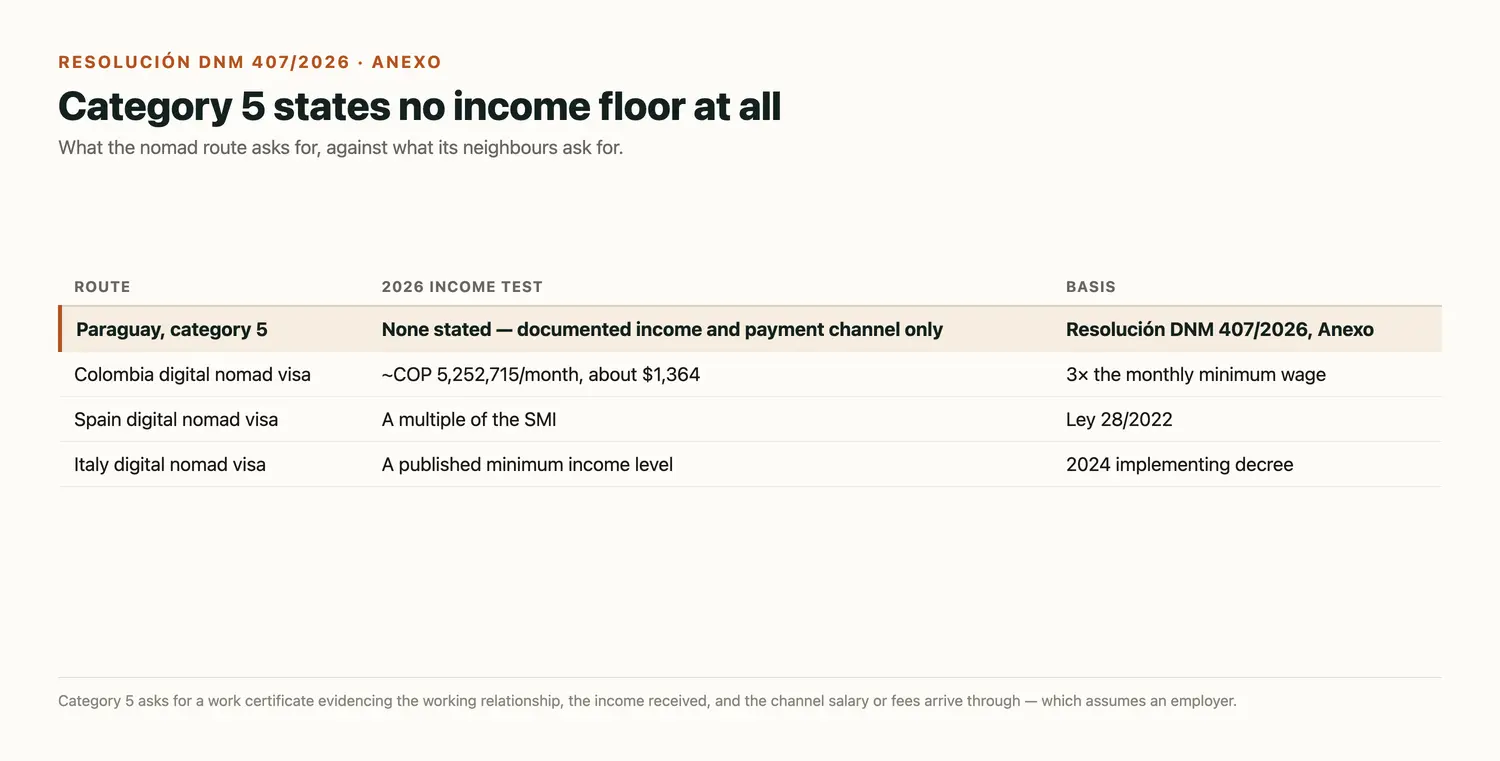
No minimum. No multiple of the minimum wage. No bank balance. For context on how unusual that is:
| Route | 2026 income test | Basis |
|---|---|---|
| Paraguay, category 5 | None stated — documented income and payment channel only | Resolución DNM 407/2026, Anexo |
| Colombia digital nomad visa | ~COP 5,252,715/month, about $1,364 | 3× the monthly minimum wage |
| Spain digital nomad visa | A multiple of the SMI | Ley 28/2022 |
| Italy digital nomad visa | A published minimum income level | 2024 implementing decree |
Do not read the blank as generosity. It is discretion, and the requirements say so: the DNM "podrá requerir cualquier otro documento adicional que considere necesario", and flagged applications go to its legal directorate. The rule removes automatic disqualification, not judgement.
Now the catch nobody names. Category 5 is built on a relación laboral and asks for a certificate from the other side of it. An employed remote worker produces that in an afternoon — HR issues a letter with the salary and the account it is paid into, apostille, translate, done. A self-employed freelancer with eight clients has nobody to write that letter.
The apparent fallback is category 4, and look at the price: taxpayer registration, three months of IVA returns or a year's IRP, and a tax-compliance certificate. To prove solvency as a freelancer you must first become a registered Paraguayan taxpayer — entering the tax system to document income Paraguay does not intend to tax.
So neither category fits a foreign-client freelancer cleanly. In practice such applicants use a principal-client contract plus payment records under category 5, or rely on categories 6, 7 or 11 where their facts allow. Whether that satisfies the DNM is its determination, and it is the first question for a Paraguayan immigration lawyer rather than the last.
What it costs: the official fee schedule
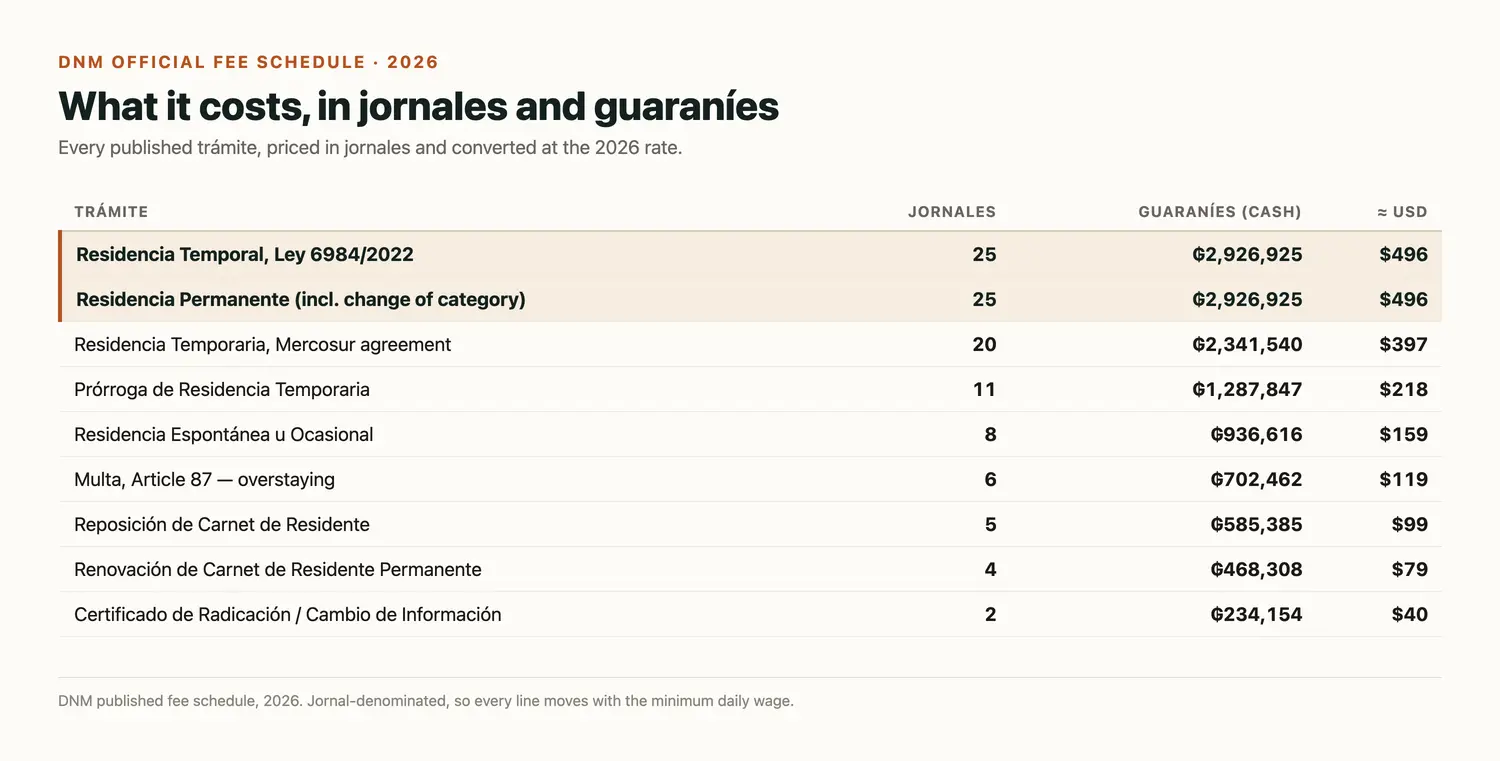
Fees are set in jornales under Article 100 of Ley 6984/2022, which is why dollar figures quoted elsewhere go stale. One jornal is ₲117,077 in 2026 — exactly a twenty-sixth of the ₲3,044,002 monthly minimum wage, the mechanism that moves these fees whenever the wage is adjusted. Conversions use ₲5,900 to the dollar, roughly the rate on 24 September 2026.
| Trámite | Jornales | Guaraníes (cash) | ≈ USD |
|---|---|---|---|
| Residencia Temporal, Ley 6984/2022 (incl. precaria and change of category) | 25 | ₲2,926,925 | $496 |
| Residencia Permanente (incl. change of category) | 25 | ₲2,926,925 | $496 |
| Residencia Temporaria, Mercosur agreement | 20 | ₲2,341,540 | $397 |
| Prórroga de Residencia Temporaria | 11 | ₲1,287,847 | $218 |
| Residencia Espontánea u Ocasional | 8 | ₲936,616 | $159 |
| Certificado de Radicación | 2 | ₲234,154 | $40 |
| Cambio de Información | 2 | ₲234,154 | $40 |
| Renovación de Carnet de Residente Permanente | 4 | ₲468,308 | $79 |
| Reposición de Carnet de Residente | 5 | ₲585,385 | $99 |
| Multa, Article 87 — overstaying the authorised period | 6 | ₲702,462 | $119 |
Paying electronically costs slightly more — the permanent line runs ₲2,991,317 to ₲3,023,514 by method.
The number that matters is the sum. The ordinary route pays the 25-jornale fee twice, for temporary and again for the change of category: ₲5,853,850, about $992, plus ₲234,154 for a certificado de radicación. Nobody advertises the two-step total, because each step looks cheap alone.
And DNM fees are not the bill. Apostilles, sworn translation, notarised copies, police and INTERPOL certificates, the cédula and legal help are extra and routinely exceed them. Treat $992 as a floor on one line item.
The timeline to a passport is five years, not three
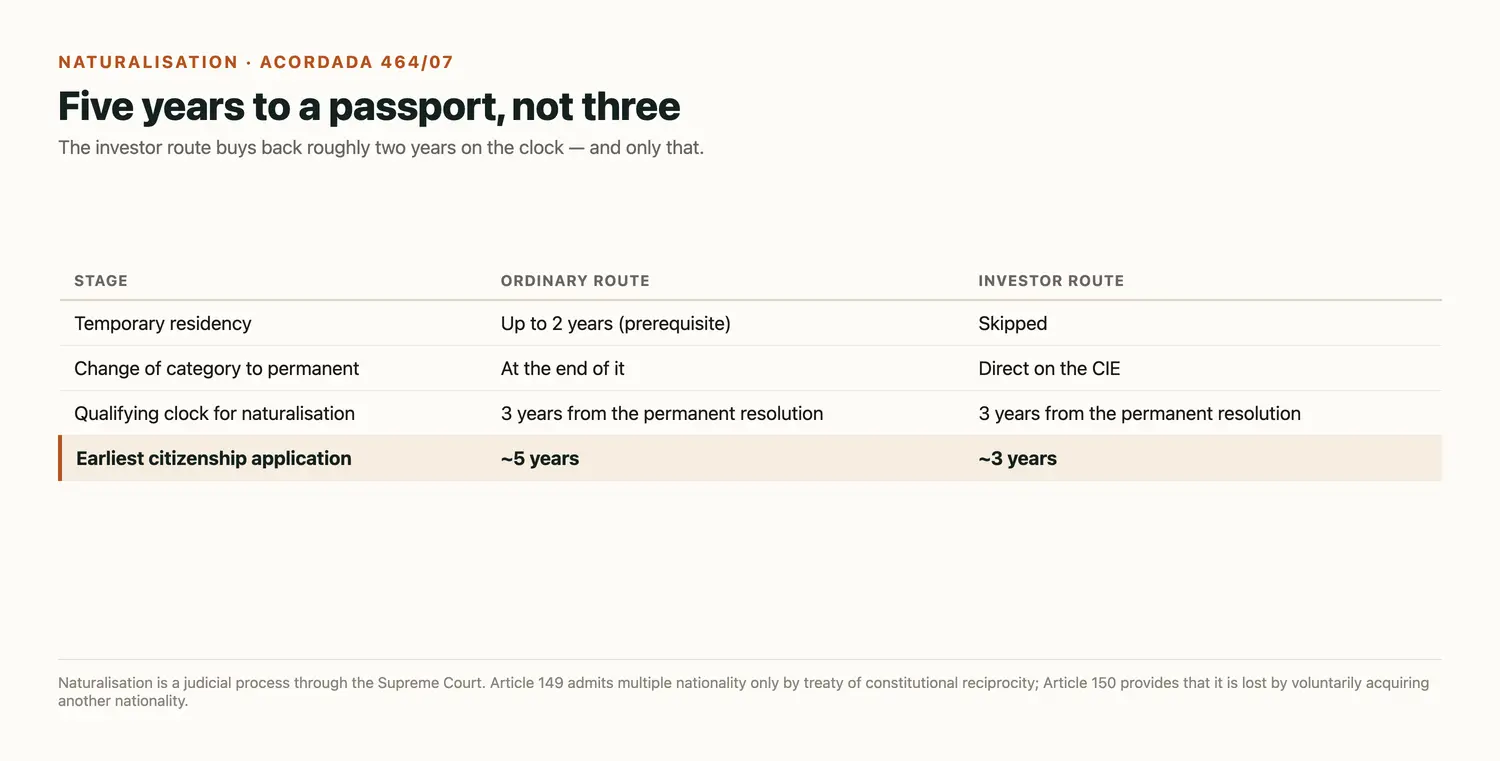
Almost everything written about Paraguay says three years to citizenship. That is what the Constitution says, and not what happens on the ordinary route.
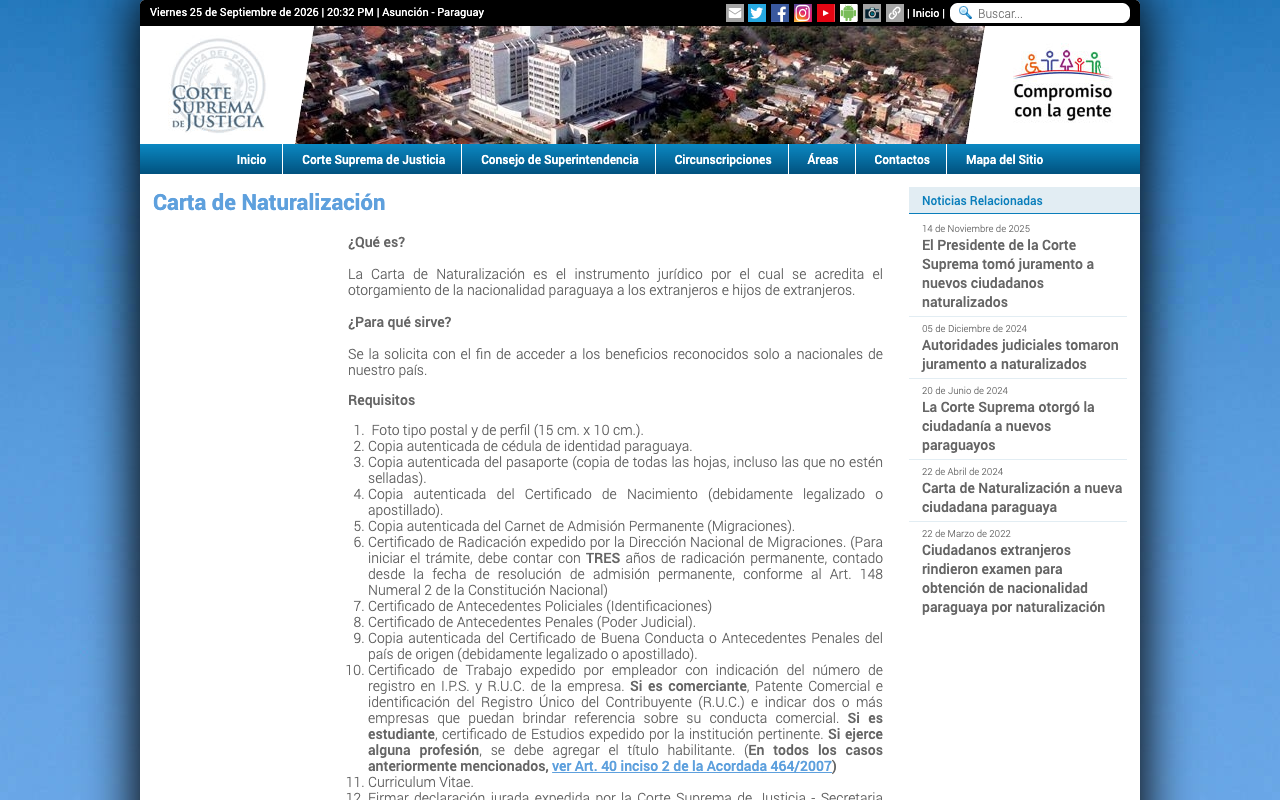
Article 148 sets four requirements: majority of age, radicación mínima de tres años en territorio nacional, regular exercise in the country of a profession, trade, science, art or industry, and good conduct. The three years is real; the question is when the clock starts, and the Judiciary answers it directly. Its Carta de Naturalización checklist states that to begin you must hold three years of radicación permanente, counted from the date of the permanent admission resolution, citing Article 148 numeral 2. Not from arrival. Not from temporary residency.
| Stage | Ordinary route | Investor route |
|---|---|---|
| Temporary residency | Up to 2 years (prerequisite) | Skipped |
| Change of category to permanent | At the end of it | Direct on the CIE |
| Qualifying clock for naturalisation | 3 years from the permanent resolution | 3 years from the permanent resolution |
| Earliest citizenship application | ~5 years | ~3 years |
That is the real value of the investor route, and not the one the brochures lead with: paying for a direct grant of permanent residency buys back roughly two years on the passport clock. Whether two years is worth six figures only your own numbers answer.
Two further points, because naturalisation is a judicial process running through the Supreme Court under Acordada 464/07. Article 148 requires exercise in the country of a profession or trade — so a reader whose entire economic life is foreign clients faces a tension: the tax advantage below depends on income being foreign-source, while naturalisation asks for activity inside Paraguay.
More serious for a Plan B buyer, Article 149 admits multiple nationality only by international treaty of constitutional reciprocity, and Article 150 provides that naturalised Paraguayans lose it by unjustified absence beyond three years once judicially declared, or by voluntarily acquiring another nationality. A Paraguayan passport is a poor building block for collecting citizenships — our guide to countries with easy citizenship sorts the alternatives on exactly this constraint.
The Investor Pass: what the money actually buys
In April 2026 the Ministry of Industry and Commerce, with the DNM, launched the Paraguay Investor Pass, implemented through Resolución MIC N° 0283/2026. It modernises the Constancia de Inversionista Extranjero (CIE) — the document unlocking direct permanent residency — and routes it through SUACE. Officials put CIE issuance at 10 to 15 business days, down from months.
| Modality | Threshold |
|---|---|
| Tourism projects — lodging, eco-tourism, hospitality | USD 150,000 |
| Real estate | USD 200,000 |
| Stock exchange instruments (bolsa de valores) | USD 200,000 |
| Traditional productive investment | Category retained; no figure published in the announcement |
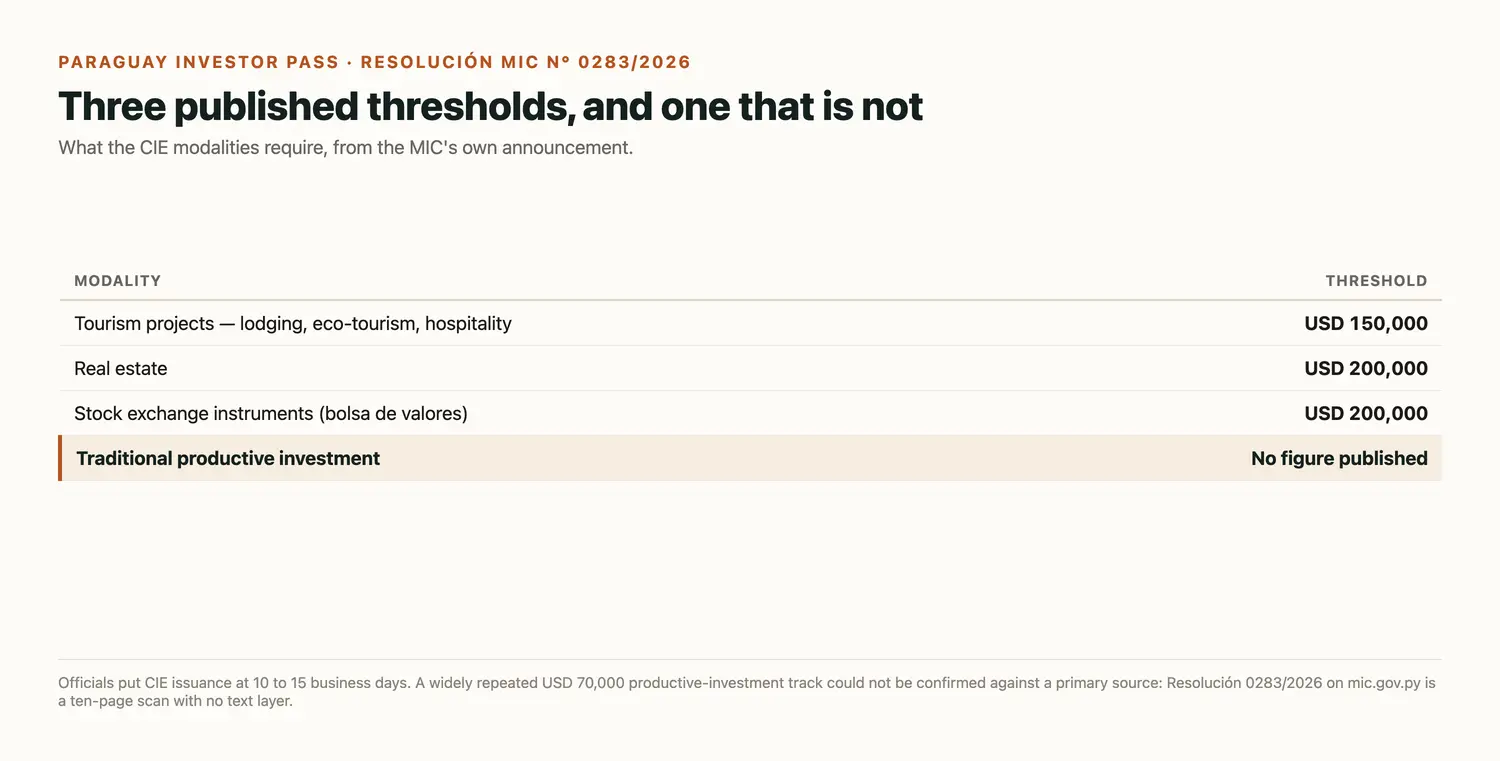
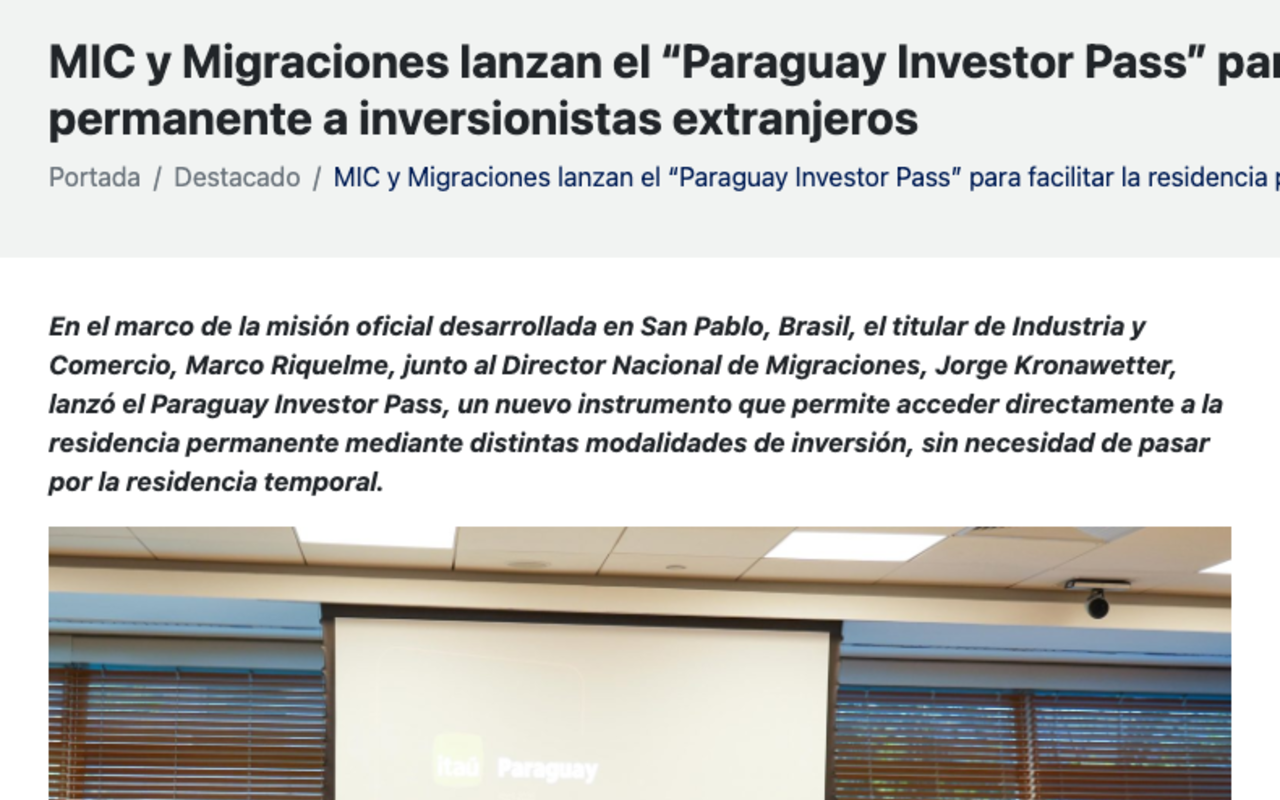
That last row deserves a flag. Several well-known advisory sites state a USD 70,000 productive-investment track through SUACE with a commitment to create at least five formal jobs. It is plausible and widely repeated, but I could not confirm it against a primary source: the text of Resolución 0283/2026 on mic.gov.py is a ten-page scan with no text layer, and the MIC's own announcement gives figures only for tourism, real estate and the exchange. On immigration rules that is not a number to repeat on trust — confirm it with SUACE before budgeting against it.
The SUACE file is short, with the CIE load-bearing alongside identity, birth and civil-status certificates, INTERPOL and National Police checks, and the sworn declaration of constitutional compliance. Fees are the standard ₲2,926,925 plus ₲234,154. For the region's other investment-light routes, see Panama's Friendly Nations visa and Mexico's temporary resident visa.
Tax: 120 days in, and foreign income stays outside the base
Paraguay's personal income tax is territorial. Individuals resident in Paraguay and abroad are taxable on Paraguayan-source income, so income from foreign clients or a foreign employer is not merely exempt — it is outside the IRP base. Set that against Colombia's digital nomad visa, where 183 days makes you taxable on worldwide income at up to 39%, and the contrast is why Paraguay appears on lists like zero-percent tax residencies.
Tax residence attaches after more than 120 days in a year. Flag that number: most of the world uses 183, so a resident spending a comfortable four months in Asunción crosses Paraguay's line while staying clear of everyone else's.
| Net income from personal services | Rate | ≈ USD band at ₲5,900 |
|---|---|---|
| Up to ₲50,000,000 | 8% | up to ~$8,475 |
| ₲50,000,001 – ₲150,000,000 | 9% | ~$8,475 – $25,424 |
| Above ₲150,000,000 | 10% | above ~$25,424 |
| Capital gains | 8% flat | — |
There is also a filing floor: gross income from personal services not exceeding ₲80,000,000, about $13,559, carries no tax.
Three qualifications, and they are why this section is not a recommendation.
Paraguayan-source is broader than "paid by a Paraguayan". It captures returns on deposits and loans within Paraguay, wages paid by the Paraguayan state, and — the one that catches consultants — services performed abroad for Paraguayan taxpayers. Invoice a Paraguayan company from Lisbon and that fee is Paraguayan-source. It is also the sting in using category 4 to prove solvency.
A Paraguayan carnet does not end your current tax residency. Your existing country decides that, on its own day counts, centre-of-interests tests, exit taxes and treaty tiebreakers. Residency in a territorial country is the second half of a plan whose first half is leaving somewhere properly — the failure mode is in tax resident nowhere.
Your company is a separate question. CFC rules, permanent-establishment risk and management-and-control tests follow the business, not the passport. And if you are a US person none of this touches citizenship-based taxation: you keep filing, and relief runs through the foreign earned income exclusion and the foreign tax credit, not through Paraguay.
How to keep it, and how to lose it
Permanent residents lose that status if absent from Paraguay for more than three years without justifying the absence to the DNM, which may extend the period in cases set by regulation. There is no minimum annual stay.
Article 55 of Ley 6984/2022 sets out cancellation more broadly: false documentation or migration fraud, unjustified absence, non-compliance with migration rules, or the resident's own request. You can recover residency lost through absence, but must prove the legal requirements again — which since 6 July 2026 means the 407/2026 categories. A three-year window is among the world's most relaxed and makes Paraguay usable as a standby residency, though the ten-year carnet renewal and the radicación certificate you will want for naturalisation both reward showing up occasionally.
Who Paraguay residency is actually for
It works well for the employed remote worker. Category 5 is close to the lowest-friction solvency test in the region — one apostilled employer letter naming your income and payment channel, no threshold. Add a territorial tax system, a 120-day trigger you can choose to trip or avoid, three years of absence tolerance and fees near $992, and there is no comparable package in Latin America.
It works badly for the Plan B passport buyer. Five years on the ordinary route, judicial naturalisation requiring activity inside Paraguay, no general recognition of dual nationality, and Article 150 stripping it from anyone who later naturalises elsewhere. Look instead at citizenship by investment or second residency options ranked.
It is unresolved for the self-employed freelancer — get the category question confirmed rather than assumed.
If the goal is simply lower tax on foreign income, Georgia's 1% regime reaches a similar place by a different mechanism, and the digital nomad visas table shows which countries exempt foreign income where Paraguay never includes it.
Related guides
- Zero-percent tax residencies — where territorial and zero-tax regimes exist, and what each demands in return.
- Second residency options ranked — cost, speed and physical-presence requirements across the field.
- Tax resident nowhere — why a new carnet does not end your old tax residency.
- Colombia's digital nomad visa — the Latin American contrast: cheap to get, worldwide taxation at up to 39%.
- Panama's Friendly Nations visa — the closest regional comparison on cost and speed to permanent status.
- Countries with easy citizenship — the routes that lead to a usable second passport, which Paraguay's does not.
FAQ
Is there a minimum income for Paraguay residency in 2026?
Not a stated one. Resolución DNM 407/2026, governing applications filed from 6 July 2026, replaced the old solvency test with twelve documentary categories, and none names a figure. The remote-worker category asks for a work certificate showing the income you receive and how you are paid — it tests that income is real and documented, not that it clears a threshold. Spain, Italy and Colombia all set hard multiples of a minimum wage. Treat the blank as discretion, not a guarantee.
How much does Paraguay residency cost in government fees?
Fees are set in jornales under Article 100 of Ley 6984/2022, and one jornal is ₲117,077 in 2026. Temporary residency is 25 jornales, ₲2,926,925, roughly $496, and the later change of category to permanent is another 25 jornales. The ordinary two-step route therefore runs about ₲5,853,850, near $992, plus ₲234,154 for a certificado de radicación. Apostilles, sworn translations and legal help are extra and usually exceed the government fees.
How long does it take to get a Paraguayan passport?
About five years by the ordinary route, not three. Article 148 requires three years of residence, but the Judiciary counts them from the date of the permanent admission resolution — and permanent status is only reachable after completing temporary residency, which runs up to two years. The investor route is the exception: it grants permanent residency directly, so the three-year clock starts at once.
Does Paraguay tax my foreign income if I become a resident?
Generally no, because the personal income tax is territorial: residents and non-residents alike are taxable on Paraguayan-source income only, so income from foreign clients or a foreign employer sits outside the IRP base. Two cautions — services performed abroad for a Paraguayan taxpayer count as Paraguayan-source, and a Paraguayan carnet does not by itself end tax residency where you are now.
When do I become a Paraguayan tax resident?
After more than 120 days in the country in a year — a much lower bar than the 183 days most countries use, so a resident spending four months a year in Asunción can cross it without intending to. Because the IRP is territorial the consequence is usually mild, since there is often nothing foreign to tax, but it is when Paraguayan filing obligations can attach.
Can a self-employed freelancer use the digital nomad category?
Awkwardly. Category 5 is written around a relación laboral and asks for a work certificate from an employer, which a freelancer with a dozen clients cannot produce. Category 4, for independent workers, instead requires Paraguayan taxpayer registration plus IVA or IRP returns. Neither fits a foreign-client freelancer cleanly. Some applicants use a principal-client contract and payment records under category 5; whether the DNM accepts that is its call.
Will a Paraguayan passport let me keep my current nationality?
Be careful here. Article 149 admits multiple nationality only by international treaty of constitutional reciprocity, so Paraguay does not recognise dual nationality generally. Worse for a Plan B buyer, Article 150 says naturalised Paraguayans lose the nationality by voluntarily acquiring another one, or by unjustified absence beyond three years once judicially declared.
Sources
- DNM — Residencia Permanente, cambio de categoría — the filing windows, the definitive carnet renewed every ten years, and the full Anexo of twelve solvency categories, including category 5 for trabajadores a distancia o nómadas digitales and category 4 for independent workers.
- DNM — Residencia Temporal (Ley N° 6984/2022) — up to two years extendable by an equal period, its status as a prerequisite for permanent residency, and residente precario status.
- DNM — Aranceles Migratorios — the Article 100 fee schedule, the ₲117,077 jornal, and every figure in the cost table.
- DNM — Régimen de acreditación de solvencia económica — Resolución DNM n.° 407/2026 and its application to filings from 6 July 2026.
- DNM — Inversionistas extranjeros bajo SUACE — the investor route's document list and the CIE.
- Ministerio de Industria y Comercio — Paraguay Investor Pass — the USD 150,000 tourism and USD 200,000 real-estate and bolsa de valores modalities.
- Poder Judicial — Carta de Naturalización — three years of radicación permanente counted from the permanent admission resolution, per Article 148 numeral 2, and the judicial process under Acordada 464/07.
- Embajada del Paraguay — Nacionalidad Paraguaya (Constitución, Arts. 146-151) — Articles 148, 149 and 150 on naturalisation, multiple nationality and loss of nationality.
- PwC — Paraguay, individual residence — the 120-day tax-residence test.
- PwC — Paraguay, taxes on personal income — the territorial IRP basis, the 8/9/10% bands, the 8% capital-gains rate, the ₲80,000,000 filing floor, and services performed abroad for Paraguayan taxpayers as Paraguayan-source.
Figures are current as of September 2026. USD conversions use ₲5,900 to the dollar, roughly the rate on 24 September 2026 — the guaraní moves, and because migration fees are denominated in jornales they change whenever the minimum wage is adjusted. The USD 70,000 productive-investment figure circulating for the Investor Pass is explicitly not confirmed here. Whether a particular document set satisfies the DNM is its determination, and it may require additional documentation in any case. Tax outcomes depend on facts this page cannot know, including your other income, residence history, company structure and treaty position. This is editorial research, not legal, immigration or tax advice.