
A second passport is a legal instrument, not a lifestyle accessory. It decides where you can live, work, bank and — depending on your current nationality — how much tax you pay for the rest of your life. This guide covers the countries with the genuinely easy citizenship routes in 2026: by descent, by naturalisation, by investment and by birth. It segments guidance by your starting nationality, because what is straightforward for a French freelancer can be a reporting trap for an American. It does not cover paid-for residency schemes dressed up as citizenship, nor any route that depends on misrepresenting where you live.
Henley & Partners — Largest RBI/CBI advisory firm in the world
What "easy citizenship" actually means
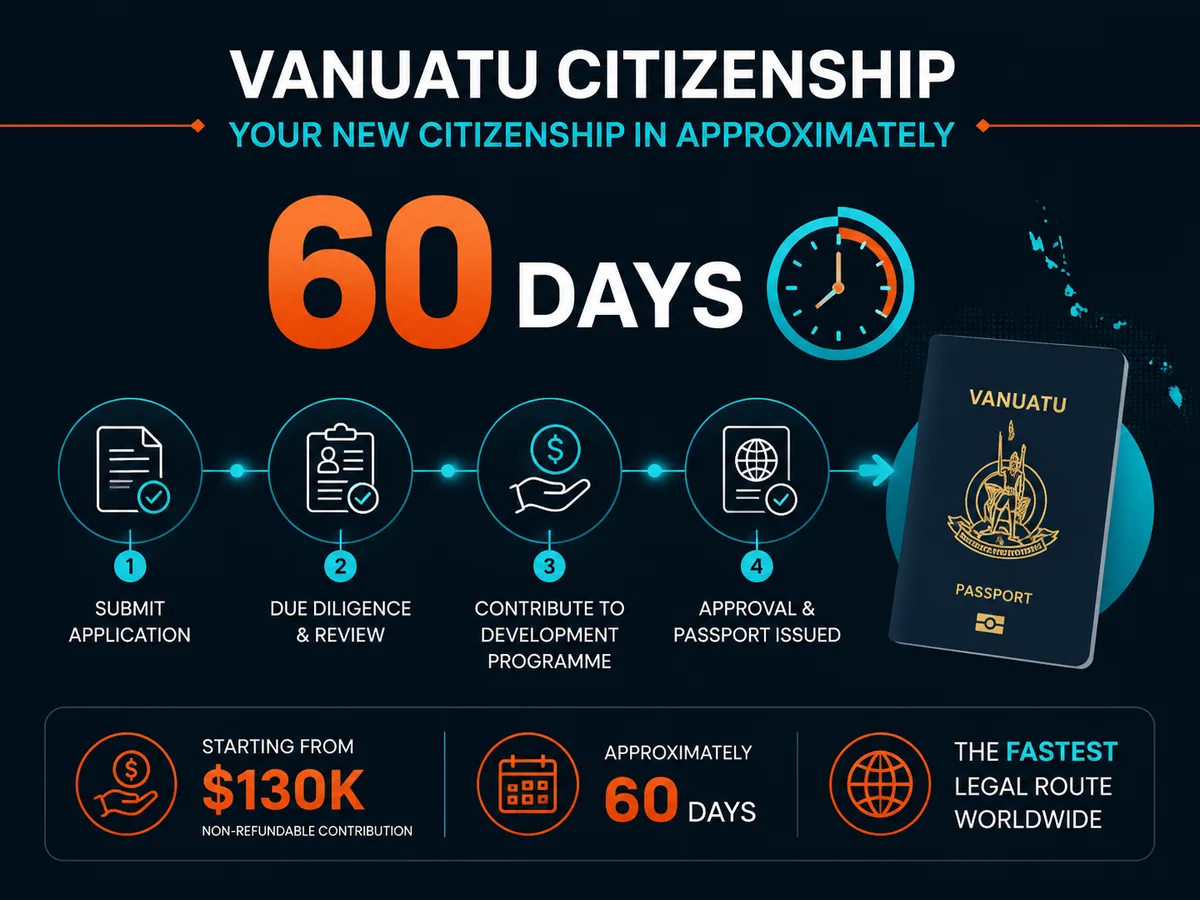
Three things make a citizenship route easy: a short qualifying period, low evidentiary burden, and tolerance of dual nationality. A country can be fast (Vanuatu, ~60 days) but expensive. It can be cheap (Argentina, court fees only) but slow in practice. It can be free (Ireland by descent) but require certified documents your grandmother never kept.
"Easy" in this article means legally accessible without lying about where you live or where your money came from. Address-only residency, sham marriages and undisclosed beneficial ownership are not in scope. They are also not legal.
Who this applies to — read your segment
The rules below behave very differently depending on the passport you already hold.
US persons (citizens and green-card holders)
The United States taxes on citizenship, not residency. Acquiring a second passport changes nothing about your IRS obligations until you formally renounce — and renunciation triggers an exit tax under IRC §877A if you are a "covered expatriate" (net worth ≥ USD 2 million or average annual US tax liability above a threshold indexed to inflation). FATCA and FBAR reporting on foreign accounts continues regardless of where you live. A second passport is useful for travel, banking access and optionality. It does not reduce your US tax bill.
EU freelancers and digital nomads
EU tax residency is determined by the 183-day rule and "centre of vital interests" tests under domestic law and the OECD Model Tax Convention. Most EU member states operate CFC (controlled foreign company) rules under ATAD, and several — France, Germany, the Netherlands — impose exit taxes on unrealised gains when you move tax residency outside the EU. A second EU citizenship (Ireland, Italy, Hungary by descent) is portable within the bloc. A non-EU citizenship is useful only if you also change tax residency, which is a separate legal act.
Non-US, non-EU readers
You have the most freedom. Most non-EU, non-US jurisdictions tax on residency, not citizenship, and CFC enforcement is uneven. A second passport plus a genuine change of residency is the cleanest path to legal tax optimisation — but "genuine" means physical presence, a real home and substance, not a mailbox.
Citizenship by descent — the cheapest route, if you qualify
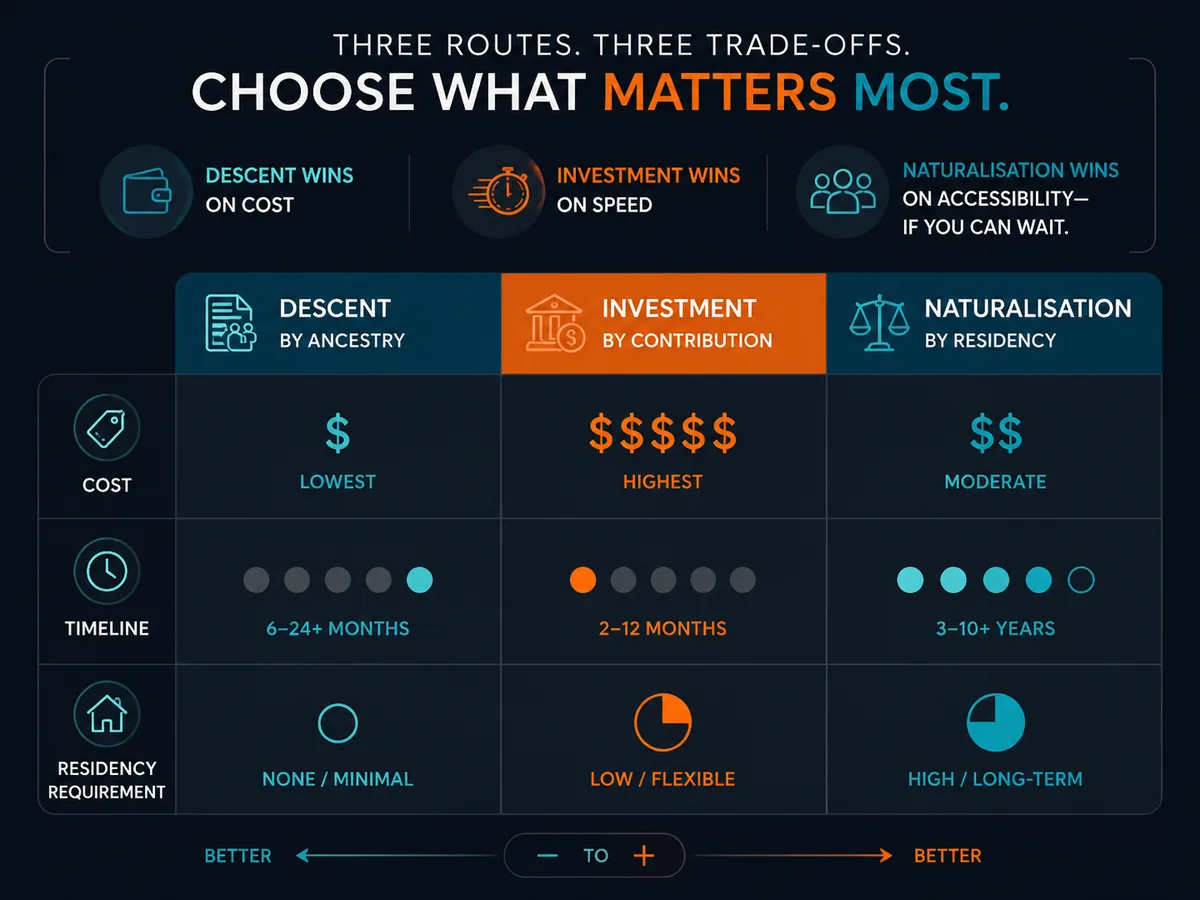
Descent (jus sanguinis) is the only route that costs nothing beyond document fees and is open to no residency requirement at all.
- Ireland — One grandparent born on the island of Ireland qualifies you. Register on the Foreign Births Register; cost EUR 278 [source]. Processing: 12–24 months.
- Italy — Jure sanguinis, no generational cap on the paternal line. A March 2024 Court of Cassation ruling tightened standards on maternal-line claims before 1948 [source: TODO — link to Cassazione ruling]. Consular queues are long; many applicants use the Italian courts.
- Hungary — Simplified naturalisation for descendants of pre-1920 Hungarian nationals, requires Hungarian language proficiency [source].
- Poland — Confirmation of citizenship for descendants of Polish nationals who held citizenship after 1920 and did not lose it.
- Germany — Article 116(2) of the Basic Law restores citizenship to descendants of those denaturalised between 1933 and 1945.
If you have documents from one qualifying grandparent or great-grandparent, descent beats every other route on cost and ease.

Citizenship by naturalisation — the legitimate slow route
Naturalisation requires physical residence. The shortest qualifying periods in 2026:
| Country | Residency required | Notable conditions |
|---|---|---|
| Argentina | 2 years | Court process; passport in 3–4 years total in practice |
| Peru | 2 years | Language test; clean record |
| Paraguay | 3 years | Permanent residency first; Spanish basics |
| Uruguay | 3 years (married) / 5 (single) | Genuine residence required |
| Portugal | 5 years | A2 Portuguese; clean record [source] |
| Ireland | 5 of last 9 years | Final year continuous |
| Canada | 3 of last 5 years | Language test (English or French) |
| Germany | 5 years (reduced from 8 in 2024) | B1 German; integration test [source] |
Argentina is the global floor. Its court-based process is slower in practice than the two-year statutory minimum suggests — three to four years is typical — but the requirements are unusually light.
Citizenship by investment — fast, legal, expensive
CBI programmes issue passports in exchange for a state-vetted contribution. They are legal, governed by national legislation, and subject to OECD/FATF scrutiny that has tightened sharply since 2023.
| Programme | Minimum contribution | Timeline | Visa-free access |
|---|---|---|---|
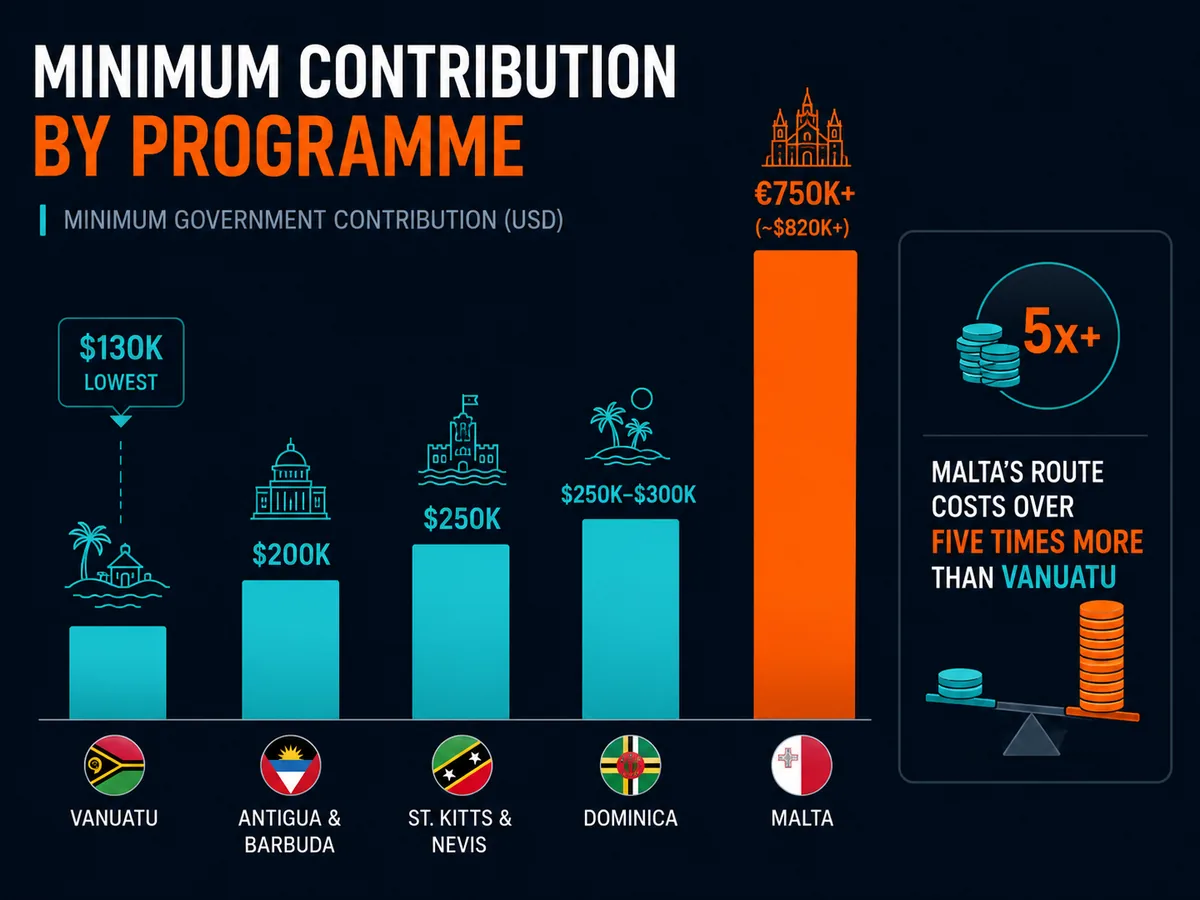
| Vanuatu | USD 130,000 (single) | ~2 months | ~95 countries (EU access suspended 2022 [source]) |
| Dominica | USD 200,000 donation | 3–6 months | ~140 countries |
| St Lucia | USD 240,000 donation | 4–6 months | ~145 countries |
| Antigua & Barbuda | USD 230,000 donation | 3–6 months | ~150 countries |
| Grenada | USD 235,000 donation | 4–6 months | ~145, includes China + E-2 US treaty |
| St Kitts & Nevis | USD 250,000 donation | 4–6 months (60 days AAP) | ~150 countries |
| Malta | EUR 690,000+ (12-month residency) | 12–36 months | EU citizenship [source] |
| Turkey | USD 400,000 real estate | 6–9 months | Not EU; useful for some Asian access |
EU access for Vanuatu passport holders was suspended in 2022; check current status before applying. Malta's programme survived a 2025 European Court of Justice challenge in a limited form [source: TODO — confirm current ECJ status].
For US persons: A second passport via CBI gives banking, travel and optionality. It does not affect US tax obligations. If you're considering CBI as part of a renunciation plan, model the §877A exit tax first.
Affiliate disclosure: Soveraine has commercial relationships with some CBI advisory firms. See our affiliate disclosure. We rank programmes by the data above, not by commission. Henley & Partners and CS Global Partners are the two largest licensed agents; smaller boutiques often quote lower mark-ups for the same government contribution.
Countries that offer citizenship by birth (jus soli)
Unrestricted jus soli — citizenship to anyone born on the soil — survives in roughly 30 countries, almost all in the Americas: United States, Canada, Mexico, Brazil, Argentina, Chile, Uruguay and most of Central America and the Caribbean. The UK, Australia, Ireland and most of Europe abolished unrestricted jus soli between 1983 and 2005.
For non-resident parents this is a planning route, not an emergency one. It also creates US tax obligations for any child born in the United States, regardless of where they live afterwards.
Realistic costs and timelines
The cheapest legal route is descent, where total costs rarely exceed EUR 1,000 in document fees. Naturalisation costs scale with residency: rent, healthcare and tax for the qualifying period, which for Argentina is roughly USD 15,000–25,000 all-in, for Portugal USD 80,000–150,000. Investment routes are governed by the table above; add USD 25,000–50,000 in due-diligence and agent fees.
The fastest legal route is Vanuatu or St Kitts AAP at around 60 days. The cheapest fast route is Argentina if you can wait three years.
Common mistakes
- Assuming a second passport changes your tax residence. It does not. Tax residence is a separate legal status established by physical presence and economic ties.
- For US persons: assuming naturalising elsewhere ends US tax filing. Only formal renunciation does, and it has its own tax cost.
- Buying real estate for "residency" you don't intend to use. Tax authorities increasingly require evidence of physical presence; address-only claims are being audited and reversed.
- Missing the apostille step on descent documents. Italian and Polish consulates reject non-apostilled foreign certificates without exception.
- Underestimating CBI due diligence. Programmes share data with FATF; undisclosed PEP status, sanctions exposure or undeclared income will surface.
When to consult a professional
Before any material action — money transferred, application filed, residency changed — consult a tax lawyer in your current jurisdiction and an immigration lawyer in the target jurisdiction. US persons should add a CPA familiar with expatriation. EU residents moving outside the bloc should model exit taxes before changing residency. These are not optional steps; they are cheaper than the mistakes they prevent. Our editorial policy and disclaimer explain the limits of what this article can do for you.
Ready to act on this?
Henley & Partners — Largest RBI/CBI advisory firm in the world. Soveraine readers go to the front of the line through our partner link, and you fund independent editorial in the process.
FAQ
Which country is easiest to get citizenship?
There is no single answer — it depends on your ancestry, budget and how long you can wait. By ancestry, Ireland and Italy are unrivalled: a single qualifying grandparent (Ireland) or unbroken Italian line can deliver a passport with no residency. By naturalisation, Argentina and Paraguay are the shortest at two and three years respectively. By investment, Vanuatu and the Caribbean Five issue passports in three to six months from USD 200,000–300,000.
Does it cost $10,000 to become a U.S. citizen?
No. The USCIS filing fee for Form N-400 (naturalisation) is USD 760 as of 2024, or USD 380 with a fee waiver for low-income applicants [source]. The USD 10,000 figure conflates total lifetime immigration costs with the citizenship step itself. The naturalisation application is cheap; the years of lawful permanent residence preceding it are where real cost sits.
Where can I get citizenship quickly?
Three routes deliver a passport in under twelve months. Caribbean CBI takes three to six months from USD 200,000. Vanuatu processes in roughly two months. Descent claims to Ireland or Italy, with complete paperwork, run six to eighteen months. Naturalisation is always slower; Argentina's two-year minimum is the global floor.
What is the fastest citizenship in the world?
Vanuatu's Development Support Programme is the fastest legal route, typically one to two months after due-diligence clearance, from USD 130,000. St Kitts' Accelerated Application Process delivers citizenship in around 60 days for an additional fee. Descent has no theoretical speed ceiling, but consular bureaucracy makes six months the practical minimum.
Where are Americans fleeing to?
Department of State data shows record US passport renunciations since 2020, with Portugal, Mexico, Canada, Italy and the UK leading destinations [source: TODO — link to DoS Federal Register quarterly publication]. Portugal's D7 and D8 visas remain popular. Mexico's Temporary Resident Visa is the cheapest route for income earners. Renunciation does not eliminate US tax obligations until completed, and an exit tax may apply.
Which countries give citizenship by descent without residency?
Ireland (one grandparent born on the island), Italy (unbroken male line; recent rulings expanded maternal-line claims), Hungary, Poland, Lithuania, Germany (Article 116 for descendants denaturalised 1933–1945) and Israel (Law of Return) all grant citizenship to qualifying descendants without residency. Documentation is strict: original birth, marriage and death certificates from each generation, apostilled and translated.## Sources
- IRC §877A — Tax responsibilities of expatriation. https://www.law.cornell.edu/uscode/text/26/877A
- EU Anti-Tax Avoidance Directive (ATAD), Directive 2016/1164. https://eur-lex.europa.eu/legal-content/EN/TXT/?uri=celex%3A32016L1164
- Department of Foreign Affairs Ireland — Foreign Births Register. https://www.dfa.ie/citizenship/born-abroad/
- German Basic Law, Article 116. https://www.gesetze-im-internet.de/englisch_gg/englisch_gg.html#p0681
- German Federal Ministry of the Interior — Citizenship reform 2024. https://www.bmi.bund.de/EN/topics/migration/citizenship/citizenship-node.html
- Portuguese Immigration Service (AIMA / SEF). https://imigrante.sef.pt/en/
- Council of the EU — Suspension of visa waiver for Vanuatu. https://www.consilium.europa.eu/en/press/press-releases/2022/03/03/vanuatu/
- Komunità Malta — Citizenship by Naturalisation for Exceptional Services. https://komunita.gov.mt/citizenship/
- USCIS — Form N-400 fees. https://www.uscis.gov/n-400