
Antigua and Barbuda runs one of five surviving Caribbean citizenship-by-investment programmes after the Court of Justice of the EU struck down Malta's investor citizenship scheme in April 2025. It is small, regulated, audited, and meaningfully tighter than it was in 2023: a USD 230,000 minimum donation set by the June 2024 Caribbean Memorandum of Agreement, mandatory physical or virtual interviews, and a 5-day physical-presence requirement the Citizenship by Investment Unit now enforces. The EU revoked visa-free Schengen access for Antiguan passport-holders in April 2025, which narrowed the practical mobility benefit. This guide is the editorial reference on the four investment routes, the real cost stack, the audit traps, and who the programme actually serves.
Henley & Partners — Largest RBI/CBI advisory firm in the world
What an Antiguan passport actually buys you in 2026
Antigua and Barbuda is a small twin-island state of about 100,000 people, hurricane-exposed and fiscally constrained — the citizenship-by-investment programme exists because the country has limited revenue alternatives. The Citizenship by Investment Act 2014 created the legal framework; 2024 amendments tightened price, due diligence and presence rules. The programme is regulated by the Citizenship by Investment Unit (CIU) under the Office of the Prime Minister.
What an Antiguan passport gives you in 2026:
- Commonwealth citizenship. Access to the Commonwealth queue at UK ports of entry and a right of abode in Antigua and Barbuda for life.
- CARICOM Free Movement. The right to live, work and establish a business across the CARICOM Single Market and Economy under the Revised Treaty of Chaguaramas.
- Permanent residency in Antigua and Barbuda. Live there indefinitely, register a business, own property and access local healthcare.
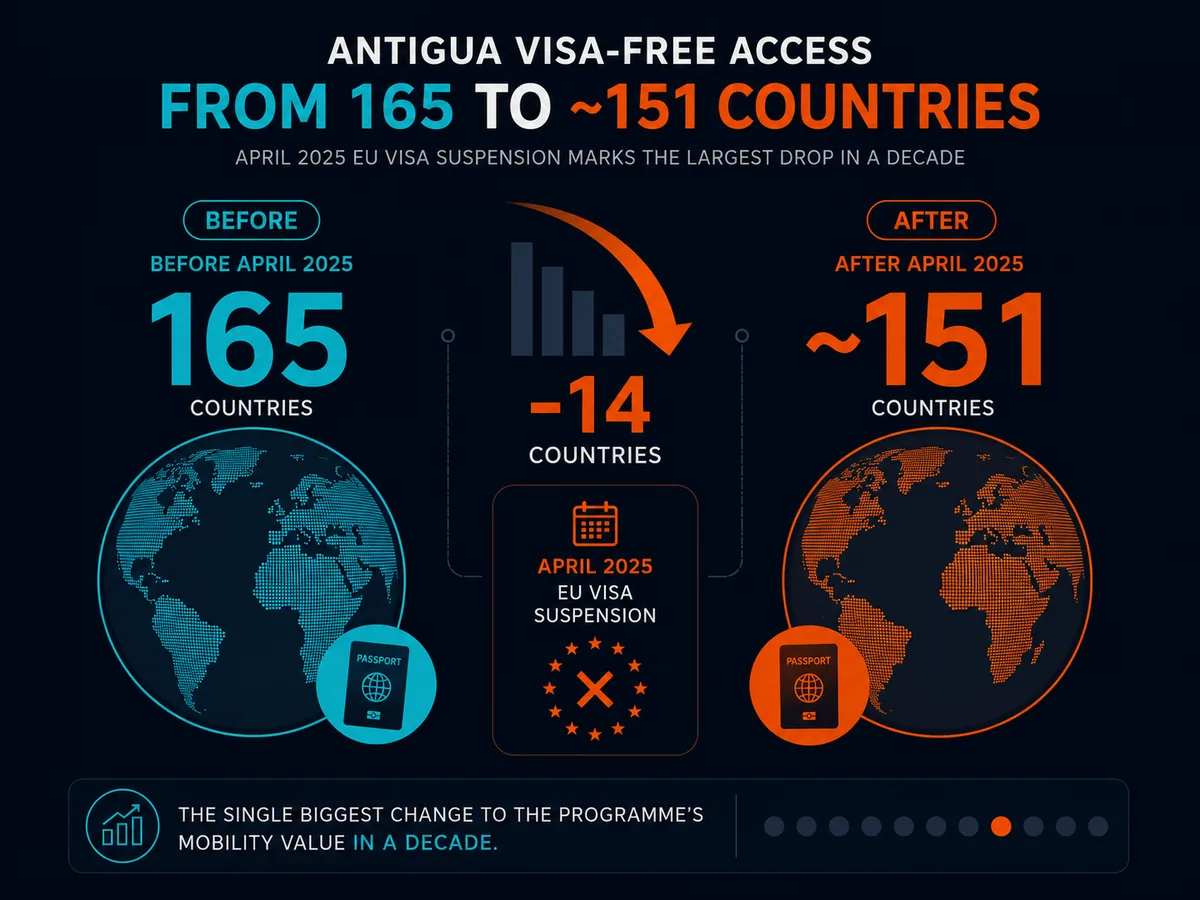
- Visa-free or visa-on-arrival travel to roughly 151 destinations. The Henley Passport Index 2026 places Antigua and Barbuda at the high end of the Caribbean cluster — but materially below where it sat before April 2025.
What it does not give you in 2026:
- Schengen visa-free access. Revoked by Council Implementing Regulation (EU) 2025/418, in force from 8 April 2025. Antiguan nationals now require a short-stay Schengen visa.
- US E-2 treaty access. Antigua has no E-2 treaty with the United States. Grenada is the only Caribbean CBI state that does.
- EU citizenship or work rights anywhere in the EU. Caribbean CBI passports are not EU passports — see Soveraine's pillar on the easiest EU citizenship for what remains in the EU after the 2025 Malta ruling.
Who this applies to — read this first
The same programme produces very different practical outcomes depending on the passport you already hold.
US persons
US persons — citizens and lawful permanent residents — are taxed by the US on worldwide income regardless of any additional passport. Acquiring Antiguan citizenship changes nothing about that. Form 1040, FBAR (FinCEN 114) on foreign accounts above USD 10,000 and Form 8938 under FATCA continue from Antigua exactly as they would from anywhere else.
For a US person the Antiguan passport is useful for three things: optionality if US conditions deteriorate, banking access in jurisdictions that block US persons under FATCA, and as the second passport you need in place before renouncing US citizenship to avoid statelessness. Renunciation itself triggers an exit tax under IRC §877A for covered expatriates — see Soveraine's guides to renouncing American citizenship and dual citizenship as a US person, which is the route that keeps a second passport without renouncing.
EU residents
If you already hold an EU nationality, an Antiguan passport offers you almost nothing on mobility. EU citizens enjoy free movement across the 27 Member States plus Schengen and visa-free access to roughly 190 destinations under the Henley index. Antigua's 151 destinations is a downgrade — and since April 2025 the Antiguan passport is not even Schengen-free for the holder.
The narrow EU use case is as a tax-residency lever: physical relocation to Antigua combined with a formal exit from EU residency can interrupt CFC and worldwide-income obligations. That is residency planning, not a passport play. France, Germany and the Netherlands impose exit taxes on unrealised gains when residency moves outside the EU under ATAD.
Non-US, non-EU readers
This is the programme's primary audience. CIU public reporting and Henley industry data show the bulk of Antigua's applicants come from India, China, Nigeria, the Middle East and the post-Soviet space — passport-holders for whom an Antiguan document materially improves visa-free access, banking and optionality. A passport opening 151 destinations is a significant upgrade on most home passports in those categories.
For this audience the question is straightforward: NDF or one of the alternative routes, which family configuration, and which licensed Authorised Representative to use. The 5-day physical-presence requirement and the post-April-2025 Schengen restriction are the two facts most often glossed over by marketing.
The four investment routes
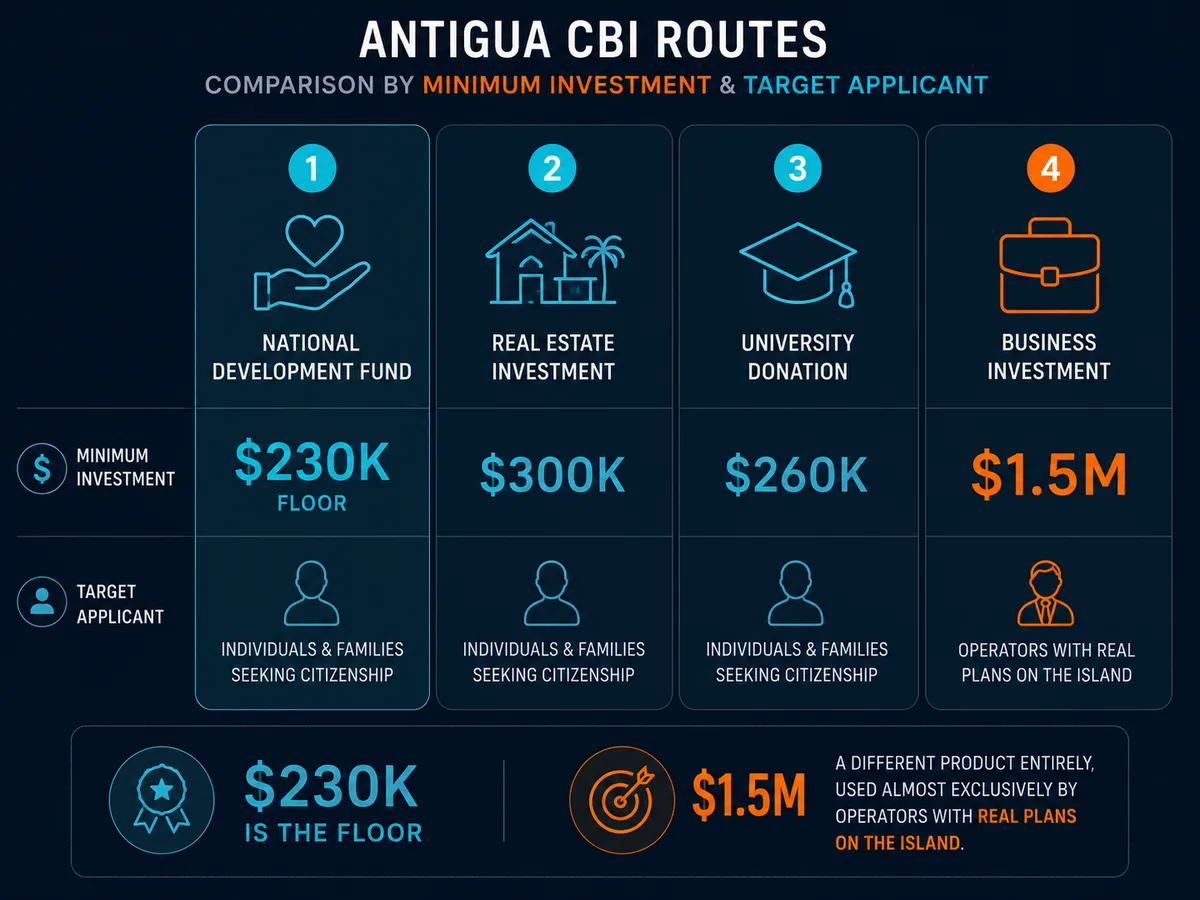
The Citizenship by Investment Act 2014 and its subsequent amendments authorise four qualifying investments. All four require the applicant to use a Licensed Authorised Representative — direct applications to the CIU are not accepted.
National Development Fund (NDF) donation — USD 230,000
The cheapest route. A non-refundable donation to the National Development Fund, an Antiguan government fund used for public-works projects.
- Single applicant or family of up to four: USD 230,000.
- Family of five or more: USD 230,000 base plus USD 30,000 per additional dependent above four.
The USD 230,000 figure reflects the June 2024 Caribbean Memorandum of Agreement floor of USD 200,000 plus Antigua's pricing premium. Government processing fees (see Real-cost stack) are on top. NDF is the standard choice for single applicants and small families because it is the lowest-priced and does not involve a real-estate hold.
University of the West Indies (UWI) Fund — USD 260,000
A donation to the University of the West Indies Five Islands Campus in Antigua, structured for larger families and including a one-year tuition-free scholarship for one nominated family member.
- Family of six or more: USD 260,000 (all-in for the donation).
For a family of four the NDF at USD 230,000 is cheaper. UWI becomes cost-competitive where NDF dependent fees stack — typically six or more.
Real estate investment — USD 300,000+
Investment in a CIU-approved real-estate development held for at least five years.
- Single buyer in an approved project: USD 300,000 minimum.
- Joint investment by two applicants: USD 300,000 each, applications processed independently.
The five-year hold is non-negotiable; early transfer can trigger revocation. The approved developments list is maintained by the CIU — investments outside it do not qualify. Real estate suits applicants who would have bought a Caribbean property anyway; for everyone else, insurance, hurricane exposure and property-management carrying costs make NDF cheaper net of resale uncertainty.
Business investment — USD 1.5M individual / USD 5M joint
Direct investment in a CIU-approved business in Antigua and Barbuda.
- Sole investor: USD 1.5 million minimum.
- Joint investment (two or more applicants in the same business): USD 5 million minimum aggregate, with each individual contributing at least USD 400,000.
The least-used path, generally only chosen by applicants with real operational plans on the island — tourism, hospitality, marine. As a pure passport route it is wildly inefficient compared with NDF.
The 2024 Caribbean MoA — what changed
On 21 June 2024 the heads of Citizenship by Investment Units of Antigua and Barbuda, Commonwealth of Dominica, Grenada, Saint Kitts and Nevis, and Saint Lucia signed a Memorandum of Agreement harmonising five aspects of their programmes after sustained pressure from the European Commission, the US Treasury and the OECD.
What the MoA imposed:
- A minimum donation floor of USD 200,000 across all five programmes. Antigua sits at USD 230,000, above the floor.
- Enhanced due diligence through a regional approach including expanded background checks and mandatory use of accredited international DD firms.
- A mandatory physical or virtual interview with every applicant aged 16 or over. Interview-by-proxy is no longer permitted.
- Information-sharing among the five CBI Units to prevent applicants rejected by one programme from quietly applying to another.
- Regular regional reviews through a coordinating mechanism intended to standardise practice.
The MoA was the price the surviving Caribbean CBI states paid to avoid losing Schengen access entirely. Antigua nonetheless lost it in April 2025, which the European Commission's 2024 report on visa policy had foreshadowed. Dominica was suspended from Schengen in 2022. The other three remain on the EU's no-visa-required list as of mid-2026 but are under active monitoring.

The application process — step by step
The CIU does not accept direct applications. Every file must be submitted through a Licensed Authorised Representative — typically a local law firm or a regulated international advisory.
- Engage a Licensed Authorised Representative. Initial KYC, route selection and source-of-funds questionnaire.
- Document gathering (8–12 weeks). Birth and marriage certificates, police clearances from every country of residence in the prior 10 years, certified passport copies, medical certificates and source-of-funds documentation.
- Four-step due diligence by the CIU. KYC, criminal background across multiple databases, source-of-funds analysis, financial-standing review. International background work is outsourced to accredited DD firms.
- Physical or virtual interview (post-MoA 2024). Every applicant aged 16 or over interviews with a CIU officer — identity, source of wealth, intent and family relationship for dependents.
- Committee review at the CIU, then recommendation to the Minister responsible for citizenship.
- Conditional approval and invoice. Applicant pays the qualifying investment plus all government fees within the timeframe in the approval letter.
- Oath of allegiance. Administered in person in Antigua, at a designated diplomatic mission, or virtually under post-2020 procedures.
- Passport issued by the Passport Office and dispatched through the Authorised Representative.
The CIU advertises 3–4 months from a complete file to oath. The realistic end-to-end timeline, including document gathering and interview scheduling, is 6–12 months. PEP exposure, complex source-of-funds histories or incomplete documentation routinely push beyond twelve months.
Real-cost stack (year 1)
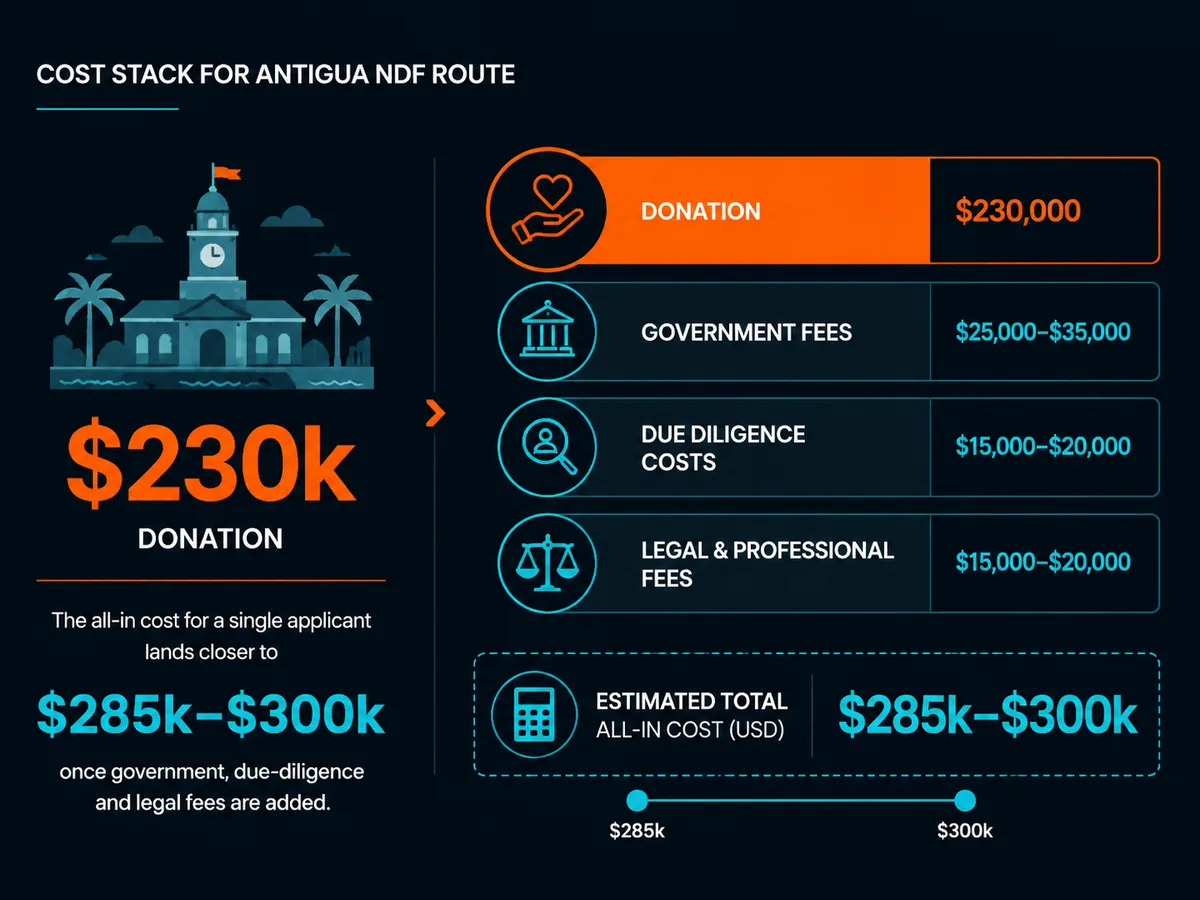
Headline donation figures are not the all-in cost. The real outlay for a single applicant on the NDF route in 2026 is roughly:
| Cost item | Single applicant | Family of 4 |
|---|---|---|
| NDF donation | USD 230,000 | USD 230,000 |
| Government processing fee — main applicant | USD 30,000 | USD 30,000 |
| Government processing fee — dependents | — | USD 15,000 (spouse) + USD 10,000 each (children) |
| Due diligence fee — main applicant | USD 7,500 | USD 7,500 |
| Due diligence fee — dependents 16+ | — | USD 7,500 per qualifying dependent |
| Passport issuance fee | USD 300 | USD 300 each |
| Oath administration fee | USD 250 | USD 250 |
| Authorised Representative / legal fees | USD 15,000–30,000 | USD 20,000–40,000 |
| Total realistic outlay | USD 283,050–298,050 | USD 320,800–365,800 |
Fee figures derive from the CIU's published schedule under the Citizenship by Investment Regulations and the 2024 amendments. Authorised Representative pricing varies materially — competitive boutiques quote toward the lower end; full-service international firms quote toward the upper. The fees are non-refundable if due diligence fails.
The 5-day physical presence requirement
Every successful Antigua CBI applicant must physically reside in Antigua and Barbuda for at least five days during the first five years after citizenship is granted. The requirement was introduced by amendment in 2017 and is now actively audited.
- The 5-day count is per individual citizen, not per family.
- Failure to meet it is grounds for revocation of citizenship under section 11 of the Citizenship by Investment Act 2014.
- Days are counted from immigration entry stamps; stop-overs at V.C. Bird International Airport without clearing immigration do not count.
- Post-2024 audits cross-check airline manifests and Antigua's Advance Passenger Information system.
This is the single most under-disclosed condition of the programme. Dominica, Grenada and St Kitts and Nevis require none; Antigua is the outlier among the surviving Caribbean CBIs. In practice a long weekend within five years is sufficient — but applicants treating the passport as purely a travel document risk revocation. The CIU has published revocation notices in the Government Gazette for non-compliance.
Comparison table — Antigua vs the other surviving Caribbean CBIs
The five Caribbean programmes that survived the 2024 MoA, compared on the metrics that materially differ:
| Antigua & Barbuda | Dominica | Grenada | St Kitts & Nevis | St Lucia | |
|---|---|---|---|---|---|
| Minimum donation | USD 230,000 | USD 200,000 | USD 235,000 | USD 250,000 | USD 240,000 |
| Family-of-4 included | Yes (no surcharge) | Yes | Yes | Yes (then USD 25k per extra) | Yes |
| Physical presence | 5 days in 5 years | None | None | None | 10 days in 5 years (post-MoA) |
| Visa-free (Henley 2026 est.) | ~151 | ~140 | ~145 | ~150 | ~146 |
| Schengen visa-free | No (suspended Apr 2025) | No (suspended 2022) | Yes (under review) | Yes (under review) | Yes (under review) |
| US E-2 treaty | No | No | Yes | No | No |
| Processing (realistic) | 6–12 months | 6–9 months | 4–8 months | 4–6 months (60d AAP option) | 4–8 months |
| Best for | Families wanting a usable Caribbean base | Lowest sticker price | E-2 access to US | Speed (Accelerated Application Process) | Larger families |
Sources: each programme's CIU, the Henley Passport Index 2026, Council Implementing Regulation (EU) 2025/418. St Lucia introduced a 10-day presence rule under its own post-MoA review in 2025. Schengen status for Grenada, St Kitts and Nevis, and St Lucia is described by the European Commission as "under active monitoring" — the Antigua and Dominica suspensions are the current baseline for what enforcement looks like.
Tax in Antigua
Antigua and Barbuda has one of the most favourable tax regimes in the Caribbean for resident citizens — but citizenship alone does not make you tax-resident. Tax residency requires physical presence and a settled life on the islands, governed by the Income Tax Act, Cap. 212 and administered by the Inland Revenue Department.
For Antiguan tax residents (not merely Antiguan citizens):
- No personal income tax (abolished 2016 by Act No. 6 of 2016), no capital gains tax, no inheritance, estate or gift tax, no wealth tax.
- Property tax of 0.1–0.5 percent of assessed market value.
- Stamp duty on property transfers (2.5 percent seller / 7.5 percent buyer).
- ABST (sales tax) of 15 percent on most goods and services.
For Caribbean CBI passport-holders who do not relocate, the tax position is unchanged: home-country tax residency continues, CRS reporting continues, and US persons remain liable for worldwide US tax. Antigua signed the OECD Common Reporting Standard MCAA in 2017 and exchanges financial-account information with treaty partners.
The passport does not deliver the tax benefits. Tax residency delivers them, and tax residency requires you to actually move. See Soveraine's pillar on tax resident nowhere for the legal limits of that strategy.
The traps
Schengen visa loss (April 2025). Most articles online still describe Antigua as Schengen-free. They have not been updated since Council Implementing Regulation (EU) 2025/418 came into force on 8 April 2025. Verify visa-free claims against current Henley Passport Index or IATA Travel Centre data, not pre-2025 marketing.
Non-refundable due-diligence fees. If the CIU rejects your file after due diligence, the DD, processing and Authorised Representative fees are not refunded — USD 15,000–30,000 at risk from day one. The investment itself is not paid until conditional approval, so loss is bounded. Source-of-funds documentation is the most common failure point.
Enhanced US scrutiny. FinCEN has issued advisories on Caribbean CBI programmes as financial-crime channels, and the OFAC sanctions list is cross-referenced into CIU due diligence. US persons who acquired Antiguan citizenship without disclosing it on the FBAR or on Form 8854 at expatriation have been pursued.
EU non-cooperative jurisdiction risk. Antigua is monitored under the EU list of non-cooperative jurisdictions for tax purposes. Movement to the blacklist would trigger additional reporting and possibly withholding on payments from EU entities — a structural risk to programme banking access.
Cap on CBI scaling. The programme is small — Henley industry data suggests roughly 1,000–1,500 successful applications per year. Demand surges extend processing times rather than accelerating them; budgeting on the CIU's advertised 3–4 month timeline is unrealistic in any high-demand period.
When to consult a professional
Before any material step in an Antigua CBI application, three professional inputs are non-negotiable:
- A Licensed Authorised Representative in Antigua and Barbuda. The CIU publishes the licensed list; using anyone outside it voids the application.
- A tax adviser in your current country of residence. Acquiring Antiguan citizenship has no immediate domestic tax impact, but relocating to Antigua to take tax-residency advantage triggers exit-tax events in many EU states and IRC §877A in the US.
- An immigration lawyer in your current jurisdiction if you hold a nationality with restrictions on dual citizenship (India, China, Saudi Arabia, Japan, the Netherlands in some cases). India does not permit dual citizenship at all and treats acquisition of a foreign passport as automatic loss of Indian nationality.
For Soveraine's view on how we evaluate and disclose CBI advisory relationships, see our editorial policy and affiliate disclosure.
Ready to act on this?
Henley & Partners — Largest RBI/CBI advisory firm in the world, and a licensed agent for the Antigua programme. Soveraine readers go to the front of the line through our partner link, and you fund independent editorial in the process.
FAQ
How much does Antigua and Barbuda citizenship by investment cost in 2026?
The minimum government contribution is USD 230,000 for a single applicant or a family of up to four under the National Development Fund (NDF) donation route, set by the June 2024 Caribbean Memorandum of Agreement. On top of that you pay government processing fees (USD 30,000 for the main applicant), due diligence fees (USD 7,500 per adult applicant and USD 7,500 per dependent aged 16 or over), agent and legal fees (typically USD 15,000–30,000), and the passport-issuance fee. A realistic single-applicant all-in figure is USD 280,000–350,000.
Does an Antigua passport give visa-free access to Europe?
No — not since April 2025. The EU formally suspended visa-free access for Antigua and Barbuda passport-holders by Council Implementing Regulation (EU) 2025/418, citing concerns about the Citizenship by Investment programme. Antiguan nationals now require a Schengen short-stay visa. The UK remains visa-free for short stays, and the Henley Passport Index 2026 lists access to roughly 151 destinations — down from 165 before the EU suspension. Anyone marketing an Antigua passport as Schengen-free in 2026 is citing pre-April-2025 information.
What is the 5-day physical presence requirement for Antigua citizenship?
Under the Citizenship by Investment Act 2014 as amended, every successful applicant must physically reside in Antigua and Barbuda for at least five days during the first five years after citizenship is granted. The requirement was introduced in 2017 and is now actively audited by the Citizenship by Investment Unit (CIU). Failure to meet it can result in revocation of citizenship. The 5-day count is per individual citizen, not per family; spouses and children granted citizenship must each fulfil it.
Which Caribbean CBI programmes still exist after the 2024 Memorandum of Agreement?
Five Caribbean states still operate citizenship-by-investment programmes after the June 2024 Memorandum of Agreement: Antigua and Barbuda, Commonwealth of Dominica, Grenada, St Kitts and Nevis, and St Lucia. The MoA harmonised minimum donation levels at USD 200,000, mandated enhanced due diligence, required a physical or virtual interview with every applicant, and set up an information-sharing framework among the five programmes. Vanuatu and Turkey operate separate CBI programmes outside the Caribbean framework.
Can a US person legally get Antigua citizenship?
Yes. US persons can hold Antiguan citizenship — and an Antigua passport — without renouncing US citizenship. The two are compatible. What an Antiguan passport does not do is end US tax obligations: the United States taxes its citizens and lawful permanent residents on worldwide income regardless of any second nationality. FATCA and FBAR reporting from Antigua continue. The only way to end US citizenship-based taxation is formal renunciation, which triggers the IRC §877A exit tax for covered expatriates.
What is the difference between Antigua's NDF and UWI investment routes?
The National Development Fund (NDF) is a non-refundable donation to a government fund used for public works — the cheapest route at USD 230,000 for a single applicant or family of four. The University of the West Indies Fund (UWI) route is restricted to families of six or more, costs USD 260,000, and includes a one-year UWI scholarship for one family member. For families of four or fewer, NDF is cheaper. For larger families, UWI can be more cost-efficient than scaling NDF dependent fees.
How long does the Antigua citizenship by investment process actually take?
The CIU advertises three to four months from a complete file to oath of allegiance. The realistic end-to-end timeline, including document gathering, agent onboarding, KYC and source-of-funds verification, due diligence, committee review and physical interview, is six to twelve months. Files with complex source-of-funds histories, PEP exposure or incomplete documentation can run beyond a year. There is no accelerated processing route — unlike St Kitts and Nevis.
Does Antigua tax citizens on worldwide income?
No. Antigua and Barbuda abolished personal income tax in 2016 (Personal Income Tax (Amendment) Act, No. 6 of 2016). There is no capital gains tax, no inheritance tax and no wealth tax. Property tax runs 0.1–0.5 percent of market value. However, citizenship does not by itself make you tax-resident in Antigua — tax residency requires physical presence and a settled life there. Your home country's residency-based tax obligations and CRS reporting continue unless you actually relocate.
Sources
- Antigua and Barbuda Citizenship by Investment Unit (CIU). https://cip.gov.ag/
- Antigua and Barbuda Investment Authority (ABIA). https://abia.gov.ag/
- Antigua and Barbuda — Citizenship by Investment Act 2014 (and amendments). https://laws.gov.ag/
- Antigua and Barbuda — Inland Revenue Department. https://ird.gov.ag/
- Antigua and Barbuda Government Gazette. https://gazette.gov.ag/
- Antigua and Barbuda Immigration Department / Passport Office. https://immigration.gov.ag/
- Council Implementing Regulation (EU) 2025/418 — suspension of visa exemption for Antigua and Barbuda. https://eur-lex.europa.eu/eli/reg_impl/2025/418/oj
- European Commission — Visa policy and Schengen short-stay rules. https://home-affairs.ec.europa.eu/policies/schengen-borders-and-visa/visa-policy_en
- CARICOM — Revised Treaty of Chaguaramas establishing the Caribbean Community. https://caricom.org/documents/4906-revised-treaty-of-chaguaramas/
- Henley & Partners — Henley Passport Index 2026. https://www.henleyglobal.com/passport-index/ranking
- IATA Travel Centre — Travel Documentation. https://www.iata.org/en/services/compliance/timatic/travel-documentation/
- OECD — Common Reporting Standard. https://www.oecd.org/tax/automatic-exchange/common-reporting-standard/
- EU list of non-cooperative jurisdictions for tax purposes. https://www.consilium.europa.eu/en/policies/eu-list-of-non-cooperative-jurisdictions/
- US Treasury FinCEN — Foreign Bank and Financial Accounts (FBAR). https://www.fincen.gov/report-foreign-bank-and-financial-accounts
- US Office of Foreign Assets Control (OFAC). https://ofac.treasury.gov/
- IRC §877A — Tax responsibilities of expatriation. https://www.law.cornell.edu/uscode/text/26/877A
- EU Anti-Tax Avoidance Directive (ATAD), Directive (EU) 2016/1164. https://eur-lex.europa.eu/legal-content/EN/TXT/?uri=celex%3A32016L1164
- TFEU Article 49 — Right of establishment. https://eur-lex.europa.eu/legal-content/EN/TXT/?uri=CELEX%3A12012E049
- University of the West Indies — Five Islands Campus. https://www.uwi.edu/
- CIU — Licensed Authorised Representatives. https://cip.gov.ag/about/authorized-representatives/