Every guide to the Japan digital nomad visa says the same reassuring thing about tax: stay under 183 days and you owe Japan nothing. The visa grants six months. Nobody checks whether six months is under 183 days.
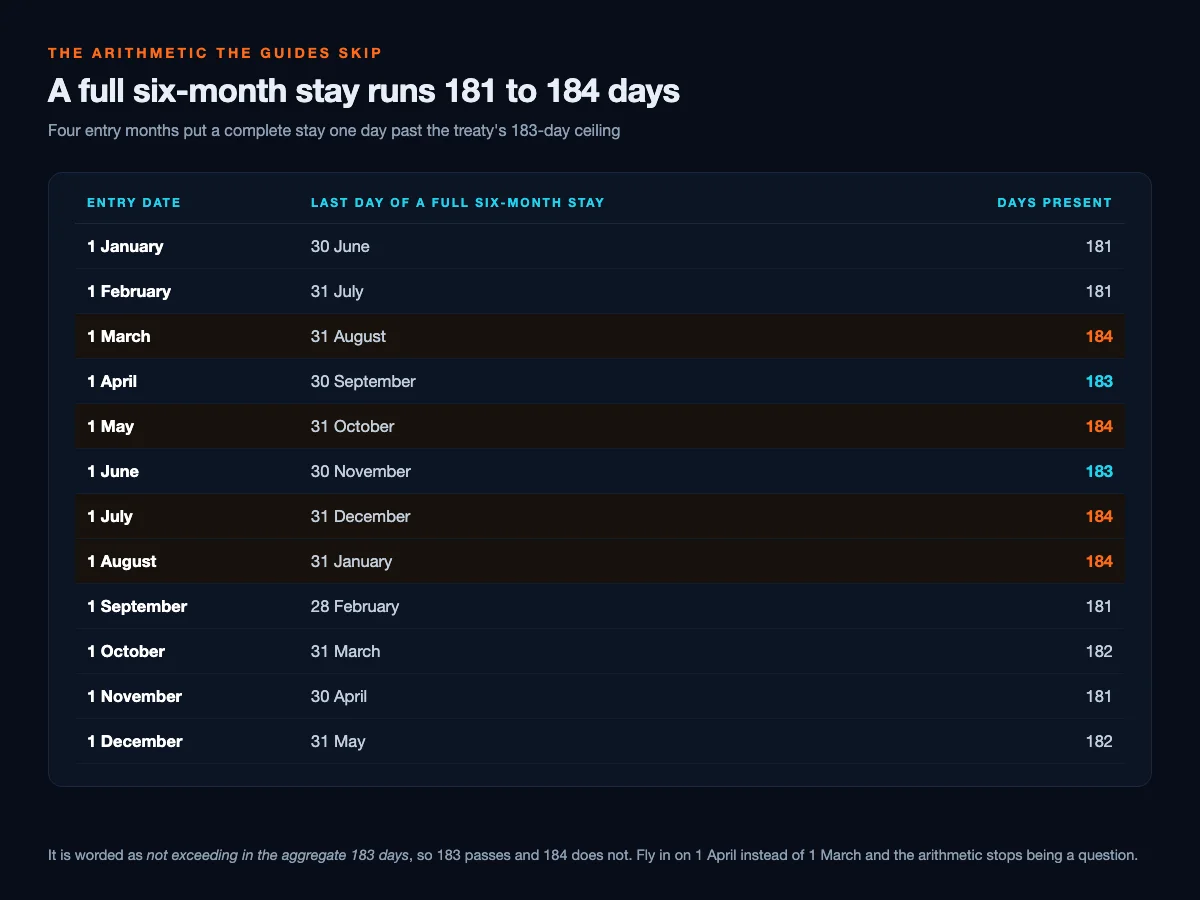
It usually is not. Depending on the month you fly in, a full six-month stay runs from 181 to 184 days, and in four of the twelve entry months it reaches 184 — one day past the limit in the tax treaty the whole scheme was built around. What hangs on that day is the difference between zero Japanese tax and a 20.42% flat charge on everything earned while physically in Japan.
So I read the Ministry of Justice notification that created the status, the Immigration Services Agency's Q&A and the text of two of Japan's tax treaties rather than the summaries. The 183-day figure is not Japan's residency test and never was — that test is one year. It is a treaty threshold for employees, and self-employed readers are governed by a different article with no day count in it at all.
Key takeaways
- A full six-month stay is 181 to 184 days. Enter on the first of March, May, July or August and you reach 184 — over the treaty's 183-day ceiling before you have done anything wrong.
- 183 days is not the residency test. Japan treats you as a resident at one year. Under that you are a non-resident — and non-residents still pay 20.42% on Japan-source income, which includes work performed in Japan.
- Employees and freelancers take different routes. Employees need the treaty's employment article and its three cumulative conditions; sole proprietors fall under business profits, where the test is a permanent establishment, not days.
- The country list is a tax list. The 51 eligible nationalities confine the scheme to people the treaties already exempt; your spouse's list has 73. Cyprus, Malta and every Caribbean investment passport are missing from yours.
- The income test is JPY 10 million, but for a sole proprietor the ISA measures it on contract value, not profit after overheads, and the fee rose to JPY 15,000 on 1 July 2026.
SafetyWing — the visa is refused without private cover, because a digital nomad gets no residence card and so cannot join Japan's public health insurance
What the Japan digital nomad visa actually is in 2026
There is no visa called the digital nomad visa. What exists is a sub-category of Designated Activities, a catch-all status under which the Minister of Justice designates activities for individual foreign nationals. Ministry of Justice Notification No. 80 of 2024 amended the Public Notice to add remote work, and the resulting definition is Public Notice on Designated Activities No. 53, in force since 31 March 2024.
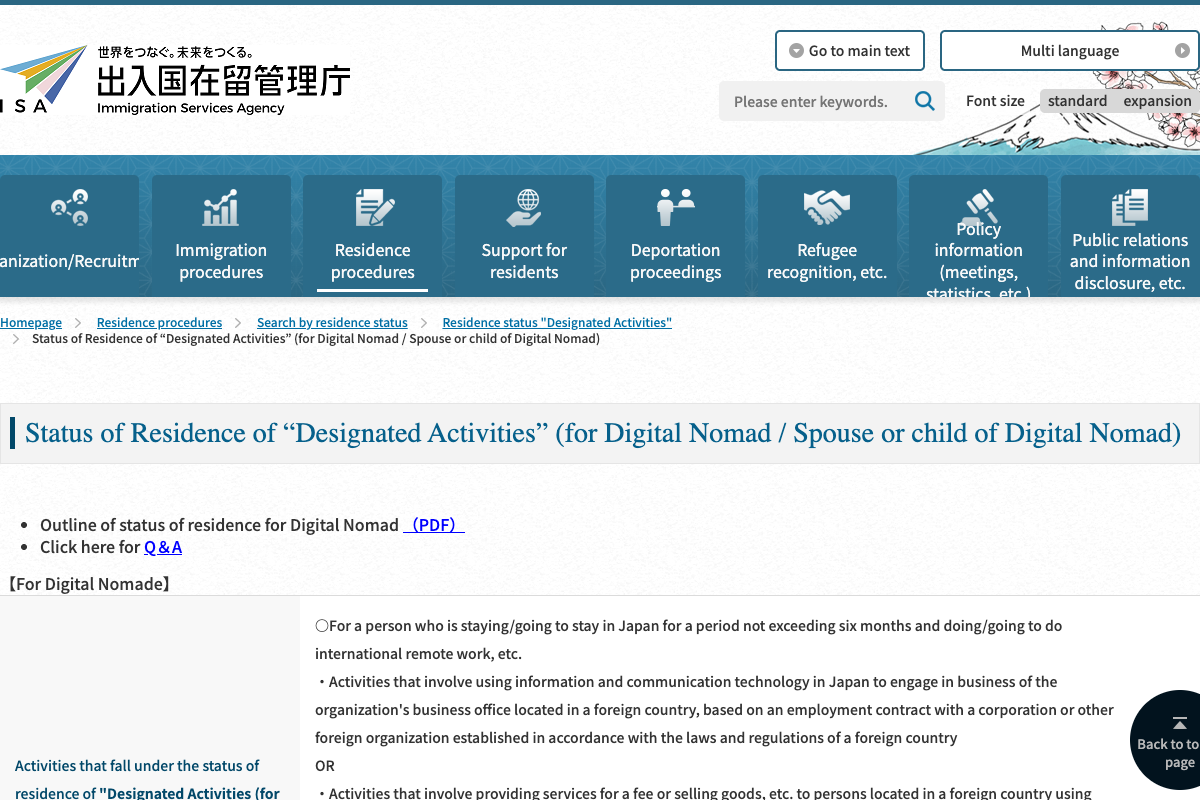
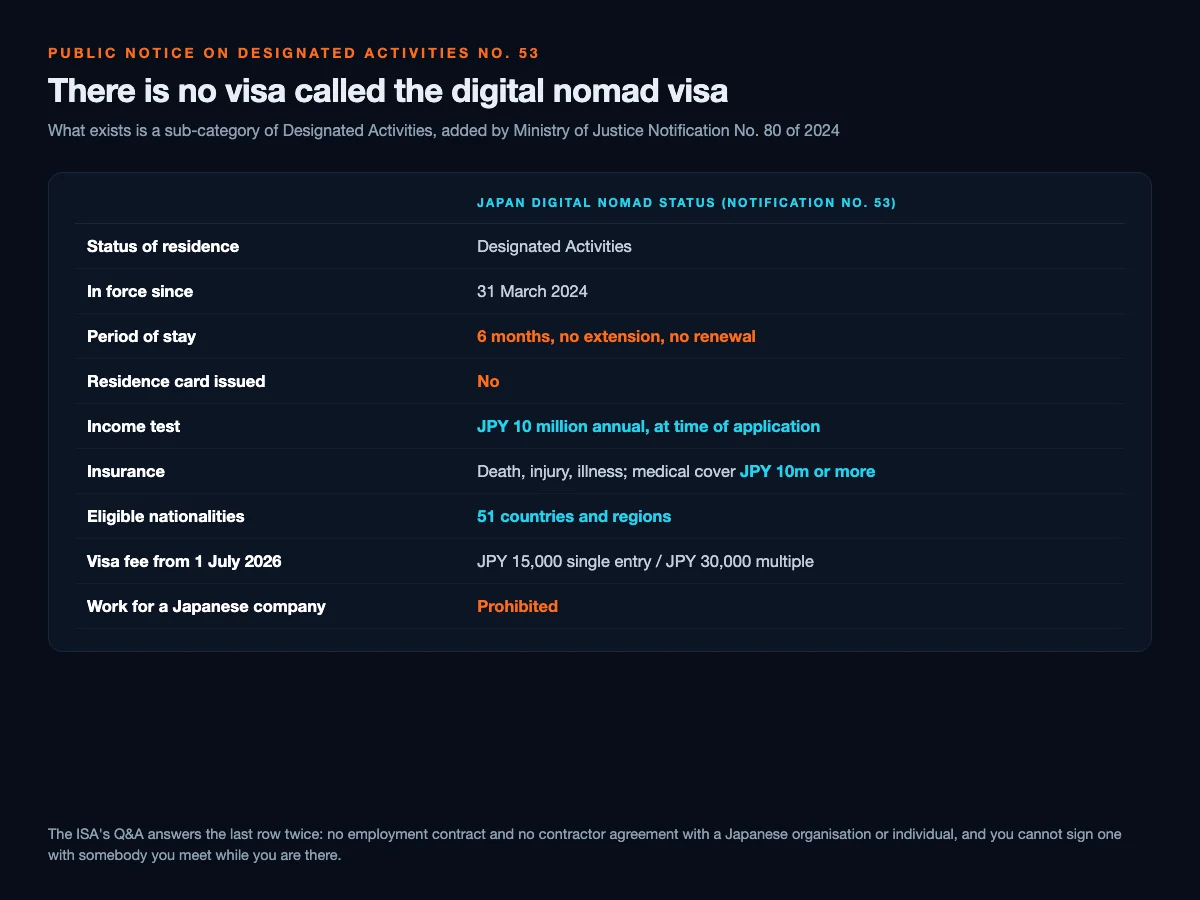
Notification No. 53 covers two things: using information and communication technology in Japan to do the work of a foreign employer's overseas office under a contract with a foreign corporation, and providing services for a fee or selling goods to persons located abroad by the same means. The second limb is the freelancer's. Both exclude anything that cannot be provided or sold without entering Japan.
| Japan digital nomad status (Notification No. 53) | |
|---|---|
| Status of residence | Designated Activities |
| In force since | 31 March 2024 |
| Period of stay | 6 months, no extension, no renewal |
| Residence card issued | No |
| Income test | JPY 10 million annual, at time of application |
| Insurance | Death, injury, illness; medical cover JPY 10m or more |
| Eligible nationalities | 51 countries and regions |
| Visa fee from 1 July 2026 | JPY 15,000 single entry / JPY 30,000 multiple |
| Work for a Japanese company | Prohibited |
That last row is absolute. The ISA's Q&A answers it twice: employment with a Japanese organisation or individual, under an employment contract or a contractor agreement, is not permitted, and you cannot sign one with somebody you meet while you are there. A Japanese client is not a grey area here; it is the thing the status is defined against.
The 183-day problem nobody does the arithmetic on
Here is the calculation that the guides skip. A six-month period of stay beginning on the first of a month ends on the last day of the sixth month, and the number of days in that window is not constant, because the months are not the same length.
| Entry date | Last day of a full six-month stay | Days present |
|---|---|---|
| 1 January | 30 June | 181 |
| 1 February | 31 July | 181 |
| 1 March | 31 August | 184 |
| 1 April | 30 September | 183 |
| 1 May | 31 October | 184 |
| 1 June | 30 November | 183 |
| 1 July | 31 December | 184 |
| 1 August | 31 January | 184 |
| 1 September | 28 February | 181 |
| 1 October | 31 March | 182 |
| 1 November | 30 April | 181 |
| 1 December | 31 May | 182 |
Four entry months put a complete stay at 184 days. Two more land exactly on 183, clearing the threshold with nothing to spare — it is worded as not exceeding in the aggregate 183 days, so 183 passes and 184 does not. Two things make the margin thinner still. The treaty counts days in any twelve-month period commencing or ending in the taxable year concerned, not per calendar year, so a stay straddling New Year is one block. And the six-month gap the ISA requires before you may return is calibrated so tightly that two consecutive stays put roughly half of every rolling twelve months inside Japan.
The fix costs nothing if you know about it in advance. Fly in on 1 April instead of 1 March, or simply leave a week early, and the arithmetic stops being a question. Discover it in month five and your options have run out.
Why the eligible-country list is a tax list, not a travel list
The eligibility rule reads like a formality: you must hold the nationality of a country with both a short-stay visa exemption arrangement with Japan and a tax treaty with Japan. Most readers assume the second condition is bureaucratic tidiness.
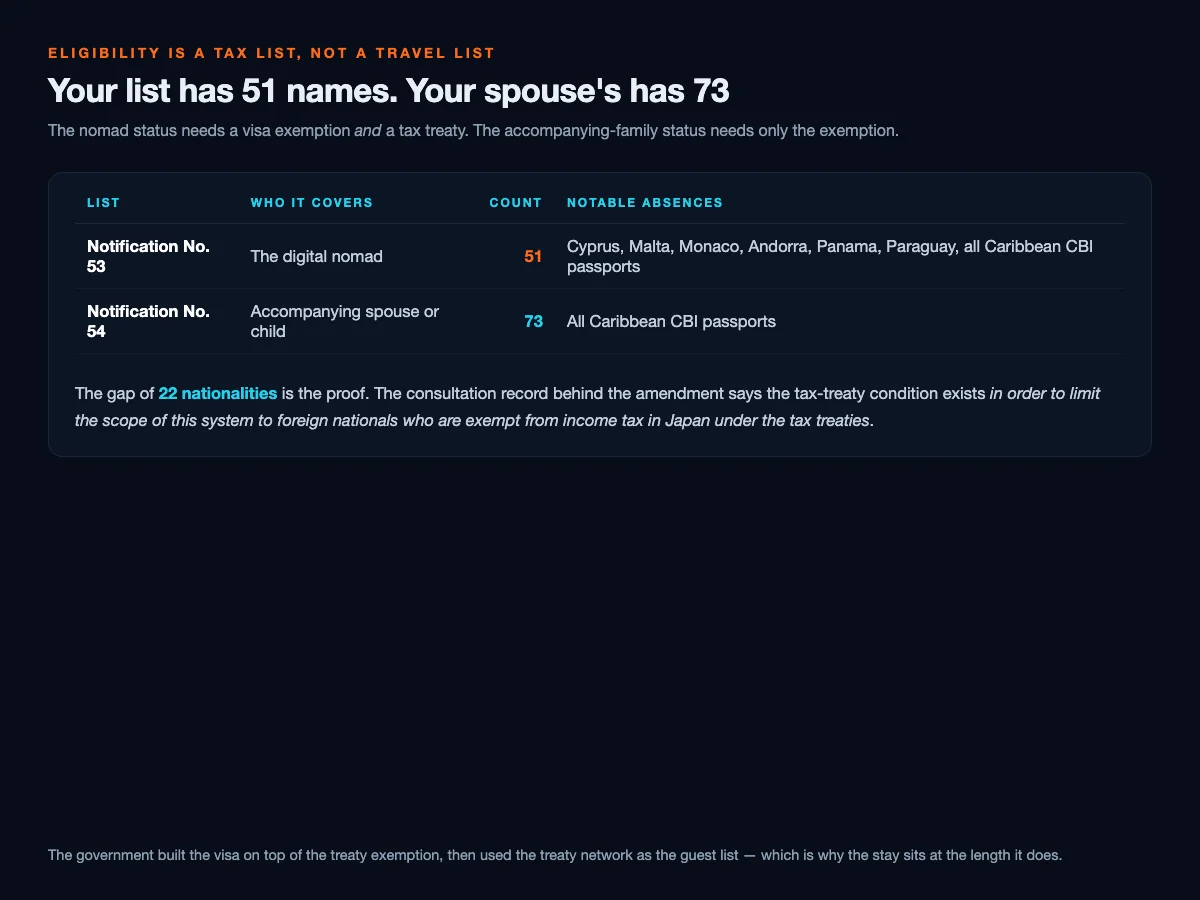
It is not. Japan's treaties exempt short-stay salaries on a reciprocity basis, and the consultation record behind the amendment says the tax-treaty condition exists in order to limit the scope of this system to foreign nationals who are exempt from income tax in Japan under the tax treaties. The government built the visa on top of the treaty exemption, then used the treaty network as the guest list — which is why the stay sits at the length it does, and why the arithmetic above is less an accident than an unexamined edge.
| List | Who it covers | Count | Notable absences |
|---|---|---|---|
| Notification No. 53 | The digital nomad | 51 | Cyprus, Malta, Monaco, Andorra, Panama, Paraguay, all Caribbean CBI passports |
| Notification No. 54 | Accompanying spouse or child | 73 | All Caribbean CBI passports |
The gap is the proof. The spouse's status needs only the visa exemption, not the treaty, so it adds 22 nationalities — among them Andorra, Costa Rica, Cyprus, Liechtenstein, Macao, Malta, Mauritius, Monaco, Panama, Paraguay and San Marino. Your spouse can be Maltese and come with you. You cannot be Maltese and go.
Two consequences matter here. If you hold a Cypriot or Maltese passport — two of the most popular EU bases for location-independent income — this visa is closed to you; see Cyprus non-dom status and the Malta Global Residence Programme for what those jurisdictions do offer. And because the gate is nationality rather than residency, a Caribbean investment passport does not open it: not Antigua, Vanuatu, St Kitts or Grenada, none of which appears on either chart. Residency programmes such as Panama's Friendly Nations visa or Paraguayan residency leave your nationality unchanged, and so leave this unchanged too.
Employee or freelancer? The treaty treats you differently
No page on the first results page makes this distinction, and it decides the whole analysis.
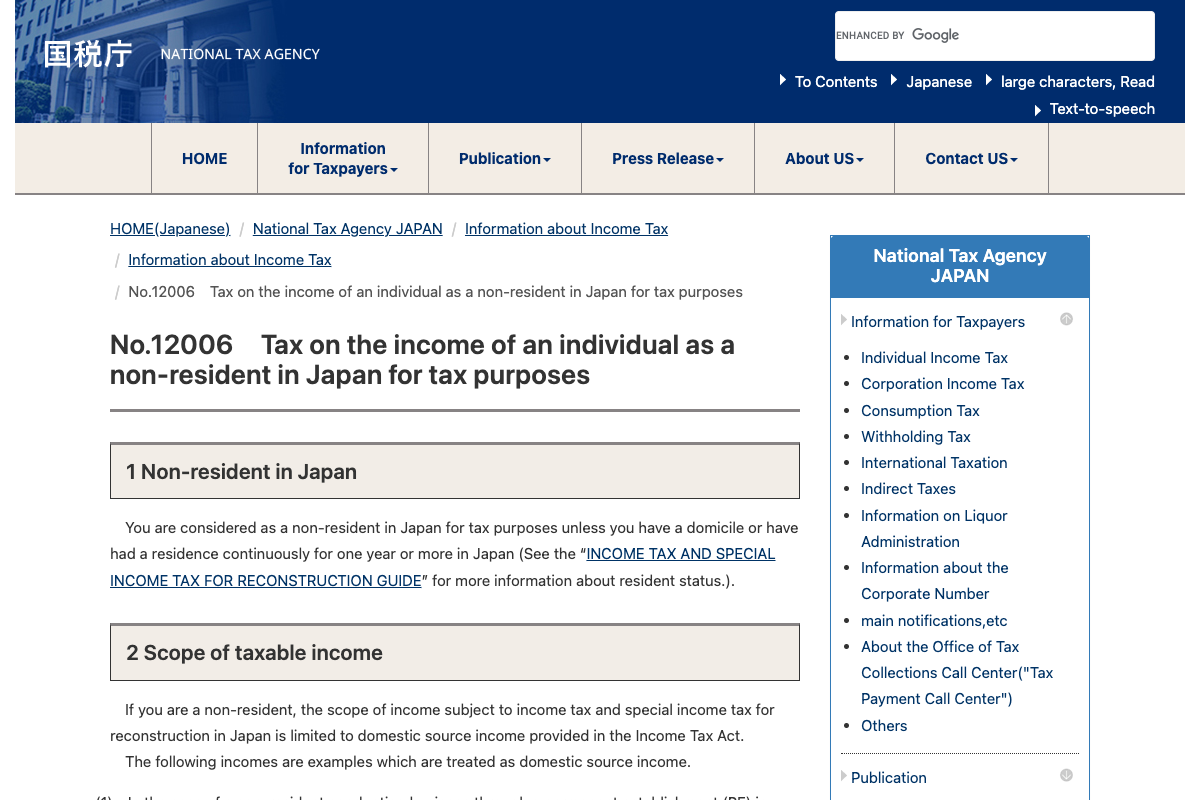
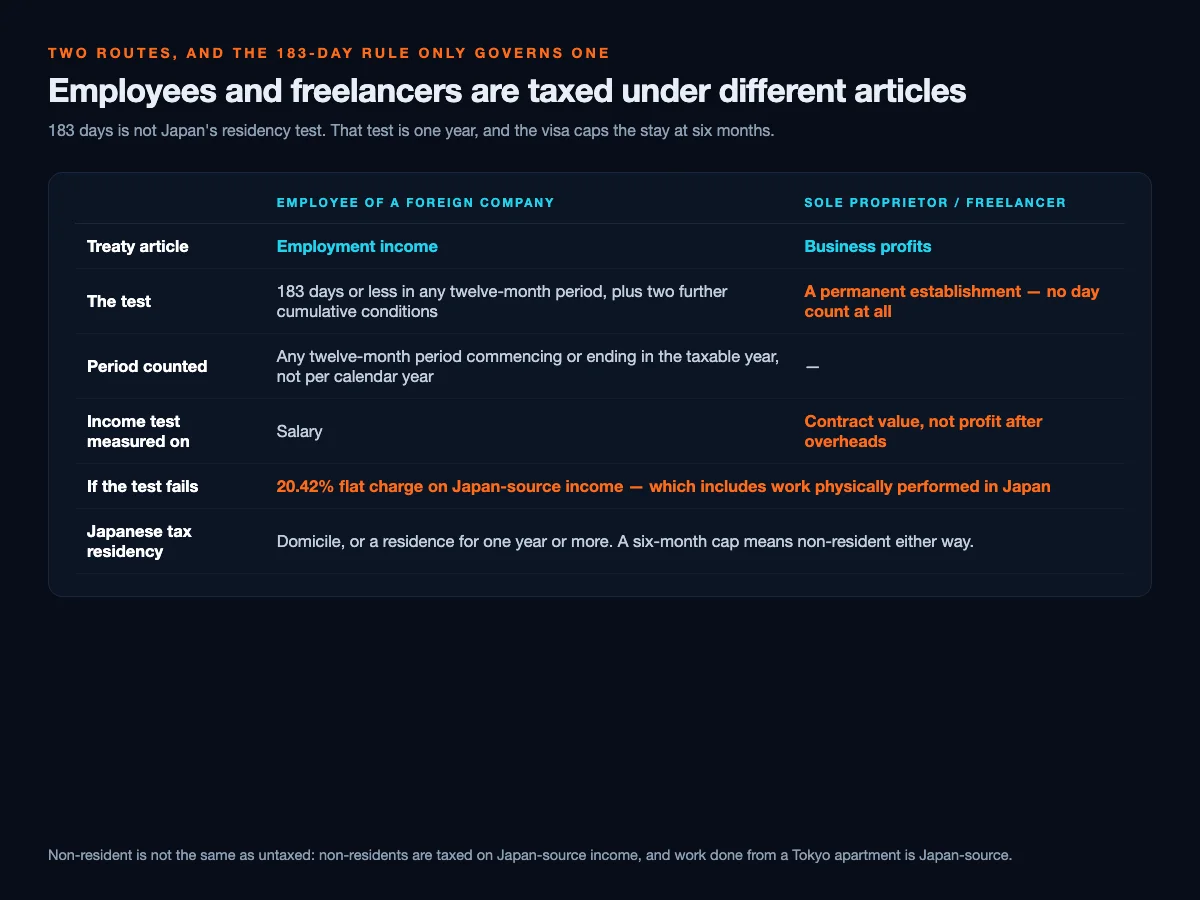
Start with Japanese domestic law, because it applies before any treaty does. The National Tax Agency's list of domestic-source income taxable to a non-resident includes salaries, wages or other remuneration received for work or the provision of other personal services carried out in Japan. Where the work happens makes the income Japanese, not where the payer sits or the money lands. The common claim that foreign remote income is untaxed because it comes from abroad has the test backwards. Absent a permanent establishment it faces separate withholding at a flat 20.42% — 20% plus the 2.1% reconstruction surtax — with no deductions.
The treaty removes that charge, and which article does the removing depends on how you are paid.
| Employee of a foreign company | Sole proprietor / freelancer | |
|---|---|---|
| Treaty article | Income from Employment (Art. 14) | Business Profits (Art. 7) |
| Test | 183 days and two further conditions | Permanent establishment in Japan |
| Day count relevant? | Yes | No |
| Who must not bear the cost | A Japanese PE of the employer | — |
| Fails if | You overrun, or a Japanese entity pays or bears it | You create a PE |
The three conditions are cumulative, and the second and third are where real cases fail. In the Japan–Germany convention, remuneration is taxable only at home if the recipient is present in Japan not exceeding in the aggregate 183 days in any twelve month period commencing or ending in the taxable year concerned, and it is paid by or on behalf of an employer who is not a resident of Japan, and it is not borne by a permanent establishment the employer has in Japan. The Japan–UK convention uses the same three limbs. If your employer has a Japanese subsidiary that recharges your salary, condition (c) fails on day one and the day count never matters.
For the self-employed there is no day count at all, because Japan's modern treaties have no independent personal services article. The Japan–UK convention settles it in its definitions: the term "business" includes the performance of professional services and of other activities of an independent character. A freelance developer's income is business profits, taxable in Japan only if attributable to a permanent establishment there.
So replace the 183-day worry with the right one. A permanent establishment is a fixed place of business through which the business of an enterprise is wholly or partly carried on — a place of management, a branch, an office. JETRO puts the domestic rule in the same register: an office in Japan, a construction project of a year or more, or business through a designated agent.
A six-month stay sits in uncertain ground, and anyone who says otherwise has not read the definition. Moving between cities with a laptop, which the ISA explicitly permits, looks nothing like a fixed place of business. A six-month lease on an apartment used mainly as a workplace, or a co-working desk held for the whole stay, is a harder argument to win — the definition turns on fixity and duration, not on who owns the furniture.
The test to apply. Described to your own tax authority in one sentence, would your Japanese arrangement sound like travelling or like opening somewhere? The first is a trip. The second is a question for an adviser in both countries before you fly, not after. The asymmetry is what makes it worth the attention: overrunning the day count as an employee costs 20.42% of the salary earned in Japan, while creating a PE pulls the attributable profits into the Japanese net at progressive rates on a filed return.
The JPY 10 million income test, as the ISA actually applies it
The headline number is JPY 10 million a year at the time of application, and the yen moves enough that you should check the rate on the day. It is an income test, not a savings test: a balance of JPY 10 million does not satisfy it. The ISA's Q&A is unusually generous about how the figure is evidenced, and none of it appears on the first page of search results.
| Your situation | How the ISA says the JPY 10m is measured |
|---|---|
| Employee, established salary | Most recent annual income of JPY 10m or more |
| Employee, mid-year raise | Income expected to reach JPY 10m in the current fiscal year |
| Newly hired this fiscal year | Paid at a rate of JPY 10m per year |
| Sole proprietor, business or sales contract | The contract amount — not profit after deducting overheads |
| Several contracts (e.g. multiple startups) | Combined, if they are considered stable incomes |
For a bootstrapped founder or contractor, the fourth row changes outcomes. Gross contract value rather than net profit is a markedly easier bar than most national income tests apply, and the fifth means a portfolio of three retainers can be added together rather than assessed one by one. The rest is documentary: contracts, income certificates and bank records that make the gross figure legible to an officer reading them cold.
No residence card, and what that costs you
The ISA is blunt: residence cards go to mid- to long-term residents, and a digital nomad is not one, so no residence card is issued. The consequences are mechanical and worth knowing before you arrive.
| Digital nomad status | Ordinary work visa | |
|---|---|---|
| Residence card | No | Yes |
| Resident registration at a ward office | No | Yes |
| Japanese public health insurance | Not eligible | Yes |
| Private medical cover | Mandatory, JPY 10m+ | Optional |
| Bank account, phone contract, lease | Usually blocked without a card | Routine |
| Move between cities | No procedure required | Notify on moving |
This is why the insurance condition exists, and the ISA says so directly: because holders cannot join Japan's public medical insurance, the cover is there so unforeseen circumstances can be dealt with. It has two limbs — medical treatment cover of JPY 10 million or more for injuries and illnesses, and death cover including transportation of the body or a payment on death, with no minimum stated for the death element.
Read your policy's Japan limit and its treatment of pre-existing conditions against that first figure specifically. A policy adequate for a fortnight in Bangkok often is not adequate here, and both the enrolment certificate and the policy terms are on the ISA's document list.
What it costs and how you apply in 2026
Most pages about the Japan digital nomad visa still print a fee of JPY 3,000. That number expired this summer. The Cabinet approved a revision to the ordinance setting visa issuance fees on 19 June 2026, effective 1 July 2026, lifting single entry from JPY 3,000 to JPY 15,000 and multiple entry from JPY 6,000 to JPY 30,000 — the first change since 1978 — applying to applications submitted on or after that date.
| Item | 2026 position |
|---|---|
| Visa fee, single entry | JPY 15,000 (was JPY 3,000 until 30 June 2026) |
| Visa fee, multiple entry | JPY 30,000 (was JPY 6,000) |
| Certificate of Eligibility | Free, but see below |
| Insurance | Market rate; must meet the JPY 10m medical limit |
| Period of stay granted | 6 months |
| Extension | Not available |
The application route has a wrinkle worth planning around. A Certificate of Eligibility is normally obtained in Japan by a sponsor acting as your agent, and the ISA's answer is that for this status there is nobody in Japan to act as your agent, so an applicant abroad should apply directly at the Japanese embassy or consulate where they are. Assemble the income evidence, the contract or proof of self-employed status, the insurance certificate and policy terms, materials describing the planned activity, and your passport.
Leaving and returning during the six months is fine with a re-entry or special re-entry permission, and does not extend or restart the period of stay. Leaving for good and coming back is the one with the gap — six months must pass after departure.
Who this visa is actually for
It is a genuinely good six months and a poor foundation. No renewal, no path to permanent residency, no residence card, no time accruing towards anything — a different class from the programmes in digital nomad visas with a path to permanent residency.
It suits an employee of a foreign company with a simple payroll, no Japanese group entity, and an entry date chosen with the day count in mind. It suits a freelancer billing foreign clients above JPY 10 million of gross contract value who will live out of short lets. It does not suit anyone hoping to pick up Japanese clients, anyone needing a bank account, or anyone treating six months as the first instalment of something longer.
Against the regional alternatives, Japan asks the highest income and gives the shortest stay. Thailand's DTV and the Thailand LTR visa both run for years, and Malaysia's DE Rantau pass sets a far lower bar. You take the Japan visa because you want to be in Japan — a perfectly good reason, as long as the one day in the arithmetic is not left to chance.
Related reading
- Digital nomad visas compared — income thresholds, durations and tax treatment across every major programme in one table.
- Digital nomad visas with a path to permanent residency — the programmes where the time actually counts towards something.
- Thailand's DTV and its tax trap — the closest regional comparison, and a remittance rule that works nothing like Japan's.
- Tax resident nowhere — why a six-month gap between countries rarely produces the result people expect.
- The Schengen 90/180 rule — the other rolling day count that catches people who plan by calendar year.
- Second residency, ranked — cost, speed and physical-presence requirements across the realistic options.
FAQ
What is the Japan digital nomad visa?
It is not a visa category of its own, but a sub-category of the Designated Activities status of residence, created by Ministry of Justice Notification No. 80 of 2024 and defined in Public Notice No. 53, in force since 31 March 2024. It permits remote work in Japan for a foreign employer or clients outside Japan, for six months with no extension.
What are the Japan digital nomad visa requirements in 2026?
Four conditions beyond the activity definition: no more than six months' stay within a year; nationality of a country with both a short-stay visa exemption and a tax treaty with Japan, which is 51 on the Immigration Services Agency's chart; annual income of at least JPY 10 million at application; and private insurance covering death, injury and illness, with medical cover of JPY 10 million or more.
Do you pay Japanese tax on the digital nomad visa?
It depends on whether your income is employment income or business profits, a distinction most guides skip. Work physically performed in Japan is Japan-source whoever does it. An employee relies on the treaty's employment article: 183 days or less in any twelve-month period, plus two further conditions. A self-employed person falls under business profits, where the test is a permanent establishment, not days.
Does the Japan digital nomad visa make you a Japanese tax resident?
No. Japan treats you as a resident if you have a domicile there or a residence there for one year or more, and the visa caps the stay at six months — so a holder is a non-resident for income tax. That is not the same as untaxed: non-residents are taxed on Japan-source income, and work done from a Tokyo apartment is Japan-source.
Which countries are eligible for the Japan digital nomad visa?
Fifty-one, on the Immigration Services Agency's chart: the United States, the United Kingdom, Canada, Australia, New Zealand, Singapore, Taiwan, Hong Kong, the Republic of Korea, the UAE, Qatar, Brazil, Mexico, Uruguay and most EU member states among them. Cyprus and Malta are not, and neither is any Caribbean citizenship-by-investment passport. A wider chart of 73 applies to an accompanying spouse or child.
Can a freelancer get the Japan digital nomad visa?
Yes, and the income test is more generous to freelancers than it looks. The Immigration Services Agency's Q&A states that for a sole proprietor under a business or sales contract, the JPY 10 million is evaluated on the contract amount rather than profit after overheads, and that several stable contracts can be combined.
Can you extend the Japan digital nomad visa or come back?
The six-month period cannot be extended or renewed. You can return, but only after a gap: the Immigration Services Agency states that once six months have passed after leaving Japan, you can re-enter under the same status. Short trips out and back during the stay are fine with a re-entry permission, and do not reset the clock.
Sources
- Immigration Services Agency — digital nomad Q&A (PDF, July 2024) — permitted activities and the ban on Japanese employment agreements; the six-month cap, no renewal, and the six-months-after-departure re-entry rule; no residence card; the tax-treaty answer; the JPY 10 million evaluation rules; the insurance limbs; and the embassy application route.
- Immigration Services Agency — Designated Activities (digital nomad) status page — the activity definition, the conditions, and the document list.
- Immigration Services Agency — eligible countries and regions chart (PDF) — the 51 nationalities for the nomad status and 73 for a spouse or child, as retrieved 7 October 2026.
- Anderson Mōri & Tomotsune — Amendment of Status of Residence Regarding Digital Nomads (PDF, June 2024) — Notification No. 80 of 2024, Public Notice No. 53 with conditions (a) to (d), Public Notice No. 54, and the policy statement behind the tax-treaty condition.
- National Tax Agency — taxation of non-residents — domestic-source income, and withholding at 20.42% absent a permanent establishment.
- JETRO — overview of the individual tax system — the one-year residence test and the domestic PE categories.
- PwC Worldwide Tax Summaries — Japan, individual residence — the jusho and kyosho definitions. Reviewed 7 August 2026.
- Ministry of Finance — Japan–Germany tax convention (PDF) — Articles 5, 7 and 14.
- Ministry of Finance — Japan–UK tax convention (PDF) — the identical employment article and the Article 3 definition of "business".
- Ministry of Finance — Japan's tax conventions (26 June 2026) — the network behind the eligibility rule.
- Newland Chase — Japan to increase visa fees from 1 July 2026 — the 19 June 2026 Cabinet decision and the rise to JPY 15,000 single entry.
Figures are current as of 7 October 2026. The day counts in the second table are arithmetic on a six-month stay beginning on the first of each month, shown to locate where the margin disappears; nobody's actual presence is counted here, and each treaty applies its own conventions. The Ministry of Foreign Affairs pages publishing the fee schedule return HTTP 403 to automated requests, so the fee is sourced to immigration-practice reporting of the Cabinet decision. The country counts are from the ISA chart on the date above, which the agency revises without notice. Treaty wording varies and yours may differ, and whether an arrangement creates a permanent establishment is a question of fact. This is editorial research, not tax advice.