
Every guide to the Thailand LTR visa lists the same two tax benefits in the same breath: a 17% flat rate and an exemption on overseas income. Both are real. No applicant has ever been able to claim both, and which one you get is decided before you fill in a single form.
For a freelancer or founder weighing a decade in Bangkok against another year of 180-day runs, that is not a technicality. It decides whether the visa solves your tax problem or leaves it exactly where it was. And a second structural fact decides something larger — whether you are eligible at all, which for most readers of this site the answer turns out to be no.
So I read the Board of Investment's own 2025 brochure rather than the summaries of it, and put its benefits matrix next to the eligibility tables. The matrix has five columns, and the two tax rows never overlap. The category built for remote workers is also the only one denied a Thai work permit, and its employer test — not its income test — is what rules out the people most likely to be reading.
Key takeaways
- The 17% rate and the overseas-income exemption are different benefits for different people. The 17% belongs to Highly-Skilled Professionals and applies to Thai employment income. The exemption belongs to the other three categories.
- The exemption is statutory and already in force — Section 5 of Royal Decree No. 743, gazetted 23 May 2022 — which is why it outruns the remittance regime that catches DTV holders.
- The Work-from-Thailand employer test is the real gate: a listed company, or a private company with three years of trading and USD 50 million of revenue over the last three. No freelancer clears it.
- February 2025 made the visa easier, not cheaper. BOI Announcement Por. 3/2568 cut employer revenue from USD 150m to USD 50m, deleted work-experience requirements and dropped the Wealthy Global Citizen income test.
- Work-from-Thailand holders get no Thai work permit and no exemption from the 4:1 employment ratio. The category assumes every baht you earn comes from outside Thailand.
- Budget 50,000 baht for issuance at the TIESC, plus insurance of USD 50,000 cover for no less than 10 months.
SafetyWing — every LTR category, without exception, must evidence health cover for treatment in Thailand before the endorsement is issued
What the Thailand LTR visa actually is in 2026
The Long-Term Resident visa opened for applications on 1 September 2022 and is run by the Board of Investment rather than the Immigration Bureau — which is why its application starts with a "qualification endorsement" instead of a visa form. It is issued in four categories, and the BOI grants a five-year stay on entry, extendable by a further five. That is where the ten-year headline comes from; it is not a single ten-year permission.
The benefits that every category receives are the ones worth having even before tax enters the picture:
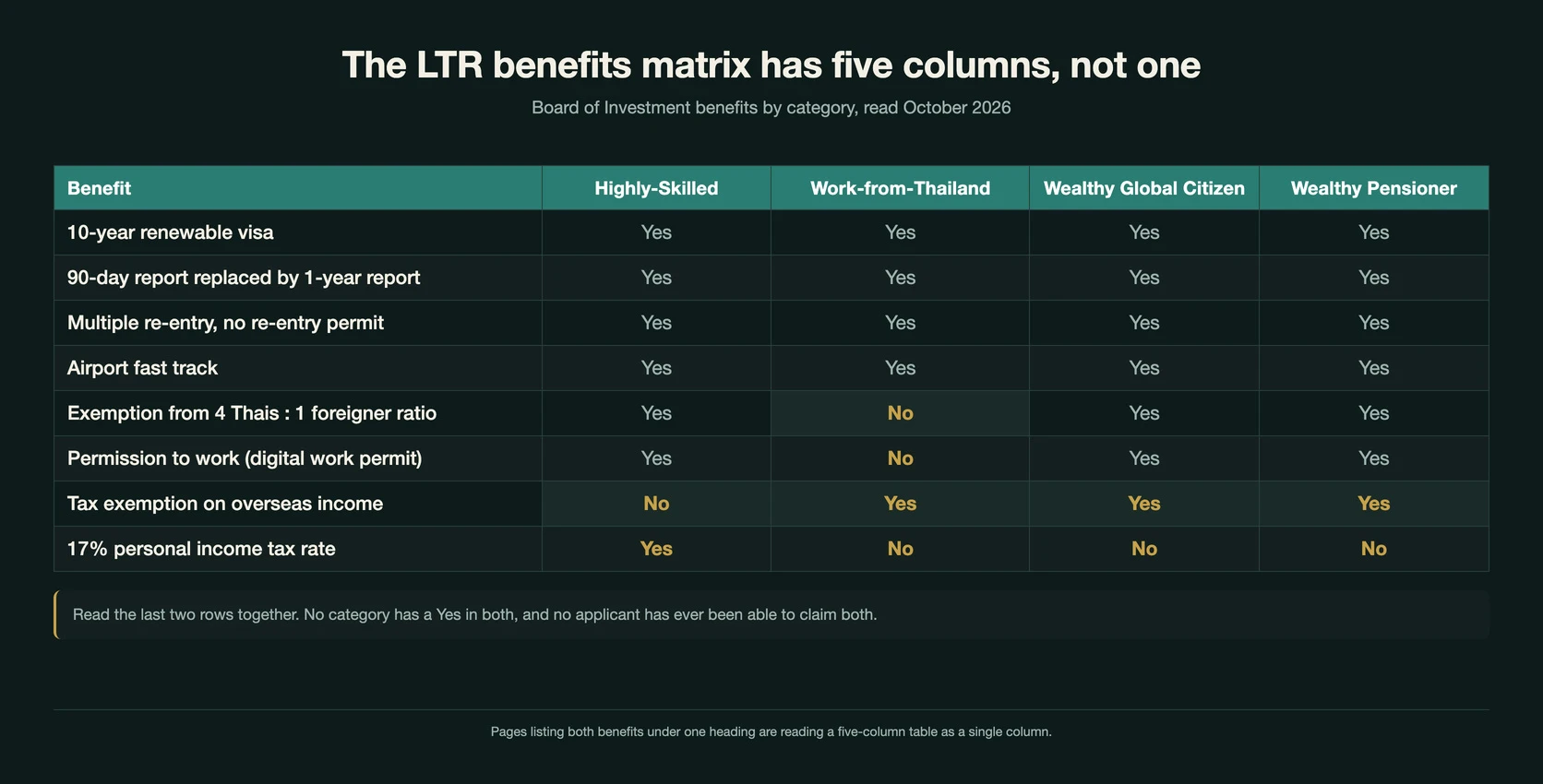
| Benefit | Highly-Skilled | Work-from-Thailand | Wealthy Global Citizen | Wealthy Pensioner |
|---|---|---|---|---|
| 10-year renewable visa | Yes | Yes | Yes | Yes |
| 90-day report replaced by 1-year report | Yes | Yes | Yes | Yes |
| Multiple re-entry, no re-entry permit | Yes | Yes | Yes | Yes |
| Airport fast track | Yes | Yes | Yes | Yes |
| Exemption from 4 Thais : 1 foreigner ratio | Yes | No | Yes | Yes |
| Permission to work (digital work permit) | Yes | No | Yes | Yes |
| Tax exemption on overseas income | No | Yes | Yes | Yes |
| 17% personal income tax rate | Yes | No | No | No |
That table is a transcription of the Board of Investment's own matrix, and it is the single most useful object in this article. Read the bottom two rows together: no column contains a Yes in both. Read the two rows above them: the remote-work category is the one that cannot work.
The two tax benefits are mutually exclusive
The 17% rate is a Highly-Skilled Professional benefit: a flat 17% on Thai-sourced employment income in place of progressive rates running to 35%. It is a rate reduction on money earned in Thailand, and does nothing for income earned abroad.
The exemption is the opposite instrument. Under Section 5 of Royal Decree No. 743, Wealthy Global Citizens, Wealthy Pensioners and Work-from-Thailand Professionals are exempt from Thai personal income tax on foreign-sourced income brought into Thailand. It covers assessable income under Section 40 of the Revenue Code arising outside Thailand — foreign employment income, offshore business profits, and dividends, interest, gains and rents from overseas assets.
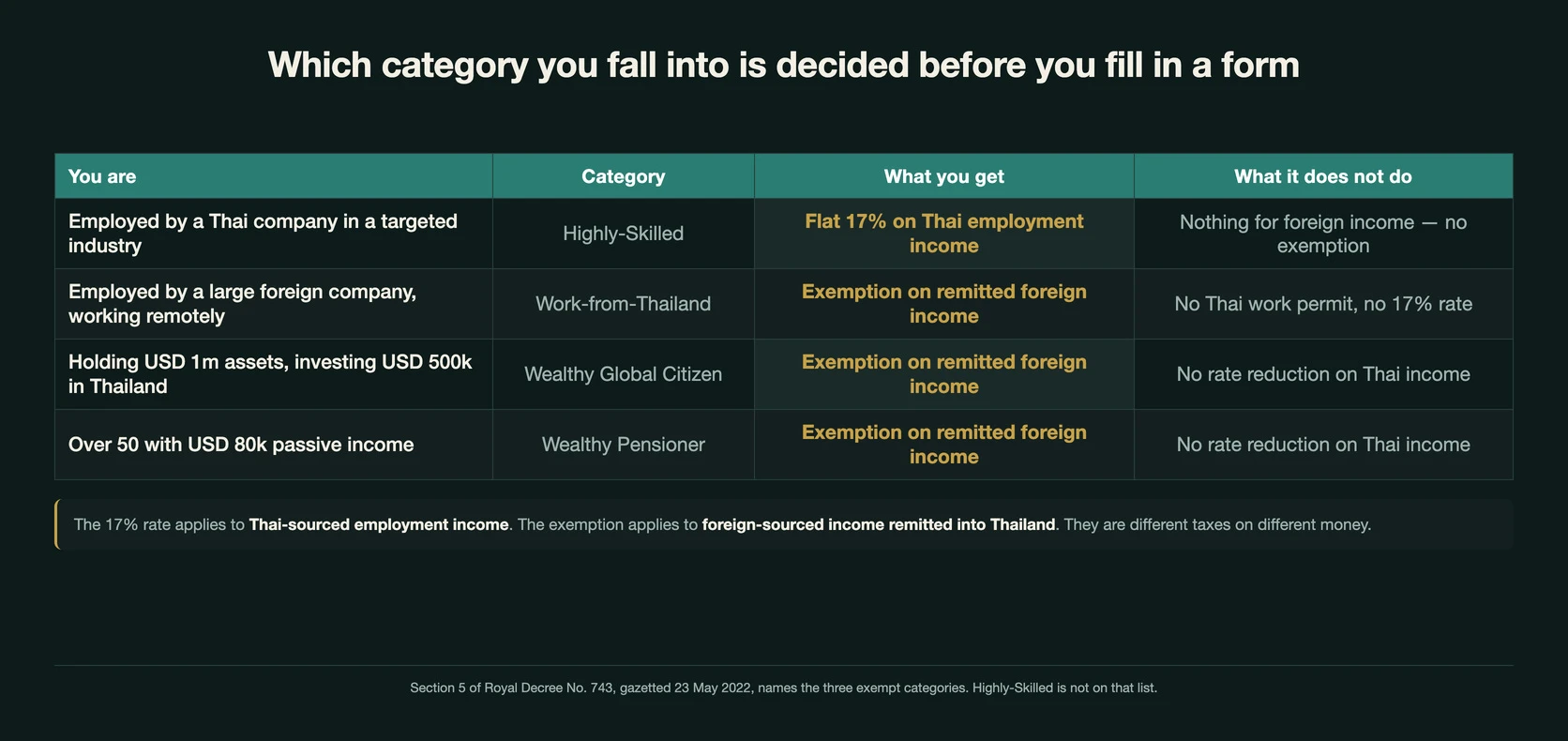
So the question "what is the LTR tax benefit?" has no single answer. It has two, and they serve opposite situations:
| You are | Category | What you get | What it does not do |
|---|---|---|---|
| Employed by a Thai company in a targeted industry | Highly-Skilled | Flat 17% on Thai employment income | Nothing for foreign income — no exemption |
| Employed by a large foreign company, working remotely | Work-from-Thailand | Exemption on remitted foreign income | No Thai work permit, no 17% rate |
| Holding USD 1m assets, investing USD 500k in Thailand | Wealthy Global Citizen | Exemption on remitted foreign income | No rate reduction on Thai income |
| Over 50 with USD 80k passive income | Wealthy Pensioner | Exemption on remitted foreign income | No rate reduction on Thai income |
A Highly-Skilled Professional with a Thai salary and a foreign portfolio gets the 17% on the salary and ordinary treatment on anything remitted from the portfolio. That is a worse tax position on foreign income than the Wealthy Pensioner sitting next to them. It is counter-intuitive enough that it is worth checking against the BOI matrix yourself before planning around it.
Why the exemption is worth more than it looks
An exemption from tax on foreign income sounds unremarkable until you know what it is an exemption from, and this is the part the LTR guides leave out entirely.
Thailand treats anyone present for 180 days or more in a calendar year as a tax resident. Until 2024, a resident could earn abroad and remit in a later calendar year without the remittance being assessable — the standard planning move for everyone on a long-stay Thai visa. Departmental Instructions Por. 161/2566 and Por. 162/2566 ended it with effect from 1 January 2024: foreign-source income remitted by a Thai tax resident is now assessable in the year it is brought in, whenever it was earned. Por. 162 carved out income earned before 1 January 2024, which can still be remitted without charge.
That is the regime every other Thai long-stay route now sits inside. The LTR exemption sits outside it:
| Route | Tax residence after 180 days | Foreign income remitted | Governing instrument |
|---|---|---|---|
| LTR (WFTP / WGC / Pensioner) | Yes | Exempt | Royal Decree 743, s.5 — in force since 2022 |
| LTR (Highly-Skilled) | Yes | Assessable on remittance | Por. 161/2566 |
| DTV | Yes | Assessable on remittance | Por. 161/2566 |
| Thailand Privilege card | Yes | Assessable on remittance | Por. 161/2566 |
| Retirement / marriage visas | Yes | Assessable on remittance | Por. 161/2566 |
A relaxation — exempting income remitted in the year it was earned or the year after — has been floated since 2025 and is widely written about as though it were law. As of late 2026 it has not been gazetted, and the firms tracking the Revenue Department's registers report no royal decree or ministerial regulation to that effect. Royal Decree 743 is the one Thai foreign-income exemption you can point at today, which is a much stronger claim than "a change is coming".
If you are weighing this against other jurisdictions, our guide to zero-percent tax residencies sets out which exemptions are statutory and which are administrative practice — the distinction that matters here.
Work-from-Thailand Professionals: the category built for remote workers
This is the category most readers will land on, so it deserves the full criteria rather than a summary. February 2025 rewrote it substantially.
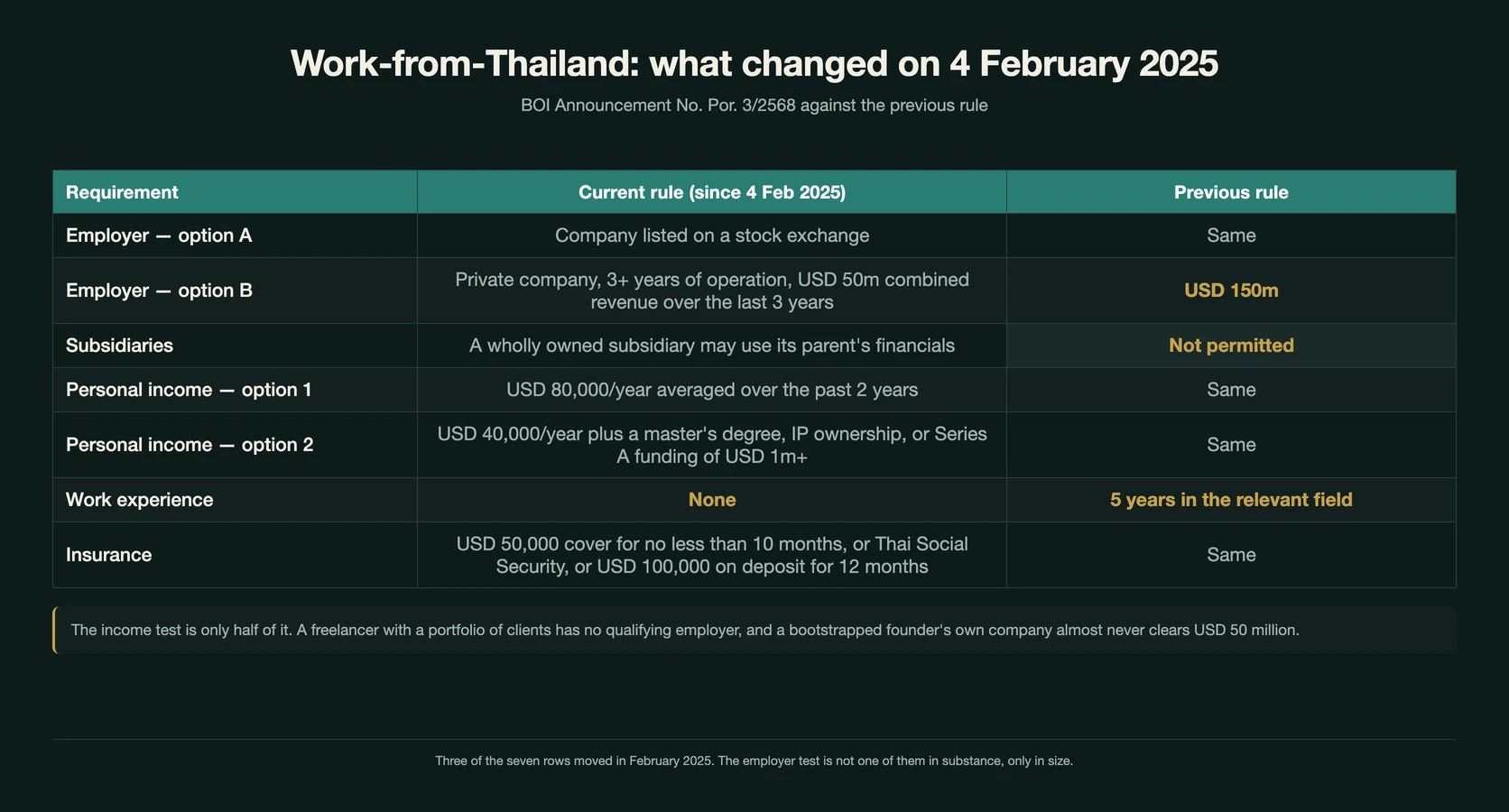
| Requirement | Current rule (since 4 Feb 2025) | Previous rule |
|---|---|---|
| Employer — option A | Company listed on a stock exchange | Same |
| Employer — option B | Private company, 3+ years of operation, USD 50m combined revenue over the last 3 years | USD 150m |
| Subsidiaries | A wholly owned subsidiary may use its parent's financials | Not permitted |
| Personal income — option 1 | USD 80,000/year averaged over the past 2 years | Same |
| Personal income — option 2 | USD 40,000/year + master's degree, IP ownership, or Series A funding of USD 1m+ | Same |
| Work experience | None | 5 years in the relevant field |
| Insurance | USD 50,000 cover for no less than 10 months, or Thai Social Security, or USD 100,000 on deposit for 12 months | Same |
Two of those changes matter more than the headline revenue cut. Deleting the five-year work-experience requirement opens the category to people who changed careers or went senior quickly. Allowing a wholly owned subsidiary to rely on its parent's financials quietly fixes the most common rejection: an employee of a small national entity owned by a large group, who previously failed a test their employer's parent passed comfortably.
The category also carries a restriction that is easy to miss and impossible to work around. Work-from-Thailand holders cannot obtain a Thai digital work permit, and are the one category not exempted from the 4:1 Thai-to-foreigner employment ratio. The design assumes every baht you earn arises outside Thailand. Take one Thai client and you are outside the terms of the visa and, separately, outside the terms of the exemption — because Royal Decree 743 relieves foreign-sourced income and Thai-sourced income was never within it.
The employer test is where most freelancers fail
Here is the part no guide written by an immigration firm will put plainly. The Work-from-Thailand category looks like a remote-work visa. It is an employee visa that happens to permit the employer to be abroad.
Both limbs of the employer test require an employment contract. A freelancer with eight clients has no employer and fails at the first question, no matter how comfortably they clear USD 80,000. A bootstrapped founder drawing USD 150,000 from their own company fails too, unless that company has three years of trading and USD 50 million of revenue — which, for the readers of this site earning between USD 50,000 and USD 300,000, it essentially never does.
The Series A limb is the one that traps people, so read it carefully: USD 1 million of Series A funding is an alternative within the income test, not the employer test. It lets a founder on USD 40,000 satisfy the personal-income limb. It does not let their startup satisfy the USD 50 million revenue limb. A funded founder who clears the income test on Series A still needs a qualifying employer, and their own company is not one.
If you are self-employed, the honest shortlist is shorter than the brochure suggests:
- Wealthy Global Citizen — if you hold USD 1 million in assets and will commit USD 500,000 to Thai bonds, companies or property.
- Wealthy Pensioner — if you are over 50 with USD 80,000 of passive income.
- The DTV — if neither applies, which for most freelancers is the answer.
That is not a reason to avoid Thailand. It is a reason to read the DTV's own terms knowing the tax exemption is not among them, and to compare against the programmes in our digital nomad visa guide on tax treatment rather than headline duration.
What the other three categories require
| Category | Core financial test | Second test | Changed Feb 2025 |
|---|---|---|---|
| Highly-Skilled Professional | USD 80,000/yr past 2 years, or USD 40,000 + master's in science or technology | Employment in one of 15 BOI-targeted industries or expertise areas | Work experience dropped; extended to academic professors in all fields |
| Wealthy Global Citizen | USD 1,000,000 in worldwide assets, including Thai investments | USD 500,000 into Thai government bonds (5+ years to maturity), direct company investment, or Thai property | Personal income requirement removed entirely |
| Wealthy Pensioner | Age 50+, passive income USD 80,000/yr | Or USD 40,000/yr plus USD 250,000 into bonds, companies or property | No change |
The Wealthy Global Citizen amendment is the largest single liberalisation in the programme's history and is still being reported incorrectly. Before February 2025 an applicant had to evidence both USD 1 million of assets, a USD 500,000 Thai investment, and USD 80,000 of personal income across two years. The income limb is gone. An asset-rich applicant with modest or lumpy income — a founder post-exit, someone living off capital — now qualifies where they previously did not. At least one accountancy-firm explainer still states that no changes have been announced to the criteria; it is wrong, and the BOI's own 2025 brochure labels each amended block "2025 Criteria Update".
Dependants were widened at the same time. The visa now extends to a spouse, legitimate children under 20, and parents and other legal dependants, with no stated limit on the number. For a reader supporting parents, that single change can be worth more than the tax position.
Fees, insurance and the application clock
| Stage | What happens | Cost / time |
|---|---|---|
| 1. Qualification endorsement | Online registration and document upload to the BOI | Free |
| 2. Document verification | BOI reviews a complete submission | 20 working days |
| 3. Visa issuance | Immigration Bureau at TIESC, Bangkok | 50,000 baht per person |
| 3. (alternative) | Royal Thai Embassy or Consulate, E-Visa system | Varies with exchange rate |
| 4. Digital work permit | Not available to Work-from-Thailand holders | Annual fee applies |
The clock in stage 3 is the one that catches people: you have 60 days from receiving the endorsement letter to obtain the visa, and that window is not extendable. The 20 working days in stage 2 runs from the date your submission is complete, so a single missing document restarts the practical timeline rather than pausing it.
On the work permit fee the sources disagree: the BOI's LTR site states 3,000 baht annually, while the 2025 brochure defers to the Ministry of Labour's rates without naming a figure. It is moot for the remote-work category, which cannot hold one.
The insurance requirement applies to all four categories and survived the amendment untouched: USD 50,000 of cover for treatment in Thailand, for no less than 10 months. The ten-month minimum is unusual and is why a twelve-month policy bought at the wrong point in the year can still fail. Thai Social Security covering full medical costs is accepted instead, as is a deposit held for twelve months — USD 100,000 for the applicant, USD 25,000 per dependant.
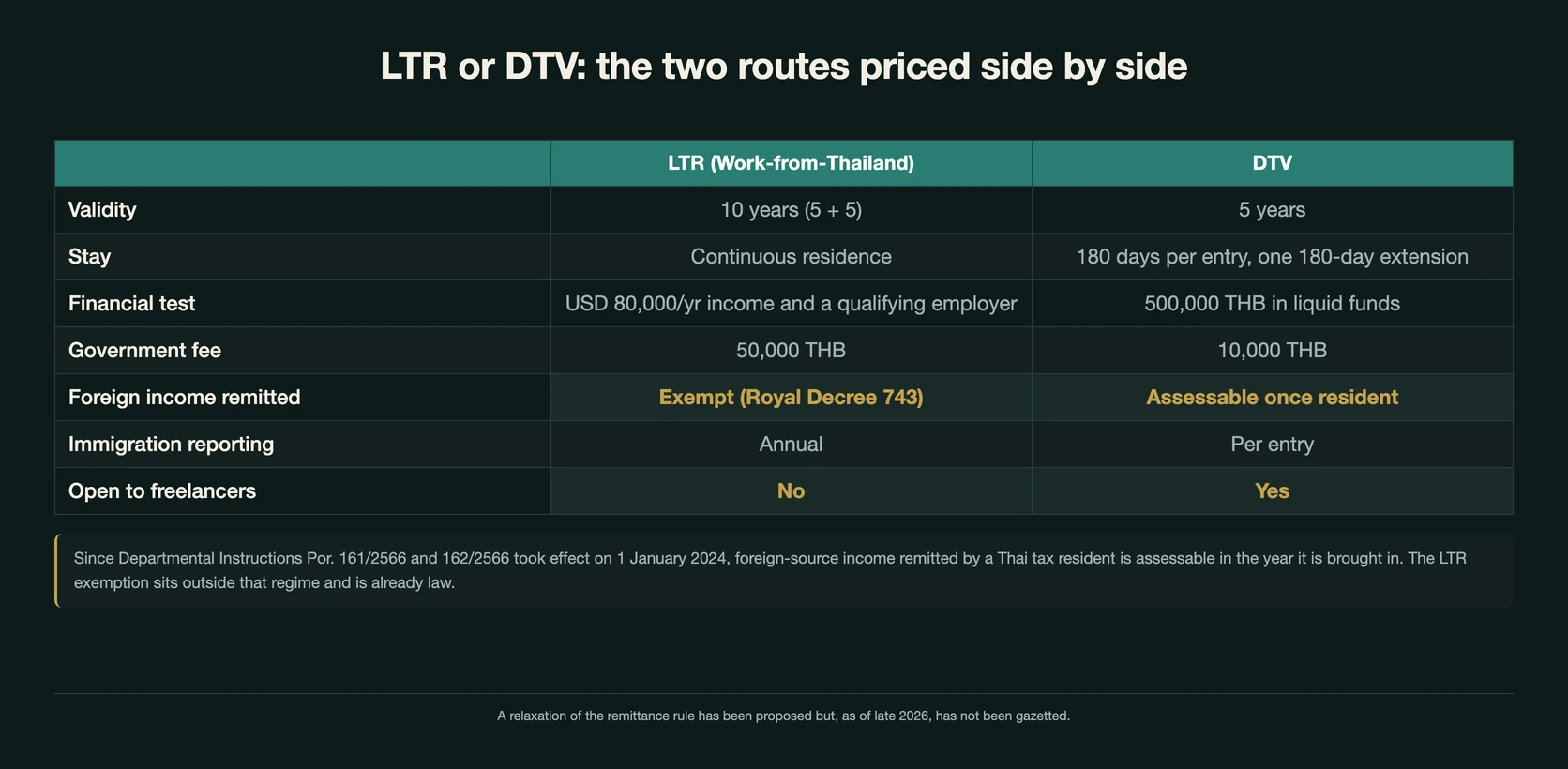
LTR or DTV: which one you actually want
| LTR (Work-from-Thailand) | DTV | |
|---|---|---|
| Validity | 10 years (5 + 5) | 5 years |
| Stay | Continuous residence | 180 days per entry, one 180-day extension |
| Financial test | USD 80,000/yr income and a qualifying employer | 500,000 THB in liquid funds |
| Government fee | 50,000 THB | 10,000 THB |
| Foreign income remitted | Exempt (Royal Decree 743) | Assessable once resident |
| Immigration reporting | Annual | Per entry |
| Open to freelancers | No | Yes |
The comparison resolves itself on one row. If you have a qualifying employer, the LTR wins on every line that matters and the fee gap is irrelevant against the exemption. If you do not, the DTV is not a worse LTR — it is the only one of the two you can get, so plan your Thai days and your remittances accordingly.
One middle case is worth naming: a contractor at a listed firm who takes a payroll contract instead converts a tax-exposed position into an exempt one. It is the only route I have found from freelance status into this visa.
Related reading
- Thailand's DTV and its tax trap — the 500,000 THB route, and why 180-day stays create the exposure Royal Decree 743 removes.
- Digital nomad visas compared — thresholds, durations and tax treatment across every programme in one table.
- Zero-percent tax residencies — where statutory exemptions exist, and where they are only practice.
- How remittance taxation actually works — the mechanics behind Por. 161/2566 and the regimes that share its logic.
- Countries with golden visas — the investor-residency comparison, including the LTR's Wealthy Global Citizen route.
- Second residency, ranked — cost, speed and physical-presence requirements across the realistic options.
FAQ
What is the Thailand LTR visa?
The Long-Term Resident visa is a ten-year Thai visa administered by the Board of Investment, open for applications since 1 September 2022. It is issued in four categories — Highly-Skilled Professionals, Work-from-Thailand Professionals, Wealthy Global Citizens and Wealthy Pensioners — and it is granted as a five-year stay that is extended for a further five. Every category gets the ten-year validity, multiple re-entry, airport fast track and the replacement of 90-day immigration reporting with a single annual report. The tax benefits are not granted to every category, which is where most summaries go wrong.
Does the Thailand LTR visa exempt foreign income from tax?
For three of the four categories, yes. Under Section 5 of Royal Decree No. 743, gazetted on 23 May 2022, Wealthy Global Citizens, Wealthy Pensioners and Work-from-Thailand Professionals are exempt from Thai personal income tax on foreign-sourced income remitted into Thailand. Highly-Skilled Professionals are not on that list — the BOI's own benefits matrix leaves their column blank for overseas-income exemption. They get a 17% flat rate on Thai employment income instead.
Can I get both the 17% rate and the foreign income exemption?
No, and the two have never been available together. The 17% personal income tax rate is a Highly-Skilled Professional benefit and applies to Thai-sourced employment income rather than foreign income. The exemption on overseas income belongs to the other three categories. Pages that list both under one heading of LTR tax benefits are reading the Board of Investment's benefits table as a single column when it has five.
What are the Work-from-Thailand Professional income requirements?
Either an average personal income of USD 80,000 a year over the past two years, or USD 40,000 a year over the past two years combined with a master's degree, ownership of intellectual property, or receipt of Series A funding of at least USD 1 million. The income test is only half of it: you must also hold an employment contract with a qualifying employer, and since BOI Announcement No. Por. 3/2568 of 4 February 2025 there is no separate work-experience requirement.
Can a freelancer get the Thailand LTR visa?
Generally not through the Work-from-Thailand category, which is the one that looks designed for remote workers. It requires an employment contract with a company listed on a stock exchange, or a private company with at least three years of operation and combined revenue of USD 50 million over the last three years. A freelancer with a portfolio of clients has no such employer, and a bootstrapped founder's own company almost never clears USD 50 million. The remaining routes are the asset-based and pension-based categories, or the DTV.
How does the LTR visa compare with the DTV for tax?
They are not close. Since Departmental Instructions Por. 161/2566 and 162/2566 took effect on 1 January 2024, foreign-source income remitted into Thailand by a Thai tax resident is assessable in the year it is brought in, which catches DTV holders who stay past 180 days and move money into a Thai account. The LTR exemption under Royal Decree 743 sits outside that regime and is already law. A relaxation of the remittance rule has been proposed but, as of late 2026, has not been gazetted.
What does the Thailand LTR visa cost and how long does it take?
The Board of Investment processes the qualification endorsement free of charge, and document verification is stated as 20 working days from the date a complete set of documents is submitted. Once the endorsement letter is issued you have 60 days to obtain the visa itself. Through the Immigration Bureau at the TIESC in Bangkok the fee is 50,000 baht per person; through a Royal Thai Embassy or Consulate on the E-Visa system the fee varies with the exchange rate.
What insurance does the Thailand LTR visa require?
Health insurance covering treatment in Thailand of at least USD 50,000, for a period of no less than 10 months. Thai Social Security covering full medical treatment costs is accepted in its place, and so is a deposit held for 12 months — USD 100,000 for the main applicant and USD 25,000 per dependant. These requirements apply to all four categories and were left unchanged by the February 2025 amendment.
Sources
- Thailand Board of Investment — LTR Visa — the four categories, the qualifying criteria quoted above, the benefits list including the 17% rate and the overseas-income exemption, the 50,000 baht issuance fee and the annual work-permit fee.
- BOI — LTR Visa brochure, 2025 edition (PDF) — the benefits matrix reproduced in the first table, each category's "2025 Criteria Update" block, the insurance requirements for all visa types, the dependants rules, and the four-step application timeline including the 20 working days and the 60-day issuance window.
- Tilleke & Gibbins — Thailand eases requirements for Long-Term Resident visas — BOI Announcement No. Por. 3/2568 of 4 February 2025, effective on issuance: the USD 150m to USD 50m employer revenue cut, the subsidiary rule, the removal of work-experience requirements, the deletion of the Wealthy Global Citizen income test, and the widened dependants definition.
- HLB Thailand — Thailand's foreign income tax changes now in force — Departmental Instructions Por. 161/2566 and Por. 162/2566 effective 1 January 2024, the remittance-year basis of assessment, the pre-2024 carve-out, and the Royal Decree 743 exemption by category.
- PwC Worldwide Tax Summaries — Thailand, residence — the 180-day aggregate test for Thai tax residency. Reviewed 24 August 2026.
- Juslaws & Consult — LTR visa for Work-from-Thailand Professionals — Section 5 of Royal Decree No. 743 and the scope of the exemption under Section 40 of the Revenue Code, and the confirmation that the category neither grants nor permits a Thai digital work permit.
Figures are current as of 5 October 2026 and are stated in the currencies the Board of Investment uses — USD for the qualifying thresholds, Thai baht for the fees. The benefits matrix in the first table is a transcription of the BOI's own 2025 brochure; where its website and brochure differ, as on the work-permit fee, both readings are given above rather than reconciled. The status of the proposed remittance-timing exemption is as reported by firms tracking the Revenue Department's registers in late 2026 and may change without notice; only the Royal Gazette settles it. Nothing here is a determination of your eligibility or your tax position — category eligibility is decided by the BOI on your documents, and the application of Royal Decree 743 to your particular income depends on facts this page cannot see. This is editorial research, not legal, immigration or tax advice.