
Nearly every page ranking for Malaysia digital nomad visa makes the same two promises: $24,000 a year gets you in, and your foreign income is taxed at 0%. The first is right for one of the two lanes. The second is a conclusion, not a rule, and the rule underneath it has a condition attached that I could not find stated on a single competing page.
For a freelancer or founder billing $50k to $300k from abroad, the gap matters in both directions. Malaysia's resident rates top out at 30% and its non-resident rate is a flat 30% with no reliefs at all, so a wrong assumption about which side of the line you are on is expensive. Equally, the exemption that makes Malaysia attractive was quietly extended by another decade in 2024, and most of the pages ranking today still tell readers it expires at the end of 2026.
So I read the gazetted exemption order rather than the summaries of it, then read the Inland Revenue Board's own guideline on how the condition in that order is applied, and pulled the MM2H tier figures from the programme's official portal instead of the property-agency blogs that dominate the search results. Three things fall out: the exemption is conditional and the condition is real, the exemption now runs to 2036 and not 2026, and the only genuinely expensive mistake available on this visa is one most guides actively encourage.
Key takeaways
- USD 24,000 a year for the tech lane, USD 60,000 for everything else. No partial credit between them.
- Foreign income is exempt, not untaxed. P.U.(A) 234/2022 requires the income to have been subjected to tax of a similar character at origin; LHDN's guideline of 29 September 2022 is what makes that condition passable for most people.
- The exemption runs to 31 December 2036, not 2026 — extended by P.U.(A) 451/2024. Pages still quoting 2026 are a year out of date.
- Residency is four tests, not one. 182 days is only section 7(1)(a); the linked-period test can make you resident on fewer days.
- One Malaysian client in a non-resident year costs 30% flat with no reliefs. On RM 60,000 of local fees that is RM 18,000, against roughly RM 2,600 if the same year is a resident one.
- MM2H is not a work permit. Only the Platinum tier allows career activity, at USD 1m on deposit plus an RM 200,000 fee.
SafetyWing — medical cover valid in Malaysia, and covering any dependants you include, is on the DE Rantau document list, not an afterthought
What the DE Rantau pass is, and who it is for
Malaysia's digital nomad visa is the DE Rantau Nomad Pass, run by the Malaysia Digital Economy Corporation (MDEC) rather than by immigration directly, and issued as a Professional Visit Pass. That matters more than it sounds: the Professional Visit Pass is the instrument Malaysia uses for a foreigner doing work in Malaysia for a foreign principal — the exact legal shape of remote work — and it is why the pass carries a quarterly or annual charge on top of the application fee.
| DE Rantau Nomad Pass | |
|---|---|
| Administered by | MDEC (Malaysia Digital Economy Corporation) |
| Legal form | Professional Visit Pass |
| Stay granted | 3 to 12 months |
| Renewal | A further 12 months, subject to approval |
| Minimum age | 18 |
| Employer | Must be registered outside Malaysia (employees) |
| Local clients | Freelancers generally permitted; taxable as Malaysian-source |
| Application | Online via MDEC, no consulate appointment |
| Processing | 6 to 8 weeks from a complete submission |
| Dependants | Spouse or partner, children under 18, disabled children, parents |
| Dependants' work rights | None |
| Nationalities | All except Israeli citizens |
The appeal is the same as Indonesia's E33G or Thailand's DTV: legality without a local sponsor, applied for from your laptop. The ceiling is about two years, short enough that it builds no clock toward anything permanent — if that is what you want, read digital nomad visas with a path to permanent residency first, because Malaysia is not on that list.
The two income thresholds, and the document set
The threshold depends on which lane MDEC puts your role in, and the two lanes are far apart.
| Tech / digital lane | Non-tech lane | |
|---|---|---|
| Minimum annual income | USD 24,000 | USD 60,000 |
| Equivalent per month | ~USD 2,000 | ~USD 5,000 |
| Typical roles | Software development, cloud and cybersecurity, data, AI/ML, UX/UI, digital marketing, digital content | Consulting, finance and accounting, legal, sales, business development, HR, supply chain |
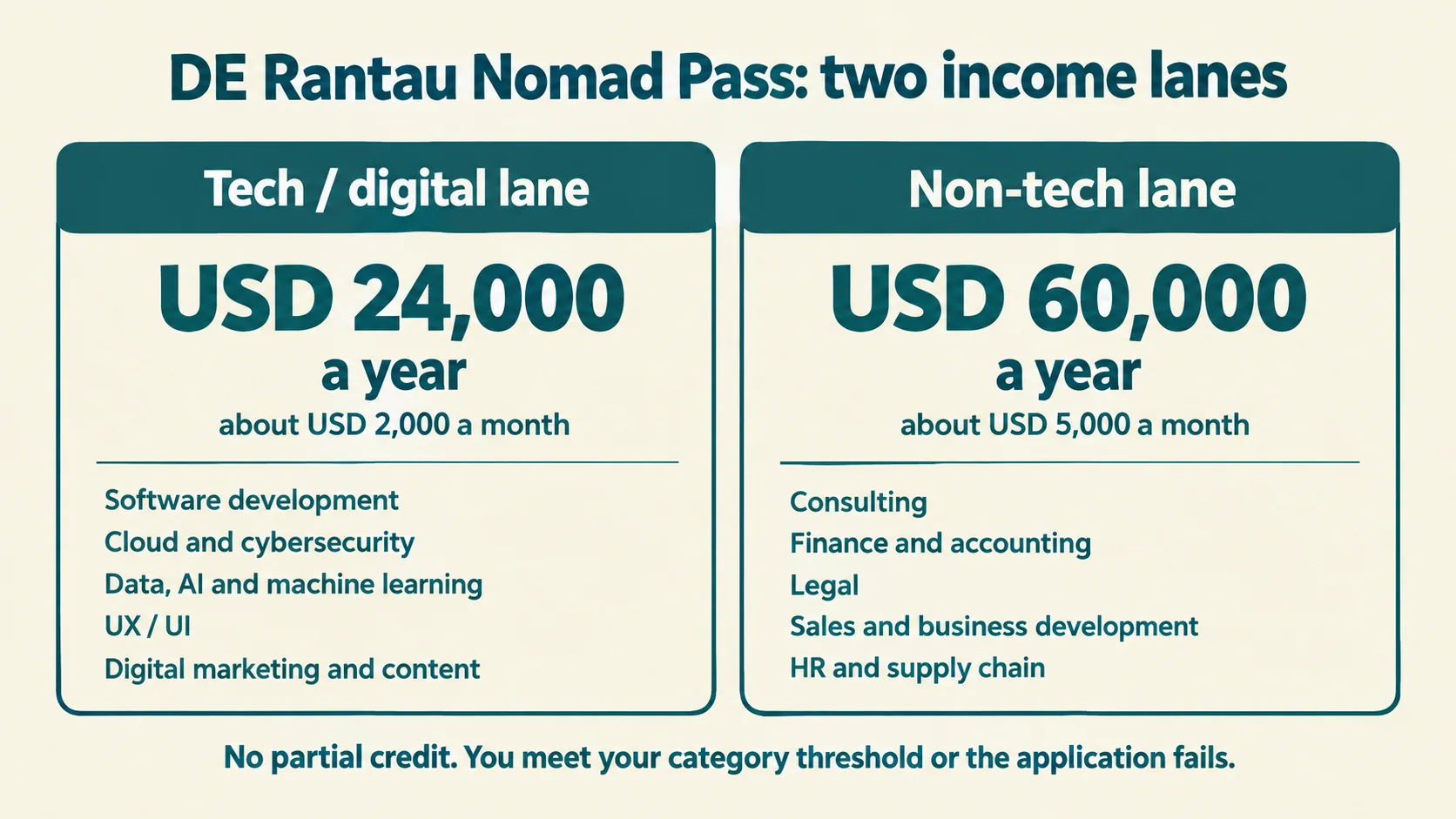
There is no averaging between them and no partial credit — a consultant earning USD 40,000 is above the tech floor, below their own, and fails. The income has to be evidenced rather than asserted: the document set runs to a CV, contracts or purchase orders showing the working relationship began at least three months before you apply, three months of invoices with proof of payment and matching bank statements, a portfolio where relevant, medical insurance valid in Malaysia and covering any dependants, and a passport with fourteen months' validity and six blank pages.
One item on that list is worth pausing on, because it tells you how Malaysia sees this pass: applicants are asked for an Inland Revenue Board tax registration slip. The country is not pretending you are a tourist.
A caveat on those figures. MDEC's own DE Rantau pages served nothing but a signup banner to automated requests, so the thresholds, role categories, fees and document list here come from the Malaysian-French Chamber of Commerce and Industry's programme page, corroborated across independent visa practices. They agree with each other; they are still second-hand, and MDEC is the only authority on your file.
What it costs in 2026
Published totals for this visa disagree, and the reason is mundane: some sources quote the fee and some quote the fee plus 8% service tax.
| Item | Amount (RM) | Notes |
|---|---|---|
| Pass fee, main applicant | 1,000 | RM 1,080 including 8% SST |
| Pass fee, per dependant | 500 | RM 540 including 8% SST |
| Professional Visit Pass charge | 90 per quarter / 360 per year | Ongoing, on top of the pass fee |
| Security bond | Varies by nationality | Not charged to every applicant |
| Refundable? | No | Fees non-refundable since May 2025 |
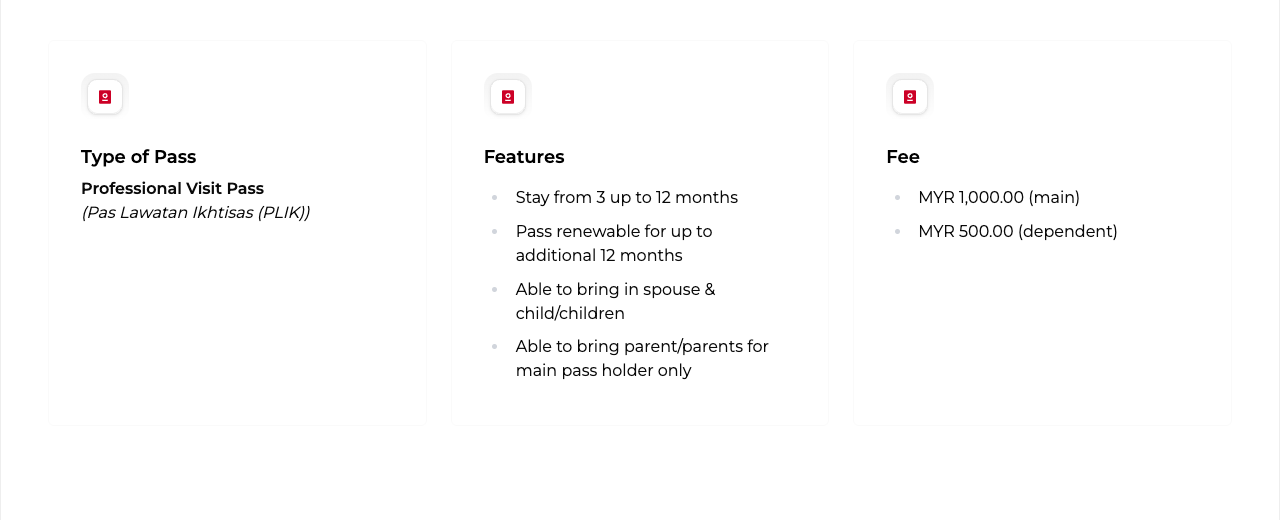
So a single applicant should budget around RM 1,450 for a first year all-in, and a couple with one child closer to RM 2,500 — modest next to the income it requires, and modest next to the four-figure agency fees that cluster around visas like this one. The non-refundable rule is the part to respect: a thin income file is not a cheap experiment.
Malaysia's residency test is four tests, not one
Every competing page I read states the 182-day rule and stops. It is the first of four limbs in section 7(1) of the Income Tax Act 1967, and the second one catches people who were counting carefully.
| Limb | Test | What it means in practice |
|---|---|---|
| 7(1)(a) | 182 days or more in a calendar year | Arrival and departure days each count in full |
| 7(1)(b) | Fewer than 182 days, but linked to a continuous 182-day period spanning the adjacent year | A stay straddling 31 December can make a short year resident |
| 7(1)(c) | 90 days or more, having been resident in 3 of the 4 preceding years | Bites on a return visit, years later |
| 7(1)(d) | Resident in the 3 preceding years and in the following year, with zero days in this one | Residency survives a year away |
For most DE Rantau holders this cuts the right way. Residency is what gives you progressive rates, personal reliefs and the foreign-income exemption. Non-residency gives you a flat 30% on Malaysian-source income with no reliefs or deductions at all. The instinct imported from Portugal or Spain — stay under the day count, stay out of the tax net — inverts here if any part of your income is local.
The year to model carefully is the arrival year. Land in September and you will not reach 182 days by 31 December; whether limb (b) pulls you in turns on whether your stay forms part of a continuous qualifying period running into the next year. That is a question about dates in your own passport, and it is cheap to answer before you book.
The 0% claim, and the condition the gazette actually imposes
Here is the part that is wrong, or at least unsupported, almost everywhere.
Until 2022 Malaysia simply did not tax foreign-sourced income in the hands of individuals. That changed on 1 January 2022, when FSI received in Malaysia came within the charge. What restores the 0% outcome is neither the territorial principle nor the visa: it is a gazetted exemption, the Income Tax (Exemption) (No. 5) Order 2022, P.U.(A) 234/2022, covering a resident individual's income from all sources under section 4 of the Act received in Malaysia from outside Malaysia, excluding income from a partnership business in Malaysia.
And it attaches a condition. The income must have been subjected to tax of a similar character to income tax under the law of the territory where it arose. For companies there is a second condition, a 15% headline rate at origin; for individuals there is just the one. One condition is still one more than "0% on foreign income".
What rescues it for most readers is the Inland Revenue Board's guideline of 29 September 2022, which interprets "subjected to tax" generously:
| Situation at origin | Condition satisfied? |
|---|---|
| Income tax or withholding tax paid or payable | Yes |
| Not taxed because of the source jurisdiction's own tax system | Yes |
| Not taxed because the income fell below that country's taxing threshold | Yes |
| Exempted at origin under a tax incentive | Yes |
| Dividends bearing underlying tax on the profits they came from | Yes |
| Income from a partnership business in Malaysia | Outside the exemption entirely |
Read together, order and guideline land most remote workers at zero — but by a route with conditions, a paper trail and an expiry date, which is a different animal from a blanket exemption. Two things follow. Keep evidence of how your income is treated where it arises, because that is the fact the condition turns on. And note that the summaries disagree: at least one professional-body technical article states plainly that resident individuals need not show their income was taxed abroad, contradicting both the order's wording and the Big Four readings of it. When commentators split like that, the answer for your file comes from LHDN or a Malaysian tax agent in writing.
The expiry date, at least, is now comfortable. The original window ran to 31 December 2026. P.U.(A) 451/2024 extended it to 31 December 2036, taking effect from 1 January 2027 — a ten-year extension that most pages ranking for this keyword have not absorbed. If you are weighing Malaysia against the alternatives in zero and one percent tax residencies, that extension is the single biggest change to the comparison in two years.
The trap nobody prices: one Malaysian client
Malaysian-source income is taxable whatever happens with your foreign income. Nothing in the exemption touches it, and freelancers on this pass are generally described as free to invoice Malaysian clients — so the visa permits the one arrangement that creates the worst available outcome.
Take RM 60,000 of fees from a Kuala Lumpur client, and change nothing but your day count.
| Same RM 60,000 of local fees | Non-resident year | Resident year |
|---|---|---|
| Rate applied | Flat 30% | Progressive |
| Personal reliefs | None | Available |
| Tax on the first RM 50,000 | — | RM 1,500 |
| Tax on the remaining RM 10,000 | — | RM 1,100 at 11% |
| Total | RM 18,000 | ~RM 2,600 |
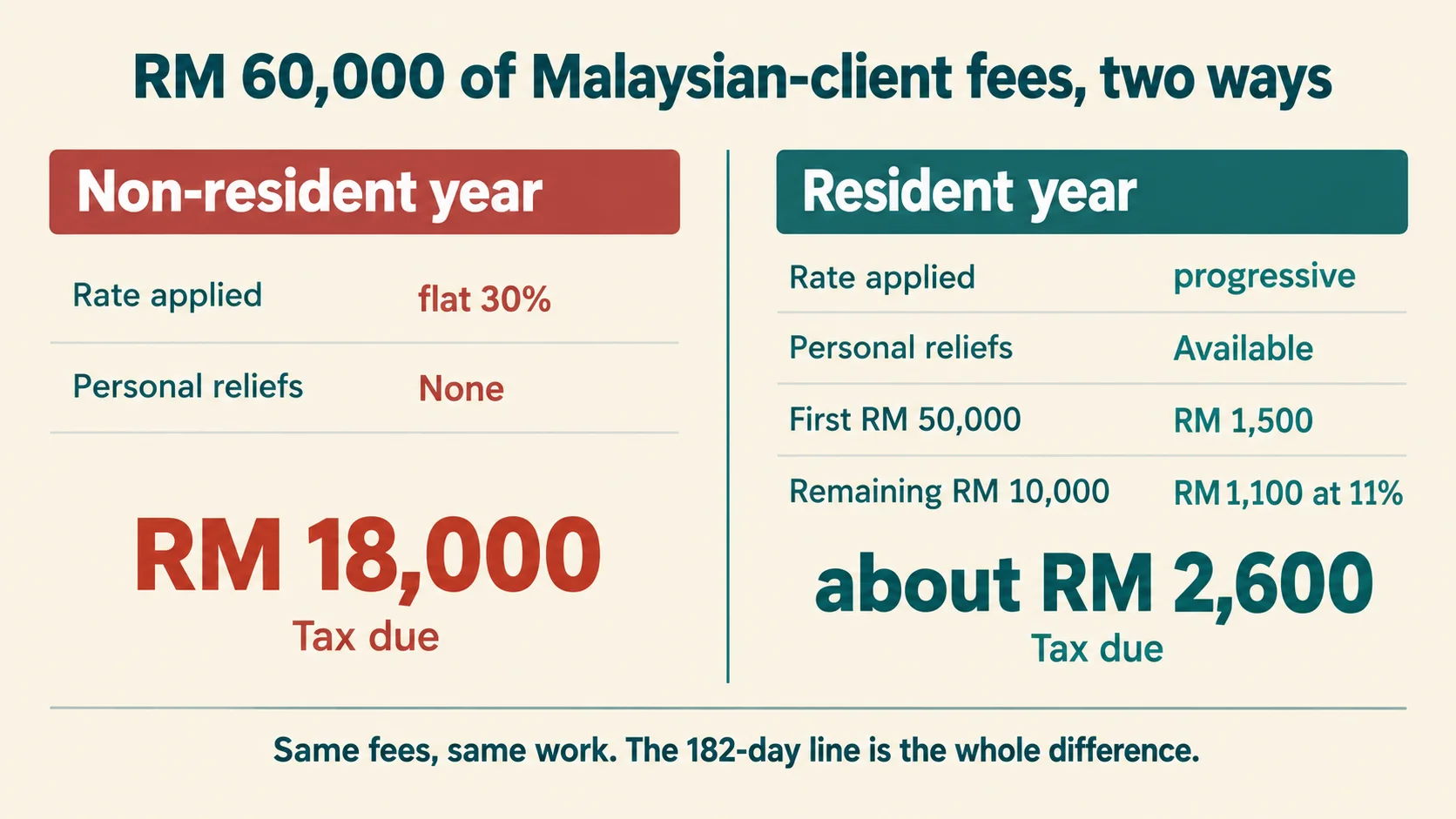
That is a difference of roughly RM 15,400 on one invoice, decided by nothing except whether the calendar year in which you were paid happened to be a resident one. The resident column is arithmetic on chargeable income before any personal reliefs, so the real gap is wider still.
The sequencing follows from the table. If you intend to take Malaysian work, take it in a year you are confidently resident — which in practice means the second calendar year, or a first year entered early enough to clear 182 days. If your arrival year is short, keep that year's invoicing foreign, exactly as you would under the logic in how to be tax resident nowhere, but for the opposite reason: here you want the residency, not the absence of it.
MM2H in 2026: four tiers, and only one of them lets you work
Malaysia's other route is Malaysia My Second Home, and its search results are dominated by property agencies working from the pre-2024 framework. The figures below come from the programme's official portal.
| Tier | Fixed deposit | Property minimum | Participating fee | Pass | Minimum stay | Work allowed? |
|---|---|---|---|---|---|---|
| Silver | USD 150,000 | RM 600,000 | RM 1,000 | 5 years, renewable | 90 days cumulative per year | No |
| Gold | USD 500,000 | RM 1,000,000 | RM 3,000 | 15 years, renewable | 90 days cumulative per year | No |
| Platinum | USD 1,000,000 | RM 2,000,000 | RM 200,000 | 20 years, renewable | 90 days cumulative per year | Yes — business and career |
| SEZ/SFZ, age 21–49 | USD 65,000 | Forest City, Johor; price varies | RM 1,000 | 10 years, renewable | 90 days cumulative per year | No |
| SEZ/SFZ, age 50+ | USD 32,000 | Forest City, Johor; price varies | RM 1,000 | 10 years, renewable | None | No |
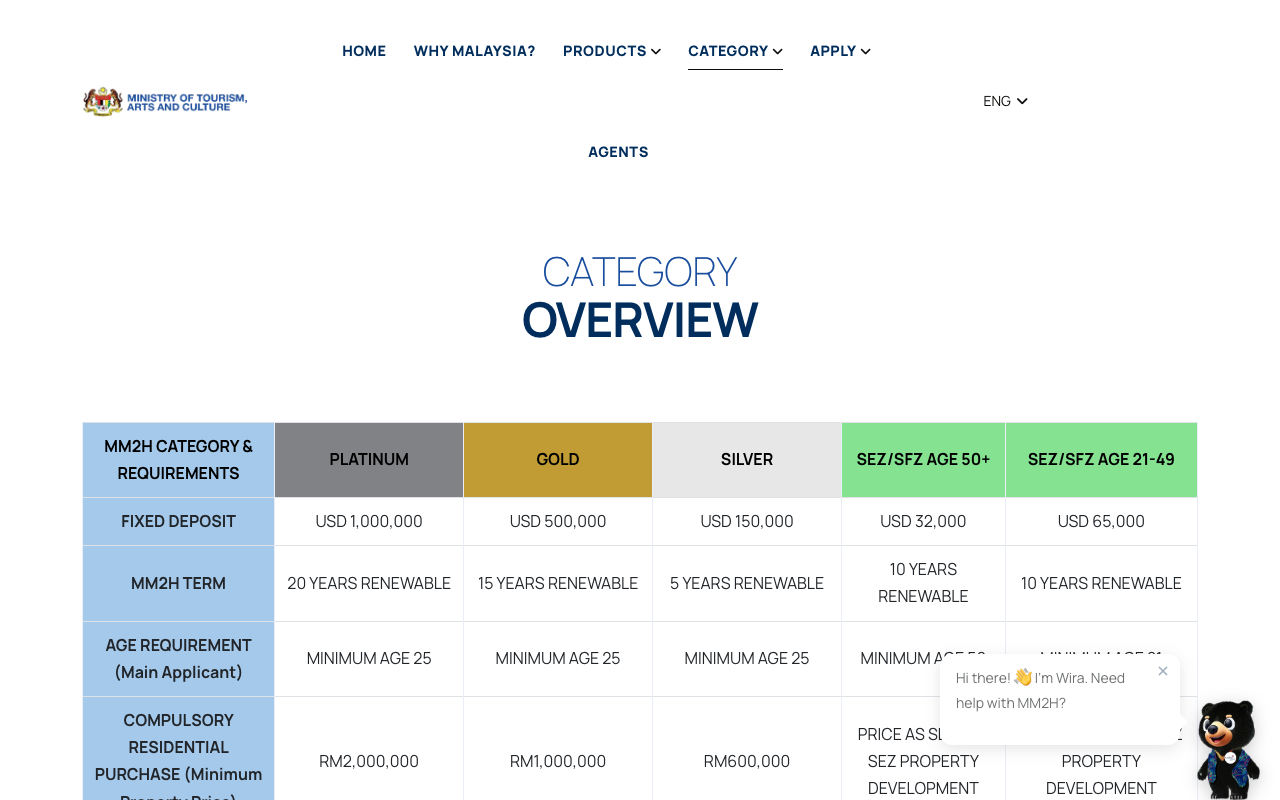
Four structural points the agency write-ups skip. The property purchase is compulsory, not an alternative to the deposit, and the residence cannot be sold for ten years, though upgrading is allowed. Up to 50% of the deposit principal can be withdrawn after approval, for a residence, education, or medical and tourism spending. Minimum age is 25 for the three national tiers and 21 for the special-zone band. And the stay requirement on the national tiers disappears at age 50 and over.
The one that decides it for this site's readers is the last column. Silver, Gold and the Forest City tiers all state that business and investment activity and career opportunities are not allowed. Only Platinum permits them, and Platinum means a million dollars on deposit, a two-million-ringgit home and a one-off RM 200,000 participating fee — before any of it earns you a cent. Anyone comparing MM2H against the golden visa programmes should price that fee honestly: it is not refundable capital, it is a cost.
Which route fits which reader
DE Rantau is right for a remote employee or freelancer above the income floor who wants one or two clean, cheap, legal years in Malaysia and will keep their invoicing foreign in any part-year. It is wrong if you need a residency clock, or if a meaningful share of your work is Malaysian.
MM2H's lower tiers suit someone with capital who wants a long, low-obligation base — 90 days a year, twenty years on Platinum — and who does not need to work from it. The special-zone tiers are the cheapest way in by deposit, but they tie you to one development in Johor, which is a property decision wearing a visa's clothes. For anyone whose honest answer is "I want to keep working and I want somewhere to be", the pass costing RM 1,450 does more than the tier costing a million dollars.
Related reading
- Digital nomad visas compared — thresholds, durations and tax treatment across every programme in one table.
- Thailand's digital nomad and long-stay visas — the closest regional comparison, and the one most readers weigh against Malaysia.
- Bali's digital nomad visa and its tax trap — the other Southeast Asian option, where residency can start on day one.
- Digital nomad visas with a path to permanent residency — which programmes build a clock, and which are dead ends.
- Zero and one percent tax residencies — where the low-tax outcomes actually exist, and what each one demands.
- Travel and health insurance for nomads — what visa document lists actually require of a policy.
FAQ
What is the income requirement for the Malaysia digital nomad visa in 2026?
USD 24,000 a year if your role sits in the digital or tech category — developer, cloud or cybersecurity engineer, data, AI, UX/UI, digital marketing, digital content creation. USD 60,000 for the non-tech lane, covering consultants, finance, legal, sales, HR, business development and supply chain roles. There is no partial credit: you meet your category's threshold or the application fails. MDEC also wants the working relationship to have started at least three months before you apply.
Is foreign income really tax-free in Malaysia on the DE Rantau pass?
Usually, but not because the visa grants anything. Foreign-sourced income received in Malaysia by a resident individual has been within the charge to tax since 1 January 2022. It is exempt under the Income Tax (Exemption) (No. 5) Order 2022 — and that order attaches a condition: the income must have been subjected to tax of a similar character at origin. The Inland Revenue Board's guideline of 29 September 2022 reads the condition broadly enough that most people pass it, including where the source country simply does not tax the income under its own system. But the exemption is a gazetted order with conditions and an end date, not a feature of the pass.
How long is the DE Rantau pass valid, and can it be renewed?
It is issued as a Professional Visit Pass for a stay of three to twelve months, renewable for a further twelve subject to approval — a practical ceiling of about two years. Processing is quoted at six to eight weeks from a complete submission, online through MDEC rather than at a consulate. Dependants (spouse or partner, children under 18, disabled children, parents) can be included but cannot work.
How much does the DE Rantau Nomad Pass cost?
The pass fee is RM 1,000 for the main applicant and RM 500 for each dependant, which becomes RM 1,080 and RM 540 once 8% service tax is added — which is why published totals disagree by exactly that margin. On top of that sits the Professional Visit Pass charge of roughly RM 90 per quarter or RM 360 per year, and some nationalities are asked for a security bond. Fees have been non-refundable since May 2025, so a rejected application is money gone.
Does the DE Rantau pass make me a Malaysian tax resident?
If you use most of it, yes — a twelve-month stay clears 182 days comfortably, and that is only the first of four tests in section 7(1) of the Income Tax Act 1967. For a nomad with purely foreign income this is not the problem it sounds like: residency is what gives you the foreign-income exemption and progressive rates rather than the non-resident flat rate. The arrival year is the risk, when a part-year stay can leave you non-resident in a year you have already invoiced a Malaysian client.
Can I work for Malaysian clients on the DE Rantau pass?
An employee's employer must be registered outside Malaysia. Freelancers are generally described as able to invoice Malaysian clients, and that is where the tax cost sits rather than the immigration cost: fees from Malaysian clients are Malaysian-source income, taxable regardless of any foreign-income exemption. In a calendar year where you are non-resident, they are taxed at a flat 30% with no reliefs or deductions. Get the position for your own contracts confirmed by MDEC in writing before you invoice locally.
Is MM2H a better option than the DE Rantau pass for a remote worker?
Not for working income. Only Platinum permits business and career activity, and it needs a USD 1 million fixed deposit, a residence of RM 2 million or more, and a one-off RM 200,000 participating fee. Silver, Gold and the Forest City tiers all state that business and career opportunities are not allowed. MM2H is a long-horizon residence instrument for people with capital to park; DE Rantau is the working route.
Sources
- MM2H official portal — category overview and the Silver, Gold, Platinum and SEZ/SFZ pages — every MM2H figure above: deposits, property minimums, participating fees, pass lengths, the 90-day stay, the ten-year resale restriction, the 50% withdrawal allowance, and the position on business and career activity tier by tier.
- EY Malaysia — foreign-sourced income exemption orders gazetted — the scope of P.U.(A) 234/2022 for resident individuals and the "subjected to tax of a similar character" condition.
- EY Malaysia — tax treatment of income received from outside Malaysia — the LHDN guideline of 29 September 2022 and when the condition counts as met despite no tax at origin.
- KPMG Malaysia — exemption orders for foreign-sourced income — the individual/company split and the 15% headline-rate condition that applies only to companies.
- PwC Worldwide Tax Summaries — Malaysia, taxes on personal income — the resident bands used in the worked example and the flat 30% non-resident rate. Reviewed 16 June 2026.
- ASEAN Briefing — when expatriates qualify for Malaysian tax residency — the four section 7(1) limbs and the "no reliefs or deductions" rule for non-residents.
- Malaysian-French Chamber of Commerce and Industry — DE Rantau Nomad Pass — pass duration and renewal, the RM 1,000 / RM 500 fees and their SST-inclusive equivalents, the Professional Visit Pass charge, processing time and dependants.
- MDEC — DE Rantau — the official programme home and application route. Its detail pages returned only a signup banner to automated requests, so the thresholds, role categories and document list above come from the chamber page, corroborated across independent visa practices.
Figures are current as of October 2026. Ringgit and dollar amounts are quoted in the currency each source publishes; no conversion is implied between the MM2H deposits (USD) and the property and fee figures (RM). The worked comparison is arithmetic on chargeable income before personal reliefs, and ignores deductible expenses and treaty relief, either of which can change the result materially. The reading of P.U.(A) 234/2022 follows the gazetted condition and LHDN's published guideline; it is not a ruling, and at least one professional-body summary reads that condition as not applying to individuals at all — a divergence flagged in the text rather than resolved. DE Rantau figures are second-hand for the reason given above. Whether any document set satisfies MDEC is that agency's determination. This is editorial research, not legal, immigration or tax advice.