
Articles of incorporation are the founding charter of a US corporation — the short legal document you file with a state government to bring a company into existence. File it, pay the fee, and a corporation that did not exist the day before now legally does, capable of owning property, signing contracts, issuing shares, and shielding its owners from personal liability. For a non-US resident, this single filing is often the entire point of entry into the American market. But the terminology trips up nearly every foreign founder, because the same idea travels under three different names — articles of incorporation, articles of organization, and certificate of incorporation — and choosing the wrong one means forming the wrong entity. This guide explains what the document is, exactly what it contains, who files it and where, how the naming and fees differ across Delaware, Wyoming and Nevada, and what a non-resident specifically needs to get it filed correctly.
Doola — US company formation, registered agent and EIN, built for non-residents
What articles of incorporation actually are
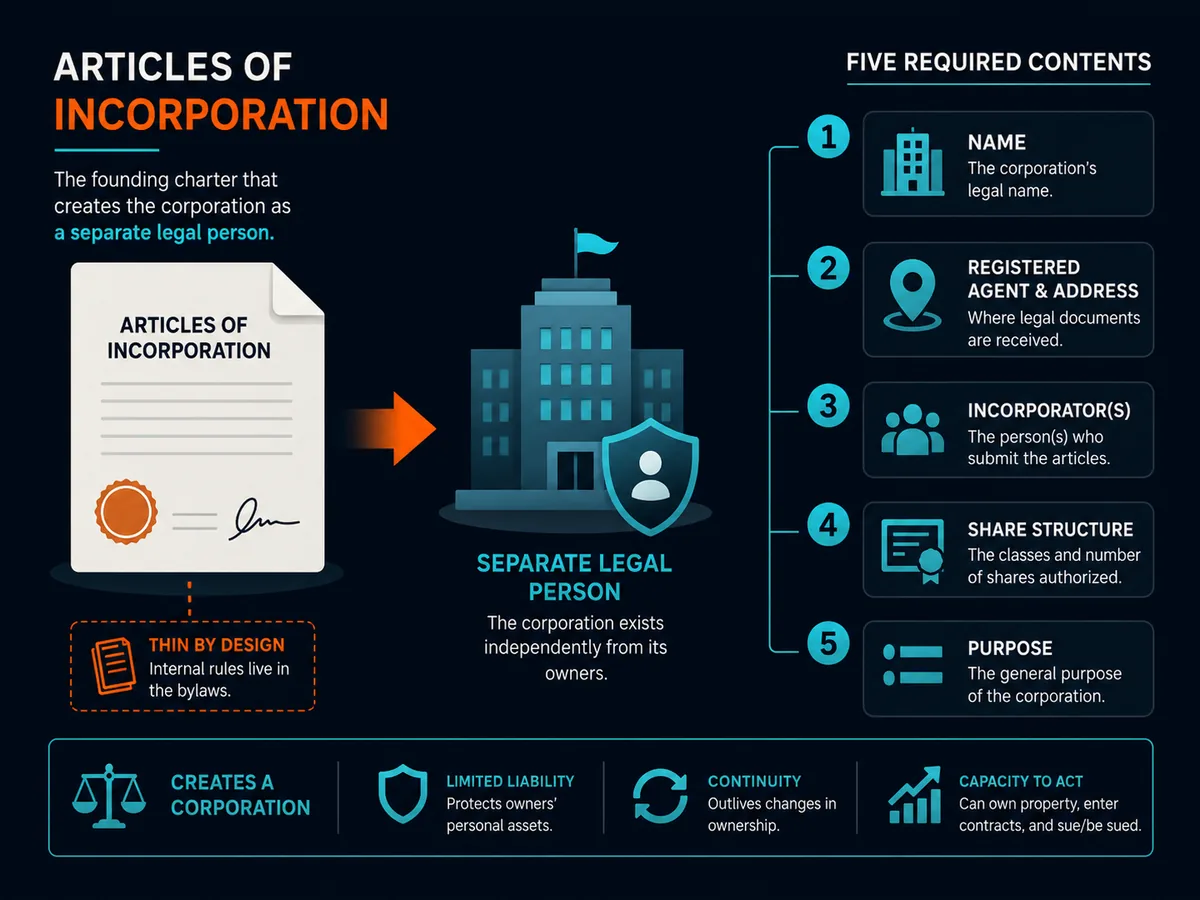
Articles of incorporation are the constitutive document of a corporation: the paper (now almost always a web form) that a state's business filing office stamps to confirm a corporation legally exists. Before the state accepts and files it, there is no corporation — just a person with an idea. After, there is a distinct legal person, separate from its owners, that can hold assets, sue and be sued, and issue stock.
The document is deliberately minimal. Most people imagine the founding charter as a thick contract; in reality a set of articles of incorporation is typically one or two pages. That thinness is by design. The charter contains only what the state requires to be on the public record — name, registered agent, shares, incorporator — and everything else about how the company runs is pushed into the private bylaws. Keeping the charter thin means the corporation can change most of its internal rules without ever going back to the state.
Every US state has a general incorporation statute that specifies what the charter must contain and grants the corporation its powers on filing. In Delaware, that statute is the Delaware General Corporation Law, and the governing section is DGCL Section 102, "Contents of certificate of incorporation." In Nevada it is NRS Chapter 78; in Wyoming, the Wyoming Business Corporation Act. The names of the sections differ, but the architecture is the same across all fifty states: a short list of mandatory contents, a longer menu of optional provisions, and an immediate grant of corporate existence once the filing clears.
The naming problem: incorporation, organisation, or formation
This is the single most confused point for non-resident founders, so it is worth being precise. Three different document names circulate, and they are not interchangeable — each maps to a specific entity type and, in some states, to specific statutory language.
Articles of incorporation — corporations
Articles of incorporation create a corporation — an entity whose name ends in Inc., Corp., Incorporated, or Company. A corporation issues shares of stock to shareholders, is run by a board of directors and officers, and by default is taxed as a C-corporation, meaning the entity pays corporate income tax and shareholders pay again on dividends. This is the vehicle almost every venture-backed startup uses. If you file articles of incorporation, you have committed to the corporate form, with its stock, its directors, and its formalities.
Articles of organization — LLCs
Articles of organization create a limited liability company (LLC) — an entity with members rather than shareholders, no stock, and pass-through taxation by default. The LLC is the workhorse structure for most solo non-resident founders because it carries far lighter formalities and, when foreign-owned and treated as a disregarded entity, no US federal income tax on non-US-source income. The distinction between the two documents is the distinction between two fundamentally different companies. We cover the choice itself in depth in our guide to LLC vs Inc, and the tax consequences for foreign owners in US C-corp for non-residents.
Certificate of incorporation / certificate of formation — the state-naming twist
Some states simply use different words for the same documents. Delaware — the most important jurisdiction for foreign founders — calls the corporate charter a certificate of incorporation (under DGCL Section 102) and calls the LLC charter a certificate of formation (under the Delaware Limited Liability Company Act). New York, Connecticut and a few others also use certificate language. The document does the identical job; only the label set by the state statute differs. When a Delaware investor asks for your "certificate of incorporation," or a Delaware bank asks for your "certificate of formation," they are asking for exactly the founding charter this guide describes. Do not be thrown by the vocabulary — it is the same instrument under a state-specific name.
| Entity type | Most states call it | Delaware calls it | Creates | Owners are | Default tax |
|---|---|---|---|---|---|
| Corporation | Articles of Incorporation | Certificate of Incorporation | A corporation (Inc./Corp.) | Shareholders | C-corporation |
| LLC | Articles of Organization | Certificate of Formation | An LLC | Members | Pass-through |
What the document actually contains
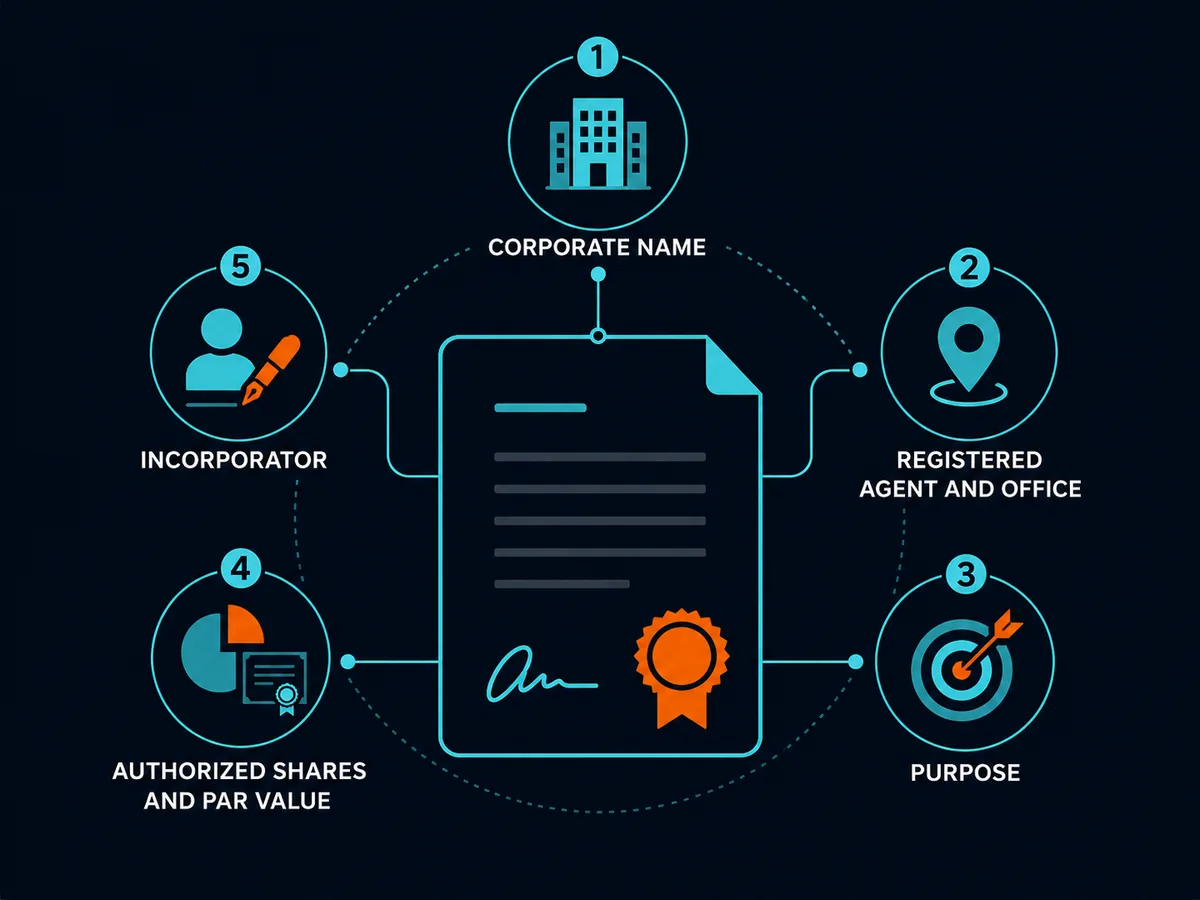
The required contents are set by statute and are short. Using DGCL Section 102 as the reference — because Delaware is where most non-resident corporations are formed — a certificate of incorporation must state the following.
Corporate name. The exact legal name, which must include one of the statutory suffixes: association, company, corporation, club, foundation, fund, incorporated, institute, society, union, syndicate, or limited (or an abbreviation such as Inc. or Corp.). The name must be distinguishable from every other entity on the state's register — check availability before you file, because a conflict rejects the whole filing.
Registered office and registered agent. The street address of the corporation's registered office inside the state of incorporation, and the name of the registered agent at that address. This is non-negotiable and is the one line every non-resident must outsource: you need a physical in-state address staffed during business hours to receive service of process. More on this in our guide to the registered agent for an LLC, which applies equally to corporations.
Purpose. A statement of what the corporation will do. In practice, nearly every charter uses the broad language the statute expressly permits — that the purpose is "to engage in any lawful act or activity for which corporations may be organized" under the state law. A narrow, specific purpose clause is almost never used because it limits the company unnecessarily.
Authorized shares and par value. The total number of shares the corporation is authorised to issue, and the par value of each share — or a statement that the shares are without par value. This is the line that most distinguishes a corporate charter from an LLC's, and it is the line that drives filing fees and franchise taxes in several states. A typical venture-track startup authorises 10 million shares at a very low par value such as 0.00001 or 0.0001 dollars, a structure chosen to keep the Delaware franchise tax low under the assumed-par-value method while leaving room for founder stock, an option pool, and future investors.
Incorporator. The name and mailing address of the incorporator — the person who signs and files the document. The incorporator need not be a director, officer, or shareholder; often it is the formation service or lawyer, whose authority ends the moment the initial board is appointed. There is no requirement that the incorporator be a US person.
Principal office and initial directors (state-dependent). Some states, though not Delaware, also ask for the principal business address and the names and addresses of the initial directors. Where the initial directors are named in the charter, the incorporator's job ends on filing.
Who files it, and how
The incorporator files the document with the state's business filing office — usually the Secretary of State, or in Delaware the Division of Corporations. Filing is done online in most states, by upload or web form, and the state returns a stamped, filed copy that is your proof the corporation exists. That stamped charter is what banks, investors, and payment processors will ask to see.
For a non-resident, there are three practical routes. You can file directly with the state yourself, which is cheapest but requires you to already have a registered agent lined up and to understand the share-structure choices. You can use a specialist formation service — Doola, Firstbase and Stripe Atlas all bundle the charter filing, a registered agent, and an EIN into one package built for founders outside the US. Or you can use a dedicated registered-agent company such as Northwest that files the charter as part of its formation service. For the C-corporation route specifically — the one VC-backed startups take — Stripe Atlas has become the default, and we compare the formation services in detail in our best LLC formation services for non-residents review.
Whichever route you choose, the sequence matters: form the entity first, receive the stamped charter, then apply for the EIN using the exact legal name on the charter. Applying for an EIN as a non-US resident before the charter is filed produces a tax ID attached to an entity that may not yet legally exist.
The filing itself, step by step
Stripped of marketing, the filing is six steps and most of the work happens before you touch the form.
- Clear the name. Search the state's business register for a conflicting name. The standard is distinguishable on the record, which is stricter than "not identical" — adding "Inc.", changing punctuation, or pluralising a word usually does not make a name distinguishable. Some words are restricted and require regulator approval before the state will accept them: bank, trust, insurance, and in many states university or engineering. If your launch depends on a specific name, reserve it before filing; most states offer a reservation of 120 days for a modest fee.
- Appoint the registered agent and get consent. You cannot file without an in-state agent, and several states will not accept the filing without documented consent — Wyoming requires a signed Consent to Appointment filed with the Articles, and it rejects formations submitted without one. Line this up first, not last. See our registered agent for an LLC guide, which applies equally to corporations.
- Decide the share structure before you type it. Authorised share count and par value are not administrative details: in Delaware they drive both the filing fee and the annual franchise tax, and in Nevada the filing fee itself is tiered by the value of authorised stock. Changing them later means a certificate of amendment and another fee.
- Complete the state's own form, or a compliant custom charter. Every state publishes a fill-in form that satisfies the statutory minimum. A custom charter is only worth drafting if you need provisions the form does not carry — preferred stock terms, director exculpation, or anything an investor will require.
- Sign as incorporator and file. Almost every state files online. There is no requirement that the incorporator be a US citizen or resident, and no US address is required of the incorporator personally.
- Collect the stamped copy. The state returns a file-stamped charter with a filing date and entity number. That document — not a screenshot of a dashboard — is what banks, processors and investors ask for. Order a certified copy at the same time if you know a bank will want one; ordering it separately later costs another fee and another wait.
Turnaround, and what it costs to skip the queue
Standard processing ranges from same-day to a couple of weeks depending on the state and the season, and every state sells expedited handling on top of the filing fee. Delaware publishes the widest and most expensive ladder of any state, and its tiers are worth knowing because they are the benchmark other states are compared against:
| Delaware expedited tier | Additional fee | Cut-off |
|---|---|---|
| One-hour service | $1,000 | Received by 9:00pm ET |
| Two-hour service | $500 | Received by 7:00pm ET |
| Same-day service | $100–$200 | Received before 2:00pm ET |
| Next-day service | $50–$100 | Next business day |
These are in addition to the base filing fee. For nearly every founder the honest answer is that expediting is a waste of money: the reason people pay $1,000 for one-hour service is a closing or a wire deadline, not impatience. If you are forming an entity in order to open a bank account or apply for an EIN, the bottleneck is downstream of the charter, not the charter itself.
Why filings get rejected
Rejections are almost always clerical, and each one costs you the queue time again:
- Name not distinguishable from an existing entity, or missing a required suffix such as Inc., Corporation, Company or Limited.
- Restricted word used without the regulator's approval.
- Registered agent missing, or consent not supplied where the state requires it.
- A PO box or mailbox service given as the registered office, which no state accepts.
- Fee mismatch — particularly in states where the fee scales with authorised shares, so a charter authorising more shares than the fee paid is bounced rather than corrected.
- Unsigned, or signed by someone not named as incorporator.
None of this is intellectually difficult. It is simply the category of mistake that costs a week, which is the main argument for using a formation service if your time is worth more than the fee.
State by state: Delaware, Wyoming, Nevada
The three states foreign founders most often weigh differ in both naming and cost. The differences are real money, and the cheapest headline fee is rarely the cheapest state once annual costs are counted.
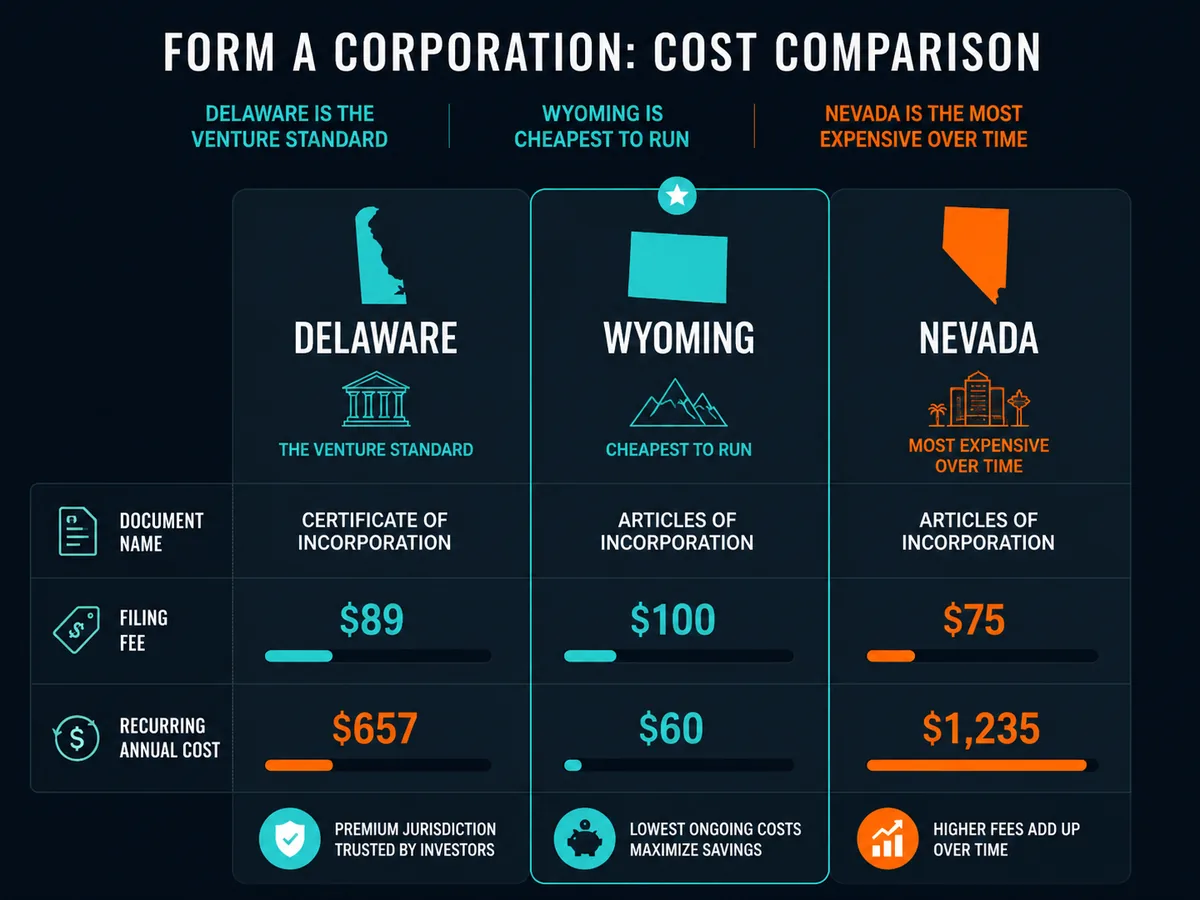
Delaware. The corporate charter is a certificate of incorporation. The minimum state filing fee is roughly 89 dollars, but it rises with the number of authorized shares, and Delaware's fee schedule is published by the Division of Corporations. Delaware's real cost is annual: every corporation owes franchise tax (a minimum of 175 dollars under the authorized-shares method, but potentially far more if you authorise millions of shares without using the assumed-par-value calculation) plus a 50 dollar annual report fee. Delaware is the standard for any company that intends to raise venture capital, for reasons we explain below and in our Delaware LLC benefits pillar.
Wyoming. Wyoming uses the traditional term articles of incorporation, and its profit-corporation filing fee is a flat 100 dollars regardless of share count. The annual license tax is a minimum of 60 dollars. Wyoming has no state corporate income tax and strong privacy protections, which is why it is the favourite for non-resident solo founders who want a simple, cheap corporation or LLC and have no intention of raising institutional money. See our Wyoming LLC benefits and Wyoming LLC cost pillars for the full picture.
Nevada. Nevada also uses articles of incorporation, but its fee structure is the most complex and the most expensive. Under NRS 78.760, the filing fee is tiered by the value of authorized stock — starting at 75 dollars for up to 75,000 dollars of authorized stock and rising in brackets up to a 35,000 dollar cap. On top of the charter fee, Nevada requires a 150 dollar initial list of officers and directors and a 500 dollar state business license, so the true cost of forming a Nevada corporation is around 725 dollars before you have done anything, and the business license and annual list recur every year. Nevada markets itself on privacy and no state income tax, but the fee load makes it the priciest of the three for most founders.
The clocks that start the day the charter is filed
The filing is the cheap part. What catches founders — non-residents especially, because state notices go to the registered agent rather than to them — is that the stamped charter starts several recurring obligations on day one.
Delaware. Every domestic corporation owes its annual report and franchise tax on or before 1 March each year, for the prior year. The annual report fee is $50 for a non-exempt domestic corporation ($25 if exempt). Franchise tax is a minimum of $175 under the authorised-shares method or $400 under the assumed-par-value capital method, capped at $200,000 (or $250,000 for large corporate filers). Miss it and Delaware adds a $200 penalty plus 1.5% interest per month. This is where an over-generous share authorisation bites: a charter with millions of authorised shares and no thought given to par value can produce a franchise-tax bill in the thousands under the authorised-shares method, which is exactly why the assumed-par-value calculation exists and why startup charters use a very low par value.
Nevada. Under NRS 78.150 the initial list of officers and directors is filed with the articles of incorporation and carries a $150 fee, and the $500 state business license is due at the same time. Both then recur annually. This is the real reason Nevada's headline filing fee is misleading — the first invoice is around $725, not $75.
Wyoming. The annual report and license tax are due on the first day of your anniversary month, at a minimum of $60 for entities with modest Wyoming assets. It is the lightest recurring burden of the three, which is the substance behind Wyoming's reputation.
Three things are also worth doing immediately, none of which is a state filing:
- Apply for the EIN using the exact legal name on the stamped charter. Sequence matters, as above.
- Adopt bylaws, hold the initial board consent, and actually issue the stock. A corporation with a filed charter and no issued shares technically has no shareholders. Banks and investors ask for the stock ledger.
- If founder stock vests, consider the 83(b) election. It must be made no later than 30 days after the stock is transferred — the IRS grants no extensions, and there is now a dedicated form, Form 15620. This is a genuine tax decision with real downside if the company fails, so take advice on it rather than filing reflexively; the only part that is not negotiable is the 30-day clock.
And if the corporation actually operates in a state other than the one it was formed in, it will need to foreign-qualify there, which is a separate filing with its own fee and its own registered agent in that state.
Articles versus bylaws versus the operating agreement
Founders routinely confuse the public charter with the private rulebook. They are different documents doing different jobs, and getting the distinction right saves genuine confusion when a bank or investor asks for "the governing documents."
The articles of incorporation are the public charter, filed with the state and searchable by anyone. They are short and rarely changed.
The bylaws are the corporation's private internal rulebook — adopted by the board, never filed with the state, and not public. Bylaws govern how the company actually runs: how directors are elected, how meetings are called, what constitutes a quorum, who the officers are and what they may do, and how shares transfer. Because bylaws are not a state filing, a corporation can amend them at will without paying the state or updating the public record. Where the articles and bylaws conflict, the articles control, because the charter is the senior document — but the articles stay thin precisely so that most operating rules can live in the flexible bylaws.
For an LLC, the analogue of both the corporation's bylaws and its shareholder agreement is the operating agreement — a private contract among the members that governs ownership percentages, profit distribution, management, and buyout terms. Like bylaws, it is not filed with the state. Our LLC operating agreement guide covers what a non-resident's operating agreement should contain. The short version: the articles (or articles of organization) create the entity in public; the bylaws or operating agreement govern it in private.
Amendments and restatements
The charter is not frozen at filing. A corporation changes its articles by filing a certificate of amendment (or articles of amendment) with the same office that accepted the original, paying a fee that is typically 50 to 150 dollars. Amendments are how a corporation changes its name, increases its authorized shares, creates a new class of preferred stock, or alters any other charter provision.
The most common amendment for a growing company is the increase in authorized shares. Because a venture financing round issues new preferred stock to investors, the company must first amend its charter to authorise enough shares to cover the raise, the founders' common stock, and the option pool. A startup that raises several rounds will amend its charter several times.
When a charter has been amended so many times that reading it means stitching together the original plus a stack of amendments, states permit a restated certificate of incorporation — a single consolidated document that integrates every prior change into one clean, current charter. Filing a "restated and amended" certificate is standard housekeeping before a major financing round or an acquisition, so that a buyer or lead investor can read one authoritative document rather than a paper trail. The restatement does not change any rights; it just tidies the record.
What a non-US-resident founder specifically needs
Everything above applies to US and non-US founders alike. Four points, though, matter disproportionately to someone filing from outside the country.
A registered agent is mandatory, and it is the one thing you cannot do yourself from abroad. Every state requires a registered agent with a physical street address inside the state of formation. As a non-resident with no US address, you must hire a commercial registered agent — 50 to 300 dollars a year through Northwest, Doola, or your formation provider. This is not optional and not a place to cut corners: if the agent lapses, the state can administratively dissolve your corporation, and you lose the good standing that banks and processors require. See our certificate of good standing guide for why that status matters.
There is no citizenship or residency requirement to incorporate. A non-resident can own the entire corporation, be its only director, and be its only officer. No US state conditions incorporation on nationality. What states check is the registered agent and the fee — not your passport.
C-corporation versus LLC is the decision the charter locks in. Filing articles of incorporation gives you a corporation taxed by default as a C-corporation, which pays US corporate income tax on its worldwide income and layers a second tax on dividends. Filing articles of organization gives you an LLC, which for a single foreign owner is usually a disregarded entity — no US corporate tax, and often no US tax at all on non-US-source income (though it still files the Form 5472 information return). One trap to note: the S-corporation election, which some US founders use, is unavailable to non-resident aliens by statute, so a non-resident's real choice is C-corp or LLC, not S-corp. We lay out the trade-offs in LLC vs S-corp and US C-corp for non-residents.
If you want venture capital, you almost certainly want a Delaware C-corp. Institutional investors — VC funds, accelerators, and most angels writing structured cheques — expect to invest in a Delaware C-corporation. Their fund structures often cannot hold LLC membership interests cleanly (pass-through income creates tax headaches for the fund's own investors), their standard financing documents assume Delaware corporate law, and Delaware's Court of Chancery gives them a predictable body of case law. So a founder building a fundraising-track startup files a Delaware certificate of incorporation, authorises around 10 million shares at a nominal par value, and accepts the C-corporation tax profile as the price of being investable. A founder building a bootstrapped, cash-flow business with no plans to raise almost always prefers a Wyoming or New Mexico LLC instead. The charter you file is the fork in that road.
FAQ
What is the difference between articles of incorporation and articles of organization
They are the same category of document — the founding charter filed with a US state — but for two different entity types. Articles of incorporation create a corporation (an Inc. or Corp.). Articles of organization create a limited liability company (an LLC). The distinction is not cosmetic: a corporation issues shares of stock, has directors and officers, and defaults to C-corporation taxation, while an LLC has members and defaults to pass-through taxation. If you file articles of incorporation, you have a corporation with all its formalities; if you file articles of organization, you have an LLC. Choosing the wrong document means forming the wrong entity, so confirm which one your state form is before signing.
Does Delaware use articles of incorporation or a certificate of incorporation
Delaware uses the term certificate of incorporation for corporations, governed by Section 102 of the Delaware General Corporation Law. It is functionally identical to what most states call articles of incorporation — the same founding charter, filed with the same office, containing the same core elements. Delaware also uses certificate of formation for its LLCs, where most states say articles of organization. The naming is purely a matter of state statute: Delaware, along with a handful of others, adopted certificate language, while the majority of states use articles. When a Delaware lawyer, investor, or bank asks for your certificate of incorporation, they mean your founding charter — the document that proves the corporation legally exists.
Do I need to be a US citizen to file articles of incorporation
No. There is no citizenship or residency requirement to incorporate in any US state. A non-resident can own 100 percent of a US corporation's stock and serve as its sole director and officer. What every state does require is a registered agent with a physical street address inside the state of formation — a person or company available during business hours to receive legal papers. Non-residents satisfy this by hiring a commercial registered agent for roughly 50 to 300 dollars a year. The one federal wrinkle is ownership type: certain S-corporation elections are closed to non-resident aliens, but a standard C-corporation or an LLC is fully available to any founder regardless of nationality.
What information goes into articles of incorporation
The mandatory contents are set by state statute and are short. For a Delaware corporation under DGCL Section 102, the certificate must state: the corporate name (including a required suffix such as Inc., Corp., or Company); the registered office street address and registered agent name in Delaware; the corporate purpose (nearly always the broad any lawful activity language); the total number of authorized shares and their par value, or a statement that shares are without par value; and the incorporator's name and mailing address. Some states also ask for the principal office address and the initial directors. Everything beyond these required lines — governance rules, share classes, transfer restrictions — lives in the bylaws, not the charter.
How much does it cost to file articles of incorporation
The state filing fee ranges from roughly 50 to a few hundred dollars, depending on the state and, in some states, the number of authorized shares. Wyoming charges a flat 100 dollars for profit-corporation articles of incorporation. Delaware's certificate of incorporation starts at a minimum of about 89 dollars and rises with authorized shares. Nevada's fee is tiered by authorized stock value, starting at 75 dollars for up to 75,000 dollars of stock, and Nevada layers on a 150 dollar initial list of officers and a 500 dollar state business license. These are one-time formation fees; annual reports, franchise taxes, and registered agent fees recur each year and often exceed the filing fee itself.
What is the difference between articles of incorporation and bylaws
The articles of incorporation are the public charter filed with the state — a short document that brings the corporation into legal existence and is visible to anyone who searches the Secretary of State's records. The bylaws are the private internal rulebook, adopted by the board, that governs how the corporation actually runs: meeting procedures, officer roles, voting thresholds, quorum, and share-transfer mechanics. Bylaws are not filed with the state and are not public. The articles win where the two conflict, because the charter is the senior document, but in practice the articles stay deliberately thin so the corporation can change its operating rules by amending bylaws without a state filing. For an LLC, the equivalent internal document is the operating agreement.
Can I change my articles of incorporation after filing
Yes. You amend them by filing a certificate of amendment (or articles of amendment) with the same Secretary of State, paying a fee that is usually 50 to 150 dollars. Amendments are how a corporation changes its name, increases its authorized shares, adds a new class of stock, or alters its purpose. Because startups routinely raise capital by issuing new shares, the amendment to increase authorized stock is one of the most common corporate filings a growth company makes. If the charter has been amended many times, states allow a restated certificate of incorporation that consolidates every change into one clean, current document — standard practice before a venture financing round or an acquisition.
How long does it take to file articles of incorporation
Standard processing runs from same-day to roughly two weeks depending on the state and how busy its filing office is, and the state returns a file-stamped charter with a filing date and entity number when it is done. Every state sells expedited handling on top of the base fee. Delaware publishes the widest ladder — one-hour service at $1,000, two-hour at $500, same-day at $100 to $200 and next-day at $50 to $100, each with its own daily cut-off time and each charged in addition to the filing fee. For most founders expediting is not worth buying: paying for one-hour service makes sense against a closing or a wire deadline, but if you are forming the company in order to get an EIN or open a bank account, the wait is downstream of the charter and expediting the charter does not move it.
Why do articles of incorporation get rejected
Almost always for clerical reasons, and each rejection costs you the queue time over again. The most common causes are a name that is not distinguishable on the state's record from an existing entity — note that adding "Inc.", changing punctuation or pluralising a word usually does not make a name distinguishable — a missing required suffix, a restricted word such as bank, trust or insurance used without the regulator's approval, no registered agent named or no consent to appointment supplied where the state requires it (Wyoming rejects formations filed without a signed consent), a PO box or mailbox service given as the registered office, a fee that does not match the authorised share structure in states where the fee scales with shares, and a document that is unsigned or signed by someone other than the named incorporator. Clearing the name and lining up the registered agent before you open the form removes most of this risk.
This guide is editorial. We hold affiliate relationships with Doola, Firstbase, Stripe Atlas and Northwest Registered Agent, disclosed via our affiliate disclosure. Nothing here is tax or legal advice — see our disclaimer.
Ready to file your charter?
Doola files your articles of incorporation or organization, provides the registered agent every state requires, and secures your EIN — all in one package built for founders outside the US. Soveraine readers go to the front of the line through our partner link, and you fund independent editorial in the process.
Sources
- Delaware Code Title 8 § 102 — Contents of certificate of incorporation (FindLaw): https://codes.findlaw.com/de/title-8-corporations/de-code-sect-8-102/
- Delaware Division of Corporations — Corporate Fee Schedule: https://corp.delaware.gov/fee/
- Delaware Division of Corporations — Certificate of Incorporation (stock) form: https://corpfiles.delaware.gov/incstk.pdf
- Delaware Division of Corporations — Certificate of Formation of a Limited Liability Company: https://corpfiles.delaware.gov/LLCFormation.pdf
- Wyoming Secretary of State — Profit Corporation Articles of Incorporation (instructions and fee): https://sos.wyo.gov/Forms/Business/PROF/P-ArticlesIncorporation.pdf
- Wyoming Secretary of State — Business Division Filing Fee Schedule: https://sos.wyo.gov/Business/docs/BusinessFees.pdf
- Wyoming Secretary of State — LLC Articles of Organization: https://sos.wyo.gov/forms/business/llc/llc-articlesorganization.pdf
- Nevada Revised Statutes § 78.760 — Filing fees: Articles of incorporation: https://nevada.public.law/statutes/nrs_78.760
- Nevada Revised Statutes § 78.035 — Articles of incorporation: Required provisions: https://nevada.public.law/statutes/nrs_78.035
- Nevada Secretary of State — Commercial Recordings Forms & Fees: https://www.nvsos.gov/sos/businesses/commercial-recordings/forms-fees
- Delaware Division of Corporations — Annual Report and Tax Instructions (1 March due date; $50 annual report fee; $175 / $400 franchise-tax minimums; $200 penalty plus 1.5% monthly interest): https://corp.delaware.gov/paytaxes/
- Delaware Division of Corporations — Expedited Services (one-hour $1,000, two-hour $500, same-day $100–$200, next-day $50–$100): https://corp.delaware.gov/expserv/
- Nevada Revised Statutes § 78.150 — Initial list of officers and directors ($150): https://nevada.public.law/statutes/nrs_78.150
- Wyoming Secretary of State — Registered Agents and Offices FAQs (Consent to Appointment; registered office may not be a PO box, drop box, virtual address or mail-forwarding location): https://sos.wyo.gov/faqs.aspx?root=RAO
- IRS — Form 15620, Section 83(b) Election (election due no later than 30 days after transfer): https://www.irs.gov/pub/irs-pdf/f15620.pdf