
Delaware is the most over-recommended jurisdiction in American small business. Roughly 68% of Fortune 500 companies are incorporated there, and that statistic gets repeated until founders assume what works for Apple works for a two-person SaaS in Lisbon. It often does not. This article covers the real benefits of a Delaware LLC — the Court of Chancery, statutory flexibility, the franchise treatment of out-of-state income — and the parts the formation agents leave out: annual fees, foreign qualification, Form 5472, and the fact that incorporating in Delaware does nothing to reduce your personal tax bill if you live in Madrid, Munich or Manhattan.
Stripe Atlas — Delaware C-Corp or LLC with Stripe banking built in
What a Delaware LLC actually is
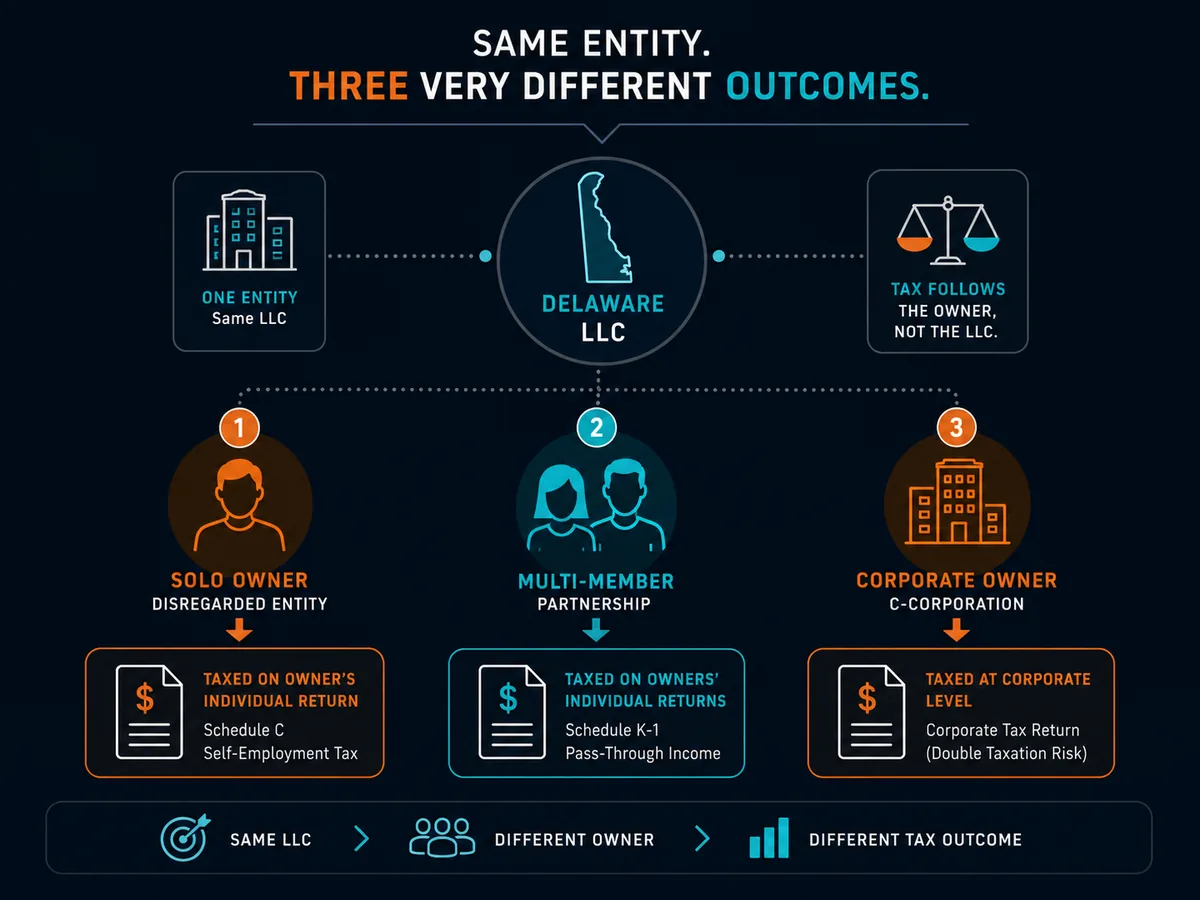
A Delaware Limited Liability Company is a business entity formed under the Delaware Limited Liability Company Act, Title 6, Chapter 18 of the Delaware Code. It is a pass-through entity by default for US federal tax purposes: profits and losses flow to the members and are taxed on their personal returns. The LLC itself pays no federal income tax unless it elects to be taxed as a corporation.
Delaware charges a flat $300 annual franchise tax on every LLC, due June 1, per the Delaware Division of Corporations. There is no Delaware corporate income tax on an LLC that does not conduct business inside Delaware. That last clause does most of the work in the marketing, and most of the misunderstanding.
Who this applies to
Tax and corporate law follow the owner, not the entity. The same Delaware LLC produces three completely different outcomes depending on who owns it.
US persons (citizens and green-card holders)
You are taxed on worldwide income regardless of where your company is registered (IRS, Taxation of US Residents). A Delaware LLC is fine for liability and contracting, but it offers you zero personal tax benefit over an LLC in your home state — and if you live in California, Texas or New York, you will likely have to register the Delaware LLC as a foreign entity there anyway, paying both states' fees.
EU freelancers and digital nomads
You are taxed where you are tax-resident (typically the 183-day rule plus centre of vital interests, as harmonised under the OECD Model Tax Convention). A Delaware LLC owned by a Portuguese or German tax resident is almost always treated by the home tax authority as either a transparent entity (income taxed personally) or as a controlled foreign company. Germany's CFC rules (Außensteuergesetz §§ 7-14) and similar regimes in France, Italy and Spain mean the LLC's profits are imputed to you whether or not you distribute them.
Non-US, non-EU readers
This is the segment for whom Delaware most often works as advertised. A resident of a territorial-tax country (Singapore, UAE, Panama, Georgia, Paraguay) owning a single-member Delaware LLC with no US-source income, no US employees and no US permanent establishment can generally achieve zero US federal income tax on the LLC's profits (IRS, Effectively Connected Income). The LLC still files Form 5472. Home-country tax still applies according to local rules.
Advantage 1: Asset protection and limited liability
A properly maintained Delaware LLC creates a legal separation between the owner's personal assets and the company's liabilities. If a client sues the LLC, the claimant can reach LLC assets but not the member's house, savings or personal accounts — unless a court pierces the corporate veil.
Delaware also offers strong charging order protection. Under 6 Del. C. § 18-703, a creditor of an LLC member cannot seize the member's interest in the LLC or force a distribution. The creditor's exclusive remedy is a charging order — a lien on any distributions the LLC chooses to make. For multi-member LLCs, this is a meaningful asset-protection feature.
The protection is not absolute. Commingling personal and company funds, undercapitalising the entity, or signing personal guarantees all undermine it. Limited liability protects against contract and tort claims; it does not protect against fraud, your own professional malpractice, or debts you personally guaranteed.
Advantage 2: Privacy and confidentiality
Delaware does not require LLC member or manager names on the Certificate of Formation. The only public name is the Registered Agent. For founders who do not want their name appearing in a free Google search of the state's business registry, this is a real benefit.
It is a benefit that federal law briefly eroded and then restored. The Corporate Transparency Act obligation is now gone for entities like this one: FinCEN's final rule, effective 14 August 2026, permanently exempts every entity created in the United States from filing beneficial ownership information, and does so regardless of who owns it (FinCEN — BOI). A Delaware LLC owned entirely by non-US persons is created in Delaware, so it is exempt. The only companies still reporting are those formed under the law of a foreign country that then register to do business in a US state.
Do not read that as anonymity. Your identity still reaches the IRS through the EIN application and, for a foreign-owned single-member LLC, through the Form 5472 disclosure that names the foreign owner every year. Your bank collects it under FinCEN's separate customer due diligence rule, which the final rule leaves untouched and expressly relies on. Treat Delaware privacy as protection from the casual searcher, not from the government.
Delaware also does not protect you from your home country's tax authority. CRS reporting, FATCA (for US persons in reverse), and information-exchange treaties mean your tax office knows about the bank account behind the LLC, even if your neighbour does not.
Advantage 3: Tax benefits — what they are and are not
This is where most articles slip into fiction. The honest version:
What Delaware does not tax: An LLC formed in Delaware but operating entirely outside Delaware pays no Delaware state income tax on its income (Delaware Division of Revenue, business taxes). It also pays no Delaware sales tax (there is no state sales tax in Delaware at all). It pays the $300 annual franchise tax and nothing else to Delaware.
What Delaware does not change:
- Federal income tax. A pass-through LLC's income flows to members and is taxed on their federal returns at ordinary rates.
- Self-employment tax. US members of an LLC treated as a partnership or disregarded entity pay 15.3% SE tax on active business income.
- Home-state tax. If you live and work in California, California taxes the income. Forming in Delaware does not move the taxable nexus.
- Home-country tax. If you live in Spain, Spain taxes your worldwide income. The LLC's Delaware address is irrelevant to Hacienda.
For non-US owners with no US-effectively-connected income, the LLC can function as a tax-transparent pipe: US tax of zero, home-country tax determined by home-country rules. This is legal optimisation, not zero tax. The structure routes through Delaware because banking and payment infrastructure recognise US LLCs, not because Delaware is a haven.
Advantage 4: The Court of Chancery
This is the single best argument for Delaware, and the one most readers will never use.
The Delaware Court of Chancery is a court of equity with jurisdiction over corporate and commercial disputes, established in 1792. There is no jury. Cases are decided by Chancellors who specialise in business law. Decisions are written, published and form a body of precedent unmatched in any other US state — see the court's own description.
For a venture-backed startup with sophisticated investor agreements, multi-member LLCs with non-standard governance, or any company likely to face a serious commercial dispute, this is genuinely valuable. Outcomes are more predictable. Cases move faster than general civil courts. Lawyers everywhere know Delaware case law.
For a one-person consulting LLC that will never be sued by another business, none of this matters. You are paying $300 a year for a court you will not use.
Advantage 5: Operational flexibility
The Delaware LLC Act takes the principle of "freedom of contract" seriously. Under 6 Del. C. § 18-1101(b), the Act gives "maximum effect to the principle of freedom of contract and to the enforceability of limited liability company agreements."
In practice this means you can:
- Allocate profits and losses disproportionately to ownership percentages.
- Create multiple classes of membership interests with different voting and economic rights.
- Eliminate or restrict fiduciary duties between members (within statutory limits).
- Set unusual governance structures — board-managed, manager-managed, or member-managed with custom rules.
This is what venture investors want. It is also what most solo founders do not need. A standard operating agreement template covers 95% of single-member LLCs. The flexibility is real but discount it heavily if your structure is simple.
What are the advantages of having an LLC in Delaware?
To compress the above:
- Predictable business law. Court of Chancery plus 230+ years of case law.
- Statutory flexibility. The operating agreement is king.
- No Delaware state tax on out-of-state income. Useful for non-residents.
- No member names in public filings. State-level only.
- Strong charging-order protection for multi-member LLCs.
- Investor familiarity. US VCs default to Delaware C-corps; LLCs are similarly recognised.
- Banking and payment-processor acceptance. Stripe, Mercury, Wise Business and most US banks accept Delaware LLCs.
What are the disadvantages of a Delaware LLC?
The list the formation services leave out:
- $300 annual franchise tax, due June 1, with $200 late penalty plus 1.5% monthly interest (Delaware Division of Corporations).
- Registered agent fee, typically $50–$300/year, mandatory.
- Foreign qualification. If you operate the LLC from another US state, that state generally requires you to register as a foreign LLC and pay its fees too. California's $800 annual minimum franchise tax applies to any LLC "doing business" there, including a Delaware LLC managed by a California resident (California FTB Publication 3556).
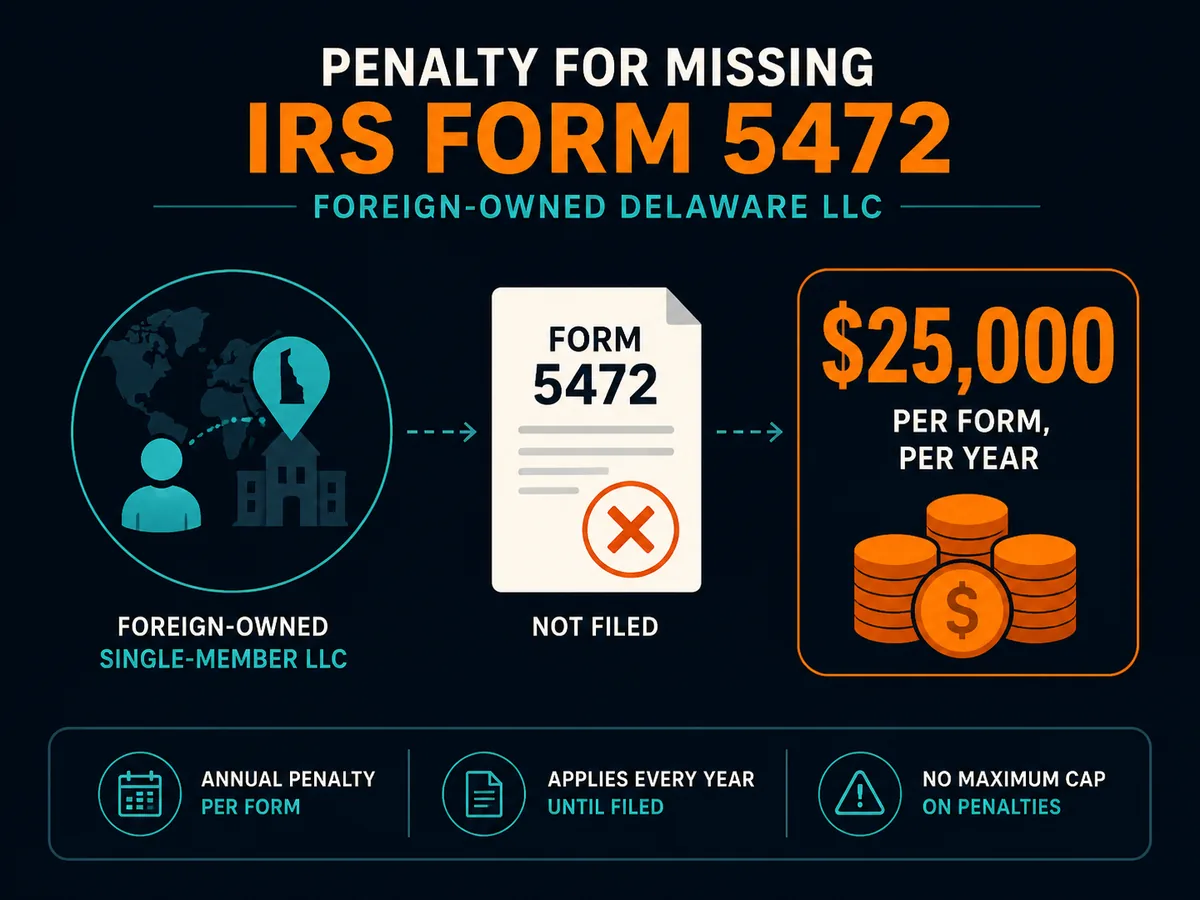
- Form 5472 + pro-forma 1120 for foreign-owned single-member LLCs. Required annually. Penalty for failure to file: $25,000 per form (IRS Form 5472 instructions).
- No personal tax benefit for US owners.
- No protection from home-country tax for non-US owners.
- Banking friction for non-residents. Most US banks now require an in-person visit or a US address. Mercury and Wise Business are common workarounds but have their own gating.
Why is Delaware so good for LLCs?
The honest answer: Delaware is excellent for a narrow set of users and acceptable-but-overkill for everyone else.
It is excellent for:
- Venture-backed companies (though most of these prefer C-corps).
- Multi-member businesses with sophisticated governance or economic arrangements.
- Holding companies with significant assets and the need for charging-order protection.
- Non-US residents in territorial-tax jurisdictions seeking US banking and payment infrastructure.
It is overkill for:
- US-resident solo freelancers — your home state is usually cheaper and equally protective.
- EU tax residents who will be taxed at home regardless — a domestic structure is usually simpler.
- Anyone whose primary motivation is "I heard Delaware has good tax benefits" — those benefits do not apply to you personally.
Realistic costs and timeline
| Item | Cost | Notes |
|---|---|---|
| Certificate of Formation filing | $110 | One-time, paid to Delaware (fee schedule) |
| Registered Agent (Year 1) | $50–$300 | Mandatory; many formation services bundle Year 1 free |
| EIN application | $0 | Direct via IRS; $0 if you have an ITIN/SSN, otherwise apply by fax/mail |
| Operating Agreement | $0–$500 | Template free; custom drafting paid |
| Annual franchise tax | $300 | Due June 1 every year |
| Annual Registered Agent | $50–$300 | Recurring |
| Form 5472 + 1120 (foreign-owned) | $0 self-filed; $400–$1,500 with CPA | Annual |
| Foreign qualification in home state | $50–$800+ | If you operate from another US state |
| Typical formation timeline | 1–10 business days | 24-hour expedited filing available for an extra fee |
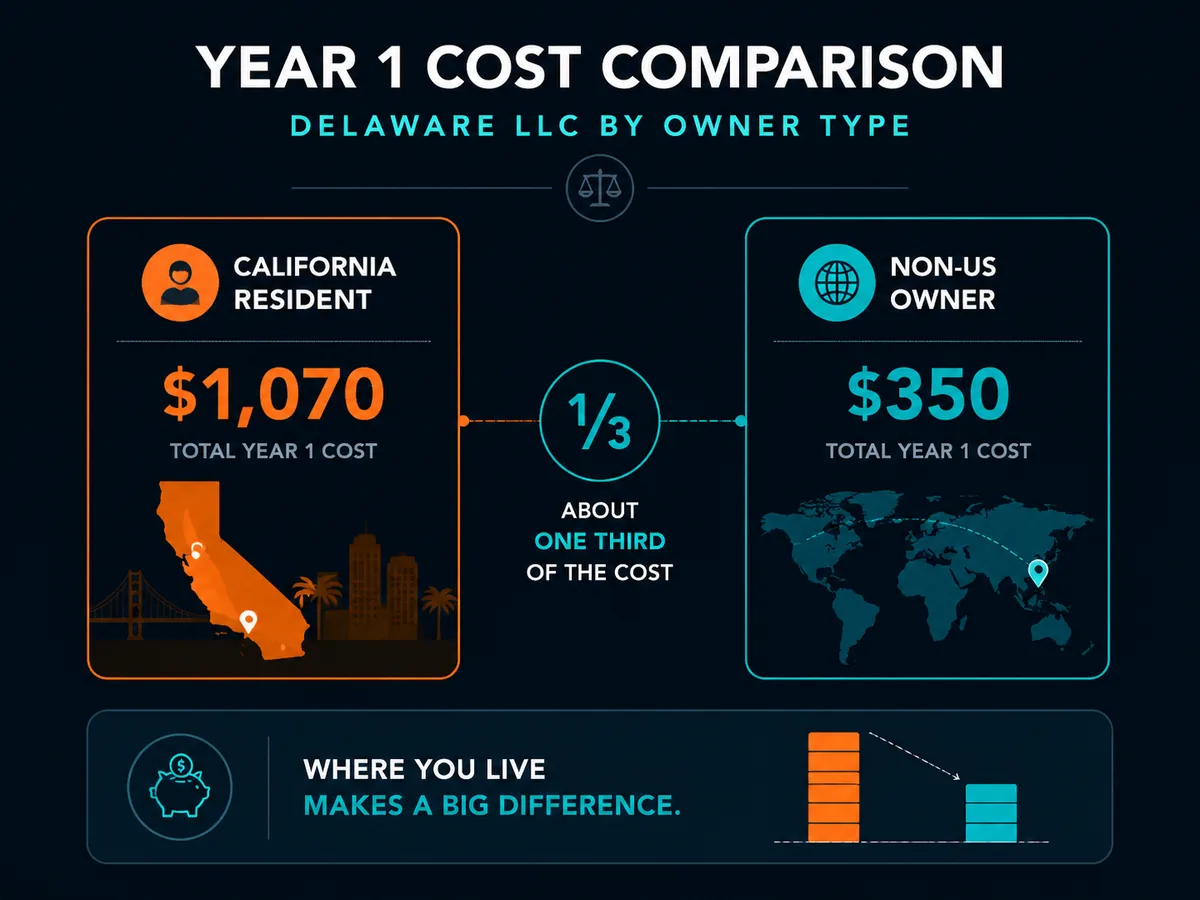
Realistic Year 1 cost, non-US owner, DIY: $110 + $150 RA + $300 franchise tax = roughly $560, plus accountant time for Form 5472.
Realistic Year 1 cost, US owner in California: Above + $800 California franchise tax + foreign qualification fees = ~$1,500+. Usually worse than just forming a California LLC.
Common mistakes and how to avoid them
1. Forming in Delaware while living in another US state. If you live and work in Texas, Texas considers your LLC to be doing business in Texas. You will pay both Delaware and Texas. Form in your home state unless you have a specific reason not to.
2. Believing the LLC reduces your personal tax. It does not, for US persons. It does not, for EU residents under CFC rules. Run the numbers with a CPA before forming.
3. Missing Form 5472. Foreign-owned single-member LLCs that miss this filing face a $25,000 penalty per year per form. The IRS does enforce it. Use a CPA experienced in this filing.
4. Using a nominee or "anonymous" service to hide ownership. The Corporate Transparency Act, FATCA, CRS and the IRS Form 5472 beneficial ownership disclosure mean ownership is reportable. Soveraine does not cover or endorse nominee structures used to conceal beneficial ownership.
5. Treating the LLC as a personal piggy bank. Commingling funds is the easiest way to lose limited liability protection. Maintain a separate bank account. Document distributions.
6. Skipping the operating agreement. Even a single-member LLC benefits from a written operating agreement. It strengthens the limited liability shield and is often required to open a business bank account.
When to consult a qualified professional
Always, before forming. Specifically:
- A CPA in your country of tax residence to confirm how a Delaware LLC will be treated under local rules (transparent entity, CFC, foreign corporation, etc.).
- A US CPA or enrolled agent if you are a non-US owner — for the EIN, Form 5472, and any ECI analysis.
- A business attorney if your LLC will have multiple members, outside investors, or unusual governance terms. The operating agreement is the document that matters; do not use a free template for a multi-member venture.
Soveraine publishes editorial guidance, not legal or tax advice. See our editorial policy and disclaimer.
Choosing a formation service
If you do form a Delaware LLC, the formation service is a commodity. Differences are small. We have no current affiliate partnership with any Delaware formation provider; when we do, it will be disclosed inline per our affiliate disclosure.
Reasonable options to compare directly: Harvard Business Services, Northwest Registered Agent, IncNow, and filing directly through the Delaware Division of Corporations. The state's own portal is the cheapest path; you only need an agent and a Certificate of Formation. Everything else a formation service sells you, you can do yourself or with a CPA.
Ready to act on this?
Stripe Atlas — Delaware C-Corp or LLC with Stripe banking built in. Soveraine readers go to the front of the line through our partner link, and you fund independent editorial in the process.
FAQ
What are the advantages of having an LLC in Delaware?
A Delaware LLC offers four practical advantages: a specialised business court (the Court of Chancery) with two centuries of case law; statutory flexibility under the Delaware LLC Act that lets members write almost any operating agreement they want; no state income tax on income earned outside Delaware by an LLC with no Delaware activity; and a credible registration that investors, banks and payment processors recognise. None of these advantages eliminate your home-country tax obligations. They reduce legal friction and improve enforceability — not your global tax bill.
What are the disadvantages of a Delaware LLC?
Three real disadvantages. First, a flat $300 annual franchise tax is due every June 1, regardless of revenue. Second, if you live and work in another US state, you almost certainly must also register the Delaware LLC as a foreign entity in your home state — doubling fees and filings. Third, for non-US owners, the LLC triggers IRS Form 5472 and a pro-forma 1120 every year; missing it costs $25,000 per failure. Delaware is not a tax haven and it adds compliance, not removes it.
Why is Delaware so good for LLCs?
Two reasons that actually matter. The Delaware Court of Chancery is a non-jury business court where judges decide commercial disputes using a body of case law dating to 1792. Outcomes are more predictable than in general civil courts. Second, the Delaware Limited Liability Company Act explicitly honours the operating agreement as the primary contract between members — courts will enforce what you wrote, including unusual governance structures. For venture-backed companies and multi-member ventures with sophisticated terms, this matters. For a solo freelancer, it usually does not.
How much is $100,000 after taxes in Delaware?
A single filer earning $100,000 of wage income while resident in Delaware pays roughly $14,260 in federal income tax, $7,650 in FICA, and about $5,800 in Delaware state income tax (top marginal rate 6.6%), leaving around $72,300 net. A Delaware LLC owned by a non-resident with no US-source income changes nothing for a Delaware resident's personal taxes — the LLC's profits flow through to the owner's personal return. The state's reputation for tax friendliness applies to corporate franchise treatment of out-of-state LLCs, not to personal income.
Can a non-US resident own a Delaware LLC?
Yes. Delaware imposes no citizenship or residency requirement on LLC members or managers. A non-resident can form a single-member Delaware LLC, open a US bank account (subject