A certificate of good standing is the document a US state issues to confirm, on its own authority, that your company legally exists and has kept up with its filings and fees. For a non-US resident running an American LLC or corporation, it is one of those documents you can ignore entirely until, suddenly, you cannot: a bank re-verifying your account, a payment processor pausing a payout, a second state asking you to register, or a bank in your home country demanding proof that the entity behind an invoice is real. Depending on the state it is called a certificate of existence or a certificate of status, but the three names describe the same thing. This guide explains what the certificate actually certifies, the specific moments a non-resident is asked for one, how to order it from the Secretary of State for $0 to $50, how long it stays useful, what quietly pushes a company out of good standing, how to get reinstated, and the apostille path when the document has to travel abroad.
Northwest Registered Agent — registered agent + compliance that keeps your LLC in good standing
What a certificate of good standing actually certifies
A certificate of good standing is an official record issued by the government office that holds your company's formation documents — in most states the Secretary of State, in a handful the Division of Corporations or an equivalent business-services agency. It states that the entity was validly formed, still exists on the state's records, and has satisfied the conditions the state imposes to remain active: filing the required periodic reports, paying the required fees, and maintaining a registered agent.
The terminology varies by state and the differences matter when you are searching an official portal. Delaware, Wyoming and many others use "certificate of good standing." Florida and New Mexico issue a "certificate of status." Texas calls it a "certificate of fact — status." A few states use "certificate of existence." They are functionally interchangeable, and any of them satisfies a bank or counterparty that asks for "good standing." When ordering, use whatever label the issuing state's website uses.
It is worth being precise about what the certificate is not. It says nothing about your finances, your revenue, your credit, or whether you have paid your suppliers. It is not a licence to operate in a regulated industry, and it is not a tax clearance. A profitable company that forgot to file a $60 annual report is not in good standing; a dormant company with no revenue that filed on time is. The certificate is a compliance snapshot, accurate on the date printed on it and no longer — which is why the date of issue is the single most important thing on the document.
For most non-residents, the entity starts life in good standing the moment the state approves the articles of incorporation or organisation. You do not need to do anything to earn it. You need only avoid the three lapses covered later that take it away.
When a non-resident actually needs one
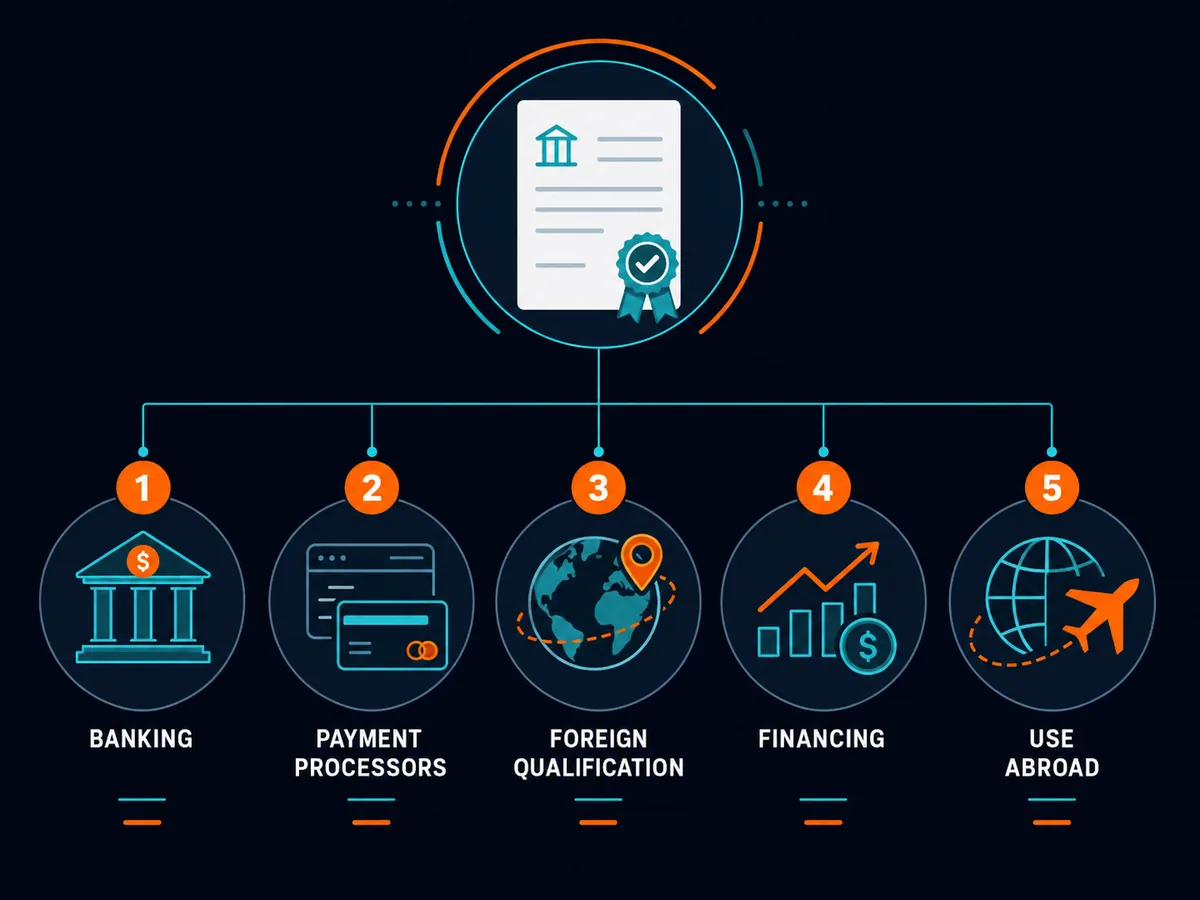
You will not be asked for a certificate of good standing often, but the moments you are asked tend to be moments that matter — money is moving or a relationship is being verified. These are the common triggers.
Opening or maintaining a business bank account
The most frequent trigger for foreign-owned LLCs. Not every bank asks for a certificate at account opening — Mercury and Relay usually verify the entity directly against state records and rely on your EIN confirmation and formation documents — but some do, and more ask for one during periodic re-verification or when you change signatories. If your account is with a traditional bank or a fintech that has tightened its compliance, a certificate issued within the last 30 to 60 days is a routine request. Our guides to opening a US company bank account and the best US business banks for foreign-owned LLCs cover which providers ask for what.
Payment processors and fintech verification
Stripe, and fintech banking platforms during enhanced due diligence, occasionally request a certificate of good standing to confirm the underlying entity is active before releasing held funds or clearing a flagged account. This is not routine onboarding — it is what happens when a review escalates. Having a fresh certificate ready can shorten a payout hold that would otherwise stretch for weeks.
Registering to do business in a second state (foreign qualification)
If your LLC is formed in Wyoming but you take on activity that legally constitutes "doing business" in another state — an office, employees, or a physical nexus — that second state requires you to register as a foreign entity. Nearly every state's foreign-qualification application requires a certificate of good standing from your home (formation) state, usually dated within 30 to 90 days, attached to the filing. This is the single most common reason a US company orders the certificate, and it applies to non-resident-owned entities exactly as it does to domestic ones.
Financing, investment and due diligence
Lenders, SBA-adjacent financing, business-credit providers and prospective investors routinely require a current certificate as part of due diligence. It is a low-cost box for them to tick that confirms the borrower or target legally exists and is not administratively dissolved. If you are raising or borrowing, expect the request in the document checklist.
Proving your company exists to an authority abroad
A bank, tax office or registrar in your country of residence may ask for documentary proof that the US entity issuing invoices or holding an account is genuine. Here the certificate usually needs to be apostilled or legalised before the foreign authority will accept it — covered in the final section.
How to order one from the Secretary of State
Ordering is deliberately simple, and in most states you do it yourself in a few minutes on the official website. The universal rule: order from the state, not from a reseller. Dozens of services will sell you "your certificate of good standing" for $75 to $200 — what you are paying for is a few minutes of their time to request the same document the state issues for $0 to $50. There are legitimate reasons to delegate (your registered agent handling it as part of a compliance package, or a formation provider bundling it), but never pay a standalone reseller markup for a document you can pull directly.
The mechanics, using the two most common formation states as examples:
Wyoming. Order free through the Secretary of State's business portal at wyobiz.wyo.gov. You enter your business Filing ID, and the portal generates a verifiable certificate immediately at no charge. A mailed paper certificate carries a small fee. This is the cheapest good-standing certificate of any major formation state.
Delaware. Order through the Division of Corporations. Delaware sells two versions: a short-form certificate of status at $50, which simply states the entity is in good standing, and a long-form certificate of good standing at $175, which additionally lists the entity's filing history. For a bank or foreign-qualification filing the short form is almost always sufficient — order the long form only if the requesting party specifically demands the full history. Delaware also sells expedited tiers on top of the base fee: next-day for $50 to $100, same-day for $100 to $200, two-hour for $500, and one-hour for $1,000. Standard online orders are typically same or next business day regardless.
The pattern repeats across states: an online request tied to your entity's document or filing number, an immediate or one-to-two-business-day electronic certificate, and a modest fee. If you use a formation and compliance provider — Northwest as registered agent, or Doola and Firstbase for formation-plus-compliance — they can pull the certificate for you, which is convenient when you are abroad and want the document handled without navigating a state portal.
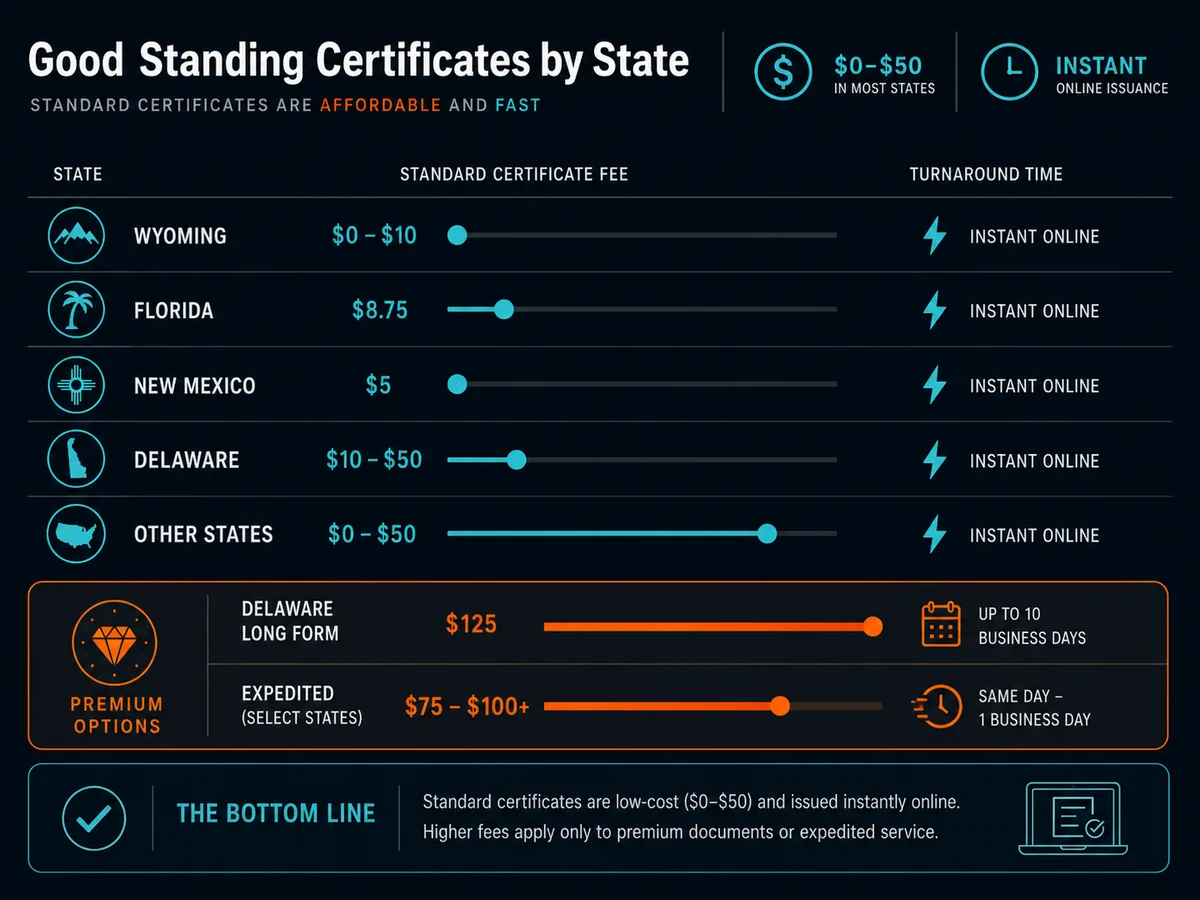
Example state fees and turnaround
Fees and processing below are for a standard certificate ordered online directly from the state; verify the current figure on the state's site before ordering, as fee schedules change.
| State | Common name | Standard fee | Online turnaround |
|---|---|---|---|
| Wyoming | Certificate of Good Standing | Free online | Immediate |
| Florida | Certificate of Status | $5 (LLC) / $8.75 (corp) | Immediate (emailed PDF) |
| New Mexico | Certificate of Good Standing | $25 (LLC) / $50 (corp) | Immediate |
| Texas | Certificate of Fact — Status | ~$15 | 1 business day |
| California | Certificate of Status | $5 | 1 business day |
| Nevada | Certificate of Good Standing | $50 | 1 business day |
| Delaware | Certificate of Status (short form) | $50 | Same / next business day |
| Delaware | Certificate of Good Standing (long form) | $175 | Same / next business day |
Wyoming's free online certificate is one reason it recurs in our Wyoming LLC cost analysis and in the wider cost of a non-resident LLC — the compliance overhead is genuinely low.
How long a certificate of good standing stays valid
The certificate has no expiry date printed on it and the state never "cancels" a validly issued one. It is a statement of fact, true on the day it was issued. That is exactly why its useful life is short: the fact it certifies can stop being true the moment you miss a filing.
In practice, the party requesting the certificate sets the freshness bar, and the norms are well established. Banks, lenders, investors and other states almost always want a certificate issued within the last 30 to 90 days, and many tighten that to 30 to 60 days. A certificate from eight months ago tells a reviewer nothing about whether you have filed your annual report since — so they will reject it and ask for a current one.
The practical consequence: do not stockpile certificates. Order one immediately before you need to submit it. A certificate you pulled "to have on file" six months ago is worthless the day you actually need it, and re-ordering costs a few dollars and a few minutes. Treat the certificate as a perishable good, not a permanent record.
What makes a company fall out of good standing
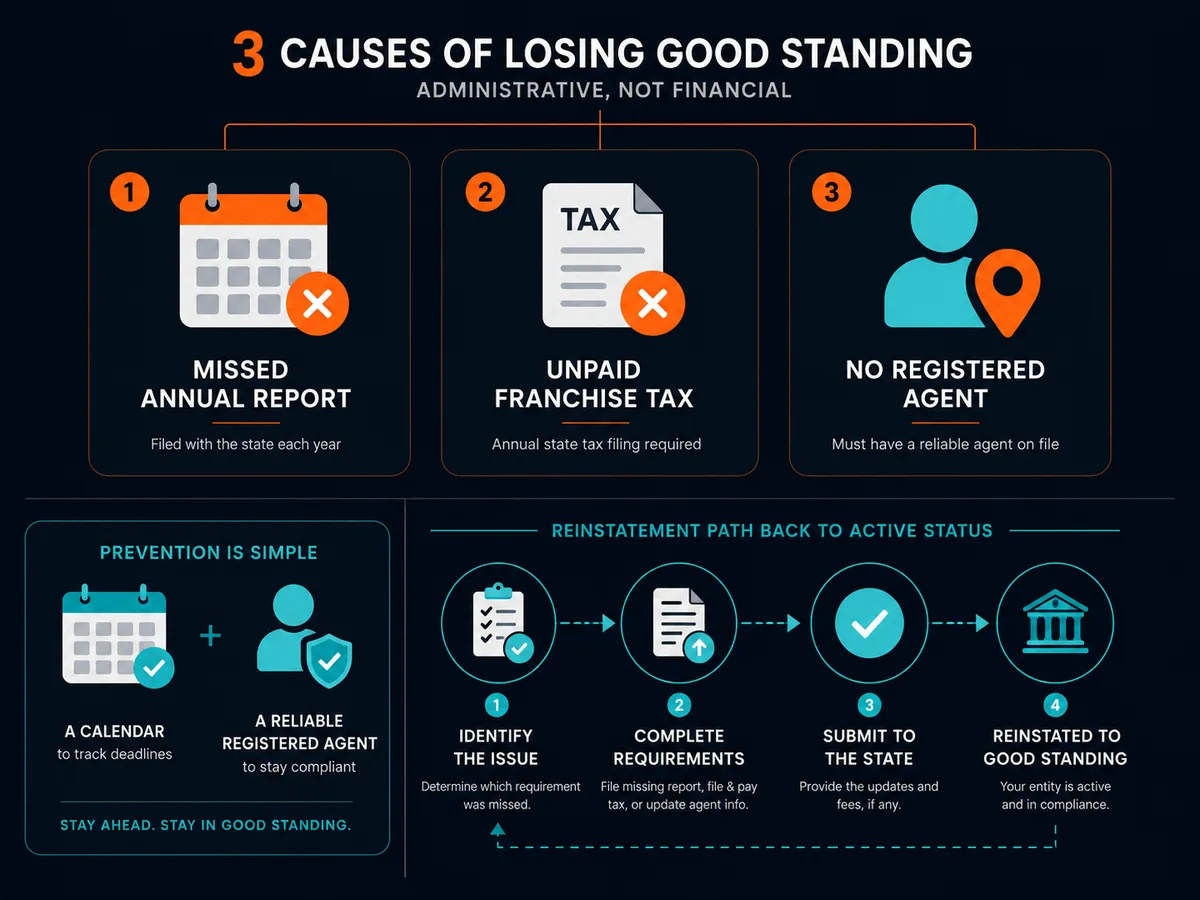
Losing good standing is almost always an administrative accident, not a financial failure. Three lapses account for nearly all cases, and each is avoidable with a calendar reminder and a reliable registered agent.
A missed annual or biennial report
Most states require a periodic report — annual in Wyoming, Delaware, Florida and many others; biennial in a few — that keeps your entity's information current and is usually bundled with a fee or franchise tax. Miss the deadline and the state marks the entity delinquent, then, after a grace period, administratively dissolves it. For non-residents this is the most common failure because the reminder notices are mailed to a US address you may not monitor. This is precisely what a good registered agent solves: our guide to the registered agent for an LLC explains how the agent receives state notices and forwards compliance deadlines so a report never slips.
Unpaid annual fees or franchise tax
Separate from, or bundled with, the report is the money owed to the state. Wyoming charges an annual report fee (minimum $60). Delaware charges LLCs a flat $300 annual franchise tax and corporations a minimum of $175, due on fixed dates. Leave the franchise tax unpaid and the entity loses good standing regardless of whether the report itself was filed. Penalties and interest accrue on the arrears, so the cost of catching up grows the longer it is left.
No registered agent
Every US LLC and corporation must continuously maintain a registered agent with a physical address in the formation state to receive legal and state correspondence. If your agent resigns — often because you stopped paying them — or you never appointed one, the state can revoke good standing and, ultimately, dissolve the entity. For a non-resident with no US presence, the registered agent is not optional infrastructure; it is the legal address of the company. Losing it is one of the fastest routes out of good standing.
How to get reinstated
If the certificate request comes back with "the entity is not in good standing" or "administratively dissolved," you cannot order a certificate until you fix the underlying lapse and reinstate. Reinstatement is a defined state process, not a negotiation, and it follows the same shape in most states.
First, identify every deficiency. The state's business record will usually show what is outstanding — unfiled reports, unpaid fees, a resigned agent, or all three. Second, cure each one: file every overdue annual report, pay all back fees, franchise taxes, penalties and accrued interest, and if the registered agent lapsed, appoint a new one before or with the filing. Third, submit the state's reinstatement filing, variously called Articles of Reinstatement, an Application for Reinstatement, or a Certificate of Revival. Some states additionally require a tax-clearance certificate from the state tax authority confirming state taxes are current before they will restore the entity.
Reinstatement fees run roughly $25 to $500 depending on the state and how long the company was delinquent — some states charge a flat fee, others scale it by the number of missed reports. Once the state approves the reinstatement, the entity returns to active status, typically retroactively, and you can immediately order a fresh certificate of good standing. If your entity was dissolved specifically because the registered agent lapsed, fixing that permanently — by putting a dependable agent in place — is the step that stops the cycle repeating.
Apostille vs attestation: what the two words actually mean
This is the single most confusing part of using a US certificate of good standing abroad, and most of the confusion is vocabulary rather than law.
When a foreign bank, registrar or authority asks for your certificate, a plain state certificate is usually not enough. The destination authority has no way to know that the Secretary of State's signature and seal are genuine, so the document must be authenticated first. There are exactly two routes, and which one applies is decided by the destination country, not by you, your state, or the party asking:
- Apostille — a single standardised certificate attached to your document, issued under the 1961 Hague Apostille Convention. One step, one authority, done. The destination country must be a contracting party.
- Legalisation — the longer consular chain used for countries outside the Convention: state, then the US Department of State, then that country's embassy or consulate in the United States, and often a final step inside the destination country itself.
"Attestation" is not a third thing. It is simply the word used for consular legalisation in the Gulf states, Egypt, and across South Asia — the regions where the non-Hague chain is most common. If a Dubai bank, a Doha registrar, an Egyptian ministry or an Indian agent asks you to get your company documents "attested", they are asking for the legalisation chain (or, where the country is a Convention member, for whatever their local practice calls the apostille). The word tells you about the requester's regional vocabulary; the Convention status table tells you what you actually have to do.
Two practical consequences follow. First, never take the requesting party's terminology as instructions — a bank clerk saying "get it attested" may work in a country that has joined the Convention since they learned the phrase, in which case an apostille is cheaper and weeks faster. Second, always ask the requester to name the country the document will be used in, then check that country yourself.
Which route your destination needs
The authoritative list is the HCCH status table, which as of its 30 June 2026 update records 130 contracting parties. Check it rather than any blog list — including this one. The countries that most often come up for readers running a US LLC from abroad:
| Destination | Convention status | Route you need |
|---|---|---|
| United Arab Emirates | Not a party | Legalisation ("attestation") |
| Qatar, Kuwait, Egypt, Jordan | Not a party | Legalisation ("attestation") |
| Saudi Arabia | Party since 7 Dec 2022 | Apostille |
| Bahrain | Party since 31 Dec 2013 | Apostille |
| Oman | Party since 30 Jan 2012 | Apostille |
| China (mainland) | Party since 7 Nov 2023 | Apostille |
| India | Party since 14 Jul 2005 | Apostille |
| Singapore | Party since 16 Sep 2021 | Apostille |
| Viet Nam | Party from 11 Sep 2026 | Apostille from that date |
| Thailand | Party from 28 Feb 2027 | Legalisation until then |
| EU / UK / most of Latin America | Party | Apostille |
Two of those rows are the ones that catch people out. The UAE is not a Hague Convention party — despite being the destination readers of this site ask about most, and despite persistent claims online that it joined. It has its own MOFAIC e-legalisation system, which is not an apostille. A US certificate of good standing bound for a Dubai free-zone registrar or a UAE bank goes through the full consular chain.
And two countries have changed status very recently: Viet Nam acceded with effect from 11 September 2026, and Thailand deposited its instrument on 30 June 2026 with entry into force on 28 February 2027. Guidance written before those dates — including plenty of pages still live today — tells you to legalise documents for both. Check the date on anything you read, this page included.
Getting the apostille (Hague route)
Because the certificate of good standing is a state document, the apostille is issued by the competent authority in the issuing state — in almost every state, the same Secretary of State's office that issued the certificate, or its notary/authentications division. The US Department of State's Office of Authentications apostilles documents issued by federal agencies; sending it a Wyoming or Delaware certificate for an apostille is a wasted month.
The sequence is: order the certificate of good standing → send or upload it to the state's apostille section with the request form, the fee, the destination country, and a prepaid return envelope → receive the certificate with the apostille attached.
State apostille fees are separate from, and usually smaller than, the fee for the certificate itself. Figures below are the states' own published fees; verify before ordering, and note these are the apostille fee only.
| State | Apostille fee | Notes |
|---|---|---|
| New Mexico | $3.00 per document | Filed online through the SOS enterprise portal |
| Florida | $10.00 per document | $20 if the document was certified by a county Clerk of Court |
| Wyoming | $20.00 per apostille or authentication | Check or money order only — no cards |
| California | $20.00 per apostille | Plus a $6.00 special handling fee per different official's signature |
| Nevada | $20.00 per authentication | Commercial Recordings Division |
| Delaware | ~$30.00 per document | Base fee is not published on the Division's apostille page — confirm on 302-739-3073. Expedited service for commercial use is published: $40 for 24-hour, $50 same-day, $500 two-hour |
| Texas | Fee not published on the SOS authentication page | Confirm before submitting |
Two details that are easy to miss and cause returns. Every state asks you to name the destination country on the request — it is a required field on Florida's request form and must appear on California's mandatory cover sheet, because the state has to decide whether to issue an apostille or a non-Hague certification. And states want the original signed certificate: California states plainly that photocopies are unacceptable, so if your state issued you a PDF, order the paper original or confirm the state will apostille its own electronic issue.
The attestation / legalisation chain (non-Hague route)
For a UAE, Qatar, Kuwait or Egypt destination, budget for four stages rather than one:
- State. Order the certificate of good standing, then have the state authenticate it. States issue a non-Hague version of the authentication — Delaware and New Mexico both distinguish between an apostille (Hague) and a certification (non-Hague), and you must request the right one, which is why the destination country is a required field.
- US Department of State, Office of Authentications. Submit Form DS-4194 with the document and a $20 per document fee. This is a flat federal fee, not a percentage. Published processing is roughly five weeks by mail; walk-in drop-off is faster (reported at one to three weeks) and appointments are reserved for genuine emergencies. This step is mandatory before the embassy will look at your paperwork — the UAE Embassy states that legal documents must be attested by the US Department of State before being sent to it.
- The destination country's embassy or consulate in the US. For the UAE that is the Embassy in Washington, DC, which does not take walk-ins and routes requests through its appointed service provider. The embassy fee is set by that country and is where the cost lands. Commercial and corporate documents are charged at a far higher rate than personal ones — for the UAE, reported figures for business documents run into the several hundred dollars per document, against a small flat fee for a personal document. We are not quoting a precise number here because the embassy publishes no stable fee schedule and changes it without notice; confirm the current figure with the embassy before you post anything.
- Inside the destination country. Many non-Hague countries require a final attestation by their own foreign ministry once the document arrives — in the UAE, MOFAIC. That step has its own fee, again materially higher for commercial documents than personal ones, and again worth confirming rather than assuming.
Realistically, plan on six to ten weeks end to end for a full legalisation, versus one to three weeks for an apostille. That gap is the real reason the Convention status of your destination matters.
What causes rejections, and the freshness trap
The failure that costs the most time is not a rejection at all — it is the clock. Your requesting party almost certainly wants a certificate issued in the last 30 to 90 days. A certificate that spends five weeks in a federal authentication queue and three more at an embassy can arrive already outside that window, and you start again from the state. Order the certificate as late as you can and start authentication the same week; where the chain is long, ask the requesting party in advance whether they will accept a certificate dated at the start of the process.
The other common rejections are mundane: sending a photocopy or a plain PDF print instead of the original, omitting the destination country so the state cannot tell which certificate to issue, sending a state document to the federal office (or a federal document to the state), paying the certificate fee and the apostille fee in one combined cheque where the state requires them separately — Florida explicitly requires separate payments — and, in Delaware, misreading expedited fees, which are charged per entity rather than per order.
Before you start, do one thing: ask the party requesting the document to confirm in writing which country it is for, whether they want an apostille or full legalisation, and how recently the underlying certificate must have been issued. Three sentences from them saves the six-week version of this process.
The Soveraine view
For a non-resident, the certificate of good standing is not something to manage proactively — it is something to be able to produce on demand. The document is cheap and fast to obtain, so the entire game is staying in good standing so the certificate is available the moment a bank, a second state or a lender asks. That comes down to three habits: file every annual report on time, pay the franchise tax or annual fee on its fixed date, and keep a reliable registered agent in place to catch the notices you would otherwise miss from abroad. Get those right and ordering the certificate is a five-minute, few-dollar errand. Neglect them and the same five-minute errand becomes a reinstatement filing with back taxes and penalties attached.
FAQ
What is a certificate of good standing
A certificate of good standing is an official document issued by a state's Secretary of State (or equivalent business filing office) confirming that a company legally exists, was properly formed, and is up to date on its required filings and fees. Depending on the state it is called a certificate of existence, certificate of status, or certificate of fact — the three terms mean the same thing. It does not describe your finances, your creditworthiness or your reputation; it is a compliance snapshot, valid on the day it is issued, stating that the entity is active on the state's records. Banks, payment processors, other states and foreign authorities request it as third-party proof that your LLC or corporation is real and in compliance.
Do non-residents need a certificate of good standing
Not to form or run a US LLC day to day, but you will be asked for one at specific moments: opening or re-verifying a US business bank account, passing a payment-processor or fintech review, registering your company to do business in a second state (foreign qualification), applying for financing, or presenting proof of your company's status to a bank or authority in your home country. A newly formed LLC is in good standing automatically, so many non-residents never need to order the certificate in year one. It becomes relevant once a third party specifically requests documentary proof — at which point you order it from the state in minutes.
How much does a certificate of good standing cost and how long does it take
State fees typically run $0 to $50 for a standard certificate. Florida charges $5 for an LLC, New Mexico $25, Nevada $50, Delaware $50 for the short-form status certificate; Wyoming issues one free online. Most states deliver an electronic certificate immediately or within one to two business days when you order through the Secretary of State's website. Mailed requests take longer — typically one to two weeks. Delaware and a few others sell expedited tiers (same-day, two-hour, one-hour) at a premium if you are on a deadline. Always order from the official state site rather than a third-party reseller charging a markup for the same document.
How long is a certificate of good standing valid
The certificate itself has no legal expiry date — it is a statement of fact true on the date of issue. In practice, the party requesting it decides how fresh it must be. Banks, lenders and other states typically want a certificate issued within the last 30 to 90 days, and many insist on 30 to 60 days. Because your compliance status can change the moment you miss an annual report or a franchise-tax payment, an old certificate is worthless to a reviewer even if the state never "cancels" it. The safe approach is to order a fresh certificate immediately before you submit it, not to keep one on file.
What makes a company fall out of good standing
Three failures cause it, and all are administrative rather than financial. First, a missed annual or biennial report — the periodic filing that keeps your entity's information current with the state. Second, unpaid annual fees or franchise tax owed to the state or its tax authority. Third, losing your registered agent, either because the agent resigned or because you never maintained one. Any of these moves the entity from "active" to "delinquent" or "not in good standing", and if left unresolved the state will eventually administratively dissolve or revoke the company. At that point you cannot obtain a certificate of good standing until you reinstate.
How do I get my LLC back into good standing
Reinstatement reverses an administrative dissolution or delinquency. You file the state's reinstatement application (often called Articles of Reinstatement or a Certificate of Revival), bring every overdue annual report current, and pay all back fees, franchise taxes, penalties and interest. If the trigger was a lapsed registered agent, you must appoint a new one before or with the filing. Some states also require a tax-clearance certificate confirming state taxes are current. Reinstatement fees range from roughly $25 to $500 depending on the state and how long the entity was delinquent. Once approved, the state restores the entity to active status and you can order a fresh certificate of good standing.
When do I need a certificate of good standing apostilled
When a bank, registrar or government authority outside the United States asks for proof that your US company exists. A raw state certificate is not automatically accepted abroad; the foreign authority needs it authenticated. For countries in the 1961 Hague Apostille Convention, you obtain an apostille from the competent authority in the issuing state — usually the same Secretary of State — which attaches a standardised certificate the destination country recognises. For non-Hague countries you follow the longer legalisation chain: state authentication, then the US Department of State (a flat $20 per document), then the destination country's embassy or consulate. Order the underlying certificate first, then request the apostille on it.
What is the difference between apostille and attestation
They are two names for solving the same problem, and which applies is decided entirely by the destination country. An apostille is the single standardised certificate issued under the 1961 Hague Apostille Convention: one authority, one step. Attestation is the everyday word used in the Gulf states, Egypt and South Asia for consular legalisation — the longer chain used for countries outside the Convention, running from the state, to the US Department of State's Office of Authentications at $20 per document, to that country's embassy or consulate in the US, and often to its foreign ministry after the document arrives. So "attestation" is not a separate legal instrument; it is regional vocabulary for legalisation. If someone asks you to have a certificate of good standing attested, establish which country it is for and check that country against the HCCH status table, which recorded 130 contracting parties as of 30 June 2026. An apostille typically takes one to three weeks; a full legalisation chain realistically takes six to ten.
Does the UAE accept an apostille on a US certificate of good standing
No. The United Arab Emirates is not a contracting party to the 1961 Hague Apostille Convention, so a US certificate of good standing destined for a UAE bank, free-zone registrar or authority needs full consular legalisation, which UAE practice calls attestation. That means state-level certification, then authentication by the US Department of State's Office of Authentications on Form DS-4194 at $20 per document, then legalisation by the UAE Embassy in Washington DC — which requires the Department of State step first and does not accept walk-ins — and usually a final MOFAIC attestation inside the UAE. Embassy and MOFAIC fees are set by the UAE and are materially higher for commercial and corporate documents than for personal ones, so confirm the current figures before submitting. Note that neighbouring states differ: Saudi Arabia (since 7 December 2022), Bahrain and Oman are Convention parties and do take an apostille.
This guide is editorial. We hold affiliate relationships with Northwest Registered Agent, Doola, Firstbase and others, disclosed via our affiliate disclosure. Nothing here is tax or legal advice — see our disclaimer.
Keep the certificate available on demand
A certificate of good standing is only there when you need it if your LLC stays compliant. Northwest acts as your registered agent, catches every state notice and tracks your annual-report and franchise-tax deadlines — so you are never scrambling to reinstate the day a bank asks for proof.
Sources
- Wyoming Secretary of State — Business Division filing and certificate portal: https://wyobiz.wyo.gov/Business/FilingSearch.aspx
- Delaware Division of Corporations — Corporate Fee Schedule: https://corp.delaware.gov/fee/
- Delaware Division of Corporations — Expedited Services: https://corp.delaware.gov/expserv/
- Florida Department of State, Division of Corporations — Order a Certificate of Status: https://dos.fl.gov/sunbiz/manage-business/certification/certificate-status-efile/
- New Mexico Secretary of State — Corporations and Business Services (Certificate of Good Standing): https://www.sos.nm.gov/business-services/
- US Department of State — Office of Authentications (apostille and authentication): https://travel.state.gov/content/travel/en/replace-certify-docs/authenticate-your-document/office-of-authentications.html
- US Department of State — Request for Authentications Service, Form DS-4194: https://eforms.state.gov/Forms/ds4194.PDF
- USAGov — Authenticate an official document for use outside the U.S.: https://www.usa.gov/authenticate-us-document
- Wolters Kluwer (CT Corporation) — Reinstatement: Restoring your business to good standing: https://www.wolterskluwer.com/en/expert-insights/reinstatement-restoring-your-small-business-to-good-standing
- HCCH — Status table, Convention of 5 October 1961 Abolishing the Requirement of Legalisation for Foreign Public Documents (130 contracting parties, updated 30 June 2026): https://www.hcch.net/en/instruments/conventions/status-table/?cid=41
- HCCH — United States of America, designated competent authorities under the Apostille Convention: https://www.hcch.net/en/states/authorities/details3/?aid=353
- HCCH — Viet Nam accedes to the 1961 Apostille Convention (in force 11 September 2026): https://www.hcch.net/en/news-archive/details/?varevent=1132
- HCCH — Thailand accedes to the 1961 Apostille Convention (in force 28 February 2027): https://www.hcch.net/en/news-archive/details/?varevent=1158
- Wyoming Secretary of State — Apostilles/Authentications ($20 per apostille or authentication): https://sos.wyo.gov/services/authentication.aspx
- Florida Department of State — Apostille or Notarial Certification Request form ($10 per document; destination country required): https://files.floridados.gov/media/702388/1-apostille_and_notarial_certificate_request_form-10-19-2023.pdf
- New Mexico Secretary of State — Apostille / Authentications ($3.00 per document): https://www.sos.nm.gov/notary-and-apostille/apostille-authentications/
- California Secretary of State — Request an Apostille ($20 per apostille, $6 special handling, mandatory destination-country cover sheet): https://www.sos.ca.gov/notary/request-apostille
- Delaware Division of Corporations — Certifications, Apostilles and Authentication of Documents: https://corp.delaware.gov/apost_info/
- Delaware Division of Corporations — Apostilles/authentications expedited fees: https://corpfiles.delaware.gov/ApostilleInfo.pdf
- Texas Secretary of State — Apostille/Authentication of Documents: https://www.sos.state.tx.us/authinfo.shtml
- USAGov — Authenticate an official document for use outside the U.S. (state documents to the state Secretary of State; federal documents to the US Department of State): https://www.usa.gov/authenticate-us-document
- UAE Embassy in Washington, DC — Legalization of Documents: https://www.uae-embassy.org/services-resources/legalization-documents