
A registered agent is the person or company legally designated to receive lawsuits and official state mail on behalf of your LLC, at a physical address inside the state where the LLC is formed. It is not an optional convenience or a marketing upsell — every US formation state a non-resident is likely to use requires it by statute (New York, where the Secretary of State is the automatic agent, is the one real exception, covered below), and an LLC that fails to maintain one can be stripped of its good standing and administratively dissolved. For a non-US resident, this requirement carries a sting that domestic owners rarely feel: you cannot be your own registered agent, because you have no physical street address in Wyoming, Delaware, or wherever you formed, and PO boxes and mail-forwarding services do not qualify. This article explains exactly what a registered agent does, why the requirement is non-negotiable in all fifty states, what happens when it lapses, and how non-residents should choose one — written for three groups: US persons, EU residents, and readers outside both.
Northwest Registered Agent — a flat $125/yr agent in every state, free the first year with formation
What a registered agent actually does
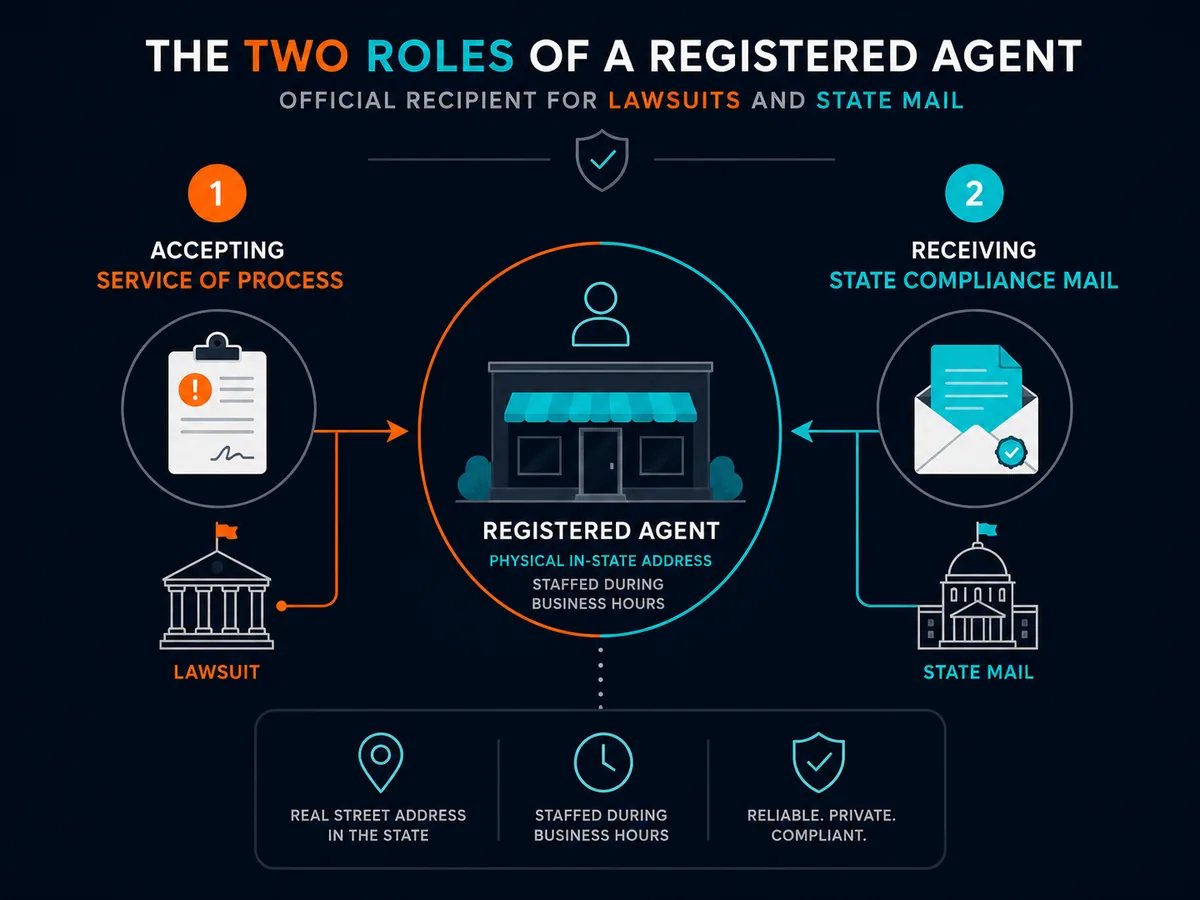
A registered agent has one core legal function and one practical one. The legal function is to accept service of process — the formal delivery of a summons and complaint when your LLC is sued, along with subpoenas, garnishment orders, and other litigation documents. State law needs a guaranteed, publicly recorded place where anyone with a legal claim against your company can hand over papers and have that delivery count as valid notice. The registered agent, at the registered office address, is that place. When a process server hands a summons to your agent, the clock on your legal deadlines starts — whether or not the documents ever reach you.
The practical function is to receive official mail from the state: the annual or biennial report reminder, franchise-tax notices, notices of delinquency, and any correspondence from the Secretary of State's business division. A good commercial agent scans these the day they arrive and puts them in your online dashboard, which for an owner living eight time zones away is the difference between catching a compliance deadline and missing it.
Two constraints define the role. First, the agent must have a physical street address in the formation state — a "registered office" — not a PO box. Second, the agent must be available at that address during normal business hours to accept hand-delivered documents. Those two rules, taken together, are precisely what a non-resident cannot personally satisfy, and they are why the commercial-agent industry exists.
The statutory requirement: every LLC, every state
There is no US state where an LLC may operate without a registered agent, and there is no entity size or activity level that exempts you. The requirement is baked into each state's limited-liability-company act, and it applies from the moment the certificate of formation is filed. If your LLC later registers to do business as a "foreign" LLC in a second state — say, a Wyoming LLC that qualifies in California — you need a registered agent in that state too. The rule follows the entity into every jurisdiction where it is on the public record.
Wyoming
Wyoming's rule lives in its Registered Offices and Agents Act, W.S. §17-28-101 et seq. The statute requires every business entity — expressly including domestic and foreign LLCs — to maintain a registered agent and a registered office "located at a street address in Wyoming" that is "a physical location" where the agent, or a natural person with an agency relationship to the agent, "can accept service of process" and "is physically present" during business hours. The Wyoming Secretary of State is unambiguous that PO boxes, private mailbox services, and mail-forwarding addresses do not satisfy this. If you form the cheapest, most popular non-resident LLC in the country — see our Wyoming LLC cost breakdown — this is the statute you are agreeing to.
Delaware
Delaware's rule is 6 Del. C. §18-104, part of the Delaware Limited Liability Company Act. Every Delaware LLC "shall have and maintain in the State of Delaware" a registered office and a registered agent, and the agent must have "agreed to accept legal papers on the limited liability company's behalf if it is sued." Delaware runs a formal registered-agent regime with listing standards enforced by the Division of Corporations, and there is no grace period: if your agent resigns and you do not replace them, the LLC is out of compliance immediately. Delaware's prestige for holding companies and venture-backed startups — covered in our Delaware LLC benefits guide — comes bundled with one of the strictest agent regimes in the country.
The physical-address rule, everywhere
The specifics vary in wording, but the substance is uniform across all fifty states plus DC: a registered office is a real street address in-state, staffed during business hours, and a PO box will never do. Around a dozen states — Wyoming, Nevada, Idaho, Montana, the Dakotas, Utah, Maine, Mississippi, Arkansas, and the District of Columbia — have adopted the Model Registered Agents Act (MoRAA) from the American Bar Association and the International Association of Commercial Administrators, which standardises these definitions and creates the "commercial registered agent" category discussed below. Delaware adopted MoRAA's commercial-agent provisions specifically. Whether or not your formation state has adopted the model act, the physical-address-in-state requirement is the same.
Can a registered agent be a PO box? What the states actually say
No — and it is worth reading the actual wording, because the rule is stricter than "no PO boxes" and catches several things founders assume are fine.
The requirement is not really about the format of the address. It is about personal service: a court officer or process server has to be able to walk up to a real door during business hours and hand a summons to a human being who has agreed to accept it. Anything that fails that test fails the rule, whatever it is called.
| State | What the state says about the registered office address |
|---|---|
| Wyoming | The Secretary of State states directly that "post office boxes, drop boxes, virtual addresses, mail forwarding locations, UPS or FedEx stores do not qualify as an acceptable registered office address." The agent must be an individual aged 18+ residing in Wyoming with a physical Wyoming address and a valid email, or a business entity in good standing |
| Texas | Under BOC §5.201, the registered office must be a street address where the agent can be personally served during normal business hours, and "may not be solely the address of a company that provides mailbox services or telephone answering service" |
| California | An individual agent must reside in California and give a California street address — the Secretary of State's forms state that a PO Box is not acceptable. If instead you use a corporate agent registered under Corporations Code §1505, you name the company and give no address at all |
| Delaware | 6 Del. C. §18-104 requires a registered office maintained in Delaware and an agent who has agreed to accept legal papers on the LLC's behalf |
| New York | The genuine exception — see below |
Three specific things that are not a registered agent address, however convincing they look:
- A PO box. The obvious one, and universally excluded.
- A private mailbox at a mail store. A UPS Store or Postal Annex address rendered as "123 Main St, Suite 400" reads like a street address on the form. Wyoming names these categories explicitly; Texas excludes an address that is "solely" a mailbox service. Formatting a mailbox as a suite number does not convert it into a registered office.
- A virtual address or mail-forwarding service. The same address that legitimately serves as your LLC's business mailing address and satisfies a bank's proof-of-address check is still a commercial mail-receiving agency, not a staffed office. See our virtual address for an LLC guide for where each one is and is not usable.
The distinction that causes the confusion: registered office vs mailing address
Almost every state filing asks for more than one address, and they have different rules. Typically there is a registered office (street address, in-state, no PO box), a principal office address, and a mailing address. The mailing and principal-office fields are far more permissive — they are frequently allowed to be out of state, and in many states may be a PO box, because nothing is served there.
This is where founders go wrong in both directions. Some see "PO box accepted" on the mailing-address line and put it on the registered-office line too, which gets the filing rejected. Others assume the strict registered-office rule applies to every address on the form and buy in-state services they do not need. Read each field's own instructions; they are not the same rule.
New York: the one state where an LLC needs no registered agent at all
New York is a real exception and it is worth knowing, because national guides — including earlier versions of this page — flatten it into "every state requires a registered agent."
Under NY LLC Law §301, the Secretary of State is automatically the agent for service of process for every New York LLC. The Department of State's own guidance puts it plainly: the LLC must designate the Secretary of State as its agent and "provide an address to which the Secretary of State may mail a copy of any process received." Section 302 then says an LLC "may designate a registered agent" in addition — permissive, not mandatory.
So a New York LLC does not have to hire a registered agent. What it must have is a working address the Department of State can forward a lawsuit to. For a non-resident that is a real trap rather than a saving: process is served on the state, forwarded once, by post, to whatever address is on file, and if that address is stale or unattended you can lose a case without ever hearing about it. Most non-residents with a New York LLC appoint a §302 registered agent anyway, for exactly that reason.
Consent: the step that gets filings rejected
You cannot simply write a name on a form. Texas has required since 1 January 2010 that anyone named as registered agent has consented in written or electronic form (Form 401-A exists for the purpose, though a copy need not be filed). Wyoming requires a signed Consent to Appointment to accompany the Articles of Organization — file without it and the formation is rejected outright.
In practice a commercial agent handles this automatically when you sign up. It matters when a founder tries to name a friend, an accountant, or a US-based contact without asking them first: the filing bounces, or worse, it is accepted and the named person has no idea they are supposed to be watching for a summons.
Why non-residents cannot be their own registered agent
For a US-resident owner, the registered-agent question is often trivial: many simply list themselves, using their home or office address in the formation state. A non-resident cannot do this, and the reason is structural rather than a matter of preference.
To serve as your own agent you need two things you almost certainly lack: a physical street address inside the formation state, and your own physical presence at that address during business hours to accept hand-delivered legal papers. Living in Lisbon, São Paulo, or Dubai, you have neither. And the address you might be tempted to substitute — the virtual mailbox you use for your LLC's business correspondence and banking — does not qualify either. As covered in our virtual address for an LLC guide, a virtual mailbox is excellent for receiving general business mail and satisfying a bank's proof-of-address request, but it is a commercial mail-receiving agency, not a staffed registered office, and states that spell out the rule (Wyoming among them) exclude exactly this category from registered-agent use.
This is the single most common point of confusion for foreign founders: they assume that because they have arranged a US address for mail and a US address for banking, they have satisfied the registered-agent requirement. They have not. The registered agent is a distinct, statutorily defined role. The correct and universal solution for non-residents is to appoint a commercial registered agent located in the formation state — a company whose entire business is being physically present at an in-state office to accept service on behalf of thousands of entities. This is not a grey-area hack; it is the mechanism the statutes were written to accommodate. Every one of the formation routes a non-resident might take — Doola, Firstbase, Bizee, Northwest, or a direct filing — assumes you will use a commercial agent, and most bundle one in.
What happens if you don't maintain one
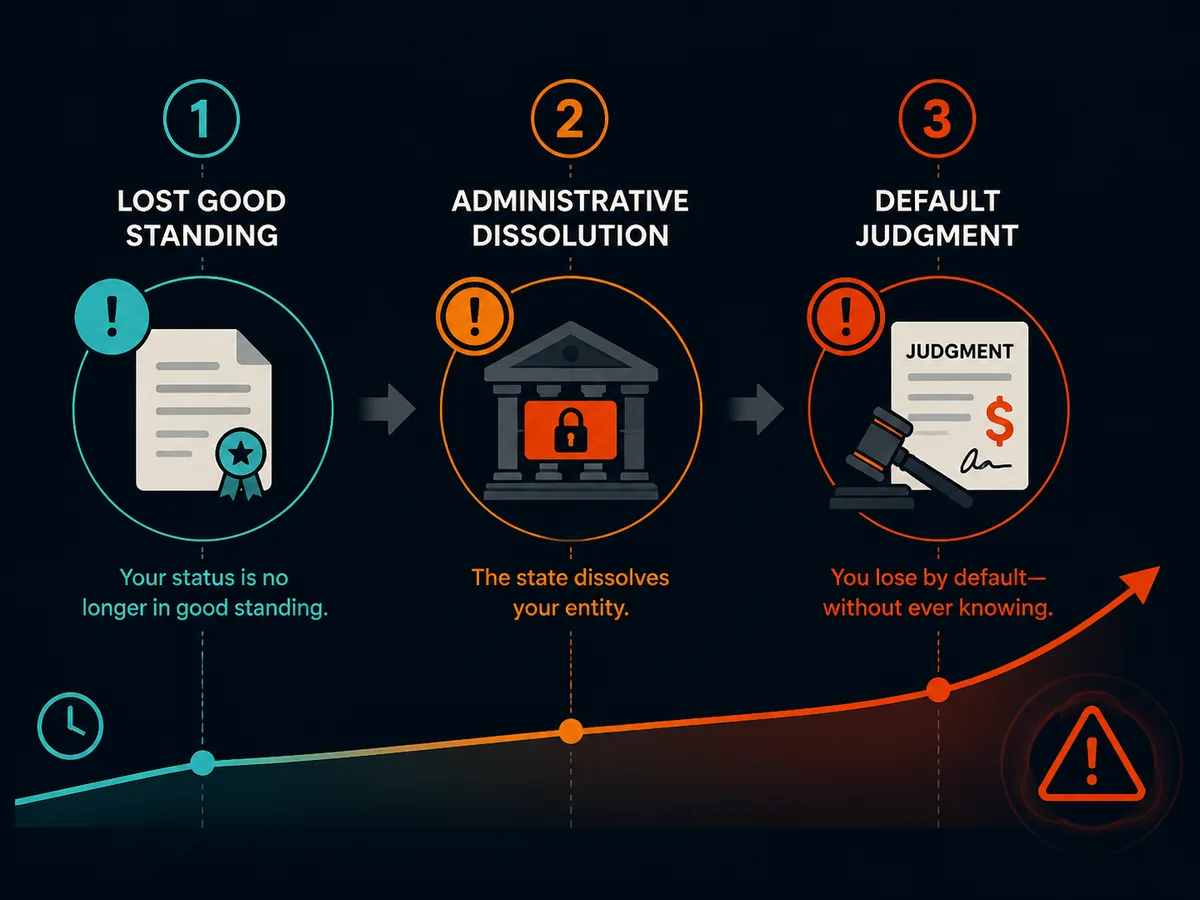
The registered-agent requirement is easy to satisfy and easy to forget — and the consequences of forgetting escalate quickly. There are three distinct failure modes, and they compound.
Loss of good standing. The moment your registered agent resigns, becomes non-compliant, or your renewal lapses without a replacement, your LLC is out of compliance with the state. You can no longer obtain a certificate of good standing — the document banks, payment processors, and counterparties sometimes demand before opening an account or signing a contract. A payout partner asking for proof your entity is current will get a "no," and you will not know why until you check the state's records.
Administrative dissolution. If the lapse persists, the state can administratively dissolve (or, in Delaware's language, cancel) the LLC for failing to maintain a registered agent — often alongside a missed annual report or unpaid franchise tax. Administrative dissolution is not a slap on the wrist. It can suspend the LLC's authority to do business and, in the window before reinstatement, expose the owner to arguments that the liability shield lapsed. Reinstatement is usually possible, but it means back-fees, penalties, a reinstatement application, and appointing a compliant agent — weeks of avoidable friction.
Default judgments — the dangerous one. This is the failure mode that turns a $125 oversight into a five- or six-figure loss. If someone sues your LLC and there is no registered agent to serve, many states permit substituted service — the plaintiff serves the Secretary of State, or serves by publication in a newspaper. Legally, that counts as notice to your company. Practically, you never see it. You do not know a lawsuit exists, you miss every deadline to respond, and the court enters a default judgment against your LLC for whatever the plaintiff claimed. A registered agent's core purpose is to make sure this never happens — that a real human catches the summons and gets it to you in time to hire a lawyer and respond. Skipping the agent to save a hundred dollars a year is a false economy against exactly this risk.
Commercial vs. individual registered agents
Under the Model Registered Agents Act, and in practice everywhere, agents fall into two categories.
A commercial registered agent is a company in the business of serving as an agent for many entities. In MoRAA states it files a "commercial registered agent listing statement" with the Secretary of State and appears on the state's official list, which lets any entity appoint it by reference. Northwest, ZenBusiness, Bizee, Harbor Compliance, and CT Corporation are commercial agents. They maintain a permanent staffed office, handle high volumes of service reliably, scan documents same-day, and — a benefit US owners value — put their address on the public record instead of yours, keeping your home address off the searchable state database.
An individual (noncommercial) registered agent is any adult who resides in the state and agrees to accept service at their own street address: the owner, a co-founder, an employee, an accountant, or a friend. It is free, but fragile. If that person moves, travels, changes jobs, or is simply out to lunch when the process server arrives, service can be missed or the address goes stale, and updating it is on you. For a non-resident the individual route is a non-starter — you have no in-state person to name — but even US owners increasingly prefer a commercial agent for the stability and privacy.
The Soveraine view: for a foreign-owned LLC there is effectively one real choice, a commercial registered agent, and the only remaining questions are which one and whether it comes bundled with your formation.
Formation-bundled vs. standalone registered agent
Non-residents obtain a registered agent one of two ways.
Bundled with formation. When you form through a service — Doola, Firstbase, Bizee, ZenBusiness, Northwest — the first year of registered-agent service is typically included free, and everything lives in one dashboard: formation documents, the agent, and often your virtual mailbox and compliance calendar. This is the path of least resistance and what most foreign founders choose. Our best LLC formation services for non-residents comparison walks through which bundles are strongest. The trade-off is coupling: if you later move formation providers, you move your agent too, and re-designating an agent means a state filing.
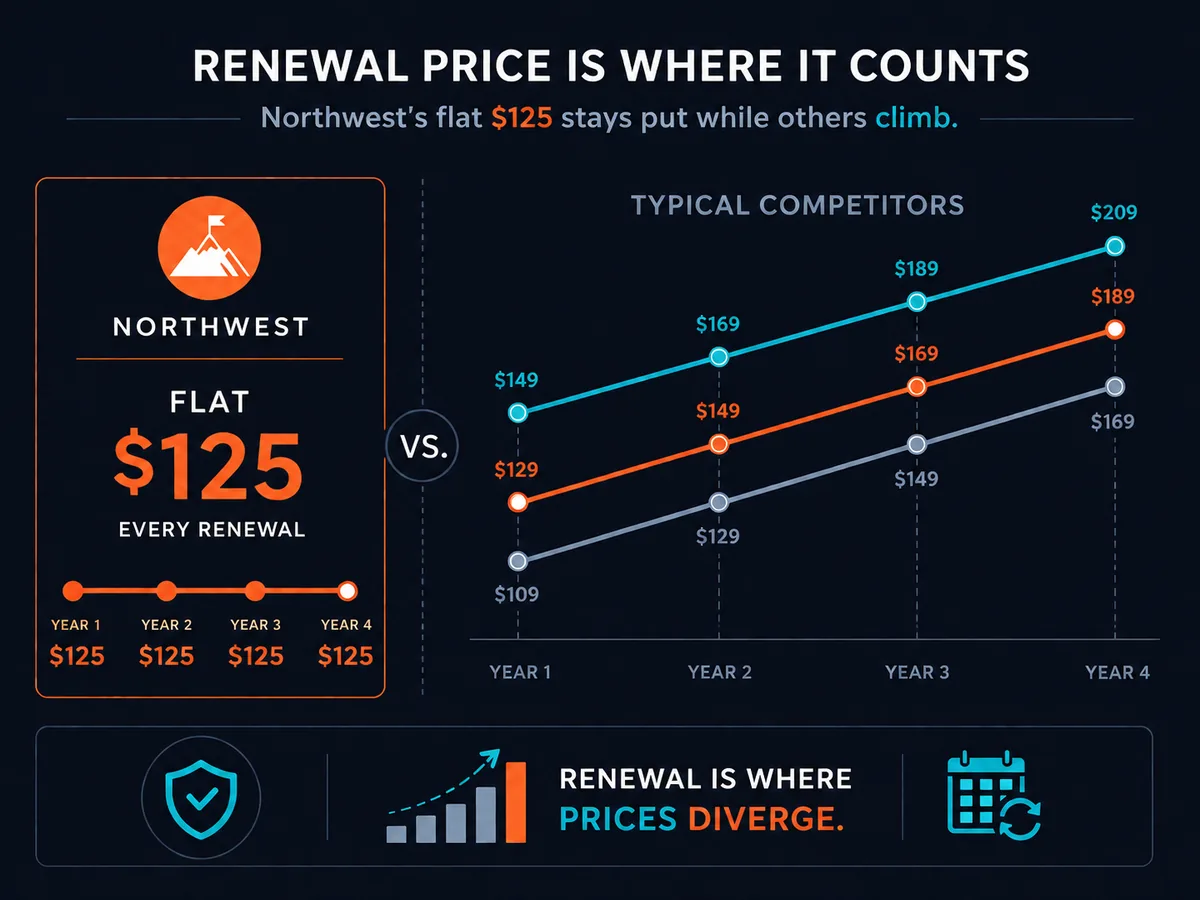
Standalone specialist. Some owners deliberately keep the agent separate from formation, appointing a dedicated agent such as Northwest and running formation or bookkeeping through whoever they like. The advantage is independence — the agent stays put no matter how often you change your other providers — and, with a flat-rate specialist, predictable pricing. Northwest is the common pick here because its price is a flat $125/year that does not jump at renewal, and it does not upsell aggressively.
Either way, the mechanics for you as owner are the same: you supply nothing but a signature, and the agent's in-state office becomes your registered office of record. Where this fits in your overall setup budget is laid out in our LLC cost for non-residents guide.
What a registered agent costs
Registered-agent service is one of the cheapest mandatory items in a US LLC, and for most non-residents it is free in the first year because formation providers bundle it. The recurring cost is where providers diverge. The table below reflects standard 2026 renewal pricing for the leading options a non-resident is likely to consider.
| Provider | First-year cost | Renewal (per year) | Notes | Best for |
|---|---|---|---|---|
| Northwest Registered Agent | Free with formation | $125 flat | No renewal price jump; same-day scanning; strong privacy | The quality leader; owners wanting a stable, standalone agent |
| Bizee | Free year 1 (bundled) | ~$149 | Free first year with formation, then renews annually | Budget-conscious owners forming through Bizee |
| ZenBusiness | ~$99 (or free with plan) | ~$199 | Slick dashboard and compliance tooling; higher renewal | Owners who want an all-in-one platform |
| Doola / Firstbase | Free year 1 (bundled) | Included in plan / add-on | Agent folded into a non-resident formation + EIN + tax bundle | Founders wanting formation, EIN and agent in one place |
| Standalone specialist (Harbor, Registered Agents Inc.) | ~$100-200 | ~$100-200 | Independent of any formation service | Owners keeping the agent fully separate |
The right choice is rarely about the dollar difference — the spread between the cheapest and priciest option here is around $100 a year. It is about whether you want everything in one dashboard (bundle it) or want the agent to stay independent of your other services (standalone). For non-residents specifically, the deciding factor is often which provider is genuinely comfortable serving foreign owners with no SSN and no US address, which narrows the field more than price does.
How to change your registered agent
Switching registered agents is routine and low-cost, and you will do it at least once if you ever change formation providers or find a better-priced agent. The process is the same in every state:
- Appoint the new agent first. Sign up with the incoming commercial agent so you have a compliant agent lined up. Never leave a gap — the moment you have no agent of record, the good-standing and default-judgment clocks start ticking.
- File a statement of change with the Secretary of State in the formation state. This is a short form naming the new registered agent and registered office. The fee is small — commonly $0 to $60. Most commercial agents file this for you as part of onboarding, so in practice you approve a form rather than draft one.
- Confirm the state's record updated. The change takes effect when the state accepts the filing, usually within a few business days. Check the state's online business search to confirm the new agent shows on the public record.
- Cancel the old service only after the state's records reflect the new agent. Cancelling first creates exactly the gap you are trying to avoid.
The state fee is genuinely small, but it is state-specific, and it is not always the number a provider quotes you. Figures below are what each state charges for the change filing itself, separate from anything your new agent charges:
| State | Filing | State fee |
|---|---|---|
| Wyoming | Appointment of New Registered Agent and Office | $5 |
| Texas | Form 401, Change of Registered Agent/Office | $15 (nonprofits and cooperative associations $5) |
| Florida | Statement of Change of Registered Office or Registered Agent (LLC) | $25 — but changing the agent inside the annual report during the 1 January to 1 May window carries no separate charge |
| New Mexico | Statement of Change, filed online | around $20 |
| Nevada | Statement of Change of Registered Agent by Represented Entity | around $60 — the most expensive of the common formation states |
| Delaware | Change of registered agent filing with the Division of Corporations | charged per entity; confirm the current figure with the Division |
Verify the fee on the state's own site before filing; these schedules change, and third-party pages quoting them go stale quickly. The pattern that matters is the ordering: Wyoming and Texas make switching almost free, Nevada makes it cost about half a year of agent service, and Florida gives you a free window once a year if you plan the switch around your annual report.
One nuance for non-residents: if your LLC is foreign-qualified in more than one state, you have a registered agent in each of those states, and a change of agent may need to be filed in each. Most owners keep a single commercial agent that operates nationwide precisely to make this a one-account affair rather than several.
Choosing a provider as a non-resident
Four names cover almost every sensible choice, and the decision turns on how independent you want the agent and how much of the rest of your setup you are outsourcing.
Northwest Registered Agent is the quality leader and our lead recommendation for the standalone agent role. The pricing is a flat $125/year that does not balloon at renewal, the service scans every document the day it arrives, its privacy posture is the best in the industry, and its support answers questions from non-residents without the upsell scripts common elsewhere. If you want one thing that just works and stays independent of whatever formation or bookkeeping tool you use, Northwest is the default.
Bizee and ZenBusiness are strong when you want the agent bundled into a broader formation platform. Bizee is the budget path — free agent in year one with formation, then a moderate renewal. ZenBusiness has the most polished dashboard and compliance tooling, at a higher renewal price.
Doola and Firstbase are the natural picks when the registered agent is one line item in a full non-resident package that also handles the EIN, the US mailing address, and annual tax filings such as the Form 5472 that a foreign-owned single-member LLC must file. If you are choosing your formation state and setup path at the same time — start with our guide to which state is best for an LLC for a non-resident — folding the agent into a Doola or Firstbase bundle keeps your whole compliance stack under one login.
Whatever you choose, do not treat the registered agent as an afterthought or try to skip it. It is a statutory requirement, it is inexpensive, and it is the mechanism that stops a lawsuit from turning into a default judgment you never saw. For non-residents especially, it is not the place to economise.
FAQ
Is a registered agent legally required for every US LLC
Yes. Every US state requires an LLC to appoint and continuously maintain a registered agent in its formation state, with no exceptions and, in most states, no grace period. The requirement is written into each state's LLC statute — for example Wyoming's Registered Offices and Agents Act (W.S. §17-28-101) and Delaware's LLC Act (6 Del. C. §18-104). If your LLC is also qualified to do business as a foreign entity in another state, you need a registered agent there too. The agent's job is to accept service of process — court summons and lawsuits — and official mail from the Secretary of State. An LLC that lets its registered agent lapse falls out of good standing and can be administratively dissolved by the state.
Can a non-US resident be their own registered agent
Almost never. To serve as your own registered agent you must have a physical street address in the LLC's formation state and be personally available there during normal business hours to accept legal documents. A non-resident living abroad has neither. PO boxes, private mailbox stores, mail-forwarding services and virtual addresses are explicitly not accepted for registered-agent purposes in states like Wyoming — the statute requires a real location where a person is physically present. This is why practically every foreign-owned LLC uses a commercial registered agent in the formation state. It is not a workaround; it is the intended, statutory design for absentee and out-of-state owners.
How much does a registered agent cost per year
For most non-residents, $0 in year one and roughly $100-300 per year thereafter. Formation services routinely bundle the first year of registered-agent service free when you form through them. At renewal, Northwest Registered Agent charges a flat $125/year, Bizee renews at around $149/year, ZenBusiness at about $199/year, and LegalZoom near $249/year. Standalone commercial agents (Harbor Compliance, Registered Agents Inc.) sit in a similar band. The price buys a compliant in-state street address, same-day scanning of any legal or state document, and compliance reminders for annual reports. It is one of the cheapest genuinely mandatory line items in running a US LLC.
What happens if my LLC loses its registered agent
Several bad things, in sequence. First, the LLC loses good standing — it can no longer obtain a certificate of good standing, which banks and payment processors sometimes request. Second, the state can administratively dissolve or cancel the LLC for failing to maintain an agent, stripping the liability shield that is the entire point of the structure. Third, and most dangerous, you stop receiving lawsuits. If someone sues your LLC and there is no agent to serve, many states permit substituted service on the Secretary of State or by publication — and because you never actually see the summons, you miss the deadline to respond and a default judgment is entered against you. You can lose a case you never knew existed.
What is the difference between a commercial and an individual registered agent
A commercial registered agent is a company in the business of acting as an agent — it files a listing statement with the state and appears on the state's official list under the Model Registered Agents Act, adopted by Wyoming, Nevada and around a dozen other jurisdictions. An individual (noncommercial) agent is any adult resident of the state, often the owner, a friend, or an employee, who agrees to accept service at their own address. For non-residents the individual route is unavailable — you have no in-state person. Commercial agents also add value US owners appreciate: a stable address that never moves, privacy (their address appears on the public record instead of yours), and reliable same-day document handling.
How do I change my registered agent
You file a statement of change with the Secretary of State in the formation state and pay a small fee — commonly $0 to $50, and free in some states. Most commercial agents file it for you as part of onboarding, so switching is usually a form you approve rather than paperwork you draft. The change takes effect when the state accepts the filing, typically within a few business days. Never simply stop paying your old agent without appointing a replacement first: the moment you have no agent of record, the good-standing and default-judgment risks begin. Line up the new agent, file the change, confirm the state's records show it, then cancel the old service.
Can I use my formation service as my registered agent
Yes, and most non-residents do — it is the simplest arrangement. Doola, Firstbase, Bizee, ZenBusiness and Northwest all act as your registered agent in the formation state, usually free for the first year and then at their renewal rate. Keeping formation, registered agent and mail in one dashboard means one login, one renewal date, and one company that already holds your entity documents. The trade-off is lock-in: moving formation providers later means moving your agent too. Some owners deliberately use a standalone specialist like Northwest for the agent role precisely so it stays independent of whichever formation or bookkeeping service they use this year.
Can a registered agent be a PO box
No. Every state requires the registered office to be a physical street address in the formation state where a process server can personally hand legal papers to the agent during normal business hours, and a PO box fails that test by definition. The rule is broader than PO boxes: Wyoming's Secretary of State states that post office boxes, drop boxes, virtual addresses, mail-forwarding locations and UPS or FedEx stores all fail to qualify, and Texas provides under BOC §5.201 that the registered office may not be solely the address of a mailbox or telephone-answering service — so formatting a private mailbox as "Suite 400" does not help. What confuses people is that most state filings also ask for a mailing address or principal office address, and those fields are far more permissive and often do accept a PO box or an out-of-state address. They are different fields with different rules. Read each one's instructions rather than applying the strict rule everywhere or the loose rule everywhere.
Does every state require an LLC to have a registered agent
Almost, but not quite. Every state a non-resident is realistically going to form in — Wyoming, Delaware, New Mexico, Florida, Texas, Nevada — requires a registered agent with an in-state street address. New York is the genuine exception: under NY LLC Law §301 the Secretary of State is automatically the agent for service of process for every New York LLC, and §302 says an LLC "may" designate a registered agent in addition, which makes it optional. That is not the bargain it looks like. A lawsuit served on the Department of State is forwarded once, by post, to whatever address the LLC put in its Articles of Organization, so a stale or unattended address abroad can mean losing a case you never knew about. Most non-residents with a New York LLC appoint a §302 agent anyway.
This guide is editorial. We hold affiliate relationships with Northwest Registered Agent, Bizee, ZenBusiness, Doola and Firstbase, disclosed via our affiliate disclosure. Nothing here is tax or legal advice — see our disclaimer.
Ready to act on this?
Northwest Registered Agent — a compliant registered agent in your formation state at a flat $125/year, free the first year with formation, with same-day document scanning built for owners abroad. Soveraine readers get the same price through our partner link, and you fund independent editorial in the process.
Sources
- Wyoming Statutes § 17-28-101 — Registered Office and Registered Agent: https://law.justia.com/codes/wyoming/title-17/chapter-28/section-17-28-101/
- Wyoming Secretary of State — Registered Offices and Agents Act (Chapter 28): https://sos.wyo.gov/Forms/WyoBiz/Registered_Offices_and_Agents_Act_Chapter_28.pdf
- 6 Delaware Code § 18-104 — Registered office; registered agent: https://law.justia.com/codes/delaware/title-6/chapter-18/subchapter-i/section-18-104/
- Delaware Division of Corporations — Registered Agent Listing Standards: https://corpfiles.delaware.gov/agtwebreq.pdf
- Nevada Revised Statutes Chapter 77 — Model Registered Agents Act: https://www.leg.state.nv.us/nrs/nrs-077.html
- Colorado Secretary of State — Registered Agent Business FAQs: https://www.sos.state.co.us/pubs/business/FAQs/regAgent.html
- Wolters Kluwer — What is a registered agent for an LLC or corporation? https://www.wolterskluwer.com/en/expert-insights/what-is-a-registered-agent
- Wolters Kluwer — The risks of using an individual as your registered agent: https://www.wolterskluwer.com/en/expert-insights/the-risks-of-using-an-individual-as-your-registered-agent
- Cogency Global — Commercial vs. Noncommercial Registered Agents: https://www.cogencyglobal.com/blog/commercial-vs-noncommercial-registered-agents-why-you-need-to-get-it-right/
- LLC University — LLC Registered Agent Requirements (2026 Guide): https://www.llcuniversity.com/registered-agent-requirements/
- Wyoming Secretary of State — Registered Agents and Offices FAQs (PO boxes, drop boxes, virtual addresses and mail-forwarding locations excluded; $5 to appoint a new agent): https://sos.wyo.gov/faqs.aspx?root=RAO
- Texas Secretary of State — Form 401-A, Acceptance of Appointment and Consent to Serve as Registered Agent (BOC §5.201; consent required since 1 January 2010): https://www.sos.state.tx.us/corp/instructions/401-a.shtml
- Texas Secretary of State — Form 401 instructions, Change of Registered Agent/Registered Office ($15 filing fee): https://www.sos.state.tx.us/corp/instructions/401.shtml
- California Corporations Code §17701.13 — office and agent for service of process: https://codes.findlaw.com/ca/corporations-code/corp-sect-17701-13/
- California Secretary of State — Service of Process: https://www.sos.ca.gov/business-programs/business-entities/service-process
- New York Limited Liability Company Law Article 3 §301 — Secretary of State as agent for service of process: https://www.nysenate.gov/legislation/laws/LLC/A3
- New York Limited Liability Company Law §302 — registered agent for service of process ("may designate"): https://www.nysenate.gov/legislation/laws/LLC/302
- New York Department of State — Forming a Limited Liability Company in New York: https://dos.ny.gov/forming-limited-liability-company-new-york