
The Wyoming LLC has become the default recommendation in every Reddit thread, YouTube video and "offshore" newsletter for the last decade. The pitch is consistent: no state income tax, strong privacy, cheap to run, bulletproof asset protection. Some of that is true. Some of it is true only for one specific reader. And some of it is a misreading of how US state taxation actually works.
Northwest Registered Agent — Privacy-first US LLC formation + registered agent
This article separates the real benefits from the marketing. It is structured by reader nationality, because a Wyoming LLC does very different things for a US citizen living in California, an Italian freelancer in Lisbon, and a Singaporean founder selling SaaS to US customers. If you skip the segmentation, you will optimise for the wrong problem.
What a Wyoming LLC actually is
A Wyoming Limited Liability Company is a state-chartered legal entity formed under the Wyoming Limited Liability Company Act, Title 17, Chapter 29. It separates the owner's personal assets from the company's liabilities, can have one or more "members" (owners), and is taxed by default as a pass-through entity — meaning the LLC itself pays no federal income tax, and profits flow to the members' personal returns.
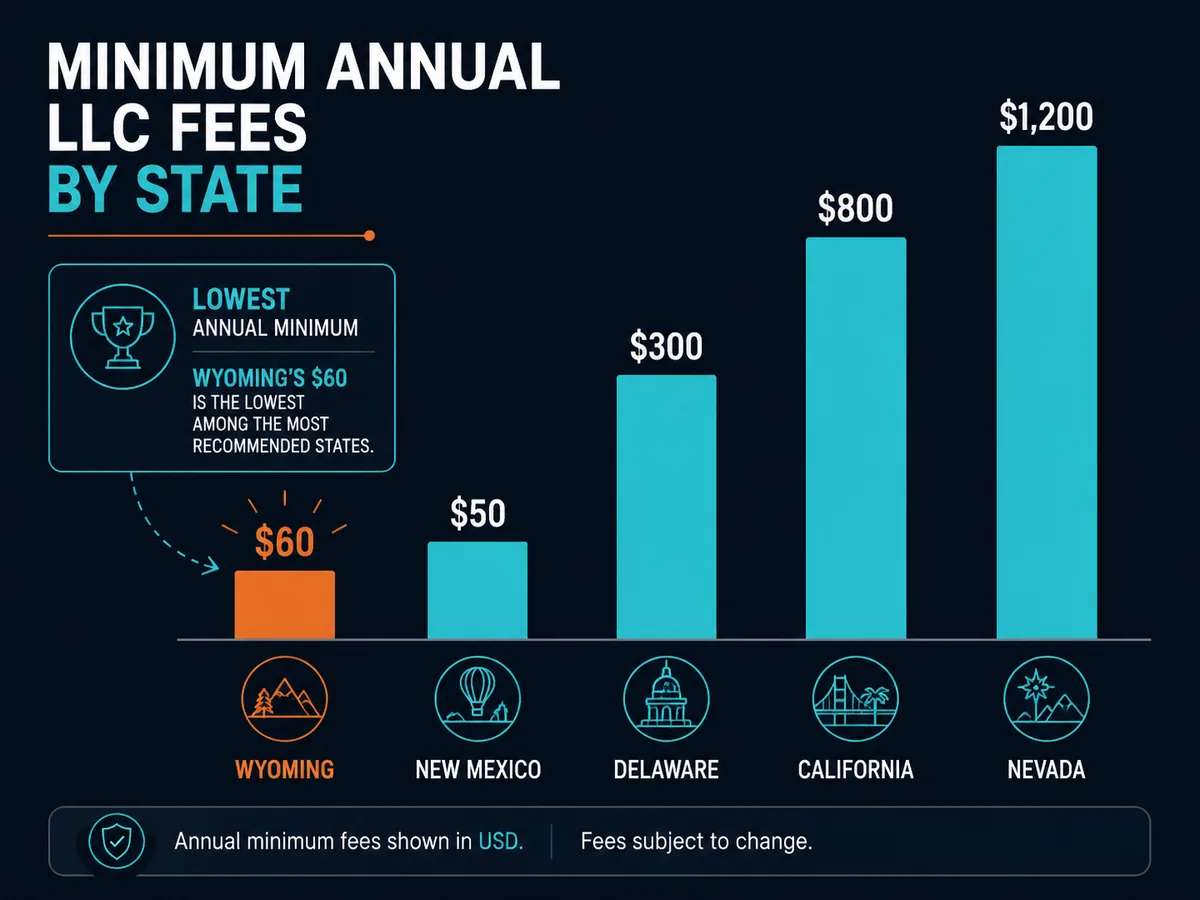
Wyoming was the first US state to authorise LLCs, in 1977. That head start produced a mature body of statute and case law, which is part of why lawyers favour it for holding structures. The annual cost to maintain a Wyoming LLC is $60 (the annual report license tax minimum), and the state filing fee to form one is $100.
That is the entity. Everything else — privacy, tax, asset protection — depends on how and where you use it.
Who this applies to
Wyoming LLC benefits do not apply uniformly. Three reader groups need different analyses.
US persons (citizens and green-card holders)
You are taxed by the US on worldwide income regardless of where you live or where your LLC is formed. Forming a Wyoming LLC does not reduce your federal tax bill. It may reduce your state tax bill only if you also move your residency to Wyoming or another no-tax state. Most readers in this segment will file in their home state regardless.
EU freelancers and digital nomads
If you are tax-resident in an EU country under the 183-day rule or centre-of-vital-interests test, your Wyoming LLC's profits are taxable where you live. Most EU countries treat a US single-member LLC as transparent and tax the owner directly; some (notably Germany and France) may treat it as a corporation and apply CFC rules under ATAD. Get a local opinion before you form.
Non-US, non-EU readers
This is the group for whom the Wyoming LLC mostly works as advertised — if your home country has territorial taxation, no CFC rules, and you do not create a US tax nexus. A Singaporean, UAE-resident or Hong Kong founder selling digital services to US customers through a Wyoming LLC can often run a fully compliant, low-tax structure. The conditions matter and we cover them below.
The benefits, ranked by what is actually true
1. No state income tax (real, but conditional)
Wyoming has no personal or corporate state income tax. The Wyoming Department of Revenue confirms this. The conditional part: this benefits you only if Wyoming is where the income is taxed, which means either you are a Wyoming resident, or your LLC has no nexus elsewhere.
If you live in California and run a consultancy through your Wyoming LLC, California taxes the income. The California Franchise Tax Board requires foreign LLCs doing business in California to register, pay the $800 annual franchise tax, and file California returns. You have not saved a dollar in tax — you have added a layer of paperwork.
2. Charging-order protection (real and meaningful)
This is the strongest legal benefit. Under Wyoming Statute § 17-29-503, a creditor who wins a judgment against an LLC member cannot seize the member's interest in the LLC. The creditor's only remedy is a "charging order" — the right to receive distributions if and when the LLC chooses to make them.
Crucially, Wyoming extends this protection to single-member LLCs. Most states do not. Several court cases (notably Olmstead v. FTC in Florida) have pierced single-member LLCs in other states by treating the lone member's interest as personal property. Wyoming statute pre-empts that argument.
If you hold real estate, brokerage accounts, or other assets that creditors might target, a Wyoming LLC as a holding vehicle is a defensible choice. This is the benefit that lawyers genuinely care about.
3. Privacy from the public register (real, but shrinking)
Wyoming does not require member or manager names on the public formation documents. Only the registered agent's name appears. This is real privacy from casual lookups, competitors, and process servers.
It is not privacy from:
- The IRS — you provide owner information on Form SS-4 to get an EIN.
- Banks — under the Bank Secrecy Act and FinCEN's Customer Due Diligence rule, every US bank account opening requires beneficial-owner disclosure.
- FinCEN — no longer, as of 14 August 2026. The Corporate Transparency Act beneficial ownership filing applied to nearly all LLCs from January 2024, was narrowed by a March 2025 interim rule, and has now been settled: FinCEN's final rule permanently exempts every entity created in the United States, whoever owns it. A Wyoming LLC no longer files. Only entities formed under foreign law that register to do business in a US state do.
- Foreign tax authorities — under the OECD Common Reporting Standard and FATCA, account information flows back to your country of residence.
Anyone selling "anonymous" Wyoming LLCs for tax-avoidance purposes is selling a fiction. Privacy from your neighbour, yes. Privacy from the state, no.
4. Low cost (real)
$100 to form, $60 minimum annual report fee. Registered agent services run $50–$200/year. Total annual maintenance for a basic Wyoming LLC is typically under $300. Compare to Delaware's $300 minimum franchise tax, or California's $800 minimum.
5. Flexible management (real, but available everywhere)
Wyoming permits member-managed or manager-managed structures, allows series LLCs, and imposes few restrictions on operating agreement terms. Almost every other state offers similar flexibility. This is not a Wyoming-specific advantage.
6. No information sharing with the IRS beyond what's required (overstated)
You will read claims that Wyoming does not share information with the IRS. Wyoming does not collect state income tax information, so it has nothing to share. The IRS gets its information directly from your federal filings, your bank, and Form 5472 if you are a non-resident owner. This "benefit" is a category error.
Using a Wyoming LLC in your home state
If you live and work in another US state, forming in Wyoming does not avoid your home state's taxes or filing requirements.
Every state has a "doing business" or "nexus" test. If you have an office, employees, inventory, regular customer contact, or a fixed place of business in a state, your LLC has nexus there. Nexus means you must:
- Register as a foreign LLC in that state.
- Pay that state's annual fees and franchise taxes.
- File that state's income or franchise tax returns.
- Comply with that state's labour and sales tax rules.
A New York resident with a Wyoming LLC running a consultancy from their Brooklyn apartment owes New York taxes, New York foreign LLC registration, and the New York LLC publication requirement (which is expensive). They have added cost, not removed it.
The legitimate use case for a Wyoming LLC by a US resident of another state is as a holding company for assets that have no operational nexus elsewhere — real estate held passively, intellectual property licensed out, or membership interests in other LLCs. Even then, get a state-specific opinion.
Wyoming LLC for non-US residents — the conditions
This is where the Wyoming LLC earns its reputation, with caveats.
A single-member LLC owned by a non-US person is a disregarded entity for US federal tax purposes. The owner is taxed personally on US-source income, not the LLC. If the LLC has:
- No US-source income that is "effectively connected" to a US trade or business (ECI),
- No US employees,
- No US office or fixed place of business,
- No dependent agent in the US with authority to conclude contracts,
then the LLC owes no US federal income tax. This follows from the IRS rules on ECI and the source rules in IRC § 861–865.
Selling software, consulting services, or digital products to US customers from abroad generally produces foreign-source income, not ECI. Selling physical goods stored in a US warehouse, or performing services while physically in the US, generally does produce ECI.
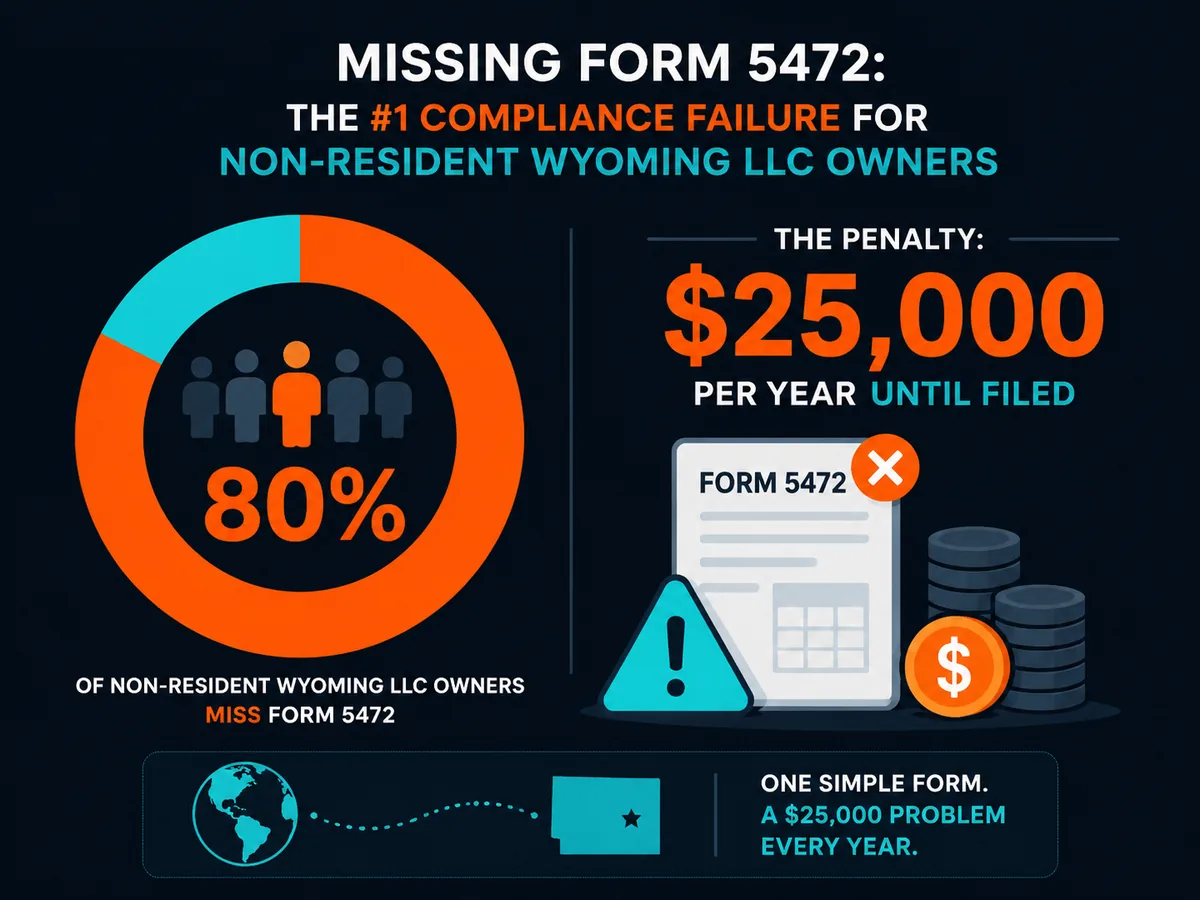
You still have filing obligations. A foreign-owned single-member LLC must file Form 5472 with a pro-forma Form 1120 annually. The penalty for missing this is $25,000 per form per year. This is the single most common compliance failure among non-resident Wyoming LLC owners.
Your home country still taxes the income. A UAE resident pays 0% personal income tax and (subject to the new 9% UAE corporate tax thresholds) may pay little or nothing on the LLC's profits. A Brazilian or Indian resident is taxable on worldwide income at home — the Wyoming LLC saves nothing.
Realistic costs and timeline
| Item | Cost | Frequency |
|---|---|---|
| State filing fee | $100 | One-time |
| Annual report fee (minimum) | $60 | Annual |
| Registered agent | $50–$200 | Annual |
| EIN application (direct from IRS) | $0 | One-time |
| EIN via agent (non-resident, no SSN) | $150–$400 | One-time |
| US business bank account (Mercury, Relay) | $0 | Ongoing |
| Form 5472 + 1120 preparation (non-resident) | $400–$1,200 | Annual |
| US tax return (if US person) | $300–$2,000 | Annual |
| Operating agreement (template vs. lawyer) | $0–$1,500 | One-time |
| Foreign LLC registration in home state (US persons) | $50–$800 | Annual |
Formation timeline: 1–5 business days with standard processing. EIN takes 1 day with an SSN, 4–6 weeks by fax for non-residents without an ITIN.
Common mistakes
Forming in Wyoming while living and working in another US state, expecting tax savings. You owe your home state's taxes regardless. You have added a registration in two states instead of one.
Skipping Form 5472. Non-resident owners who treat the Wyoming LLC as a non-US entity and ignore US filings face $25,000 penalties that the IRS does assess.
Believing "anonymous LLC" means anonymous to authorities. Banks, the IRS and your home tax authority will all know who you are. FinCEN's beneficial ownership register no longer will, since US-formed entities were exempted on 14 August 2026 — one disclosure channel closing does not make the other three go away.
Using a Wyoming LLC to "establish residency" in Wyoming. Residency is a facts-and-circumstances test — where you actually live, vote, register cars, and spend time. A registered agent's address is not a residence.
Forgetting CFC rules. EU residents who own a Wyoming LLC may trigger Controlled Foreign Company rules under ATAD Article 7, which can attribute the LLC's profits to the owner regardless of distribution.
Using a US-formed entity to "avoid" home-country tax in a worldwide-taxation country. This is the most expensive mistake. Your home country sees through the LLC and taxes you. If the LLC was an attempt to hide income, you have crossed from optimisation into evasion.
Which state has the best LLC benefits
For most US residents, the best state is the one where you actually live, because that is where the LLC will be taxed anyway. Forming elsewhere creates two registrations and saves nothing.
For holding companies, asset protection, and non-US owners, the realistic shortlist is:
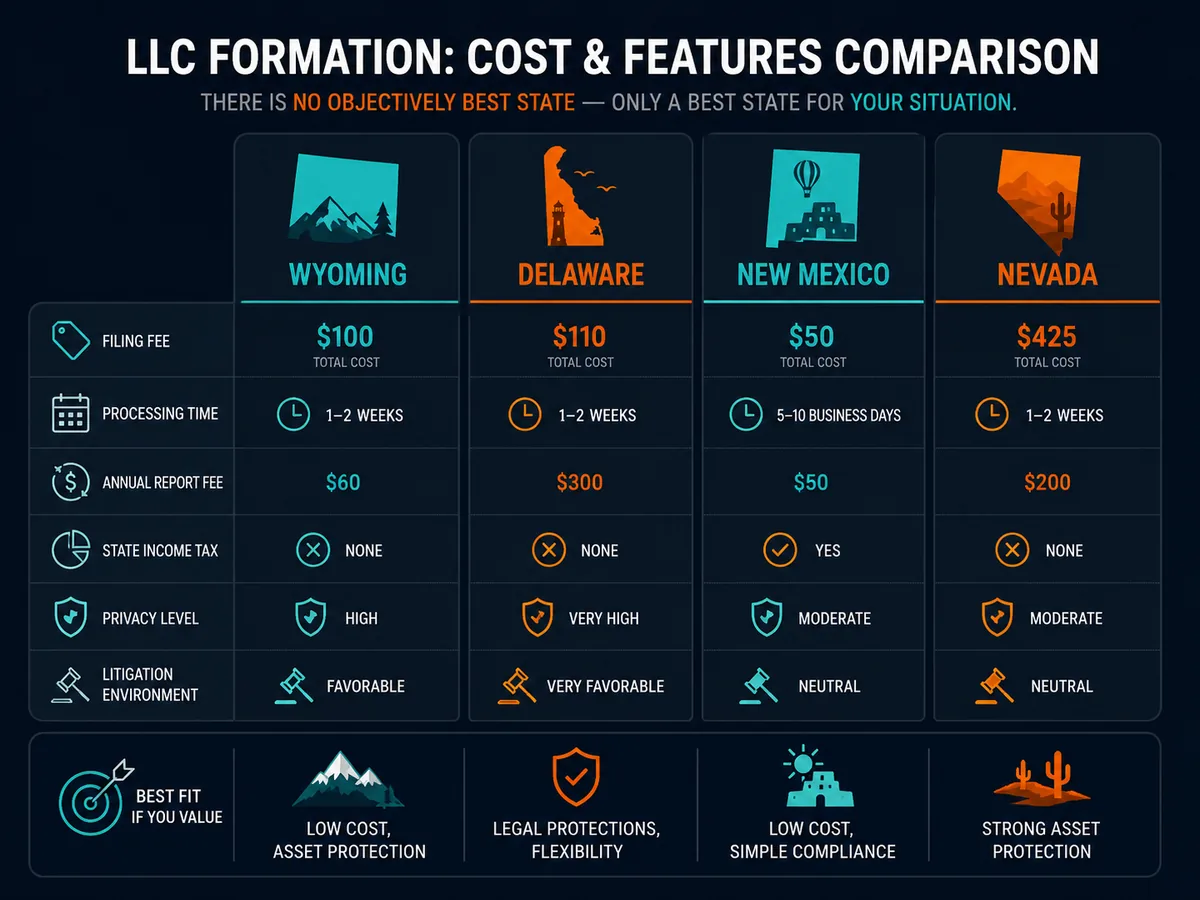
- Wyoming — best for single-member charging-order protection, lowest cost, decent privacy. The default for non-US owners running digital businesses.
- Delaware — required if you will raise venture capital. Investors expect it. Higher cost ($300 minimum franchise tax) and weaker single-member protection.
- New Mexico — no annual report at all, cheapest long-term, strong privacy. Weaker case law than Wyoming.
- Nevada — similar to Wyoming on paper but higher fees ($350+ annually) and weaker statutory protections than its marketing suggests.
There is no objectively best state. There is a best state for your specific situation.
When to consult a qualified professional
Before forming, you want two opinions: a US tax advisor familiar with non-resident structures (or your state's foreign-LLC rules if you are a US person), and a tax advisor in your country of residence. The interaction between US and home-country tax law is where every real problem lives, and neither side's specialist sees the whole picture alone.
You especially need professional advice if:
- You are a US person considering a Wyoming LLC to hold appreciated assets or operate across state lines.
- You are an EU resident — CFC rules, exit taxes and treatment of US transparent entities vary by country.
- Your LLC will have US employees, a US office, or US inventory.
- You will move countries during the LLC's life.
- The LLC will own real estate, regulated assets, or generate over $100,000/year.
Soveraine is an editorial publication, not a law or accounting firm. Read our editorial policy and disclaimer before acting on anything in this article.
FAQ
What are the disadvantages of a Wyoming LLC?
If you live and work in another US state, your Wyoming LLC almost certainly has to register as a foreign LLC there, pay that state's fees, and file that state's taxes. You get double paperwork and double annual fees, not tax savings. Wyoming's privacy is also weaker than marketed: banks and the IRS both require beneficial-owner disclosure, and FinCEN's separate customer due diligence rule keeps your identity in your bank's file. (The Corporate Transparency Act filing that applied from 2024 was permanently withdrawn for US-formed entities on 14 August 2026.) For non-US founders, a single-member Wyoming LLC triggers Form 5472 reporting with $25,000 penalties for missed filings.
Which state has the best LLC benefits
There is no universal best. Wyoming wins on annual cost ($60), privacy from the public register, and charging-order protection that extends to single-member LLCs. Delaware wins for venture-backed companies that will raise institutional capital — investors expect Delaware. New Mexico is cheaper for pure privacy with no annual report. For most people, the right answer is the state where you actually live and work, because that is where the LLC will be taxed regardless of formation state.
How much is $100,000 after taxes in Wyoming
Wyoming has no state income tax, so a Wyoming resident earning $100,000 of W-2 wages in 2025 pays roughly $14,260 in federal income tax (single filer, standard deduction) plus $7,650 in FICA, leaving around $78,090. An LLC owner taxed as a sole proprietor pays self-employment tax of 15.3% on net earnings instead of FICA, so take-home drops closer to $74,000. Forming a Wyoming LLC while living elsewhere does not give you Wyoming's tax treatment — your home state taxes you.
Does a Wyoming LLC give non-US residents a tax-free company
Sometimes, but the conditions are narrow. A non-US owner of a Wyoming LLC pays no US federal income tax only if the LLC has no US-source income effectively connected to a US trade or business (ECI), no US employees, no US office, and no dependent agent in the US. Selling SaaS or digital services to US customers from abroad usually qualifies. Selling physical goods from a US warehouse, or working from the US on a visit, usually does not. Your home country still taxes the income.
What names should you avoid for an LLC
Wyoming statute prohibits names that imply you are a bank, trust company, insurer, or government agency unless licensed. You cannot use 'Inc.', 'Corp.', or 'Corporation' in an LLC name. The name must include 'LLC', 'L.L.C.', or 'Limited Liability Company'. Avoid trademarked terms — using 'Apple Consulting LLC' will not survive a cease-and-desist. Check the USPTO trademark database, not just Wyoming's business name database, before filing. A clean Wyoming name search means nothing if a federal trademark blocks your use of it.
Do I still need to file US taxes if my Wyoming LLC has no US income
Yes, in most cases. A US single-member LLC owned by a non-resident is a disregarded entity that must file Form 5472 plus a pro-forma Form 1120 every year, even with zero revenue. The penalty for missing this filing is $25,000 per form per year. Multi-member LLCs file Form 1065. US persons report all worldwide income regardless of where the LLC is formed. Wyoming's no-state-tax status does not eliminate federal filing — it only removes one layer.
Ready to act on this?
Northwest Registered Agent — Privacy-first US LLC formation + registered agent. Soveraine readers go to the front of the line through our partner link, and you fund independent editorial in the process.
Sources
- Wyoming Limited Liability Company Act, Title 17, Chapter 29 — https://www.wyoleg.gov/statutes/compress/title17.pdf
- Wyoming Secretary of State, Annual Report License Tax — https://sos.wyo.gov/Business/Docs/Wyoming_AR_LicenseTax.pdf
- Wyoming Department of Revenue — https://revenue.wyo.gov/
- California Franchise Tax Board, Limited Liability Companies — https://www.ftb.ca.gov/file/business/types/limited-liability-company/index.html
- New York Department of State, Limited Liability Compan