
Stripe Atlas is the most-recognised way to incorporate a US company from outside the United States. It is also one of the most over-recommended. This article is a working review for founders deciding whether to pay Stripe's $500 fee or use a cheaper registered agent. It covers what Atlas actually does, what it costs across the first two years, and — critically — what your tax obligations look like depending on whether you are a US person, an EU tax resident, or based somewhere with weaker enforcement of controlled-foreign-company rules. It does not cover venture-track Delaware C-corps in depth; that is a separate playbook.
Stripe Atlas — Delaware C-Corp or LLC with Stripe banking built in
What Stripe Atlas is
Stripe Atlas is a company-formation service run by Stripe. You choose either a Delaware LLC or a Delaware C-corporation, pay a one-time fee, and Atlas handles the state filing, appoints a registered agent for the first year, issues founder stock (for C-corps), applies for an Employer Identification Number (EIN) with the IRS, and gives you a dashboard with template documents and partner credits.
It is not a law firm. It is not an accountant. It does not file your annual Delaware franchise tax, your federal return, or your state return. It does not maintain your cap table beyond the initial issuance. The product is a fast, well-designed wrapper around filings that any Delaware registered agent can do.
Atlas launched in 2016 and, according to Stripe's own announcements, has been used to form companies for founders from more than 145 countries. The current product is documented at stripe.com/atlas.
Who this applies to — by nationality
This is the section most Atlas reviews skip. Incorporating a US company has very different consequences depending on where you and your business are tax-resident. Get this wrong and the $500 you saved on formation becomes a five-figure tax bill.
US persons (citizens and green-card holders)
A US C-corp owned by a US person is straightforward: you file Form 1120, the company pays 21% federal corporate tax, and dividends are taxed again at your personal level. A US LLC owned by a single US person is a disregarded entity by default — all profit flows to your personal 1040.
What Atlas cannot do for you: reduce your worldwide tax obligation. As a US person you are taxed on worldwide income regardless of where you incorporate (IRS, Taxation of US Resident Aliens). Incorporating offshore does not change this. Subpart F and GILTI rules in IRC §951A pull foreign-corporation income back to your US return. If anyone tells you to use Atlas to "set up a Delaware LLC and avoid US tax," they are either confused or selling you something illegal.
EU freelancers and digital nomads
Here is where Atlas gets interesting but also dangerous. A US LLC is treated by the IRS as a pass-through. If you are the sole non-US member and have no US trade or business and no US-source income, the LLC owes no US federal income tax and you file Form 1120 plus 5472 as an information return (IRS, Form 5472 instructions).
The catch is your home country. Most EU tax authorities — France, Germany, Spain, Italy — apply one or more of:
- Place of effective management rules. If you run the LLC from Paris, France will likely tax the LLC as a French company ([source: TODO — French Code général des impôts art. 209 on place of effective management]).
- CFC (controlled foreign company) rules under the EU Anti-Tax Avoidance Directive (ATAD), which attribute the LLC's passive income to you personally.
- Permanent establishment rules that treat your home office as a PE of the LLC.
Some EU countries (notably Estonia, Cyprus, Malta) are more permissive in practice. Most are not. Treat a US LLC as a useful billing entity, not a tax shelter, until a local accountant has confirmed otherwise in writing.
Non-US, non-EU readers
Founders tax-resident in territorial-tax or low-enforcement jurisdictions — UAE, Singapore (for foreign-source income), Hong Kong, Georgia, Paraguay, Panama — are the audience for whom the Atlas LLC structure works as advertised. A non-US single-member LLC with no US-source income owes no US tax, and your home jurisdiction taxes only what it taxes locally.
This is the cleanest setup for an independent software vendor, agency, or creator selling to a global audience. It is also the setup most online "passport bro" advice describes — usually without mentioning that it falls apart the moment you spend half the year in a CFC jurisdiction.
Why founders pick Atlas over a cheaper agent
There are three real reasons to pay Stripe's premium over a $39 LLC filing through a registered agent.
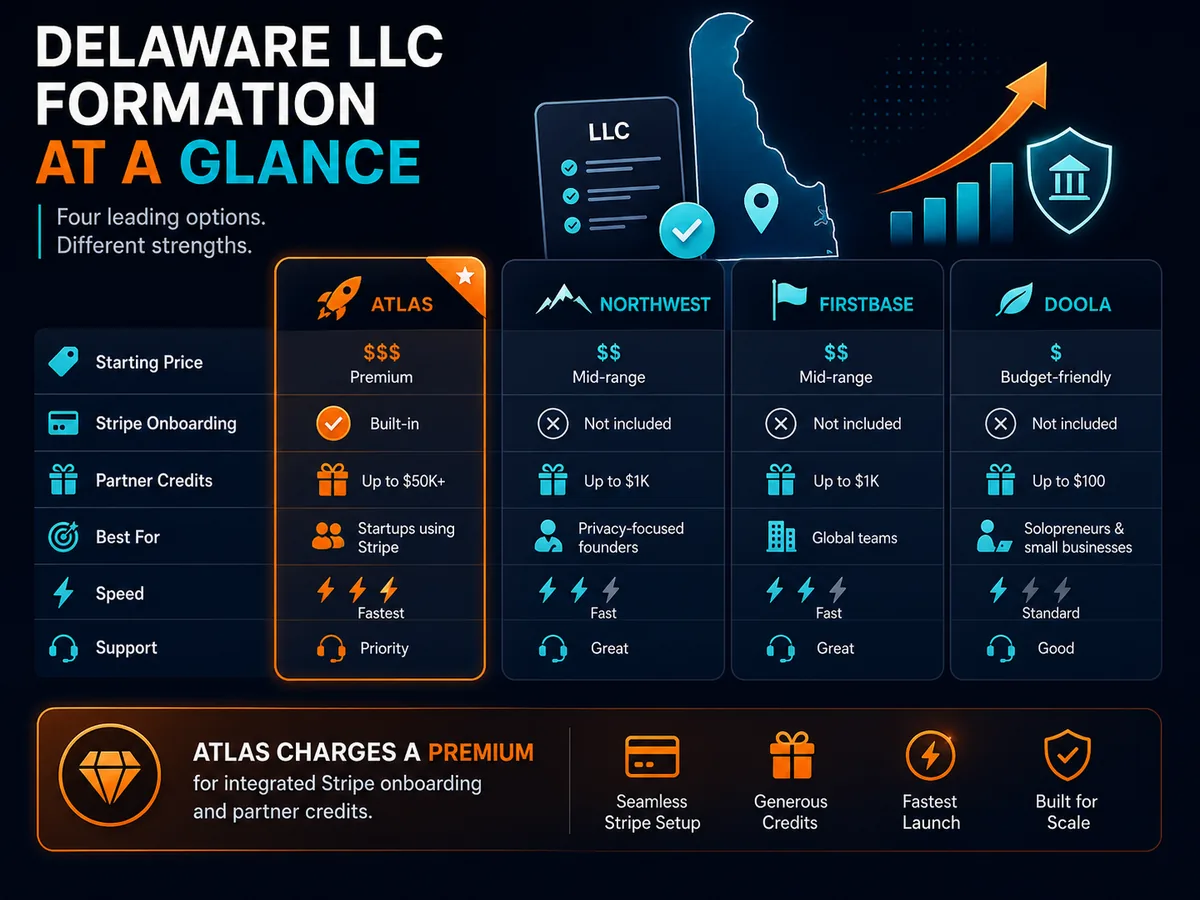
One: integrated Stripe onboarding. Atlas pre-fills your Stripe account application using your formation data, which historically reduces friction for first-time founders in countries Stripe is slow to approve. This is the strongest argument for Atlas if you have been rejected by Stripe before.
Two: partner credits. Atlas users get advertised credits from AWS, Notion, Mercury, OpenAI, and others. Stripe lists the current perks at stripe.com/atlas/perks — the total face value has historically exceeded the $500 fee. Most founders use a fraction.
Three: founder paperwork in one click. For C-corps, Atlas issues founder stock, generates 83(b) election letters, and produces a basic cap table. If you are raising on a SAFE in the next twelve months, this saves a lawyer two hours.
If none of those three apply to you, a registered agent is cheaper and gets you the same legal entity.
Getting started with Atlas
The flow is straightforward and takes about thirty minutes if you have your documents ready.
- Create a Stripe account or sign in at dashboard.stripe.com/atlas.
- Choose entity type — LLC or C-corp. Atlas defaults to C-corp; pick LLC unless you are raising venture capital.
- Enter founder details, ownership split, and company name. Atlas checks name availability against the Delaware Division of Corporations database.
- Pay the $500 fee by card.
- Sign the formation documents via Atlas's e-signature flow.
- Atlas files with Delaware (typically same day) and submits your EIN application to the IRS.
Timeline in practice: Delaware certificate of formation arrives within one to two business days. The EIN takes three to ten business days for non-US founders without an SSN or ITIN, sometimes longer if the IRS is backed up. Mercury or other bank introductions happen after the EIN is issued.
You will need a US business address for the entity. Atlas provides one through its registered agent partner; this is fine for receiving legal mail but is not a substitute for a real business address if you need one for banking or operations.
Pricing — what you actually pay
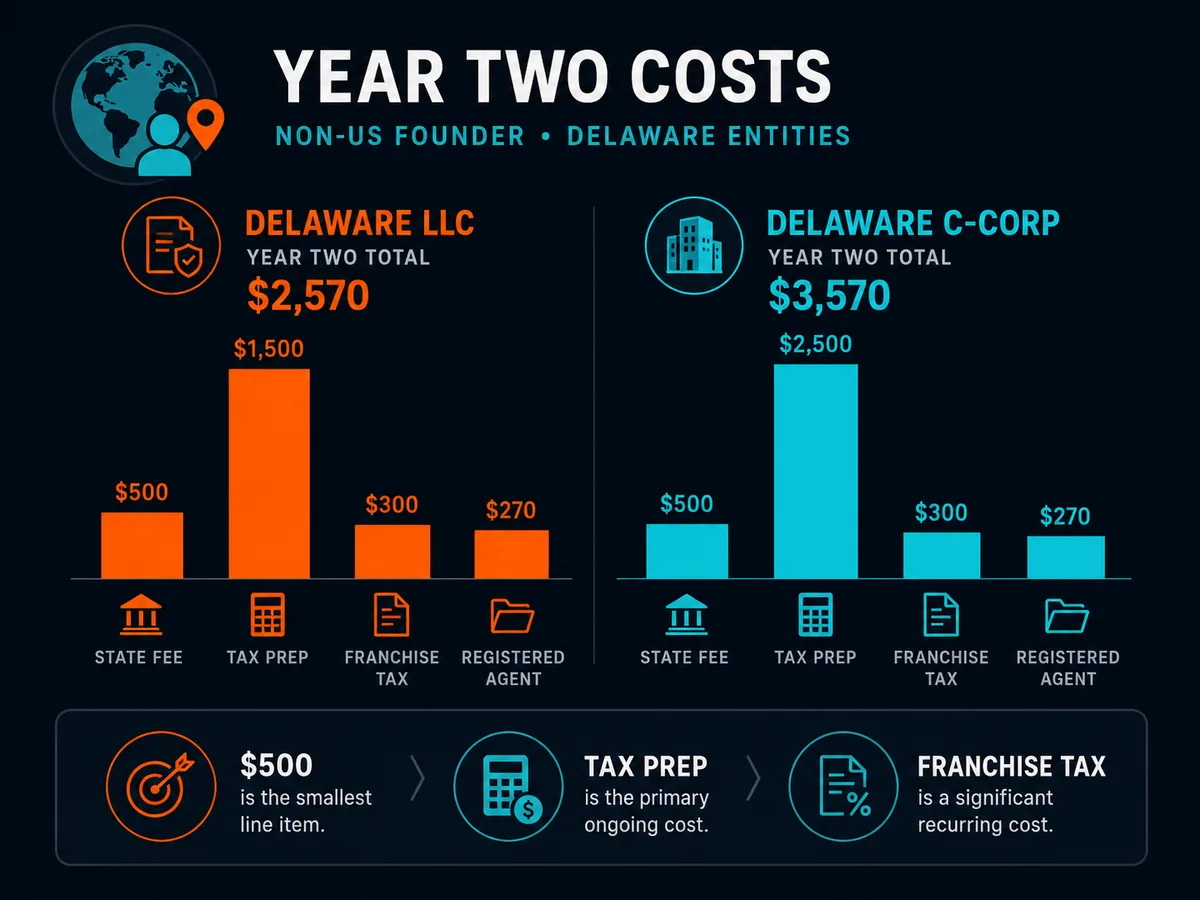
Stripe lists the headline price at $500 one-time. The full first-year and second-year picture looks like this.
| Item | Year 1 | Year 2+ |
|---|---|---|
| Atlas formation fee | $500 | — |
| Delaware state filing fee | included | — |
| Registered agent | included | ~$100–$125 |
| Delaware franchise tax + annual report (LLC) | — | $300 |
| Delaware franchise tax + annual report (C-corp, minimum) | — | $400+ |
| US tax return prep (LLC, non-US owner, Form 1120 + 5472) | — | $400–$1,000 |
| US tax return prep (C-corp, Form 1120) | — | $800–$2,500 |
| Bookkeeping (optional, recommended) | — | $300–$1,200 |
Sources: Delaware Division of Corporations annual report and tax instructions, Atlas registered agent renewal disclosed in dashboard.
Realistic all-in year-two cost for a non-US founder running a single-member LLC: $800–$1,600. For a C-corp with any complexity: $2,000–$5,000. Atlas's $500 is the smallest line item in year two.
The "Stripe Atlas 50% off" search query that comes up periodically usually refers to YC, On Deck, or accelerator promo codes given to portfolio companies. There is no public discount.
Atlas versus the cheaper alternatives
If you are not optimising for the Stripe integration, three competitors do the formation job for less.
Northwest Registered Agent (northwestregisteredagent.com) files a Delaware LLC for $39 plus the $90 state fee, includes one year of registered agent service, and is the option most accountants quietly recommend. No partner perks, no slick dashboard. Year-two registered agent is $125.
Firstbase (firstbase.io) charges $399 for formation and includes EIN, registered agent, and a dashboard similar to Atlas. Aimed at non-US founders. We have no affiliate relationship with Firstbase.
doola charges $297 for the formation tier and aggressively upsells bookkeeping. Reviews are mixed on responsiveness.
For most non-US solo founders we would pick Northwest if cost is the priority, Atlas if Stripe approval has been a problem before, and Firstbase if you want a middle ground. None of these are affiliate links; we will update this article if that changes and disclose inline per our affiliate disclosure.
Realistic timeline from sign-up to first invoice
- Day 0: Sign up, pay, sign documents.
- Day 1–2: Delaware certificate of formation issued.
- Day 3–10: EIN issued by IRS. Atlas can sometimes expedite this for non-US founders, but the IRS controls the queue.
- Day 5–15: Mercury or alternative bank account approved. Rejection is common for founders in higher-risk jurisdictions; have a backup.
- Day 7–20: Stripe account approved for payments. The integration with Atlas usually speeds this up.
- Day 15–30: First invoice paid into US bank account.
Plan for a month, not the "two business days" in Atlas's marketing copy. That figure assumes everything goes right.
Common mistakes and how to avoid them
Forming a C-corp when you needed an LLC. Atlas defaults to C-corp because that is what venture-backed startups use. If you are bootstrapping or freelancing, the LLC is cheaper, simpler, and pass-through for tax. You can convert later if you raise.
Assuming you still owe a BOI report. You almost certainly do not. FinCEN's final rule, effective 14 August 2026, permanently exempts every entity created in the United States from filing beneficial ownership information, whoever owns it (fincen.gov/boi). An Atlas company is formed in Delaware, so it is exempt — including when every shareholder is a non-US person. Only entities formed under foreign law that register to do business in a US state still report. Providers and forums are still selling BOI filing as an Atlas to-do item; as of this update it is not one.
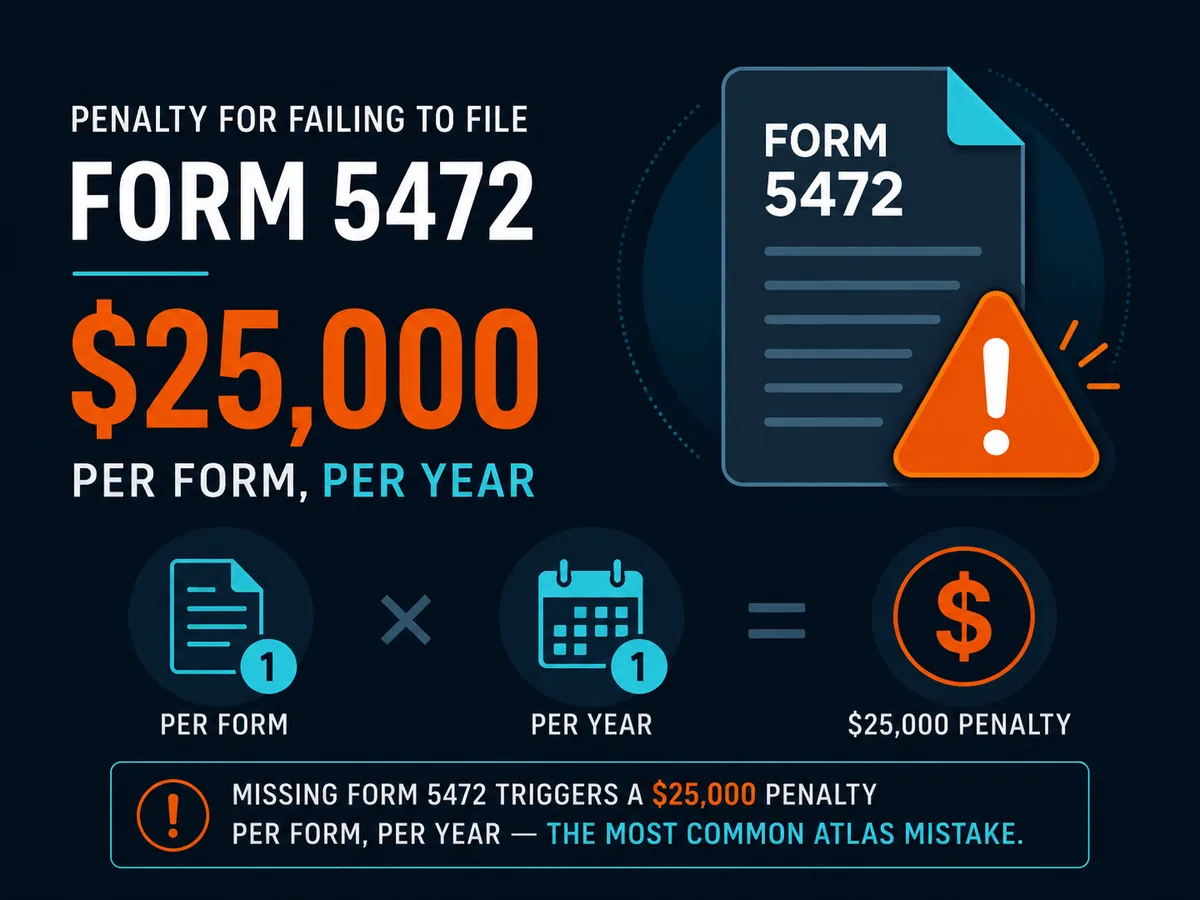
Forgetting Form 5472. Single-member LLCs owned by non-US persons must file a pro-forma Form 1120 plus Form 5472 reporting any "reportable transactions" with the foreign owner. The penalty for not filing is $25,000 per form per year. This is the single most common Atlas mistake we see. Source: IRS Form 5472 instructions.
Mixing personal and company spending. Wire your salary or distribution to a personal account; do not pay your rent from the LLC card. Beyond bookkeeping pain, it weakens the limited-liability shield and creates more Form 5472 reportable transactions.
Assuming US incorporation changes your home tax residence. It does not. Your tax residence is determined by where you live, not where your company is registered. CFC and place-of-management rules apply regardless.
When to consult a qualified professional
Before signing up for Atlas, talk to:
- A tax accountant in your country of residence. Ask specifically about CFC rules, place of effective management, and whether a US LLC will be treated as transparent or opaque under local law. The answer varies wildly across jurisdictions.
- A US CPA who works with non-resident-owned LLCs. Form 1120 plus 5472 is not difficult, but it is unforgiving. Budget $400–$1,000 a year.
- A lawyer if you are raising capital or issuing equity to employees. Atlas's templates are fine starting points and bad finishing points.
This article is editorial, not advice. Read our editorial policy and disclaimer for the boundaries of what we can and cannot tell you.
FAQ
What is Stripe Atlas?
Stripe Atlas is a paid service from Stripe that incorporates a US company — either a Delaware C-corp or a Delaware LLC — on behalf of founders anywhere in the world. The flat fee covers the state filing, registered agent for the first year, founder stock issuance, an EIN application, and access to Stripe payments along with partner perks. It does not handle ongoing tax filings, state franchise tax, or bookkeeping. Atlas is a formation service with a slick interface, not a law firm or accountant.
Is Stripe Atlas worth it for an LLC?
For a single-member LLC owned by a non-US founder selling digital products, Atlas is convenient but expensive. A registered agent like Northwest or a formation service like Firstbase can do the same Delaware LLC plus EIN for $200 to $400 total. Atlas costs $500 and adds founder agreements that an LLC arguably does not need. Pick Atlas if you value the integrated Stripe onboarding and partner credits. Pick a cheaper agent if you only need the entity and tax ID.
How much does Stripe Atlas cost per year?
Atlas charges a one-time $500 formation fee. After year one you pay the Delaware registered agent fee (around $100 to $125 annually, billed by Atlas's partner), the Delaware franchise tax and annual report ($300 for LLCs, $400+ for C-corps), and federal and state tax filings prepared by your accountant. Realistic year-two cost for a non-US founder running a small LLC is $700 to $1,500 including bookkeeping. C-corps cost more because of mandatory equity records and Form 1120 filings.
Is Stripe Atlas safe?
Stripe Atlas is operated by Stripe Inc., a regulated US payments company, and uses Mercury or Stripe's own treasury partners for banking introductions. The formation itself is filed with the Delaware Division of Corporations, which is a matter of public record. There is no anonymity — your name appears on the EIN application to the IRS, in your bank's customer due diligence file, and on the annual Form 5472 if the company is a foreign-owned disregarded entity. Atlas is safe in the sense that it is legitimate; it is not safe in the sense of hiding ownership. Note that FinCEN's beneficial ownership reporting regime no longer applies to US-formed companies at all as of 14 August 2026, so that particular filing is not part of the picture.
Which countries does Stripe Atlas support?
Atlas accepts founders from more than 145 countries, including most of Europe, the UK, Canada, Australia, India, Brazil, Mexico, Singapore, the UAE, and Nigeria. It does not support founders resident in countries under US sanctions (Cuba, Iran, North Korea, Syria, parts of Russia and Belarus). The current list is published on the Stripe Atlas signup page. Acceptance by Atlas does not guarantee acceptance by Mercury or another partner bank — banking is a separate review with its own KYC, and rejection rates vary by country.
Has Elon Musk invested in Stripe?
Yes, but as an early angel, not a current major shareholder. Musk was among the seed-round investors in Stripe in 2011 alongside Peter Thiel, Sequoia, and others, according to Stripe's published funding history. He has no operational role and is not connected to Stripe Atlas, which launched in 2016. Stripe remains privately held and was last valued at around $91.5 billion in a February 2025 tender offer. The company has not announced an IPO.
Ready to act on this?
Stripe Atlas — Delaware C-Corp or LLC with Stripe banking built in. Soveraine readers go to the front of the line through our partner link, and you fund independent editorial in the process.
Sources
- Stripe Atlas product page — https://stripe.com/atlas
- IRS, Taxation of US Resident Aliens — https://www.irs.gov/individuals/international-taxpayers/taxation-of-resident-aliens
- 26 U.S. Code §951A (GILTI) — https://www.law.cornell.edu/uscode/text/26/951A
- IRS Form 5472 instructions — https://www.irs.gov/forms-pubs/about-form-5472
- EU Anti-Tax Avoidance Directive (ATAD) — https://taxation-customs.ec.europa.eu/anti-tax-avoidance-directive_en
- Delaware Division of Corporations — annual report and franchise tax — https://corp.delaware.gov/paytaxes/
- FinCEN Beneficial Ownership Information reporting — https://www.fincen.gov/boi
- Northwest Registered Agent — https://www.northwestregisteredagent.com/
- Firstbase — https://firstbase.io/
- [source: TODO — French CGI art. 209 / equivalent place-of-management citation for the EU section]