
Most guides to Italian citizenship by descent were written for a law that no longer exists. For twenty years the pitch was that Italy placed no generational limit on the bloodline: find an Italian great-great-grandfather who never naturalised, assemble the certificates, and the passport followed. That route closed on 27 March 2025, and in 2026 it closed twice more — once in the Senate and once in the Constitutional Court.
The stakes are concrete. An Italian passport is an EU passport, which is the cheapest route into the bloc there is — the alternative is a golden visa costing six figures, or a decade of physical residence. A claim that was worth pursuing in February 2025 may now be worth nothing, and a claim that is still good may be unfileable at your consulate because the queue has a legal ceiling on it.
So this guide does three things the ranking pages do not. It states the two-generation rule in the exact terms Italy's own consulates use, including the three alternative conditions that decide most grandparent cases. It covers Law 11 of 19 January 2026, which capped how many applications each consulate may accept and moves the whole process to Rome in 2029 — a change two of the three top-ranking guides do not mention at all. And where the law is genuinely unsettled, as it is for pre-1948 maternal lines, it says so rather than picking a side. Every figure below is sourced to Normattiva, an Italian consulate, or the published judgment.
Key takeaways
- Descent now runs two generations, not unlimited. A parent or grandparent can carry a claim; a great-grandparent alone cannot, for anything filed after 11:59pm Rome time on 27 March 2025.
- Born abroad with another citizenship? You need a second qualifier — exclusive Italian citizenship, an ancestor who held it exclusively, or an Italian parent resident in Italy two continuous years before your birth.
- Your consulate now has a legal quota. Under Law 11/2026 each office may accept no more adult applications per year than it closed the year before, never fewer than 100. Sydney has suspended new adult appointments outright.
- From 1 January 2029 you will not apply at a consulate at all — adult applications move to a director-general office inside the foreign ministry in Rome, with a 36-month decision term.
- The Constitutional Court upheld the reform in judgment no. 63 of 30 April 2026, reasoning that the rule bars acquisition from the outset rather than revoking anything.
- The EUR 600 consular fee is non-refundable and is the smallest line in the budget.
Wise — The consular fee, Italian record requests and certified translations are all billed in euros
What changed, and then changed again
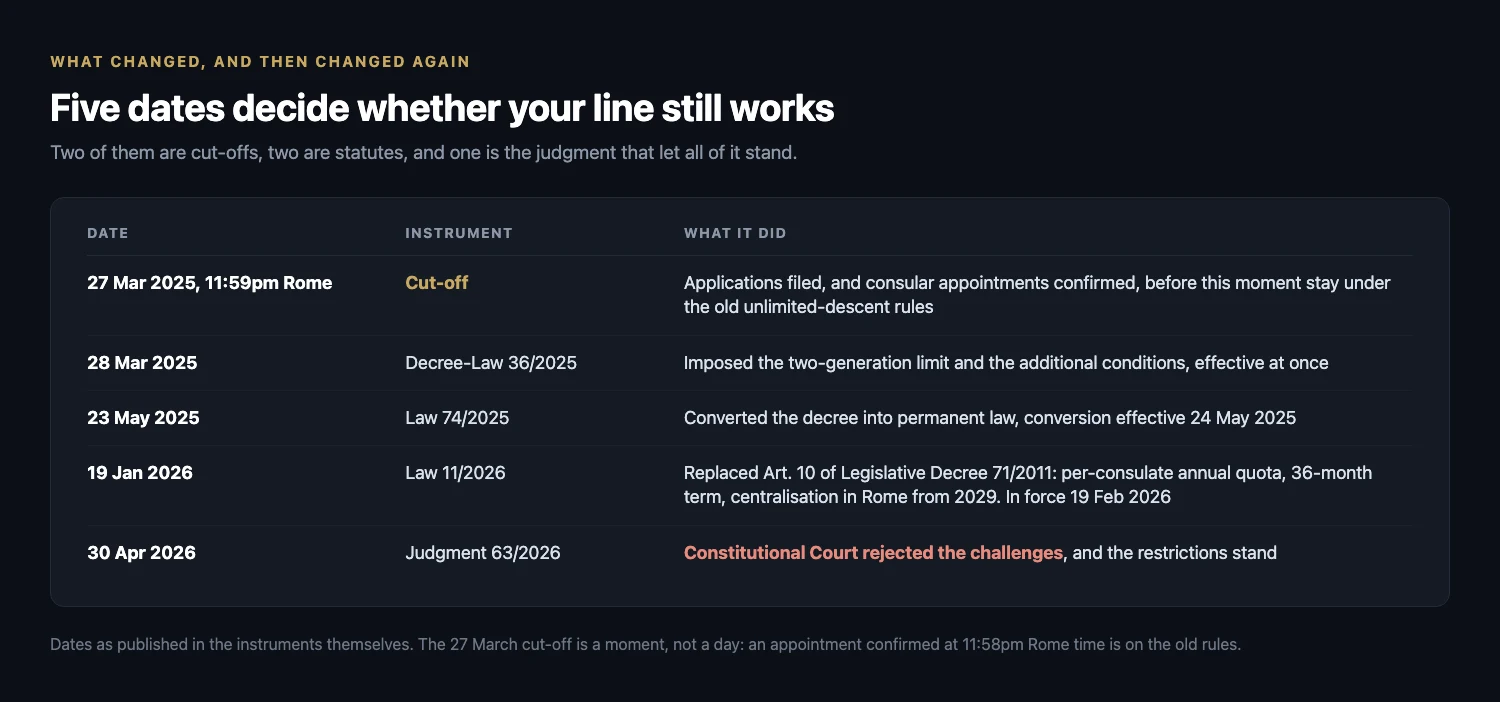
Three instruments did the damage, and they are frequently collapsed into one. Decree-Law No. 36 of 28 March 2025 imposed the generational limit with immediate effect. Law No. 74 of 23 May 2025 converted it, with amendments, into permanent law. Then Law No. 11 of 19 January 2026 left the eligibility rules alone and attacked the queue instead — which, for anyone still eligible, is now the binding constraint.
| Date | Instrument | What it did |
|---|---|---|
| 27 Mar 2025, 11:59pm Rome | Cut-off | Applications filed, and consular appointments confirmed, before this moment stay under the old unlimited-descent rules |
| 28 Mar 2025 | Decree-Law 36/2025 | Imposed the two-generation limit and the additional conditions, effective at once |
| 23 May 2025 | Law 74/2025 | Converted the decree into permanent law (conversion effective 24 May 2025) |
| 19 Jan 2026 | Law 11/2026 | Replaced Art. 10 of Legislative Decree 71/2011: per-consulate annual quota, 36-month term, centralisation in Rome from 2029. In force 19 Feb 2026 |
| 30 Apr 2026 | Judgment 63/2026 | Constitutional Court rejected the challenges; the restrictions stand |
The cut-off is the first thing to establish about your own case, because it decides which body of law you are reading. If you lodged an application or held a confirmed appointment before that March 2025 deadline, the additional conditions below do not apply to you.
The two-generation rule, and how to test your own line
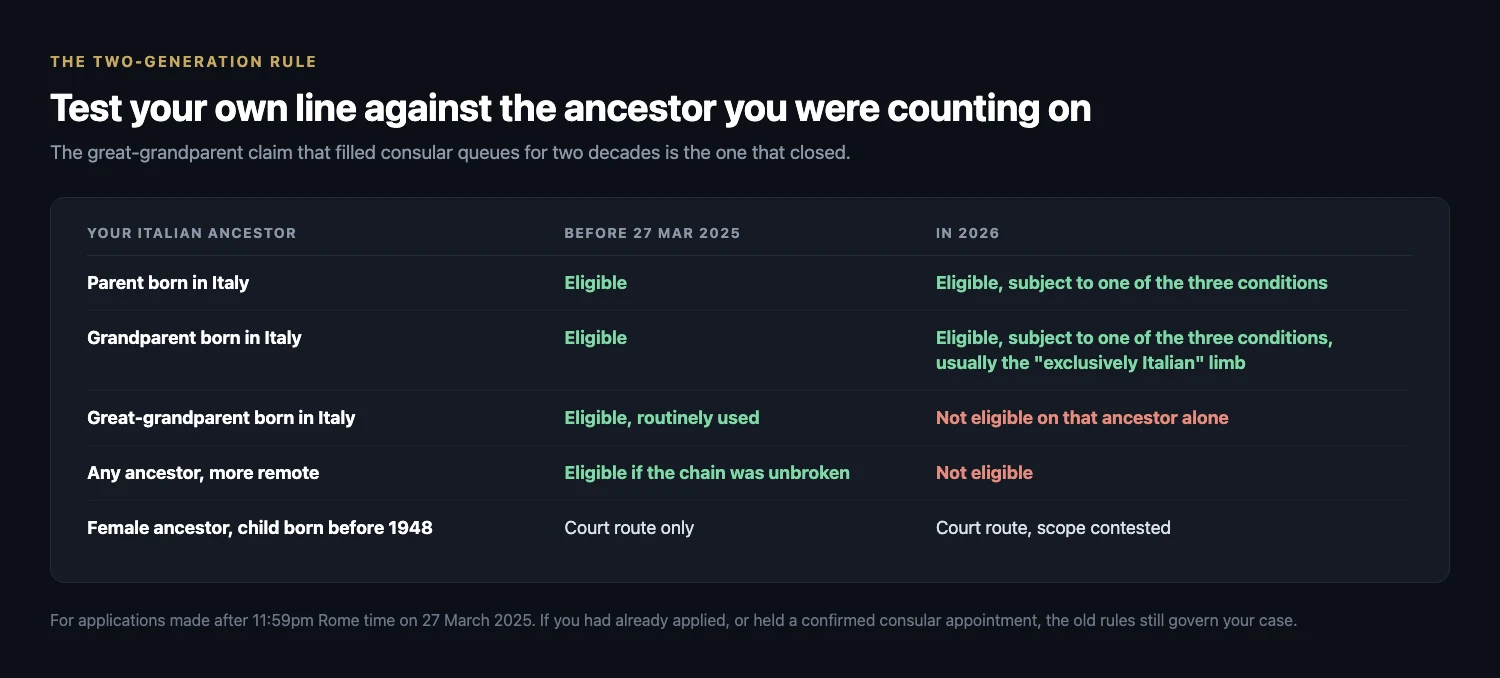
Italy's consulates state the core rule in almost identical words: citizenship transmits from parent to child for a maximum of two generations, provided the Italian parent never renounced Italian citizenship. The phrasing matters — it is about generations born abroad, and it is conditional on an unbroken chain in which nobody gave the citizenship up before passing it on.
For anyone born abroad who holds or could hold another citizenship, that is only the first test. The consulates list three alternative conditions, and you need at least one:
- You are entitled exclusively to Italian citizenship — you hold no other nationality and cannot acquire one.
- A parent or grandparent (including adoptive) held exclusively Italian citizenship at the time of your birth, or at the time of their death.
- An Italian parent (including adoptive) was resident in Italy for at least two continuous years after acquiring Italian citizenship and before your birth or adoption.
Condition 2 is where most surviving grandparent claims live, and it is stricter than it reads. An ancestor who had naturalised as American, Brazilian or Australian by the relevant date did not hold Italian citizenship exclusively, so that limb fails even though the bloodline is intact.
| Your Italian ancestor | Before 27 Mar 2025 | In 2026 |
|---|---|---|
| Parent born in Italy | Eligible | Eligible, subject to one of the three conditions |
| Grandparent born in Italy | Eligible | Eligible, subject to one of the three conditions — usually the "exclusively Italian" limb |
| Great-grandparent born in Italy | Eligible, routinely used | Not eligible on that ancestor alone |
| Any ancestor, more remote | Eligible if the chain was unbroken | Not eligible |
| Female ancestor, child born before 1948 | Court route only | Court route, scope contested (below) |
The practical consequence is blunt: the great-grandparent claim, which was the engine of the whole industry, is gone for new applicants. If your line reaches Italy only at the great-grandparent generation, the honest answer is that there is probably nothing to file.
The 1948 rule and the part nobody can settle
Italian women transmit citizenship only to children born on or after 1 January 1948, the date the Republican Constitution took effect. A woman whose child was born before then did not pass citizenship under the law as consulates apply it, and an Italian woman who married a foreign man before 1948 generally lost her own citizenship automatically if his country conferred its nationality by marriage.
Those pre-1948 maternal lines have historically been pursued not at a consulate but in the Italian courts, on the argument that the old rule was unconstitutional sex discrimination. That judicial route is well established.
What is not established is whether the new two-generation cap reaches inside it. Reputable Italian firms argue both ways in 2026: some treat the 1948 route as a separate judicial remedy for a constitutional defect, untouched by Law 74/2025; others read the cap as applying to every application filed after the cut-off regardless of route, so that a great-great-grandmother falls outside it just as a great-grandfather does.
We are not going to resolve this for you, because it is not resolved. This is the most contested question in the field, the outcome is line-specific, and anyone quoting you a confident yes or no on a 1948 case in 2026 is quoting a position, not settled law. Secondary legal commentary also reports a Court of Cassation decision in July 2026 on the narrower question of who counts as having filed before the cut-off; we could not verify it against the Court's own published text, which sits behind a bot wall, so treat it as a lead for an Italian lawyer rather than as authority.
The 2026 bottleneck: a quota, a suspended queue, and Rome from 2029
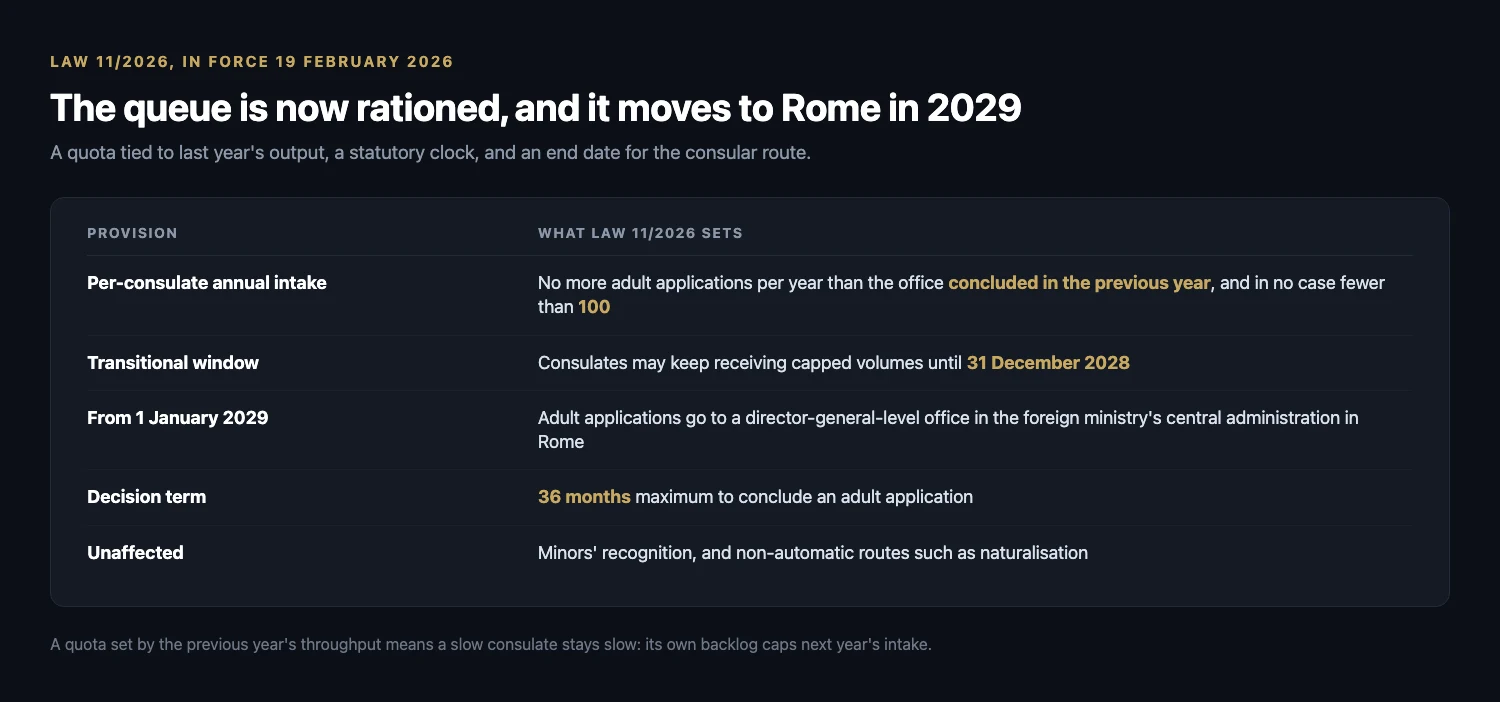
This is the change that two of the three top-ranking English guides omit, and for anyone still eligible it now matters more than the eligibility rules. Law No. 11 of 19 January 2026 — published in Gazzetta Ufficiale No. 28 of 4 February 2026, in force 19 February 2026 — replaced Article 10 of Legislative Decree 71/2011.
| Provision | What Law 11/2026 sets |
|---|---|
| Per-consulate annual intake | No more adult applications per year than the office concluded in the previous year, and in no case fewer than 100 |
| Transitional window | Consulates may keep receiving capped volumes until 31 December 2028 |
| From 1 January 2029 | Adult applications go to a director-general-level office in the foreign ministry's central administration in Rome |
| Decision term | 36 months maximum to conclude an adult application |
| Unaffected | Minors' recognition, and non-automatic routes such as naturalisation |
Read the first row again, because it is self-limiting in a way that compounds: an office that closed few cases last year may legally accept only that few this year. The floor of 100 is the only thing preventing a backlogged consulate from accepting almost nobody.
The effect is already visible. The Consulate General in Sydney has suspended new appointments for adult citizenship recognition, stating the limited intake as the reason, while continuing to serve minors and non-automatic acquisitions. If your consulate has gone quiet on appointments, this is why — it is not a booking glitch, and refreshing the portal will not fix it.
For a claim you believe is good, the planning point is unpleasant but clear: the window to file with a consulate closes at the end of 2028, the intake between now and then is rationed, and after that the file goes to Rome with a three-year clock on it.
What the Constitutional Court actually decided
The reform was challenged, and through 2025 a great deal of commentary treated it as provisional — one of our competitors still says the Court "is expected to review" it. It has reviewed it.
In judgment no. 63 of 30 April 2026 the Constitutional Court declared the questions referred to it partly unfounded and partly inadmissible. The restrictions survive intact. Two strands of the reasoning are worth knowing because they close off the arguments most often made against the reform:
- It is a bar, not a revocation. The Court characterised the new provision as creating an original bar to acquiring Italian citizenship for certain people born abroad who already hold another nationality, rather than taking away a citizenship already acquired. That distinction defeats the retroactivity objection: nobody who already holds Italian citizenship loses it.
- There is no constitutional right to a citizenship. The Court held that the Constitution protects the right of a citizen to enter and remain in the territory of the state whose citizenship they hold — not a right to obtain or to keep a citizenship in the first place.
Commentary around the judgment also notes the Court's view that the previous system had drifted from any meaningful idea of a national community, extending citizenship to people with no substantive connection to Italy. Whether or not that is good constitutional law, it tells you the direction of travel, and it is the reason to stop treating the 2025 reform as temporary.
What it costs and how long it takes
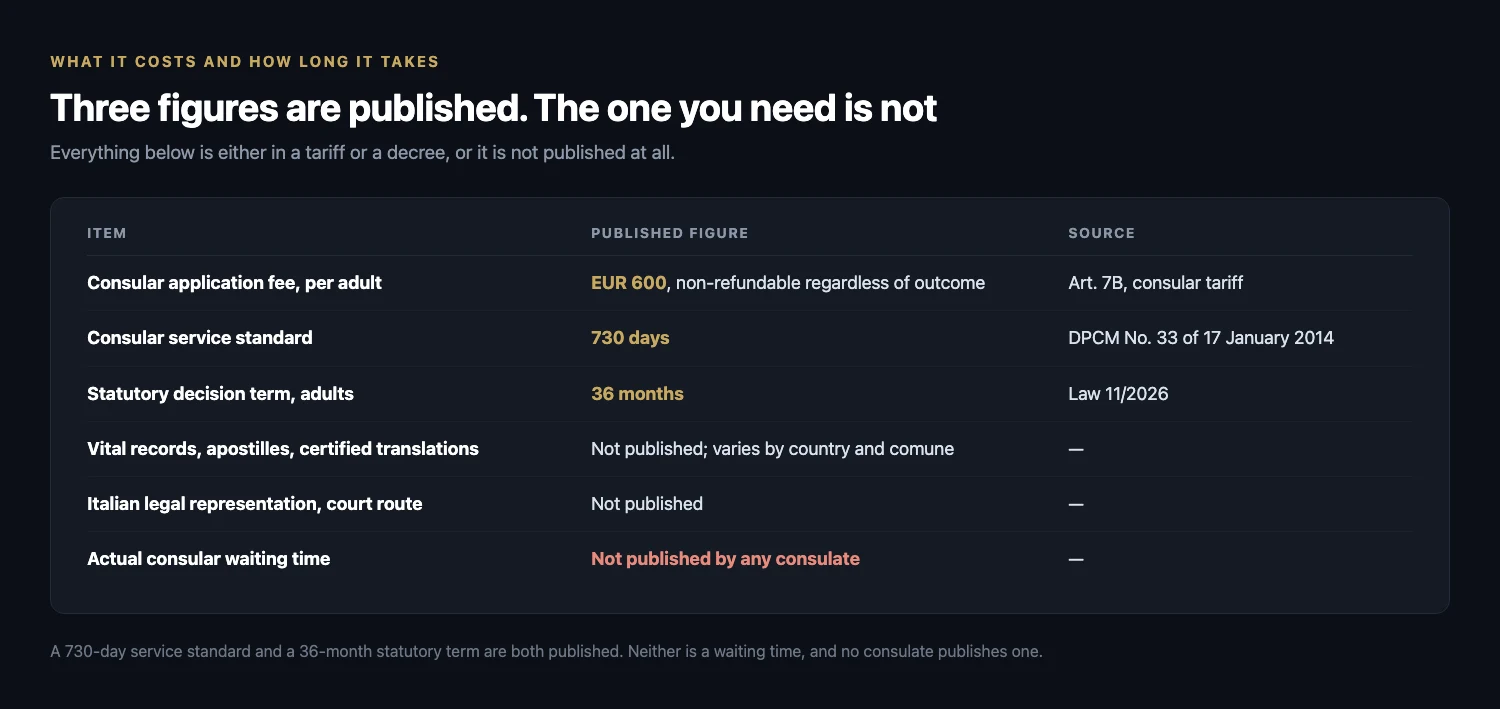
The published numbers are thin, and the gap between them and reality is where applicants get caught out.
| Item | Published figure | Source |
|---|---|---|
| Consular application fee, per adult | EUR 600, non-refundable regardless of outcome | Art. 7B, consular tariff |
| Consular service standard | 730 days | DPCM No. 33 of 17 January 2014 |
| Statutory decision term, adults | 36 months | Law 11/2026 |
| Vital records, apostilles, certified translations | Not published; varies by country and comune | — |
| Italian legal representation (court route) | Not published | — |
| Actual consular waiting time | Not published by any consulate | — |
Two things follow. First, the EUR 600 is the smallest meaningful line in the budget — a multi-generation document set typically means certificates from two or three countries, apostilles on each, and sworn translations into Italian, and that is the real spend. Second, neither the 730-day standard nor the 36-month term is a queue estimate. Since the 2026 quota took hold, the binding delay for many people is not processing but securing an appointment at all.
One transitional date has already passed and is worth checking if it touches your family: minors who were under 18 on 24 May 2025 and were children of a citizen recognised under a qualifying pre-cut-off application needed a parental declaration filed by 31 May 2026. That window shut. Note too that under Article 15 of Law 91/1992 citizenship acquired by declaration runs from the day after the declaration, not from birth.
Consulate, court, or comune: three routes compared
Which door you use is partly your choice and partly decided for you by where you live and what your line looks like. None of the top-ranking guides sets the three side by side, which is odd, because the differences are the decision.
| Consulate | Italian court | Comune (in Italy) | |
|---|---|---|---|
| Who it is for | Adults resident abroad, line within two generations | Contested lines, classically pre-1948 maternal cases | Applicants who have moved to Italy and registered residence |
| Published fee | EUR 600 per adult | Court costs plus counsel, not published | Local contributions, set by the comune |
| Published clock | 730 days; 36 months statutory | None | None |
| Capacity limit in 2026 | Yes — annual quota, floor of 100 | No equivalent cap | No equivalent cap |
| Available after 2028 | No — moves to Rome from 1 Jan 2029 | Unchanged | Unchanged |
| Main drawback | Rationed intake; appointments suspended at some posts | Cost, and the unsettled scope question above | Requires actually relocating and registering |
The comune route deserves a word, because it is the one people overlook. Establishing residence in an Italian municipality and applying there sidesteps the consular quota entirely — but it means genuinely moving, registering with the anagrafe, and accepting the tax consequences of doing so. That is a different life decision, not a procedural shortcut.
What an Italian passport does to your tax position
Almost nothing, directly — and the confusion on this point costs people real money in both directions.
Italy taxes its residents on worldwide income. Tax residency turns on where you actually live: registration with a comune, where your domicile sits, and days present in Italy. It does not turn on your passport. Acquiring Italian citizenship while continuing to live in Lisbon, Dubai or Austin does not by itself create an Italian filing obligation, and anyone telling you an EU passport is a tax event has it backwards.
What the passport changes is optionality, and optionality is where the tax consequences actually sit. An EU citizen can move to and work in any member state without a visa, which puts the full menu of European regimes within reach without the golden-visa price of admission — see our guides to the countries with golden visa programmes and the Italian investor visa for what that alternative costs. It also means the decision you eventually face is the ordinary one: breaking residency in the country you are leaving, which triggers an exit tax on unrealised gains in several European states, and establishing it somewhere new on that country's own terms rather than on your nationality.
Three further cautions for this audience. US citizens are taxed on worldwide income wherever they live and whatever else they hold, so an Italian passport changes nothing about that — see dual citizenship and the United States. Spending time in Italy on a new passport without registering does not make you invisible; the Schengen 90/180 rule stops applying to you as a citizen, but Italian residency tests still do. And if the plan is to hold the passport while being tax resident somewhere cheaper, read what "non-dom" actually means and the trouble with being tax resident nowhere before building anything on it.
Citizenship is a durable asset and a cheap one if you qualify. It is simply not a tax structure, and the two decisions should be taken separately with advice in both countries.
Related guides
- Easiest European countries to get citizenship — naturalisation timelines, descent routes and the post-Malta investment landscape.
- Countries with easy citizenship — where a second passport is realistically obtainable, and on what terms.
- Dual citizenship and the United States — what a second passport does and does not do for a US person.
- Exit tax in Europe — the charge on unrealised gains when you break residency, country by country.
- Italian golden visa — the investor route, its real thresholds, and who it actually fits.
- Digital nomad visa Italy — the residence option for people who want Italy without a bloodline claim.
FAQ
Can I still get Italian citizenship by descent in 2026?
Yes, but the reachable line is much shorter than it was. For applications made after 11:59pm Rome time on 27 March 2025, descent runs a maximum of two generations — so a parent or a grandparent, not a great-grandparent — and if you were born abroad holding another citizenship you must also satisfy one of three further conditions. If you had already applied, or held a confirmed consular appointment, before that moment, the old unlimited-descent rules still govern your case.
What is the two-generation rule for Italian citizenship?
Decree-Law 36/2025, converted into Law 74 of 23 May 2025, limits automatic transmission of Italian citizenship to two generations born abroad. Italy's consulates state it as citizenship passing from parent to child for a maximum of two generations, provided the Italian parent never renounced. A great-grandparent no longer opens a claim on its own, which is the single biggest change — most of the US, Brazilian, Argentine and Australian claims that filled consular queues for two decades ran through great-grandparents.
Can I get Italian citizenship through a grandparent?
Often yes, and the grandparent route is the main one still open. But being born abroad with another citizenship means you must additionally show one of three things: that you are entitled exclusively to Italian citizenship; that a parent or grandparent held exclusively Italian citizenship at your birth or at their death; or that an Italian parent lived in Italy for at least two continuous years after acquiring citizenship and before you were born. The second limb is the one most grandparent claims now turn on.
How much does Italian citizenship by descent cost in 2026?
The consular fee is EUR 600 per adult applicant under Article 7B of the consular tariff, and it is explicitly non-refundable whatever the outcome. That is only the filing fee. Vital records from several countries, apostilles, certified translations into Italian and — on the court route — Italian legal representation are all separate, are not published centrally, and in practice dwarf the EUR 600.
How long does Italian citizenship by descent take?
Two statutory clocks exist and neither is a queue estimate. DPCM No. 33 of 17 January 2014 sets a 730-day service standard for consular recognition, and Law 11/2026 sets a maximum 36 months for concluding adult applications. No consulate publishes its actual waiting time, and since the 2026 quota took effect the binding delay for many applicants is getting an appointment at all, not the processing itself.
What did the Constitutional Court decide about the 2025 citizenship reform?
In judgment no. 63 of 30 April 2026 the Court declared the challenges to the reform partly unfounded and partly inadmissible, so the restrictions stand. Its central reasoning was that the new provision creates an original bar to acquiring citizenship for certain people born abroad who already hold another nationality — it does not revoke a citizenship already held. The Court also held that the Constitution does not guarantee a right to obtain or keep a citizenship.
Do the new limits apply to 1948 maternal-line court cases?
This is genuinely unsettled and you should not trust a confident answer either way. Italian women transmit citizenship to children born only from 1 January 1948 onward, and earlier maternal lines have historically been pursued in the Italian courts rather than at a consulate. Whether the two-generation cap reaches inside that judicial route is the most contested question in the field in 2026: reputable Italian firms argue both sides. Take advice on your specific line.
Does an Italian passport make me an Italian taxpayer?
No. Italy taxes residents on worldwide income, but tax residency turns on where you actually live — registration with a comune, your domicile, and days spent in Italy — not on nationality. Holding the passport while living elsewhere does not by itself create an Italian filing obligation. What citizenship does change is your freedom to move to and work anywhere in the EU, which is a tax decision in its own right and one with exit-tax consequences in the country you leave.
Paying euro fees from an account that does not hold euros
A descent file is a long sequence of small cross-border payments — the EUR 600 consular fee, record requests to Italian comuni, sworn translations, apostille charges in two or three countries, and counsel if the case goes to court. Each one is a conversion, and bank spreads on a dozen small euro payments quietly add up to more than the filing fee. Wise holds euros directly and converts at the mid-market rate, which keeps the admin cost of the claim where it belongs.
Sources
- Normattiva — Legge 19 gennaio 2026, n. 11 (official consolidated text; replaces Art. 10 of D.Lgs. 71/2011 — per-consulate quota with a floor of 100, 36-month term, central office from the third calendar year; published in GU n. 28 of 4 February 2026, in force 19 February 2026)
- Consulate General of Italy in Perth — Citizenship by descent (new rules) (two-generation limit; the three additional conditions; 27 March 2025 11:59pm Rome cut-off; EUR 600 under Art. 7B; 730 days under DPCM 33/2014; 31 May 2026 minors' declaration deadline; Art. 15 of Law 91/1992)
- Consulate General of Italy in Sydney — Citizenship by descent: new regulation and Citizenship by descent: important news (Law 74 of 23 May 2025; the 1948 maternal-line rule; Law 11/2026 limited intake to 31 December 2028, MAECI central office from 1 January 2029, suspension of new adult appointments)
- Servizi Demografici — La Corte Costituzionale conferma la disciplina introdotta dal decreto-legge n. 36/2025 (judgment no. 63 of 30 April 2026). The Constitutional Court's own page for the judgment is at cortecostituzionale.it and is the primary text; it is served behind a bot wall and could not be fetched for this guide, so the judgment number, date and outcome here rest on corroborating Italian legal sources rather than on the Court's published PDF.
Figures and rules are as published in 2026 and change without notice — this area of Italian law has moved three times in twenty months. Consular practice also varies by post. Verify every requirement with the consulate for your jurisdiction, and take advice from an Italian lawyer on your specific line and from a tax adviser in both countries before acting. Nothing here is legal, immigration or tax advice.