
"Dual citizenship in the United States" is one of the most-searched and most-misunderstood phrases in the whole field of cross-border life. The short answer is that the US permits it — there is no law against being a citizen of America and somewhere else at the same time. The longer answer, the one that actually matters, is that holding two passports does nothing to change the single most consequential fact of being American: the US taxes you wherever you live. This guide sets out the law, the tax catch, the passport rules and the country-by-country restrictions, in plain English. It applies primarily to US citizens and to people considering US naturalisation.
Bright!Tax — US expat tax specialists for dual citizens (FEIE, FBAR & FATCA done right)
Does the US actually allow dual citizenship?
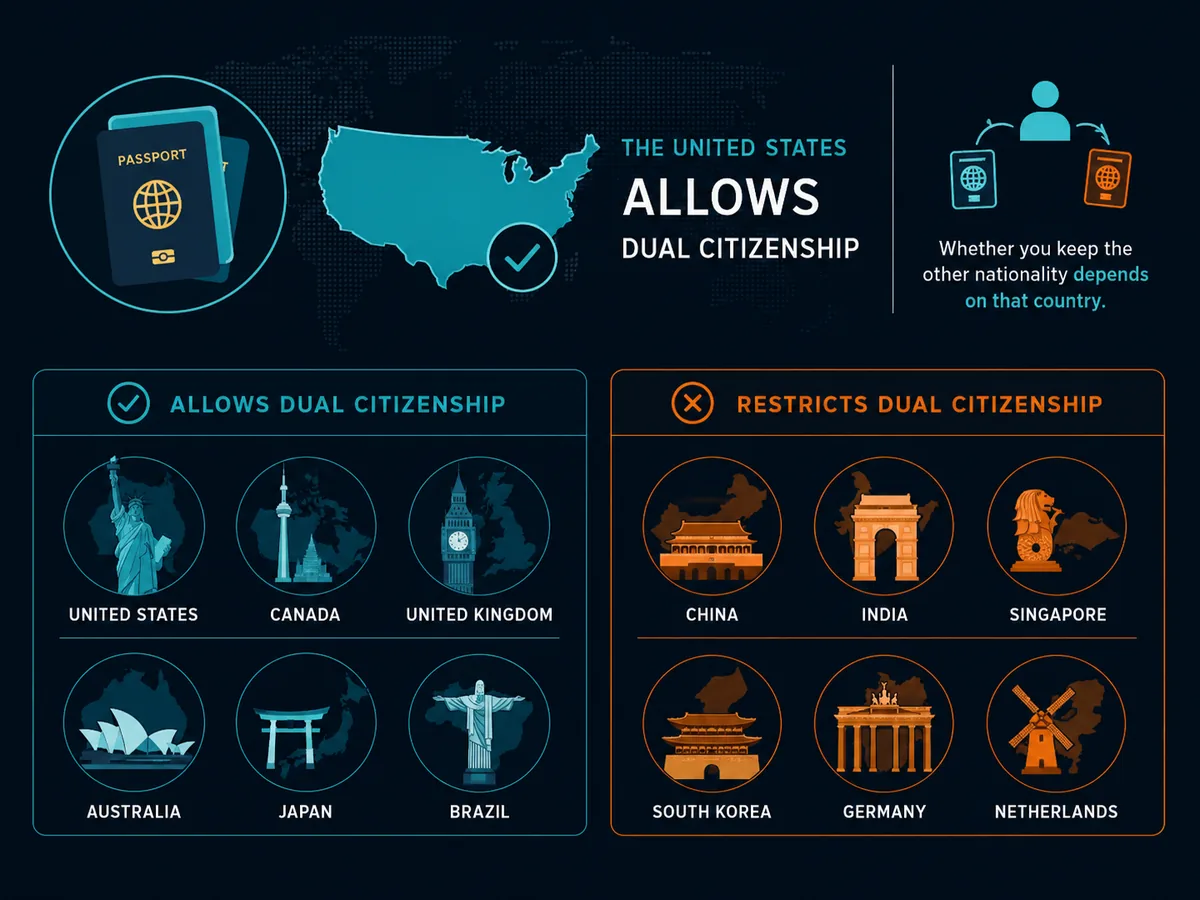
Yes — and the position is settled law, not a grey area. The United States does not require a person to choose between US citizenship and another nationality. The State Department's own guidance on dual nationality states plainly that a US citizen may also be a national of another country.
The legal foundation is a pair of Supreme Court decisions. In Afroyim v. Rusk (1967) the Court held that the Fourteenth Amendment prevents the government from stripping citizenship from someone who has not voluntarily relinquished it. In Vance v. Terrazas (1980) the Court confirmed that loss of citizenship requires both a statutory expatriating act and the specific intent to give up US nationality. The practical result: you can acquire, hold and use a second citizenship without endangering your American one, as long as you do not actively intend to abandon it.
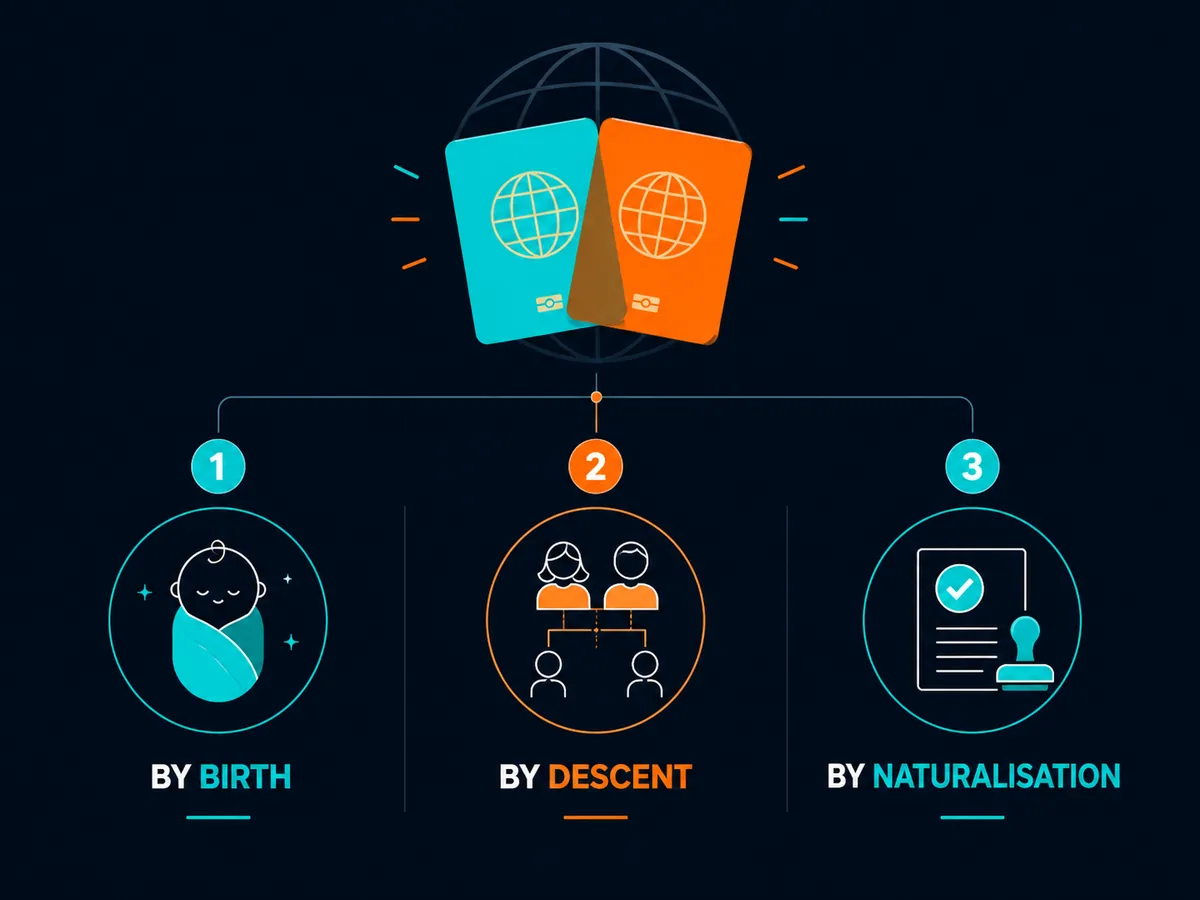
Dual citizenship is not something you apply for in the US. It arises automatically in three ways:
- By birth — born in the US to foreign parents (US citizen plus the parents' nationality), or born abroad to a US-citizen parent in a country that grants citizenship by birthplace.
- By descent — claiming a second citizenship through a parent, grandparent or great-grandparent. This is the route behind the huge search volume for Irish, Italian, Polish and other ancestry citizenships.
- By naturalisation — a foreign national naturalising as a US citizen while keeping their original nationality, or a US citizen naturalising elsewhere.
The catch nobody mentions: US tax follows the passport
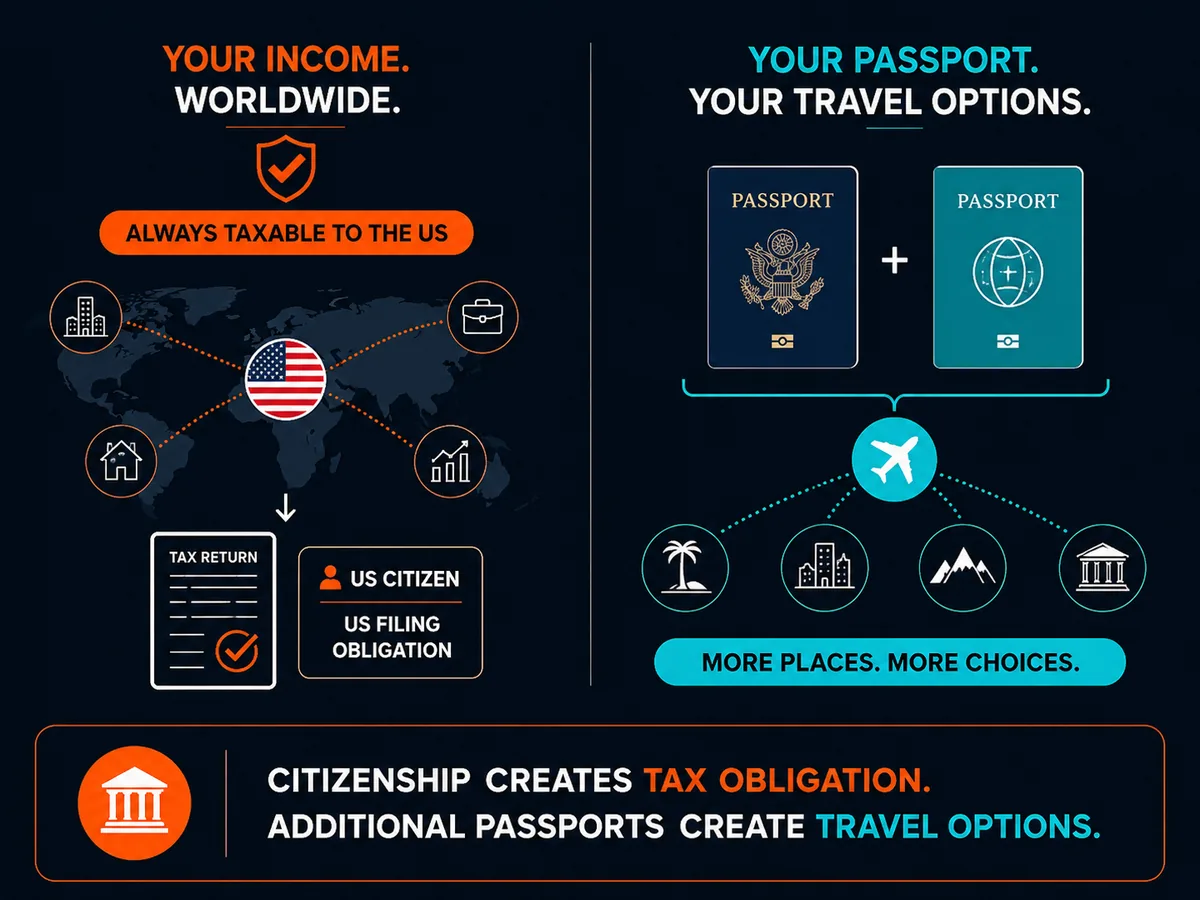
Here is the part that the "get a second passport" content almost always skips. The United States is one of only two countries in the world — the other is Eritrea — that taxes on the basis of citizenship, not residence. That means a US citizen owes US federal tax on worldwide income for life, no matter where they live, and a second passport does not change that.
If you are a dual citizen living in Lisbon, Dubai or Mexico City, you still:
- File a US federal tax return (Form 1040) every year you meet the income threshold.
- Report foreign bank and brokerage accounts over $10,000 aggregate on the FBAR (FinCEN Form 114).
- Report specified foreign financial assets on Form 8938 under FATCA if you exceed the thresholds.
In most cases you will not owe double tax — the Foreign Earned Income Exclusion and the Foreign Tax Credit usually wipe out the US liability for ordinary earned income. But the filing obligation never goes away, and the penalties for missing FBAR or FATCA are severe: up to $10,000 for a single non-wilful FBAR failure. Acquiring a second citizenship does not reduce any of this. Only formally renouncing US citizenship does — and that has its own exit-tax consequences.
Passports: which one do you use, and when?
Dual citizens hold two valid passports and use them for different purposes.
- Entering and leaving the US: federal law (8 U.S.C. § 1185) requires US citizens to travel on a US passport when crossing the US border. Present your US passport to US Customs and Border Protection.
- Entering your other country of citizenship: use that country's passport. An EU dual citizen, for example, uses their EU passport to enter and reside in the EU without a visa.
- Third countries: use whichever passport gives the better visa treatment. A US–Irish dual citizen visiting Brazil might prefer the Irish passport if it offers easier entry.
Carrying both passports when you travel is normal and legal. The one mistake to avoid is trying to enter the US on a foreign passport — it flags an inconsistency and causes delays.
Which countries say no to dual citizenship?
The US permits dual citizenship, but the other country's law decides whether you can keep both. This is where most plans go wrong, so check before you act.
Countries that broadly allow dual citizenship include the United Kingdom, Ireland, Canada, Australia, France, Italy, Portugal, Mexico and most of the EU. Countries that prohibit or heavily restrict it include China, India, Japan, Singapore, Austria and several Gulf states. India occupies a special position: it does not allow dual citizenship at all, but offers the Overseas Citizen of India (OCI) status, which gives many of the practical rights without the passport.
The risk is asymmetric. The US will not take your citizenship for naturalising elsewhere, but a country like India or China will treat your US naturalisation as automatic loss of their citizenship. Losing a citizenship is far harder to undo than gaining one, so confirm the current rule with the relevant consulate first.
How people actually acquire a second citizenship
If you are a US citizen looking to add a second nationality, the realistic routes are:
- By descent (ancestry). The cheapest and most common. If you have an Irish, Italian, Polish, German or other qualifying grandparent, you may be able to claim citizenship by descent. See our guide to the easiest EU citizenship options.
- By naturalisation through residence. Move, become a tax resident, hold legal residence for the required years, then naturalise. This is the slow route — typically five to ten years.
- By investment. Several countries grant citizenship in exchange for a qualifying investment or donation. See countries with a golden visa, Antigua & Barbuda and Vanuatu citizenship-by-investment programmes.
Citizenship-by-investment is the only fast route, and it is regulated, paperwork-heavy and easy to get wrong. Specialist firms handle the due diligence and filing.
Henley & Partners — the established global firm for citizenship- and residence-by-investment programmes.
Common misconceptions
"A second passport lets me stop paying US tax." No. Only formal renunciation does, and that triggers the exit-tax regime for covered expatriates.
"The US oath of renunciation means I lose my old citizenship." The US naturalisation oath contains renunciation language, but the US does not enforce surrender of the old passport or notify the other country. Your original citizenship survives or not according to that country's law.
"Dual citizenship is illegal / risky in the US." It is neither. Tens of millions of Americans are dual citizens. The only genuine complications are tax filing, security clearances and certain government or military roles.
"My children automatically get both citizenships." Sometimes, but transmission rules vary by country and often have residence or registration deadlines. Citizenship by descent frequently must be claimed before a child reaches a certain age.
When to consult a qualified professional
Get advice before you act if:
- You are a US person who will acquire a second citizenship and want the US tax filing handled correctly (FEIE, FBAR, FATCA, and state filing if applicable).
- You hold or are seeking a security clearance, or work for the US government or military.
- The other country restricts dual citizenship and you risk losing one nationality.
- You are weighing renunciation — the exit tax and the irreversibility make this a decision for a cross-border tax lawyer, not a forum thread.
Soveraine is an editorial publication, not a law or tax firm. Read our editorial policy and disclaimer before acting on anything in this article.