
A founder who moves from Munich to Lisbon can be handed a six-figure German tax bill for a company they still own, have not sold, and may never sell. The instrument is an exit tax: four European states treat the end of your tax residency as a deemed sale of your shares at market value, and Germany's version reaches anyone who has held 1% of a corporation in the last five years. Since 1 January 2025 it reaches privately held fund units too, once their acquisition costs pass €500,000 — no company required. The 2026 question is which of four very different machines you are standing in front of.
We built this from the statutes, because the guides disagree with each other and with themselves. We read § 6 AStG and § 17 EStG at gesetze-im-internet.de, article 167 bis CGI on Légifrance, article 95 bis LIRPF in the Boletín Oficial del Estado and the Belastingdienst's own emigration pages — then checked the German valuation default in § 203 of the Bewertungsgesetz, the number that turns an abstract charge into an estimate you can run yourself.
Key takeaways
- Germany is the one that catches ordinary founders. The test is 1% of a corporation held within five years (§ 17(1) EStG) plus seven of the last twelve years of unlimited tax liability (§ 6(2) AStG). No value threshold at all.
- France and Spain have thresholds that exclude most readers. France starts at 50% of a company's profits or €800,000 of share value; Spain at €4,000,000, or 25% of an entity worth over €1,000,000, after residence in ten of fifteen years.
- Germany's EU escape hatch is gone. The indefinite EU/EEA deferral was abolished from 2022. What is left is seven equal annual interest-free instalments on application, and only against security.
- Three of the four charges can die. Germany's lapses on return within seven years, France's after holding the shares two years (five above €2.57m), Spain's on resuming residence within five. The Dutch one does not expire — it waits.
- A €1.1m GmbH on €25,000 of share capital implies roughly €271,000 of German tax, about €38,700 a year across the instalment plan, at a 42% marginal rate.
Wise — a deferred exit tax is a euro bill due every 31 July for seven years, long after your income has moved currency
What an exit tax actually charges you for
An exit tax is a deemed disposal. On the day your unlimited tax liability ends, the law pretends you sold an asset you still hold, measures the gain against your original cost, and taxes it. Nothing is realised, no buyer exists, and in a private company there is rarely cash near the size of the bill.
It is unlike the other instruments this site covers. A double tax treaty allocates income between two countries that both want it; a totalization agreement does the same for social security. An exit tax allocates nothing — it is the departure country taking its share before it loses the right to tax the sale.
It is also unlike the American version, where the trigger is giving up citizenship or long-term green-card status — that charge belongs in our guide to renouncing American citizenship. Europe taxes the loss of residence, so you can trigger a European exit tax on a move of a few hundred kilometres with the same passport in your pocket. And the EU's Anti-Tax Avoidance Directive, whose exit-taxation article is often cited here, is about companies moving assets or tax residence, not people — individual exit taxes are purely national law, which is why the four regimes below share so little.
The four regimes that reach a founder
These are the four European exit taxes an owner-manager earning $50k–$300k is realistically going to meet, with the statute each lives in. Read the residence condition first: it is the cheapest escape in three of the four, and the one most guides skip.
| Country | Statute | Residence condition | What is in scope | Threshold to be caught |
|---|---|---|---|---|
| Germany | § 6 AStG with § 17 EStG; § 19(3) InvStG | Unlimited liability 7 of the last 12 years | Corporate shares (GmbH, AG); private fund units since 2025 | ≥ 1% held at any time in 5 years. Funds: ≥ 1% of units or ≥ €500,000 acquisition cost |
| France | Art. 167 bis CGI | Resident 6 of the 10 years before the transfer | Shares, securities, certain deferred gains | Shares representing ≥ 50% of a company's profits or total value > €800,000 |
| Spain | Art. 95 bis LIRPF | Resident 10 of the 15 preceding tax periods | Shares in any type of entity | Market value > €4,000,000, or > 25% of an entity worth > €1,000,000 |
| Netherlands | Wet IB 2001, box 2 | None stated | Substantial-interest shares | ≥ 5% of issued capital, alone or with a partner (art. 4.6) |
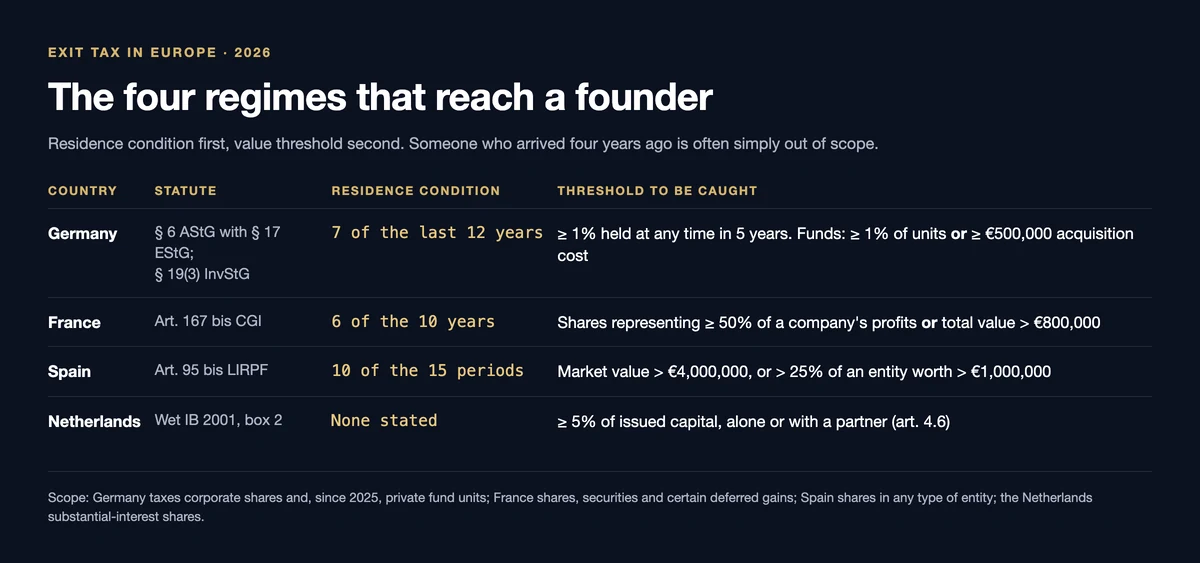
The pattern is the point. Germany has no value threshold and a low ownership one; France and Spain have high value thresholds; the Netherlands has a modest ownership bar and the gentlest collection. A reader comparing destinations compares income tax rates — but the exit charge is set by the country you are leaving, and it is frequently larger than the first few years of saving where you arrive.
Germany: the 1% rule, and the 2022 tightening
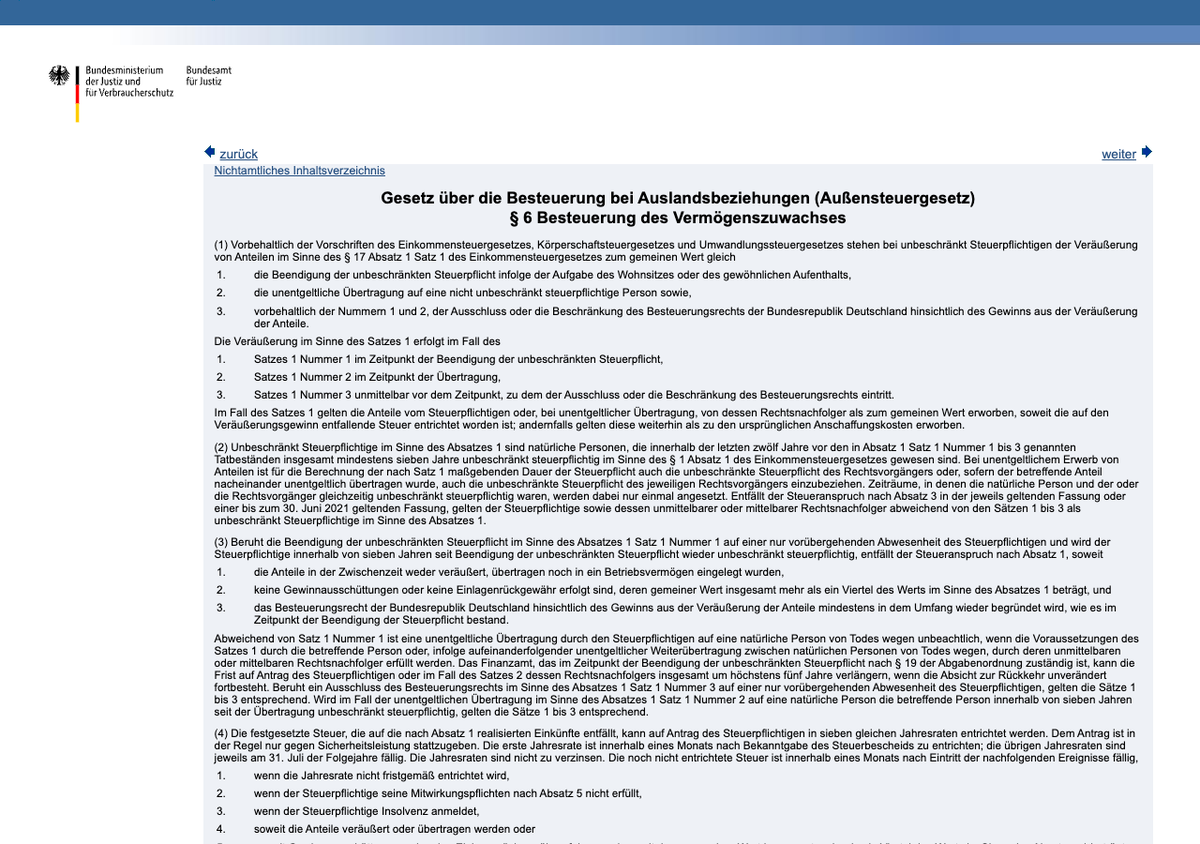
Germany is the regime to understand first, because its thresholds are the ones an ordinary bootstrapped founder crosses. § 6(1) AStG puts three events on the same footing as a sale at market value: ending unlimited tax liability by giving up your residence or habitual abode, transferring the shares for free to a non-resident, and anything else that excludes or restricts Germany's right to tax the eventual gain.
What is caught is a shareholding "im Sinne des § 17 Absatz 1 Satz 1 des Einkommensteuergesetzes", and § 17(1) sets that at a direct or indirect holding of at least 1% of a corporation's capital at any time in the previous five years. A single-member GmbH, a 2% slice of a startup, a holding you sold down last year: all in scope, with no monetary floor.
The gate is the residence test in § 6(2): unlimited tax liability "insgesamt mindestens sieben Jahre" within the last twelve. It used to be ten years, and PwC Germany records the move to seven-of-twelve from 1 January 2022 along with the change that matters more — the elimination of the EU/EEA indefinite deferral. Before 2022 an intra-EU move could park the charge indefinitely; now Lisbon, Dublin and Madrid are treated like Dubai.
What survives is § 6(4): on application the tax can be paid in seven equal annual instalments, interest-free, the first within a month of the assessment notice and the rest on 31 July each year after. Then comes the sentence that decides whether this helps you: "Dem Antrag ist in der Regel nur gegen Sicherheitsleistung stattzugeben" — as a rule, only against security. For a founder whose only asset is the company being valued, that is the real problem.
The tax itself is not a flat rate. Under § 3 no. 40(c) EStG, 40% of the deemed proceeds is exempt, so 60% of the gain enters your taxable income at your personal progressive rate — the partial-income method, not the 25% flat capital regime circulating guides quote. Where the shares are unlisted, § 199(1) BewG permits the simplified capitalised-earnings method, whose capitalisation factor § 203 BewG fixes at 13.75, provided it does not produce "offensichtlich unzutreffenden Ergebnissen" — obviously incorrect results. That factor lets you estimate your own exposure.
| Sustainable annual earnings | Indicative value at 13.75× | Deemed gain over €25,000 cost | Taxable at 60% | Tax at 42% marginal | Per instalment (÷7) |
|---|---|---|---|---|---|
| €40,000 | €550,000 | €525,000 | €315,000 | €132,300 | €18,900 |
| €60,000 | €825,000 | €800,000 | €480,000 | €201,600 | €28,800 |
| €80,000 | €1,100,000 | €1,075,000 | €645,000 | €270,900 | €38,700 |
| €120,000 | €1,650,000 | €1,625,000 | €975,000 | €409,500 | €58,500 |
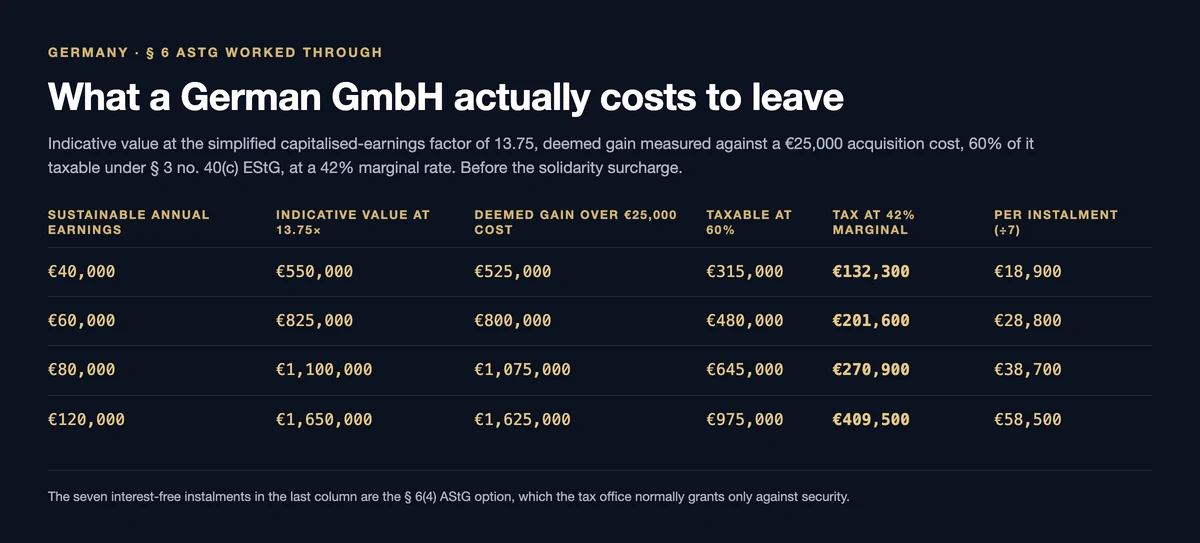
One basis throughout: a single founder, €25,000 of nominal acquisition cost, the § 203 BewG factor applied to sustainable annual earnings, a flat 42% marginal rate. The solidarity surcharge, the 45% top band and the § 17(3) allowance are not charted; the first two push the figures up, the third barely moves them.
Germany's fund trap, new since 1 January 2025
This is the change the English-language guides have not caught up with, and it ends the assumption that an exit tax is only a founder's problem. § 19(3) of the Investmentsteuergesetz treats the end of unlimited tax liability as a disposal of investment fund units held outside a business in either of two cases: you held at least 1% of a fund's issued units within the previous five years, or you hold units at departure whose acquisition costs are at least €500,000.
The second limb is the one with reach: half a million euros of accumulated acquisition cost in a broad ETF is an ordinary outcome for a disciplined saver in their forties with no company at all. § 19(3) borrows § 6(2) to (5) AStG wholesale, so the residence test, the instalment option and the annual reporting duties apply to a portfolio exactly as to a GmbH.
On timing there is no ambiguity: § 57 InvStG applies § 19(3) "erstmals auf Fälle, in denen die unbeschränkte Steuerpflicht des Anlegers nach dem 31. Dezember 2024 endet" — first to cases where unlimited tax liability ends after 31 December 2024. A 2024 departure was outside it; a 2026 departure is not. If you are reading advice that says German exit tax only concerns company shares, check its date.
France: six of ten years, and a clock that deletes the bill
France's regime looks fiercer than it is. Article 167 bis CGI applies to anyone tax resident in France "pendant au moins six des dix années précédant le transfert", and bites where the household's shares either represent at least 50% of a company's profits or have an aggregate value above €800,000 on the departure date. Gains are taxed at the rates in article 200 A, the flat-tax regime for securities gains.
Then comes the escape. Under article 167 bis, VII-2 the tax on latent gains is discharged, or refunded if already paid, where you still hold the shares after two years from the transfer — extended to five years where their total value exceeded €2.57 million at the date you left — or earlier if you move your tax domicile back to France while still holding them. France charges you for leaving and then, in the ordinary case, writes the charge off if you simply keep your shares for two more years.
Deferral follows the destination. A move to an EU member state, or to a state with administrative-assistance and mutual-recovery agreements and not blacklisted under article 238-0 A CGI, gives automatic sursis de paiement with no guarantee. Anywhere else, deferral comes only on request, you need a representative in France, and guarantees are set before you go — at 12.8% of the gross gains. For a founder weighing Portugal against Dubai, the same charge is a two-year formality in one case and a secured, represented negotiation in the other.
Spain: ten of fifteen, and an EU option that waits a decade
Spain's exit tax is the most widely misdescribed of the four, because its thresholds get quoted without its residence condition. Article 95 bis LIRPF requires resident status "durante al menos diez de los quince períodos impositivos anteriores" — ten of the fifteen preceding tax periods — and then either shares worth more than €4,000,000 in total, or, failing that, more than 25% of an entity whose shares are worth more than €1,000,000, in which case only those shares are caught. An expat who spent six years in Valencia is out of scope at any valuation; this aims at long-term residents with substantial holdings, not the readers of Spain's nomad visa taxes.
The gain is savings income under article 46(b), attributed to the final resident tax period, with a complementary self-assessment carrying no penalty, interest or surcharge. Where the company is unlisted, article 95 bis(3) sets the valuation default at the higher of net equity per the last closed balance sheet or the average of the last three years' results capitalised at 20% — a five-times-earnings multiple, against Germany's 13.75 — unless you prove another market value.
Two reliefs matter. For a temporary work move to a non-blacklisted country, or any move to a treaty country with an exchange-of-information clause, payment is deferred on request with interest and guarantees; the debt and its interest are extinguished if you become Spanish-resident again within five tax years without having transferred the shares, extendable by five more for work moves. And where you move to another EU or EEA state with effective exchange of information, article 95 bis(6) lets you elect not to self-assess at all unless, within the ten following tax years, you transfer the shares inter vivos, stop being EU/EEA resident, or fail the communication duty.
The Netherlands: 5%, and a deferral that never expires
Dutch law sets a substantial interest at 5% or more of a company's issued capital, alone or with a partner, under article 4.6 Wet IB 2001 — the lowest ownership bar of the four. On emigration the Belastingdienst treats the shares as sold, puts the gain in box 2, and issues a conserverende aanslag, a preserving assessment.
Collection is the gentle part. Emigrate to an EU or EEA country and deferral is automatic, with no collection interest; outside it you will generally be asked for security, with Norway, Iceland and Liechtenstein exempted. And since 2015 the deferral is indefinite: for deregistrations after 15 September 2015 the Belastingdienst grants it for life and does not cancel the assessment on request after ten years, as it did for earlier emigrations.
That cuts both ways: there is no clock to outlast and no return window to hit. The assessment sits behind you until one of three events ends it — you sell the shares, the company pays a dividend, or the company ceases to exist — each reportable, each making it payable in whole or in part. A 30%-ruling employee who never owned 5% will not meet this; an owner-director meets it the first time they want cash out of their BV.
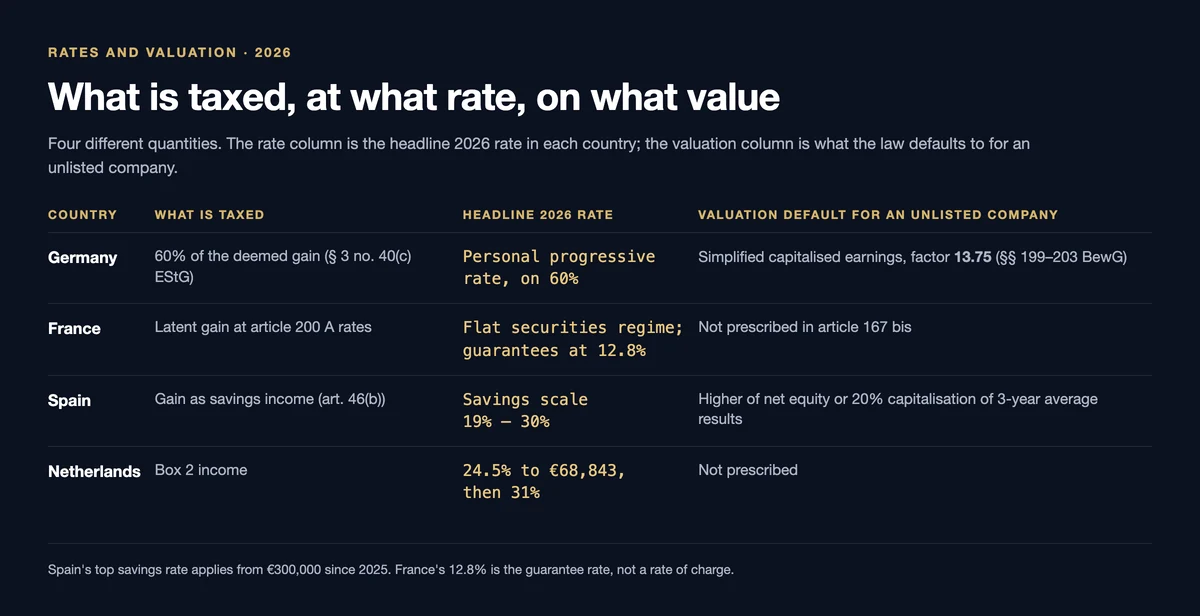
| Country | What is taxed | Headline 2026 rate | Valuation default for an unlisted company |
|---|---|---|---|
| Germany | 60% of the deemed gain (§ 3 no. 40(c) EStG) | Personal progressive rate, applied to 60% | Simplified capitalised earnings, factor 13.75 (§§ 199–203 BewG) |
| France | Latent gain at article 200 A rates | Flat securities regime; guarantees set at 12.8% | Not prescribed in article 167 bis |
| Spain | Gain as savings income (art. 46(b)) | Savings scale 19%–30%, top rate from €300,000 since 2025 | Higher of net equity or 20% capitalisation of 3-year average results |
| Netherlands | Box 2 income | 24.5% to €68,843, then 31% | Not prescribed |
Deferral, security, and the paperwork that keeps it alive
The charge is one problem; keeping the deferral alive is the other, and it is the half that gets people. Each regime imposes duties on someone who has already left, and in Germany missing them is itself an acceleration event.
| Germany | France | Spain | Netherlands | |
|---|---|---|---|---|
| EU/EEA move | 7 interest-free instalments on application; no EU relief since 2022 | Automatic sursis, no guarantee | Art. 95 bis(6): no self-assessment for 10 years | Automatic, no interest |
| Non-EU move | Identical | On request: French representative + 12.8% guarantee | On request, with interest and guarantees | Security generally required |
| Security required | As a rule, yes | Only outside the EU/assistance network | Yes, possibly the shares themselves | Outside EU/EEA |
| How it dies | Return within 7 years, extendable by 5 | Hold the shares 2 years, or 5 above €2.57m, or return | Resume residence within 5 years (+5 for work), unsold | It does not — deferral is lifelong |
| What revives it | Sale, gift, insolvency, missed instalment, distributions above 25% of departure value, reporting breach | Sale inside the clock | Inter vivos transfer, loss of EU/EEA residence, missed communication | Sale, dividend, company ceasing to exist |
| Duty while deferred | Report events within a month; confirm address and ownership by 31 July yearly | Declarations via the French representative | Communicate the election, keep it current | Report the triggering event |
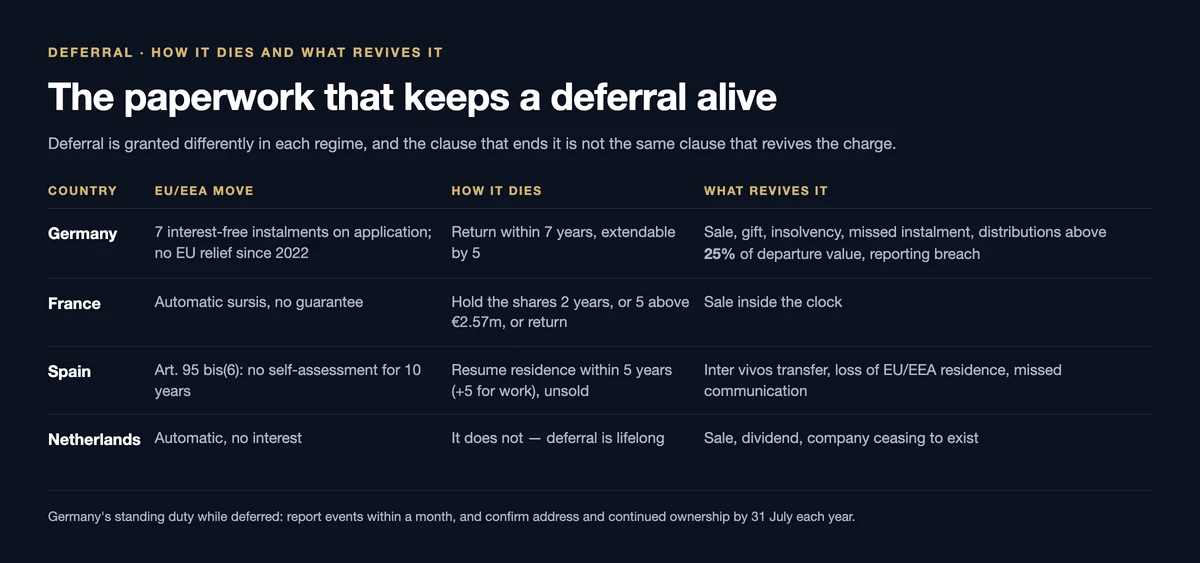
Germany's annual filing is the duty people do not expect. § 6(5) AStG requires electronic notice to the Finanzamt of any acceleration event within a month, plus a confirmation by 31 July each year of your address and continued ownership. An ex-resident who changes flat in Lisbon and forgets has not merely been untidy: under § 6(4) sentence 5 no. 2 the unpaid balance can fall due within a month.
The return rule deserves the same attention. § 6(3) cancels the claim if the absence was temporary and you become an unlimited taxpayer again within seven years, provided the shares were not sold, transferred or contributed to a business, distributions did not exceed a quarter of the departure value, and Germany's taxing right is restored — extendable by five further years where the intention to return holds. For anyone testing a second residency, that clause is the difference between an experiment and a seven-figure decision.
What we could not verify, and why we are saying so
Three regimes came up repeatedly in research and are not in the tables above, because no primary source settled them for 2026. Naming them beats guessing.
- Austria. Instalment treatment under § 27(6) EStG, applied by analogy to § 6 Z 6 EStG, is mid-change: one RIS draft describes a seven-year period, a later explanatory document proposes shortening the business-side period from seven to five to align with ATAD, and the Budgetmaßnahmengesetz 2026 lists further tightening. We could not confirm which is enacted.
- Norway. Skatteetaten documents the NOK 500,000 net-gain threshold and perpetual liability for moves from 29 November 2022, but the 2025 national budget proposed replacing it with a NOK 3 million allowance, and no official page settled what is now in force.
- Belgium. A 10% charge on financial-asset gains applies from 1 January 2026, and KPMG's alert on the draft law records that "an exit tax is introduced for Belgian tax residents transferring their tax residency abroad", with gains realised within two years of the move in scope. Secondary sources disagree on the enacting date and on whether the exit element is a deemed disposal or a two-year look-back.
If you hold shares in any of those three and are moving in 2026, that is where paid local advice earns its fee.
What to do if you hold shares and plan to leave
The order of operations is narrower than most relocation checklists suggest, and the first two steps cost nothing.
- Check the residence condition before the value threshold. Seven of twelve years in Germany, six of ten in France, ten of fifteen in Spain. Someone who arrived four years ago is often simply out of scope.
- Get a number before you book anything. For a German GmbH, 13.75 × sustainable earnings, less acquisition cost, times 60%, times your marginal rate is a defensible first estimate.
- Ask what security you can actually post. Germany's instalment plan is conditional on it, and a founder whose wealth is the company being valued may not be able to give it. That constraint, not the rate, decides whether the charge is payable over seven years or at once.
- Treat the destination's rate as the second question. A zero-tax residency saving €30,000 a year does not clear a €270,000 exit charge quickly.
Related reading
- Second residency ranked 2026 — cost, speed and days required.
- 0% tax residencies — the destinations that make people consider leaving.
- Totalization agreements — the social security half of the same move.
- Renouncing American citizenship — the US charge, triggered by nationality.
- Germany crypto tax — German law on a different unrealised gain.
- Tax resident nowhere — why leaving properly is a documented act.
FAQ
Does Germany's exit tax apply if I move inside the EU?
Yes. The indefinite EU/EEA deferral that made intra-EU moves painless was abolished from 1 January 2022. What remains, for every destination, is the § 6(4) AStG option to pay in seven equal annual interest-free instalments — which the tax office normally grants only against security.
How much German exit tax would a GmbH worth €1 million trigger?
On a €25,000 acquisition cost the deemed gain is €975,000. Forty per cent is exempt under § 3 no. 40(c) EStG, so €585,000 enters your income at your personal rate — roughly €245,700 at a 42% marginal rate, before the solidarity surcharge. There is no flat 26.375% rate here; that belongs to a different regime.
Does the German exit tax apply to ETFs and funds?
Since 1 January 2025, yes. § 19(3) of the Investmentsteuergesetz treats departure as a disposal of privately held fund units where you held at least 1% of a fund's issued units in the previous five years, or hold units whose acquisition costs are at least €500,000. You need no company to be in scope.
Can the French exit tax be cancelled?
Yes, and it is what makes France's regime milder than its headline. Under article 167 bis, VII-2 CGI the tax is discharged, or refunded if paid, once you have held the shares two years after the transfer — five years above €2.57 million — or earlier if you move back to France still holding them.
Who does the Spanish exit tax actually hit?
Only long-term residents with large holdings. Article 95 bis LIRPF requires residence in at least ten of the fifteen preceding tax periods, plus either shares worth more than €4,000,000 or a holding above 25% in one entity worth more than €1,000,000. Below those lines it does not apply.
Does the Dutch conserverende aanslag expire after ten years?
Not for emigrations after 15 September 2015. The Belastingdienst states that deferral is then granted for life and the assessment is not cancelled on request after ten years, unlike the pre-2015 position. It is comfortable — automatic within the EU/EEA, no interest — but permanent, and a sale or dividend makes it payable.
Is this tax or legal advice?
No. This is editorial research read from the statutes and the tax authorities' own pages, and Soveraine sells no tax or relocation services. Thresholds, valuations and deferral conditions turn on your own facts, so take advice in your departure country before you move.
Sources
- § 6 AStG — triggering events, the seven-of-twelve residence test, the return rule, the instalments "in der Regel nur gegen Sicherheitsleistung", the acceleration events, the 31 July duty.
- § 17 EStG — the 1% holding within five years, and the § 17(3) allowance.
- § 3 Nr. 40 EStG — 40% of the "gemeinen Werts im Sinne des § 17 Absatz 2" exempt, which makes 60% taxable.
- § 19 InvStG and § 57 InvStG — the fund-unit charge, its two limbs, and first application after 31 December 2024.
- § 199 BewG and § 203 BewG — the simplified capitalised-earnings method, factor 13.75.
- Article 167 bis CGI — six of ten years, the 50% and €800,000 thresholds, automatic sursis, the 12.8% guarantee, the two- and five-year dégrèvement.
- Article 95 bis LIRPF — ten of fifteen periods, the thresholds, the unlisted valuation rules, the five-year extinction, the ten-year EU/EEA election. Article 66 gives the savings scale and the 30% top rate from 2025.
- Belastingdienst — conserverende aanslag bij emigratie — the deemed sale, automatic EU/EEA deferral, lifelong deferral after 15 September 2015, the sale/dividend/liquidation triggers.
- Wet IB 2001, article 4.6 — the 5% substantial-interest definition.
- PwC Germany on the 2022 reform — ten years to seven-of-twelve, and the end of the EU/EEA indefinite deferral.
- KPMG on Belgium's draft capital gains tax — the 10% rate, the €10,000 exemption, the exit tax for residents transferring residency abroad. Draft-stage; enacted mechanics unverified.