
Dubai sells this permit as a lifestyle product and almost every guide to it reads like one. The thing nobody tells you is that the UAE remote work visa is not primarily an immigration instrument at all — it is the cheapest legal key to a tax residency, and it unlocks at 90 days, not the 183 everyone quotes.
That distinction is worth real money. A European freelancer who spends four months a year in Dubai on this permit, and three months in each of two other countries, may be able to document UAE tax residency while nowhere else has a strong claim — or may simply have paid AED 740 for a nice apartment viewing, depending on details that none of the top-ranking guides get into.
So this guide does two things the others do not. It puts the two official fee schedules side by side, line by line, because the all-in numbers circulating online ($287, AED 1,535, AED 1,500–1,700) disagree with each other and with both government pages. And it reads the tax residency criteria against this specific permit. Every figure below comes from u.ae, ICP, GDRFA Dubai or the Federal Tax Authority's published guide — and where the internet asserts something those four do not, this guide says so.
Key takeaways
- The published fees are AED 300 federally and AED 240–740 through Dubai, itemised below — not the single all-in figures quoted elsewhere. None of them include the medical test, Emirates ID or insurance.
- The income test is USD 3,500 a month, on all three official pages in 2026. The USD 5,000 figure still circulating is stale.
- The six-month bank statement rule is on no official page. Every secondary guide states it; u.ae, ICP and GDRFA do not, and the sources disagree on whether it began on 27 or 28 January 2026.
- This permit can make you a UAE tax resident at 90 days, not 183, because it is a valid residence permit for the purposes of Article 4 of Cabinet Decision No. 85 of 2022.
- It does nothing to your home tax residency on its own. That ends when you stop meeting the other country's test, which is a separate exercise with its own exit taxes.
SafetyWing — Private health cover, which both UAE application channels list as a mandatory document
What the UAE remote work visa actually is
Formally there is no product called the UAE remote work visa. The federal service is the virtual work residence, GDRFA Dubai calls the Dubai version the virtual work residence permit, and the tourism board markets the same thing as the Virtual Working Programme. They are one status, issued through two authorities, and which one you deal with depends on the emirate.
What makes it unusual is that it is self-sponsored. Almost every other UAE residence permit requires a sponsor inside the country — an employer, a free-zone company, a property. GDRFA states this one is issued without a guarantor or host inside the country, which means you can hold UAE residency without forming a company or buying anything.
| Virtual work residence | |
|---|---|
| Issued by | ICP (federal) or GDRFA (Dubai) |
| Validity | 1 year, renewable |
| Income test | USD 3,500/month or currency equivalent |
| Sponsor | None — self-sponsored |
| Family | Holder may sponsor family for the same period |
| Decision time | ICP: 2 days · GDRFA: 48 hours (after documents accepted) |
| Must be in the UAE to apply? | No |
| UAE employment permitted? | No — foreign employer only |
The one-year term is the main structural weakness, and it is the reason this is a tax tool rather than a settlement route: a permit you renew annually accrues nothing toward long-term residency the way a golden visa does.
Who qualifies, and the $3,500 income test
The eligibility rules are short enough to state in full. You work remotely for an organisation outside the UAE, you can prove it, and you can evidence income of at least USD 3,500 a month or the equivalent in another currency. Your passport must have at least six months of validity. That is the whole test.
The income figure is worth pinning down because the internet has two of them. The u.ae national portal specifies a salary certificate of a minimum of 3,500 US dollars; the ICP service page lists a salary certificate of USD 3,500 or its equivalent in foreign currencies; GDRFA asks for documentation showing at least $3,500 per month. Three official pages, one number. The USD 5,000 threshold that still appears on aggregator sites and in several 2026 guides traces back to the programme's 2021 launch and appears on none of them today.
There is a second figure in circulation — USD 5,000 for business owners rather than employees, sometimes with a one-year ownership condition attached. We could not find it on any official page either, so we are not repeating it as a rule. If you own the company that pays you, expect to evidence both the company's existence and your income from it.
A caution the brochures skip: the salary certificate is the test, so the permit fits salaried remote employees far more neatly than it fits freelancers with a dozen clients and no employer to issue one.
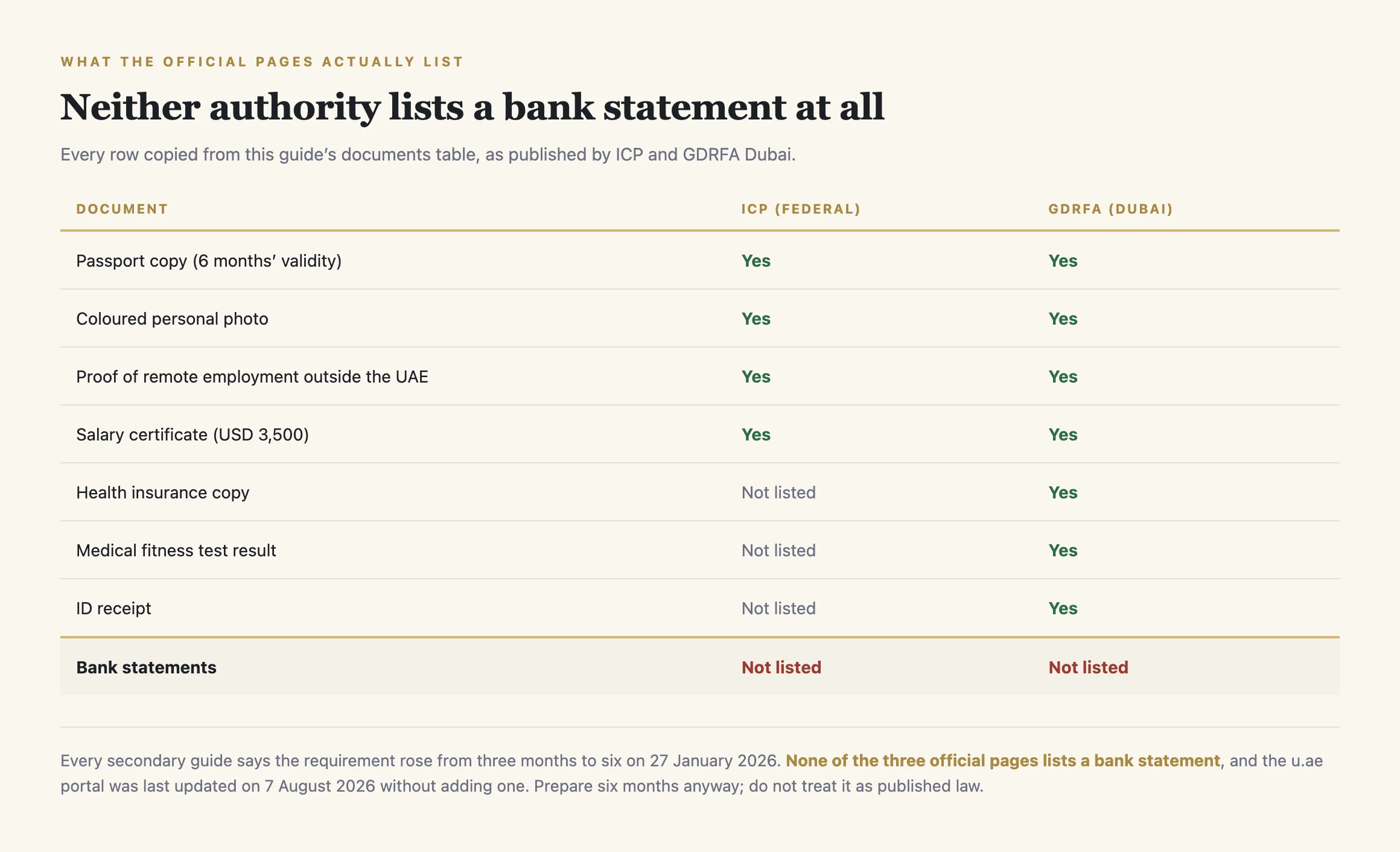
The documents the official pages actually list
Here is where the official record and the guide-writing industry part company. Below is the mandatory document list exactly as the two authorities publish it — nothing added, nothing inferred.
| Document | ICP (federal) | GDRFA (Dubai) |
|---|---|---|
| Passport copy (6 months' validity) | Yes | Yes |
| Coloured personal photo | Yes | Yes |
| Proof of remote employment outside the UAE | Yes | Yes |
| Salary certificate (USD 3,500) | Yes | Yes |
| Health insurance copy | Not listed | Yes |
| Medical fitness test result | Not listed | Yes |
| ID receipt | Not listed | Yes |
| Bank statements | Not listed | Not listed |
Two things stand out. The first is that GDRFA's list is longer than ICP's, which is a difference in what each page publishes rather than proof that Dubai is stricter — the u.ae national portal lists health insurance and the medical fitness test as requirements for the federal route too, so treat both as universal. Health insurance in particular has to be valid in the UAE, which is the detail that catches people arriving with a home-country policy.
The second is the bottom row, and it is the single most consequential line in this article.
The six-month bank statement rule, and why this guide will not state it as fact
Since early 2026 essentially every page written about this visa has carried the same claim: that on 27 January 2026 the requirement rose from three months of bank statements to six, and that applications are being refused without them. Immigration firms repeat it; it is the headline on the best-ranked guide in the search results.
It appears on none of the three official pages. The u.ae national portal carries a last-updated date of 7 August 2026 — more than six months after the supposed change — and lists four documents, none of them a bank statement. ICP lists four and no bank statement. GDRFA lists seven and no bank statement; it asks for a salary certificate and for documentation of monthly income, which is not the same instruction.
The secondary sources also disagree with each other: one gives the effective date as 27 January, another 28 January, a third says it was only visible in public guidance from 1 April. One of the most-read guides contradicts itself inside a single page — three months in its checklist, six in its application steps, "3–12" in its FAQ.
What is the honest reading? Probably that caseworkers ask for six months as supporting evidence without the published document list changing — common in immigration practice, and exactly why it has no citation. Prepare six months of statements from an account showing the salary landing, and if you were planning to close a home-country account on the way out, keep it open and funded. Just do not believe anyone who tells you where that rule is written.
What it costs: two official fee schedules, side by side
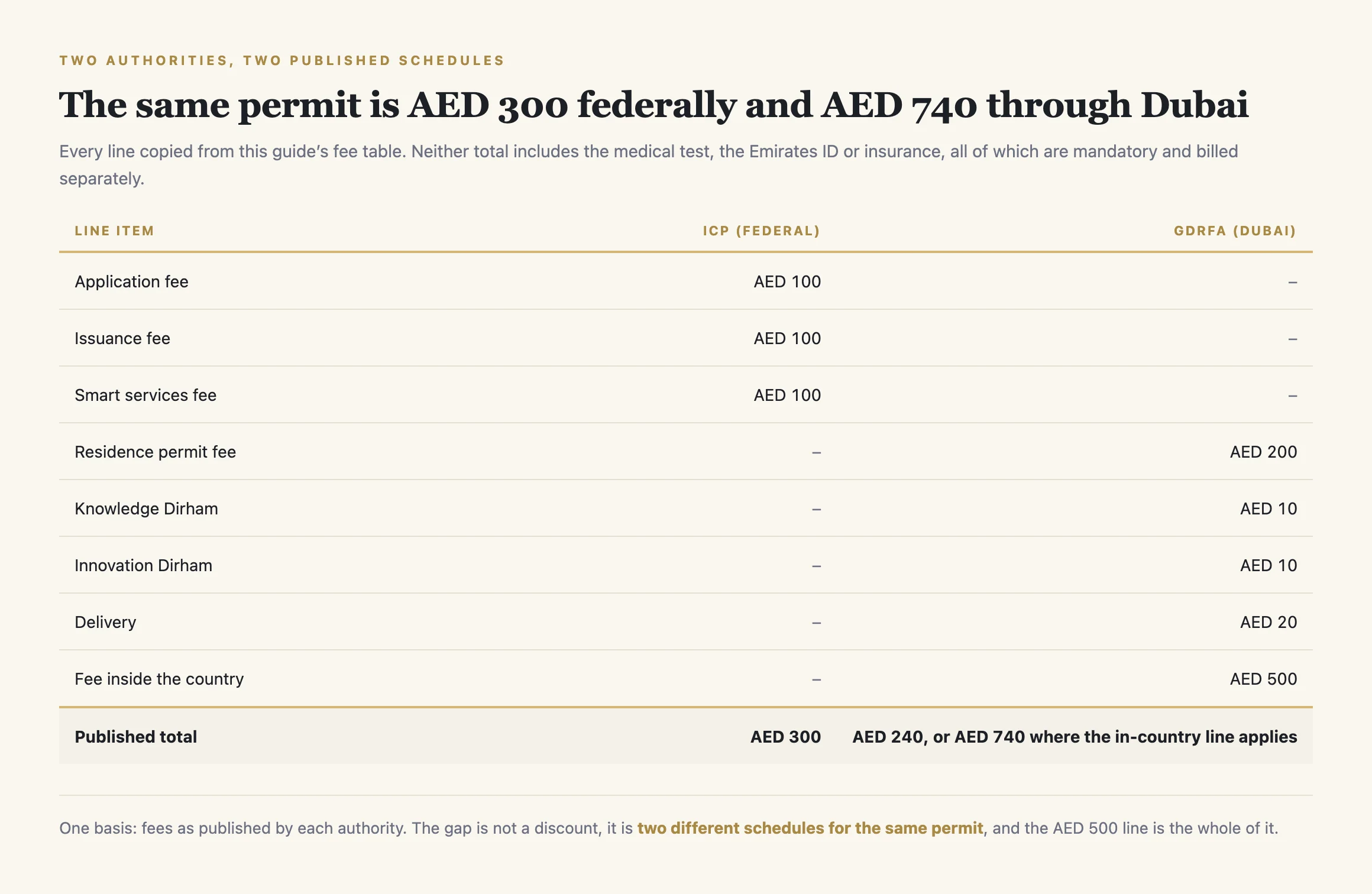
The all-in numbers circulating for the UAE remote work visa cost — $287, AED 1,535, AED 1,500–1,700 — do not match each other and do not match either published schedule. Here is what the two authorities actually list.
| Line item | ICP (federal) | GDRFA (Dubai) |
|---|---|---|
| Application fee | AED 100 | — |
| Issuance fee | AED 100 | — |
| Smart services fee | AED 100 | — |
| Residence permit fee | — | AED 200 |
| Knowledge Dirham | — | AED 10 |
| Innovation Dirham | — | AED 10 |
| Delivery | — | AED 20 |
| Fee inside the country | — | AED 500 |
| Published total | AED 300 | AED 240, or AED 740 where the in-country line applies |
Our arithmetic, their line items. The AED 500 GDRFA line is labelled as applying inside the country, so someone filing from abroad and someone already in the UAE are not paying the same amount — one reason the single figures quoted elsewhere cannot all be right.
Three costs sit outside both schedules and none is optional: the medical fitness test, the Emirates ID, and a health insurance policy valid in the UAE. We are not quoting amounts for the first two, because we could not reach a current published schedule for either — and inventing a number on a page people budget from is how the AED 1,535 figure got into circulation. Confirm them with the authority you apply through, and treat any all-in total online as an estimate.
The 90-day rule that turns this permit into a tax instrument
This is the section the lifestyle guides do not write, and it is the reason the permit is worth more than it costs.
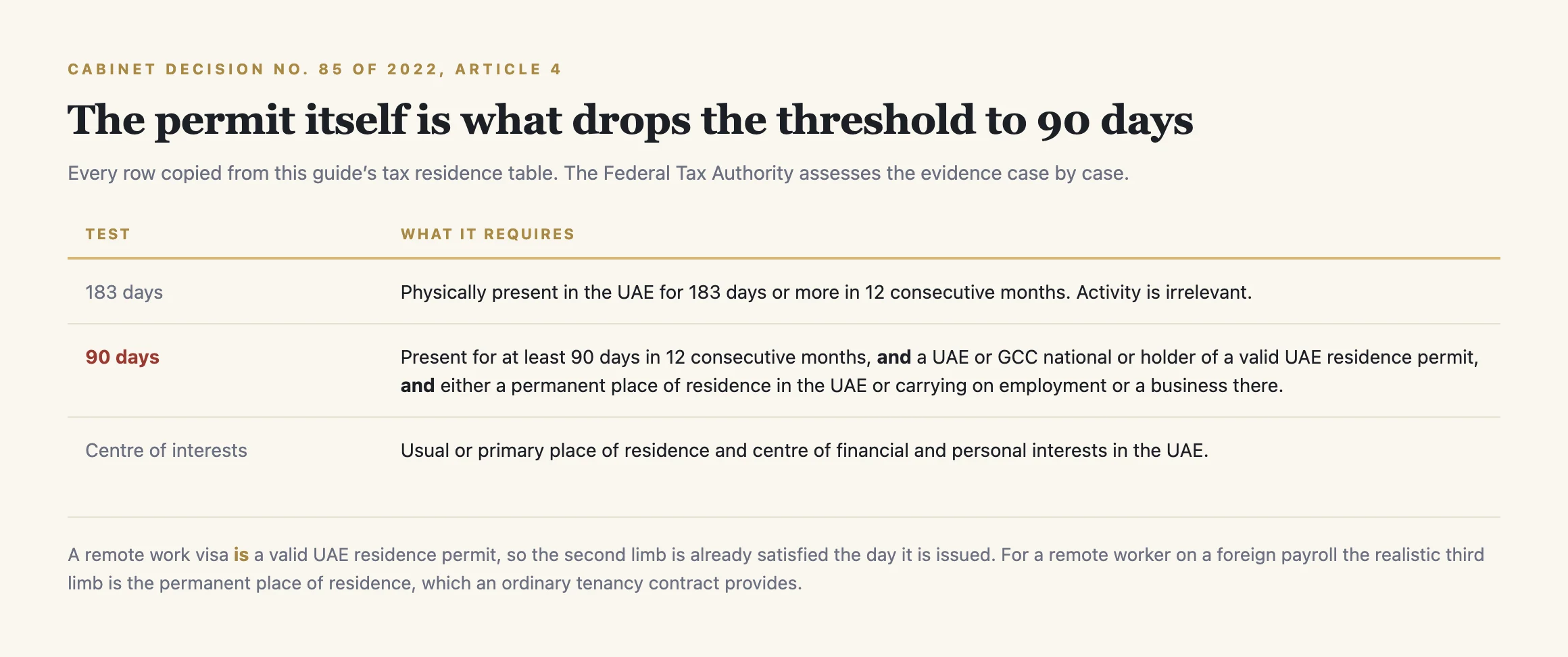
UAE tax residency for individuals is set by Article 4 of Cabinet Decision No. 85 of 2022, with the mechanics in Ministerial Decision No. 27 of 2023, and the Federal Tax Authority sets out both in its Tax Resident and Tax Residency Certificate guide. There are three independent tests, and meeting any one of them makes you a UAE tax resident under domestic law.
| Test | What it requires |
|---|---|
| 183 days | Physically present in the UAE for 183 days or more in 12 consecutive months. Activity is irrelevant. |
| 90 days | Present for at least 90 days in 12 consecutive months, and a UAE/GCC national or holder of a valid UAE residence permit, and either a permanent place of residence in the UAE or carrying on employment or a business there. |
| Centre of interests | Usual or primary place of residence and centre of financial and personal interests in the UAE. |
Read the middle row against this permit. A virtual work residence is a valid UAE residence permit, so that limb is satisfied the day it issues. The remaining limb needs care: you are employed by a foreign company, so you are not carrying on employment in the UAE — which leaves the permanent place of residence. The FTA defines that as a furnished house, apartment, room or other dwelling arranged to be continuously available to you. It need not be owned; a rented flat qualifies, provided it is available at all times rather than occupied occasionally or for a short stay.
The day counting is generous and worth knowing precisely. Any part of a day in the UAE counts as a full day, including both travel days, and the days do not need to be consecutive. The FTA's own worked example adds four separate trips to 186 days.
None of this is automatic — the FTA assesses the evidence, and this is a reading of published criteria rather than advice. But the structural point stands: this is the cheapest residence permit in the UAE, and it is what makes the 90-day test reachable. For what UAE residency does and does not change, see taxes in Dubai.
Getting a UAE Tax Residency Certificate on this permit
Domestic tax residency is one thing; a certificate you can hand to another country's tax authority is another, and it is the certificate that actually settles arguments. The FTA issues a Tax Residency Certificate either for domestic purposes or for the application of a double tax agreement.
| Amount | |
|---|---|
| Submission fee (non-refundable) | AED 50 |
| Processing — natural person with a Corporate Tax TRN | AED 500 |
| Processing — natural person without a TRN | AED 1,000 |
| Each hard copy | AED 250 |
For an applicant in the 90–182 day band — the typical remote work visa holder running this deliberately — the FTA's published documentation is your Emirates ID and residence visa (or passport plus an entry and exit report from the federal authority), plus either proof of employment or business in the UAE, or proof of a permanent place of residence such as a certified tenancy contract, a long-term rental contract, a signed landlord statement, or a title deed with a utility bill in your name. At 183 days or more, the identity evidence alone is the published requirement.
One widely repeated claim deserves a flag: that the FTA requires a full 183 days for a treaty certificate even where domestic residency is established at 90. The guide does not say that. It says that if the treaty's own residence requirement refers to being resident in the UAE, you supply the domestic-purpose documents above. That distinction is a question for an adviser in both countries. US persons should note the equivalent American instrument works differently again — see Form 8802.
What the permit does not do to your home tax residency
Here is the mistake that costs the most. A UAE residence permit is an arrival document. It does nothing, on its own, to end tax residency in the country you left.
That ends only when you stop satisfying that country's own test — and those tests are not day counts alone. Most look at days present, whether a home remains permanently available to you, and where your centre of vital interests sits: family, main home, economic ties. A freelancer who spends 95 days in Dubai but keeps a flat and a partner in Lisbon or Berlin is very likely still tax resident at home, UAE certificate or not. Where two countries both claim you, a treaty's tie-breaker decides, and it starts with the permanent home — not with whose certificate is more recent.
Two further traps. Several European states levy an exit tax on unrealised gains when you break residency, so the act of leaving can itself be the taxable event; we cover the mechanics in exit taxes in Europe. And US citizens are taxed on worldwide income wherever they live, so a UAE permit changes the state and local picture and essentially nothing federal.
The sequencing follows: work the departure test in the country you are leaving first, and only then the arrival test in the UAE. The other way round produces people who are tax resident in two places, which is strictly worse than being resident in the expensive one. If you are aiming at residency nowhere in particular, read tax resident nowhere first.
Who it fits, and who needs a free-zone company instead
The permit is an unusually good fit for one profile: a salaried remote employee of a foreign company, earning comfortably above USD 3,500 a month, who wants UAE residency without forming a company, and who either wants a low-commitment base or is deliberately building toward the 90-day test with a tenancy contract.
It fits poorly in three cases. If you need a salary certificate and nobody can issue you one, the application has no spine. If you want to invoice UAE clients, the visa does not permit local work and you are into corporate tax territory — a natural person enters UAE corporate tax only where gross revenue from business conducted in the UAE exceeds AED 1,000,000 in a calendar year under Cabinet Decision No. 49 of 2023, with wages excluded entirely. And if you want something that lasts longer than a year at a time, a free-zone company with an investor visa or the ten-year golden route is the structural answer.
For those, start with setting up a company in the UAE and the Dubai Golden Visa. If the UAE is one option among several you are weighing, our digital nomad visas guide puts it next to the European alternatives, most of which cost more and ask for more days.
Related guides
- Taxes in Dubai: the 2026 guide — 0% income tax, the 9% corporate tax, and what you still owe at home.
- Dubai Golden Visa — the ten-year route, its real costs and who actually qualifies.
- Setting up a company in the UAE — free zone versus mainland, and the 9% threshold.
- Digital nomad visas: a 2026 guide — how the UAE compares with the European programmes.
- Second residency ranked 2026 — cost, speed and days required across the realistic routes.
- Zero-percent tax residencies — where the UAE sits among the genuinely low-tax bases.
FAQ
How much does the UAE remote work visa cost in 2026?
The two authorities publish different schedules. ICP lists three AED 100 line items — application, issuance and smart services — totalling AED 300. GDRFA Dubai lists AED 200 for the permit, AED 10 Knowledge Dirham, AED 10 Innovation Dirham, AED 20 delivery and a separate AED 500 line labelled as applying inside the country, so AED 240 or AED 740. Neither includes the medical test, Emirates ID or insurance, all of which are mandatory and billed separately.
What is the minimum income for the UAE remote work visa?
USD 3,500 a month, evidenced by a salary certificate, or the equivalent in another currency. All three official pages — the u.ae national portal, ICP and GDRFA Dubai — state the same figure in 2026. The USD 5,000 threshold still quoted on aggregator sites dates from the 2021 launch and appears on none of them today.
Do you need six months of bank statements for the UAE remote work visa?
Possibly, but we cannot source it. Every secondary guide says the requirement rose from three months to six on 27 January 2026, yet none of the three official pages lists a bank statement at all, and the u.ae portal was last updated on 7 August 2026 without adding one. The sources even disagree on whether the date was 27 or 28 January. Prepare six months anyway — just do not treat it as published law.
Does the UAE remote work visa make you a UAE tax resident?
It can, at a lower day count than most guides state. Article 4 of Cabinet Decision No. 85 of 2022 makes you a UAE tax resident at 183 days in 12 consecutive months, but also at just 90 days if you hold a valid UAE residence permit — which this is — and have either employment or a business in the UAE or a permanent place of residence there. For a remote worker on a foreign payroll the realistic limb is the permanent place of residence, which an ordinary tenancy contract provides. The Federal Tax Authority assesses the evidence case by case.
Can you work for a UAE company on a remote work visa?
No. The permit is issued on the basis that you work remotely for an organisation outside the UAE, and both authorities require proof of that foreign employment. Taking a job with a UAE-based entity means moving to a different status sponsored by that employer. Invoicing UAE clients as a freelancer is a separate question that runs into the corporate tax rules rather than the visa rules.
Will the UAE remote work visa stop you paying tax at home?
Not by itself, and this is where most of the money is lost. A UAE permit does not end tax residency in the country you left; that ends only when you stop meeting that country's own test, which weighs days present, whether a home stays available to you, and where your centre of vital interests sits. Several EU states also levy an exit tax on unrealised gains when you break residency, and US citizens are taxed on worldwide income wherever they live.
Do you pay corporate tax as a freelancer in the UAE?
Only above a threshold, and wages never count. Under Cabinet Decision No. 49 of 2023 a natural person is within UAE corporate tax only where gross revenue from business conducted in the UAE exceeds AED 1,000,000 in a calendar year. Wages are excluded whatever the amount and do not count toward that threshold, as are personal investment and most real estate income. The AED 375,000 figure quoted on many remote work visa pages is the zero-rate band, not the trigger for a natural person.
How long does the UAE remote work visa last and can you renew it?
One year from issue, renewable, and the holder can sponsor family for the same period. ICP states a service completion duration of two days and GDRFA an expected 48 hours, though that clock starts once your documents are accepted. You do not need to be inside the UAE for the visa to be issued.
Paying AED fees from an account you do not hold dirhams in
Government fees, the medical test, the Emirates ID and the first year's rent all land in dirhams, usually within a few weeks of each other and usually from an account denominated in something else. Wise holds and converts at the mid-market rate, which keeps the spread from quietly becoming a line item of its own next to the AED 300 you were budgeting for.
Sources
- Government of the UAE — Residence visa for working outside the UAE (national portal, last updated 7 August 2026)
- Federal Authority for Identity, Citizenship, Customs and Port Security — Issuance of Visa Virtual Work Residence (ICP service page)
- GDRFA Dubai — Issuance of the virtual work residence permit
- Federal Tax Authority — Tax Resident and Tax Residency Certificate, Tax Procedures Guide TPGTR1 (Cabinet Decision No. 85 of 2022; Ministerial Decision No. 27 of 2023; Cabinet Decision No. 49 of 2023; fees per Cabinet Decision No. 65 of 2020)
Figures are as published in 2026 and change without notice. Fee schedules in particular are published per service page and differ between authorities. Verify every amount and requirement with ICP or GDRFA directly, and take advice in both your home country and the UAE, before committing money or breaking a tax residency.