
The United Arab Emirates has spent the last five years rewriting its commercial rulebook: 100% foreign ownership on the mainland, a 9% corporate tax floor, and a federal small-business relief that exempts qualifying companies under AED 3 million in revenue through 2026. The pitch is no longer "no tax" — it is "low tax, real substance, fast setup." This guide walks through how to set up a company in the UAE in 2026: the structures, the realistic costs, the 3,000 dirham rule, and — critically — what changes depending on whether you hold a US, EU or other passport. It is informational, not legal advice.
SPC Free Zone (Sharjah) — UAE free-zone formation with a public referral programme
What "set up a company in the UAE" actually means
The UAE has three parallel company regimes. Mainland companies are licensed by the emirate-level Department of Economy (in Dubai, the Department of Economy and Tourism) and can trade freely inside the UAE and contract with the federal government. Free zone companies are licensed by one of more than 40 free zone authorities (DMCC, IFZA, DIFC, ADGM, Meydan, SHAMS and others); they are fast to set up and tax-efficient, but face restrictions on trading directly with the UAE mainland market without a local distributor. Offshore companies (RAK ICC, JAFZA Offshore) cannot trade inside the UAE at all and do not grant residence visas — they are holding vehicles.
Most founders setting up to live and work in the UAE choose a free zone or a mainland LLC. Offshore is a structuring tool, not a base of operations.
Who this applies to — by nationality
The mechanics of UAE incorporation are the same for everyone. The tax consequences are not.
US persons (citizens and green-card holders)
The United States taxes on citizenship, not residence. Incorporating in the UAE does not exempt you from US federal income tax. Your UAE company is almost certainly a Controlled Foreign Corporation and triggers annual Form 5471 filing, GILTI inclusions on most active business income under IRC §951A, and FBAR reporting on any UAE bank account over USD 10,000 via FinCEN Form 114. The Foreign Earned Income Exclusion can shelter up to USD 126,500 (2024 figure, indexed) of earned income if you meet the physical presence or bona fide residence test — but that is a personal exclusion, not a corporate one. Renunciation is the only clean exit from US tax on worldwide income. Anyone telling you otherwise is selling something.
EU freelancers and tax residents
EU member states tax on residence. If your centre of vital interests — family, primary home, economic ties — remains in Germany, France, Spain or Italy while you incorporate in Dubai, your home tax authority will almost certainly treat the UAE company as tax-resident at home or apply CFC rules to attribute its profits to you. France's Article 209 B CGI and Germany's Außensteuergesetz are the textbook examples. Several EU states also charge exit tax on unrealised gains when you move tax residence — see the EU Anti-Tax Avoidance Directive (ATAD) Article 5. To make the UAE structure work, most EU founders need to genuinely relocate: spend more than 183 days in the UAE, break ties at home, and document it.
Non-US, non-EU readers
Citizens of jurisdictions with territorial taxation (Singapore, Malaysia, Hong Kong, Panama, much of Latin America) or weak CFC enforcement have the cleanest path. A UAE company plus UAE residence often genuinely shifts your tax base. You still need to break tax residence properly at home and respect any local exit rules, but the optimisation works closer to the way it is marketed.
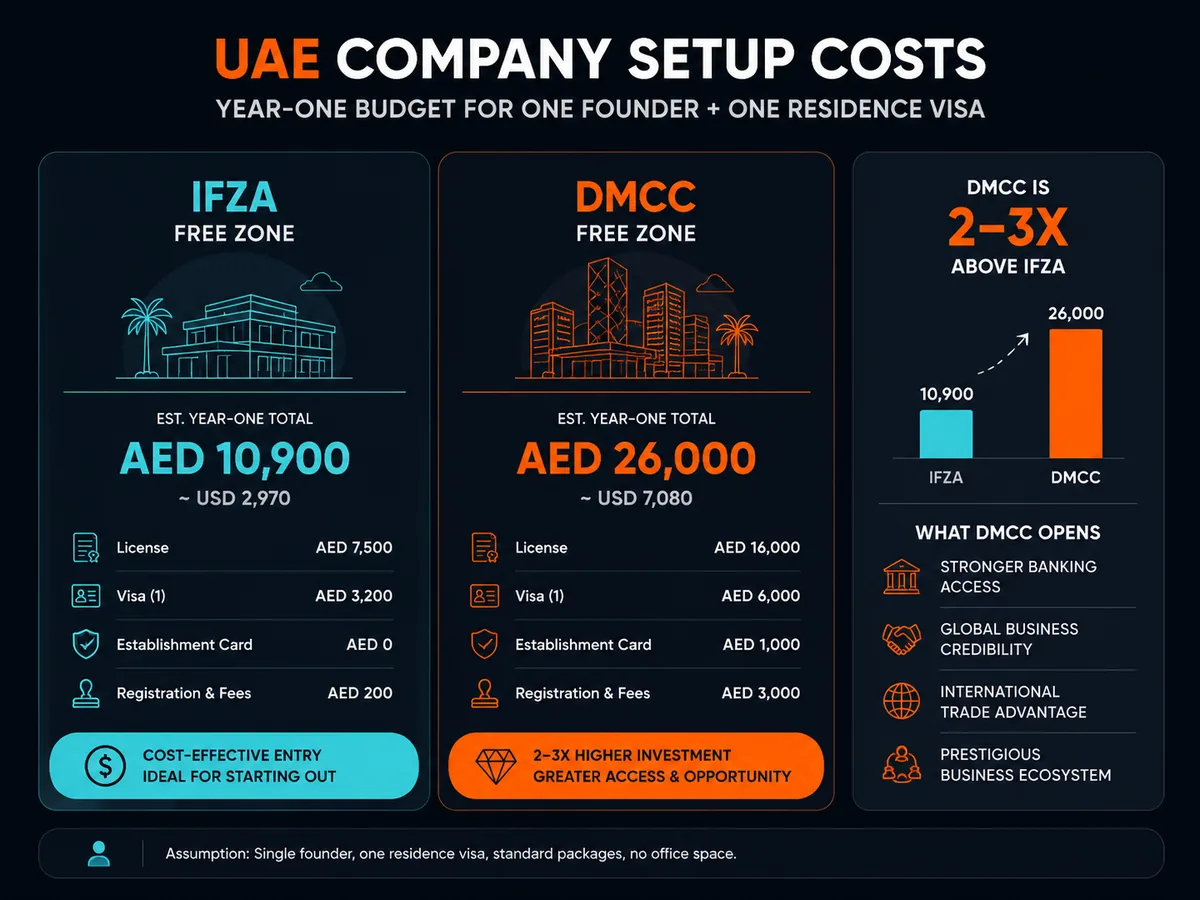
How much does it cost to set up a company in the UAE?
Realistic 2026 budget for a single-founder service business with one residence visa:
| Item | Free zone (IFZA / Meydan) | Free zone (DMCC) | Mainland (Dubai DET) |
|---|---|---|---|
| Trade licence (year 1) | AED 12,500–16,000 | AED 20,000–34,000 | AED 13,000–18,000 |
| Office / flexi-desk | Included | AED 15,000+ | AED 6,000–20,000 (Ejari) |
| Establishment card | AED 1,200 | AED 2,000 | AED 2,000 |
| Investor visa + Emirates ID | AED 3,500–5,000 | AED 4,500 | AED 5,000 |
| Medical + biometrics | AED 700 | AED 700 | AED 700 |
| Bank account opening | Free–AED 2,000 | Free–AED 2,000 | Free–AED 2,000 |
| Year-one total | ~AED 18,000–25,000 | ~AED 42,000–58,000 | ~AED 27,000–48,000 |
Sources: IFZA package list, DMCC fees, Dubai DET service catalogue. Renewals from year two typically run 20–30% lower. Activities that need external approvals — financial services through the DFSA or FSRA, healthcare through the DoH, education through KHDA — cost materially more and take months longer.
Since 1 June 2023, federal corporate tax applies: 0% on taxable profits up to AED 375,000, 9% above, under Federal Decree-Law No. 47 of 2022. Qualifying Free Zone Persons may retain 0% on qualifying income — the conditions are narrow, defined in Cabinet Decision No. 100 of 2023, and worth reading before assuming they apply to you.
What is the 3,000 dirham rule?
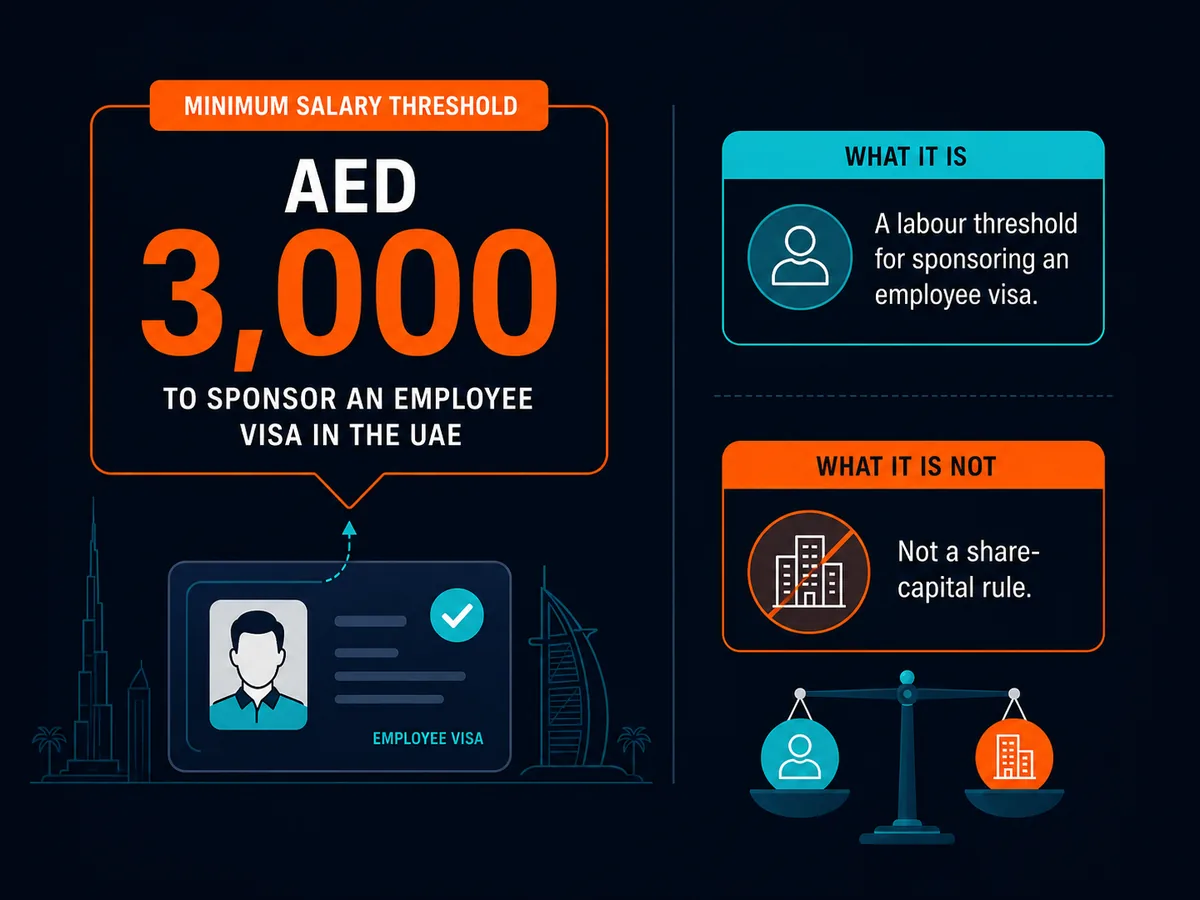
It is a labour rule, not a company rule. To sponsor an employee for a standard residence visa, the company must pay them at least AED 3,000 per month. To let that employee then sponsor a spouse or child, salary must usually clear AED 4,000 (or AED 3,000 with employer housing). The thresholds come from Ministry of Human Resources and Emiratisation guidance — see MOHRE. Founders on an investor or partner visa are not subject to it. The rule matters once you start hiring.
Can a foreigner set up a company in Dubai?
Yes, with full ownership in almost all cases. The 2021 amendments to the UAE Commercial Companies Law (Federal Decree-Law No. 32 of 2021) removed the 51% Emirati shareholder requirement for most mainland activities. Free zones have offered 100% foreign ownership since inception. Reserved activities — defence, certain oil and gas, parts of banking — still require local participation, and a small number of "strategic impact" activities are reviewed case by case.
You will need a passport copy, a recent utility bill or bank statement for proof of address, a CV or business plan for some regulators, and clean KYC. Criminal background checks are now standard at the larger free zones.
Realistic timeline
- Day 1–3: Choose activity, jurisdiction, name. Initial approval.
- Day 4–10: Pay licence fees, sign MOA / shareholder resolution, receive trade licence.
- Week 2–4: Establishment card, entry permit, status change, medical, Emirates ID biometrics, residence stamping.
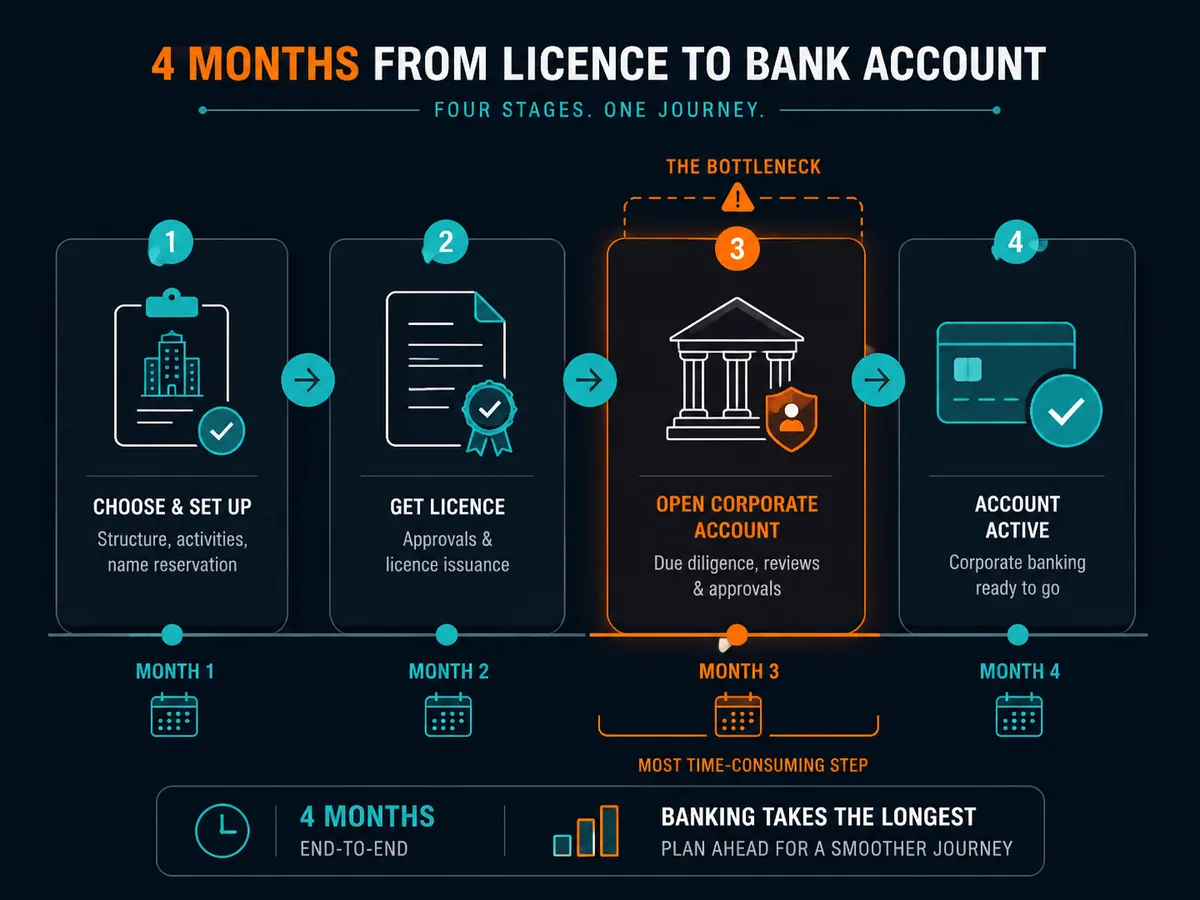
- Week 4–12: Corporate bank account at Emirates NBD, Mashreq, WIO or RAKBank. Compliance review is the slow step.
Plan four months end-to-end if banking matters. Plan two weeks if you only need the licence and visa.
Common mistakes and how to avoid them
Choosing a free zone by price alone. The cheapest licence often comes with a free zone whose name carries no weight with banks, payment processors or counterparties. DMCC, DIFC, ADGM and IFZA open doors that AED 5,500 specials do not.
Assuming the licence equals tax residence. A UAE trade licence is not a Tax Residency Certificate. The TRC requires 183 days of physical presence or a 90-day rule with qualifying ties, per Cabinet Decision No. 85 of 2022. Without it, your home country can still claim you.
Ignoring economic substance and corporate tax filings. Even free zone companies must file an annual corporate tax return with the Federal Tax Authority. Skipping it does not save tax — it generates penalties.
Using a "nominee" or address-only setup. This fails substance tests everywhere and is grounds for the home tax authority to disregard the structure entirely.
Trusting a setup agent for tax advice. Formation agents form companies. They are not licensed to advise on US, German or French tax. The cost of getting that wrong dwarfs the cost of an hour with a qualified adviser.
When to consult a qualified professional
Before signing anything, talk to:
- A tax adviser in your home jurisdiction about exit, CFC and reporting consequences.
- A UAE tax adviser or licensed corporate service provider about activity classification, corporate tax positioning and the Qualifying Free Zone Person test.
- A lawyer if shareholders are split across jurisdictions, if you plan to take outside investment, or if IP will sit in the UAE entity.
We maintain an editorial policy and affiliate disclosure explaining how we evaluate providers. We do not currently take commissions from UAE setup agents; when we do, it will be disclosed inline.
FAQ
How much does it cost to set up a company in the UAE?
Budget AED 12,500–35,000 (roughly USD 3,400–9,500) for a first-year free zone licence with one visa. IFZA and Meydan sit at the lower end; DMCC and DIFC at the upper end. Mainland licences through the Department of Economy and Tourism in Dubai usually start near AED 15,000 once name reservation, initial approval, MOA notarisation and the trade licence are paid. Add Emirates ID, medical and visa stamping (around AED 3,500–5,000 per person), plus an Ejari-registered office or flexi-desk. Year-two renewals are typically 20–30% cheaper than year one.
What is the 3,000 dirham rule in Dubai?
It refers to the AED 3,000 minimum monthly salary a company must pay a sponsored employee to qualify them for a standard residence visa; to sponsor dependants the employee must usually earn at least AED 4,000 (or AED 3,000 with employer-provided accommodation), per MOHRE rules. It is not a rule about company share capital. Founders on an investor visa are not bound by it, but if you plan to hire and sponsor staff, your payroll has to clear that threshold.
Can a foreigner set up a company in Dubai?
Yes. Since the 2021 amendment to the UAE Commercial Companies Law, foreigners can own 100% of a mainland LLC across most activities, removing the old 51% Emirati partner requirement. Free zones have always allowed full foreign ownership. You will need a passport, proof of address, a business plan for some regulators, and — if you want to live in the UAE — a residence visa tied to the company. Certain strategic activities (defence, oil and gas, some banking) still require local participation.
What business can I start with AED 50,000 in Dubai?
AED 50,000 (about USD 13,600) is enough to launch a service business: consulting, marketing, software development, e-commerce, content production, or a small trading company. It covers a free zone licence with one or two visas, a flexi-desk, banking setup costs and a few months of runway. It is not enough for inventory-heavy retail, a physical restaurant, or any regulated activity (financial services, healthcare, education) where capital requirements and approval fees push setup well into six figures.
Do I still pay tax at home if I incorporate in the UAE?
Often, yes. US citizens and green-card holders are taxed on worldwide income regardless of where their company sits, and a UAE entity is reportable on Forms 5471, 8938 and FBAR. EU tax residents who keep their centre of vital interests at home remain taxable there and may trigger Controlled Foreign Company rules that attribute the UAE company's profits back to them. Moving the company without moving yourself rarely works. Get advice in both jurisdictions before you file anything.
How long does UAE company formation take?
A straightforward free zone licence — IFZA, Meydan, SHAMS — can be issued in 3–7 working days once KYC and payment are complete. Mainland licences through Dubai's Department of Economy and Tourism typically take 5–10 working days. Visa stamping adds another 2–4 weeks: entry permit, status change, medical, Emirates ID biometrics, residence stamping. Corporate bank account opening is the real bottleneck — expect 4–12 weeks at a UAE bank, longer if shareholders are from sanctioned-adjacent jurisdictions or the business model is unusual.
Ready to act on this?
SPC Free Zone (Sharjah) — UAE free-zone formation with a public referral programme. Soveraine readers go to the front of the line through our partner link, and you fund independent editorial in the process.
Sources
- UAE Ministry of Finance — Corporate Tax: https://mof.gov.ae/corporate-tax/
- Federal Decree-Law No. 47 of 2022 on the Taxation of Corporations and Businesses: https://mof.gov.ae/
- Cabinet Decision No. 100 of 2023 — Qualifying Free Zone Person: https://mof.gov.ae/
- UAE Federal Tax Authority — Tax Residency Certificate: https://tax.gov.ae/en/services/issuance.of.tax.residency.certificate.aspx
- Cabinet Decision No. 85 of 2022 — Determination of Tax Residency: https://mof.gov.ae/
- UAE Commercial Companies Law (Federal Decree-Law No. 32 of 2021): https://www.moec.gov.ae/
- Ministry of Human Resources and Emiratisation (MOHRE): https://www.mohre.gov.ae/
- Dubai Department of Economy and Tourism: https://www.economy.gov.ae/ and https://invest.dubai.ae/
- DMCC business setup fees: https://www.dmcc.ae/setup-a-business
- IFZA: https://ifza.com/
- US IRS Form 5471: https://www.irs.gov/forms-pubs/about-form-5471
- US IRC §951A (GILTI): https://www.law.cornell.edu/uscode/text/26/951A
- US IRS Foreign Earned Income Exclusion: https://www.irs.gov/individuals/international-taxpayers/foreign-earned-income-exclusion
- FinCEN FBAR (Form 114): https://bsaefiling.fincen.treas.gov/main.html
- EU Anti-Tax Avoidance Directive (ATAD): https://eur-lex.europa.eu/legal-content/EN/TXT/?uri=celex%3A32016L1164
- France Article 209 B CGI: https://www.legifrance.gouv.fr/codes/article_lc/LEGIARTI000033817781
- Dubai Financial Services Authority: https://www.dfsa.ae/
- ADGM Financial Services Regulatory Authority: https://www.adgm.com/