
The question "how much does it cost to start an LLC" has an honest answer and a marketing answer, and for a non-US resident the gap between them is wide. The marketing answer is the state filing fee — "form your LLC for $0 plus state fees" — which conveniently ignores the registered agent you are legally required to have, the US address you need to open a bank account, and the annual federal filing that most foreign-owned LLCs are quietly on the hook for. The honest answer is a stack of line items, some one-time and some recurring, that together determine what your entity actually costs in year one and every year after. This guide breaks down every component — verified against current Secretary-of-State fee schedules and IRS rules — and gives you two realistic total-cost tables: one for the do-it-yourself route, one for the done-for-you route. It is written for non-residents in three groups: US persons, EU residents, and readers outside both blocs.
Doola — US LLC + registered agent + EIN + tax filings in one price, built for non-residents
The seven cost components, and which are optional
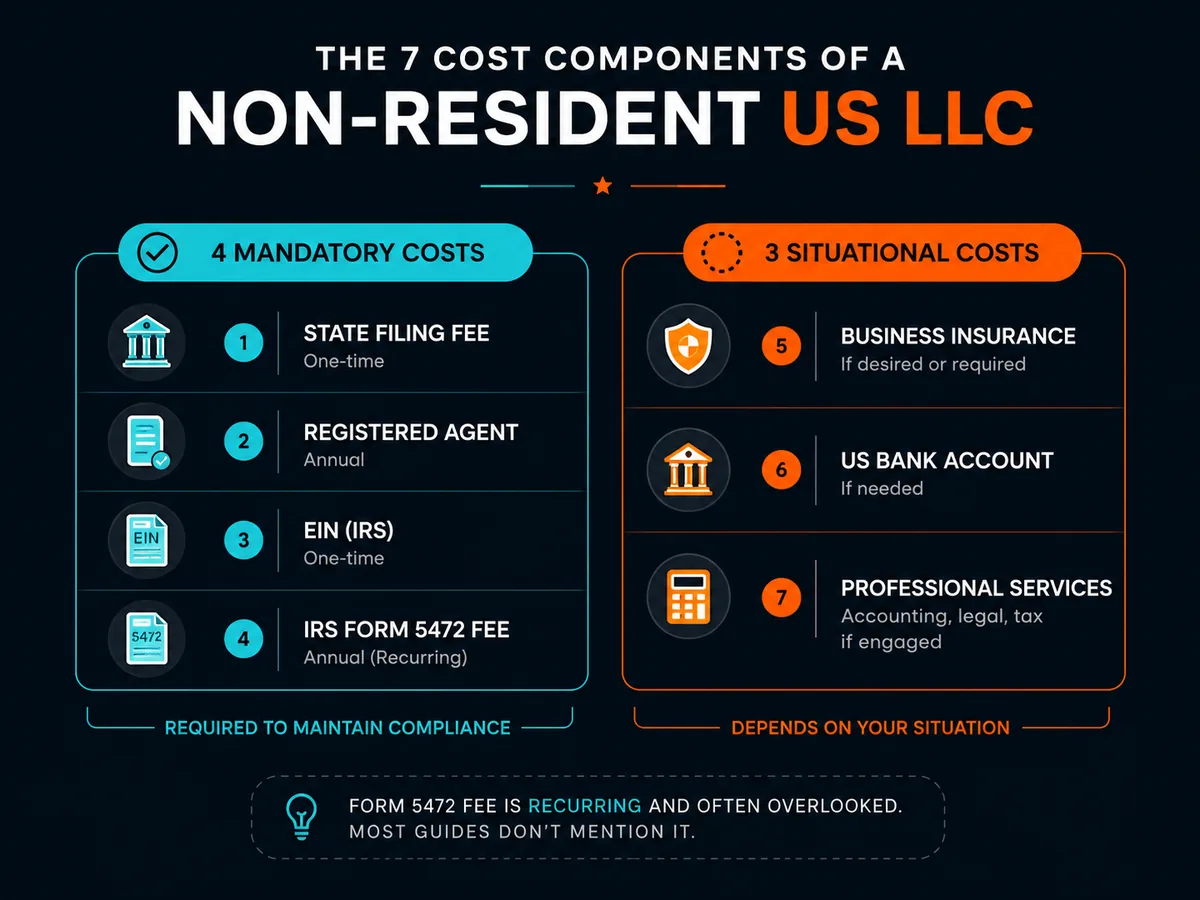
Every US LLC cost falls into one of seven buckets. Four are effectively mandatory for a non-resident who wants a functioning entity with a bank account; three are situational. Getting clear on the buckets is what lets you see past the "$0 formation" headline.
The mandatory four are the state filing fee (one-time, to bring the entity into existence), the registered agent (annual, legally required in every state), a US business address (practically required to open a bank account and file cleanly), and the EIN (one-time, free from the IRS but a prerequisite for everything). The situational three are the state annual report or franchise tax (recurring, but $0 in some states), the formation-service fee (optional — the premium for done-for-you versus DIY), and Form 5472 preparation (recurring, and the single most-omitted cost in nearly every guide aimed at non-residents).
That last one deserves emphasis up front because it inverts the usual advice. Guides obsess over saving $50 on a state filing fee while ignoring that a foreign-owned single-member LLC carries a mandatory annual federal information return — Form 5472 with a pro-forma 1120 — whose preparation, if you hire a CPA, costs several times the state fee every single year. Optimising the cheap, one-time number while ignoring the expensive, recurring one is the classic non-resident mistake. We cover the full mechanics in our Form 5472 guide; here the point is simply that it belongs in your cost model from day one.
State filing fee — where the numbers diverge
The state filing fee is the cost to file your Articles of Organization (called a Certificate of Formation in Delaware, a Certificate of Organization in Massachusetts) and bring the LLC into legal existence. It is a one-time charge, paid to the Secretary of State, and it is the number most "LLC cost" content fixates on. For a non-resident with no physical US presence, you are free to choose almost any state, which means you can and should shop on cost and compliance rather than geography.
The spread is dramatic. The genuinely cheap states cluster around $35-100; a handful of expensive states charge five to fifteen times that. Here are the figures that matter for non-residents, taken from each state's own fee schedule:
- New Mexico — $50 to file, $0 recurring. New Mexico is the outlier: a $50 Articles of Organization fee and, uniquely among popular states, no annual report and no annual state fee at all. Recurring state cost is genuinely zero. The trade-off is thinner registered-agent infrastructure and less of the privacy machinery Wyoming is known for.
- Montana — $35 to file. The lowest headline filing fee in the country. Montana's on-time annual report fee ($20 historically) has been administratively waived for 2026 and 2027, though filings after the April 15 deadline are charged.
- Wyoming — $100 to file, $60 minimum annual report. The most popular non-resident choice, covered in depth in our Wyoming LLC cost pillar. The $100 fee and $60 annual report (technically a license tax of the greater of $60 or two-tenths of one mill on Wyoming assets) buy a mature, privacy-friendly, non-resident-tested ecosystem.
- Delaware — $90 to file, $300 flat annual franchise tax. Delaware's Certificate of Formation is $90, but every LLC owes a flat $300 annual franchise tax due June 1 regardless of income or activity. The reasons founders still choose it — Court of Chancery, investor familiarity — are set out in our Delaware LLC benefits pillar.
- Massachusetts — $500 to file, $500 annual report. One of the most expensive states in the country: $500 to file the Certificate of Organization ($520 online with the surcharge) and another $500 every year for the annual report. Only worth it if you have a specific Massachusetts reason.
- California — $70 to file, plus the $800 franchise tax trap. The $70 filing fee looks cheap until the $800 minimum annual franchise tax lands, due even at zero profit, even if you never visit. Add a $20 biennial Statement of Information. California is almost never right for a non-resident, and the way it snares people through unintended nexus is a genuine hazard.
Which state actually fits your situation is a bigger question than cost alone — it turns on banking, privacy, and your business model — and we work through it in which state is best for an LLC for a non-resident. For pure cost, the answer for most location-independent non-residents is Wyoming or New Mexico.
| State | Filing fee (one-time) | Recurring state fee | Notes for non-residents |
|---|---|---|---|
| Montana | $35 | $0 in 2026-2027 (normally ~$20) | Lowest filing fee; thin agent market |
| New Mexico | $50 | $0 (no annual report) | Cheapest to run; strong privacy, less infrastructure |
| Delaware | $90 | $300 flat franchise tax | Investor-friendly; $300 due every June 1 |
| Wyoming | $100 | $60 minimum annual report | Most popular non-resident choice |
| California | $70 | $800 minimum franchise tax + $20 biennial | Avoid unless you have real CA nexus |
| Massachusetts | $500 | $500 annual report | Among the most expensive in the US |
Registered agent — the mandatory annual you cannot skip
Every US state requires an LLC to maintain a registered agent: a person or company with a physical address in the state of formation who accepts legal service of process and official state mail during business hours. A non-resident, by definition, does not have a physical presence in Wyoming or Delaware, so a commercial registered agent is not optional — it is a structural requirement of having the entity at all. Our registered agent guide covers the role in full.
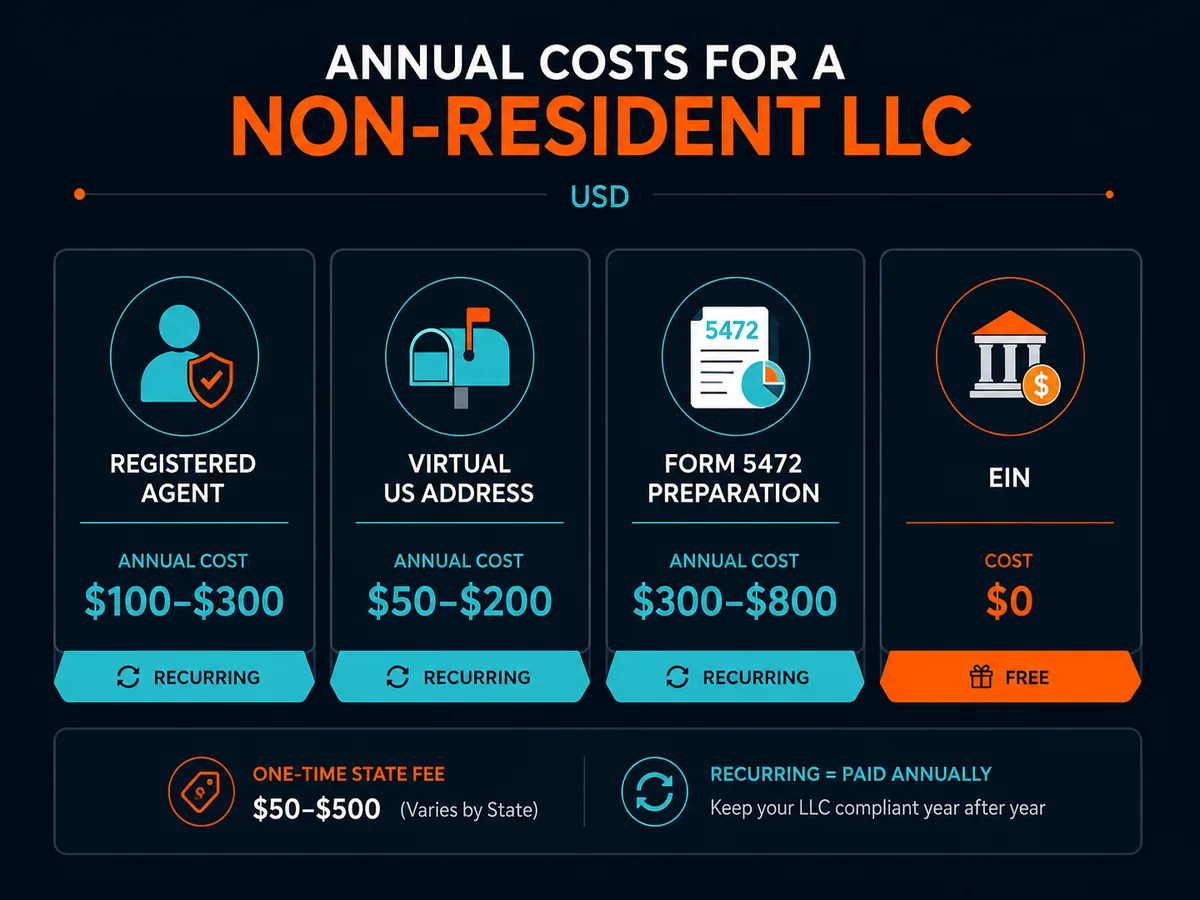
Pricing runs from $0 to about $300 a year. The $0 figure appears when a formation service includes the first year of registered-agent service free as an acquisition hook, then renews at $100-300. Standalone, the market clusters as follows: Northwest Registered Agent charges a flat $125 a year and is the choice most non-resident specialists recommend for its privacy stance and mail handling; ZenBusiness is cheaper in year one and renews higher; Bizee offers a free first year on formation and renews around $249. Budget $100-150 a year as a realistic mid-market figure. Paying much more than $150 for a bare registered agent, with no address or mail-scanning attached, is overpaying.
US business address — the cost most DIY guides forget
A registered-agent address and a business mailing address are not the same thing, and conflating them causes problems. The registered agent's address is for legal service and state correspondence; many agents will not let you use it as your general business address, and the IRS specifically dislikes seeing the registered-agent address on your EIN application. To open a business bank account, register with the IRS cleanly, and receive commercial mail, you need a real US street address with mail scanning — a virtual mailbox.
Virtual US addresses run $10-30 a month, or roughly $120-360 a year, depending on the provider and how much mail-forwarding and scanning you use. iPostal1 sits at the affordable end with thousands of address locations; premium and CMRA-compliant options cost more. This is a genuine recurring cost that the "$0 formation" framing ignores entirely, and it matters more for non-residents than for US founders because you cannot fall back on a home address. The full breakdown, including which addresses banks accept, is in our virtual address for LLC guide and the related US proof of address piece.
EIN — free from the IRS, priced by everyone else
The Employer Identification Number is the federal tax ID your LLC needs before it can open a bank account, take Stripe payouts, or file anything. The IRS charges nothing for it. A non-resident without an SSN or ITIN cannot use the instant online tool but can obtain the identical EIN for free by phone, fax or mail — the mechanics are in our EIN for non-US residents guide.
So why does "EIN" show up on price lists? Because formation services sell the labour of obtaining it, not the number. Bundled into a formation package it often costs nothing marginal; as a standalone add-on it runs $50-200, which pays for the phone call, the documentation packet, and the follow-up if the IRS asks for clarification. That can be reasonable value for a non-resident who would rather not spend forty minutes on an international call at 6am — but it is a service fee, never a government fee. Any provider implying the EIN itself has a cost from the IRS is being dishonest.
State annual report and franchise tax — the recurring state bill
Beyond the one-time filing fee, most states charge to keep the entity in good standing each year — an annual (or in some states biennial) report, sometimes paired with a franchise tax. This is pure recurring cost, and it varies as widely as the filing fee. New Mexico charges nothing. Wyoming's minimum is $60. Delaware's flat franchise tax is $300. California's minimum franchise tax is $800. Massachusetts charges $500 a year for its annual report.
The strategic point for a non-resident is that this recurring number, not the one-time filing fee, is what compounds over the life of the entity. Over five years a New Mexico LLC pays $0 in recurring state fees; a Wyoming LLC pays $300; a Delaware LLC pays $1,500; a California LLC pays $4,000 in franchise tax alone. Choosing a state on its $50-versus-$100 filing fee while ignoring a $300-versus-$800 annual obligation is optimising the wrong variable. Missing these filings has consequences too: the state administratively dissolves the LLC, and reinstating it plus catching up back fees costs far more than staying current — which is partly why a certificate of good standing is worth keeping clean.
Form 5472 — the recurring cost almost every guide omits
Here is the line item that changes the whole calculation. Since 2017, a US LLC that is wholly owned by a foreign person and treated as a disregarded entity — the default structure for the overwhelming majority of non-resident single-member LLCs — must file Form 5472 together with a pro-forma Form 1120 every year, reporting reportable transactions between the LLC and its foreign owner. This is not income tax; it is an information return, and it applies even to an LLC with no US tax liability and modest activity. The governing rule is IRC §6038A, and the penalty for a late or incomplete filing is $25,000 per form, per year, with no cap. Our single-member LLC for non-residents guide and the Form 5472 pillar cover exactly who is caught and how to file.
The cost consequence: because Form 5472 is technical, cannot be filed electronically by most non-residents, and carries a punishing penalty, most foreign owners pay a US CPA or a specialist to prepare it. That runs $200-600 a year for a simple, low-transaction single-member LLC, higher for active businesses. Specialist expat-tax firms such as Bright!Tax and Greenback price the 5472 in that band, and formation services like Doola fold it into an annual compliance plan. A confident owner with a simple profile can prepare and mail it themselves, but the $25,000 downside is why many treat the CPA fee as cheap insurance. Either way, this recurring number belongs in your model — and it typically exceeds every state fee combined.
Formation-service fee — the DIY versus done-for-you premium
The final variable is whether you assemble the pieces yourself or pay one provider to do it. Doing it yourself means filing directly with the Secretary of State (paying only the state fee), contracting a registered agent, arranging a virtual address, and calling the IRS for the free EIN. Total service markup: zero. A done-for-you formation service charges a fee on top of the state cost to consolidate all of that into one order and one renewal.
Those service fees, verified against current 2026 pricing, run from $0 to around $500. Bizee and ZenBusiness advertise $0 formation plus state fees, monetising through registered-agent renewals and add-ons. Northwest charges a modest fee and includes a year of registered agent. Doola (around $297) and Firstbase (around $399) are purpose-built for non-residents and bundle the EIN, address and banking introductions that a foreign founder actually needs. We compare them head-to-head in best LLC formation services for non-residents. The honest split is this: the cheapest raw path is always DIY, but for a non-resident coordinating unfamiliar US agencies across time zones, paying one accountable provider $300-400 to deliver a working entity — EIN and address included — is frequently worth every dollar.
Two realistic totals — DIY versus done-for-you
Enough components. Here is what a real non-resident actually pays, using a Wyoming LLC as the reference case (the most common non-resident choice) and separating the one-time first-year cost from the recurring annual cost.
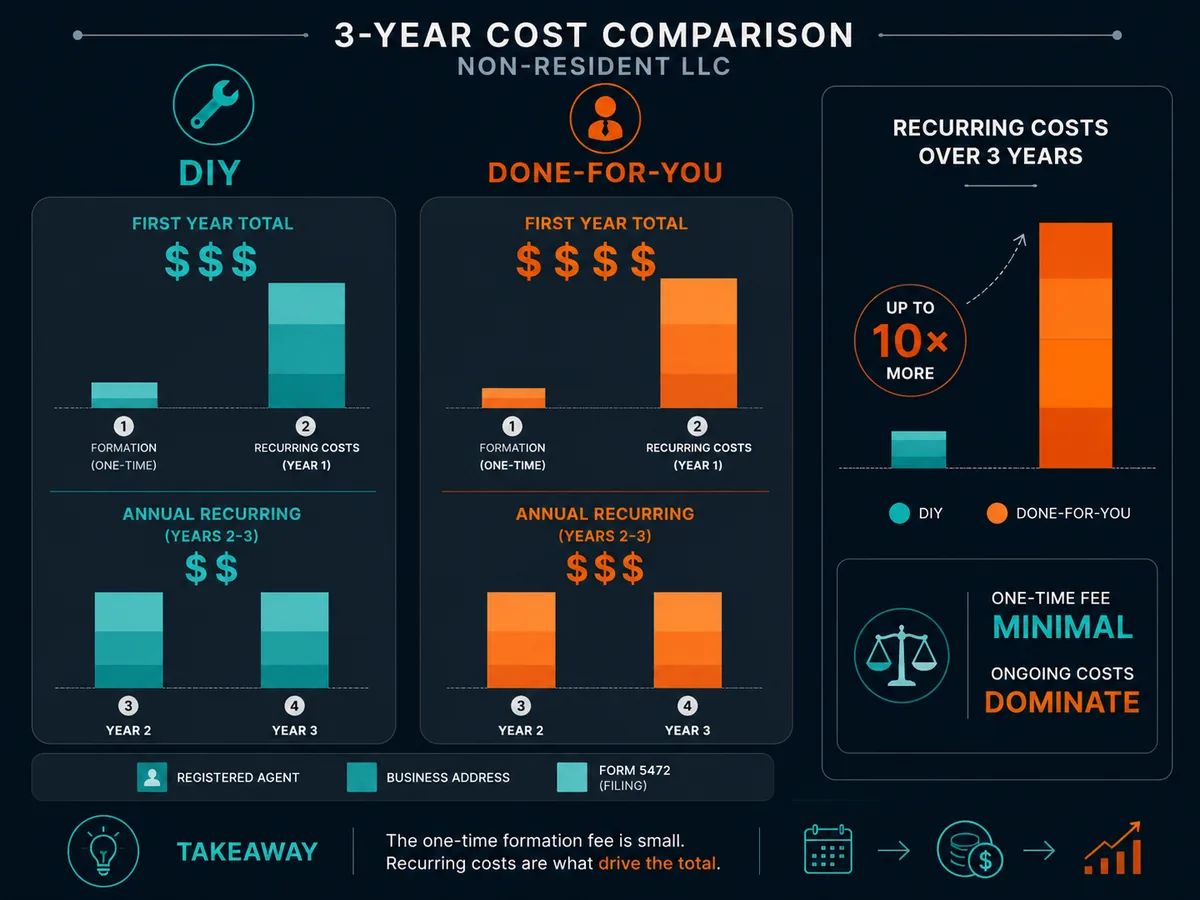
Do-it-yourself Wyoming LLC: state filing fee $100 (one-time), registered agent $125, virtual US address $180 a year, EIN $0. First-year total: about $405. If you also file Form 5472 yourself, that is your complete cost. If you hire a CPA for the 5472 at $300, first-year total is about $705. Recurring annual cost thereafter: $60 (Wyoming annual report) + $125 agent + $180 address = $365, or about $665 with the CPA-prepared 5472.
Done-for-you Wyoming LLC: a formation service package bundling filing, first-year registered agent, EIN and address typically runs $400-900 in year one depending on tier, with the state fee sometimes included and sometimes added. Recurring annual cost lands around $500-900, higher if you add a full tax-compliance plan that covers the 5472. You pay a premium of a few hundred dollars for consolidation and support.
Swap the state and the totals shift predictably: New Mexico removes the $60 annual report (saving $60 a year), Delaware adds $300 a year, California adds $800 a year, Massachusetts adds $500 a year. The federal Form 5472 cost stays the same regardless of state — which is exactly why, for a non-resident, state choice matters far less to your total cost than the compliance decisions that follow it.
When paying more is the cheaper decision
The instinct to minimise the visible number is understandable, but a few places reward spending more. Paying a registered agent with proper mail scanning beats saving $50 on a bare agent who forwards nothing and loses your state notices. Paying a CPA $300-600 for Form 5472 beats a $25,000 penalty. Paying for a formation service beats forming in the wrong state, missing a franchise-tax deadline, or filing an EIN application with the registered-agent address and never seeing your CP 575.
The Soveraine view: choose your state on total lifetime cost, not the filing fee — Wyoming or New Mexico for most non-residents. Budget realistically for the four mandatory components plus Form 5472, not just the one-time filing fee the headlines quote. And decide DIY versus done-for-you honestly on whether your constraint is money or time. Both routes produce the same functioning entity; they differ only in who does the assembly and how much support you buy. What no route lets you skip is the recurring federal filing — the cost most guides pretend does not exist.
FAQ
How much does it really cost to start an LLC as a non-resident
The all-in first-year cost for a non-resident typically lands between $250 and $1,200, depending on the state and how much you delegate. A do-it-yourself Wyoming or New Mexico LLC runs about $250-400: the state filing fee ($100 or $50), a registered agent ($50-150), a virtual US address ($120-360 a year) and a free EIN you obtain yourself. A done-for-you package through a formation service that bundles the EIN, registered agent and address costs $400-900 in year one. Where the number climbs is state choice — California adds an $800 franchise tax and Massachusetts charges $500 just to file — and the annual Form 5472 preparation most foreign owners eventually pay a CPA $200-600 to handle.
What is the cheapest state to form an LLC as a non-resident
New Mexico has the lowest headline cost: a $50 filing fee and, uniquely, no annual report and no annual state fee, so recurring state cost is genuinely $0. Wyoming is the more popular choice at $100 to file and a $60 minimum annual report, because it pairs low cost with strong privacy and a mature registered-agent market. Montana files for $35. The catch with the cheapest states is that low state cost does not lower your federal obligations — every foreign-owned single-member LLC still files Form 5472 regardless of state, and that federal compliance cost dwarfs the state filing fee over time.
Do I have to pay the $800 California franchise tax if I never visit California
If your LLC is formed in California or is "doing business" in California, yes — the $800 minimum annual franchise tax applies even with zero profit and even if you never set foot in the state. This is why non-residents almost never form in California. The trap catches people who use a California-based virtual address, hire a California contractor, or hold inventory there, any of which can create nexus. For a location-independent online business with no California connection, forming in Wyoming, New Mexico or Delaware avoids the $800 entirely.
Is the EIN free, or do I have to pay for it
The IRS charges nothing for an EIN — it is free whether you apply by phone, fax or mail. What you may pay for is the labour of someone filing Form SS-4 on your behalf. Formation services bundle the EIN into their packages or sell it as a $50-200 add-on, which buys you the phone call and the paperwork handling rather than the number itself. A non-resident with time and comfortable English can obtain the same nine-digit EIN for free by calling the IRS international line. Any service implying the EIN itself has a government fee is misleading you.
What ongoing annual costs does a non-resident LLC have
Recurring annual cost has four typical components: the state annual report or franchise tax (from $0 in New Mexico to $800 in California), the registered agent renewal ($0-300), the virtual US address ($120-360 a year), and Form 5472 preparation if you use a CPA ($200-600). For a lean Wyoming LLC that is roughly $60 state, $125 agent, $180 address and $300 for the 5472 — about $665 a year all in. Skip the CPA and file the 5472 yourself and it drops to around $365. Delaware adds $300, California adds $800 on top.
How much does Form 5472 cost to prepare each year
Form 5472 preparation for a foreign-owned single-member LLC typically costs $200-600 a year through a US CPA or specialist firm, with simple, low-transaction entities at the bottom of that range and more active businesses higher. The form itself carries no government fee, but it is technical, cannot be filed electronically by most non-residents, and carries a $25,000 penalty for a late or incomplete filing under IRC §6038A. Many owners consider the CPA fee cheap insurance against that penalty. A confident owner with a simple reporting profile can prepare and mail it themselves for the cost of postage.
Is it cheaper to use a formation service or do everything myself
Doing it yourself is always cheaper in raw dollars — you pay only the state fee plus a registered agent and address, and you get the EIN free. A DIY Wyoming LLC can be live for under $300. A formation service adds $0-500 in service fees on top of the state cost, but it consolidates the state filing, registered agent, EIN and US address into one workflow and one renewal, which for a non-resident coordinating across time zones and unfamiliar agencies is often worth the premium. The honest split: DIY if you value money and have time; done-for-you if you value time and want one accountable provider.
This guide is editorial. We hold affiliate relationships with Doola, Firstbase, Northwest Registered Agent, Bizee, ZenBusiness, iPostal1, Bright!Tax and Greenback, disclosed via our affiliate disclosure. Nothing here is tax or legal advice — see our disclaimer.
Ready to act on this?
Doola — US LLC, registered agent, EIN and tax filings in one transparent price, built for non-residents. One accountable provider instead of five separate renewals, and Soveraine readers fund independent editorial through our partner link.
Sources
- Wyoming Secretary of State — Business Division Fee Schedule: https://sos.wyo.gov/business/docs/businessfees.pdf
- Wyoming Secretary of State — Annual Report: https://wyobiz.wyo.gov/Business/AnnualReport.aspx
- New Mexico Secretary of State — Business Services (LLC filing): https://www.sos.nm.gov/business-services/start-a-business/limited-liability-company-llc/
- Delaware Division of Corporations — LLC/LP/GP Franchise Tax Instructions ($300 annual tax): https://corp.delaware.gov/paytaxes/
- Delaware Division of Corporations — Filing Fees: https://corp.delaware.gov/fee/
- Montana Secretary of State — Business Services Filing Fees: https://sosmt.gov/business/fees/
- Massachusetts Secretary of the Commonwealth — Corporations Division Filing Fees: https://www.sec.state.ma.us/divisions/corporations/general-information/corporations-filing-fees.htm
- California Franchise Tax Board — Limited Liability Company ($800 annual tax): https://www.ftb.ca.gov/file/business/types/limited-liability-company/index.html
- IRS — About Form 5472: https://www.irs.gov/forms-pubs/about-form-5472
- IRS — Instructions for Form 5472 (penalties under IRC §6038A): https://www.irs.gov/instructions/i5472
- 26 U.S. Code § 6038A — Information with respect to certain foreign-owned corporations: https://www.law.cornell.edu/uscode/text/26/6038A
- IRS — Apply for an Employer Identification Number (EIN): https://www.irs.gov/businesses/small-businesses-self-employed/apply-for-an-employer-identification-number-ein-online