
A virtual address for an LLC is a commercial street address you can use on your LLC's filings, website and bank applications without renting an office. Done right, it is a legitimate compliance tool. Done carelessly, it triggers bank rejections, missed legal notices and state tax disputes. This article covers what a virtual address is, what it cannot do, how the rules differ for US persons, EU freelancers and non-US, non-EU founders, and what to look for in a provider. It does not cover full virtual office packages (meeting rooms, receptionists) or registered agent services in depth — those are adjacent products with their own rules.
iPostal1 — Virtual US address + mail scanning
What a virtual address for an LLC actually is
A virtual address is a real commercial street address, operated by a mail-handling company, that you are licensed to use as a business address. You file USPS Form 1583 — notarised, with two forms of ID — to authorise the provider to receive mail on your behalf. They scan envelopes, open and scan contents on request, forward physical mail, and shred what you do not want.
Three things a virtual address is not:
- It is not a PO Box. PO Boxes have separate rules and are rejected by many banks and state agencies.
- It is not a registered agent. The registered agent receives service of process and state correspondence and must be available in person during business hours.
- It is not proof of residency, nexus, or a "place of business" for tax purposes. It is a mailing address.
Who this applies to — by nationality
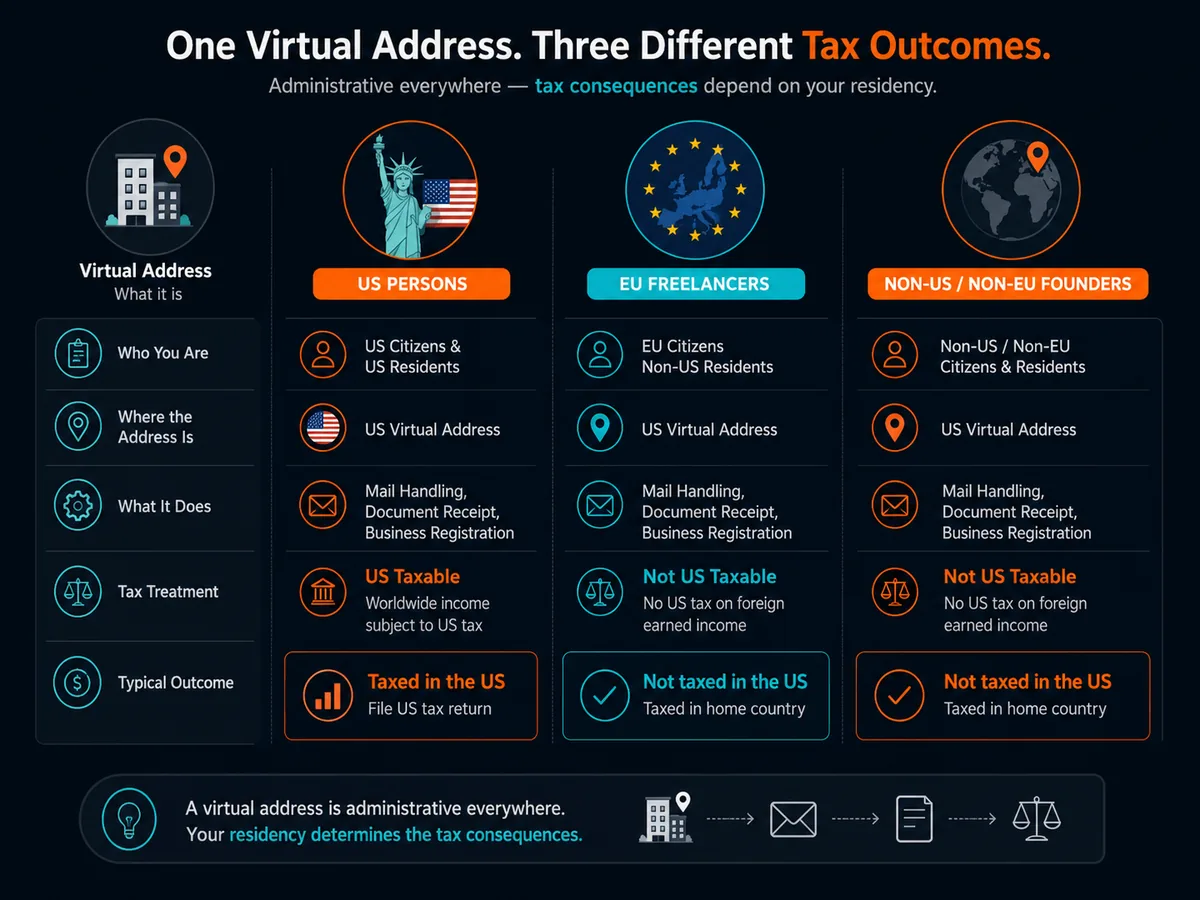
The mechanics of getting a US virtual address are the same for everyone. The tax consequences are not.
US persons (citizens and green-card holders)
A US LLC is usually a disregarded entity (single-member) or partnership (multi-member) by default. Your worldwide income flows to your personal 1040 regardless of where the LLC's mailing address is. A virtual address in Wyoming does not move your tax residence and does not avoid state tax in California if that is where you live and work. The California FTB explicitly treats out-of-state LLCs with California-resident managing members as doing business in California, triggering the $800 franchise tax.
What a virtual address legitimately does for you: keeps your home address off public formation documents, satisfies the IRS mailing requirement, and gives you a stable business address through moves.
EU freelancers and digital nomads
A US LLC owned by an EU tax resident is a common structure, but it does not free you from your home country's tax. If you are tax resident in Germany, France, Spain or Portugal, your country's CFC rules and "place of effective management" doctrines will generally treat the LLC's profits as taxable to you personally, or treat the LLC itself as a domestic taxpayer.
A US virtual address makes the LLC look administratively American. It does not change where the LLC is managed, which is what most EU tax authorities care about. Use the address for what it is — a mailing point — and structure substance and tax residency separately, with advice from a tax professional in your home country.
Non-US, non-EU readers
This is the segment with the most flexibility. If you are tax resident in a territorial-tax jurisdiction (e.g. Georgia, Paraguay, UAE, Malaysia for foreign-source income), a US LLC with a virtual address can function as a clean billing and banking vehicle for non-US-source income, with no US federal income tax if the LLC has no US trade or business and no US-source income. The IRS confirms this treatment in the instructions to Form 1040-NR and through the Form 5472 filing requirement for foreign-owned single-member LLCs.
Even here, the virtual address is administrative. Your tax residence is determined by where you live, not where your mailbox is.
How to get a virtual address for an LLC
The process is straightforward.
- Pick a state. If you have no US ties, Wyoming, Delaware and New Mexico are the usual choices for non-resident-owned LLCs because of low fees, light reporting and mature service ecosystems. If you live in a US state, use your home state — out-of-state formation usually creates a foreign-qualification obligation that costs more than it saves.
- Choose a provider. Compare on: street address (not a suite-only number that screams "mail forwarder"), mail scanning included, forwarding cost, USPS 1583 process, and bank acceptance. iPostal1, Anytime Mailbox, Physical Address, Earth Class Mail and Stable are the larger players. Registered agent companies like Northwest also bundle a usable business address with formation.
- Complete USPS Form 1583. Notarised, two forms of ID. Many providers offer online notarisation.
- Update your records. File IRS Form 8822-B within 60 days of any address change for the LLC. Update your Secretary of State, bank, and any licensing bodies.
We have no affiliate relationship with the providers named above. See our affiliate disclosure for how we handle commercial links elsewhere on the site.

Does the IRS accept a virtual address
Yes, with a caveat. The IRS accepts any address where the taxpayer reliably receives mail. The address on Form SS-4 (EIN application), 8822-B (change of address) and your annual return needs to be one that gets correspondence to you. The risk is not formal rejection — it is missed notices. A CP2000, a CP504 or a Notice of Deficiency that you do not see still carries deadlines. Use a provider with same-day or next-day scanning and turn on notifications.
For the LLC's "principal business address" on a return, the IRS does not define this term as strictly as some commentators imply. But if your operations are clearly run from a different country or state, putting a Wyoming virtual address on a Form 1065 while you operate from Lisbon is a misalignment that can come up in an audit.
Can you use a virtual address for an LLC in New Jersey
Yes for the business address, but New Jersey requires a registered agent with a physical New Jersey address available during business hours. The New Jersey Division of Revenue and Enterprise Services confirms the registered office must be a physical location in-state. Most virtual address providers operating in NJ also offer registered agent service — buy them together or use a dedicated registered agent and a separate mailbox. The same logic applies in California, New York and Texas, each of which has its own quirks.
Realistic costs and timeline
| Item | Typical cost | Notes |
|---|---|---|
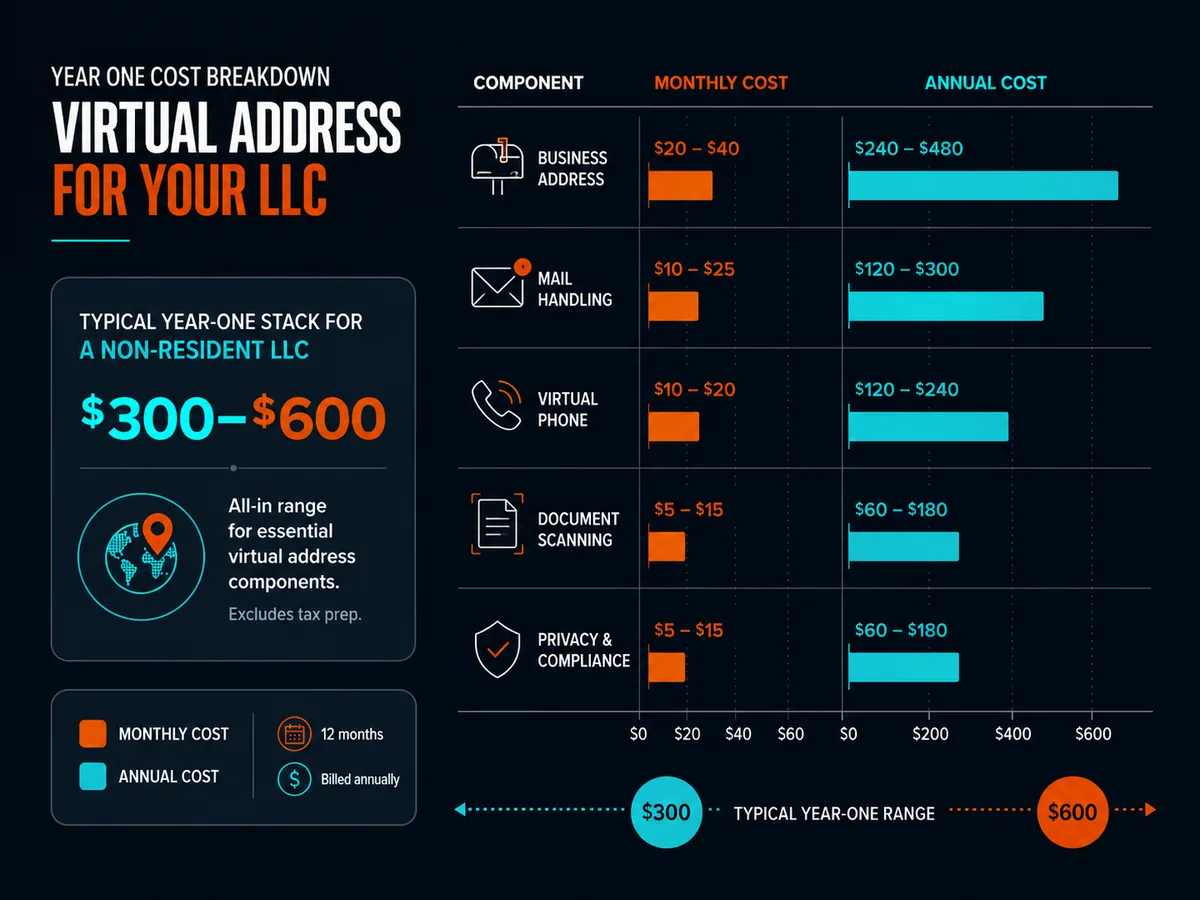
| Basic virtual mailbox | $7–$15/month | Mail scanning included, limited forwarding |
| Mid-tier mailbox | $20–$40/month | More mail items, faster scanning, cheaper forwarding |
| Registered agent (separate) | $50–$200/year | Required in every state |
| USPS Form 1583 notarisation | $0–$25 | Many providers include online notary |
| Setup time | 1–5 business days | Most of this is the 1583 process |
| LLC formation (DIY) | $50–$500 state fee | Plus registered agent if needed |
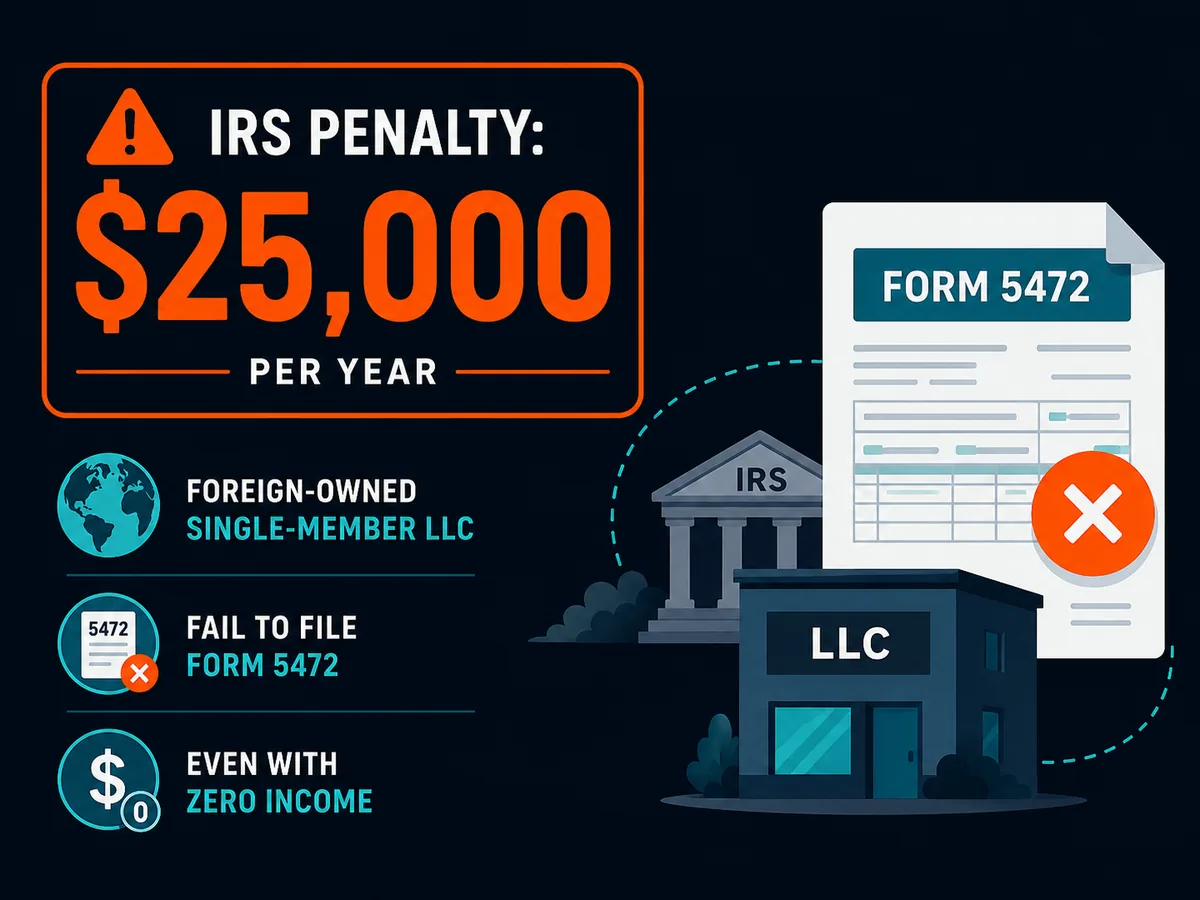
| Form 5472 filing (foreign-owned SMLLC) | $0 to file, ~$300–$800 to prepare | $25,000 penalty for non-filing per IRC §6038A |
Budget $300–$600 in year one for a typical non-resident-owned single-member LLC including formation, registered agent, virtual address and basic compliance. Add a tax preparer for the 5472/1120 pro forma.
Common mistakes and how to avoid them
Using the same address as your registered agent without checking. Some banks pattern-match registered agent addresses and decline applications. Use a separate virtual mailbox for banking and customer-facing materials.
Putting a virtual address on a US LLC operated from a state where you actually live and work. This does not avoid the home state's franchise tax or income tax. It creates a paper trail that contradicts your actual operations.
Forgetting Form 8822-B. A 60-day rule, often missed. The IRS will eventually catch up via the next return, but in the meantime, notices go to the old address.
Treating the address as a residency claim. A virtual address does not establish US tax residency, voting residency, or any other kind of residency. Using it to claim benefits tied to physical presence is fraud.
Skipping the 5472 filing. Foreign-owned single-member LLCs must file Form 5472 with a pro forma 1120 every year, even with zero income. The penalty is $25,000 per year per failure.
When to consult a qualified professional
A virtual address is a low-stakes decision. The structure around it is not. Talk to a tax professional in your home country and a US CPA familiar with non-resident LLCs before you form anything if:
- You are an EU tax resident considering a US LLC for client billing.
- You are a US person considering an out-of-state LLC for tax reasons.
- You have employees, inventory or contractors in any US state.
- Your total revenue through the LLC will exceed roughly $100,000 per year.
For background on how we approach these topics, see our editorial policy and disclaimer.
Ready to act on this?
iPostal1 — Virtual US address + mail scanning. Soveraine readers go to the front of the line through our partner link, and you fund independent editorial in the process.
FAQ
Does the IRS accept a virtual address
Yes, for most filings. The IRS asks for the address where the entity receives mail and where the responsible party can be reached. A virtual address that genuinely forwards or scans mail to you satisfies that. What the IRS will not tolerate is mail that never reaches you — if a CP-series notice goes unanswered, the underlying assessment stands. For the LLC's principal place of business on Form 8832, 1120 or 1065, use the address that reflects where the business is actually managed. Misrepresenting that can create state-level nexus disputes later.
How do you get a virtual address for an LLC
Pick a provider with a real commercial street address (not a PO Box), choose a state that fits your business, sign up, and complete USPS Form 1583 with notarisation so the provider can legally receive your mail. Expect to pay between $10 and $40 per month for basic mail scanning, plus extras for forwarding. You then update the address with the IRS (Form 8822-B), your state's Secretary of State, your bank, and any licensing authorities. A virtual address does not replace a registered agent — those are separate roles in most states.
Can I use a virtual address for an LLC in New Jersey
Yes, but with caveats. New Jersey requires LLCs to maintain a registered office and registered agent in the state. A virtual address can serve as the principal business address, but the registered agent must be a person or company with a physical presence in New Jersey available during business hours. Some virtual office providers in New Jersey bundle both. Check the New Jersey Division of Revenue requirements before relying on a single provider for both functions.
How do you start an LLC without a physical address
Hire a registered agent service in your formation state — they provide a compliant in-state address for service of process. Then add a virtual mailbox for your business correspondence. Wyoming, Delaware and New Mexico are common formation states for non-residents because their registered agent ecosystems are mature. You will still need a real address somewhere on tax filings, and US banks generally want to see a US address and EIN before opening a business account. Mercury and Relay accept some virtual addresses; Chase and Bank of America are stricter.
What are the drawbacks of using a virtual address
Four main ones. Banks may reject the address during KYC if they recognise the provider's commercial address as a known mail forwarder. Some states (California, New York) take a sceptical view of virtual addresses for establishing principal place of business and can assert nexus where the work actually happens. Mail delays of three to seven days are common, which matters for time-sensitive legal notices. And in litigation, an opposing party can argue the LLC is not bona fide if the address is purely nominal. None of these are dealbreakers, but they are real.
Is a free virtual address for an LLC realistic
Not really. Truly free services are either PO Boxes (which most states and the IRS treat differently from a street address) or trial offers that convert to paid plans. Some incorporation services bundle a "free" business address into a higher-tier formation package, but you are paying for it through the formation fee. Expect $7 to $15 per month for a basic functional service. If a provider promises a free street address with mail scanning and no catch, read the terms — the catch is usually a 12-month contract or a per-scan fee that adds up.## Sources
- USPS Form 1583 — https://about.usps.com/forms/ps1583.pdf
- IRS Form 8822-B (Change of Address — Business) — https://www.irs.gov/forms-pubs/about-form-8822-b
- IRS Form 5472 — https://www.irs.gov/forms-pubs/about-form-5472
- IRS Form 1040-NR — https://www.irs.gov/forms-pubs/about-form-1040-nr
- 26 U.S. Code § 6038A (penalty for failure to file information returns) — https://www.law.cornell.edu/uscode/text/26/6038A
- California FTB — Doing Business in California — https://www.ftb.ca.gov/file/business/doing-business-in-california.html
- EU Anti-Tax Avoidance Directive (CFC rules) — https://taxation-customs.ec.europa.eu/anti-tax-avoidance-directive_en
- New Jersey Division of Revenue — LLC FAQ — https://www.nj.gov/treasury/revenue/llcfaq.shtml
- New Jersey Business Registration Portal — https://www.njportal.com/DOR/businessregistration/