
A US proof of address is a document with your name and a US street address from a source banks, the IRS and payment processors accept — typically a utility bill, bank statement, lease or government letter dated within ninety days. For non-residents, producing one legitimately is one of the more frustrating steps in setting up US business infrastructure. Banks need it to comply with the Customer Identification Program under 31 CFR §1020.220, Stripe needs it for KYC on payouts, and Amazon Seller Central asks for it during account verification. This article covers what works, what fails KYC, and which method fits which reader. It does not cover EIN applications, full LLC formation, or US tax filing.
iPostal1 — Virtual US address + mail scanning
What "proof of address" actually means
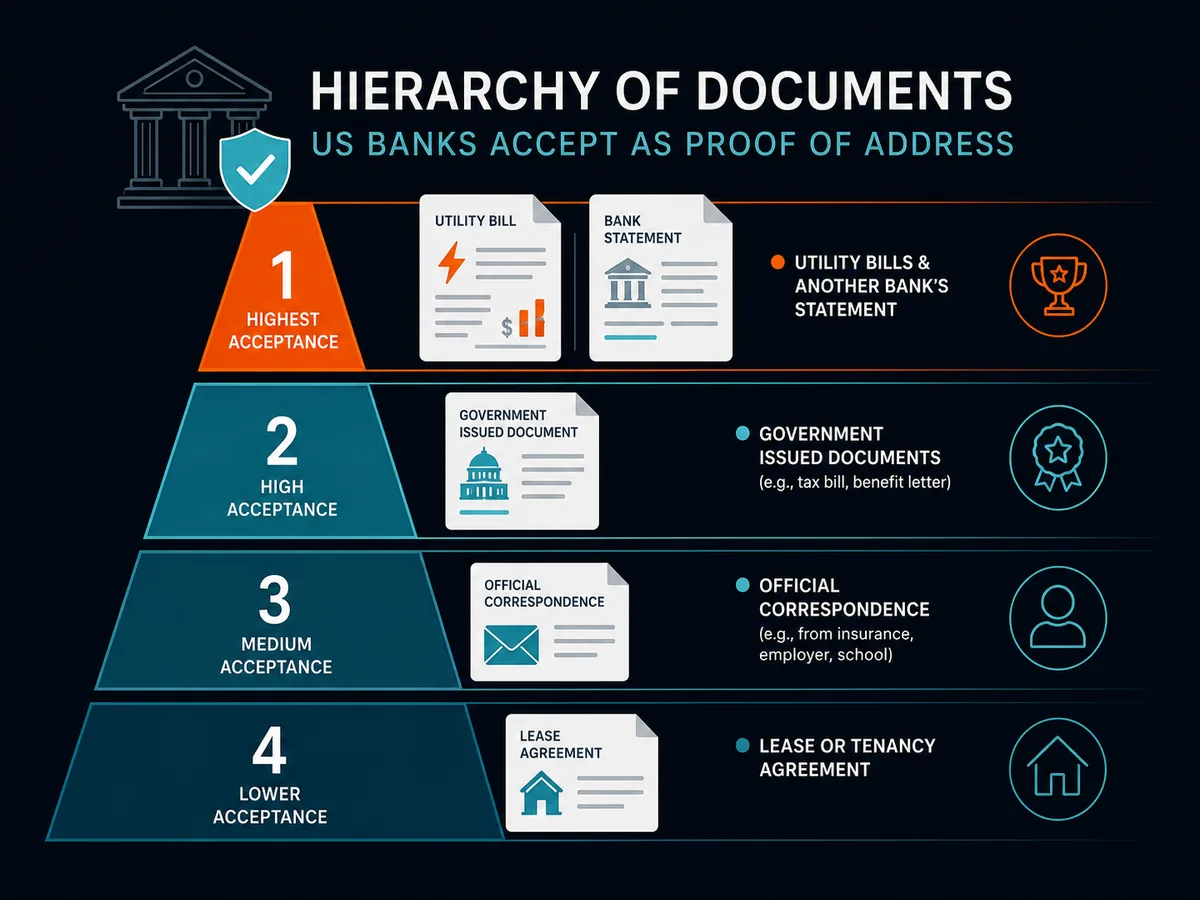
In US banking and tax contexts, proof of address is documentary evidence linking a named person or entity to a physical street address. The FDIC Customer Identification Program guidance and the FFIEC BSA/AML Examination Manual list the accepted categories: a utility bill (electricity, gas, water, internet, residential phone), a bank statement from another regulated institution, a lease or mortgage statement, a government document (tax notice, voter registration, driver's licence), or an insurance declaration page.
Three constraints apply. The document must show your full legal name and the address, must be dated within ninety days, and must come from an issuer a bank can verify exists. Some banks ask for two independent documents; some accept one. A PO Box is rejected almost universally, and a Commercial Mail Receiving Agency address is increasingly flagged.
Who this applies to — read this first
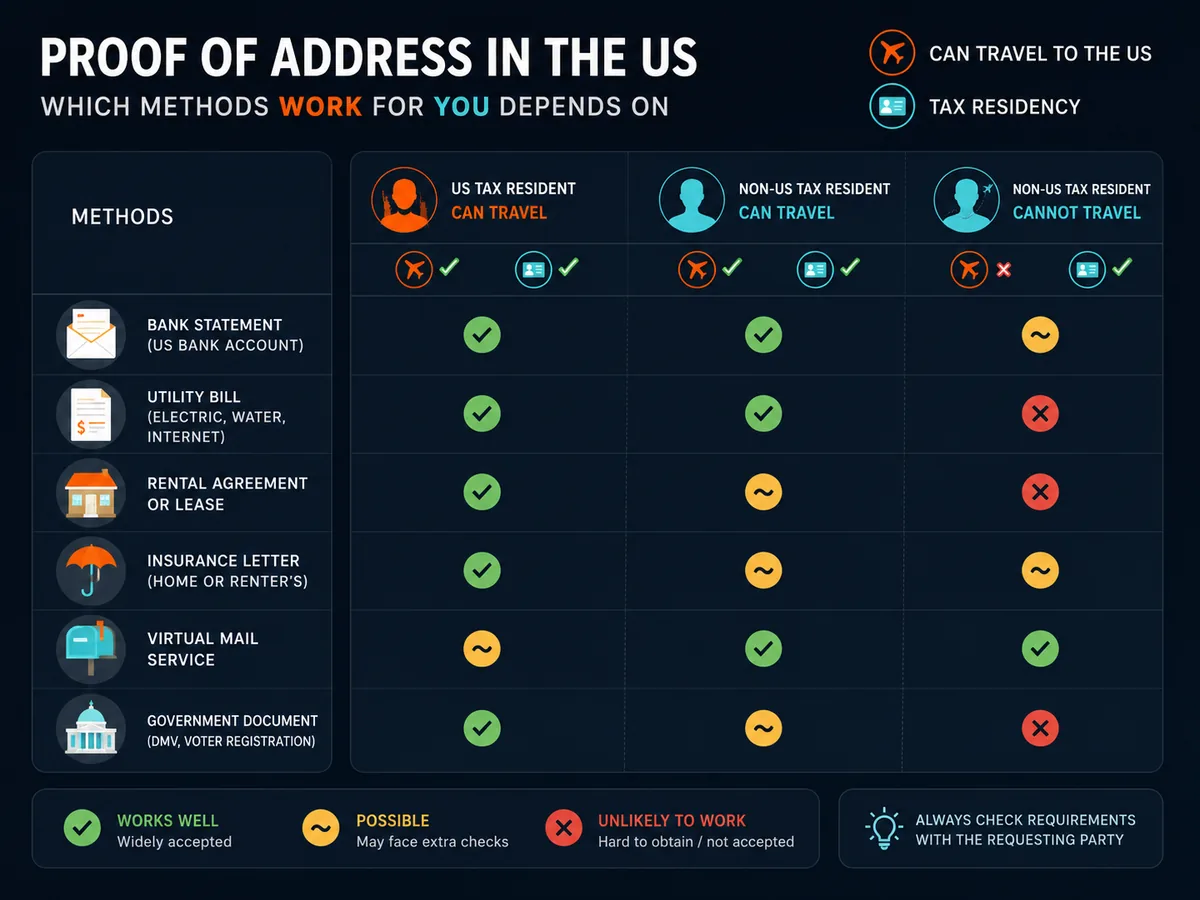
The methods that work depend on your legal status and on whether you can travel to the US.
US persons
If you are a US citizen or green-card holder living in the US, you already have proof of address. Your driver's licence, your residential utility bills, and your existing bank statements satisfy any KYC request. This article is not for your personal banking. The relevant question for US persons is whether to put a separate virtual address on a US LLC for privacy reasons — covered in our piece on virtual addresses for an LLC. The methods below are designed for people who do not have a US residence.
EU residents
EU residents who occasionally travel to the US have the broadest set of options. A short-term lease during a US visit, a phone or internet account opened in your name at the rental address, and a subsequent US bank statement together give you the strongest possible documentation. EU readers who never visit the US can still use virtual mailbox services and remote-friendly fintechs (Mercury, Relay, Wise USD), but they will not pass branch-based onboarding at Chase, Bank of America or Wells Fargo without an in-person visit. EU CRS and DAC2 reporting still applies — opening a US account does not remove the obligation to report it to your home tax authority.
Non-US, non-EU readers
This segment has the most variance. If you live somewhere the US offers no consular services that help with banking, the visit-and-establish route is the most reliable. For everyone else, the practical path is a US LLC plus a defensible virtual address plus a non-resident-friendly fintech bank. Personal US accounts remain difficult without travel. The US does not participate in CRS, but Wise, Payoneer and several other providers report under it to your country of tax residence.
The legitimate methods
The methods below are arranged from least to most effort, with bank-acceptance ratings based on observed behaviour at major US institutions in 2026.
Virtual mailbox with CMRA registration
The standard path. iPostal1, Anytime Mailbox, Earth Class Mail, Physical Address, US Global Mail and Virtual Postmail operate networks of physical addresses where they accept mail on customers' behalf. You complete USPS Form 1583, notarised, with two forms of ID. The provider registers as a CMRA under USPS Domestic Mail Manual 508.1.8, and you receive an address with a # or PMB designator usable on bank applications, LLC filings and Stripe accounts.
Monthly cost ranges from roughly $10 at the budget end to $40 for mid-tier scanning plans. Premium dedicated-address products (Virtual Postmail's TruResidence) reach $250-$400 per month. Address choice matters more than marketing implies: a residential-coded address in Wilmington, Delaware or a Wyoming small town fares better in KYC than a strip-mall mailbox in a known forwarder corridor. Smarty, the common USPS-licensed validation API, shows whether a given address is currently coded residential or commercial.
The CMRA detection problem is the central catch. Banks subscribe to fraud-screening services that maintain CMRA lookup tables. If your address sits on a known mail-forwarder list, the application is declined or queued for manual underwriting. There is no public list of which addresses each bank accepts; the working approach is to pick a provider with a track record, verify the address is residential-coded, and have a backup plan if the first application is declined.

Registered agent address vs business address
A registered agent address is not a business address and is not a personal address. Under each state's LLC act, the registered agent is the designated point of service for legal process and state correspondence. Using Northwest Registered Agent or any equivalent service gives you a compliant registered agent — it does not give you a usable address for bank KYC. Banks recognise the major registered agent addresses on sight and treat them as filing-only addresses.
Some LLC formation services, including Doola and similar non-resident-focused packages, bundle a "free business address" in higher-tier plans. Read the fine print: in most cases the bundled address is itself a CMRA and carries the same KYC risk as any other mail forwarder.
Utility bill workarounds — what to avoid
Several websites sell pre-made utility bills, edited PDFs and "novelty" documents that look real. Submitting any of these to a US bank is fraud under 18 U.S. Code §1344, with criminal exposure on top of the certainty of account closure and a SAR filing under the Bank Secrecy Act. Compliance teams flag inconsistent fonts, mismatched issuer addresses and metadata mismatches automatically. Do not do this.
What is legitimate is opening a real, low-cost US service in your own name at an address you are entitled to use. A T-Mobile Connect line for roughly $10 per month, a Vonage home VoIP service, or a Mint Mobile plan all produce a genuine, verifiable utility bill. The address has to be one you can defend if asked — typically a friend's residence, a short-term rental, or a virtual address the provider treats as a billing address.
Statement from a US person who hosts you
Some banks accept a notarised letter from a US-resident host stating that you reside or receive mail at their address, supplemented by the host's own proof of address. It appears in onboarding flows at credit unions and community banks, but is not universal. The host takes on a small risk: their address becomes associated with your tax and banking footprint. The setup is legitimate when the host consents and mail is reliably forwarded; banks notice clusters of unrelated account holders sharing a single residence.
Establishing real US presence
The most defensible method, and the most expensive, is to spend time in the US. A short-term lease through Furnished Finder, Sonder or Blueground — typically a one to three month rental with a real lease — paired with a phone or internet service in your name at that address gives you the two strongest categories of proof. You can then walk into a Chase, Bank of America or Wells Fargo branch with passport, ITIN or SSN, your address documents, and either personal income evidence or LLC formation papers, and open accounts that are difficult or impossible to open remotely.
Cost depends on the city. A furnished month in Las Vegas, Tampa or a Texas mid-size city runs $1,500-$3,000 plus utilities. Three to four weeks is the practical minimum to clear bank verification timelines. The trip pays for itself if you intend to operate a serious US-banked business, since the resulting bank statements then function as portable proof of address for every subsequent application.
The KYC reality
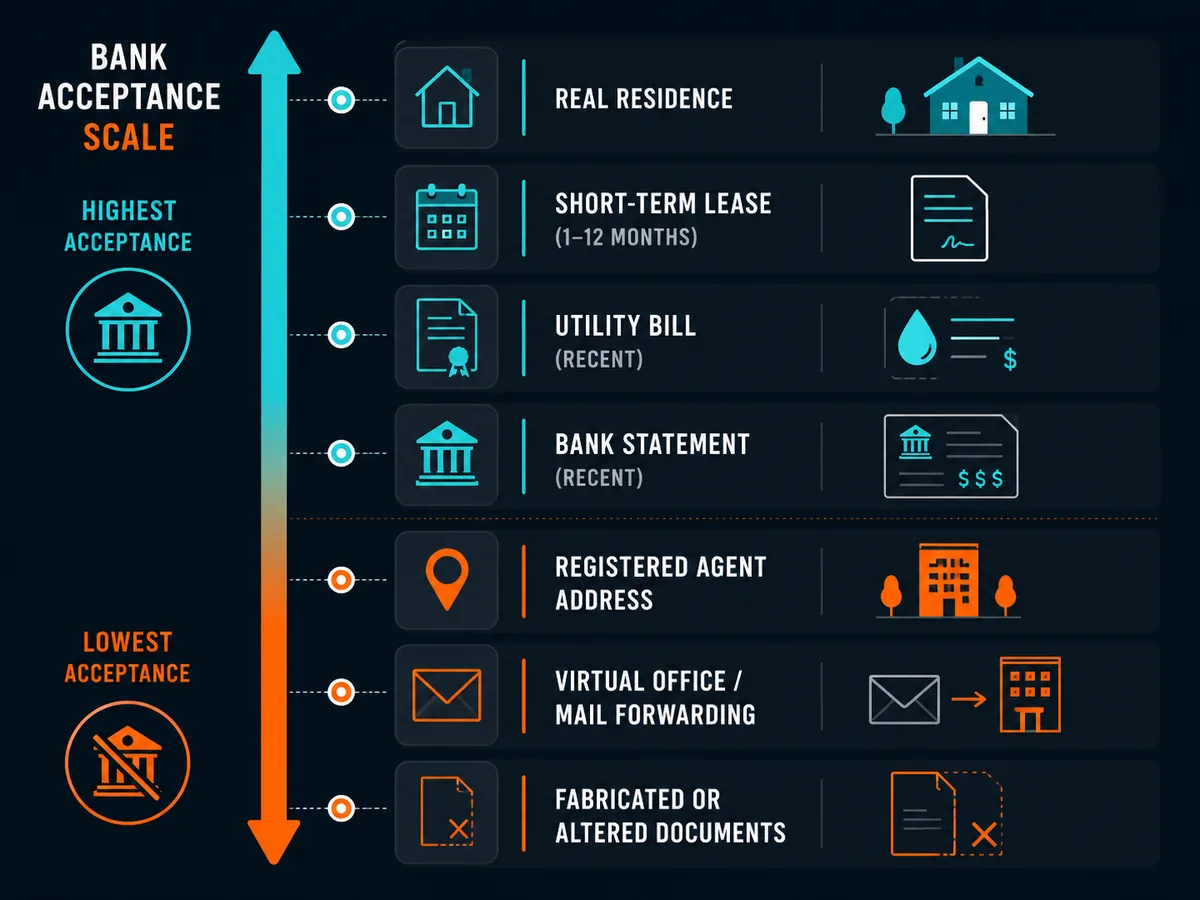
US banks do not treat all addresses equally. The fraud-screening industry — LexisNexis Risk Solutions, Acuant (now Idemia), Socure, and the USPS CMRA file itself — supplies the lookup tables that flow into bank onboarding software. Mercury and Relay, the two non-resident-friendly fintechs most often discussed, both run incoming addresses through these checks. Their policies are not identical to Chase's, which is why they sometimes approve where the big banks decline.
A CMRA address is not disqualifying at every bank, but it is a known signal. Hiding it by routing through a forwarder that "doesn't show as a CMRA" tends to fail, because the underlying USPS classification feeds most third-party databases. The better strategy: pick a provider whose addresses are accepted by your target bank — Earth Class Mail has historically had stronger acceptance than iPostal1 — and have a backup.
If a US bank rejects you, Wise Business with a USD receiving account, Relay for a true US business bank account, and Payoneer for marketplace receivables together cover most operational needs without a branch visit.
Comparison of US address methods
| Method | Monthly cost | USPS 1583 required | Bank acceptance | Best for |
|---|---|---|---|---|
| iPostal1 | $10-$40 | Yes | Mixed — fintechs OK, big banks variable | Non-residents starting an LLC |
| Anytime Mailbox | $10-$30 | Yes | Mixed — address-by-address | Budget setups, side businesses |
| Earth Class Mail | $25-$120 | Yes | Stronger — B2B reputation | Serious operations, multi-bank |
| Virtual Postmail TruResidence | $250-$400 | Yes (lease included) | Strong — dedicated residential | High-volume, compliance-critical |
| Friend or family address | $0 | No | Strong — real residence | Anyone with a willing US contact |
| Short-term US rental + utility | $1,500-$3,000/visit | No | Strongest — passes any KYC | Travellers, serious banking setup |
| Registered agent address | Bundled with formation | No | None — not a business address | Legal compliance only, never KYC |
| Fabricated documents | "Cheap" | n/a | Fraud — account closure + SAR | No legitimate use case |
Common mistakes and how to avoid them
Treating the registered agent address as a business address. Two different roles, two different addresses. The registered agent goes on the formation document; the business address goes on the bank application and the EIN.
Submitting the same virtual address that two thousand other LLCs use. Some budget mailbox providers assign shared addresses that show clusters of unrelated entities in OpenCorporates and Secretary of State filings. Banks notice.
Ignoring the CMRA designator. The "#" or "PMB" in your address is what flags CMRA status to automated systems. Removing it can cause mail loss and does not fool the lookup tables, which work off the underlying USPS classification rather than the formatting.
Not updating the IRS. Form 8822-B must be filed within 60 days of any business address change. Missed notices remain enforceable.
Assuming what worked last year still works. Banks update CMRA lookup tables quarterly. An address that opened a Chase account in 2023 may be flagged in 2026.
When to consult a qualified professional
For most non-residents, a virtual mailbox plus a non-resident-friendly fintech is a self-serve setup. Talk to a US CPA and a local tax advisor before putting more than $100,000 per year through US-banked accounts, structuring around CFC or non-dom regimes, or responding to a US bank's request for additional documentation after a flag. See our editorial policy and disclaimer.## FAQ
Will banks accept a virtual mailbox as US proof of address
Some will, most large retail banks will not. Mercury, Relay and several fintechs accept addresses from established mailbox providers if other KYC signals (EIN, formation documents, beneficial ownership) are clean. Chase, Bank of America and Wells Fargo run incoming addresses against CMRA lookup tables sourced from the USPS CMRA file and from vendors such as LexisNexis and Acuant. If the address matches a known mail receiver, the application is declined or pulled for manual review. The fix is not to hide the address — it is to choose a provider whose addresses are coded residential or whose CMRA classification is current and accepted by your target bank.
What is a CMRA and why does it matter for proof of address
A Commercial Mail Receiving Agency is any business that accepts mail on behalf of customers under USPS Domestic Mail Manual 508.1.8. The USPS maintains a public CMRA list that banks, payment processors and fraud-screening vendors download regularly. When a CMRA receives mail for a customer, USPS requires PS Form 1583 on file and standardised addressing with a # or PMB designator. That designator is the tell — banks and Stripe pattern-match it during onboarding. A CMRA address is not illegal, but it signals "mail forwarder" to every automated KYC system in the country.
Can I use a friend or family member's US address
Yes, if you tell them what you are doing and they consent. Asking someone to act as your US correspondent is legitimate; using their address without permission is not. The address must be one where you can reliably receive bank cards, IRS notices and other compliance mail. Most US banks will accept a relative's address for an initial application, especially if you can produce a phone or internet bill in your name at that address. Keep in mind that mail volume from the IRS for a foreign-owned LLC is real, and your host will see it. Switch to electronic statements as soon as the account is open.
Does the IRS care which US address I use
The IRS cares that you receive its mail. Form 8822-B exists so businesses can update the address on file, and a virtual address that scans and forwards same-day satisfies the requirement. What the IRS will not forgive is a missed notice — a CP504, a CP2000 or a Notice of Deficiency carries the same deadlines whether you read it or not. Use a provider that emails you when new mail arrives, and check it. For a foreign-owned single-member LLC, the address on Form 5472 and the pro-forma 1120 needs to be reachable; the penalty for the underlying filing failure is $25,000 per year under IRC §6038A.
Is paying for a US phone or internet bill a valid proof of address
It can be, if the bill is genuinely issued in your name at an address you are entitled to use. A real US phone line (T-Mobile prepaid, Mint Mobile, Visible) or a residential internet service in your name at a friend's address produces a legitimate utility bill that most banks accept. What is not legitimate, and what some online services sell, is a fake utility bill or one created using template software. Submitting a fabricated document to a bank is bank fraud under 18 U.S. Code §1344 and a basis for account closure, blacklisting, and in some cases referral to law enforcement. The cost of getting caught dwarfs the cost of doing it correctly.
Can I use a registered agent address as my proof of address
No. A registered agent address is the legal point of contact for service of process and state correspondence on behalf of an LLC or corporation. It is not the company's business address and is not a personal address for the owner. Banks know what registered agent addresses look like — Northwest, Harvard Business Services, the major Wyoming and Delaware providers all have well-known addresses that are flagged in onboarding. If you submit a registered agent address as your business address, expect an automatic decline. The two roles serve different purposes and must be separate addresses on bank applications.
Which US virtual address providers have the best bank acceptance
Acceptance changes as banks update their lookup tables, but a few patterns hold. Earth Class Mail has historically had stronger bank acceptance than iPostal1, partly because its addresses are fewer and more closely tied to physical office locations. Anytime Mailbox and Physical Address are large networks where individual addresses vary — some are flagged, some are not, and Smarty (a USPS-licensed address validation API) can show how an address is currently classified before you commit. Premium services like Virtual Postmail's TruResidence assign dedicated residential addresses with real lease and utility documents, at roughly $250-$400 per month. Pricing scales with bank-acceptance reliability.
What if I never plan to set foot in the US
Then your options narrow but they do not disappear. You can form a US LLC, get an EIN, contract a registered agent, and open accounts at Mercury, Relay, Wise USD or Payoneer using a defensible virtual address — none of these require you to visit. What you cannot easily do without a US visit is open a personal account at Chase, Bank of America or Wells Fargo, get a US-issued credit card to build a SSN-linked credit score, or apply for products that require in-branch verification. For a non-resident running an internet business, the LLC plus fintech stack is sufficient. For full retail banking, plan a trip.
This guide is editorial. We hold affiliate relationships with iPostal1, Northwest, Doola, Relay and Wise, disclosed via our affiliate disclosure. Nothing here is tax or legal advice — see our disclaimer.
Ready to act on this?
iPostal1 — Virtual US address + mail scanning. Soveraine readers go to the front of the line through our partner link, and you fund independent editorial in the process.
Sources
- USPS Form 1583 — https://about.usps.com/forms/ps1583.pdf
- USPS Domestic Mail Manual 508.1.8 (CMRA rules) — https://pe.usps.com/text/dmm300/508.htm
- 31 CFR §1020.220 — Customer Identification Program for banks — https://www.ecfr.gov/current/title-31/subtitle-B/chapter-X/part-1020/subpart-B/section-1020.220
- FDIC — Bank Secrecy Act / AML — https://www.fdic.gov/resources/bankers/bank-secrecy-act/index.html
- IRS Form 8822-B (Change of Address — Business) — https://www.irs.gov/forms-pubs/about-form-8822-b
- 18 U.S. Code §1344 — Bank fraud — https://www.law.cornell.edu/uscode/text/18/1344