
Key takeaways
- The renewal test is 180 days, not 80. Article 15 of Ley 10008 requires a minimum of ciento ochenta días in Costa Rica during the first year to authorise the second. Several widely-read English guides print 80.
- $3,000 a month alone, $4,000 with family — and the family figure can be pooled. Article 10(a) lets you reach the US$4,000 by combining your income with your spouse's or another member's. Almost nobody says so.
- The statute refuses you tax residency. Article 16 says beneficiaries are "in no case" habitual residents for tax purposes. That is the benefit and the limitation: it exempts your foreign income, and it gives you nothing to show a country you are trying to leave.
- The exemption stops at you. Articles 4 and 16 exclude the family group from the tax benefit entirely, even when they are on your immigration application.
- Roughly four in five applicants get it. The DGME received 1,225 applications and granted 949 from launch to 30 September 2024 — and 455 of the approvals went to Americans.
- The fees are not in the law. Articles 10(c) and 11(c) delegate the amount to regulation, so every dollar figure you read online is a report, not a statute.
SafetyWing — Article 10(b) makes a medical policy covering your whole stay a condition of the visa, not an optional extra
Why this visa is easier than it looks and harder than it reads
Costa Rica will let you live on the Pacific for two years and tax none of your foreign income, and the application is one form with a fifteen-day decision clock. The catch is buried in a single Spanish clause: to get the second year you must spend 180 days of the first one physically in the country, and a striking number of English-language guides to the Costa Rica digital nomad visa tell you the number is 80. That is not a rounding error. It is the difference between a renewal and a flight home, and anyone who planned a year of regional travel around the wrong figure finds out at the worst possible moment.
So this guide works from the statute. I pulled the text of Ley 10008 and its implementing decree rather than paraphrasing other people's paraphrases, and every requirement below carries the article number it comes from, so you can check me. Where a figure is not in the law — and the fees are not — I say so instead of dressing up a consultant's price list as legislation.
What Costa Rica actually grants you
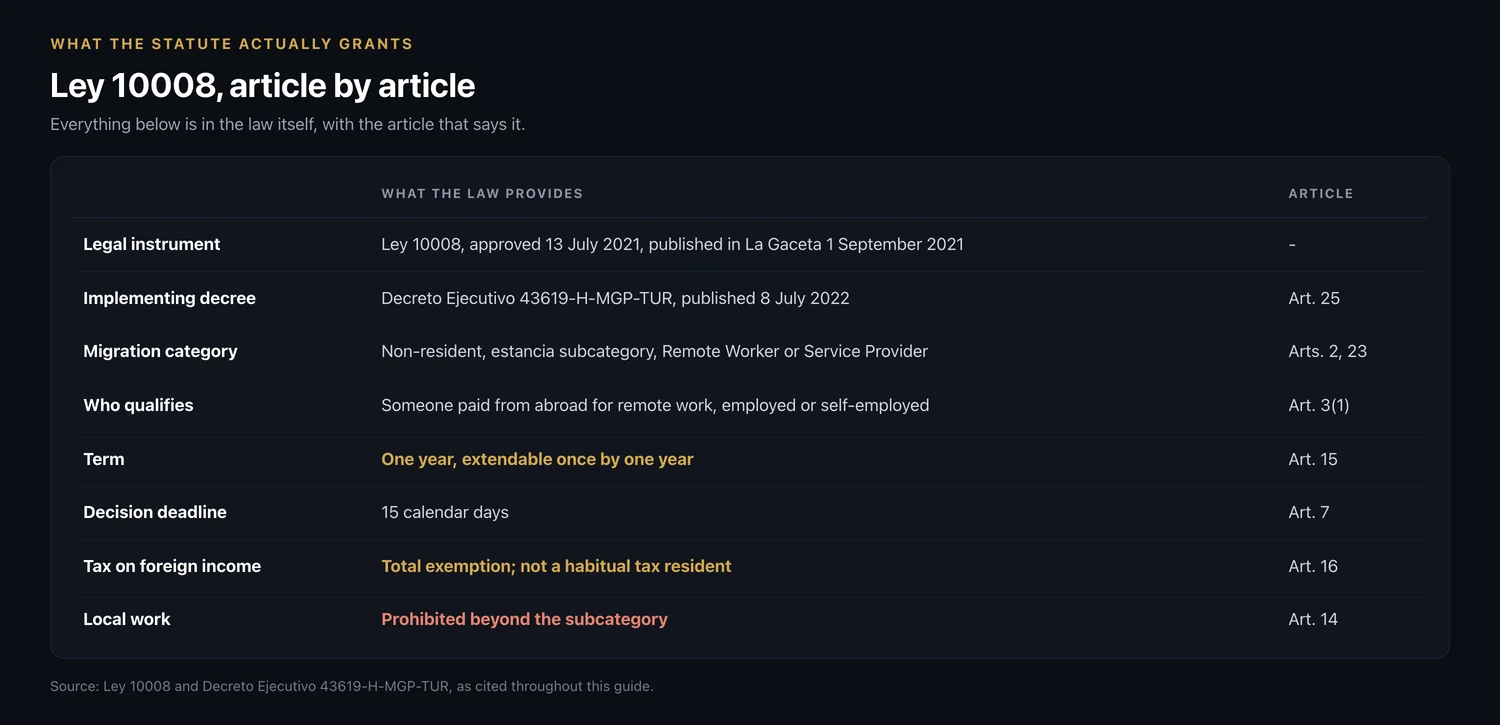
The law creates no new residency. It adds a subcategory to an existing one: Article 2 places you in the non-resident category, estancia subcategory, as a Trabajador o Prestador Remoto de Servicios, and Article 23 inserts that status into Article 88 of the General Migration Law (Ley 8764) as a new subsection 5.
That framing explains most of the status's behaviour. A non-resident estancia is a long-stay permission, not a step on a residency ladder, which is why the two-year ceiling is absolute and why the clock does not feed into permanent residency.
| What the law provides | Article | |
|---|---|---|
| Legal instrument | Ley 10008, approved 13 July 2021, published in La Gaceta 1 September 2021 | — |
| Implementing decree | Decreto Ejecutivo 43619-H-MGP-TUR, published 8 July 2022 | Art. 25 |
| Migration category | Non-resident, estancia subcategory, Remote Worker or Service Provider | Arts. 2, 23 |
| Who qualifies | Someone paid from abroad for remote work, employed or self-employed | Art. 3(1) |
| Term | One year, extendable once by one year | Art. 15 |
| Decision deadline | 15 calendar days | Art. 7 |
| Tax on foreign income | Total exemption; not a habitual tax resident | Art. 16 |
| Local work | Prohibited beyond the subcategory | Art. 14 |
Note the gap between the law and its regulation — Article 25 told the Executive to issue the decree within two months of entry into force, and it arrived ten months late, in July 2022. The programme only became usable then, which is why every statistic you will see starts in 2022 and not 2021.
The income test, and the pooling rule nobody mentions
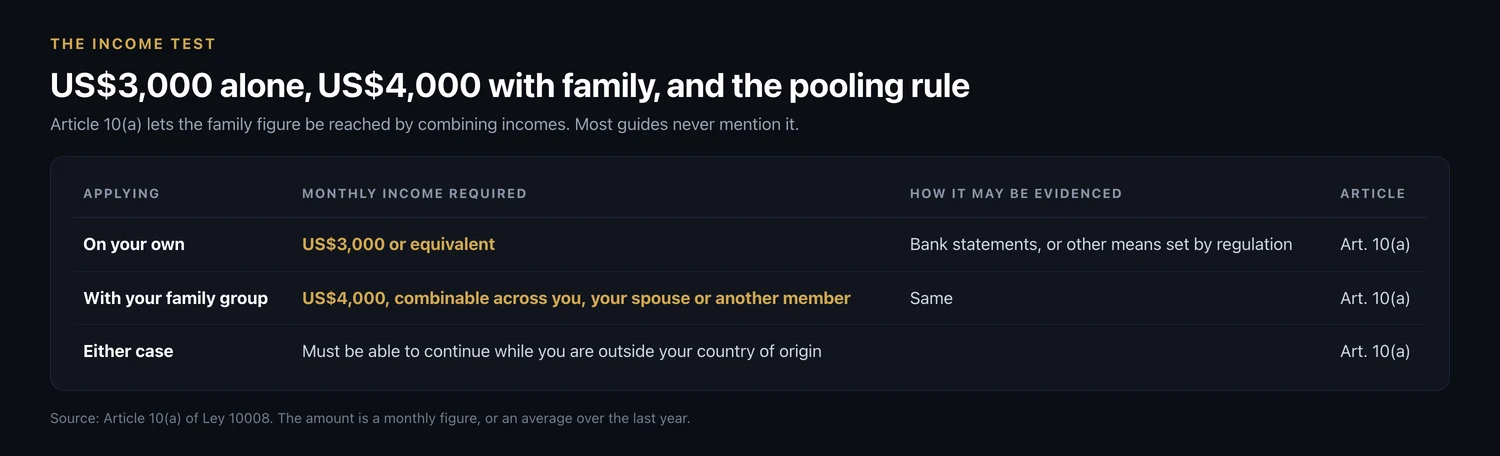
Article 10(a) is more flexible than the single number suggests. It accepts stable monthly remuneration, fixed income (rentas fijas), or an average monthly income across the last year — so a freelancer with lumpy invoicing is measured on the twelve-month average rather than on their worst month.
The threshold is US$3,000 a month, or US$4,000 if you want your family group covered. Here is the part that is missing from nearly every guide I read: the law says the US$4,000 "may validly be made up" of your income together with your spouse's or that of another member of the group. A couple each earning $2,100 clears the family threshold; neither of them clears the solo one.
| Applying | Monthly income required | How it may be evidenced | Article |
|---|---|---|---|
| On your own | US$3,000 or equivalent | Bank statements, or other means set by regulation | Art. 10(a) |
| With your family group | US$4,000, combinable across you, your spouse or another member | Same | Art. 10(a) |
| Either case | Must be able to continue while you are outside your country of origin | — | Art. 10(a) |
The family group itself is defined generously in Article 3(3): spouse or de facto partner, children under 25, children of any age with a disability, and older adults who live with you. Dependent-parent coverage is unusual in this class of visa and worth knowing if you support one.
That last condition in the table is the one that quietly disqualifies people. Income that stops the moment you leave — a local employment contract, in-person work, a business requiring your physical presence at home — fails the test however large it is.
The 180-day rule that decides your second year
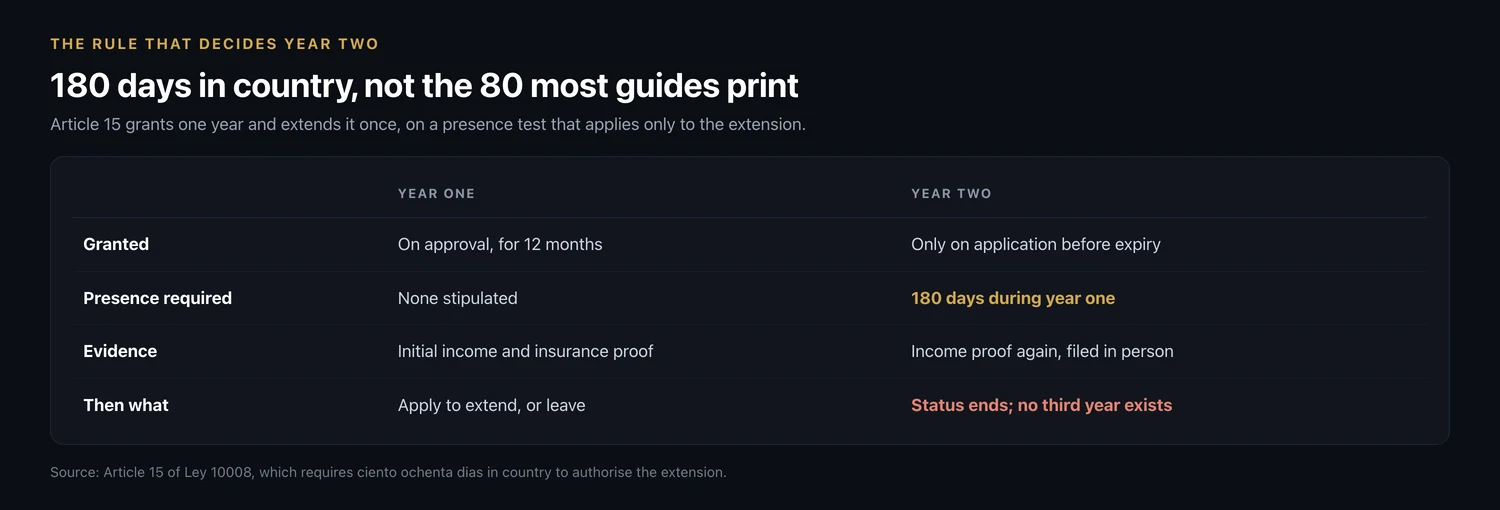
Article 15 is short enough to quote in full effect: the migratory benefit is granted for one year, extendable for a single additional period of one year, and to authorise that extension the beneficiary must have remained in the country a minimum of ciento ochenta días — 180 days — during the year originally granted.
Two things follow. First, the maximum is two years, full stop; there is no second renewal to plan for. Second, the second year is conditional on behaviour in the first, which makes this a poor fit for the nomad who treats a visa as a base for regional travel. Half the year on the ground is a real commitment.
| Year one | Year two | |
|---|---|---|
| Granted | On approval, for 12 months | Only on application before expiry |
| Presence required | None stipulated | 180 days during year one |
| Evidence | Initial income and insurance proof | Income proof again, filed in person |
| Then what | Apply to extend, or leave | Status ends; no third year exists |
Article 15 has a second paragraph that cuts the other way, and it is the reason "this visa is a dead end" is too blunt. Before the benefit expires, a holder may apply to change migratory category under Ley 8764 where the formal and substantive requirements are met. The nomad time itself does not convert into residency, but the law explicitly contemplates stepping across into a category that does — Rentista being the usual destination.
What it costs, and which figures are not in the law
This is where guides quietly invent authority. Articles 10(c) and 11(c) require a one-time payment for the visa, and another for each family member, with the amount "determined by regulation issued by the Directorate, based on objective parameters and service at cost." The statute names no sum.
The figures below are what Costa Rican immigration firms report consistently in 2026. They are probably right. They are not law, and the DGME's published checklist is the only thing you should pay against.
| Item | Commonly reported 2026 figure | Status |
|---|---|---|
| Government application deposit | US$100, to a Banco de Costa Rica account | Set by regulation, not statute (Art. 10(c)) |
| DGME document / accreditation fee | US$90, paid at the immigration appointment | Reported, not in the statute |
| Per family member | A further one-time payment each | Amount delegated to regulation (Art. 11(c)) |
| Medical insurance | Minimum US$50,000 cover, for the entire stay | DGME sets the minimum (Art. 10(b)) |
| ID card collection | In person, within about three months of approval | Procedural; confirm current window |
One outlier is worth flagging: at least one source lists a US$238 "guarantee deposit" instead of the $90 fee. I could not reconcile it, and I will not average two numbers into a third nobody charges. Ask the DGME.
Article 10(b) leaves the insurance minimum to the Directorate rather than fixing it, which is why $50,000 can move without the law changing. The requirement itself is firm: the policy must cover the whole duration of your stay, and every family member you include.
SafetyWing — nomad medical cover you can hold for the full permit period rather than a trip-length travel policy
Travel insurance sold by the trip is the usual reason a file is rejected on Article 10(b): the policy has to span the stay, not a holiday inside it. Check any policy's cover limit and term against the DGME's current checklist before you file. Our SafetyWing review covers what it does and does not pay for.
The tax exemption, and the trap inside it
Article 16 does two things, and most coverage notices only the first. It grants a total exemption from the impuesto sobre las utilidades — the profits tax under Title I of Ley 7092 of 21 April 1988 — and then adds that beneficiaries will "in no case be considered habitual residents of the country for tax purposes," nor will income they receive from abroad be treated as Costa Rican-source.
Read that second clause again if this visa is part of a wider tax plan, because it is a refusal, not a gift. Costa Rica is not giving you tax residency at a 0% rate on foreign income; it is declining to make you a tax resident at all. You get the exemption, and nothing to hand a tax authority wanting evidence you became resident elsewhere.
If you are leaving a country that releases you only once you are taxable somewhere else, that is a problem rather than a solution — the subject of our guide to being tax resident nowhere. A tax residency certificate ends most such disputes, and this status is drafted so you cannot get one.
| Benefit | You, the remote worker | Your family group | Article |
|---|---|---|---|
| Immigration status | Yes | Yes, on your application | Arts. 10, 11 |
| Exemption from profits tax | Yes | No | Arts. 4, 16 |
| Treated as a habitual tax resident | No — expressly excluded | n/a | Art. 16 |
| Equipment import exemption | Yes | No | Arts. 4, 17 |
| Home driving licence valid | Yes | Yes | Art. 19 |
The family exclusion in that table is the second thing readers get wrong, and the law states it twice — which suggests the drafters expected the confusion. Article 4 gives the tax benefits only to the remote worker, "not extended to members of their family group." Article 16 repeats it and adds the remedy: a family member wanting the exemption must apply and meet every requirement of a direct beneficiary themselves. A spouse with their own foreign income is not sheltered by your status; they need their own $3,000.
The exemption is also conditional throughout its life. Article 18 ends the tax benefits immediately on cancellation, and Article 21 ties every benefit to the term of the permission. This is not a settled entitlement; it is a status you continue to hold.
The benefits nobody lists, and the penalties nobody mentions
Beyond the headline exemption, Ley 10008 carries four provisions that rarely appear in coverage of this visa, and two sanctions that never do.
| Provision | What you get, or risk | Article |
|---|---|---|
| Equipment imports | Exemption from all import taxes on basic personal computing, IT and telecom equipment needed for your work, subject to proportionality criteria from the Dirección Nacional de Aduanas | Art. 17 |
| Driving | Your valid home-country licence is good for driving in Costa Rica | Art. 19 |
| Banking | You may open savings accounts in the national banking system, subject to AML law 8204 | Art. 20 |
| Transferring your kit | Sell or transfer the duty-free equipment while still holding the status and you owe the taxes you were exempted | Art. 17 |
| Losing the status | Cancellation means paying national taxes to nationalise the imported goods — and your family loses status with you | Art. 13 |
| False documents | Immediate payment of the exonerated taxes plus 25% as a fine, without prejudice to criminal proceedings | Art. 22 |
The equipment exemption is more practical than it sounds. The decree treats a personal computer, mobile phone, tablet, camera and a sound recording or playback device as baggage needing no prior procedure; anything beyond that goes through Exonet. If you are arriving with a studio or a second monitor array, plan around that line.
The banking provision deserves a flag for its wording. Article 20 grants cuentas de ahorros — savings accounts — not the full current-account relationship a business needs, and it remains subject to the bank's own compliance under Ley 8204. Treat local banking as a convenience, not a substitute for the multi-currency setup you already run.
Who actually gets approved
The DGME's own numbers, reported by El Financiero in October 2024, cover the programme from launch to 30 September 2024. They are the only approval data I could find, and they are more encouraging than the application process feels.
1,225 applications, 949 granted — about 78%. Applicants came from 63 countries and approvals went to nationals of 58 of them.
| Nationality | Applications | Approved |
|---|---|---|
| United States | 580 | 455 |
| Canada | 138 | 105 |
| Russia | 66 | 57 |
| United Kingdom | — | 48 |
| El Salvador | — | 13 |
| Spain | — | 10 |
| Period | Applications | Approvals |
|---|---|---|
| 2022 (first year) | 455 | 193 |
| 2023 | — | 555 |
| 2024, to 30 September | 193 | 201 |
Two readings matter. This is a small programme — fewer than a thousand grants in two and a half years — so budget for the written prevention under Article 7 rather than treating it as failure. And it is overwhelmingly North American: Americans and Canadians make up 59% of applications, while European numbers are tiny, which says more about awareness than eligibility. (The 2024 row where approvals exceed applications is not a misreading: El Financiero notes approvals may include files carried over.)
Costa Rica against the other Americas routes
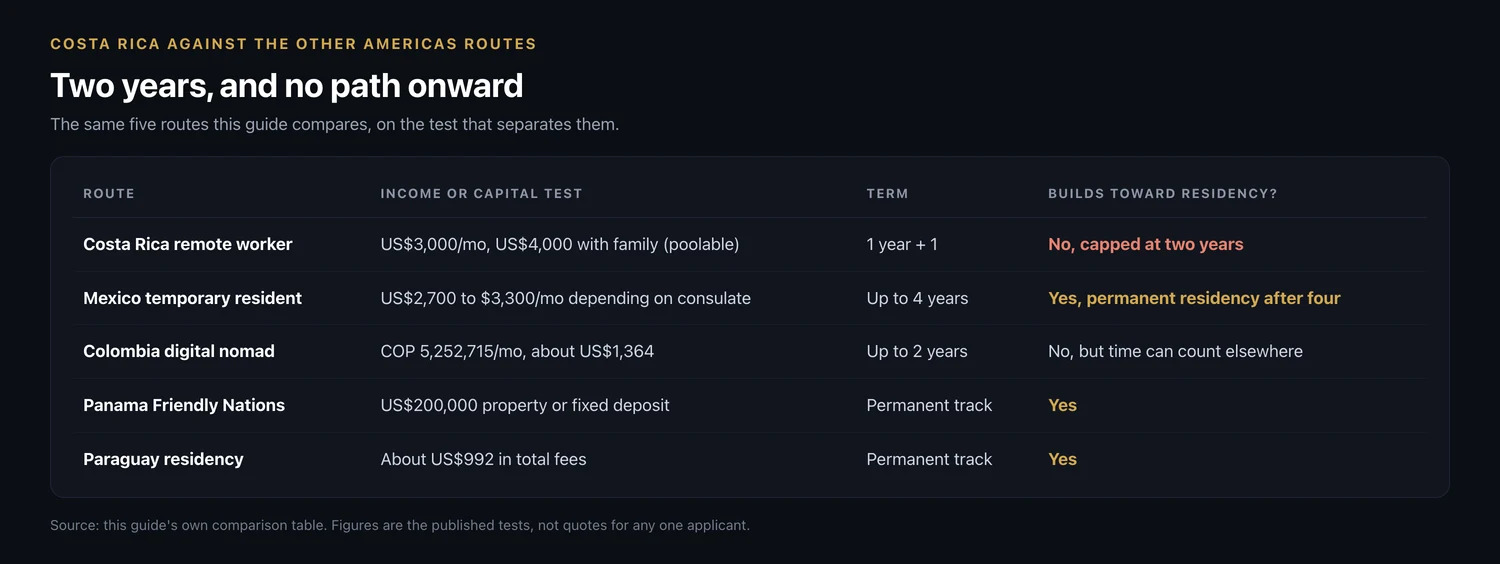
The comparison nobody publishes is the one that decides this. Costa Rica is competing with four routes we have covered in detail, and on cost it loses while on tax it wins.
| Route | Income or capital test | Term | Builds toward residency? |
|---|---|---|---|
| Costa Rica remote worker | US$3,000/mo, US$4,000 with family (poolable) | 1 year + 1 | No — capped at two years |
| Mexico temporary resident | US$2,700–$3,300/mo depending on consulate | Up to 4 years | Yes — permanent residency after four |
| Colombia digital nomad | COP 5,252,715/mo, about US$1,364 | Up to 2 years | No, but time can count elsewhere |
| Panama Friendly Nations | US$200,000 property or fixed deposit | Permanent track | Yes |
| Paraguay residency | About US$992 in total fees | Permanent track | Yes |
Costa Rica has the most expensive income test on that list, and it is the only one handing you an explicit statutory refusal of tax residency. Colombia asks less than half the monthly income; Mexico asks slightly less and gives a four-year runway to permanent residency; Paraguay costs about a thousand dollars all in.
So what is Costa Rica selling? A clean, fast, written exemption on foreign income for two years, in a country people genuinely want to live in, under a statute specific enough to read your own position off. That is not nothing — most of this category runs on discretion rather than text. But if you want a second residency that accumulates, this is the wrong instrument, and our second residency rankings and nomad visas with a residency path both point elsewhere.
What I would actually do
If I wanted two tax-clean years in Costa Rica and nothing more, I would take this visa and plan the 180 days deliberately — blocked as two long stays rather than hoped for in fragments, because the renewal is decided on a day count that nobody will round up for me.
If I wanted Costa Rica and a path, I would use Article 15's second paragraph on purpose: take the nomad status, live there, and apply to change category to Rentista before the second year expires, treating the nomad years as the look-before-you-commit period rather than as progress. Rentista is reported at about US$2,500 a month in passive income for 24 months, or a US$60,000 deposit in an approved bank. I could not verify from a primary source whether Rentista time credits toward permanent residency, so I would get that answered by a Costa Rican lawyer before betting a relocation on it.
And if I were doing this as tax planning rather than as a move, I would stop. Article 16 refuses you habitual residence for tax purposes in terms too plain to argue with, and a status that cannot produce a tax residency certificate is the wrong tool for leaving a tax net. The exemption is real and it is narrow: it covers Costa Rican profits tax on your foreign income while you hold the status, and it does nothing about the country you came from.
Related guides
- Digital nomad visas: the full comparison — every programme worth the application, ranked.
- Mexico temporary resident visa — the Americas route that actually accrues toward permanent residency.
- Colombia digital nomad visa — half the income test, two years, and a cédula at the end.
- Panama Friendly Nations visa — the capital-based alternative with a permanent track.
- Tax resident nowhere — why a statutory refusal of tax residency is a problem, not a perk.
- Nomad travel insurance — what Article 10(b) actually requires you to buy.
FAQ
What is the income requirement for the Costa Rica digital nomad visa?
Article 10(a) requires stable monthly remuneration, fixed income, or an average monthly income over the last year of at least US$3,000 — US$4,000 if you include your family group. The law lets you reach the US$4,000 by combining your income with your spouse's or another member's, which most guides never mention. The income must also be capable of continuing while you are outside your country of origin.
How many days must I spend in Costa Rica to renew the digital nomad visa?
A minimum of 180 days during the originally granted year. Article 15 grants the benefit for one year, extendable once, and requires that the holder have remained in the country at least ciento ochenta días to authorise the extension. Several English-language guides print 80 days instead. That figure appears nowhere in the statute, and planning a year around it would cost you the renewal.
Do Costa Rica digital nomad visa holders pay income tax in Costa Rica?
No, on foreign income. Article 16 grants a total exemption from the impuesto sobre las utilidades under Title I of Ley 7092, and says beneficiaries are in no case habitual residents for tax purposes, nor is their foreign income Costa Rican-source. The exemption ends immediately on cancellation, and never covers work for clients inside Costa Rica.
Does the Costa Rica digital nomad visa lead to permanent residency?
Not by accrual. It is a non-resident estancia status capped at two years, and the time does not build toward permanent residency as temporary residency does in Mexico or Panama. Article 15 does let a holder apply to change migratory category under Ley 8764 before the benefit expires, so it is not a sealed dead end — but that starts the new category's clock rather than continuing this one.
Does the tax exemption cover my spouse and children?
No. Article 4 grants the tax benefits only to the remote worker and does not extend them to the family group; Article 16 repeats it and adds that a family member wanting the exemption must apply and meet every requirement of a direct beneficiary themselves. Your family can sit on your immigration application while remaining wholly outside the tax exemption.
Can I work for Costa Rican clients on this visa?
No. Article 14 bars remunerated work or services inside Costa Rica beyond what the subcategory permits, and that subcategory is defined by remote work for people or companies abroad. Article 13 sets the consequence: cancellation, loss of every benefit, and payment of all corresponding tax obligations plus interest and penalties.
How much does the Costa Rica digital nomad visa cost?
The law does not say. Articles 10(c) and 11(c) require a one-time payment for the visa and for each family member, with the amount set by regulation at cost. Practitioners consistently report US$100 to a Banco de Costa Rica account plus a US$90 DGME document fee, and a US$50,000 insurance minimum — none of which is in the statute. Treat the DGME's published checklist as the only authority.
How long does the DGME take to decide?
Article 7 gives the DGME 15 calendar days to resolve. It has five working days to check your file and may issue one written prevention asking you to complete or clarify; that suspends the clock and gives you up to eight working days to respond. The published figures suggest roughly four in five applications succeed.
The requirement that fails more files than the income test
Article 10(b) makes medical cover a condition of the visa, for you and every family member you include, and it has to span the whole permit — a trip-length travel policy does not. SafetyWing is built to be held continuously while you are abroad rather than bought per trip, which is the shape this requirement asks for. Check the cover limit and term against the DGME's current checklist before you file.
Sources
- Asamblea Legislativa de Costa Rica — Ley 10008, via the Sistema Costarricense de Información Jurídica. Every article cited above is from this text, including Art. 10(a) (the poolable US$3,000/US$4,000 test), Art. 15 (one year + one, 180 days, the category change), Art. 16 (total profits-tax exemption; "in no case" a habitual tax resident; family excluded) and Arts. 17-22 (equipment, driving, banking, the 25% fine).
- EY Centroamérica — Costa Rica: autoridades publican el reglamento a la Ley de Nómadas Digitales (Decreto 43619-H-MGP-TUR published 8 July 2022; Ley 10008 published 1 September 2021; the equipment that enters as baggage, and Exonet for the rest).
- El Financiero — Costa Rica ha dado 949 visas a nómadas digitales (28 October 2024; the DGME figures to 30 September 2024 and both tables above).
- Dirección General de Migración y Extranjería — Nómadas digitales, the official requirements page; applications go through its Trámite Ya platform.
The fees (US$100, US$90) and the US$50,000 insurance minimum are not in Ley 10008 — Arts. 10(b) and 10(c) delegate both — and are practitioner-reported for 2026 rather than checked here against a published schedule. One source gives a US$238 guarantee deposit instead of the US$90 fee; I could not reconcile it and have not averaged it away. The DGME site did not answer our automated requests, so read its checklist directly before paying. The Rentista figures are practitioner-reported, and whether Rentista time credits toward permanent residency is unverified.
Rules and figures are as published in 2026 and change without notice. How Ley 10008 applies depends on your residence, your income structure and the tax system you are leaving. Take advice from a Costa Rican immigration lawyer and a cross-border tax adviser before acting. Nothing here is legal or tax advice.