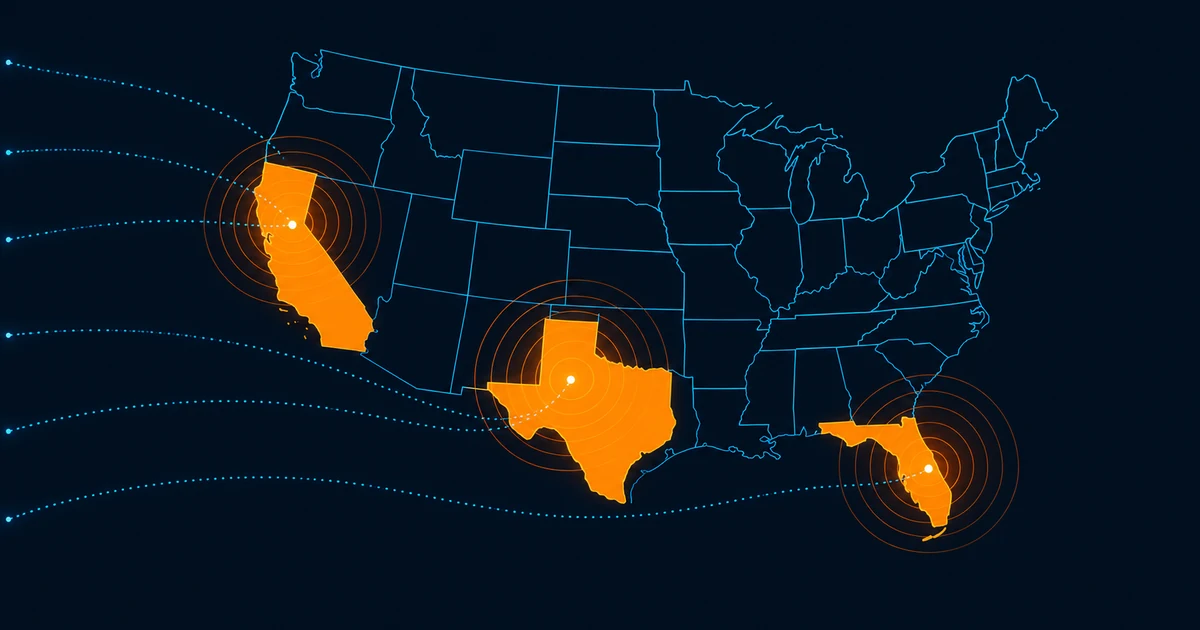
You formed a US LLC from outside the US, checked the federal position carefully, and concluded that you have no effectively connected income and therefore no US federal income tax. That conclusion can be entirely correct and still leave you with an unfiled tax obligation in eight states. Sales tax is not an income tax, it does not care about your treaty position, and since 2018 it has not cared whether you have ever set foot in the country. This guide covers what the Wayfair decision actually did, the 2026 economic nexus thresholds for the states that matter most, why SaaS is the hardest case to get right, and what registration involves when you have no SSN. Every threshold below is quoted from the state revenue department that publishes it.
Key takeaways
- Zero federal income tax and a sales tax liability are perfectly compatible. The ECI test decides federal income tax; economic nexus decides sales tax. They are unrelated tests, and passing the first tells you nothing about the second.
- The big three markets are not at $100,000. California and Texas both use $500,000; New York uses $500,000 and more than 100 sales — both conditions, which makes it the easiest of the three to stay under.
- No treaty protects you here. Income tax treaties cover income taxes and bind the federal government; Public Law 86-272 shields only net income taxes. Neither reaches a state sales tax.
- The transaction-count tests are disappearing. Illinois dropped its 200-transaction leg on 1 January 2026, leaving a single $100,000 receipts test (IDOR Bulletin FY 2026-12).
- Marketplace-only sellers are mostly covered. Every state with a sales tax now makes the platform collect. Your own checkout is the exposure.
On this page: Sales tax is not income tax · What Wayfair changed · The 2026 thresholds · Why no treaty helps · Is your product taxable? · Marketplace facilitators · Registering without an SSN · Streamlined Sales Tax · What to do this quarter · Related guides · FAQ · Sources
doola — Formation plus bookkeeping and filings for foreign-owned US LLCs, in one place
Sales tax is not income tax, and that is the whole problem
Almost every guide written for non-resident LLC owners — including our own on the single-member LLC — spends its energy on one question: is the LLC's profit effectively connected income? That question decides federal income tax. It is the right question, and for a founder with no US office, no US staff and no US-source services the answer is frequently no.
Sales tax asks nothing of the kind. It is levied by individual states on the transaction, not on your profit, and you are not really the taxpayer — you are the collection agent the state deputises to charge the customer and hand the money over. Whether you made a profit is irrelevant. Whether you are foreign is irrelevant. What matters is whether you sold enough of a taxable thing into a particular state.
That structural difference is why the two obligations come apart so cleanly. A foreign-owned LLC can file a correct $0 federal return and simultaneously be an unregistered, delinquent sales tax vendor in California. Nothing in the federal analysis would ever surface it.
The second-order problem is that nobody tells you. The IRS does not police state sales tax. Your registered agent does not monitor your revenue by state. Stripe will happily process the sales without collecting anything unless you configure it to. The obligation simply accrues quietly.
What Wayfair actually changed in 2018
For fifty years, a state could only make you collect its sales tax if you had a physical presence there — an office, staff, inventory. That rule came from National Bellas Hess and was reaffirmed in Quill Corp. v. North Dakota, and it is why mail-order and early e-commerce sellers shipped into most states tax-free.
South Dakota deliberately picked a fight with it. The state passed a law requiring any seller delivering more than $100,000 of goods or services into the state, or engaging in 200 or more separate transactions for delivery into the state on an annual basis, to collect its sales tax regardless of physical presence. Wayfair, Overstock and Newegg refused, and the case reached the Supreme Court.
In South Dakota v. Wayfair, Inc., 585 U.S. 162, decided 21 June 2018, the Court overruled the physical presence rule of Quill and Bellas Hess. Economic presence in a state was enough. Within about two years, essentially every state with a sales tax had enacted its own version of South Dakota's threshold.
The part that matters for readers of this site is what the decision did not say. It set no floor for who counts as a seller, and it drew no line at the water's edge. A company incorporated in Wyoming and run from Lisbon is in exactly the same position as one run from Ohio. There is no foreign-seller exemption anywhere in the framework.
The 2026 thresholds that actually matter
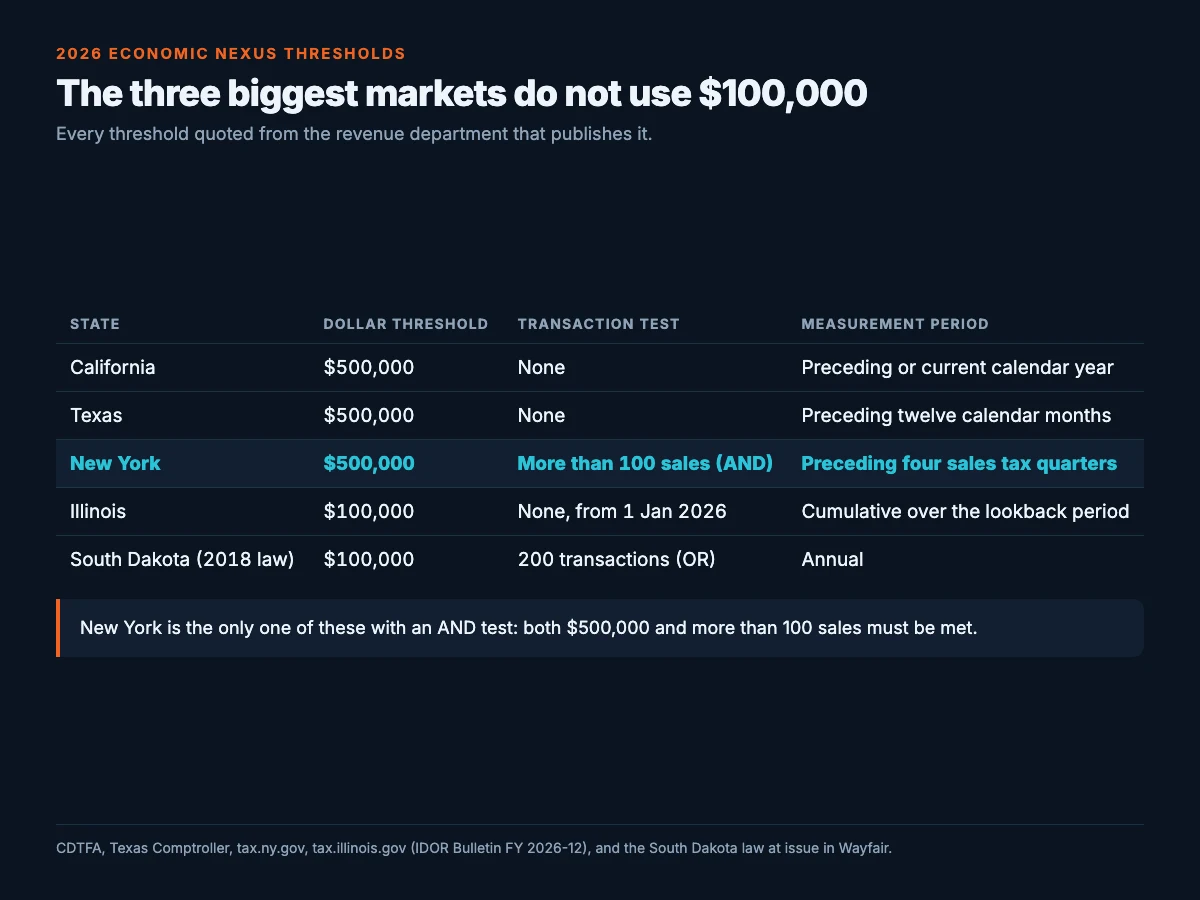
The $100,000 figure gets quoted as though it were national. It is the most common test, but the three largest consumer markets in the country all sit somewhere else, and the differences are not cosmetic. Here is what the revenue departments themselves publish as of September 2026:
| State | Dollar threshold | Transaction test | Measurement period | Notes |
|---|---|---|---|---|
| California | $500,000 | None | Preceding or current calendar year | Combined sales of tangible personal property delivered into CA, including related persons |
| Texas | $500,000 | None | Preceding twelve calendar months | "Total Texas revenue" includes nontaxable sales, resale sales and sales to exempt entities |
| New York | $500,000 | More than 100 sales | Preceding four sales tax quarters | Both conditions must be met — the only one of these with an AND test |
| Illinois | $100,000 | None (from 1 Jan 2026) | Cumulative over the lookback period | 200-transaction leg removed by IDOR Bulletin FY 2026-12 |
| South Dakota (2018 law) | $100,000 | 200 transactions (OR) | Annual | The template the rest of the country copied after Wayfair |
Three things in that table are worth pausing on.
Texas measures gross, not taxable, revenue. The safe harbour is based on total Texas revenue from taxable and nontaxable sales of tangible personal property and services, including separately stated handling and transportation charges, sales for resale and sales to exempt entities. A seller whose product is largely exempt can still blow through $500,000 and owe a permit.
New York's AND is a genuine safe harbour. A business that clears $500,000 in gross receipts but made only 90 sales into New York is not required to register. High-ticket B2B sellers — consultancies, agencies, enterprise software — frequently sit exactly there. Once both are met you must register within 30 days and begin collecting 20 days after that.
California counts related persons. The threshold is measured on combined sales by the retailer and all persons related to the retailer, so splitting a business across two entities does not split the threshold.
Timing differs too, and it is the detail people get wrong. Texas gives you until the first day of the fourth month after the month you exceed the safe harbour before collection must begin — an unusually generous runway. New York gives you 30 days to register. Do not assume one state's grace period applies in another.
Why no tax treaty protects you here
This is the single most common misconception, and it is held confidently. If you are resident in a country with a US income tax treaty, you have probably read that you owe no US tax without a permanent establishment. That is true, and it is about income tax.
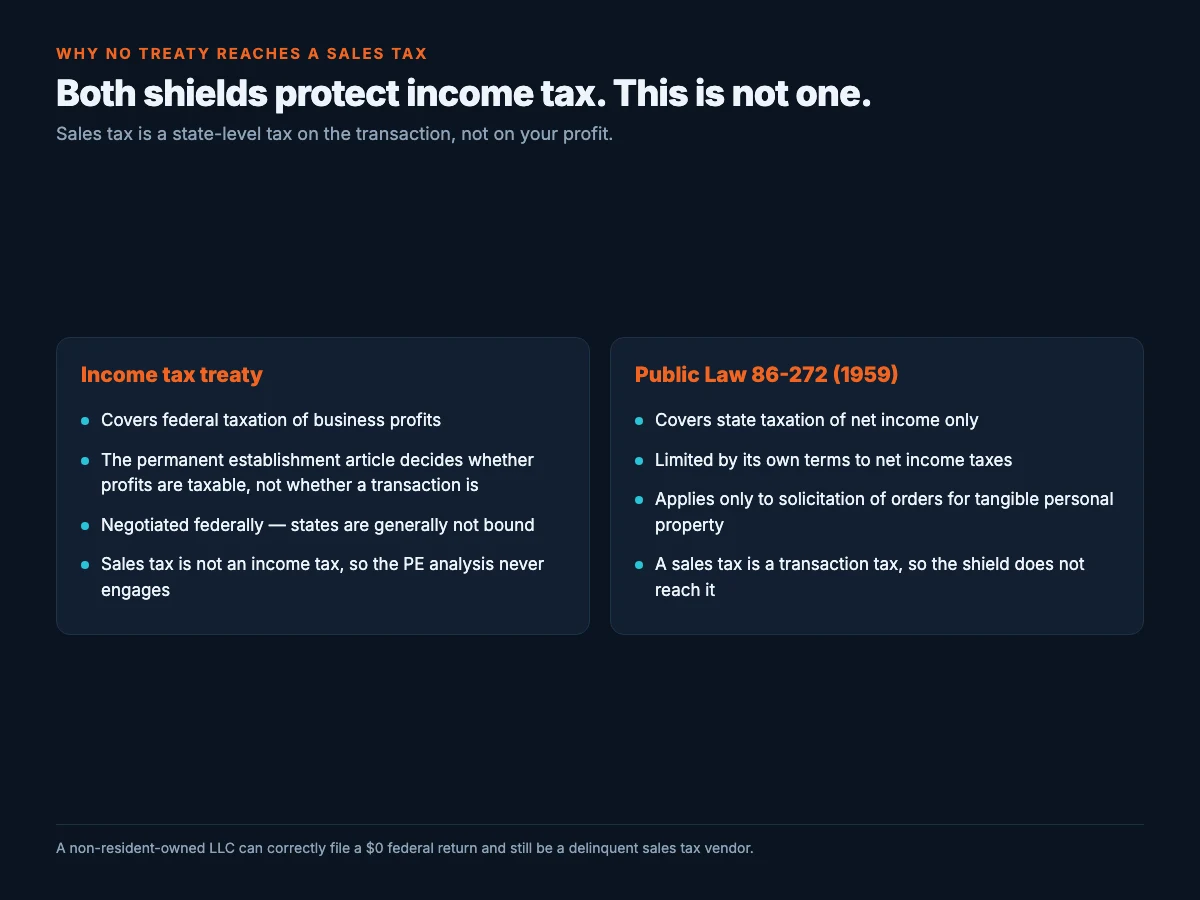
Two separate shields exist in US law, and neither one covers sales tax:
| Protection | What it covers | Why it does not apply |
|---|---|---|
| Income tax treaty (permanent establishment article) | Federal taxation of business profits | Negotiated federally; states are generally not bound, and sales tax is not an income tax, so the PE article never engages |
| Public Law 86-272 (1959) | State taxation of net income | By its terms limited to net income taxes, and only for solicitation of orders for tangible personal property — a sales tax is a transaction tax, not a net income tax |
The practical upshot: your treaty may well mean you owe nothing in federal income tax, and it does nothing whatsoever about a Texas sales tax permit. State tax practitioners advising inbound businesses treat this as settled — the treaty question and the sales tax question simply do not intersect.
If you also have state income tax exposure — a different question again, and one that turns on where you have employees, property or receipts — that is where 86-272 and state-level treaty conformity start to matter. For sales tax, they never do.
Is your product even taxable? SaaS is the hard case
Crossing a threshold only creates an obligation if you are selling something the state taxes. For physical goods the answer is usually yes. For software and digital services, states genuinely disagree with each other, and the disagreement is substantive rather than a drafting quirk.
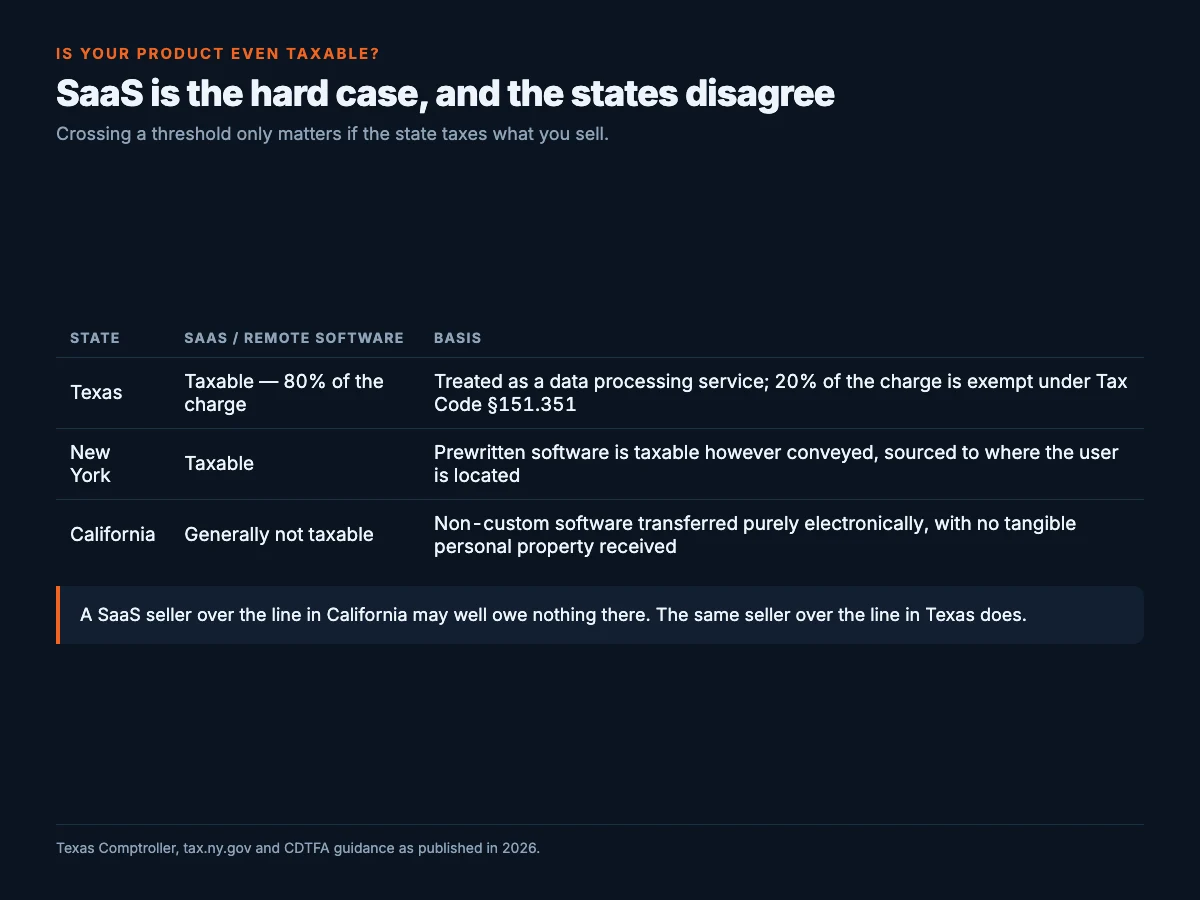
| State | SaaS / remote software | Basis |
|---|---|---|
| Texas | Taxable — as a data processing service, with 20% of the charge exempt, so tax applies to 80% | Providers of software as a service are data processing service providers; the 20% exemption comes from Tax Code §151.351 |
| New York | Taxable — prewritten software is taxable however conveyed, including remote access | Sourced to where the user is located, so a customer with staff in and out of NY is apportioned |
| California | Generally not taxable where transferred purely electronically | Tax does not apply to non-custom software transferred electronically if the customer receives no tangible personal property |
The California rule has a sharp edge worth knowing: if you also ship the customer a USB stick, a backup disc or a printed manual, the entire transaction becomes taxable. Electronic-only delivery is doing the work.
New York's sourcing rule is the one that surprises people. The tax follows the location from which the purchaser uses or directs the use of the software, not where your servers are and not where the buyer's head office is. A customer with users in three states means apportioning a single invoice.
For a European SaaS founder with a Delaware or Wyoming LLC, the realistic picture is that Texas and New York sales count toward a taxable-product obligation and California sales largely do not. That alone can change which threshold you hit first.
Marketplace facilitators: when the platform collects for you
The best news in this article. Every US state that levies a sales tax has enacted a marketplace facilitator law requiring the platform — Amazon, Etsy, eBay, Walmart, the app stores — to calculate, collect and remit sales tax on sales made through it, rather than leaving it to the individual seller.
If a marketplace is your only channel, your practical sales tax workload is usually close to zero. That is a genuine structural advantage of selling through platforms, and it is why many small foreign sellers never encounter this problem at all.
Two caveats stop it being a complete answer:
- Direct sales are yours. The moment you sell through your own Shopify or Stripe checkout, those transactions sit outside the facilitator regime and count as your own.
- Threshold maths varies. Some states count marketplace sales toward your economic nexus threshold even though the platform remitted the tax, which can drag you over the line on the strength of sales you never had to collect on.
Note also that five states levy no statewide sales tax at all — Alaska, Delaware, Montana, New Hampshire and Oregon — though Alaska permits local jurisdictions to impose one. Forty-five states plus the District of Columbia do.
Registering as a non-resident without an SSN
Assume you have crossed a threshold with a taxable product. Registration is a state-by-state process, and the friction for a non-resident is rarely the tax itself.
You will generally need the LLC's EIN — if you do not have one yet, getting an EIN without an SSN is the prerequisite step — plus formation documents, a business address, and an estimate of expected monthly taxable sales. So far so ordinary.
The forms then start asking for things a foreign founder may not have: a responsible party's Social Security number or ITIN, a US date of birth format, a US driver's licence number, or a US bank account for electronic remittance. States vary in how strictly they enforce these fields, and several will accept an ITIN or process a paper application where the online portal refuses. If you have been putting off an ITIN application, this is one of the situations that forces it.
Once registered you inherit a filing calendar in every state where you registered, typically monthly or quarterly, and most states require a zero return even in periods with no sales. That is the ongoing cost people underestimate: not the tax, the returns. Registering in a state you did not need to be in is a real and recurring cost, which is why the threshold analysis is worth doing properly before you register anywhere.
The federal filings are only half the compliance picture.
A foreign-owned LLC already owes Form 5472 with a pro-forma 1120 every year, and state sales tax registrations add their own monthly or quarterly returns on top. doola handles formation, EIN, bookkeeping and the federal filings for non-resident owners, which keeps the base layer straight while you work out which states you actually need to register in. Soveraine readers go through our partner link, and you fund independent editorial in the process.
Streamlined Sales Tax: the one genuine shortcut
A bloc of states got together to make multi-state compliance survivable, and the result is the only piece of this system designed with small sellers in mind.
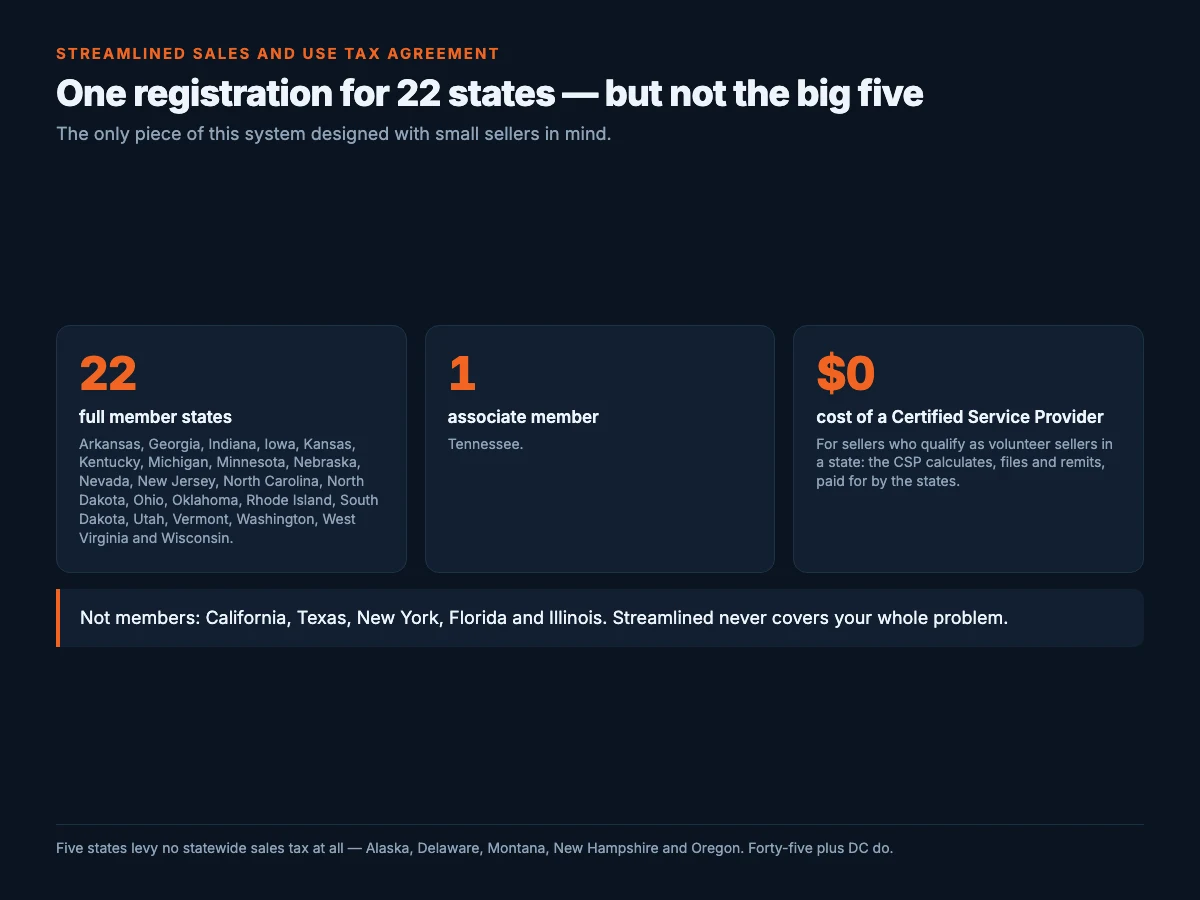
The Streamlined Sales and Use Tax Agreement has 22 full member states — Arkansas, Georgia, Indiana, Iowa, Kansas, Kentucky, Michigan, Minnesota, Nebraska, Nevada, New Jersey, North Carolina, North Dakota, Ohio, Oklahoma, Rhode Island, South Dakota, Utah, Vermont, Washington, West Virginia and Wisconsin — plus Tennessee as an associate member. Note who is not on that list: California, Texas, New York, Florida and Illinois all sit outside it, so Streamlined never covers your whole problem.
What it gives you is worth having anyway:
- One registration through the Streamlined Sales Tax Registration System covers every member state you select, instead of 22 separate applications.
- Free Certified Service Provider services for sellers who qualify as volunteer sellers in a state — a CSP calculates the tax, files the returns and remits, paid for by the states rather than by you.
The volunteer-seller definition is the catch and it is state-specific, turning broadly on your not having had a physical presence or registration obligation there. A foreign seller with no US footprint is often exactly the profile the programme was built for, which makes it worth checking before paying for commercial compliance software.
What to do this quarter
You do not need a project. You need four numbers and an afternoon.
- Pull your last twelve months of US sales by state, from Stripe, your marketplace reports, or your invoicing system. Gross, not net.
- Compare against the thresholds — $500,000 for California, Texas and New York, $100,000 as the working assumption everywhere else, and check the specific state before acting.
- Ask whether your product is taxable in the states you cleared. A SaaS seller over the line in California may well have no obligation there; the same seller over the line in Texas does.
- Separate marketplace sales from direct sales, because the platform has already handled the first category.
If nothing clears a threshold, write the analysis down with the date and revisit it annually. If something did clear, look at that state's voluntary disclosure programme before you register — coming forward first usually caps the lookback period and waives penalties, where waiting to be found does neither.
And keep the two systems separate in your head. Your federal filing obligations as a foreign-owned LLC are unchanged by any of this, and the state you formed in has nothing to do with where you owe sales tax. Sales tax follows your customers, not your registered agent.
Related guides
- Foreign-owned single-member LLC: tax and filing rules — the ECI question and the Form 5472 obligation that runs alongside this one.
- How to get an EIN without an SSN — the prerequisite for every state registration form.
- What a US LLC actually costs a non-resident — the recurring compliance costs, before sales tax registrations.
- Best state to form an LLC as a non-resident — why formation state and sales tax nexus are unrelated questions.
- US C-corp for non-residents — the alternative structure, and how its tax profile differs.
- Form 5472 and the $25,000 penalty — the federal filing that catches foreign-owned LLCs with no US tax due.
FAQ
Does a foreign-owned LLC with no US income tax still owe sales tax?
Yes, and this is the trap. Federal income tax turns on whether you have effectively connected income from a US trade or business. Sales tax is a separate state-level tax on the transaction, not on your profit, and it turns only on whether you crossed that state's economic nexus threshold selling something the state taxes. A non-resident-owned LLC can correctly file a $0 federal return and still be a delinquent sales tax vendor in California, Texas or New York.
Does a tax treaty protect my LLC from US state sales tax?
No. US income tax treaties are negotiated by the federal government and address income taxes — the permanent establishment article decides whether business profits are taxable, not whether a transaction is. States are generally not bound by those treaties, and sales tax is not an income tax in any event, so the permanent establishment analysis never engages. The federal statutory shield in Public Law 86-272 does not help either: it protects only net income taxes, and only for solicitation of orders for tangible personal property.
What are the 2026 economic nexus thresholds I should watch?
Most states that publish a dollar test use $100,000, but the three largest markets do not. California requires $500,000 in combined sales of tangible personal property delivered into the state in the preceding or current calendar year, with no transaction count. Texas uses $500,000 of total Texas revenue over the preceding twelve calendar months. New York uses $500,000 in gross receipts and more than 100 sales over the preceding four sales tax quarters, and both conditions must be met.
Do the 200-transaction tests still exist?
Fewer of them every year. South Dakota's law in the Wayfair case used $100,000 or 200 separate transactions, and many states copied it. States have been dropping the transaction leg because it caught tiny sellers with low-value orders: Illinois removed its 200-transaction threshold effective 1 January 2026, leaving a single $100,000 gross receipts test. Check the specific state rather than assuming, because a minority still apply a transaction count.
If I sell only through Amazon or Etsy, do I need to register?
Often not, but do not assume it. Every US state with a sales tax has a marketplace facilitator law that shifts collection and remittance onto the platform for sales made through it. If the marketplace is your only sales channel, the platform generally handles the tax. The moment you also sell through your own checkout, those direct sales are yours to measure and potentially collect on, and some states still count marketplace sales toward your threshold.
Is SaaS subject to US sales tax?
It depends entirely on the state, and the split is real rather than a technicality. Texas treats software as a service as a taxable data processing service, with 20% of the charge exempt so tax applies to the remaining 80%. New York taxes prewritten software including remote access, sourced to where the user is located. California generally does not tax software transferred purely electronically where the customer receives no tangible media.
What do I need to register as a non-resident seller?
An EIN for the LLC is the baseline, plus formation documents and a business address. Several states also ask for a responsible party's Social Security number or ITIN, a date of birth, or a US bank account on the registration form, which is where non-resident founders usually stall. Registering through the Streamlined Sales Tax Registration System covers 22 full member states in one application, and qualifying volunteer sellers can get a Certified Service Provider to calculate and file at no cost.
What happens if I ignore this?
Sales tax you failed to collect is generally still owed by you as the seller, plus penalties and interest, and the assessment period usually never closes for a business that never registered. That is the asymmetry worth understanding: unfiled years stay open indefinitely in most states, so the exposure grows rather than ages out. Most states run voluntary disclosure programmes that cap the lookback and waive penalties for sellers who come forward before being contacted.
Sources
- Supreme Court of the United States — South Dakota v. Wayfair, Inc., 585 U.S. 162, decided 21 June 2018 (slip opinion): https://www.supremecourt.gov/opinions/17pdf/17-494_j4el.pdf
- California Department of Tax and Fee Administration — Use tax collection requirements based on sales into California due to the Wayfair decision: https://www.cdtfa.ca.gov/industry/wayfair.htm
- Texas Comptroller of Public Accounts — Remote sellers (the $500,000 safe harbour and Rule 3.286): https://comptroller.texas.gov/taxes/sales/remote-sellers.php
- Texas Comptroller of Public Accounts — Data processing services are taxable (Publication 94-127, the 20% exemption): https://comptroller.texas.gov/taxes/publications/94-127.php
- New York State Department of Taxation and Finance — Registration requirement for businesses with no physical presence in New York State: https://www.tax.ny.gov/pubs_and_bulls/publications/sales/nexus.htm
- New York State Department of Taxation and Finance — Tax Bulletin ST-128, Computer Software: https://www.tax.ny.gov/pubs_and_bulls/tg_bulletins/st/computer_software.htm
- Illinois Department of Revenue — Informational Bulletin FY 2026-12, destination-based Retailers' Occupation Tax changes: https://tax.illinois.gov/research/publications/bulletins/fy-2026-12.html
- California Department of Tax and Fee Administration — Regulation 1502, Computers, Programs, and Data Processing: https://cdtfa.ca.gov/lawguides/vol1/sutr/1502.html
- Streamlined Sales Tax Governing Board — member states, registration system and Certified Service Providers: https://www.streamlinedsalestax.org/
- 15 U.S.C. §381 (Public Law 86-272) — limitations on state net income taxation: https://www.law.cornell.edu/uscode/text/15/381
Sales and use tax is state-specific and fact-specific. Nothing here is legal or tax advice, and the thresholds above are quoted as published in September 2026 — confirm the current position with the relevant state revenue department or a US state and local tax adviser before registering or declining to register.