
Somewhere in the last few years, "open a US LLC" became the default answer to every tax question asked by a European freelancer. It is cheap, it takes a week, the state does not care where you live, and a single-member LLC is disregarded for US federal tax — so with no US person behind it and no US-source income, it pays no US income tax. All of that is true.
What is also true, and far less often said out loud, is that none of it has any bearing on what your own country thinks. A Wyoming LLC run from an apartment in Valencia or Berlin is, to Spain and Germany, a company managed from Valencia or Berlin. The gap between "pays no US tax" and "is not taxed anywhere" is where people lose five and six figures.
This guide sets out the three separate tests your home country applies, in the order they actually bite. I have quoted the governing statutes directly — the German Fiscal Code and Corporation Tax Act, Spain's Ley 27/2014, the EU's anti-tax-avoidance directive and the 2016 US Model treaty — because the secondary material here is unusually promotional, and the most confident pages on the first page of results are selling the structure they describe.
Key takeaways
- Three independent tests, and any one is enough. Corporate residence by place of management, permanent establishment under the treaty, and CFC attribution. Failing the first is the worst outcome, and it is also the most likely.
- US "disregarded" status does not travel. Germany's Federal Fiscal Court held in I B 75/20 (18 May 2021) that the type comparison "takes no account of whether the company is transparent under US tax law." The Colorado LLC in that case was treated as a German corporation.
- Management is the residence test. §10 of the German Fiscal Code defines it as "the centre of commercial executive management"; Spain's Article 8.1.c) uses sede de dirección efectiva. Meeting it means tax on worldwide income, not a slice.
- CFC rules catch a single-member LLC by definition. ATAD's threshold is more than 50% of voting rights; Spain's Article 100.2 imputes total income where the entity has no material and human resources.
- The US still wants a filing. Form 5472 with a pro forma 1120, $25,000 per form per year, due even when the company owes nothing and did nothing.
On this page: Why the LLC is not a wrapper · Test one: management · Test two: permanent establishment · Test three: CFC rules · The classification conflict · What the US still wants · Germany's rate cut · What actually works · Related guides · FAQ · Sources
Doola — US LLC formation with the Form 5472 filing actually handled
Why a US LLC is not a tax-free wrapper
The appeal rests on one accurate fact: a US LLC with a single non-US owner, no US employees, no US office and no US-source income generally owes no US federal income tax, because the entity is disregarded and its owner sits outside the US tax net. Nothing below contradicts that.
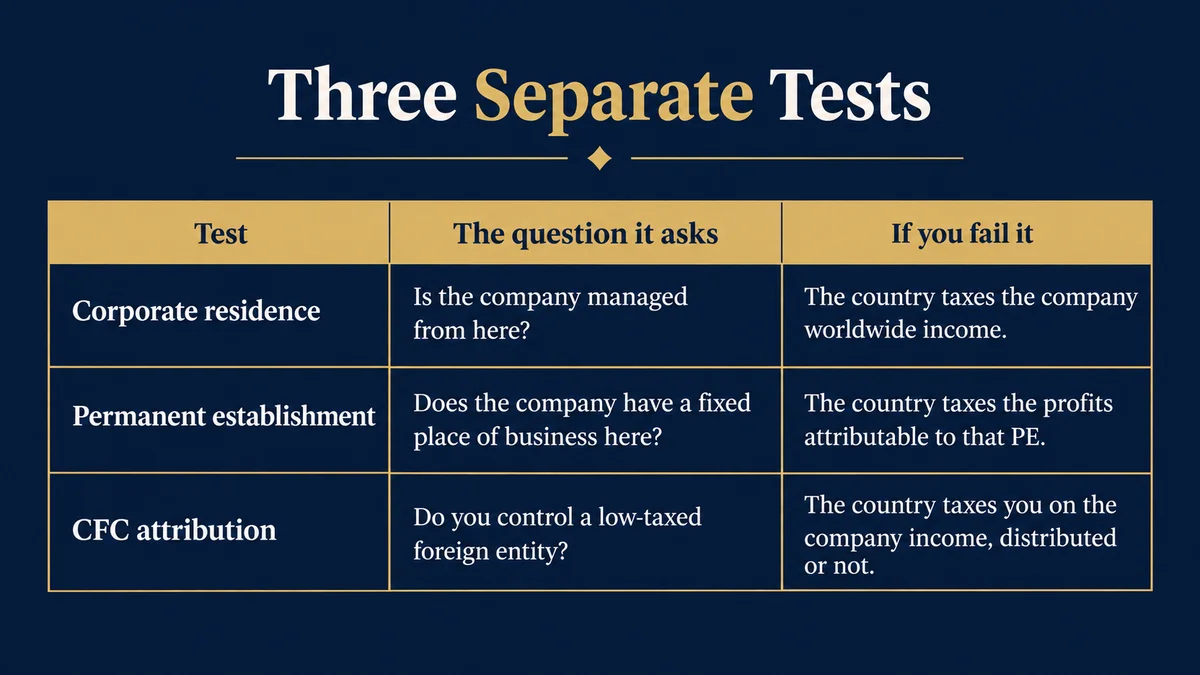
The error is treating a US conclusion as a global one. Your home country runs its own tests, in its own order, and does not ask the IRS for an opinion first. There are three, they are independent, and clearing two does not help if you fail the third.
| Test | The question it asks | If you fail it |
|---|---|---|
| Corporate residence | Is the company managed from here? | The country taxes the company's worldwide income |
| Permanent establishment | Does the company have a fixed place of business here? | The country taxes the profits attributable to that PE |
| CFC attribution | Do you control a low-taxed foreign entity? | The country taxes you on the company's income, distributed or not |
The ordering is what almost every promotional page gets wrong. Permanent establishment is the test that gets discussed, and it is the least dangerous of the three. Corporate residence is the one most one-person LLCs actually fail, and it produces the largest bill.
Test one: where your LLC is actually managed
Most of Europe decides corporate tax residence on where a company is really run, not where it was registered. The statutes are short and unambiguous.
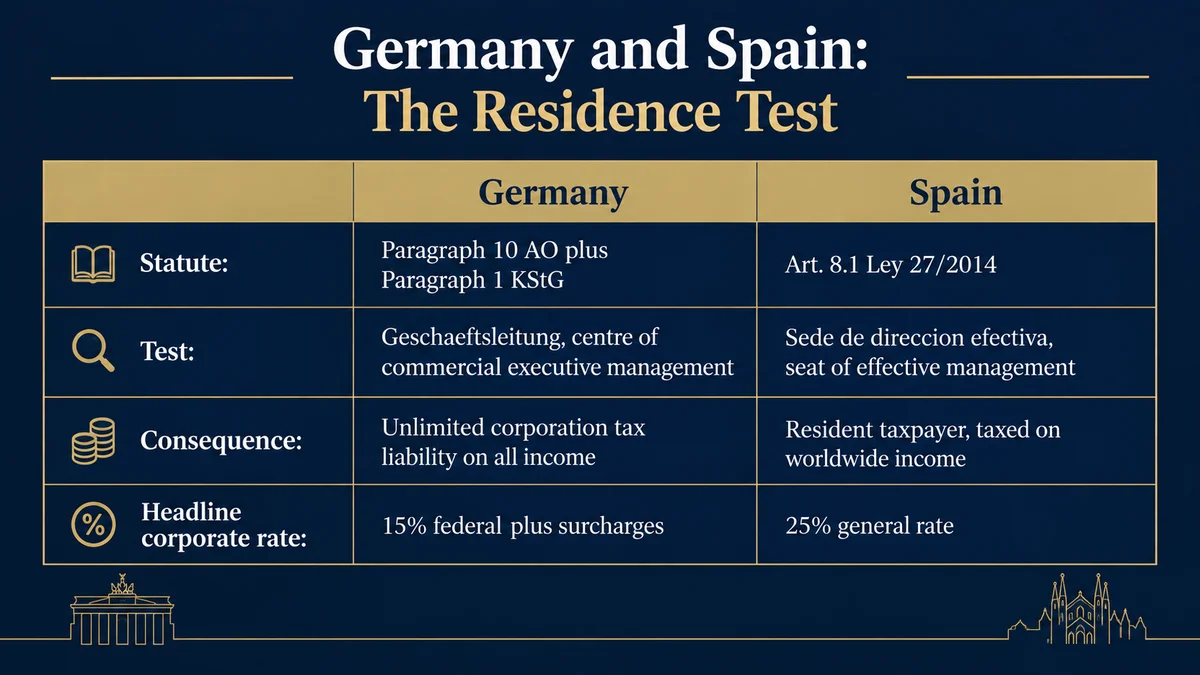
Germany's Fiscal Code defines the connecting factor in §10: "Business management shall mean the centre of commercial executive management." §1 of the Corporation Tax Act then makes any body with its management (Geschäftsleitung) or registered seat (Sitz) in Germany subject to unlimited corporation tax liability, and §1(2) extends that to all income.
Spain writes the same rule in Article 8.1 of Ley 27/2014: an entity is resident if any one of three things is true — it was incorporated under Spanish law, its domicilio social is in Spain, or its sede de dirección efectiva is in Spanish territory.
| Germany | Spain | |
|---|---|---|
| Statute | §10 AO + §1 KStG | Art. 8.1 Ley 27/2014 (LIS) |
| Test | Geschäftsleitung — centre of commercial executive management | Sede de dirección efectiva — seat of effective management |
| Alternative triggers | Registered seat in Germany | Incorporated in Spain, or registered office in Spain |
| Consequence of meeting it | Unlimited corporation tax liability on all income (§1(2) KStG) | Resident taxpayer — taxed on worldwide income |
| Headline corporate rate | 15% federal (§23 KStG) plus solidarity surcharge and municipal trade tax | 25% general rate (Art. 29.1 LIS) |
Now apply that to a one-person LLC. You are the sole member and the sole manager. Every decision — pricing, hiring, which clients to take, when to distribute — is made by you, at your desk, in your country of residence. There is no board anywhere else, because there is nobody else.
That is not a grey area; it is the textbook case. The centre of commercial executive management is wherever you are sitting, and if you are tax resident in Germany or Spain, so, on these tests, is your company. Registering in Wyoming changes the letterhead, not the decision-maker.
It is also why the usual fixes do not work. A registered agent is a statutory address for service of process with no management function; a virtual office is a mail drop. Neither relocates the person taking the decisions, which is the only thing the statute is looking at — see what a registered agent actually does. It is a compliance requirement, never a substance argument.
Test two: permanent establishment under the treaty
If your company is not resident in your country, the next question is whether it nevertheless has a taxable presence there. That is the permanent establishment test, and for US structures it runs through the treaty.
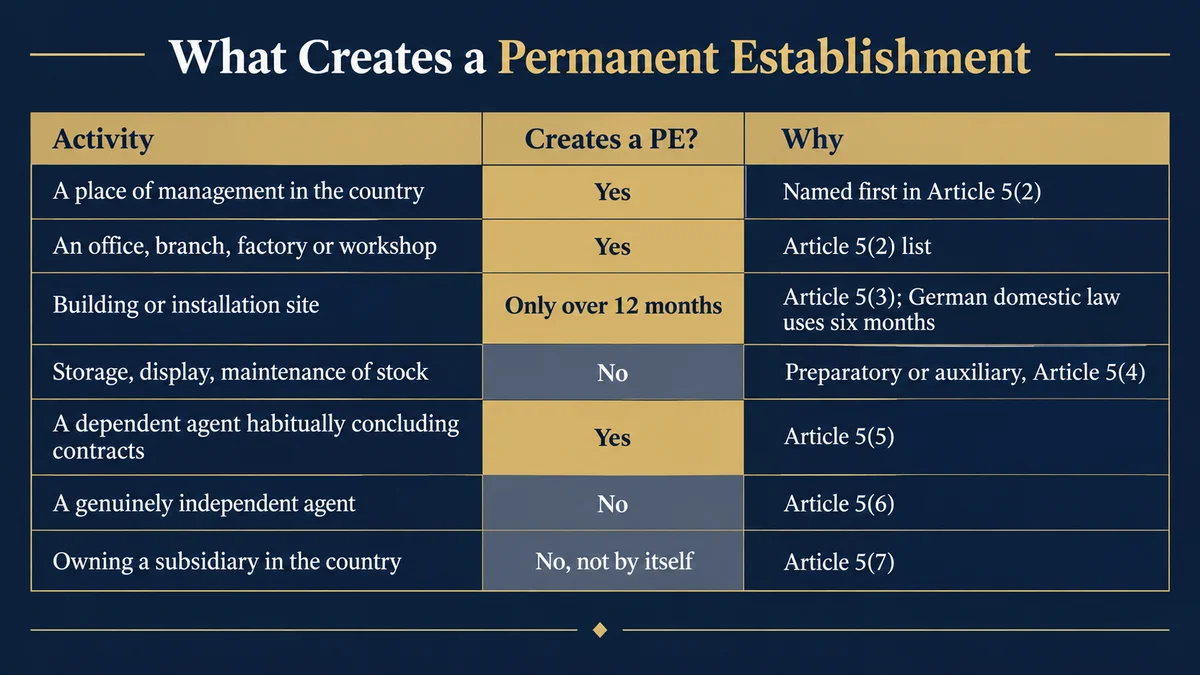
Article 5(1) of the 2016 US Model Income Tax Convention defines a permanent establishment as "a fixed place of business through which the enterprise carries on business." Article 5(2) gives a non-exhaustive list whose first item is "places of management", followed by branches, offices, factories, workshops and extraction sites. Article 7(1) is the payoff: a resident's business profits "may be taxed only in that state" unless attributable to a permanent establishment in the other.
| Activity | Creates a PE? | Why |
|---|---|---|
| A place of management in the country | Yes | Named first in Article 5(2) |
| An office, branch, factory or workshop | Yes | Article 5(2) list |
| Building or installation site | Only over 12 months | Article 5(3) — note German domestic law uses six months (§12 AO) |
| Storage, display, maintenance of stock | No | Preparatory or auxiliary, Article 5(4) |
| A dependent agent habitually concluding contracts | Yes | Article 5(5) |
| A genuinely independent agent acting in the ordinary course of business | No | Article 5(6) |
| Owning a subsidiary in the country | No, not by itself | Article 5(7) |
Two things are worth pulling out of that table. The first is the six-versus-twelve-month split on construction sites: §12 of the German Fiscal Code catches a site lasting more than six months, while the treaty threshold is twelve. Domestic law defines the exposure; the treaty limits it.
The second is that "place of management" appears in both lists. The same home office that makes you fail the residence test also satisfies the permanent-establishment definition. A European tax authority does not have to choose a theory — it can lead with residence and plead permanent establishment in the alternative, and you have to defeat both.
The treaty is also less help than people assume, because a disregarded LLC is not itself liable to tax in the United States and so is not a US resident able to claim benefits in its own name. The owner claims, and if the owner lives in Madrid there is no US residence to certify. That is the practical meaning of the Form 8802 and Form 6166 process: the certificate issues in the individual's name, and for a European-resident owner it is not available at all.
Test three: CFC rules take the profit anyway
Suppose you clear both of the above. There is a third door, built to catch exactly this arrangement.
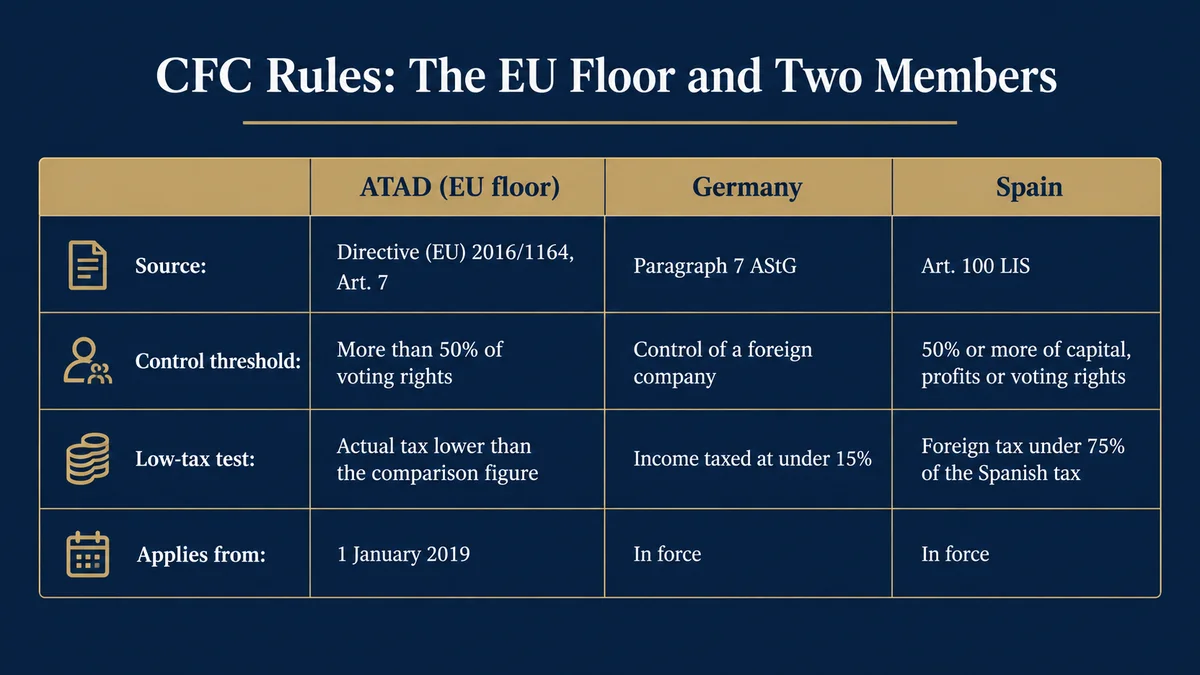
Every EU member state has operated a controlled foreign company regime since Council Directive (EU) 2016/1164 — ATAD — which states had to adopt by 31 December 2018 and apply from 1 January 2019. Article 7(1) attributes a foreign entity's income to the shareholder where the taxpayer holds "a direct or indirect participation of more than 50 percent of the voting rights" and the entity's actual corporate tax is low by comparison with what the shareholder's state would have charged.
A single-member LLC holds at 100%. The control test is not a hurdle; it is a formality.
| ATAD (EU floor) | Germany | Spain | |
|---|---|---|---|
| Source | Directive (EU) 2016/1164, Art. 7 | §7 AStG | Art. 100 LIS |
| Control threshold | More than 50% of voting rights | Control (Beherrschung) of a foreign company | 50% or more of capital, profits or voting rights |
| Low-tax test | Actual tax lower than the comparison figure | Income taxed at under 15% (§8(5) AStG) | Foreign tax under 75% of the Spanish tax that would have applied (Art. 100.1.b) |
| Substance escape | National implementation | Substance requirements | None if there is no substance — Art. 100.2 imputes total income where the entity lacks an organisation of material and human resources |
| Applies from | 1 January 2019 | In force | In force |
Spain's Article 100.2 is the most precisely aimed provision I found while researching this. Where the non-resident entity lacks "la correspondiente organización de medios materiales y personales" — the corresponding organisation of material and human resources — for obtaining the income, the Spanish resident imputes the entity's total income, not merely its passive income, and the article states explicitly that this applies even where the operations are recurrent.
A Wyoming LLC with no employees, no office and no fixed assets, whose entire output is produced by its owner in Spain, is an entity without material and human resources. The rule is less a trap than a description.
The classification conflict nobody warns you about
Underneath all three tests sits a quieter problem: your home country may not even agree with the United States about what kind of thing your LLC is.
In the US, the check-the-box regime lets a single-member LLC be disregarded by default — income flows straight to the member. Many European countries reach that conclusion only sometimes, and by a different route. Germany applies a Typenvergleich, comparing the LLC's legal characteristics against German company forms using criteria set out in the Federal Ministry of Finance letter of 19 March 2004 (IV B 4 - S 1301 USA - 22/04): centralised management, limited liability, transferability of interests, profit distribution, capital contributions, duration and formation requirements.
The Federal Fiscal Court confirmed the method in decision I B 75/20 of 18 May 2021, and the holding is the sentence every LLC seller leaves out: the type comparison takes no account of whether the company is transparent under US tax law. The Colorado LLC in that case was classified as the equivalent of a German corporation, so what its owner had treated as a simple flow of profit became taxable distributions.
| United States | Germany | |
|---|---|---|
| Method | Check-the-box election (default: disregarded for a single member) | Typenvergleich against German company types |
| Governing authority | Treasury regulations | BMF letter 19.03.2004; BFH I B 75/20 (18.05.2021) |
| Relevance of the other country's view | — | None — US transparency is expressly disregarded |
| Typical outcome for a manager-managed single-member LLC | Disregarded | Often the equivalent of a corporation |
| Practical effect on the owner | Profit is simply the owner's income | Profit sits in a company; getting it out is a taxable distribution |
The asymmetry is what hurts. If Germany sees a corporation and the US sees nothing, income can be taxed in Germany at the company level when it arises and again in the owner's hands when it is distributed, with no US tax paid to credit against either. The structure sold as double non-taxation quietly becomes double taxation. The EU addressed this class of mismatch for entities established inside a member state in ATAD 2 — Directive (EU) 2017/952, whose reverse-hybrid rule in Article 9a has applied since 1 January 2022 — but a US-incorporated LLC sits outside that provision, leaving the mismatch to domestic classification law, which is to say unpredictable.
What the US still wants from you
None of the above removes the American side of the ledger. A foreign-owned single-member LLC that is disregarded is nevertheless treated as a domestic corporation solely for reporting purposes, and the reporting is not optional.
| Obligation | Applies when | Penalty for missing it |
|---|---|---|
| EIN | Always, for a foreign-owned disregarded LLC | Cannot file without it |
| Form 5472 + pro forma Form 1120 | Any reportable transaction with a foreign related party — including the capital contribution that funded the company | $25,000 per form per year, plus $25,000 per 30-day period after an IRS notice |
| State annual report / franchise fee | Per state of formation | Administrative dissolution |
| Registered agent | Per state of formation | Loss of good standing |
The $25,000 surprises people because it attaches to an information return rather than a tax return — it is due even if the company earned nothing. Nor can a foreign-owned disregarded entity e-file it, a recurring source of missed deadlines. The mechanics, including the fax route and the Ogden address, are in the Form 5472 guide, and the wider picture in single-member LLC for non-residents.
Germany's rate cut makes the CFC problem worse
Here is a wrinkle that will catch people over the next few years. Germany's CFC rules treat foreign income as low-taxed under §8(5) AStG when it bears income taxes of less than 15 per cent. Meanwhile §23(1) of the Corporation Tax Act now sets German corporation tax on a declining schedule:
| Assessment period | German corporation tax rate (§23(1) KStG) |
|---|---|
| Up to 2027 | 15% |
| 2028 | 14% |
| 2029 | 13% |
| 2030 | 12% |
| 2031 | 11% |
| From 2032 | 10% |
The two numbers move in opposite directions relative to each other. As the domestic rate falls toward 10%, a fixed 15% threshold becomes more inclusive of foreign structures, not less: an entity taxed at 12% is low-taxed under §8(5) even in a year when a German company would pay 12% federally. Whether the threshold is revisited is an open policy question. What matters for planning is that a US LLC paying zero federal income tax sits below the threshold under every version of this schedule, so the CFC analysis does not improve at any point between now and 2032.
What actually works
There are honest answers here. They are just less exciting than the ones being marketed.
Accept transparency and report at home. The most common workable arrangement: treat the LLC as a US-facing trading and banking vehicle, declare the profit where you live, and take the benefits that are real — a US bank account, US payment rails, credibility with US clients, formation costs in the hundreds. You are not saving tax. You were probably never going to.
Build genuine substance in the United States. This works and it is expensive. Substance means people with real decision-making authority, not an address and a mailbox. Price it against the tax at stake first; for a freelancer billing $120,000 it is almost never worth it, and for a founder with a US-market product it sometimes is.
Change your own residence. The only move that resets all three tests at once, because every one is anchored to where you are — see second residency ranked for what the realistic programmes cost in money and days on the ground, and tax resident nowhere for why being resident nowhere at all rarely survives a treaty tiebreaker.
What does not work is any structure whose pitch depends on a European authority never asking where the company is managed. Those fail on the first test, before the treaty is reached, and the classification conflict means the downside is not "you pay the tax you would have paid anyway" — it can be worse.
Related guides
- Form 5472 and the $25,000 penalty — the US filing a quiet LLC still owes every year.
- Single-member LLC for non-residents — what the structure does and does not do, end to end.
- Best state for a non-resident LLC — why the state choice matters far less than people think.
- Company structures for zero tax — where the LLC sits among the alternatives.
- Tax resident nowhere — the residence question underneath all of this.
- Second residency ranked 2026 — cost, speed and days required, if changing residence is the real answer.
FAQ
Does a US LLC create a permanent establishment where I live?
It can — Article 5(2) of the 2016 US Model treaty lists "places of management" first, and a desk you run the company from is squarely within that. But the bigger risk sits earlier: most European countries apply a domestic corporate residence test before the treaty is reached. A permanent establishment costs you tax on the profits attributable to it; failing the residence test costs you tax on everything.
What is place of effective management, and why does it matter more than PE?
It decides whether the company is tax resident in a country at all. Germany's §10 AO defines Geschäftsleitung as "the centre of commercial executive management", and §1 KStG makes a body managed from Germany liable to unlimited corporation tax on all its income; Spain uses sede de dirección efectiva in Article 8.1.c) of Ley 27/2014. For a single-member, single-manager LLC that centre is wherever the owner sits.
If my LLC is disregarded for US tax, is it disregarded in Europe too?
No — classification is decided under local law. Germany applies a Typenvergleich using the criteria in the Federal Ministry of Finance letter of 19 March 2004, and in decision I B 75/20 of 18 May 2021 the Federal Fiscal Court held that the comparison takes no account of whether the company is transparent under US tax law. The Colorado LLC in that case was treated as the equivalent of a German corporation.
Do CFC rules apply to a one-person US LLC?
Frequently. Article 7(1) of ATAD bites at more than 50% of voting rights combined with low taxation — thresholds a single-member LLC paying no US federal tax meets automatically, and every member state has applied the rules since 1 January 2019. Spain goes further: Article 100.2 of Ley 27/2014 imputes the entity's total income where it has no organisation of material and human resources.
Does a US LLC with no US income still have to file anything in the US?
Yes. A foreign-owned disregarded single-member LLC needs an EIN and must file a pro forma Form 1120 with Form 5472 attached. The penalty is $25,000 per form per year, applied automatically, with a further $25,000 for each 30-day period after an IRS notice — due even when the company owes no US tax and its only reportable transaction was the contribution that funded it.
Can my US LLC claim treaty benefits in its own right?
Usually not. A disregarded entity is not itself liable to tax in the United States, so it is not a US resident for treaty purposes — the owner is the claimant, which is why Form 6166 certification is issued in the owner's name. If that owner lives in Spain or Germany, there is no US residence to certify.
Does a registered agent or virtual office in the US fix this?
No. A registered agent is a statutory address for receiving legal documents, and a virtual office is a mail drop. Neither relocates the person taking the decisions, and the German and Spanish tests look at conduct rather than paperwork.
Is there a legitimate way to run a US LLC from Europe?
Three, and none is a trick: report the profit where you live and use the LLC as a US-facing trading vehicle; build real US substance in people rather than addresses; or change your own residence, which resets all three tests at once. The structures sold as shortcuts generally fail on the first test.
If you are going to run one, run it compliantly
Nothing above is an argument against owning a US LLC — it is an argument against expecting it to do something it cannot. If the vehicle genuinely fits (US clients, US banking, US payment rails), the one thing you cannot skip is the annual pro forma Form 1120 with Form 5472 attached, which carries a $25,000 penalty and cannot be e-filed by a foreign-owned disregarded entity. Doola forms the LLC, obtains the EIN and handles that filing.
Sources
- Abgabenordnung §10 and §12 — official English translation: "centre of commercial executive management", and the PE list with the six-month building-site rule.
- Körperschaftsteuergesetz §1 — unlimited liability on management or seat, extending to all income.
- Körperschaftsteuergesetz §23 — 15% to 2027, stepping down to 10% from 2032.
- Außensteuergesetz §7 and §8 — German CFC control test and the under-15% threshold in §8(5).
- BFH, I B 75/20, 18 May 2021 — the Typenvergleich and the irrelevance of US transparency.
- Ley 27/2014, del Impuesto sobre Sociedades — BOE consolidated text: Article 8.1 residence, Article 29.1 (25%), Article 100 (the 50% and 75% thresholds and total-income imputation in 100.2).
- Council Directive (EU) 2016/1164 (ATAD) — Article 7 CFC rule, Article 11 transposition dates.
- Council Directive (EU) 2017/952 (ATAD 2) — Article 9a reverse hybrids, from 1 January 2022.
- US Model Income Tax Convention (2016) — Treasury: Article 5 permanent establishment and Article 7(1) business profits.
Provisions are current as of September 2026. Residence, permanent establishment and CFC outcomes are intensely fact-specific and differ between member states; the German and Spanish provisions quoted here are examples, not a survey of the EU. This is editorial research, not legal or tax advice — take advice where you live before relying on any structure described above.