
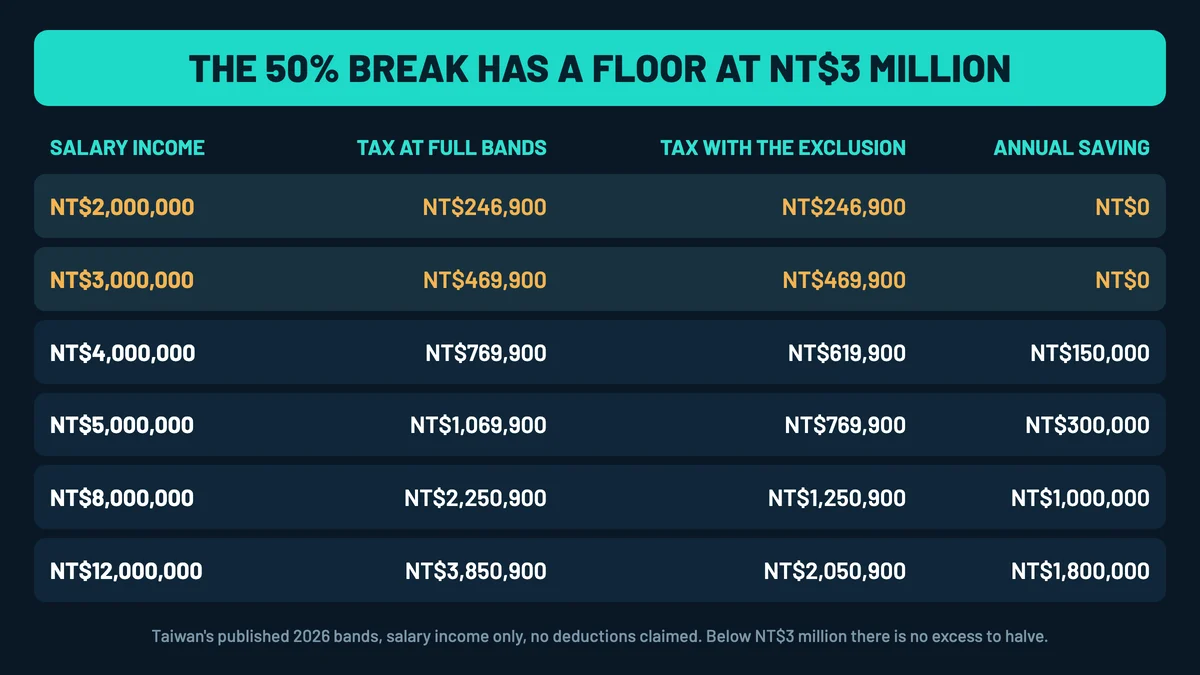
The Taiwan Gold Card is sold on a number, and the number is real: 50% of your salary above NT$3 million is struck out of your tax assessment for five years. At NT$8 million of salary that is a saving of NT$1,000,000 a year, and it drops your effective rate from 28.1% to 15.6%.
It is also worth nothing to most of the people who read about it. The exclusion applies to the excess over NT$3 million — about US$94,000 at NT$32 to the dollar — so at NT$2 million of salary the break is zero, at NT$3 million it is zero, and at NT$4 million it is NT$150,000. Every guide leads with the 50%; none leads with the floor.
So we ran the statute instead of the brochure: the Regulations, the Ministry of Finance's published 2026 bands, and the National Development Council's fee and qualification pages field by field. The card is excellent at one thing the guides barely mention and mediocre at the thing they all sell.
Key takeaways
- The 50% break has a floor at NT$3 million of salary. Below it the saving is NT$0; at NT$5 million it is NT$300,000; at NT$12 million it is NT$1,800,000. It is a high-earner incentive wearing a nomad-visa jacket.
- Remote work done in Taiwan is Taiwan-source income, under Item 3, Paragraph 1, Article 8 of the Income Tax Act — so the "Taiwan doesn't tax foreign income" story that half this SERP runs on does not describe a freelancer sitting in Taipei.
- The salary route is an employment test. The official FAQ says stocks and property income cannot be used as proof, and asks for an employment certificate. A freelancer qualifies on the eight-years-experience route instead, which almost nobody writes about.
- Three years to an APRC, averaging 183+ days a year — against five for an ordinary foreign professional. Among remote-work visas that is close to unique.
- Six months with no National Health Insurance if you have no Taiwanese employer and no registered Taiwanese business, and over 60 business days to process the application.
SafetyWing — a Gold Card holder with no Taiwanese employer waits six months for National Health Insurance, and the clock only runs while you are in the country
What the Taiwan Gold Card actually is
It is not a visa, and calling it one undersells it. The Employment Gold Card is one document carrying four permissions that a foreigner would otherwise collect separately: a resident visa, an open work permit, an Alien Resident Certificate and a re-entry permit.
The open work permit is the whole product. Nobody sponsors you. You can contract, freelance, take a job, leave it, start a company or earn nothing, and your right to stay does not move. That is a different proposition from the European nomad permits, where the permission is welded to a specific income source and a specific employer's foreignness.
| Taiwan Employment Gold Card | |
|---|---|
| What it bundles | Resident visa + open work permit + ARC + re-entry permit |
| Validity | 1, 2 or 3 years — you choose at application |
| Qualifying fields | Architecture, Arts & Culture, Digital, Economy, Education, Finance, National Defense, Science & Technology, Law, Sports, Biotechnology, Environment — apply under one only |
| Employer needed | No |
| Processing | Over 60 business days with complete documents |
| Tax benefit | 50% of salary above NT$3m excluded, 5 years, conditions apply |
| Permanent residence | APRC after 3 years, averaging 183+ days a year |
| Family | Spouse and children join; parents and grandparents can visit |
Two notes the portal buries. You apply under one field and the criteria differ sharply between them, so the wrong field is the commonest self-inflicted rejection. And the National Development Council's own page says "ten different fields" while listing twelve.
The Taiwan Gold Card salary requirement is an employment test
The figure everyone quotes is right: an average monthly salary of at least NT$160,000 before tax, which is NT$1.92 million a year. How it is measured is where the guides fall over.
The Workforce Development Agency takes one annual tax statement issued within three years of your application and divides the amount by 12 — a US W-2, a Canadian T4, a UK P60. Foreign currency converts at the Bank of Taiwan's historical cash buying rate. If local law makes such a statement impossible, an employer certification can substitute once you have explained why.
What cannot substitute is what most of this site's readers have. The official FAQ states that income from stocks and property cannot be used as proof, and the document list asks for an employment certificate naming your company, position and dates, stamped or signed by the issuer. A sole trader invoicing clients has neither.
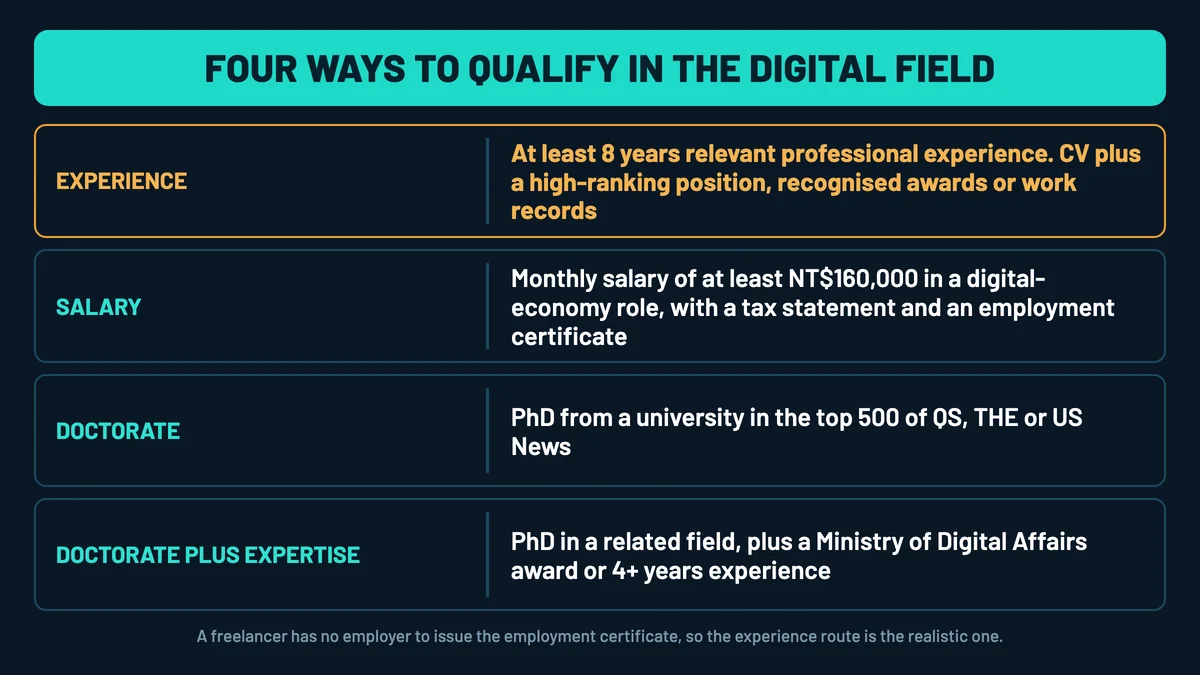
So the route a freelancer or bootstrapped founder actually takes is the other one:
| Route (Digital field) | Test | Evidence |
|---|---|---|
| Experience | At least 8 years relevant professional experience in digital-economy industries or fields | CV plus one or more of: proof of a high-ranking position, recognised awards, work-experience records |
| Salary | Most recent monthly salary ≥ NT$160,000 in a digital-economy role | Tax statement or salary proof, employment certificate, CV |
| Doctorate | PhD from a university in the top 500 of QS, THE or US News | Graduation certificate |
| Doctorate + expertise | PhD in a related field, plus an award recognised by the Ministry of Digital Affairs or 4+ years' experience | Patent filing or published research |
The Economy field works the same way with eight routes rather than four, including senior executive roles at eight years' standing and a startup route for a legal representative or core R&D member of a Taiwanese company that has taken at least US$1 million from a venture investor.
If you are self-employed and earning well, do not apply under the salary criterion and hope. Apply under experience and spend the effort on the supporting documents.
What the Taiwan Gold Card costs in 2026
The fee schedule is published, exact and misreported everywhere. One guide currently ranking gives NT$9,400 for a three-year US card; another converts to "USD 100 to 310" and leaves it. The official table:
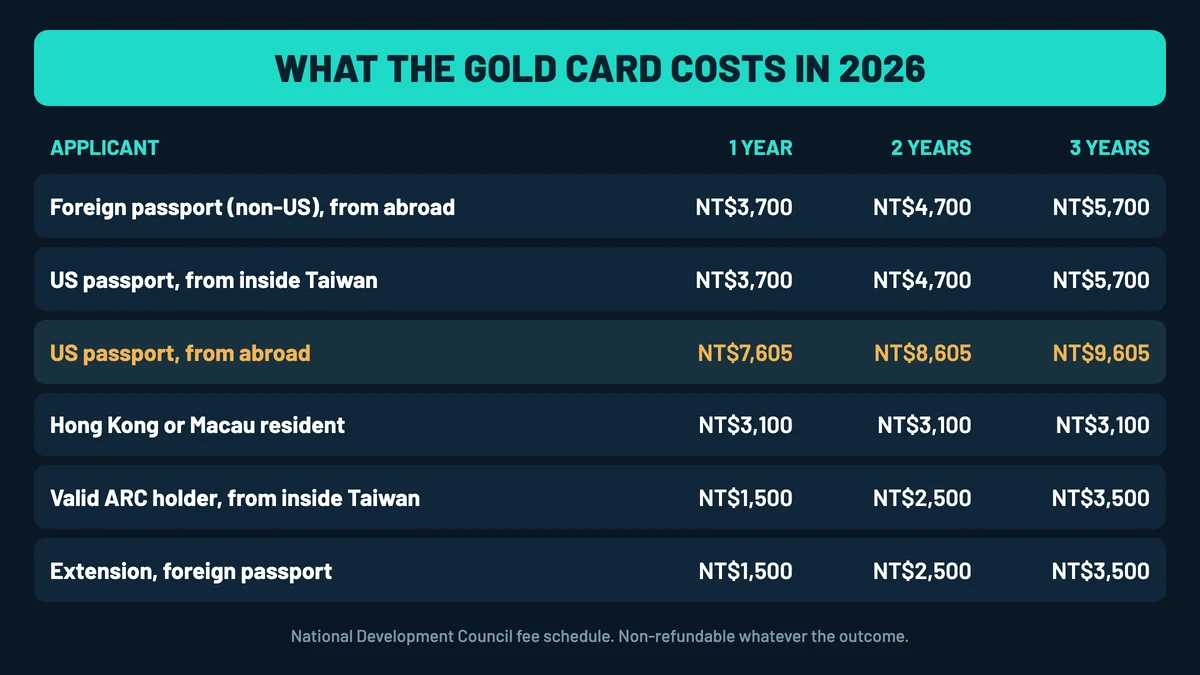
| Applicant | 1 year | 2 years | 3 years |
|---|---|---|---|
| Foreign passport (non-US), from abroad | NT$3,700 | NT$4,700 | NT$5,700 |
| US passport, applying from inside Taiwan | NT$3,700 | NT$4,700 | NT$5,700 |
| US passport, applying from abroad | NT$7,605 | NT$8,605 | NT$9,605 |
| Hong Kong or Macau resident | NT$3,100 | NT$3,100 | NT$3,100 |
| Valid ARC holder, applying from inside Taiwan | NT$1,500 | NT$2,500 | NT$3,500 |
| Extension, foreign passport | NT$1,500 | NT$2,500 | NT$3,500 |
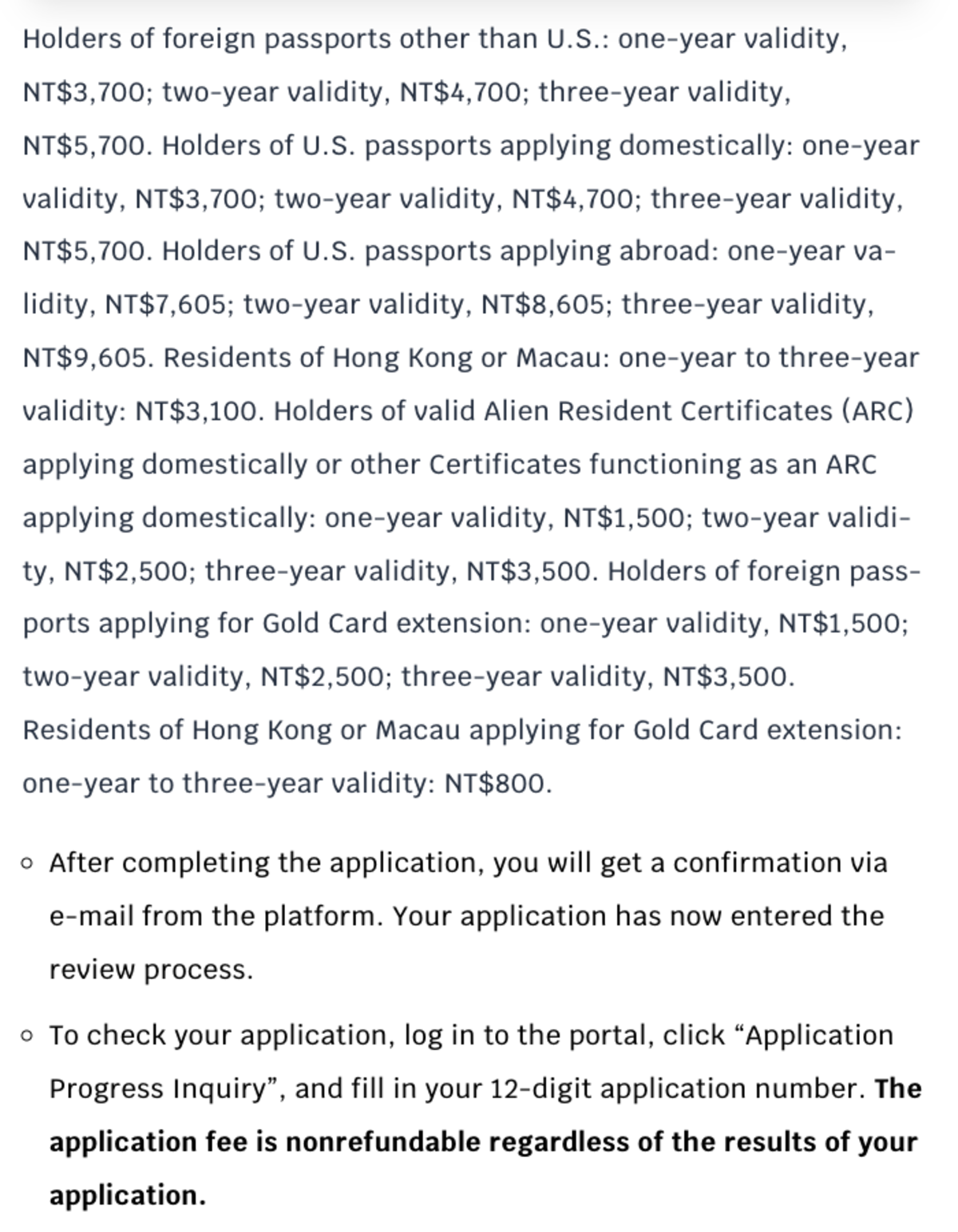
Three things follow, none of them in the guides. A US passport costs roughly NT$3,900 more from abroad than from inside Taiwan, and the gap disappears once you hold an ARC. The ARC-holder column is the cheapest route in, at NT$3,500 for three years. And the fee is non-refundable regardless of the result, with the authorities under no duty to explain a refusal.
On timing, the portal's own numbers: over 60 business days end to end with complete documents, plus roughly seven working days of passport inspection abroad and one to two weeks of immigration review. A document request adds weeks; you get 30 days to supply it, or six months if it only exists abroad.
The 50% tax break: three conditions, five years, and a floor
The incentive lives in the Act for the Recruitment and Employment of Foreign Professionals — the Gold Card portal cites Article 20, the National Taxation Bureau's April 2026 release cites Article 22, and we could not reconcile the two — and operatively in Articles 3 to 5 of the Regulations Governing Reduction and Exemption of Income Tax of Foreign Specialist Professionals. Article 3 sets three conditions, and all three must hold:
| Condition | What it means in practice |
|---|---|
| First-time approval to reside for work | A previous ARC as a student or a dependant does not disqualify you; a previous work-based ARC does |
| Professional work related to your recognised expertise | The field you applied under has to match what you then do |
| No household registration and no Income Tax Act residence in the five years before employment | Five years of genuine absence. Prior residence as a tax resident closes the door |
Article 4 then sets the clock. The five-year window starts in the first taxable year in which you both reside in Taiwan for 183 full days and have salary income above NT$3 million. It does not start when you land, and it does not start when the card is issued.
Two consequences. A year under 183 days is a year the break cannot apply to. And the preference is not automatic: Article 5 of the Regulations requires the return to be filed within the statutory deadline with the application and its supporting documents attached, which for the 2025 tax year meant 1 May to 1 June 2026.
The Taipei National Taxation Bureau published what that costs. A Gold Card holder it calls Mr. B filed late — 10 December 2025 — and lost the incentive for the 2024 tax year outright. His NT$6.71 million of professional salary went into gross consolidated income in full and the bureau assessed a deficiency of over NT$540,000. The card preserves nothing; the filing date does.
And the part the SERP never states
Half of the excess over NT$3 million. Not half your salary. If your salary income is NT$2.9 million, there is no excess, so there is no relief — and you are on Taiwan's ordinary progressive rates, which reach 40%.
What the break is worth against the 2026 bands
Taiwan's published brackets for the 2026 tax year run 5% to NT$610,000, 12% to NT$1,380,000, 20% to NT$2,770,000, 30% to NT$5,190,000 and 40% above that, with a progressive-difference deduction at each step. Applying them to salary income with no deductions claimed, to isolate the effect of the exclusion:
| Salary income | Tax at full bands | Tax with the 50% exclusion | Effective rate with break | Annual saving |
|---|---|---|---|---|
| NT$2,000,000 | NT$246,900 (12.3%) | NT$246,900 | 12.3% | NT$0 |
| NT$3,000,000 | NT$469,900 (15.7%) | NT$469,900 | 15.7% | NT$0 |
| NT$4,000,000 | NT$769,900 (19.2%) | NT$619,900 | 15.5% | NT$150,000 |
| NT$5,000,000 | NT$1,069,900 (21.4%) | NT$769,900 | 15.4% | NT$300,000 |
| NT$8,000,000 | NT$2,250,900 (28.1%) | NT$1,250,900 | 15.6% | NT$1,000,000 |
| NT$12,000,000 | NT$3,850,900 (32.1%) | NT$2,050,900 | 17.1% | NT$1,800,000 |
Read the right-hand column, then the one beside it. The exclusion does not produce a flat rate; it produces an effective rate sitting in a band around 15% to 17% across a sixfold range of income, because it halves exactly the slice the 30% and 40% bands were about to take. That is a well-designed incentive — for someone on NT$5 million and up.
For a freelancer on NT$2.5 million, roughly US$78,000, the tax value is zero and the real value is the open work permit and the clock to permanent residence. Still a reason to want it — just not the reason you were sold.
The sourcing rule that breaks the "tax-free foreign income" story
A lot of nomad content on Taiwan is wrong here, in both directions.
One guide tells readers Taiwan "taxes residents' worldwide income". It does not. Article 2 of the Income Tax Act levies consolidated income tax on an individual's income derived from sources in the Republic of China, and foreign-source income reaches a resident only through the separate Income Basic Tax, where it is included once it hits NT$1 million and bites only above a NT$7.5 million basic-income exemption at a flat 20%. The Ministry of Finance confirmed in its 2026 announcement that the NT$7.5 million figure is unchanged for 2026, because CPI movement did not reach the 10% trigger.
Another set of guides takes that structure and concludes the opposite: that a Gold Card holder's foreign clients produce untaxed income. That is where Item 3, Paragraph 1, Article 8 arrives.
"the remuneration he/she receives from his/her employer(s) outside of the ROC" for services rendered within the territory of the ROC "shall be considered as ROC-sourced income"
The Ministry of Finance's eTax portal states the trigger: an alien staying in Taiwan more than 90 days in a tax year has overseas-employer pay for work performed in Taiwan treated as Taiwan-source. The National Taxation Bureau's logic is one line — the source of service income is the country where the service is rendered.
So the laptop is the deciding fact, not the invoice. Work performed at a desk in Taipei is Taiwan-source income however foreign the payer — and a holder clearing 183 days for the tax break is three months past the 90-day trigger by definition. There is no version of this in which your working income is foreign-source.
What the Income Basic Tax carve-out genuinely shelters is everything you are not working for while sitting in Taiwan: foreign dividends, capital gains and rent. For a founder holding shares outside Taiwan that is a real five-year benefit, and it is the half of Article 4 nobody prices. It does nothing for consulting fees. Against a genuinely territorial system, our zero-percent tax residencies breakdown is the fairer comparison, and tax resident nowhere explains why the gap-between-countries plan rarely survives contact with either.
Six months in Taiwan with no national health insurance
Taiwan's National Health Insurance is one of the reasons people move there, and the Gold Card does not hand it to you on arrival.
If you are employed by a Taiwan-registered company, or are an employer or registered self-employed business owner in Taiwan, you enrol immediately. If you are none of those — the exact position of a freelancer invoicing foreign clients, which is most of the people this card is marketed to — you wait six months, then apply at your local bureau.
"Six months" is defined, and the definition is strict: six consecutive months of residence, or a period in which you leave Taiwan once for no more than 30 days, with the time abroad excluded from the count. A second trip restarts it. The Gold Card's own member-benefits page says 180 consecutive days while its FAQ and health pages say six months — treat the longer reading as the planning number.
Dependants are better off than the holder: once you are enrolled, a spouse and minor children face no separate wait. The gap is yours alone, and it is the most predictable uninsured stretch in this programme.
Three years to permanent residence — the part that is actually rare
Most remote-work permits lead nowhere. Malta's caps at four years and converts to nothing; Thailand's LTR is a long stay rather than a path. The Gold Card is the exception, and it is the strongest argument for it.
| Route to an APRC | Residence needed | Condition |
|---|---|---|
| Gold Card, standard | 3 consecutive years | Average more than 183 days a year in Taiwan |
| Ordinary foreign professional | 5 years | Average more than 183 days a year |
| Gold Card + Taiwanese master's | 2 years | Degree offsets one year; not available to dependants |
| Gold Card + Taiwanese doctorate | 1 year | Degree offsets two years |
| High-income Gold Card holder | 1 year | NT$6 million or more of domestic salary and professional income in the most recent year |
| Mixed ARC + Gold Card time | 5 years total | Earlier professional-ARC time counts, but the requirement rises to five years |
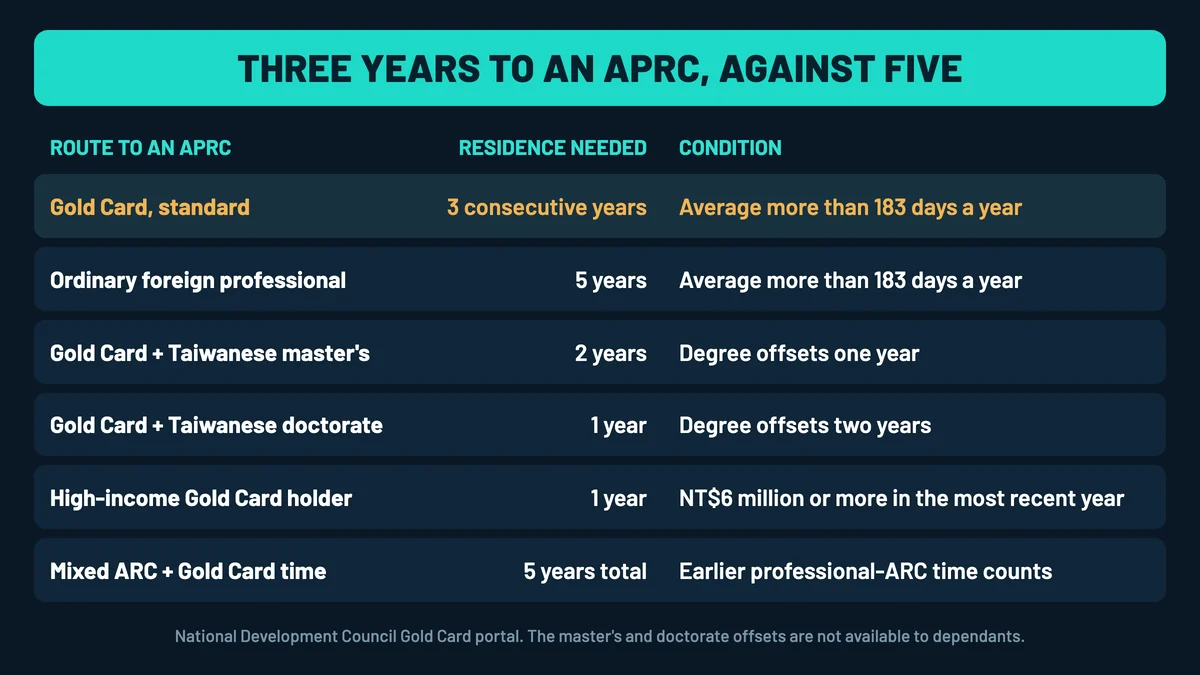
Three details before you plan around it. The clock starts from the issue date printed on the card, not the day you arrived. The window opens the day after the three years close and runs two years — miss it and you re-qualify. And a spouse or children can apply three consecutive years after you hold permanent residence, without financial proof.
A permit that converts to permanent residence in three years, with no investment and no employer, is a genuinely short runway — see digital nomad visas with a path to permanent residency for how few programmes manage it, and Japan's six-month dead end for the usual shape.
Who the Taiwan Gold Card actually fits
It fits a remote employee or senior contractor on NT$5 million and up — roughly US$155,000 — who will live in Taiwan for more than half of each year, wants permanent residence inside three years, and has not been a Taiwanese tax resident in the last five. At that income the exclusion saves NT$300,000 to NT$1.8 million a year.
It fits a founder holding foreign shares and investments, for whom the quieter half of Article 4 — overseas income out of the Income Basic Tax for five years — is worth more than the salary break.
It fits poorly for a freelancer on NT$2 million to NT$3 million, who gets no tax benefit, qualifies on experience rather than income, pays ordinary rates on work done in Taiwan and waits six months for health insurance. And poorly for anyone wanting a base without the presence: 183 days is the condition on both the tax break and the APRC.
Take it for the open work permit and the three-year runway, and treat the 50% as a bonus that arrives at NT$3 million. On that reading it is one of the better products in this market. On the brochure's reading, most applicants will be disappointed by their first Taiwanese tax return.
Related reading
- Digital nomad visas with a path to permanent residency — the short list of programmes where the years actually count, and where Taiwan sits on it.
- Japan digital nomad visa — six months, no renewal, no residence accrued: the standard against which three years to an APRC should be read.
- Thailand LTR visa — the other Asian ten-year option, with a flat-rate regime and a very different income test.
- Malta digital nomad visa — the EU comparison: 10% flat, four-year ceiling, and nothing at the end.
- Digital nomad visas compared — income thresholds, duration and tax treatment across every major programme in one table.
- Second residency, ranked — cost, speed and physical-presence requirements across the realistic options.
FAQ
What is the Taiwan Employment Gold Card?
It is a single document that bundles four things a foreigner would otherwise apply for separately: a resident visa, an open work permit, an Alien Resident Certificate and a re-entry permit. The open work permit is the unusual part — no employer sponsors you, so you can freelance, contract, change jobs or work for nobody at all. You choose a validity of one, two or three years when you apply.
What is the Taiwan Gold Card salary requirement in 2026?
An average monthly salary of at least NT$160,000 before tax, in the Economy and Digital fields among others. The Workforce Development Agency takes the figure from one annual tax statement issued within three years of the application and divides it by 12. It must be salary: the official FAQ states that income from stocks and property cannot be used as proof, which rules out most self-employed and investment income.
Can a freelancer get the Taiwan Gold Card?
Yes, but not usually on the salary route, because a freelancer has no employer to issue the employment certificate the salary route asks for. The realistic path is the experience route — in the Digital field, at least eight years of relevant professional experience in digital-economy industries, evidenced by a CV plus supporting documents such as a high-ranking position, awards or work records. Several guides say freelancers qualify on income alone; the official criteria do not support that.
How much does the Taiwan Gold Card cost?
On the official fee schedule, a three-year card is NT$5,700 for most foreign passport holders applying from abroad and NT$9,605 for a US passport holder. Applying from inside Taiwan on a valid ARC costs NT$1,500 to NT$3,500. Hong Kong and Macau residents pay NT$3,100 for any validity. The fee is non-refundable whatever the outcome.
How does the Taiwan Gold Card 50% tax break work?
For five years, half of your salary income above NT$3 million is excluded from your consolidated income tax assessment, and certain overseas income is excluded from the Income Basic Tax. Below NT$3 million of salary the break is worth nothing at all, because there is no excess to halve. You must also reside in Taiwan for 183 full days in the year, and the benefit is not automatic — it has to be claimed in a return filed within the statutory period.
Is foreign income taxed in Taiwan on a Gold Card?
Not as foreign income — but the question misses the point. Taiwan's consolidated income tax reaches income from sources in Taiwan, and under Item 3, Paragraph 1, Article 8 of the Income Tax Act, remuneration for services rendered inside Taiwan is Taiwan-source even when the payer is overseas. The Ministry of Finance states that for an alien staying more than 90 days in a tax year, overseas-employer pay for work performed in Taiwan counts as Taiwan-sourced. Work done at a desk in Taipei is Taiwan-source wherever the client banks.
Does the Taiwan Gold Card lead to permanent residency?
Yes, and that is the rarest thing about it. Three consecutive years holding the card, averaging more than 183 days a year in Taiwan, qualifies you to apply for an APRC — against five years for an ordinary foreign professional. A Taiwanese master's degree offsets one year and a doctorate two, and domestic salary and professional income of NT$6 million or more in the most recent year also brings it to one year.
Sources
- Taiwan Employment Gold Card — official portal, National Development Council — the four permissions bundled in the card, the qualifying fields, the validity choice, the family provisions and the APRC rules.
- Gold Card — Application Information — every fee tier above, "over 60 business days" processing, the document deadlines and the non-refundable rule.
- Gold Card — Field of Economy criteria — the NT$160,000 salary route and its evidence, the eight-year experience and executive routes, the US$1 million startup route.
- Regulations Governing Reduction and Exemption of Income Tax of Foreign Specialist Professionals — Article 3's three conditions, Article 4's five-year window and the half-above-NT$3-million exclusion, and the Income Basic Tax carve-out.
- National Taxation Bureau of Taipei — timely filing requirements for foreign specialist professionals — the five consecutive tax years, the two-part start condition, Article 5's filing deadline, and the Mr. B assessment of over NT$540,000 (released 17 April 2026).
- Ministry of Finance — eTax Portal, progressive tax rates — the 2026 brackets and progressive-difference figures used in the tax table.
- Ministry of Finance — eTax Portal, deemed ROC-sourced income — Article 8's Item 3 and the 90-day trigger for overseas-employer pay earned in Taiwan.
- Ministry of Finance — 2026 income basic tax announcement — the NT$7,500,000 exemption unchanged for 2026, the CPI trigger not having been reached.
- PwC Worldwide Tax Summaries — Taiwan, taxes on personal income — Income Basic Tax mechanics: flat 20%, the NT$7.5 million exemption, the NT$1 million inclusion threshold.
Figures are current as of 11 October 2026. The tax table applies Taiwan's published 2026 brackets to salary income with no exemptions, deductions or reliefs claimed, so the effect of the 50% exclusion is visible on its own; a real return will differ, and the 2025 tax year uses a lower set of brackets. The NT$3 million threshold is statutory in New Taiwan dollars — US figures are rough orientation at around NT$32 to the dollar and will move. APRC rules, fee tiers and the NHI wait come from the National Development Council's Gold Card portal; where its member-benefits page says 180 days and its FAQ says six months, we have used the longer reading. This is editorial research, not tax or immigration advice; the five-year no-prior-residence condition and the sourcing of your own income belong with a Taiwanese practitioner before you file.