The Malta digital nomad visa is sold on one number, and the number is real: your first twelve months of remote-work income are not taxed in Malta at all. Ten per cent after that, against standard Maltese rates that reach 35%. On €100,000 of freelance income that is a difference of €25,600 a year.
Then you read the statute. The exemption in rule 3(3) of the Nomad Residence Permits (Income Tax) Rules holds unless you file a written declaration that your residence in Malta "is not merely of a casual nature" — and that declaration is exactly the document you need if you are trying to prove to your old country that you have left. The zero-tax year and a defensible Maltese tax position are alternatives. Nobody selling the permit mentions it.
So we read Legal Notice 277 of 2023 in full, the agency's own eligibility page, checklist and FAQ, and ran the 10% against Malta's published 2026 bands rather than against a brochure. Four of the five rules in that legal notice appear in none of the top-ranking guides, and three of those guides still publish an income threshold that changed in April 2024.
Key takeaways
- The 0% first year is conditional, not automatic. Rule 3(3) withdraws it the moment you declare to Residency Malta that your residence is more than casual — the declaration a departing tax resident usually wants to make.
- The income test is €42,000 gross, not the €2,700 a month or USD 1,500 a month still live in the top ten. Applications filed before 1 April 2024 keep €32,400.
- 10% beats Malta's own bands by €2,900 at €42,000 and €28,100 at €150,000 — and beats the Global Residence Programme at every income level, because the GRP carries a €15,000 minimum tax and the nomad permit carries none.
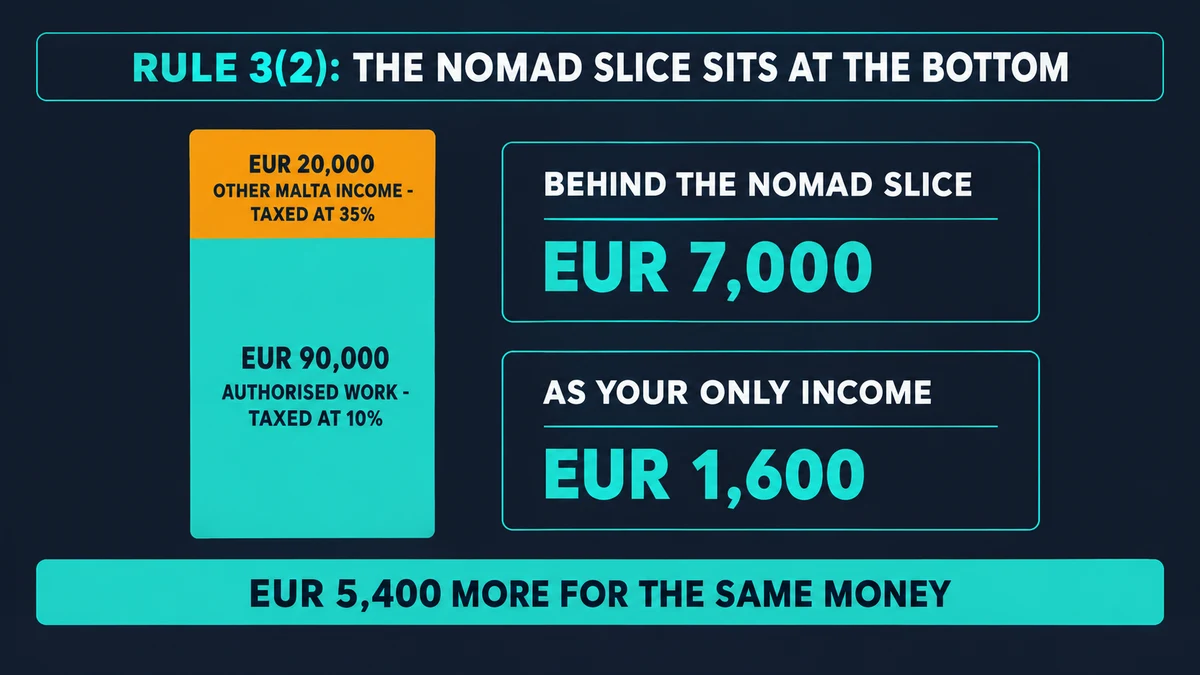
- Authorised-work income is the first part of your chargeable income (rule 3(2)), so any other Malta-taxable income stacks in the bands above it. €20,000 of other income behind €90,000 of nomad income is taxed at 35%, not 25%.
- Four years is the ceiling and it leads nowhere. The agency states the permit "does not lead to any sort of permanent/long-term residency or citizenship", and travel insurance is not accepted for the insurance condition.
SafetyWing — Residency Malta wants a full year of comprehensive health cover before it issues the card, and says in writing that travel insurance will not do
What the Malta digital nomad visa actually is in 2026
There is no Maltese visa by that name. What exists is the Nomad Residence Permit, issued by the Residency Malta Agency under the Immigration Act, and the income tax rules define it as a permit "that grants a third country national a licence to perform work in Malta consisting exclusively of authorised work".
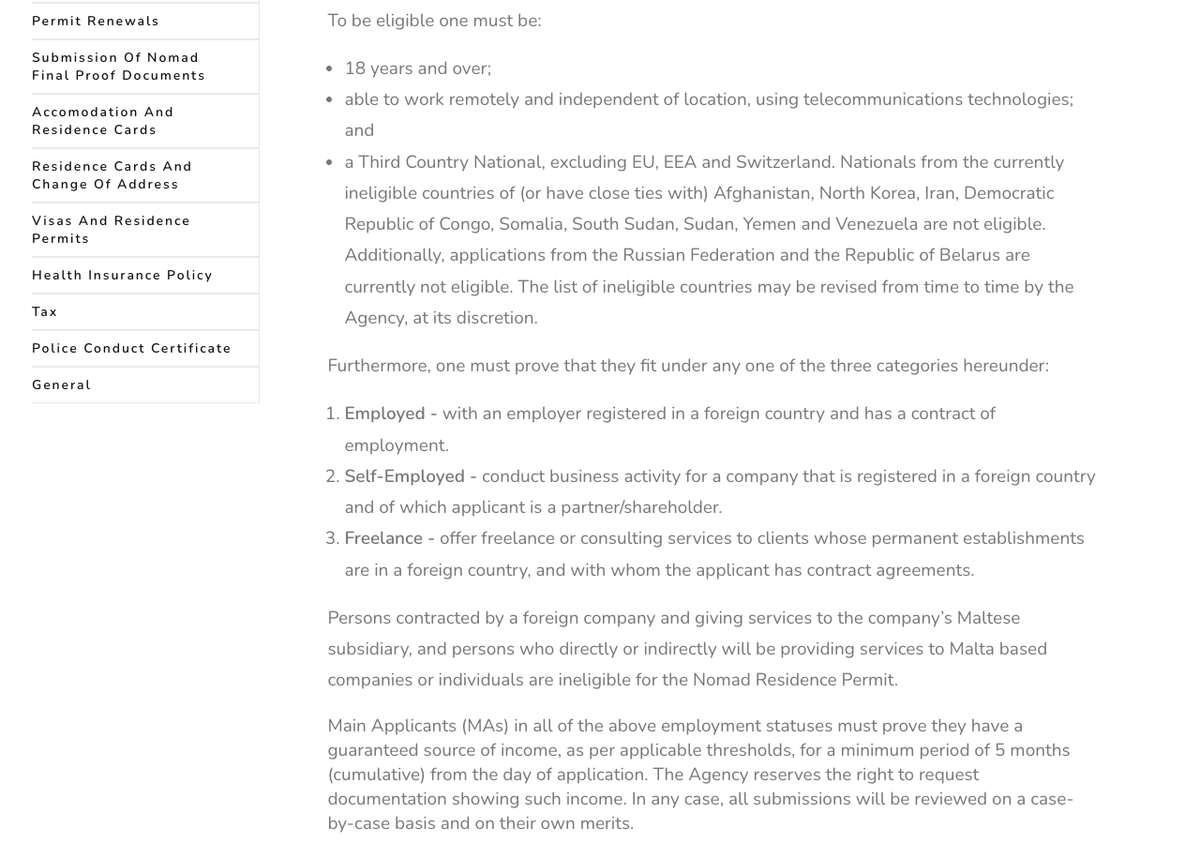
That word exclusively is the first thing the guides soften. The permit does not let you do a little local work on the side, and the eligibility rules close the obvious loophole: a person contracted by a foreign company but serving that company's Maltese subsidiary is not eligible, nor is anyone whose service cannot be delivered without being in Malta.
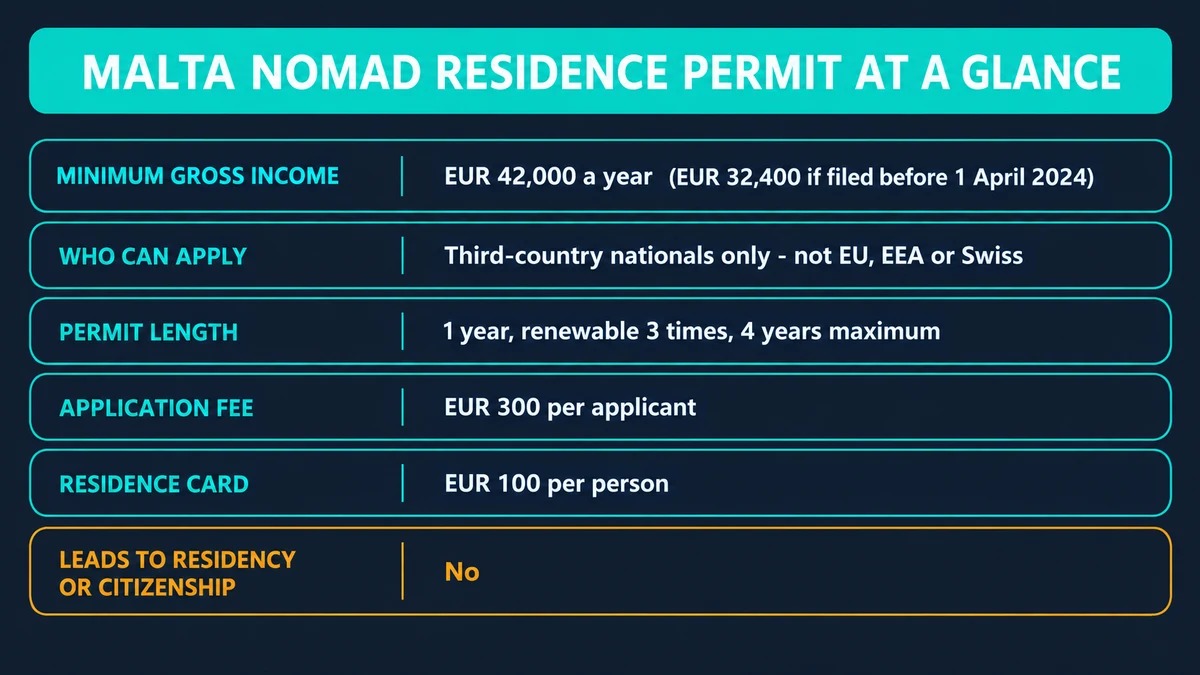
| Malta Nomad Residence Permit | |
|---|---|
| Legal basis | Immigration Act permit; tax under S.L. 123.210 (LN 277 of 2023) |
| Who can apply | Third-country nationals only — non-EU, non-EEA, non-Swiss |
| Minimum gross income | €42,000/year (€32,400 if filed before 1 April 2024) |
| Permit length | 1 year from issue of the residence card |
| Renewals | 3, at the agency's discretion — 4 years maximum |
| Tax on authorised work | 0% for 12 months, then 10% |
| Path to permanent residency | None |
| Application fee | €300 per applicant + €100 per residence card |
The third-country limit has a consequence worth stating early for this site's readers: an EU, EEA or Swiss national already has the right to live and work in Malta, so has no use for the permit — and no access to the 10% rate either, because the rate attaches to the permit rather than to residence. For those passports the options are the Residence Programme or the ordinary bands.
What the Malta digital nomad visa income requirement really asks for
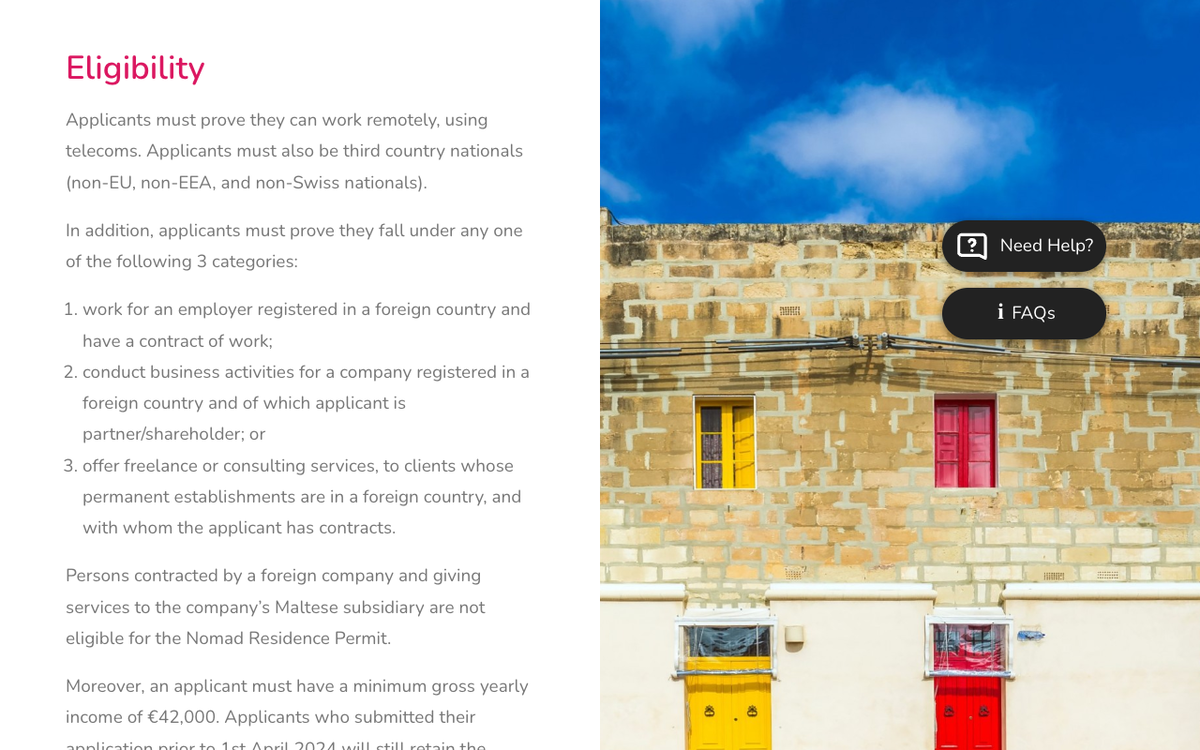
The threshold is a minimum gross yearly income of €42,000. It replaced €32,400 on 1 April 2024, and anyone who filed before that date keeps the old figure. Three of the pages currently ranking for this keyword still publish the old number or a converted monthly version of it; one publishes USD 1,500 a month, which was never the rule in any year.
Gross, and from remote work. Dividends, rent and other passive income do not satisfy the test however large they are — the income has to come from one of three forms of authorised work.
| Category | What you show | The restriction that bites |
|---|---|---|
| Employment | A contract with an employer registered in a foreign country | The employer must not be resident in Malta or trade here through a fixed place of business |
| Business | Partner or shareholder conducting business for a foreign-registered company | Same foreign-establishment test, applied to the company |
| Freelance / consulting | Service contracts with clients having permanent establishments abroad | Clients must not reside in Malta or trade here through a fixed place of business |
The checklist asks for employment contracts, or a certificate of incorporation and share register, or service contracts and income statements, depending on which box you are in — plus three months of unmasked bank statements in the main applicant's name and proof of a guaranteed income source for at least five cumulative months from the application date. That last requirement is the one freelancers underestimate: a healthy three months of invoices is not what is being asked for.
The 0% first year, and the declaration that cancels it
Here is rule 3(3) of the Nomad Residence Permits (Income Tax) Rules, which is the whole reason this article exists. An eligible main applicant is not liable to tax on authorised-work income before the end of twelve months from the later of the permit's issue or 1 January 2024 —
"unless he files with Residency Malta Agency a written declaration that his residence in Malta, even during the said period of twelve (12) months, is not merely of a casual nature."
Read that as someone who is moving, not visiting. Most people take this permit to stop being tax resident somewhere expensive, and that argument is won by showing the departure country a real, non-casual residence elsewhere: a lease, a tax registration, a certificate. The declaration that supports your exit is the declaration that ends your zero-tax year. Which of the two is worth more depends entirely on the country you are leaving.
If you take the exemption, note what you still must do. Rule 4(2) requires you to register for income tax anyway, even for activities inside the twelve-month window; you are simply not required to report the authorised-work income unless you filed the declaration. Registration is not optional — reporting is what the exemption suspends.
One more wrinkle, in rule 3(7), which no guide in the top ten mentions. If you stop holding a permit and are granted a new one within two years, you keep the 10% rate but not a fresh exemption. Wait longer than two years and the exemption comes back with the new permit. The clock rewards a clean break over a quick return, which is the opposite of how most people would guess.
What 10% actually saves against Malta's own 2026 bands
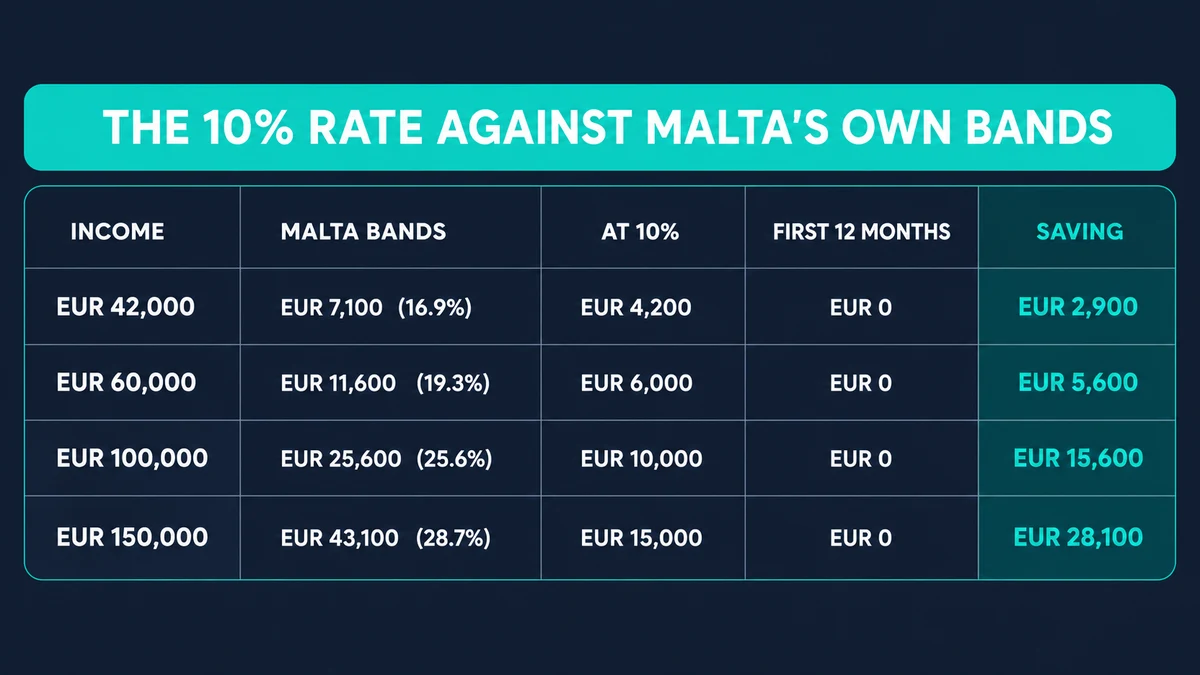
The honest way to price a flat rate is against the rate it replaces. Malta's single-computation bands for basis year 2026 run 0% to €12,000, 15% to €16,000, 25% to €60,000, and 35% above €60,000, with the band deductions applied.
| Gross authorised-work income | Standard Maltese rates | Nomad permit at 10% | First 12 months | Annual saving, year 2+ |
|---|---|---|---|---|
| €42,000 | €7,100 (16.9%) | €4,200 | €0 | €2,900 |
| €60,000 | €11,600 (19.3%) | €6,000 | €0 | €5,600 |
| €100,000 | €25,600 (25.6%) | €10,000 | €0 | €15,600 |
| €150,000 | €43,100 (28.7%) | €15,000 | €0 | €28,100 |
Two things fall out of that table. The saving is modest at the entry threshold — €2,900 on €42,000 is roughly one month of the rent you are now committed to — and it grows fast, because the flat rate is doing most of its work above €60,000 where the 35% band starts. The permit is priced for someone earning €80,000 and up; at €42,000 you are buying the right to live in Malta more than you are buying a tax outcome.
Two rules in the legal notice that nobody mentions
Rule 3(2) is one sentence and it costs real money. Authorised-work income "shall be deemed to constitute the first part of the person's total chargeable income for that year of assessment".
So the 10% slice sits at the bottom of your income, and anything else chargeable in Malta sits on top of it — in the bands above. Take €90,000 of nomad income and €20,000 of other Malta-chargeable income. The €90,000 is taxed at 10% for €9,000. The €20,000 does not get its own 0% and 25% bands; it occupies the range from €90,000 to €110,000, which is 35%, for €7,000.
Had that €20,000 been your only income, it would have cost €1,600. Behind the nomad slice it costs €7,000 — €5,400 more for the same money. Anyone planning a small Maltese side activity, or holding an asset that produces Maltese income, should price it at the top band and not at the band their total would suggest. How the deduction method applies in a particular return is a question for a Maltese practitioner, and the direction of travel is not in doubt.
Your family is not on the 10%
Rule 3(5) is the other quiet one. Any income chargeable in Malta that is earned by a family member included in your permit "shall not be regulated by these rules, but shall continue to be governed exclusively by the provisions of the Act".
The 10% is the main applicant's, and only on their authorised work. A spouse who also works remotely does not share it; if their income becomes chargeable in Malta it meets the ordinary bands. Couples who both freelance and who read the brochure as a household rate are planning on a figure that does not exist. The dependants Malta will admit — spouse, minor children, dependent adult children, and adult children unable to cope independently — ride on your permit for immigration purposes and not for tax.
Rule 3(6) is the one that helps: it takes authorised-work employment income outside the Final Settlement System, Malta's payroll withholding regime, so a foreign employer is not asked to run Maltese payroll for you. That is a real simplification, and it is why the filing obligation lands on you.
Nomad permit or Global Residence Programme?
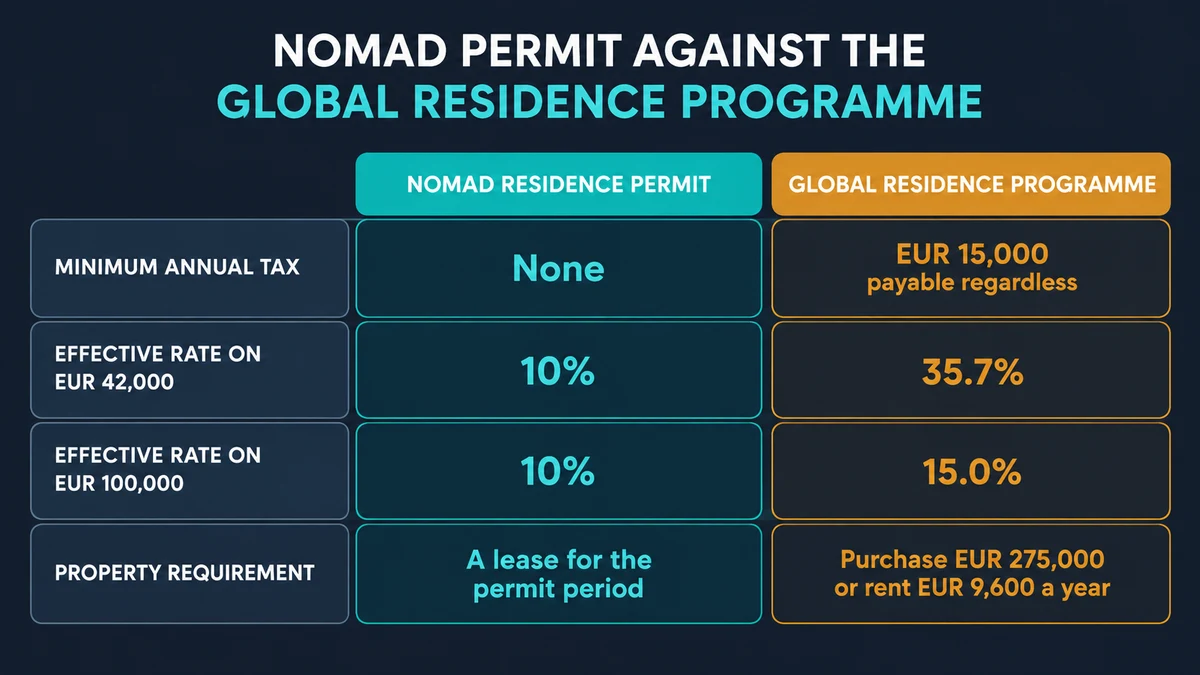
The leading guide on this keyword compares the nomad permit to the MPRP, Malta's investment-residency route. The comparison a €42,000-to-€150,000 freelancer actually faces is against the Malta Global Residence Programme, which is the other way to hold a special Maltese tax status without buying residency.
| Nomad Residence Permit | Global Residence Programme | |
|---|---|---|
| Tax treatment | 10% on authorised work (0% for 12 months) | 15% on foreign income remitted to Malta |
| Minimum annual tax | None | €15,000, payable regardless |
| Effective rate on €42,000 | 10% | 35.7% |
| Effective rate on €100,000 | 10% | 15.0% |
| Property requirement | A lease for the permit period | Purchase €275,000 / €220,000, or rent €9,600 / €8,750 a year |
| Minimum stay | None to apply; 5 months in 12 to renew | None |
| Duration | 4 years maximum | Indefinite, reviewed annually |
| Leads to | Nothing | Nothing, but it does not expire |
The nomad permit wins on rate at every income level in this site's range, and wins decisively below €100,000 where the GRP's minimum tax dominates. What the GRP buys instead is time: no four-year ceiling and no presence test. Our verdict is unglamorous — take the nomad permit for the four years and use them to decide whether Malta deserves the longer status, rather than paying €15,000 a year to find out.
What it costs to apply in 2026
The government fees are small, exactly specified, and misreported. One page currently ranking gives the fee as €280; another quotes the card at $100.
| Item | Amount | Notes |
|---|---|---|
| Application fee | €300 per applicant | Non-refundable, by bank transfer from the main applicant's own account |
| Residence card | €100 per person | Paid in person, by card only — cash is not accepted |
| Change of address / stolen card | €50 | Card re-issue |
| Accommodation | Not priced here | A lease or purchase agreement covering the full permit period is compulsory |
| Health insurance | Not priced here | Comprehensive, one full year, Malta and international |
The two blank lines are deliberate. We could not source an official Maltese statistic for residential rents — the national property series indexes sale prices — and the figures circulating for a Sliema or Valletta one-bedroom disagree by several hundred euro a month with no stated method behind any of them. The largest line in your budget is the one nobody in this SERP can source, and a cost table that quietly invents it is worse than one that admits the gap.
Timing, from the agency's FAQ: 30 working days to process from receipt of funds, excluding visa processing. After a letter of approval in principle you have 30 working days to file proof of accommodation and the insurance policy. Cards take three to four weeks. Applicants who need an entry visa must book at least 15 nights of temporary accommodation.
Renewal: five months in Malta, and a tax declaration by year three
The initial application has no physical-presence test. Renewal does, and it is the number that actually governs the permit: at least five cumulative months in Malta over the previous twelve, evidenced by bank statements showing payments made in Malta.
Five months of card transactions is no formality for someone who took a nomad permit in order to keep moving. It is a residence requirement by another name, enforced with evidence you cannot assemble retrospectively — so spend locally from month one, or do not plan on renewing.
Then the detail that appears nowhere else on this keyword. The checklist states that the second and third renewals also require a Local Practitioner Tax Declaration. By year three you need a Maltese tax practitioner putting their name to your position — which lands squarely back on the rule 3(3) choice you made in year one. A declaration cancelling your exemption, filed to support an exit from a high-tax country, is a coherent story for a practitioner to sign. Three years of claiming Malta as home to one authority while treating residence as casual for another is not.
The four-year ceiling and what it is not
One year, renewed three times, is four years and then it stops. The agency's own FAQ puts the consequence in plain words: the permit "does not lead to any sort of permanent/long-term residency or citizenship".
No time accrues. Nothing converts. At the end of four years you are where you started, minus the rent — which makes this a close relative of the programmes in digital nomad visas with a path to permanent residency, and on the wrong side of the line. Greece's permit and Italy's sit inside national immigration systems where time can count. Malta's sits outside its own.
There is a second-order cost. Five months a year for four years is real presence, and presence is what tax authorities look at when deciding where you live — see tax resident nowhere for why a gap between countries rarely produces the outcome people expect. You accumulate the exposure of living somewhere without any of the status.
Who the permit actually fits
It fits a third-country freelancer or remote employee earning €80,000 to €200,000 who wants an English-speaking EU base, will spend five months a year there, and is clear that the four years lead nowhere. At that income the 10% does serious work.
It fits poorly at €42,000, where €2,900 of saving funds about one month of the lease you are now obliged to hold; poorly for a couple who both earn, because rule 3(5) keeps the second income on the ordinary bands; and poorly for anyone whose real goal is status, for whom the honest comparison is second residency, ranked.
Take it for what it is: four well-taxed years in the EU, bought cleanly, leading to nothing. That is a good product, and it is not the product the brochures describe.
Related reading
- Malta Global Residence Programme — the 15% remittance alternative, and why the €15,000 minimum tax decides between them.
- Digital nomad visas compared — income thresholds, durations and tax treatment across every major programme in one table.
- Digital nomad visas with a path to permanent residency — the programmes where the time actually counts towards something.
- Second residency, ranked — cost, speed and physical-presence requirements across the realistic options.
- Tax resident nowhere — why a five-month presence in one country and a gap everywhere else is a weaker position than it looks.
- How remittance taxation actually works — the mechanism behind the GRP's 15%, which catches people who assume unremitted means untaxed.
FAQ
What is the Malta digital nomad visa?
It is not a visa but the Nomad Residence Permit, issued by the Residency Malta Agency under the Immigration Act. It licenses a third-country national to live in Malta doing nothing but "authorised work" — remote work for an employer or clients outside Malta. The permit runs one year from the date the residence card is issued and can be renewed three times, for a maximum of four years.
What is the Malta digital nomad visa income requirement in 2026?
A minimum gross yearly income of €42,000. Applicants who submitted before 1 April 2024 keep the older €32,400 threshold. The income must come from remote work, and the checklist asks for proof of a guaranteed income source for at least five cumulative months from the application date. Several live guides still publish €2,700 a month or USD 1,500 a month; both are out of date.
How much tax do you pay on the Malta Nomad Residence Permit?
Ten per cent on chargeable income from authorised work, under rule 3(1) of the Nomad Residence Permits (Income Tax) Rules. For the first twelve months from the later of the permit's issue or 1 January 2024 there is no liability at all on that income — unless you file a written declaration with Residency Malta that your residence is not merely of a casual nature, which cancels the exemption.
Can EU citizens get the Malta digital nomad visa?
No. The eligibility rules limit it to third-country nationals, meaning non-EU, non-EEA and non-Swiss. EU, EEA and Swiss nationals do not need it, because free movement already lets them live and work in Malta — but it also means they cannot access the 10% rate, which is attached to the permit rather than to residence.
Does the Malta Nomad Residence Permit lead to permanent residency or citizenship?
No. The agency's FAQ states that the permit "does not lead to any sort of permanent/long-term residency or citizenship". Four years is the ceiling, and none of the time accrues towards anything. If you want a route that counts, that is a different programme and a different budget.
How much does the Malta digital nomad visa cost to apply for?
An application fee of €300 per applicant, non-refundable and paid by bank transfer from the main applicant's own account, plus €100 per person for the residence card, payable in person by card. A later change of address or a stolen card costs €50. The larger costs are the compulsory 12-month lease and a full year of comprehensive health insurance.
What health insurance does Malta accept for the nomad permit?
A fully comprehensive health insurance policy covering the main applicant and every dependant, for a full year and for the validity of the residence card, covering Malta and internationally. The checklist states plainly that travel insurance is not accepted — which rules out most of the travel-medical products nomads already carry.
Sources
- Nomad Residence Permits (Income Tax) Rules, S.L. 123.210 (Legal Notice 277 of 2023) — the definition of authorised work; rule 3(1) 10%; rule 3(2) first-part stacking; rule 3(3) the twelve-month exemption and the written declaration; rule 3(5) family members; rule 3(6) the FSS exclusion; rule 3(7) the two-year re-grant rule; rule 4(2) registration during the exempt period.
- Residency Malta Agency — Nomad Residence Permit eligibility — the €42,000 threshold and the €32,400 figure retained for pre-1 April 2024 applications, the third-country-national limit, the three work categories, the Maltese-subsidiary exclusion, the insurance and accommodation conditions.
- Residency Malta Agency — Nomad Residence Permit FAQs — €300 application fee, €100 card, €50 re-issue; one-year permit, three renewals, four-year maximum; 30 working days processing; the five-months-in-twelve renewal test; the statement that the permit leads to no permanent residency or citizenship.
- Residency Malta Agency — application checklist — the document list, proof of guaranteed income for five cumulative months, "travel insurance is not accepted", and the Local Practitioner Tax Declaration required at the second and third renewals.
- PwC Worldwide Tax Summaries — Malta, taxes on personal income — the basis-year 2026 single-computation bands and deductions used in the tax table, and the 35% top rate from €60,001.
Figures are current as of 9 October 2026. The tax table applies the published single-computation bands to gross authorised-work income with no deductions or reliefs claimed, to isolate the effect of the flat rate; a real return will differ. The Global Residence Programme column assumes full remittance of foreign income to Malta, which is the assumption that makes the two comparable — unremitted income is outside the Maltese charge and outside this comparison. Malta's tax authority pages return HTTP 403 to automated requests, so the programme terms are sourced to our own Global Residence Programme guide, which cites them directly. Accommodation and insurance are left unpriced because we could not source either from an official Maltese statistic. This is editorial research, not tax or immigration advice; the rule 3(3) choice in particular turns on the country you are leaving, and belongs with an adviser in both jurisdictions.