
Sri Lanka spent most of 2026 being written about as the cheap beach option for remote workers, usually on the strength of two figures: USD 2,000 a month and USD 500. Both appear in the Department of Immigration and Emigration's own document, and both are routinely quoted in a way that gets the actual obligation wrong.
The gap matters because of what sits at the other end of the first year. The Sri Lanka digital nomad visa is renewable annually, and the Department's published condition for renewing it is proof of tax registration with the Inland Revenue Department. A visa that asks you to register with the tax authority as a condition of staying is not a tax-free visa, whatever the comparison sites say — and Sri Lanka removed the exemptions that would have made it one with effect from 1 April 2025.
This guide is built from the Department's own "Digital Nomad Visa Category" document, the Inland Revenue Department's notice on the 2025 amendments, and the consolidated text of the Inland Revenue Act. We read those rather than the news coverage, because on this visa the news coverage and the source document disagree about the fee, the income test and the tax position.
Key takeaways
- The income test is a remittance test. The Department asks for a "minimum monthly income remittance of USD 2,000" and for proof of that remittance — not proof of earnings.
- The fee is USD 500 per person per year, and that includes the spouse. Main applicant, spouse and each dependant are three separate USD 500 lines, so a family of four pays USD 2,000 a year.
- Renewal requires Inland Revenue registration. The extension condition is the first-issuance documents plus "proof of Tax registration via Inland Revenue Department".
- Sri Lanka taxes residents on global income, and residence is 183 days or more in aggregate in any twelve-month period under section 69(1) of the Inland Revenue Act.
- Foreign-source income remitted through a bank is capped, not exempt. The First Schedule sets a maximum rate of 15% from 1 April 2025 — the exemption that ran from 2020 was removed.
SafetyWing — the application requires international health insurance that covers medical care inside Sri Lanka, which is a narrower test than "travel insurance"
What the Sri Lanka digital nomad visa is, and where it sits
The visa is a sub-category of Sri Lanka's residence visa, not a visit visa and not an extension of the ETA most visitors arrive on. The Department of Immigration and Emigration publishes it as a category document titled "Digital Nomad Visa Category", and its residence-visa page now lists Digital Nomad as category 14, alongside the employment, investor, religious, educational and family routes.
It is new enough that the Department's own site has not fully caught up with it. The general visa-information page still tells readers there are "thirteen (13) sub-categories which come under residence visas", while the residence-visa listing itself runs to sixteen. CNBC reported the launch in February 2026; the category document itself carries no date, which is worth knowing before you treat any particular figure as the final word.
Its stated purpose is to attract foreign professionals who want to live in Sri Lanka while serving clients or companies based outside the country. That framing is not decoration — it is the eligibility test.
Who qualifies, and why the income test is really a remittance test
The eligibility criteria are short. The main applicant must be 18 or older, and must be engaged in remote employment, freelancing, or own a business not registered in Sri Lanka that serves clients outside Sri Lanka. Then the money condition, quoted in full: a "minimum monthly income remittance of USD 2,000 for the main applicant and if the dependent count increases more than 2, additional USD 500 should be remitted monthly for each".
Note the verb. It is not "earn" and it is not "show savings of". It is remitted, and the document's required-documents list closes the loop by asking for "proof of the minimum monthly remittance for the main applicant and the dependents". Most published guides translate this into "USD 24,000 a year in income", which is the same arithmetic and a different obligation: you are being asked to move money into Sri Lanka every month, and to be able to evidence that you did.
| Requirement | What the Department's document says |
|---|---|
| Age | 18 years or older (main applicant) |
| Work status | Remote employment, freelancing, or own a business not registered in Sri Lanka |
| Clients | Must be served from outside Sri Lanka |
| Money test | Minimum monthly income remittance of USD 2,000 |
| Dependants | Spouse and dependents eligible; above 2 dependants, +USD 500 remitted monthly each |
| Local work | Not permitted — all income must be earned from foreign sources |
| Visa duration | 01 year, renewable annually |
That last restriction is the one that catches people who intend to drift into local consulting. The terms and conditions state plainly that the holder is "not permitted to engage in local employment within Sri Lanka" and that all income must be earned from foreign sources, with any violation liable to result in immediate cancellation of the visa.
What it actually costs: USD 500 each, every year
The fee schedule is three lines, and the third is the one that gets dropped in summary coverage: main applicant USD 500 per year, spouse USD 500 per year, each dependant USD 500 per year. "USD 500 to apply" is accurate only for a single applicant.
| Household | Annual visa fees | Monthly remittance required |
|---|---|---|
| Single applicant | USD 500 | USD 2,000 |
| Couple, no children | USD 1,000 | USD 2,000 |
| Couple + 1 child | USD 1,500 | USD 2,000 |
| Couple + 2 children | USD 2,000 | USD 2,000 |
| Couple + 3 children | USD 2,500 | USD 2,500 |
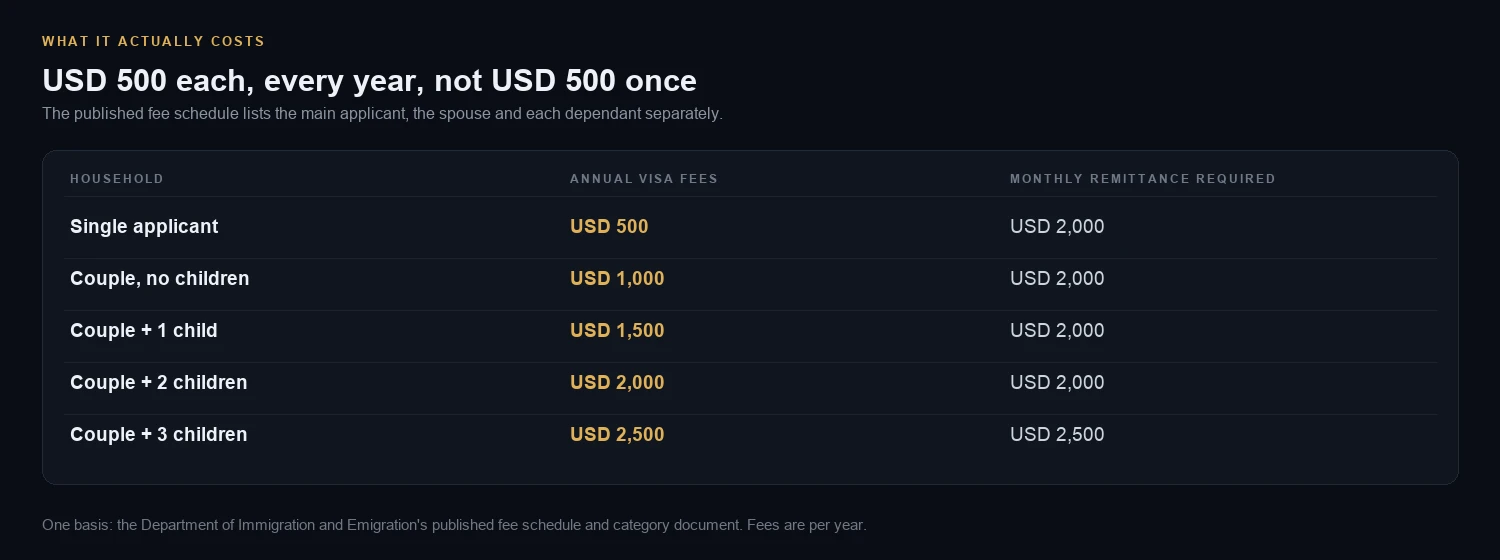
Two things to read off that table. The fee scales with every person including the spouse, while the remittance requirement only moves once the dependent count passes two — those are two different rules and they are frequently merged into one. And because the fee is annual and the visa is one year, the renewal cost is the same number again, not a reduced extension fee.
What the schedule does not cover is everything else the file requires: a police clearance certificate no older than three months, a medical clearance report, and an international health insurance policy that works in Sri Lanka. Budget for those separately.
The twelve documents, and the two that will slow you down
The Department lists twelve required documents for all applicants. Most are routine — a filled visa application form, a request letter, a passport copy valid for at least six months, two passport photographs, a marriage certificate for a spouse, birth certificates for dependants, a security clearance form.
Two are not routine, and between them they explain why a "seven day" processing claim should be treated with caution:
- International health insurance that covers medical care in Sri Lanka. The qualifier is doing real work. A policy that excludes your country of residence, or that only reimburses treatment at home, does not meet a requirement written as cover in Sri Lanka. A separate medical clearance report is also required, and it is a different document.
- A recommendation from the Ministry of Digital Economy. The category document names this requirement and publishes no procedure, form, fee or timescale for obtaining one. Essentially no secondary coverage of this visa mentions it. If any single item decides how long your application takes, it is likely to be this one.
The remaining items are the police clearance, not older than three months, and the proof of monthly remittance already discussed. Because the police certificate expires on a three-month clock while the ministry recommendation has no published timescale, sequencing matters: start with the recommendation and order the police certificate once you can see an end to it.
Applying, and what the visa gives you
The procedure the Department publishes has three steps and no portal of its own: submit the documentation to the Department of Immigration and Emigration's Residence Visa Division, wait for the documents to be reviewed for eligibility and compliance, and on approval receive the visa endorsement in your passport. The Visa Division sits at "Suhurupaya", Battaramulla, and the document gives contvisa@immigration.gov.lk and +94 11 210 1540 for enquiries.
Once issued, the published benefits are more concrete than most nomad visas manage. Holders may reside legally for up to 12 months renewable annually, open and maintain personal bank accounts, enter into property rental or lease agreements, enrol dependent children in international or private schools, access telecommunications, internet and utility services, and take part in co-working spaces, ICT programmes and tourism events run by government or private bodies.
The banking and leasing rights are the practically valuable ones, and they are also the quiet reason the remittance condition is enforceable: a local account is what makes a monthly inbound transfer visible. Exit is governed too — leaving voluntarily requires two months' written notice, and 14 working days' notice if you are leaving Sri Lanka permanently. The Department can terminate for failure to meet income, legal or compliance requirements, and any change in employment, income or dependants must be notified within 30 days.
The renewal condition that changes the calculation
Here is the sentence that distinguishes this visa from most of its competitors, quoted from the extension section of the Department's document: along with the required documents for first issuance, the applicant "must submit a proof of Tax registration via Inland Revenue Department".
Not a tax return, and not necessarily a tax bill — registration. But registration is how a tax authority acquires you as a taxpayer, and it is an odd thing to require of someone the system intends to leave alone. Read next to Sri Lanka's 2025 tax changes, it looks less like paperwork and more like design.
This is where guides that call the visa "tax-exempt" fall over. We found that claim stated flatly on a page that also cites the Department's PDF, which is the tell: the fee and income figures were read off the document, and the renewal condition three lines below them was not. A digital nomad visa that routes you into a tax system is a different product from one that does not, and it should change which countries you are comparing.
What Sri Lanka can actually tax
Start with residence, because nothing else matters until you resolve it. Section 69(1) of the Inland Revenue Act No. 24 of 2017 makes an individual resident for a year of assessment if the individual "resides in Sri Lanka", or is present in Sri Lanka for "a period or periods amounting in aggregate to one hundred and eighty three days or more in any twelve month period that commences or ends during the year".
Two traps live in that wording. The twelve-month period does not have to be the tax year, so days either side of 31 March can combine. And the first limb — "resides in Sri Lanka" — is not a day count at all, which means a 12-month lease, a local bank account and schooled children are facts a tax authority can point at regardless of your calendar. The Inland Revenue Department's own guidance is blunt about the consequence: a person resident in Sri Lanka is chargeable "in respect of his income from Sri Lanka and income derived by him from outside Sri Lanka", so "the liability to income tax therefore extends to his global income".
What stops that from being punitive is the rate cap added in 2025. The Inland Revenue (Amendment) Act No. 02 of 2025, certified on 20 March 2025, inserted a paragraph into the First Schedule providing that an individual's gains and profits from the two categories below "shall be taxed at the maximum rate of 15% with effect from April 1, 2025":
- services rendered in or outside Sri Lanka to any person to be utilised outside Sri Lanka, where payment is received in foreign currency and remitted through a bank to Sri Lanka ("service exports"); and
- gains and profits from any foreign source, earned or derived in foreign currency and remitted through a bank to Sri Lanka.
| Sri Lanka personal income tax, from 1 April 2025 | Rate |
|---|---|
| Personal relief (deducted in arriving at taxable income) | LKR 1,800,000 |
| First LKR 1,000,000 of taxable income | 6% |
| Next LKR 500,000 | 18% |
| Next LKR 500,000 | 24% |
| Next LKR 500,000 | 30% |
| Balance | 36% |
| Service exports / foreign-source income remitted through a bank | maximum 15% |
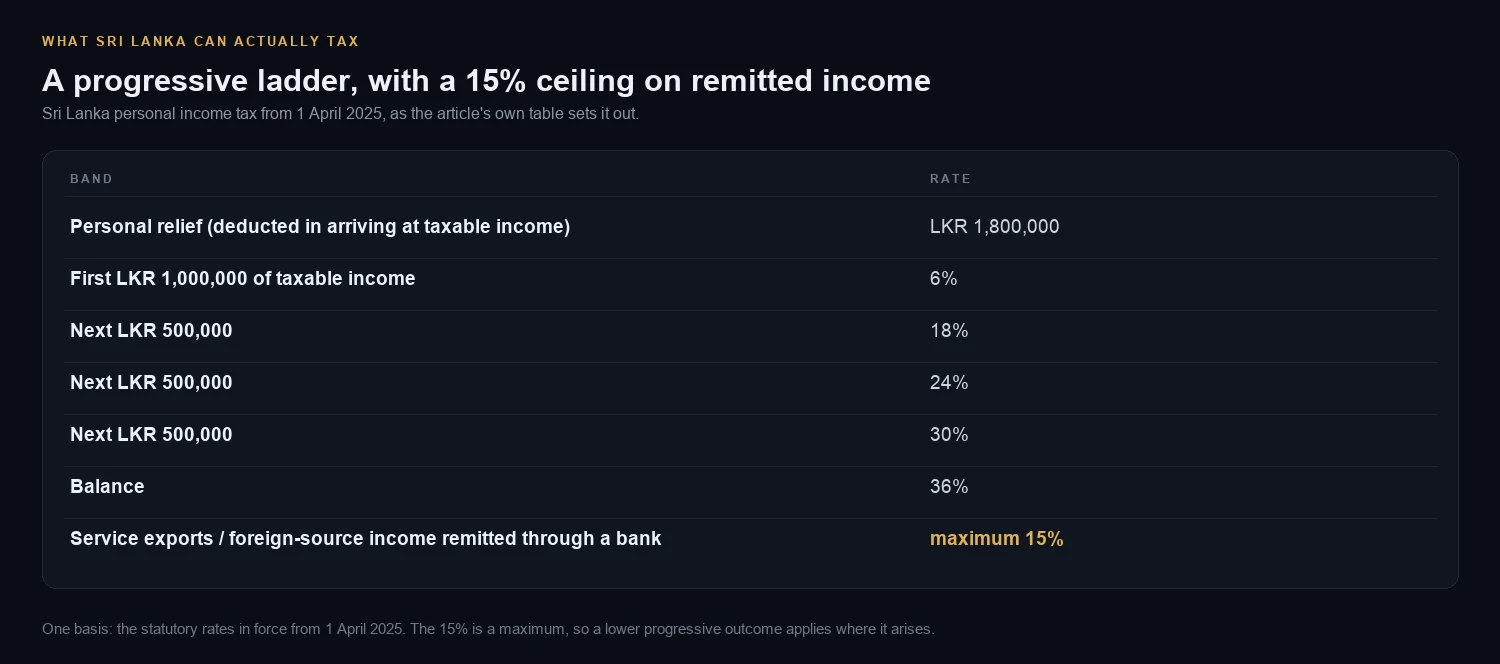
The word "maximum" is statutory, not editorial, and it resolves a disagreement that runs through most secondary coverage. It is a ceiling, not a flat rate: where the progressive computation produces less than 15% — which the LKR 1,800,000 relief and the 6% first band make entirely possible at modest income — the lower figure applies. Several widely-read guides describe it as a flat 15%, and at the bottom of the scale that overstates the bill.
Notice how neatly the visa's requirements map onto the cap's conditions. The 15% ceiling applies to foreign-currency income remitted through a bank to Sri Lanka; the visa requires exactly that, monthly, as a condition of eligibility. The structure the Department obliges you to adopt is the structure the Inland Revenue Act rewards. Whether a particular transfer route satisfies the "remitted through a bank" test is a question for a Sri Lankan adviser, not for a comparison table.
Two cautions before you plan around any figure. The Inland Revenue Department's general income-tax page still displays a tax-free allowance of LKR 500,000, superseded by the LKR 1,800,000 relief — where an official site contradicts itself, the amending instrument wins. And your visa obligation is denominated in US dollars while the tax bands are in rupees, so the exchange rate on the day quietly decides which band your remittance lands in. If this is the exposure you are trying to avoid altogether, the tax-resident-nowhere arithmetic is a different conversation, and a harder one than it looks.
Where the published figures go wrong
We checked the most-read coverage against the Department's document line by line. The pattern is consistent: the headline numbers survive, the conditions attached to them do not.
| Commonly published claim | What the source documents say |
|---|---|
| "USD 500 to apply" | USD 500 per year, separately for main applicant, spouse and each dependant |
| "You must earn USD 2,000 a month" | Minimum monthly income remittance of USD 2,000, evidenced by proof of remittance |
| "+USD 500 per dependant" (as a fee) | +USD 500 remitted monthly for each dependant above two — a remittance rule, not a fee |
| "Holders are exempt from Sri Lankan income tax" | Exemptions on service exports and foreign-source income removed from 1 April 2025; renewal requires IRD registration |
| "Flat 15% on foreign income" | A statutory maximum of 15%, so a lower progressive outcome applies where it arises |
| "Renewable up to 24 months total" | "01 year", "renewable annually" — the category document publishes no ceiling |
| "Five-year route to citizenship" | The category document says nothing about settlement or naturalisation |
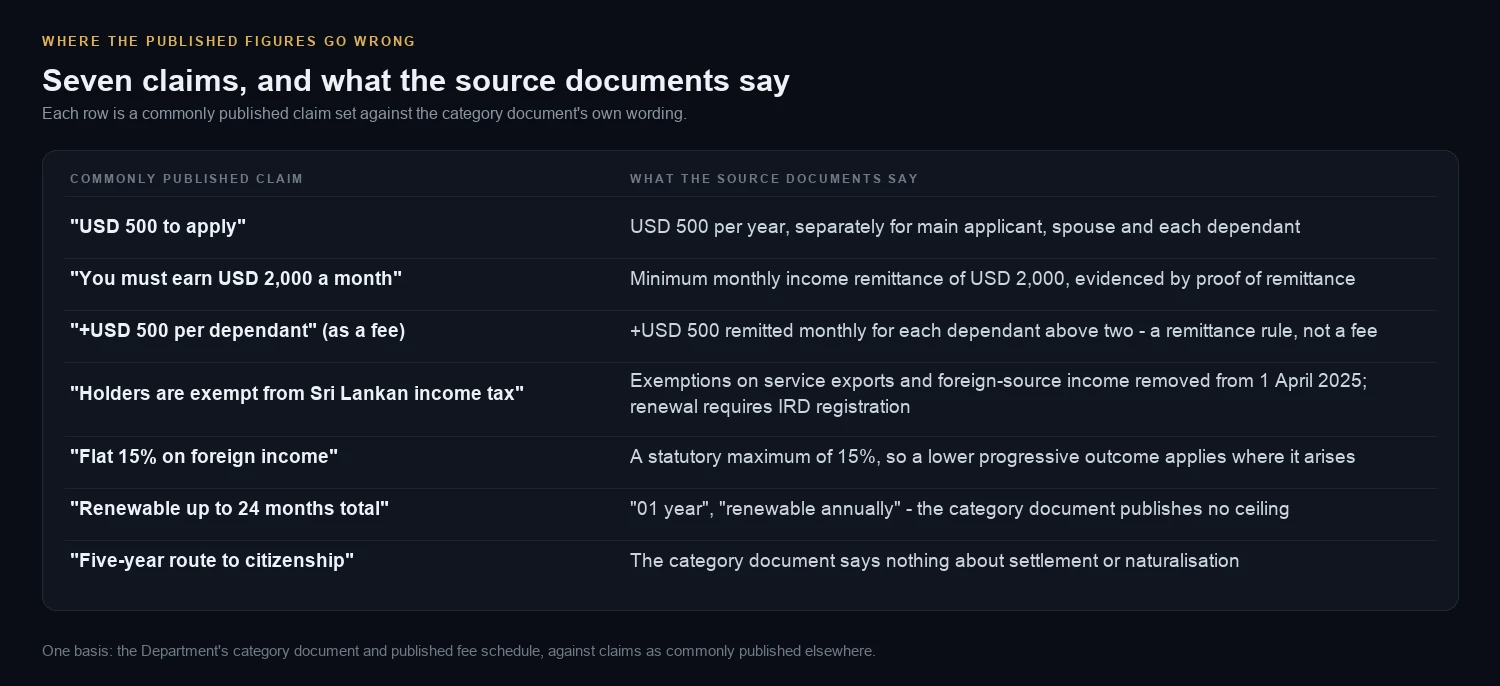
None of this makes Sri Lanka a bad option. It makes it a documented one, which is rarer than it sounds in this category, and the documentation is more favourable than the rumours in at least one respect: a 15% ceiling on remitted foreign income is competitive against most of Europe.
Who the visa actually suits
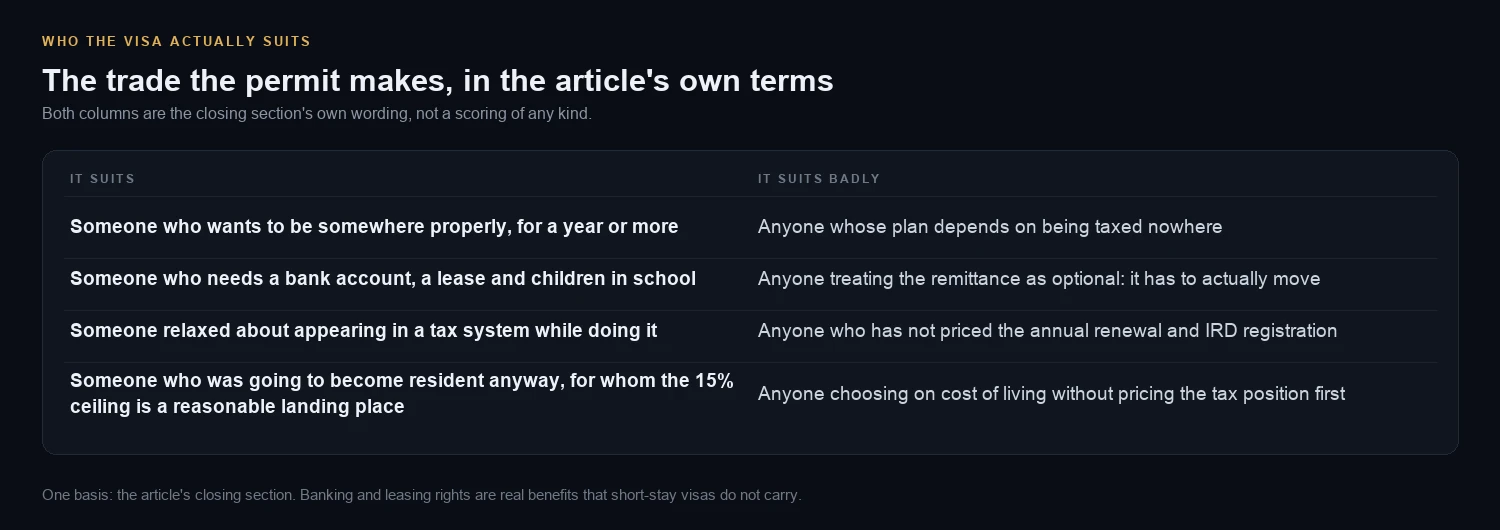
It suits someone who wants to be somewhere properly, for a year or more, with a bank account, a lease and children in school — and who is relaxed about appearing in a tax system while doing it. The banking and leasing rights are real benefits that short-stay visas do not carry, and the 15% ceiling is a reasonable landing place if you were going to become resident anyway.
It suits badly anyone whose plan depends on being taxed nowhere. The remittance requirement, the local account, the annual renewal and the Inland Revenue registration all point the same way, and Asia's other long-stay options make very different trades — Thailand's LTR and Malaysia's programme sit in the same shortlist for a reason. If the attraction is the cost of living rather than the structure, that is a fair reason to choose it, but price the tax position in first rather than discovering it at renewal. The broader mechanics of remittance taxation are worth understanding before you move USD 2,000 a month into any jurisdiction.
Related guides
- Digital nomad visas: the full 2026 list — every programme worth considering, with the structural differences that actually separate them.
- Digital nomad visas that lead to permanent residency — which permits accumulate toward settlement and which are capped by design.
- Thailand LTR visa — the ten-year Asian alternative, and its very different tax treatment.
- Malaysia digital nomad visa — DE Rantau, and how its terms compare on cost and duration.
- Tax on remittance — how remittance-based taxation works, and where the 2026 rules bite.
- Second residency ranked — cost, speed and days-on-the-ground across the main routes.
- Nomad travel insurance — what a policy needs to contain before a visa office will accept it.
FAQ
How much income do you need for the Sri Lanka digital nomad visa?
The Department of Immigration and Emigration's category document sets a minimum monthly income remittance of USD 2,000 for the main applicant. Read the wording carefully, because it is a remittance test rather than an earnings test: the document asks for proof of the minimum monthly remittance, not proof of salary. If your dependent count goes above two, an additional USD 500 per month must be remitted for each. Guides that quote a flat USD 24,000 a year are converting the monthly figure, which is arithmetically the same but loses the point that the money has to actually move.
How much does the Sri Lanka digital nomad visa cost?
USD 500 per year for the main applicant, USD 500 per year for a spouse, and USD 500 per year for each dependant. The published fee schedule lists all three lines separately, so a couple with two children pays USD 2,000 a year rather than the single USD 500 most coverage quotes. That is the visa fee alone and excludes the police clearance, medical report, insurance policy and document costs the application also requires.
Do you pay tax in Sri Lanka on a digital nomad visa?
Possibly, and the visa is structured in a way that makes it likely. Section 69(1) of the Inland Revenue Act No. 24 of 2017 makes you resident if you reside in Sri Lanka, or are present for 183 days or more in aggregate in any twelve-month period commencing or ending during the year. A resident is chargeable on global income. The Inland Revenue Department also removed the exemptions on service exports and foreign-source income with effect from 1 April 2025, and the visa itself requires proof of tax registration to renew. Any guide telling you the visa is tax-exempt is describing a regime that ended.
How long is the Sri Lanka digital nomad visa valid?
One year. The Department's document states a visa duration of 01 year and describes the residency benefit as residing legally in Sri Lanka for up to 12 months, renewable annually. It sets no published ceiling on the number of renewals, so the widely repeated claim that the visa caps out at 24 months total does not come from the category document. Renewal requires the first-issuance documents again, plus proof of Inland Revenue registration.
Can you bring your family on the Sri Lanka digital nomad visa?
Yes. The eligible persons are foreign nationals aged 18 or older plus the spouse and dependents of the main applicant. A marriage certificate is required for a spouse and a birth certificate for each dependant. Holders may enrol dependent children in international or private schools. Each family member carries their own USD 500 annual fee, and dependants beyond the first two raise the monthly remittance requirement by USD 500 each.
Do you need health insurance for the Sri Lanka digital nomad visa?
Yes, and the wording is specific. The required document list includes international health insurance that covers medical care in Sri Lanka, so a policy that excludes your country of residence, or one that only reimburses treatment at home, does not satisfy it. A separate medical clearance report is also on the list, which is a different document from the insurance policy and is easy to conflate when you are assembling the file.
What is the Ministry of Digital Economy recommendation?
It is the twelfth item on the Department's required document list: a recommendation from the Ministry of Digital Economy. The category document names the requirement without publishing a procedure, a form or a timescale for obtaining one, and almost no secondary coverage of this visa mentions it at all. Treat it as the step most likely to govern how long your application actually takes, and ask the Visa Division about it before you assemble anything else.
Does the Sri Lanka digital nomad visa lead to permanent residency?
The category document does not say that it does. It describes a one-year residence visa, renewable annually, and its list of residency benefits covers banking, leases, schooling, utilities and co-working access — not settlement or naturalisation. Some published guides attach a five-year citizenship timeline to this visa without citing anything; nothing in the Department's own document supports that, so we have left it out rather than repeat it.
The insurance line is the one the file fails on
Of the twelve documents, the health insurance policy is the one applicants most often get wrong, because "travel insurance" and "international health insurance that covers medical care in Sri Lanka" are not the same product. SafetyWing's nomad cover is written for exactly this situation — long stays, a country you do not hold a passport for, and a visa office that wants to see the territory named.
Sources
- Digital Nomad Visa Category — Department of Immigration and Emigration, Sri Lanka; eligibility, the USD 2,000 monthly remittance, the twelve required documents, the three-step procedure, the 01-year duration, the USD 500 per-person fees, the residency benefits, the terms and conditions, and the tax-registration condition for extension.
- Residence Visa — Department of Immigration and Emigration; the residence-visa sub-categories, listing Digital Nomad as category 14.
- Notice to the Taxpayers: Amendments to the Inland Revenue Act, No. 24 of 2017 (PN/IT/2025-01) — Inland Revenue Department, 26 March 2025; the LKR 1,800,000 personal relief, the 6–36% bands effective 1 April 2025, the 15% maximum on service exports and foreign-source income, and the removal of the exemptions.
- Inland Revenue Act No. 24 of 2017, consolidated with 2025 changes — Inland Revenue Department; section 69(1) on resident persons, and the First Schedule paragraph setting the maximum rate of 15% from 1 April 2025.
- Sri Lanka launched a new digital nomad visa — CNBC, 12 February 2026; the February 2026 launch and the Residence Visa Division as the administering office.