
Every page ranking for Philippines digital nomad visa sets out an income requirement, a document list and an application process. One of the top results states plainly that the visa "is now operational". I could not find a way to apply for it, and after a morning with the government's own sources I am fairly sure that is because you cannot.
For a freelancer or founder weighing Southeast Asia against the Mediterranean, that matters more than another requirements table. A visa that exists on paper but not in practice is a planning risk: you cannot book a relocation against a document no consulate issues. And the Philippines is one of the few countries where the alternative route is genuinely good — three years of legal stay, and no tax on foreign income at all.
So I read Executive Order No. 86 rather than the summaries of it, then counted the visa types the Department of Foreign Affairs and the Bureau of Immigration actually list today, and checked the reciprocity condition in Section 2 against the countries this site's readers hold passports from. Three things fall out: the order's own 30-day deadline is now 17 months overdue, the USD 24,000 figure everyone quotes is not in the order and appears to be borrowed from Malaysia, and the reciprocity clause as drafted would exclude Americans, Britons, Canadians and Australians.
Key takeaways
- The visa is not open. EO 86 required implementing guidelines within 30 days of 24 April 2025 and a pilot within 60. As of 3 October 2026 the DFA eVisa policy page lists 9(a) and its eight sub-categories and no nomad visa; "nomad" appears zero times there and zero times on the Bureau of Immigration's visa list.
- No income figure has ever been published. EO 86 says "sufficient income which is generated outside the Philippines" and nothing more. The USD 24,000 in circulation is unsourced.
- Reciprocity is the real gate. Issuance is limited to nationals of countries that grant digital nomad visas to Filipinos. The US, UK, Canada and Australia have no such visa.
- Foreign income is outside the Philippine charge anyway. Aliens, resident or not, are taxed only on Philippine-source income — so the visa buys convenience, not a tax outcome.
- The legal route today runs to 36 months for visa-free nationals (24 for visa-required), built from a 30-day entry, a Php 3,030 visa waiver and extension blocks at a BI office.
- The SRRV starts at age 40, from USD 15,000 on deposit, and is the only long-stay instrument you can actually obtain this year.
SafetyWing — health cover is a condition in EO 86, and on the tourist route that works today it is the only cover you will have
Where the Philippines digital nomad visa actually stands in October 2026
Executive Order No. 86 was signed on 24 April 2025 and took effect on publication. It instructed the DFA, coordinating with the Department of Justice, the Department of Tourism, the Bureau of Immigration and the Bureau of Internal Revenue, to issue implementing guidelines within 30 days and to begin a pilot programme within 60 days.
Both deadlines passed in mid-2025. Here is the gap between what the order required and what exists.
| What EO 86 required | Deadline | Status on 3 October 2026 |
|---|---|---|
| Implementing guidelines (DFA + DOJ, DOT, BI, BIR) | ~24 May 2025 | Not published; 17 months overdue |
| Pilot programme commenced | ~23 June 2025 | No pilot announced |
| Visa issuable at Foreign Service Posts | On guidelines | Not listed as a visa type by the DFA |
| List of reciprocating countries | Implied by Section 2 | Never published |
| Income threshold | Left to guidelines | Never published |
| Application form and fee schedule | Left to guidelines | Do not exist |
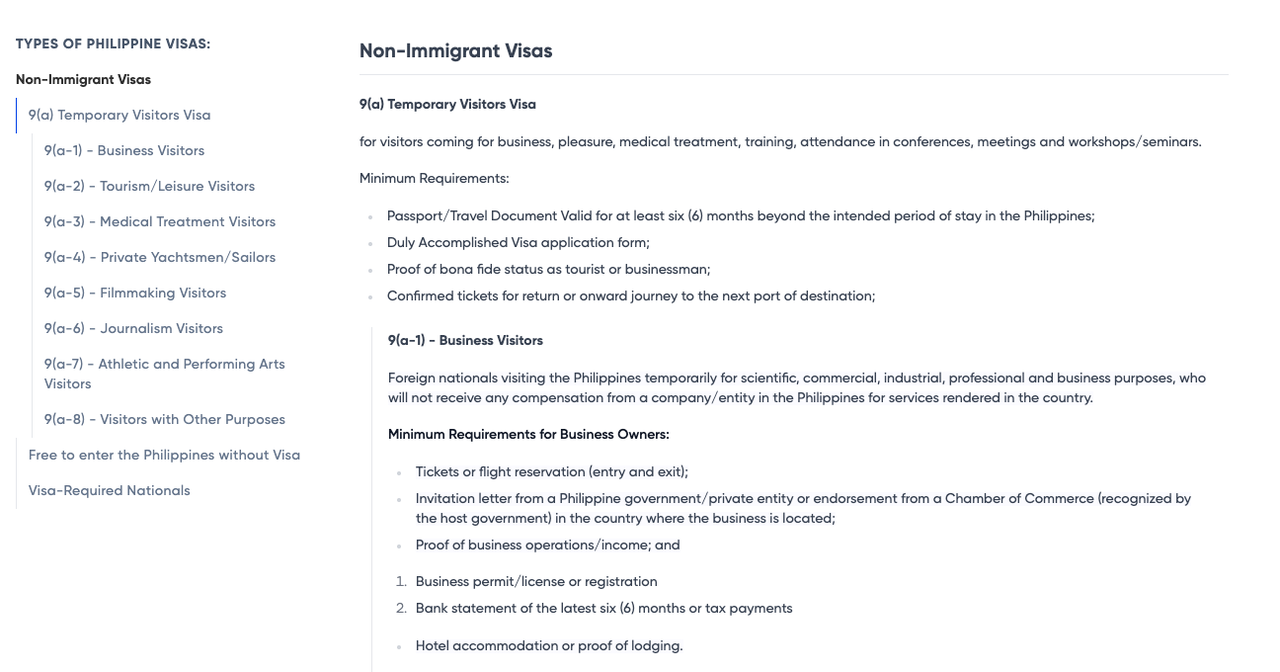
You can repeat the check behind that last column in two minutes. The DFA's eVisa portal publishes a "PH Visa Policy" page enumerating every visa type it issues; under non-immigrant visas it lists 9(a) Temporary Visitors and sub-categories 9(a-1) to 9(a-8) — business, tourism, medical treatment, yachtsmen, filmmaking, journalism, athletics and "other purposes". No digital nomad entry, and the string "nomad" does not appear. The same search against the Bureau of Immigration's visa index returns nothing.
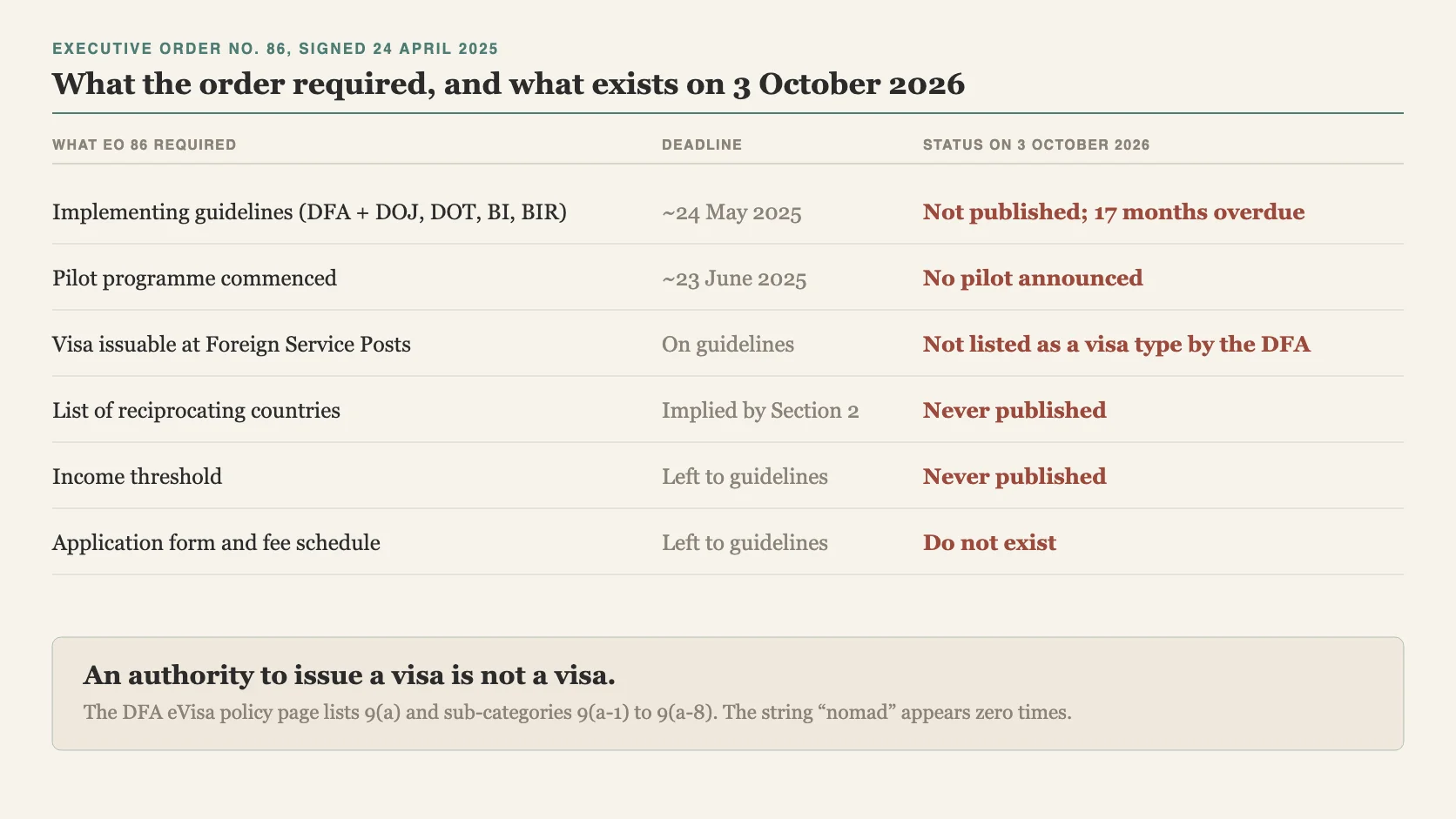
Which is why this article has no application-steps section. An authority to issue a visa is not a visa. Below is what the order actually commits the Philippines to, so you can recognise the real thing when it arrives.
What Executive Order 86 actually says
The order is short. Section 2 sets the conditions an applicant must satisfy, and it is worth reading as written rather than as summarised, because the summaries add numbers the text does not contain.
| Condition in Section 2 | As drafted | What it leaves open |
|---|---|---|
| Age | At least 18 | Nothing |
| Work | Proof of remote work using digital technology | Whether contracts, a letter, or both |
| Income | "Proof of sufficient income which is generated outside the Philippines" | The amount |
| Criminal record | Proof of none | Which jurisdictions must certify |
| Insurance | Valid health cover for the DNV period | Minimum cover and acceptable insurers |
| Nationality | A country that grants DNVs to Filipinos and hosts a Philippine Foreign Service Post | Which countries those are |
| Security | No threat to national security | Nothing |
| Local work | Not employed within the Philippines | Whether Philippine clients are permitted |
The grants are equally spare: a maximum stay of one year, renewable for the same period, which is where the commonly quoted "two years" comes from. Nothing creates a path to permanent residence, and nothing addresses tax — the BIR is named as a coordinating agency precisely because that question was left to the guidelines.
Two of the four open items in that table are the ones that will decide whether the visa is any use to you.
The two unanswered questions in the Philippines digital nomad visa
An income threshold and a nationality list. Neither exists, and the second is the one that could rule you out entirely however much you earn.
The $24,000 income figure is not in the order
The number appears on page after page as though it were settled. It is not in EO 86, it is not in any DFA release I could locate, and the more careful competitors concede they cannot trace it either.
Its likely origin is next door. USD 24,000 a year is exactly the threshold Malaysia's DE Rantau Nomad Pass sets for its technology lane — see our breakdown of the Malaysia digital nomad visa, where that figure is official and documented. A plausible reading is that one agency used Malaysia as a comparator, a second copied it without the qualifier, and it hardened into a requirement through repetition.
Why it matters: if the threshold lands at Indonesia's level instead, the picture changes completely. Indonesia's E33G asks USD 60,000 a year; Thailand's DTV asks for 500,000 THB in liquid funds rather than an income at all. Plan around $24,000, meet a $60,000 rule, and you have mis-specified the whole relocation. Anyone quoting a number for an unpublished regulation is guessing, this article included — the plausible range spans two and a half times.
The reciprocity clause is the real eligibility test
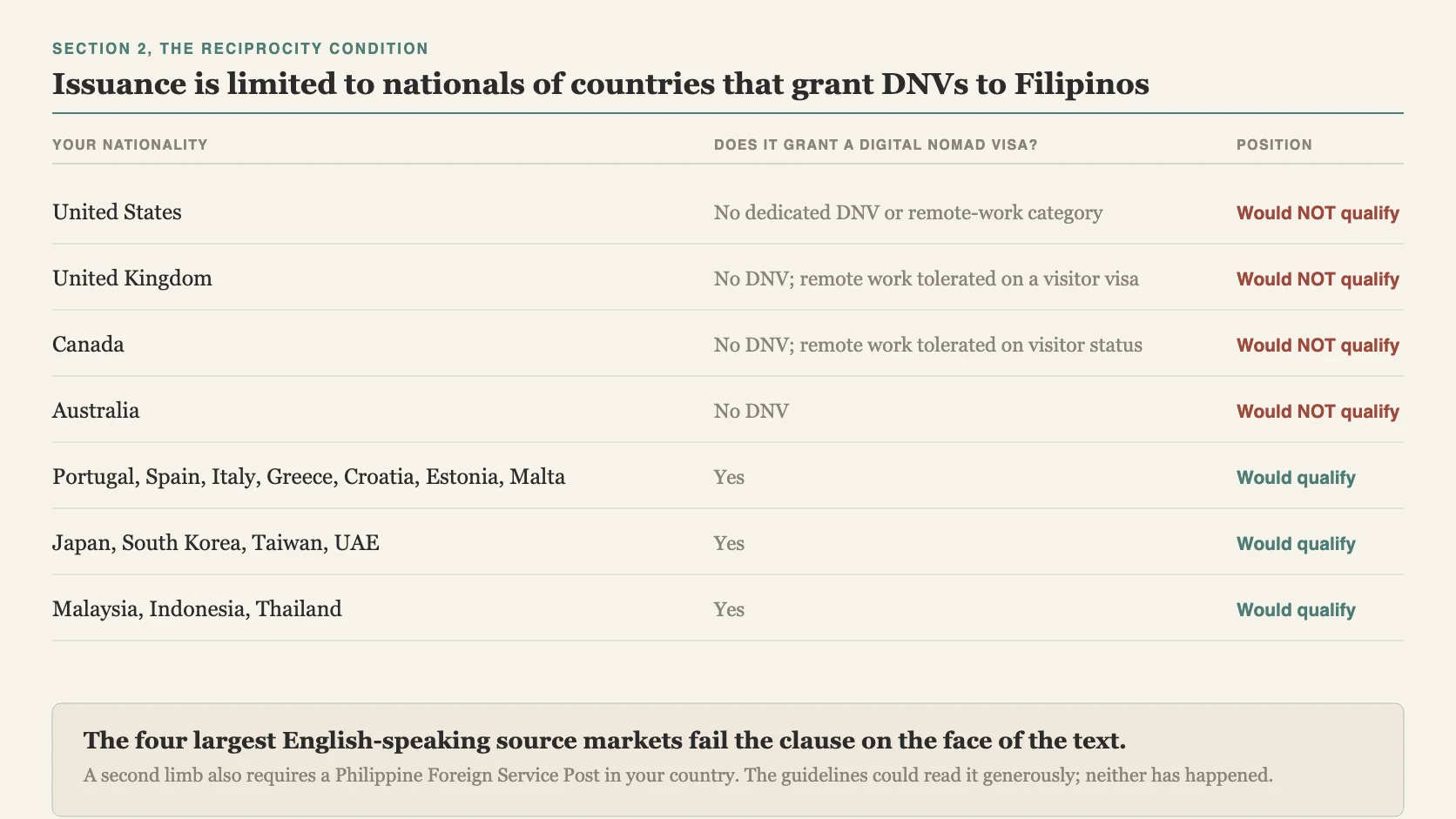
This is the condition almost nobody examines, and it is the one most likely to exclude you. Section 2 limits issuance to a national of a country that itself grants digital nomad visas to Filipinos, and where the Philippines maintains a Foreign Service Post.
Read literally, that is not a formality. The countries that send the most remote workers are largely not countries that receive them under a dedicated visa.
| Your nationality | Does it grant a digital nomad visa? | Position under EO 86 as drafted |
|---|---|---|
| United States | No dedicated DNV or remote-work category | Would not qualify |
| United Kingdom | No DNV; remote work tolerated on a Standard Visitor visa | Would not qualify |
| Canada | No DNV; remote work tolerated on visitor status | Would not qualify |
| Australia | No DNV | Would not qualify |
| Portugal, Spain, Italy, Greece, Croatia, Estonia, Malta | Yes | Would qualify |
| Japan, South Korea, Taiwan, UAE | Yes | Would qualify |
| Malaysia, Indonesia, Thailand | Yes | Would qualify |
The asymmetry is the point. An Irish or Portuguese freelancer sails through the nationality condition; an American or Canadian one fails it on the face of the text, however much income they show. Note also the second limb — a Philippine Foreign Service Post in your country — which quietly rules out applying from wherever you happen to be staying.
Two caveats, stated plainly. The guidelines could read "offers DNVs to Filipinos" generously — the UK's January 2024 visitor-rules update, which permits some remote work on a Standard Visitor visa, is exactly the provision a permissive list might count — and a reciprocity condition can be waived in practice. But neither has happened, and the drafting is what exists. If you hold a US, UK, Canadian or Australian passport, this is the question to put to your nearest Philippine embassy before planning anything around this visa.
Why the tax benefit is smaller than it looks
Here is the part that reframes the whole wait. Most nomad visas are interesting because of what they do to your tax position. This one largely cannot, because the Philippine charge is territorial for anyone who is not a Filipino citizen.
| Status | Day count | Taxed on | Rate on Philippine-source income |
|---|---|---|---|
| Resident citizen | — | Worldwide income | Graduated, to 35% |
| Non-resident citizen | — | Philippine-source only | Graduated |
| Resident alien | Lives there, no definite intention as to length | Philippine-source only | Graduated, to 35% |
| Non-resident alien engaged in trade or business | More than 180 days in a calendar year | Philippine-source only | Graduated, to 35% |
| Non-resident alien not engaged in trade or business | 180 days or fewer | Philippine-source only | Flat 25%, no bands |
Read the right-hand column of the three alien rows together: whichever one you land in, foreign-sourced income is outside the Philippine charge. Unlike Indonesia, where an E33G permit can make you a worldwide-taxable resident from arrival, or Malaysia, where the 0% outcome depends on a gazetted exemption with a condition attached, the Philippines simply does not reach a foreign client's fee. There is no exemption to qualify for and no condition to fail.
Which means the 180-day line does something counterintuitive. It is not a tax-residency cliff to stay under — it is a classification switch, and crossing it usually helps:
| Scenario | Under 180 days (NRANETB) | Over 180 days (NRAETB) |
|---|---|---|
| PHP 600,000 of foreign client fees | Not taxable in PH | Not taxable in PH |
| PHP 600,000 of Philippine-source fees | 25% flat = PHP 150,000 | Graduated: 0% on first 250,000, 15% to 400,000, 20% above → PHP 62,500 |
So the only readers for whom the day count matters are those earning inside the Philippines, and for them a short stay is the expensive one. The graduated schedule has run from 1 January 2023: nil to PHP 250,000, then 15%, 20%, 25%, 30% and 35% above PHP 8 million.
None of this touches your home country. A US citizen stays taxable on worldwide income wherever they sit — see the foreign earned income exclusion for the only real relief — and a European freelancer who never properly exited their old residence has gained nothing by arriving. The Philippines does not tax your foreign income; it also does not stop anyone else doing so, which is the trap in being tax resident nowhere.
What works today: the 9(a) extension ladder
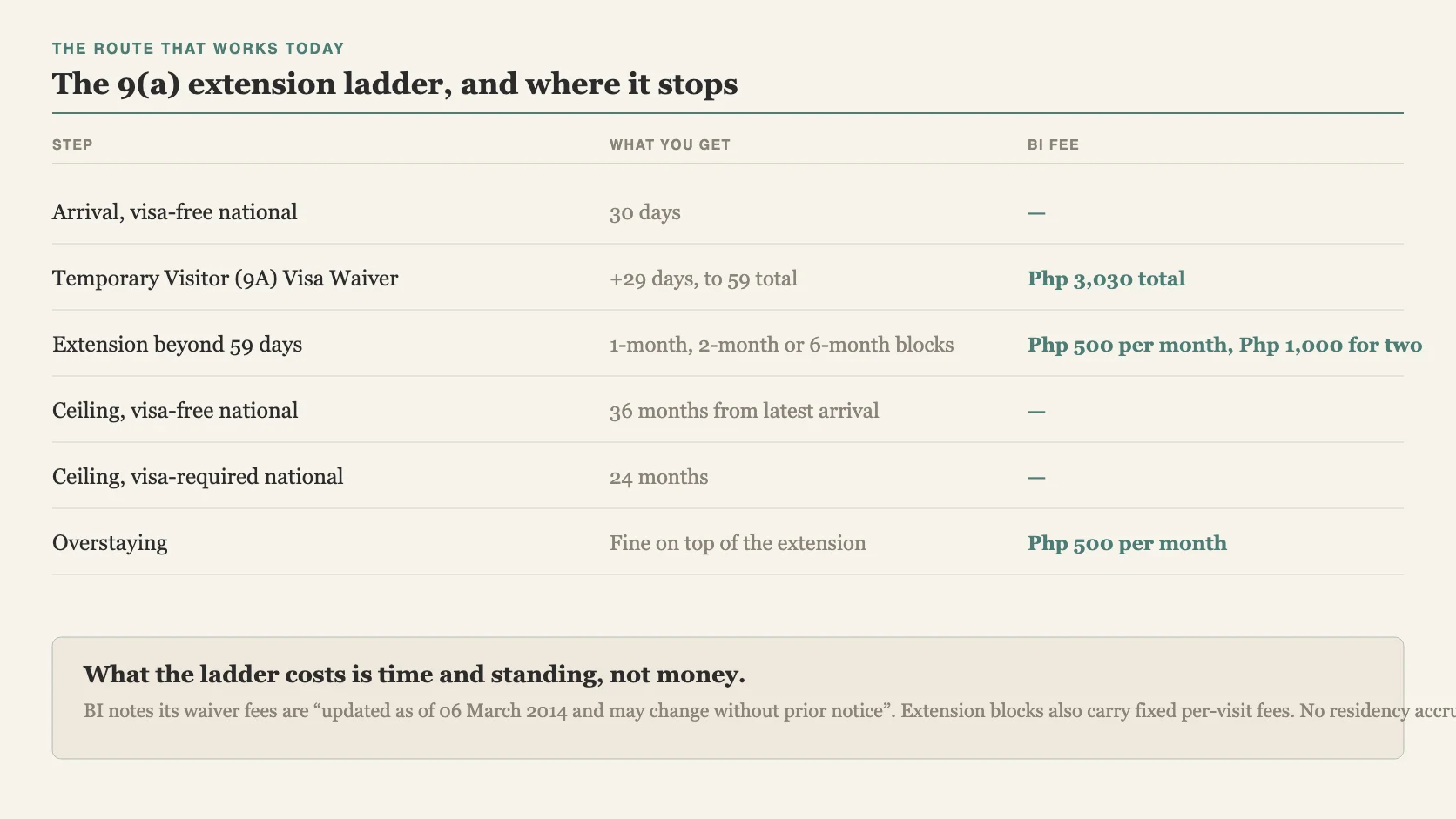
With no nomad visa to apply for, the route remote workers in the Philippines actually use is the tourist one, and the ceiling is higher than most people expect. The Bureau of Immigration's own pages name the maximum allowable stay as 36 months from your latest arrival for visa-free nationals and 24 months for visa-required nationals — the figures appear in BI's criteria for who must file a motion for reconsideration for overstaying.
| Step | What you get | BI fee |
|---|---|---|
| Arrival, visa-free national | 30 days | — |
| Temporary Visitor (9A) Visa Waiver | +29 days, to 59 total | Php 3,030 total |
| Extension beyond 59 days | 1-month, 2-month or 6-month blocks | Php 500 per month of extension, Php 1,000 for two, plus fixed per-visit fees |
| Ceiling, visa-free national | 36 months from latest arrival | — |
| Ceiling, visa-required national | 24 months | — |
| Overstaying | Fine on top of the extension | Php 500 per month |
Two honest caveats about those fees. BI's published schedule for the visa waiver carries the note "Fees are updated as of 06 March 2014 and may change without prior notice", so treat the Php 3,030 as the published figure rather than today's cashier total. And on the extension-beyond-59-days page, the only totals BI tabulates — Php 3,150 for a one-month block and Php 3,650 for two — sit under an age-bracket column for minors below 14, not under an adult column. I am not going to convert that into an adult figure it does not state. Budget in the region of Php 3,000 to Php 4,000 per visit and confirm at the counter.
What the ladder costs is time and standing, not money. Each extension is an in-person application with a Consolidated General Application Form, a clearance check and a cashier queue. You accrue no residency, no path to permanence, and nothing that reads as a visa to a landlord or a bank. For a one-year experiment it is workable; as a base it is attrition.
The SRRV, for anyone over 40 with capital
The one long-stay instrument you can actually obtain in 2026 is the Special Resident Retiree's Visa, issued by the Bureau of Immigration under the Philippine Retirement Authority's programme. Its name is misleading in a useful way: the principal applicant floor is 40, not 60.
| SRRV option | Age | Deposit required |
|---|---|---|
| Classic, pensioner | 50+ | USD 15,000 |
| Classic, non-pensioner | 50+ | USD 30,000 |
| Classic, pensioner | 40–49 | USD 25,000 |
| Classic, non-pensioner | 40–49 | USD 50,000 |
| Courtesy (foreign nationals, special categories) | 50+ | USD 1,500 |
| Courtesy (former Filipino citizens) | 50+ / 40–49 | USD 1,500 / USD 3,000 |
The pensioner tiers need a lifetime pension of at least USD 800 a month for a single applicant, or USD 1,000 with dependants — which is what pushes most working-age nomads into the non-pensioner column. On top of the deposit sits a USD 1,500 PRA processing fee, and the deposit can be converted to an approved investment under the programme's rules.
What it buys is real: permanent residency, multiple entry and indefinite stay, exemption from BI annual reporting and from the Alien Certificate of Registration I-Card, exemption from exit and re-entry permits, a PhilHealth special rate, one duty-free shipment of household effects up to USD 7,000, and no separate work or student permit required. For a founder in their forties with USD 50,000 they can leave on deposit, the SRRV is a materially better instrument than the nomad visa would be even if it existed — and it is available now. Compare it against the second residency options that need a similar outlay.
How the Philippines compares with the regional visas that exist
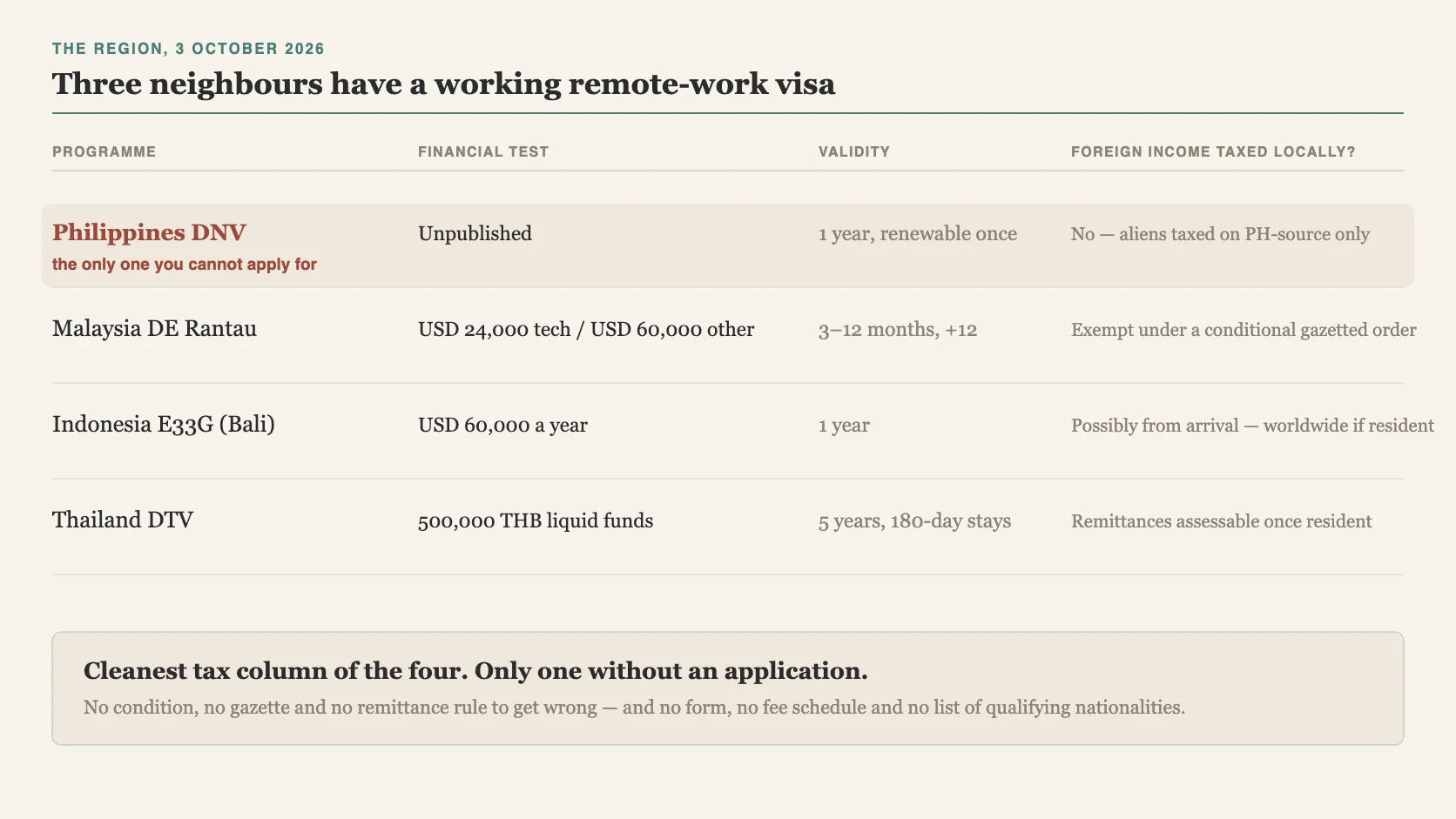
Context is what makes the Philippine delay costly. Three neighbours have working remote-work visas, and all three admit Filipinos, so all three satisfy their own side of any reciprocity test.
| Programme | Financial test | Validity | Foreign income taxed locally? |
|---|---|---|---|
| Philippines DNV | Unpublished | 1 year, renewable once | No — aliens taxed on PH-source only |
| Malaysia DE Rantau | USD 24,000 tech / USD 60,000 other | 3–12 months, +12 | Exempt under a conditional gazetted order |
| Indonesia E33G (Bali) | USD 60,000 a year | 1 year | Possibly from arrival — worldwide if resident |
| Thailand DTV | 500,000 THB liquid funds | 5 years, 180-day stays | Remittances assessable once resident |
Read as a tax column, the Philippines is the cleanest of the four — no condition, no gazette, no remittance rule to get wrong. Read as an immigration column, it is the only one you cannot apply for. That is why the practical answer for most readers is the extension ladder plus, if the numbers work, the SRRV, rather than a wait.
If the guidelines land, check the income threshold, the reciprocity list, and whether the BIR disturbs the territorial position above. Until then, plan against what the digital nomad visas that exist actually offer.
Related reading
- Digital nomad visas compared — thresholds, durations and tax treatment across every programme in one table.
- Malaysia's DE Rantau pass — where the USD 24,000 figure genuinely comes from, and the condition on its 0%.
- Bali's digital nomad visa and its tax trap — the regional option where residency can begin on day one.
- Thailand's DTV — five years of validity, and the 180-day remittance line behind it.
- Digital nomad visas with a path to permanent residency — which programmes build a clock, and which are dead ends.
- Travel and health insurance for nomads — what visa document lists actually require of a policy.
FAQ
Can I apply for the Philippines digital nomad visa in 2026?
No. Executive Order 86 created the authority to issue one on 24 April 2025, but as of 3 October 2026 the Department of Foreign Affairs has not published the implementing guidelines the order required within 30 days, and the visa appears on neither the DFA's own eVisa policy page nor the Bureau of Immigration's visa list. There is no application form, no fee schedule and no list of qualifying nationalities. Pages setting out application steps are describing a process that does not exist yet.
What is the income requirement for the Philippines digital nomad visa?
Nobody knows, because no figure has been published. Executive Order 86 requires "proof of sufficient income which is generated outside the Philippines" and leaves the amount to the implementing guidelines. The USD 24,000 a year that circulates on visa-agency pages cannot be traced to the order or to any DFA release — it is the figure Malaysia's DE Rantau pass uses for its tech lane, and it appears to have been borrowed. Treat it as a guess until the guidelines say otherwise.
Will Americans qualify for the Philippines digital nomad visa?
On the wording of the order, probably not. Section 2 limits issuance to nationals of countries that themselves grant digital nomad visas to Filipinos and host a Philippine Foreign Service Post. The United States has no digital nomad or remote-work visa category, and neither do the United Kingdom, Canada or Australia, so unless the guidelines read reciprocity loosely the four largest English-speaking source markets fail it. It is the most consequential unanswered question about this visa, and almost no guide raises it.
How long can I legally stay in the Philippines as a remote worker right now?
Up to 36 months from your latest arrival as a visa-free national, and up to 24 months if your nationality requires a visa — the maximum allowable stays the Bureau of Immigration itself names. You arrive for 30 days, buy a 29-day visa waiver to reach 59, then extend in one-, two- or six-month blocks at a BI office. Legal and well established, at the cost of an in-person immigration appointment several times a year.
Do digital nomads pay tax in the Philippines on foreign income?
Generally no, which is what makes the missing visa matter less than it sounds. The Philippines taxes resident citizens on worldwide income, but aliens — resident or non-resident — only on Philippine-source income. Crossing 180 days changes your classification, not the territorial scope, so foreign clients stay outside the Philippine charge whether you stay two months or two years. Your home country's rules are a separate question, and usually the binding one.
Is it better to stay under 180 days in the Philippines for tax reasons?
Usually the opposite, if you have any Philippine-source income at all. Under 180 days you are a non-resident alien not engaged in trade or business, taxed at a flat 25% on Philippine-source income with no graduated bands. Over 180 days you are treated as engaged in trade or business and taxed on the same income at graduated rates that start at 0% on the first PHP 250,000. If all your income is foreign, the threshold makes no difference to your Philippine liability either way.
What is the SRRV and is it an alternative to the nomad visa?
The Special Resident Retiree's Visa is a permanent non-immigrant visa issued by the Bureau of Immigration under the Philippine Retirement Authority's programme, and the only long-stay instrument that exists today. It is open from age 40, not 60: SRRV Classic asks USD 15,000 from a pensioner aged 50 or over, rising to USD 50,000 for a non-pensioner aged 40 to 49, plus a USD 1,500 PRA processing fee. It gives indefinite stay and exemption from BI annual reporting and exit permits, and while it confers no right to Philippine work, foreign-sourced income is untouched either way.
Should I wait for the digital nomad visa or use the tourist route?
Use the tourist route if you want to be in the Philippines in the next year. A 30-day deadline 17 months overdue, with no draft guidelines and no pilot, is not a timetable to plan a relocation around. The extension ladder already reaches three years, and since the Philippines does not tax aliens on foreign income, the nomad visa would buy convenience rather than tax or residency standing.
Sources
- Executive Order No. 86, s. 2025 (full text) — the date signed, the one-year maximum stay and renewal, every Section 2 condition quoted above including the reciprocity limb, the 30-day guidelines deadline and the 60-day pilot deadline, and the agencies tasked.
- DFA eVisa — Philippine visa policy and visa types — the enumerated non-immigrant categories 9(a) and 9(a-1) to 9(a-8) against which the absence of a digital nomad visa was checked on 3 October 2026.
- Bureau of Immigration — visa list — the second check on the same absence, and the index of visa types BI administers.
- Bureau of Immigration — Temporary Visitor (9A) Visa Waiver and extension of authorized stay — the 30-day admission and 29-day waiver, the Php 3,030 waiver total and its 2014 revision note, the per-month extension charges, the Php 500 monthly overstay fine, and the 36-month / 24-month maximum allowable stays.
- Philippine Retirement Authority — SRRV — every SRRV deposit figure by age and pensioner status, the USD 800 / USD 1,000 pension evidence, the USD 1,500 processing fee, the age-40 floor and the benefit list including the ACR I-Card and annual-reporting exemptions.
- PwC Worldwide Tax Summaries — Philippines, taxes on personal income — the territorial scope for aliens, the NRANETB flat 25%, and the graduated bands effective 1 January 2023. Reviewed 2 July 2026.
- PwC Worldwide Tax Summaries — Philippines, residence — the resident-alien definition and the 180-day line separating NRAETB from NRANETB. Reviewed 2 July 2026.
- Erickson Immigration Group — Philippines announces digital nomad visa — an independent contemporaneous reading of EO 86's scope and deadlines, used to corroborate the order's text.
Figures are current as of 3 October 2026. The reciprocity analysis reads EO 86's Section 2 as drafted; it is not a determination, the guidelines may construe it more permissively, and only a Philippine Foreign Service Post can say how it will apply to your nationality. The absence of the visa is evidenced by the DFA and BI listings on the date above and may change at any time. BI's fee schedule is quoted only where unambiguous — the totals it gives for blocks beyond 59 days sit under a minors' bracket and are not reproduced as adult figures. Tax treatment is the general statutory position for aliens and ignores treaty relief, Philippine-source deeming rules and your home country's law. This is editorial research, not legal, immigration or tax advice.