
Every guide to the Bali digital nomad visa tells you the same two things: that you need $60,000 a year, and that your foreign income is not taxed in Indonesia. The first is right. The second is the kind of claim that survives because almost nobody checks the residency rule it depends on, and the rule does not say what those pages think it says.
For a freelancer or founder billing $50k to $300k from abroad, this is not a technicality. Indonesia's top personal rate is 35%, and a resident is taxed on worldwide income. Getting the residency question wrong on an $80,000 year is a roughly $19,600 mistake, and it is a mistake you make by arriving, not by staying too long.
So I read the residency test as the tax authorities' own reference states it, rather than as the visa agencies summarise it, and I read PMK 18/2021 — the regulation everyone cites for the "four-year exemption" — against what the E33G actually permits you to do. Three things fall out that the pages ranking for this query get wrong or skip entirely: the 183-day count is only one of three ways to become an Indonesian tax resident, the four-year exemption is structurally unavailable to anyone on this visa, and the sources cannot even agree on whether the permit extends.
Key takeaways
- $60,000 a year in foreign income, about $5,000 a month, plus a bank statement showing $2,000 across the preceding three months.
- 183 days is not the only trigger. A person who resides in Indonesia, or is present during a fiscal year and intends to reside, is a tax resident — and a one-year stay permit is evidence of exactly that intent.
- The four-year foreign-income exemption is not available on this visa. PMK 18/2021 requires an Appendix II occupation, evidenced expertise and a knowledge-transfer obligation — conditions that assume an Indonesian employer the E33G forbids you to have.
- Resident tax on $80,000 works out near IDR 324 million, roughly $19,600, an effective rate around 24.5% before any treaty relief.
- Government fees start around IDR 7,000,000, but published totals run to IDR 13,000,000 once agency fees load on.
- Nobody agrees on whether it extends. Most agencies say no; at least one account says the official portal says yes. That gap decides your second tax year.
SafetyWing — international health cover is on the E33G document list, and immigration wants it in the file, not bought after approval
What the E33G actually is
The Bali digital nomad visa has no such official name. There is no Bali visa at all — immigration is national, and Bali is simply where most holders choose to live. The instrument is the E33G remote worker visa, which on arrival converts into a KITAS, Indonesia's limited stay permit. Conflating the entry visa with the stay permit is the commonest error in this niche, and it matters because the KITAS, not the visa, is what carries the tax implication.
It is a one-year, multiple-entry permit. It needs no Indonesian sponsor, which is the real advantage over Indonesia's work-permit routes, where a local company must sponsor you and file an RPTKA. Applications go through the official evisa.imigrasi.go.id portal and are handled online.
| E33G remote worker visa | |
|---|---|
| Official status | Entry visa converting to a limited stay permit (KITAS) |
| Validity | 1 year, multiple entry |
| Sponsor required | No |
| Income source | Must be entirely outside Indonesia |
| Local work permitted | No — no Indonesian employer, client, or sales |
| Application | Online, evisa.imigrasi.go.id |
| Approval validity | Must be used within 90 days of issue |
| Family | Dependants can be included |
The restriction is stricter than most readers expect. You cannot take a job with an Indonesian company, receive payment from any Indonesian entity, or sell goods or services inside the country — and that holds for a single local client. If your business model drifts toward local customers, this is the wrong visa, and the wider comparison of digital nomad visas sets out which programmes tolerate local income.
The $60,000 test and what actually counts
The threshold is USD 60,000 a year, about $5,000 a month, and it must come from outside Indonesia. Alongside it you show a personal bank statement with at least USD 2,000 across the preceding three months. The two tests do different jobs: the first proves you can support yourself, the second proves you have liquid funds on landing.
| Requirement | 2026 figure | Notes |
|---|---|---|
| Annual foreign income | USD 60,000 | Around USD 5,000/month |
| Bank balance | USD 2,000 | Averaged over preceding 3 months |
| Employment evidence | Contract with a company registered outside Indonesia | The document immigration anchors on |
| Passport validity | 6 months minimum | Standard |
| Health insurance | International cover | Listed among supporting documents |
| Other documents | CV, colour photograph, itinerary, proof of income | Translations where required |
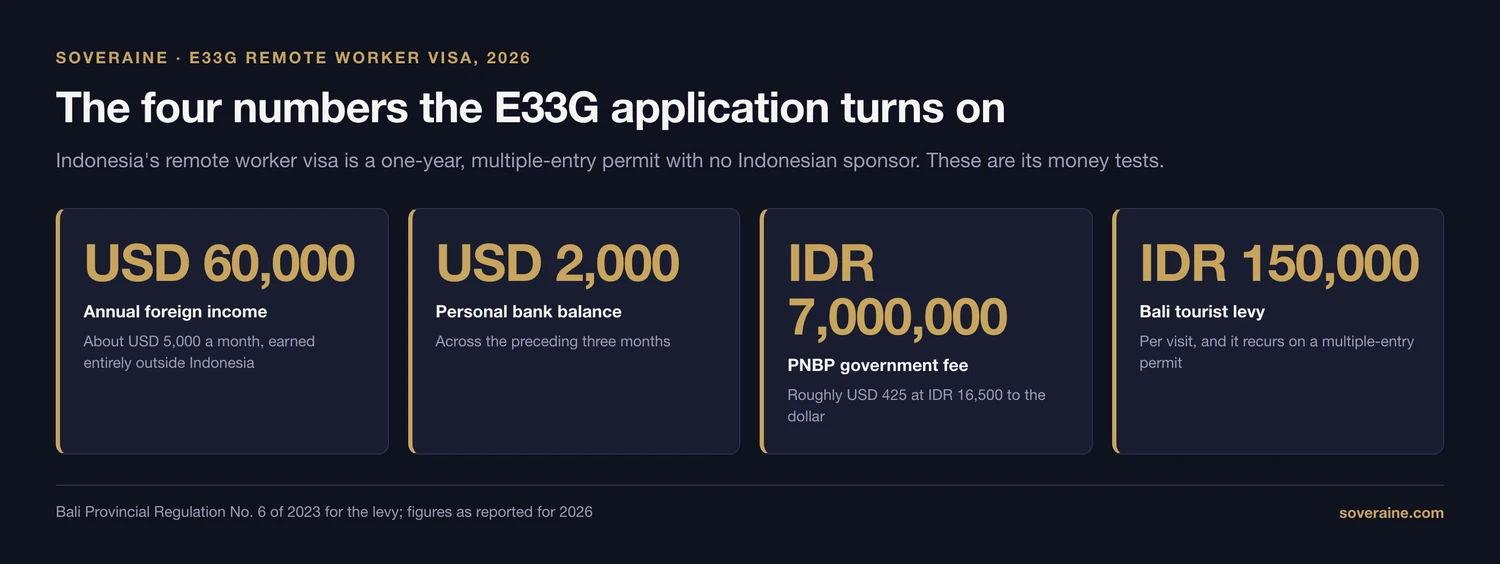
The contract requirement is where genuinely self-employed applicants struggle. The rule is written around a remote employee with an overseas employment contract. A freelancer with a dozen rolling clients has income but no single instrument that looks like the document immigration expects, and the practical answer tends to be long-term client agreements plus consistent bank inflows. Note too that $60,000 is a floor, not a margin: an applicant landing at $60,100 has no cushion if a currency conversion moves the number.
What it costs in 2026
Here the published numbers diverge badly, and that divergence is itself the finding. The government charge most consistently reported is IDR 7,000,000 in PNBP, roughly USD 425 at IDR 16,500 to the dollar. Add the stay permit and re-entry components and self-filed totals land nearer IDR 8,500,000.
| Item | Reported figure (IDR) | Approx. USD |
|---|---|---|
| PNBP government fee | 7,000,000 | ~425 |
| Stay permit / re-entry components | ~1,500,000 | ~90 |
| Self-filed total | ~7,000,000–8,500,000 | ~425–515 |
| Agency service fee | ~6,000,000 | ~365 |
| Agency-inclusive total | ~13,000,000 | ~790 |
| Bali tourist levy (per visit) | 150,000 | ~10 |
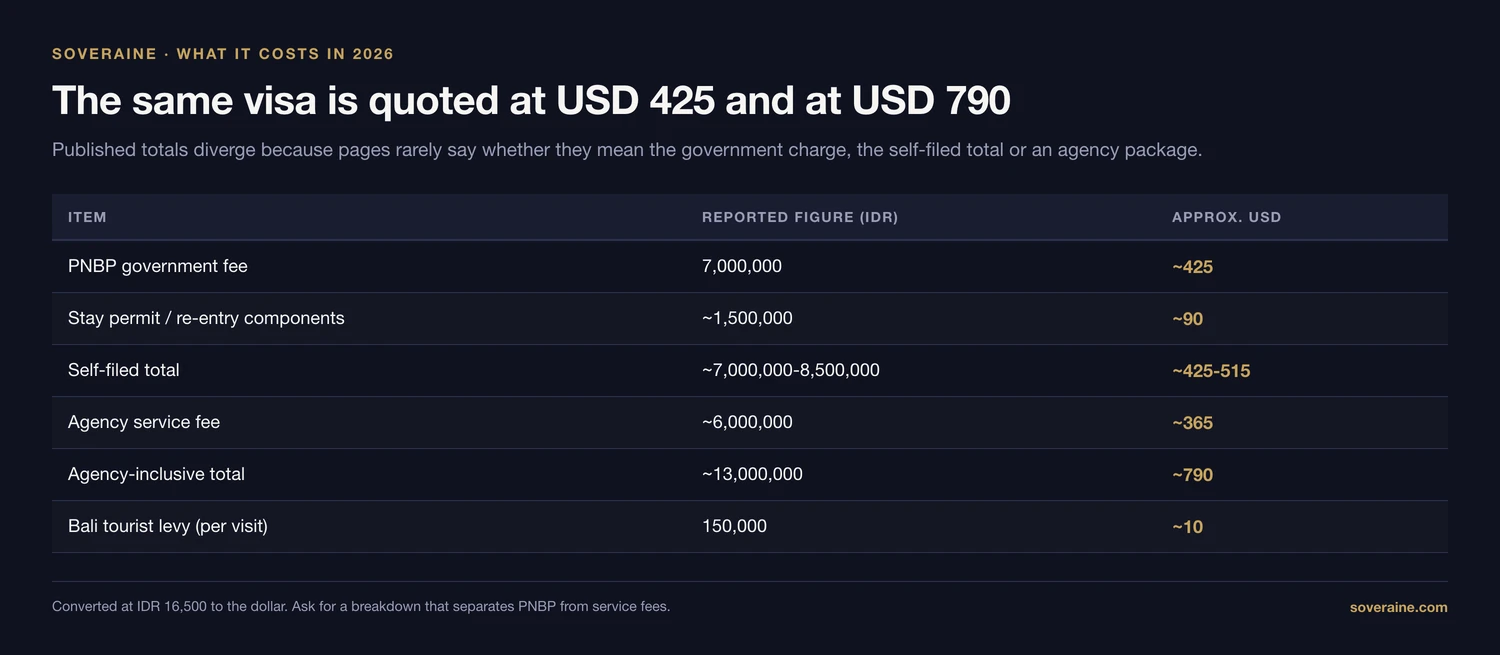
Two cautions. First, sources reporting a single "cost" figure are rarely clear about whether they mean the government charge, the self-filed total or an agency package, which is how the same visa appears at $430 on one page and $790 on another. Ask for a written breakdown that separates PNBP from service fees.
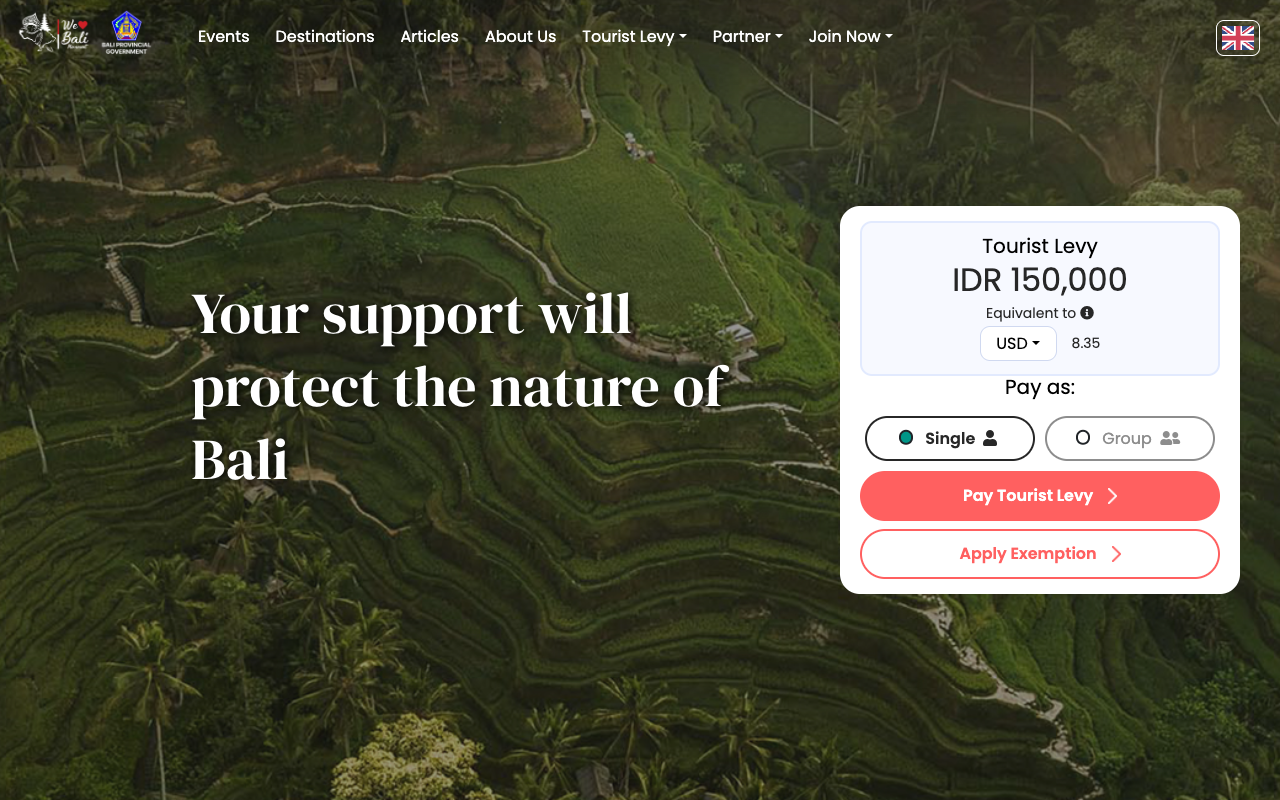
Second, the Bali tourist levy is separate from anything immigration charges: IDR 150,000 per visit under Bali Provincial Regulation No. 6 of 2023, paid through the official Love Bali portal. It is small, it is per entry, and on a multiple-entry permit it recurs.
The tax myth: residency can start on day one
This is the section the competing pages do not write, and it turns on a sentence most of them never quote. Almost every guide tells you the Indonesian trigger is 183 days. That is one of three tests, not the test.
As PwC's reference on Indonesian individual residence sets it out, an individual is a tax resident if they meet any of the following:
| # | Statutory test | What it means in practice |
|---|---|---|
| 1 | Resides in Indonesia | Facts on the ground — a home, a life based there |
| 2 | Present more than 183 days in any 12-month period | The rolling day count everyone quotes |
| 3 | Present during a fiscal year and intends to reside in Indonesia | Intention, evidenced by your own paperwork |
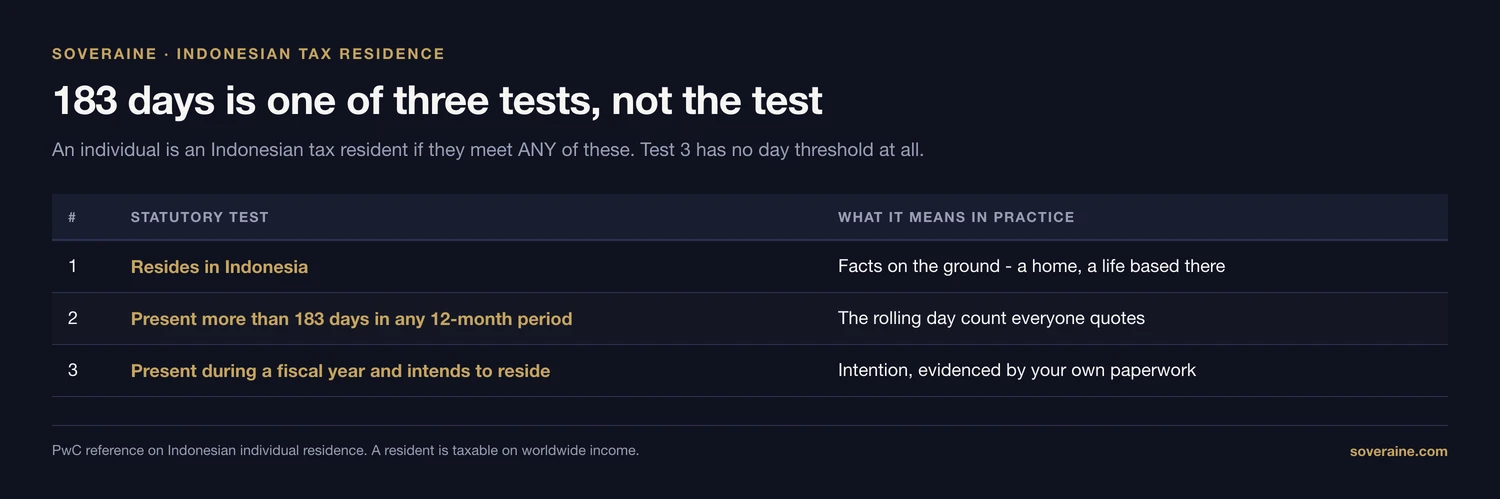
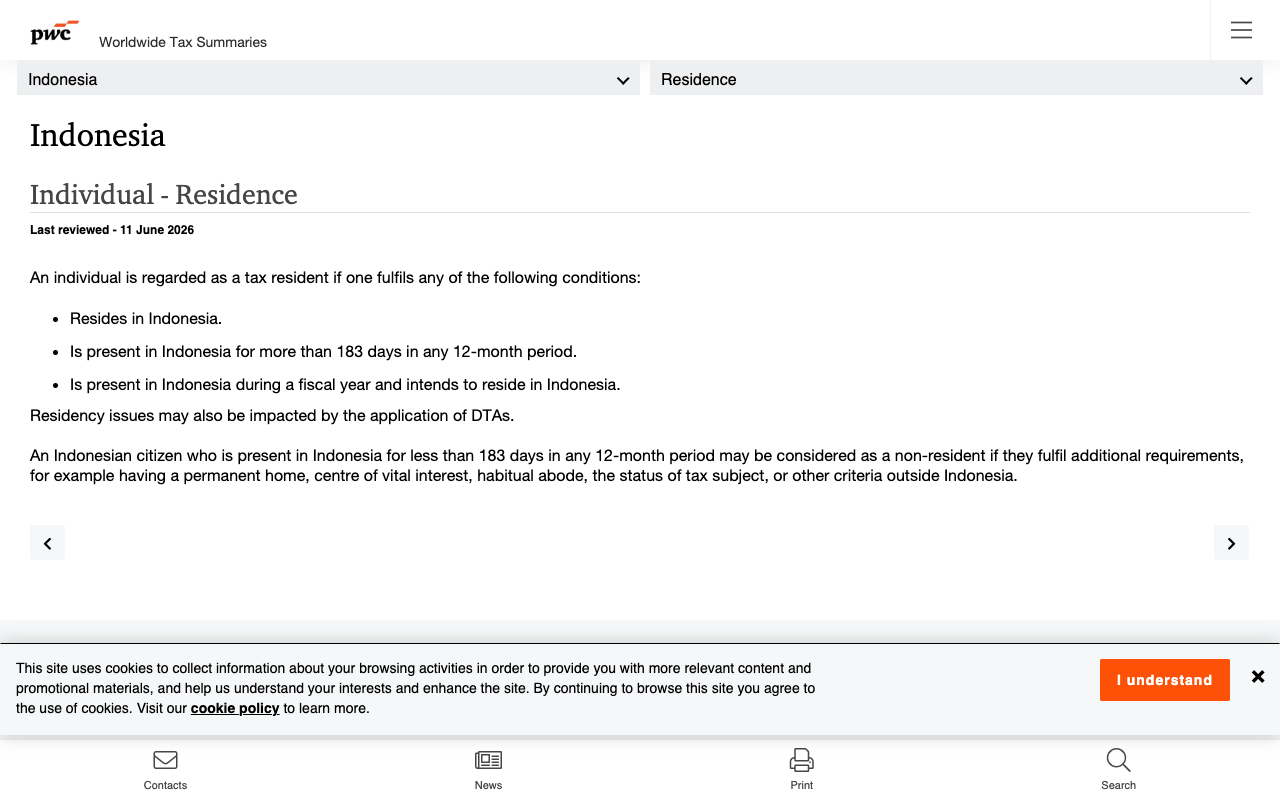
Test 3 is the one that bites. It has no day threshold at all. It asks whether you were present during the fiscal year and whether you intended to reside — and the most persuasive evidence of an intention to reside for a year is an application for a permit to reside for a year. Practitioners working in this market describe the KITAS as exactly that: evidence of intent, capable of making a holder a tax resident from arrival regardless of the day count.
So the common plan — take the E33G, stay under 183 days, declare nothing — rests on test 2 while tests 1 and 3 sit above it untouched. An Indonesian tax resident is taxable on worldwide income. There is no blanket exemption for foreign earnings, and nothing in the E33G grants one.
I want to be precise about the strength of this claim: it is a reading of the statutory tests against what the permit evidences, not a ruling, and no published circular I could reach settles it. That cuts both ways — nobody can promise you day-one residency applies, and nobody can promise it does not, which is why the confident "tax-free Bali" framing is the irresponsible half of the argument. If your plan depends on being a non-resident while holding a residence permit, put it to an Indonesian tax adviser before you file. Readers structuring around day counts should read what it takes to be tax resident nowhere.
Why the four-year exemption is not yours
The second thing agencies advertise is Indonesia's four-year territorial regime: qualifying foreign nationals pay Indonesian tax only on Indonesian-source income for their first four years of residency. It is real, it comes from PMK 18/2021 under the Omnibus Law, and it is not available to you.
The conditions describe a foreign expert, not a remote worker:
- Your occupation must appear on the regulation's Appendix II list — chemists, biologists, lecturers, product designers, system analysts, software developers, mining supervisors and similar roles.
- You must evidence certain expertise with a certificate from an authorised institution, or a minimum of five years' work experience in science, technology or mathematics.
- You take on an obligation to transfer knowledge to an Indonesian citizen.
- You must apply to the Directorate General of Taxes — the treatment is elected, not automatic.
Read the third condition next to the E33G's core restriction. A knowledge-transfer obligation to an Indonesian citizen presupposes an Indonesian role, employer or institution to perform it within. The E33G forbids you from having an Indonesian employer, an Indonesian client, or Indonesian-source earnings of any kind. The arrangement the exemption is designed around is the arrangement this visa prohibits.
Notice the shape of this: a software developer is on the Appendix II list, which is why the pairing sounds plausible — but being on the list is one condition of four, and it is not the one the E33G breaks. There is a further trap for anyone qualifying by another route: leave and re-enter within the four-year window and the clock runs from when you first became a domestic tax subject, not from your return.
What Indonesian tax would actually cost you
No page ranking for this query runs the numbers, so here they are. Indonesia's individual rates under the HPP Law are progressive, applied to taxable income after the PTKP personal allowance of IDR 54,000,000 for a single taxpayer with no dependants.
| Taxable income (IDR) | Rate |
|---|---|
| Up to 60 million | 5% |
| 60 million – 250 million | 15% |
| 250 million – 500 million | 25% |
| 500 million – 5 billion | 30% |
| Above 5 billion | 35% |
Worked at IDR 16,500 to the dollar, the rate I have used throughout, and ignoring deductions:
| Foreign income | Taxable after PTKP | Indonesian tax | Approx. USD | Effective rate |
|---|---|---|---|---|
| $60,000 (the minimum) | IDR 936 million | IDR 224.8 million | ~$13,600 | ~22.7% |
| $80,000 | IDR 1,266 million | IDR 323.8 million | ~$19,600 | ~24.5% |
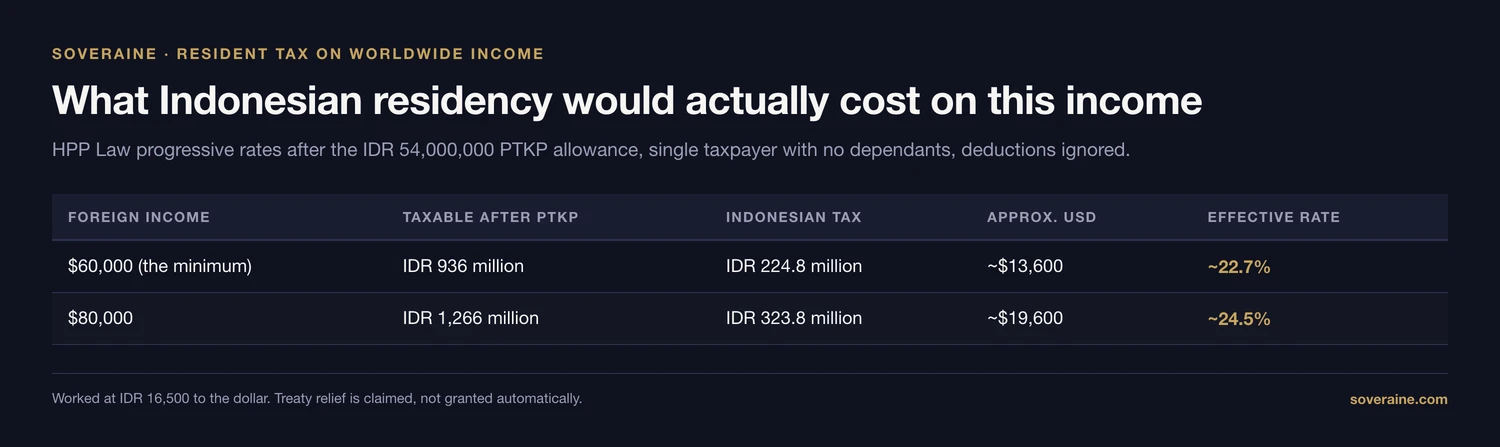
Those are meaningful sums against a $60,000 floor, and they are the exposure the "tax-free" framing quietly assumes away.
Three qualifications, because that arithmetic is deliberately crude. Deductible expenses and Indonesia's deemed-profit norms (NPPN) can cut the base substantially for the genuinely self-employed. Exchange rates move, and IDR 16,500 is my assumption. And relief may be available under Indonesia's treaty network of more than 70 countries — but it needs a certificate of domicile from your home tax authority and correct disclosure in your Indonesian return. Treaty relief is claimed, not granted automatically.
Residents register for an NPWP tax number and file an annual SPT return. The statutory deadline for individuals is 31 March following the tax year, though the filing season has been extended in at least one recent year, so confirm the current date rather than assuming it.
Can you extend it? The sources disagree
This should be a one-line answer and it is not. Extension determines whether you spend a second year in Indonesia, which determines whether you are arguing about tax residency at all — so the uncertainty is expensive.
| Source type | Claim |
|---|---|
| Most visa agencies | One year, non-extendable — leave and reapply from scratch |
| One published account of the official portal | Extension described as available, processed online |
| Common agency advice | Begin fresh application paperwork ~60 days before expiry |
I could not resolve this from primary sources: the official portal's E33G page refused automated requests, and the agency pages dominating the results are commercially interested in the answer. The honest position is that the agency consensus is non-extendable, that it is not unanimous, and that you should get it in writing before building a two-year plan on it. The asymmetry is worth naming: plan for non-extendable and it extends, you lose nothing; plan for an extension that does not exist and you are booking a departure at short notice.
The alternatives, and how they compare
The E33G is not the only route, and for a good number of readers it is not the best one.
| Route | Duration | Financial test | Work rights |
|---|---|---|---|
| E33G remote worker | 1 year, multi-entry | $60,000/yr income + $2,000 balance | Foreign employers/clients only |
| Short-stay visit visa | Weeks to months, extendable | None comparable | None |
| Second Home Visa | 5 or 10 years | IDR 2 billion (~$130,000) deposit at a state bank, or qualifying property | Not a work permit |
| Work KITAS | Tied to employment | Employer-sponsored | Indonesian employer, RPTKA required |
The short-stay visit visa is what most remote workers in Bali have actually used for years. It carries no work rights, and the widespread practice of working remotely on one is a risk people take rather than a compliant plan. Its advantage is that it evidences no intention to reside — which, per the section above, is the whole argument.
The Second Home Visa is the serious long-stay option: five or ten years against an IDR 2 billion deposit, about $130,000, held in your own name at an Indonesian state bank, or qualifying property. The visa is approved first and you then have 90 days to fund it. The deposit remains yours and earns interest, but it is idle capital, and this is not a work permit either.
Against the region, the trade is clear enough: Thailand's programmes offer longer horizons with their own tax questions, and if you are optimising for a residency clock rather than a year in the sun, visas that lead to permanent residency are a different shortlist. Whichever you choose, getting paid across borders cheaply matters more than most people budget for — see our notes on business accounts for receiving foreign income.
Who this visa is actually right for
The E33G is a good instrument for a narrow group: a salaried remote employee of a foreign company, earning comfortably above $60,000, who wants one clean legal year in Indonesia, is willing to register for an NPWP and file, and has priced Indonesian resident tax into the decision or has treaty relief that covers it.
It is the wrong instrument if you are chasing a tax outcome. Nothing about it is tax-free, the exemption people cite is built for somebody else, and the residency test can catch you without your ever seeing day 184. It is also wrong if any part of your income is Indonesian, or may become so.
What it does offer is unusual and underrated: legality without a sponsor. For anyone who has spent years on visa runs, a year of not having to think about it has a value that is not measured in tax. Just do not confuse it with a second residency play — a one-year, possibly non-extendable permit builds no clock toward anything.
Related reading
- Digital nomad visas compared — thresholds, durations and tax treatment across every programme in one table.
- Thailand's digital nomad and long-stay visas — the closest regional comparison, with a longer horizon.
- Digital nomad visas with a path to permanent residency — which programmes build a residency clock, and which are dead ends.
- How to be tax resident nowhere — why the day-count plan fails more often than it works.
- Georgia's 1% tax regime — the low-tax alternative for freelancers who want the number in writing.
- Travel and health insurance for nomads — what the document lists actually require.
FAQ
What is the income requirement for the Bali digital nomad visa in 2026?
At least USD 60,000 a year, around USD 5,000 a month, earned from sources outside Indonesia, plus a personal bank statement showing at least USD 2,000 over the preceding three months. Indonesian-source income does not count toward the threshold, and the visa's own conditions forbid you from earning any. Immigration wants the income evidenced by a contract with a company registered outside Indonesia, not by a single good month of invoices.
Do digital nomads pay tax in Bali on the E33G?
Possibly from the day they arrive, which is not what most pages ranking for this query say. Indonesia's residency test is not only the 183-day count: a person who resides in Indonesia, or who is present during a fiscal year and intends to reside there, is a tax resident. A one-year limited stay permit is the kind of evidence of intent that practitioners expect the tax office to rely on. An Indonesian tax resident is taxable on worldwide income, so the E33G is not a tax-free visa and nothing in it grants an exemption.
Does the E33G qualify for Indonesia's four-year foreign income exemption?
No, on the face of the rules. The four-year territorial regime comes from PMK 18/2021 and is built for foreign experts: you must hold an occupation on the regulation's Appendix II list, evidence your expertise with a certificate or at least five years of relevant experience, take on an obligation to transfer knowledge to an Indonesian citizen, and apply to the Directorate General of Taxes. Those conditions assume a foreign national placed in an Indonesian role. The E33G requires the opposite, that you work only for employers and clients outside Indonesia, so the structure the exemption assumes cannot exist. Agencies still advertise the two together.
How much does the Bali digital nomad visa cost in 2026?
The government charge most commonly reported is IDR 7,000,000 in PNBP, roughly USD 425, with the limited stay permit and re-entry components adding perhaps another IDR 1,500,000. Published totals then diverge sharply, from about IDR 7,000,000 for a self-filed application to around IDR 13,000,000 once an agency's service fee is included. Treat any single headline number with suspicion and get a written fee breakdown before paying.
Can the E33G visa be extended after one year?
The sources genuinely disagree, which is itself worth knowing. Most visa agencies state plainly that the permit runs one year and does not extend, so you leave and reapply. At least one account reports the official immigration portal describing an extension as available online. Because an extension governs whether you cross into a second year of Indonesian tax residency, do not plan around the agency consensus. Put the question to Indonesian immigration or a licensed agent in writing before you file.
How long does the E33G take to process, and how long is the approval valid?
Reported processing runs from about five business days to two weeks after payment clears, submitted through the official evisa.imigrasi.go.id portal. The approval must then be used within 90 days of issue or it lapses, so do not file months ahead of a flexible travel date. Applications are online and need no Indonesian sponsor, which is the main practical advantage over Indonesia's work permit routes.
What are the alternatives if I do not qualify for the E33G?
Two realistic ones. The short-stay visit visa route suits anyone staying a few months, carries no work rights and is widely misused by remote workers who never establish residency. At the other end, the Second Home Visa gives five or ten years against an IDR 2 billion deposit, about USD 130,000, held at an Indonesian state bank in your own name, or qualifying property, with 90 days from approval to put the money in place. The deposit stays yours, but it is capital you cannot deploy elsewhere.
Sources
- PwC Worldwide Tax Summaries — Indonesia, individual residence — the three statutory residency tests, including "is present in Indonesia during a fiscal year and intends to reside in Indonesia".
- PwC Worldwide Tax Summaries — Indonesia, taxes on personal income — the 5/15/25/30/35 rate schedule and its IDR bands.
- Emerhub — E33G remote worker visa — the USD 60,000 income test, the USD 2,000 three-month bank statement, the non-extendable framing, and the prohibition on Indonesian employers, payments and sales.
- Emerhub — digital nomad tax in Bali — the KITAS-as-intent-to-reside reading, the PTKP of IDR 54,000,000, NPWP and SPT obligations, and the certificate of domicile required for treaty relief.
- ASEAN Briefing — Indonesia's Omnibus Law tax changes — PMK 18/2021's Appendix II expertise requirement, the five-years-experience alternative, the knowledge-transfer obligation, and the four-year clock.
- Taxes for Expats — Bali digital nomad visa guide — the ~USD 430 government fee, five-business-day processing and the application route. It treats 183 days as the trigger; the residency section above departs from it deliberately.
- Indonesian immigration e-visa portal — the official application system. Its E33G detail page refused automated requests (HTTP 403), so figures above are cited from the secondary sources listed here, and the extension question could not be settled against it.
- Love Bali — official tourist levy portal — the IDR 150,000 per-visit levy under Bali Provincial Regulation No. 6 of 2023.
Figures are current as of September 2026. USD conversions use IDR 16,500 to the dollar, which is my assumption and moves. The worked tax figures are illustrative arithmetic on gross income after PTKP; they ignore deductible expenses, deemed-profit norms and treaty relief, any of which can change the result materially. The residency analysis reads the statutory tests against what a limited stay permit evidences — it is not a ruling, and no published circular I could reach settles the position for E33G holders specifically. Fee totals and the extension question are reported inconsistently across sources, and both are flagged as such above rather than resolved. Whether any document set satisfies Indonesian immigration is that office's determination. This is editorial research, not legal, immigration or tax advice.