Bulgaria opened a digital nomad visa on 20 December 2025, and the pitch writes itself: an EU member state, newly inside both Schengen and the euro, charging a flat 10% income tax. Half the coverage of it stops at that number.
It should not. A registered freelancer in Bulgaria pays social and health contributions of 27.8% on 75% of revenue, and those contributions are not a footnote to the 10% — below about €35,000 of revenue they are five times larger than the income tax. We built the liability from the two statutes that produce it, with the 2026 thresholds that only came into force on 1 August, and the curve is nothing like a flat 10%.
Key takeaways
- The all-in burden is about 26.3% of revenue up to roughly €35,000, not 10%. It then falls as the contribution ceiling bites: 20.7% at €50,000, 14.1% at €100,000, 10.8% at €200,000. The headline 10% is not reached until about €263,000.
- The inflection point is €35,042 of revenue (2026 figures), where 75% of what you earn hits the maximum insurable income and contributions stop growing. Everything about Bulgaria's attractiveness is a function of which side of that line you are on.
- The income requirement is 50× the monthly minimum wage, so it moved on 1 January 2026 — from about €27,533 to €31,010. Guides quoting the lower figure are quoting the threshold as it stood at launch.
- Two years is the ceiling. One year, extendable once, with no published route from the permit to long-term residence.
- The permit's second and third categories forbid providing services to anyone in Bulgaria, which sits awkwardly with the Bulgarian freelance registration that produces the 25% expense deduction in the first place.
SafetyWing — health insurance is on the document list for the Type D visa, and you need it in place before the consulate interview, not after you land
What Bulgaria's digital nomad permit actually is
It is a residence permit reached through a long-stay visa, not a visa you can turn up on. The Council of Ministers approved the procedure in December 2025 under the Foreigners in the Republic of Bulgaria Act, and applications opened on 20 December 2025.
The sequence has three steps and each one has its own clock. You apply for a Visa D in your country of nationality or legal residence, which takes one to two months. You enter Bulgaria on that visa and submit the same documents again for the permit, which takes two to four weeks, and the residence application has to go in within 14 days of arrival. Then an identity card application, three to 30 calendar days.
| Bulgaria digital nomad residence permit | |
|---|---|
| Open since | 20 December 2025 |
| Who | Third-country nationals — not EU, EEA or Swiss citizens |
| Income test | 50× the monthly minimum wage annually — €31,010 in 2026 |
| Validity | 1 year, extendable once — two years total |
| Path to permanent residence | None published |
| Route in | Visa D abroad (1–2 months) → permit in Bulgaria (2–4 weeks) → ID card (3–30 days) |
| Permit application deadline | 14 days after arrival |
| Family | Dependents sponsored through family reunification |
| Also required | Clean criminal record, health insurance, proof of accommodation at a Bulgarian address |
Two things in that table do most of the work. Two years is the whole product — there is no published mechanism that turns this permit into long-term residence, so it is a two-year base, not a first step. And the permit is for third-country nationals: if you hold an EU, EEA or Swiss passport you never needed it, and you register your residence at the Migration Directorate directly.
The Schengen context is newer than most readers assume. Bulgaria's air and sea borders came inside Schengen on 31 March 2024 and the land borders on 1 January 2025, under a Council decision of 12 December 2024. A Bulgarian residence permit now carries the ordinary Schengen travel rights, and the 90/180 rule governs your time in the rest of the area rather than your time at home.
The income test is 50× the minimum wage, which is why you see two numbers
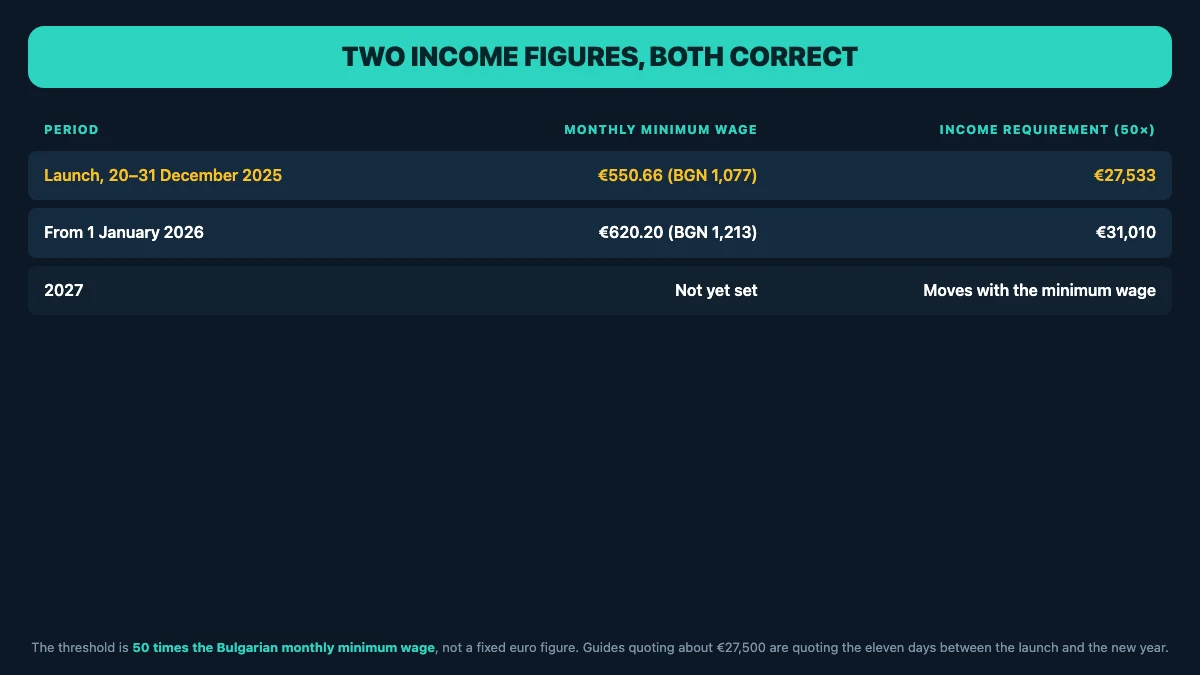
The threshold is not a fixed euro figure. It is 50 times the Bulgarian monthly minimum wage, measured against annual income, and the minimum wage moves every January.
That single fact explains a contradiction running through the English-language coverage. Bulgaria's minimum wage rose on 1 January 2026 from BGN 1,077 to BGN 1,213 — a 12.6% increase, and in euro terms from €550.66 to €620.20. Multiply each by 50:
| Period | Monthly minimum wage | Income requirement (50×) |
|---|---|---|
| Launch, 20–31 December 2025 | €550.66 (BGN 1,077) | €27,533 |
| From 1 January 2026 | €620.20 (BGN 1,213) | €31,010 |
| 2027 | Not yet set | Moves with the minimum wage |
Neither figure is wrong. The guides quoting about €27,500 are quoting the threshold that applied in the eleven days between the launch and the new year, and nobody says so. Work from the current minimum wage, not from any guide's euro figure, and expect the number to rise again each January.
The test is tied to a Bulgarian wage floor, so it ratchets with Bulgarian wage policy rather than with your earnings. At 12.6% in one year, that is not a trivial escalator for a borderline applicant planning a renewal.
Three categories, and the condition aimed at freelancers
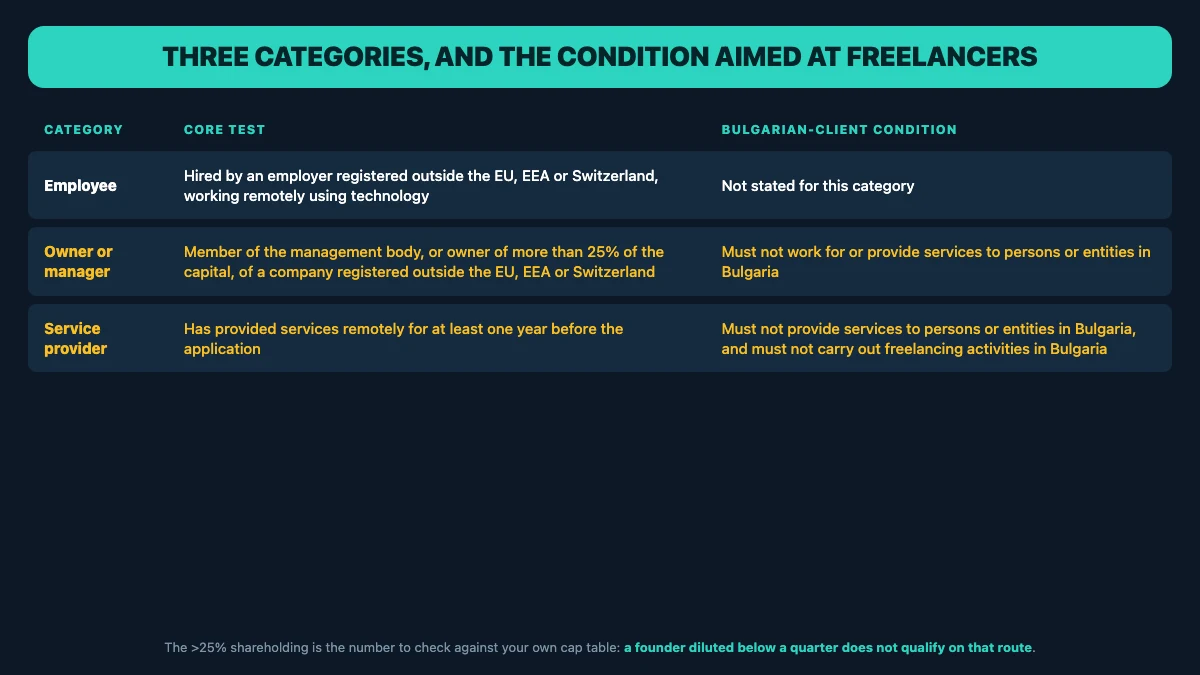
The procedure defines three kinds of digital nomad, and they are not interchangeable — the conditions differ in a way that matters more than the labels.
| Category | Core test | Bulgarian-client condition |
|---|---|---|
| Employee | Hired by an employer registered outside the EU/EEA/Switzerland, working remotely using technology | Not stated for this category |
| Owner or manager | Member of the management body, or owner of more than 25% of the capital, of a company registered outside the EU/EEA/Switzerland | Must not work for or provide services to persons or entities in Bulgaria |
| Service provider | Has provided services remotely for at least one year before the application | Must not provide services to persons or entities in Bulgaria, and must not carry out freelancing activities in Bulgaria |
The employee category is the one with an explicit salary test "as determined by law" — the 50× figure above. The owner category is the one most of this site's readers will use, and the >25% shareholding is the number to check against your own cap table before anything else: a founder diluted below a quarter does not qualify on that route.
The third category's wording is the one to read twice. "Does not carry out freelancing activities in Bulgaria" is a condition on the permit, and the Bulgarian tax regime that makes the country attractive to a freelancer is a Bulgarian freelance registration. Those two facts are in tension, and I come back to it below, because it decides which tax arithmetic actually applies to you.
The 10% flat tax is 26.3% until you earn €35,000
Here is the part the SERP does not do. Bulgaria's income tax is a flat 10%, and a registered freelance practitioner deducts 25% statutory recognised expenses under Article 29 of the Personal Income Taxes Act — no receipts, deducted by law. Published guides stop there and call the effective rate 7.5%.
They have left out the larger number. A self-insured person pays social and health contributions of 27.8% — 14.80% to the state social security funds, 5.00% to the universal pension fund, 8.00% to health — or 31.3% if you also insure for general sickness and maternity. Those contributions are charged on the same 75% of revenue, and they are deductible from the income tax base, which is the only mercy in the structure.
Run both together on 2026 figures:
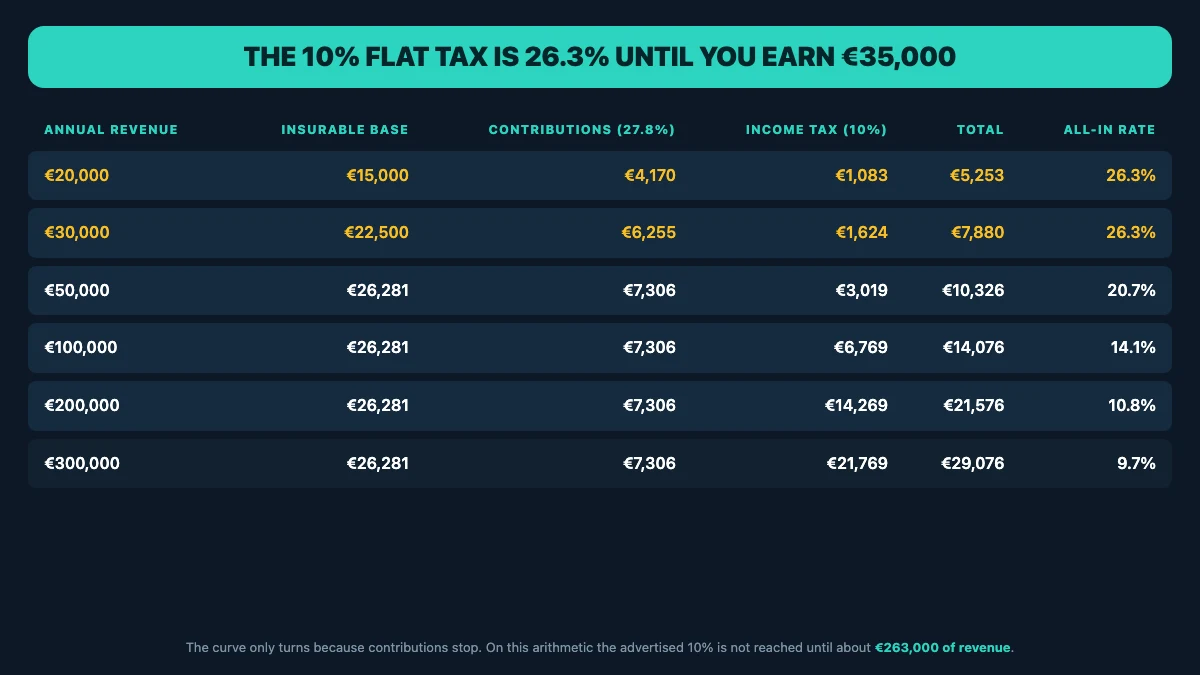
| Annual revenue | Insurable base | Contributions (27.8%) | Income tax (10%) | Total | All-in rate |
|---|---|---|---|---|---|
| €20,000 | €15,000 | €4,170 | €1,083 | €5,253 | 26.3% |
| €30,000 | €22,500 | €6,255 | €1,624 | €7,880 | 26.3% |
| €36,000 | €26,281 | €7,306 | €1,969 | €9,276 | 25.8% |
| €50,000 | €26,281 | €7,306 | €3,019 | €10,326 | 20.7% |
| €75,000 | €26,281 | €7,306 | €4,894 | €12,201 | 16.3% |
| €100,000 | €26,281 | €7,306 | €6,769 | €14,076 | 14.1% |
| €150,000 | €26,281 | €7,306 | €10,519 | €17,826 | 11.9% |
| €200,000 | €26,281 | €7,306 | €14,269 | €21,576 | 10.8% |
| €300,000 | €26,281 | €7,306 | €21,769 | €29,076 | 9.7% |
Read the first two rows and the last together. A freelancer on €20,000 and a freelancer on €30,000 both pay 26.3% of revenue in a country advertised at 10%. The curve only turns because contributions stop: once 75% of revenue passes the maximum insurable income, every further euro carries income tax alone. On this arithmetic the advertised 10% is not reached until about €263,000 of revenue, and the 7.5% that circulates online is an asymptote — €1,000,000 of revenue still lands at 8.2%.
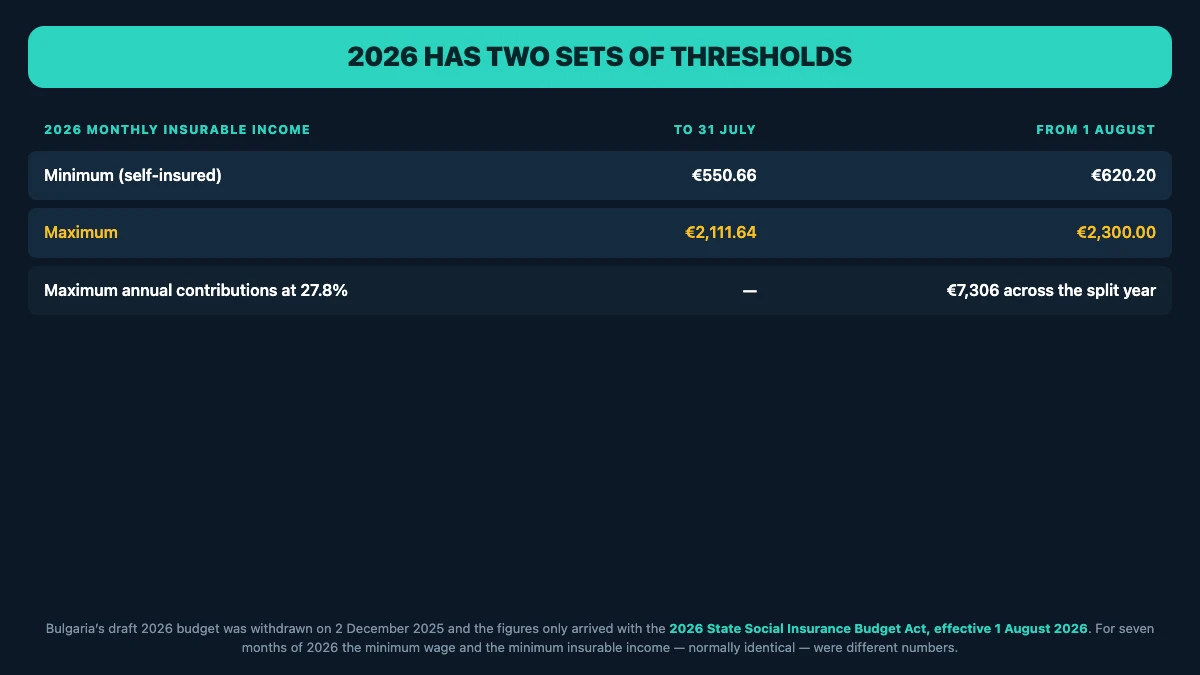
The ceiling and floor are where 2026 gets strange. Bulgaria's draft 2026 budget collapsed: it was withdrawn on 2 December 2025 after the largest protests in years, the government resigned days later, parliament extended the 2025 budget, and the social security figures for 2026 only arrived with the 2026 State Social Insurance Budget Act, effective 1 August 2026. So 2026 has two sets of thresholds:
| 2026 monthly insurable income | To 31 July | From 1 August |
|---|---|---|
| Minimum (self-insured) | €550.66 | €620.20 |
| Maximum | €2,111.64 | €2,300.00 |
| Maximum annual contributions at 27.8% | — | €7,306 across the split year |
The minimum wage went to €620.20 on 1 January while the minimum insurable income stayed at €550.66 until 31 July. For seven months of 2026 those two figures — normally identical — were different numbers, which is a small thing unless you are reconciling a year's contributions, in which case it is the whole calculation.
Freelance registration or an EOOD
Bulgaria's other route is a company: an EOOD paying 10% corporate tax, distributing profit as a dividend taxed at a 5% final withholding tax, with the owner-manager self-insured on a chosen insurable income rather than on the company's profit. That asymmetry — personal contributions tracking revenue, company contributions tracking a choice — is the entire comparison.
| Annual revenue | Freelance registration | EOOD, owner self-insured on the minimum base | Cheaper |
|---|---|---|---|
| €50,000 | €10,326 (20.7%) | €8,903 (17.8%) | EOOD |
| €100,000 | €14,076 (14.1%) | €16,153 (16.2%) | Freelance |
| €200,000 | €21,576 (10.8%) | €30,653 (15.3%) | Freelance |
The crossover sits between €50,000 and €100,000, and it runs the opposite way to the usual intuition. Below it the company wins, because contributions on the minimum base are a fraction of contributions on 75% of revenue. Above it the freelance registration wins, because its contributions are capped at roughly €7,300 while the company's 5% dividend layer keeps scaling with profit. Two layers of 10% and 5% total 14.5% of distributed profit forever; the freelance route's marginal rate past the ceiling is 10%.
Three caveats, because this table is arithmetic and not advice. A manager on a management contract is insured differently from a self-insured owner, and that changes the left-hand column materially. The freelance route is only open to activity that is not trade — the statutory 25% is for free-lance practitioners, and selling goods is a different regime. And an EOOD has accounts, filings and an accountant's fee that a freelance registration does not; at €50,000 the €1,400 saving in the table is roughly one year of that fee.
The permit's no-Bulgarian-clients condition collides with the cheap regime
This is the question I could not settle from outside Bulgaria, and it is the most important one on the page.
The tax arithmetic above describes a registered Bulgarian freelancer: entered in the BULSTAT register, declared as a self-insured person, deducting the 25% under Article 29 and reconciling contributions on the annual return. That is the regime that produces the 26.3%-then-falling curve.
The permit's third category says the holder "does not carry out freelancing activities in Bulgaria", and the second says they do not provide services to persons or entities in Bulgaria. The obvious reading bars Bulgarian clients, not a Bulgarian tax registration — the provision is plainly aimed at keeping permit holders out of the domestic labour market. But it is written broadly, and the English-language reporting does not address it.
So the sequence most readers assume — get the permit, register as a Bulgarian freelancer, pay the capped contributions — is the one nobody has confirmed is available. If it is not, a permit holder who becomes tax resident is taxed on worldwide income at 10% with none of the freelance machinery: a different, in some ways simpler outcome. Put the question to a Bulgarian adviser in writing before you pay a consulate fee. On something this structural, "probably fine" is not a plan.
Tax residency: 183 days, vital interests, and worldwide income
Bulgarian tax residency does not follow the permit — it follows the four statutory tests, and you can trip them without the permit or hold the permit without tripping them.
| Test | What it takes | The catch |
|---|---|---|
| Permanent address | A permanent address in Bulgaria | Only counts if your centre of vital interests is also in Bulgaria |
| 183 days | More than 183 days in any 12-month period | Residency attaches to the calendar year in which the 183rd day falls |
| Centre of vital interests | Personal and economic ties to Bulgaria | Judgemental, and the test that survives clever day-counting |
| Assignment abroad | Sent abroad by a Bulgarian company or the State | Rarely relevant to this audience |
Residents are taxed on worldwide income; non-residents only on Bulgarian-source income. Where a double tax treaty applies, the treaty's residency article overrides the domestic test — which is the provision that matters if you have not cleanly exited your previous country, a problem we covered in tax resident nowhere.
Note the asymmetry in the first two rows. The permit requires proof of accommodation at a Bulgarian address, so the permanent-address test is nearly automatic — yet it does nothing alone, because it needs the centre of vital interests too. The 183 days in any 12-month period is the test that catches people, and the rolling window means a stay straddling two calendar years can produce residency in the year you did not expect.
With a Bulgarian address and a two-year lease, assume you will be tax resident and plan from there. The alternative — holding the permit, staying under 183 days, keeping vital interests elsewhere — is legal, but it makes the 10% irrelevant, since you are then taxed wherever you actually are.
Two years, no permanent residence, and who this fits
Set the pieces side by side and the permit has a narrow, real fit.
It fits a non-EU founder or contractor earning above roughly €75,000 from clients outside Bulgaria who wants a cheap, lawful EU base for a couple of years, inside Schengen, with a 14.1%-at-€100,000 all-in burden that very few EU countries can match. For that person the arithmetic is genuinely good and the two-year ceiling is not fatal, because the plan was never twenty years.
It fits badly for two groups. A freelancer earning €20,000 to €35,000 is the clearest no: 26.3% all-in, no benefit from the flat rate, and the contributions are flat in absolute terms whether you earn €20,000 or €35,000. And anyone whose goal is a passport or permanent residence is in the wrong instrument — one year plus one year, and the published procedure stops there. If accruing residence years is the point, the programmes that actually count them are the subject of digital nomad visas with a path to permanent residency.
The euro changeover is the last thing to carry away. Bulgaria adopted the euro on 1 January 2026 at a fixed and irrevocable €1 = BGN 1.95583, with dual pricing mandatory until 8 August 2026. Every lev figure in older guidance converts at that rate and nothing real changed — but the thresholds that matter here are now denominated in euro, including the €51,130 VAT registration threshold — the euro equivalent of BGN 100,000, and from 2026 monitored on a calendar-year basis. That threshold is going up, but do not plan on a figure: two bills the National Assembly accepted for consideration on 30 April 2026 would set it at €85,000 from 1 January 2027, while a Finance Ministry draft published in September 2026 says €75,000. Neither is law. Treat any BGN figure you find as something to convert, not something to compare.
Related reading
- Digital nomad visas with a path to permanent residency — the programmes where the years actually accrue, which Bulgaria's two-year permit does not.
- Digital nomad visas compared — income thresholds, duration and tax treatment across every major programme in one table.
- Croatia digital nomad visa — the nearest EU comparison, with a tax exemption rather than a flat rate.
- Malta digital nomad visa — 10% flat on a four-year ceiling, the other EU low-rate option.
- Cyprus non-dom — the 60-day residency route and a seventeen-year exemption, for readers whose income is dividends rather than fees.
- Zero-percent tax residencies — where the genuine 0% setups are, and what each one costs in presence.
FAQ
Does Bulgaria have a digital nomad visa in 2026?
Yes. Bulgaria's digital nomad residence permit has been open to applications since 20 December 2025, after the government approved the procedure under the Foreigners in the Republic of Bulgaria Act earlier that month. It is for third-country nationals only — EU, EEA and Swiss citizens do not need it and register their residence directly. The permit runs for one year with the possibility of one further year, so two years is the ceiling.
What is the income requirement for the Bulgaria digital nomad visa?
At least 50 times the Bulgarian monthly minimum wage, measured annually. The 2026 minimum wage is €620.20, so the threshold is €31,010. That is why you will see guides quoting about €27,500 — that is 50 times the 2025 minimum wage of €550.66, and it was the figure in force when applications opened in December 2025. The number moves with the minimum wage, so check it against the current figure rather than any guide's.
Who qualifies for Bulgaria's digital nomad residence permit?
Three categories are defined. An employee of a company registered outside the EU, EEA or Switzerland who works remotely using technology; a member of the management body or an owner of more than 25% of the capital of a company registered outside the EU, EEA or Switzerland; and someone who has provided services remotely for at least a year before applying. The second and third categories carry an explicit condition that you do not provide services to persons or entities in Bulgaria.
Is Bulgaria really a 10% tax country?
The income tax rate is genuinely a flat 10%, but income tax is not the whole bill. A registered freelancer also pays social and health contributions of 27.8% on 75% of revenue, subject to a floor and a ceiling. Run both together and the all-in burden is about 26.3% of revenue up to roughly €35,000, then falls as the contribution ceiling bites: around 14.1% at €100,000 and 10.8% at €200,000. On our arithmetic the headline 10% is not actually reached until about €263,000 of revenue.
Why does the all-in rate fall as income rises in Bulgaria?
Because contributions are capped and income tax is not. Social and health contributions are charged on a monthly insurable income that cannot exceed a published maximum — €2,300 a month from 1 August 2026 — so once 75% of your revenue passes that ceiling, every further euro carries only the 10% income tax. The ceiling is reached at about €35,000 of annual revenue, which is the inflection point in the whole structure.
Does Bulgaria's digital nomad permit lead to permanent residency?
No. The permit is valid for one year and can be extended once, which caps it at two years, and nothing in the published procedure converts it into long-term residence. Anyone wanting to stay longer has to move to a different residence category on its own merits. If a path to permanent residence is the point of the move, this is the wrong instrument.
Will I be taxed on my worldwide income if I move to Bulgaria?
If you become a Bulgarian tax resident, yes — residents are taxed on worldwide income, non-residents only on Bulgarian-source income. You become resident by spending more than 183 days in Bulgaria in any 12-month period, or by having your centre of vital interests there; a permanent address in Bulgaria only makes you resident if your centre of vital interests is there too. A double tax treaty, where one applies, overrides the domestic test.
Is a Bulgarian freelancer registration or an EOOD company cheaper?
It depends on revenue, and the crossover is lower than most people assume. On our arithmetic a company paying 10% corporate tax and 5% dividend tax, with the owner self-insured on the minimum base, is cheaper at around €50,000 of revenue — roughly 17.8% against 20.7%. Above about €75,000 the freelance registration wins, because its contributions are capped while the company's second layer of tax is not: about 14.1% against 16.2% at €100,000.
Sources
- Fragomen — Bulgaria: Digital Nomad Residence Permit Introduced — the 20 December 2025 opening, the three categories, one year extendable once, the Visa D process.
- Bulgarian National Radio — Bulgaria now issues visas for digital nomads — the 50× minimum wage test and the 14-day permit deadline.
- PwC — Bulgaria, individual residence — the four residency tests, the permanent-address qualifier, and the treaty override.
- PwC — Bulgaria, individual income determination — the 10% rate, deductible contributions, 5% dividends (reviewed 2 August 2026).
- PwC — Bulgaria, taxes on corporate income — the flat 10% corporate rate.
- Ruskov & Kollegen — Social security contributions by self-insured persons — the 27.8% and 31.3% rates, the 25%-expenses base, both 2026 thresholds.
- BTA — Social security income thresholds increase from August 1 — €620.20 and €2,300 from 1 August 2026.
- BTA — Cabinet raises minimum wage to EUR 620.20 — BGN 1,213 from 1 January 2026.
- European Commission — Bulgaria adopts the euro — the €1 = BGN 1.95583 rate, dual pricing to 8 August 2026.
- eucrim — Bulgaria and Romania fully join Schengen — Council Decision (EU) 2024/3212, land borders from 2025.
- Bulgarian tax law — Income taxes on liberal professions — Article 29's 25% statutory expenses.
- Bloomberg Tax — Bulgaria Assembly considers bills to increase the VAT registration threshold — the €51,130 threshold and the €85,000 bills of 30 April 2026.
Figures are current as of 13 October 2026. The effective-rate tables apply the 2026 rules to a registered free-lance practitioner born after 1959, self-insured without the general sickness and maternity fund, taking the 25% statutory deduction and no other reliefs, and annualise the insurable floor and ceiling across the 1 August 2026 change — a real return with reliefs, a different birth year or the maternity fund will differ. The EOOD column assumes an owner self-insured on the minimum base with all profit distributed; a management contract differs. The National Revenue Agency's site was unreachable from this session and the guidance I could reach disagrees on whether a fourth-quarter advance instalment exists, so it is left out rather than guessed. The dividend rate here is 5%: the draft 2026 budget would have doubled it, was withdrawn on 2 December 2025, and PwC's August 2026 review still states 5%. This is editorial research, not advice, and whether a permit holder may register as a Bulgarian freelancer belongs with a Bulgarian practitioner.