
Vanuatu's Development Support Programme is the cheapest and fastest citizenship-by-investment route in the world — USD 130,000 for a single applicant, passport in roughly two to four months, no language test, no residency requirement, no interview in Port Vila. The marketing has not changed in a decade. The product has. On 3 March 2022 the EU suspended visa-free Schengen access for Vanuatu passport holders under Council Decision (EU) 2022/366, followed by full suspension on 24 October 2022. The United Kingdom followed on 17 July 2023. The passport that still trades on a "130-plus country" visa-free list now opens roughly 89 countries on the Henley Passport Index, and the Schengen area is not among them.
This guide is for buyers who want the actual 2026 product description, not the pre-2022 sales sheet. It covers what the passport now unlocks, who it makes sense for, how the Development Support Programme actually works, the cost stack, the application path, and the traps — including the cancellation risk that has grown since the suspensions. Primary sources only. No claims that are no longer true.
Henley & Partners — Largest RBI/CBI advisory firm in the world
What a Vanuatu passport actually buys you in 2026
Before March 2022, Vanuatu passport holders had visa-free or visa-on-arrival access to the Schengen area, the United Kingdom, Hong Kong, Singapore, Malaysia, Russia, the United Arab Emirates and most of the Commonwealth — roughly 130 destinations on the Henley Passport Index. That headline travelled with every brochure and is still quoted today. It is no longer accurate.
The current 2026 picture:
- No Schengen visa-free access. The EU Council suspended the EU-Vanuatu short-stay visa waiver agreement under Council Decision (EU) 2022/366 of 3 March 2022, then moved to full suspension under Council Implementing Decision (EU) 2022/2099 of 24 October 2022. Vanuatu nationals now require a Schengen visa to enter any EU Member State.
- No UK visa-free access. The UK Home Office removed Vanuatu from the visa-free list effective 17 July 2023, citing similar due-diligence concerns. Vanuatu citizens now require a Standard Visitor visa to enter the UK (UK Home Office).
- Yes to Hong Kong, Singapore, Malaysia, UAE, Russia. The Asian and Gulf access points remain open, which is where most of the practical value of the passport now sits.
- Yes to most of the Commonwealth Caribbean. Vanuatu is a Commonwealth member, which provides reciprocal short-stay access to a number of Caribbean and Pacific states — but it is not part of CARICOM or any equivalent free-movement zone in the Caribbean.
- Visa-free count: approximately 89 destinations. This is the Henley Passport Index 2026 ranking, down from 130-plus before the suspensions (Henley Passport Index).
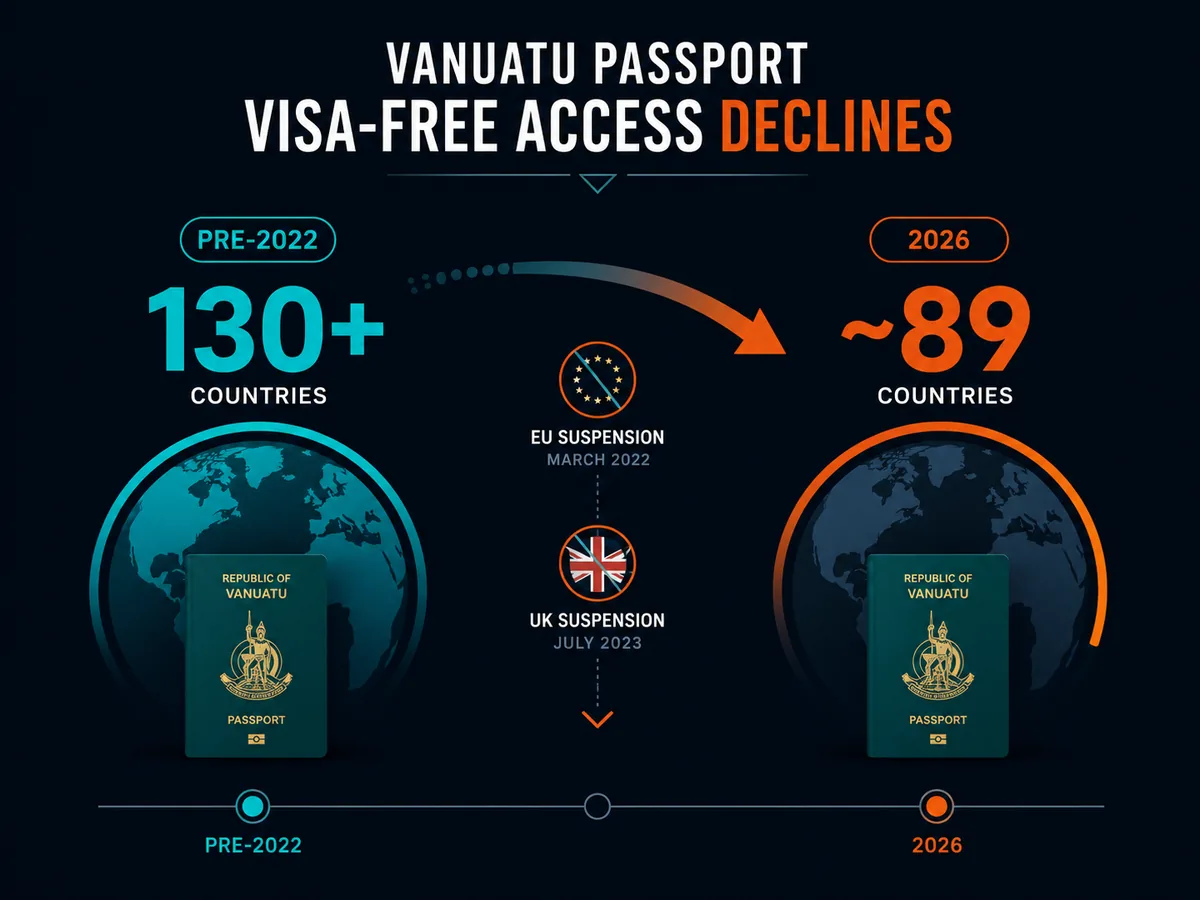
The passport still has uses — they are just narrower than the brochure suggests. The honest framing in 2026: Vanuatu citizenship is a fast, cheap Commonwealth passport with strong Asia-Pacific mobility and weak Western mobility. It is not, and has not been for four years, a back-door route to Schengen.

Who this applies to — read this first
The same Vanuatu passport produces very different practical advice depending on the passport you already hold.
US persons
US persons — citizens and lawful permanent residents — are taxed by the United States on worldwide income regardless of where they live or what additional passports they hold. Acquiring a Vanuatu passport does not change Form 1040, FBAR under FinCEN 114 or Form 8938 obligations. Only formal renunciation does, and renunciation triggers the IRC §877A exit tax for covered expatriates (net worth at or above USD 2 million, or average annual US tax liability above an indexed threshold).
The narrowed visa-free list is less of a problem for US persons than for most other buyers. US citizens already have visa-free access to the Schengen area and the UK on their US passport. The Vanuatu passport adds Commonwealth and Asia-Pacific options — Hong Kong, Singapore, Malaysia, UAE, parts of Africa — that are not strictly necessary but are useful as a Plan B for travel, banking and incorporation. For a US person modelling a future renunciation, Vanuatu's speed makes it one of the few options that can be lined up in months rather than years. See Soveraine's guide to renouncing American citizenship for the §877A modelling.
EU residents
If you already hold an EU passport, Vanuatu is a poor substitute on mobility — your EU passport almost certainly outranks it on the Henley index by 70 to 100 destinations, and the EU passport carries free movement, residence and establishment rights across the bloc that no third-country passport can replicate. See Soveraine's guide to the easiest EU citizenships for the comparison.
There are two scenarios where Vanuatu still makes sense for an EU resident: as a Plan B passport against political or fiscal instability inside the EU, where the speed is the asset; or as part of a broader change of tax residency to a no-tax jurisdiction, where Vanuatu citizenship pairs with Vanuatu residency to break ties with the high-tax EU member state. Even then, exit-tax rules under ATAD and domestic implementations (France, Germany, the Netherlands) apply on departure regardless of which passport you acquire.
Non-US, non-EU readers
This is Vanuatu CBI's primary 2026 market. The typical buyer profile is a businessperson from a jurisdiction with a weak passport (limited mobility), unstable political conditions, or active sanctions exposure on the country of birth, who needs a Commonwealth passport with workable Asia-Pacific access at a price below USD 200,000. For this buyer the EU/UK suspensions are a known constraint, not a deal-breaker, and the alternative Caribbean programmes cost USD 200,000–250,000 minimum with similar tightened due diligence.
Tax planning matters here too. Vanuatu does not tax personal income, but most other countries tax their tax residents on worldwide income. Citizenship alone does not move your tax residency; physical presence and economic ties do. The OECD Common Reporting Standard (CRS) means Vanuatu reports your account information to your country of tax residency regardless of which passport you hold.
The Development Support Programme — the only CBI route
Vanuatu has run several citizenship-by-investment schemes since the 1990s. The current and only operational route in 2026 is the Development Support Programme (DSP), established in 2017 and administered by the Vanuatu Citizenship Office under the supervision of the Citizenship Commission (Citizenship Office of Vanuatu).
A few features of the DSP that distinguish it from Caribbean programmes:
- Donation only. There is no real-estate option, no business-investment option, no government-bond option. The applicant pays a non-refundable contribution into the government's Development Support Programme fund. The simplicity is part of why processing is fast.
- No physical presence required. No requirement to visit Vanuatu before, during or after the application. The oath of allegiance may be administered remotely at a Vanuatu high commission or by an authorised commissioner, including a notary in your country of residence.
- No language test, no investment-management requirement, no interview. Due diligence is documentary.
- Licensed agent required. Direct applications are not accepted. The applicant must engage a licensed Authorized Agent or Designated Agent registered with the Citizenship Office.
- Family applications permitted. Spouse, dependent children up to age 25 (subject to evidence of dependency), parents over 50 and unmarried siblings may be included.
Earlier Vanuatu programmes — the Capital Investment Immigration Plan (CIIP), the Vanuatu Contribution Programme (VCP) and the Vanuatu Economic Rehabilitation Programme (VERP, introduced briefly during the pandemic) — have been consolidated into or superseded by the DSP. Brokers occasionally still advertise these names; assume any reference to a non-DSP route in 2026 is outdated marketing.
Cost breakdown — DSP 2026
The government contribution under the Development Support Programme is set by Vanuatu government regulation and has remained stable in USD terms since 2017:
| Applicant configuration | Government contribution (USD) |
|---|---|
| Single applicant | 130,000 |
| Applicant + spouse | 150,000 |
| Family of 3 (couple + 1 child) | 160,000 |
| Family of 4 (couple + 2 children) | 165,000 |
| Family of 5 (couple + 3 children) | 180,000 |
| Each additional dependant | 25,000 |
On top of the contribution, applicants pay the following:
| Item | Approximate cost (USD) |
|---|---|
| Government processing fee | 5,000 per file |
| Due-diligence fee (per adult applicant) | 7,500 – 10,000 |
| Licensed-agent professional fees | 10,000 – 35,000 |
| Document gathering, apostille, translation | 1,500 – 5,000 |
| Passport issuance fee | 200 per person |
| Bank wire and FX costs | 500 – 2,000 |
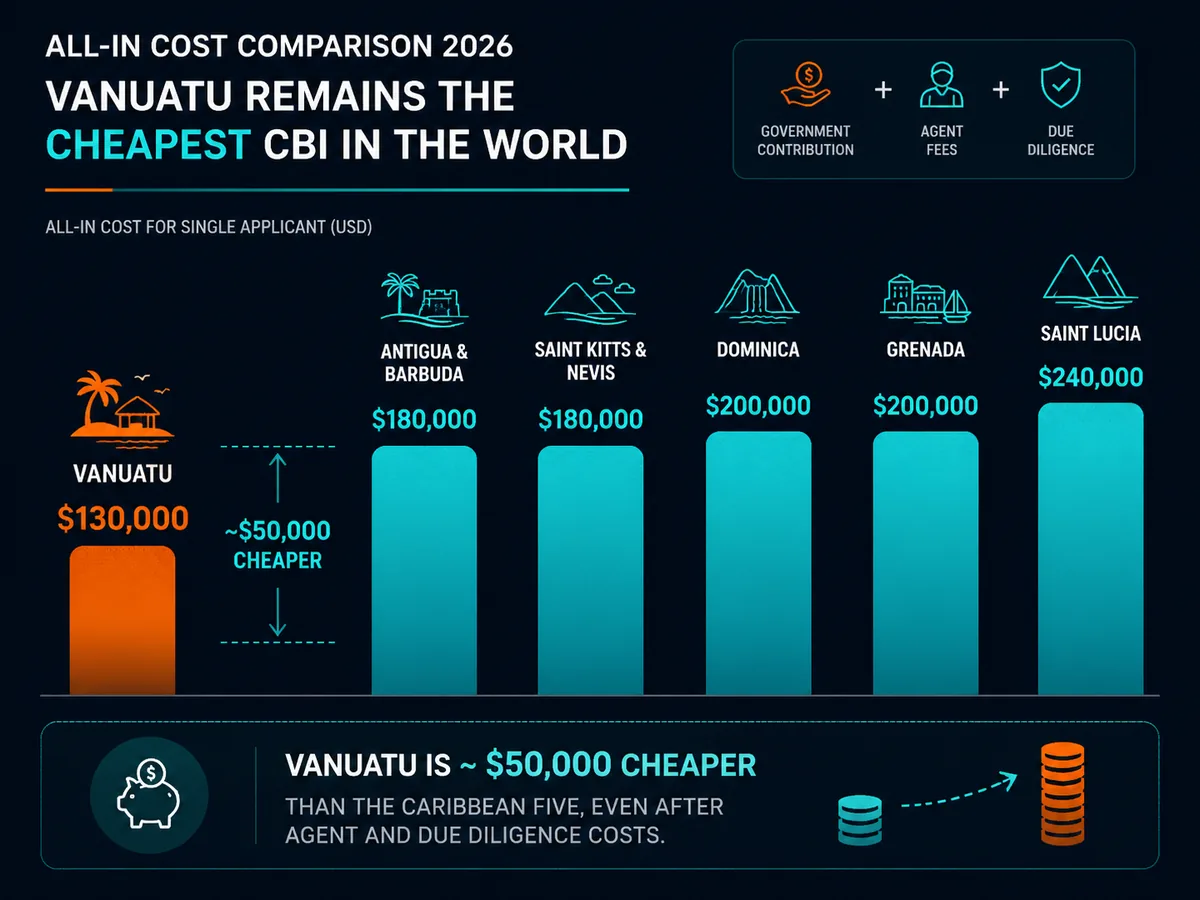
Realistic all-in outlay for a single applicant: USD 145,000–175,000. For a family of four: USD 190,000–235,000. Even at the top of the range, Vanuatu undercuts every Caribbean programme by USD 30,000–80,000 per file.
The application process
The DSP runs as an eight-step process. Realistic end-to-end timing for a clean file is 60–120 days, with the Citizenship Commission's in-principle decision typically issued within 30–60 days of file submission.
- Engage a licensed Authorized Agent. Direct applications are not accepted by the Citizenship Office. A list of licensed agents is maintained by the Office; major international firms operate via licensed local sub-agents.
- Pre-application screening. The agent runs a preliminary KYC and source-of-funds review. PEP status, sanctions exposure, prior visa refusals and criminal history are surfaced now — finding them later means the file is rejected after fees have been paid.
- Document collection. Certified passport copies, police clearance certificates from every country of residence in the prior ten years, medical certificate, evidence of source of funds (typically bank statements, business documents, sale agreements, audited financials), educational certificates, marriage certificates and birth certificates for dependants. All apostilled and where necessary translated into English.
- File submission. The agent submits the complete file to the Vanuatu Citizenship Office. Due-diligence fees are paid at submission.
- External due-diligence review. Vanuatu contracts third-party international due-diligence providers (post-2022 reforms tightened this layer materially). The review typically takes 30–60 days.
- In-principle approval (IPA). The Citizenship Commission issues the IPA letter on completion of due diligence. The applicant then has a defined window (typically 60 days) to pay the government contribution.
- Oath of allegiance. Administered remotely via video link with a Vanuatu high commission or at a notary public/commissioner of oaths in the applicant's country of residence, witnessed and returned to Port Vila.
- Citizenship certificate and passport issuance. The Citizenship Certificate is issued, followed by the biometric passport. The passport is couriered to the agent for delivery to the applicant.
The bottleneck in 2026 is step 5 — due diligence — which has lengthened materially since the EU suspension and is the main reason "two months" has become "two to four months" for most files.
The 2022 EU suspension and the 2023 UK suspension — why
The story behind the lost visa-free access is uncomfortable, well-documented, and the central reason any buyer needs to read past the brochure.
In January 2022 the European Commission published its report assessing Vanuatu's investor citizenship scheme under the EU visa-suspension mechanism of Regulation (EU) 2018/1806. The findings, in summary:
- Vanuatu was granting citizenship to applicants who had been refused visas by EU Member States or who were subject to EU restrictive measures.
- The programme's due-diligence framework was assessed as having "low integrity standards" and was not exchanging adequate information with EU consular authorities.
- Citizenship had been granted to a number of individuals later identified as politically exposed or subject to international criminal investigations.
The Council of the EU adopted Council Decision (EU) 2022/366 of 3 March 2022 partially suspending the EU-Vanuatu short-stay visa waiver agreement. When subsequent reviews did not show sufficient improvement, the Council moved to full suspension under Council Implementing Decision (EU) 2022/2099 of 24 October 2022.

The United Kingdom, post-Brexit, runs its own visa regime and reached the same conclusion. The UK Home Office announced on 19 July 2023 that Vanuatu (and Dominica) would be removed from the visa-free list, citing "clear and evident abuse" of the schemes, including "the granting of citizenship to individuals known to pose a risk to the UK" (UK Home Office announcement, 19 July 2023).
Vanuatu has implemented reforms since — tightening third-party due diligence, raising agent licensing standards, publishing more granular cancellation data, and excluding nationals of additional countries from the programme. Neither the EU nor the UK has yet restored visa-free access. Vanuatu's status remains under periodic review; reinstatement is possible but not on a defined timeline.
Tax in Vanuatu
Vanuatu operates a no-direct-tax regime that is sometimes oversold to CBI buyers.
What Vanuatu does not tax:
- No personal income tax on residents or non-residents.
- No corporate income tax for Vanuatu International Business Companies (IBCs) registered under the International Companies Act.
- No capital gains tax.
- No inheritance or estate tax.
- No wealth tax.
- No withholding tax on most outbound payments.
What Vanuatu does tax: a 12.5% VAT on most goods and services, customs duties, business licence fees, rent tax, stamp duty on land transfers. The fiscal base is consumption and transactions, not income.
Two material caveats every buyer needs to understand:
- Vanuatu is a CRS participating jurisdiction. Vanuatu signed the OECD Multilateral Competent Authority Agreement on Automatic Exchange of Financial Account Information and began first exchanges of CRS data in 2018 (OECD CRS portal). Account information held in Vanuatu financial institutions is reported annually to the tax authority of the account holder's country of tax residency.
- Vanuatu became OECD "compliant" in 2020. The OECD Global Forum on Transparency and Exchange of Information for Tax Purposes upgraded Vanuatu to 'Largely Compliant' in its second-round peer review, but compliance status is reviewed periodically and a regression could trigger blacklisting consequences for Vanuatu-resident financial flows.
The practical takeaway: Vanuatu citizenship plus continued tax residency in a high-tax country produces no tax saving — your home country still taxes your worldwide income, and CRS reporting tells them what's in your Vanuatu accounts. Tax savings require an actual change of tax residency, with physical presence and the breaking of ties, which is a separate legal exercise from acquiring the passport.
Vanuatu vs the Caribbean — what you actually buy
The honest comparison in 2026:
| Programme | Min. cost (single, all-in) | Processing time | Visa-free count 2026 | Physical presence | EU visa-free | Best for |
|---|---|---|---|---|---|---|
| Vanuatu (DSP) | USD 145–175k | 60–120 days | ~89 | None | No (suspended 2022) | Speed, lowest cost, Asia-Pacific mobility |
| Dominica | USD 220–260k | 90–180 days | ~140 | None | Yes | Cheapest Caribbean with EU access |
| St Lucia | USD 260–310k | 120–180 days | ~145 | None | Yes | Government-bond and donation options |
| Antigua & Barbuda | USD 250–300k | 90–180 days | ~150 | 5 days in 5 years | Yes | Family applications, Asia + EU access |
| Grenada | USD 255–305k | 120–180 days | ~145 | None | Yes | China visa-free; US E-2 treaty access |
| St Kitts & Nevis | USD 270–320k (60d AAP available) | 90–180 days (60 days AAP) | ~150 | None | Yes | Speed (AAP), reputational quality |
Sources: each programme's official Citizenship Office or Investment Unit, plus the Henley Passport Index 2026. The five Caribbean programmes signed a 2024 Memorandum of Agreement coordinating minimum prices and due-diligence standards; Vanuatu was not a party to that agreement and continues to undercut on price.
The trade-off is clear and stable: pay more for a Caribbean passport and keep Schengen and UK access; pay less for Vanuatu and accept that the Western visa-free list has been excised. Anyone telling you otherwise has not updated their materials since 2021.
When Vanuatu actually makes sense in 2026
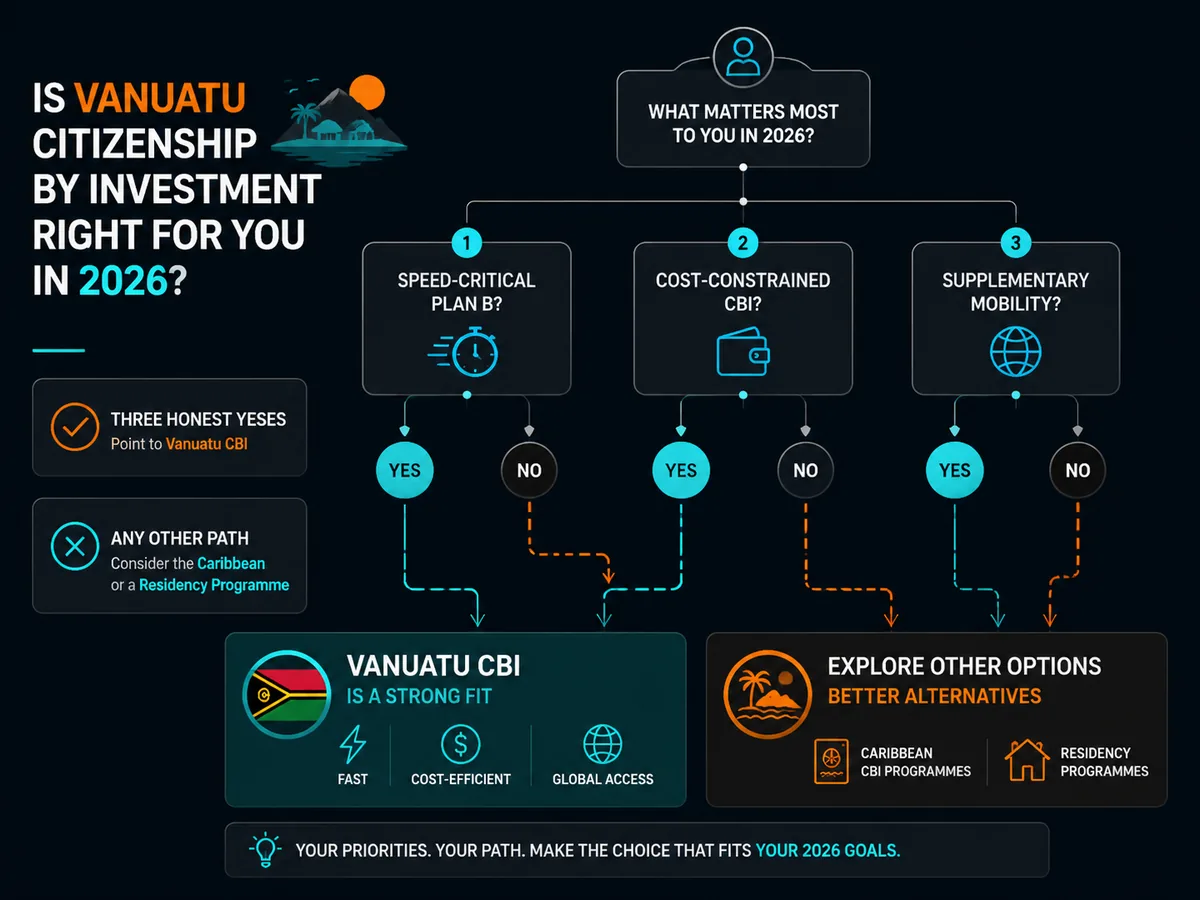
There are three scenarios where Vanuatu is the right answer in the current market:
1. Speed-critical Plan B. A second passport needed in months, not quarters, against deteriorating political or economic conditions at home — and where the primary use case is travel, banking and incorporation in Asia-Pacific rather than Western Europe. The 60–120-day timeline beats every Caribbean alternative except St Kitts' AAP, and Vanuatu is cheaper than the AAP.
2. Cost-constrained CBI buyer. A buyer whose budget tops out around USD 175,000 for a single applicant, who needs a real Commonwealth passport (not a residency dressed up as one), and who does not require EU or UK visa-free access. Vanuatu is the only programme priced at this level after the 2024 Caribbean MoA raised the floor across the five.
3. Supplementary mobility for an already-strong primary passport. A buyer who already holds a US, Canadian, Australian or strong EU passport, for whom the Vanuatu passport is a redundant-but-useful additional document for banking, incorporation, or specific Asia-Pacific business contexts. The narrowed Western visa-free list is irrelevant because the primary passport already covers it.
Vanuatu is not the right answer if:
- The primary goal is EU access — the Caribbean programmes still deliver this; Vanuatu does not.
- The buyer needs a passport that signals reputational quality to a Tier-1 bank's compliance team — Vanuatu has carried added KYC friction in some institutions since the suspensions.
- The buyer is from a jurisdiction excluded from the DSP under Vanuatu's revised list (the Citizenship Commission has periodically updated this list since 2022; current scope is checked at the agent screening stage).
The traps
The visa-free count keeps moving. Vanuatu's visa-free list has been the most volatile of any CBI programme since 2022. Track the current count via the Henley Passport Index quarterly rather than relying on agent brochures. Several countries have followed the EU/UK lead with reciprocal suspensions; others have remained open.
CRS reporting continues regardless. A Vanuatu passport does not break the chain of automatic information exchange. If you remain tax-resident in a CRS-participating country (which is most of the world), your Vanuatu account information is reported back to your tax authority.
OECD blacklist risk. Vanuatu has been on and off the EU's list of non-cooperative jurisdictions for tax purposes and the FATF grey list over the past decade. Inclusion can trigger derisking by international banks, payment-processor restrictions and additional reporting in EU Member States dealing with Vanuatu-source flows. Status changes are published quarterly; check before structuring any meaningful financial activity through Vanuatu.
Cancellation risk has grown. Post-2022 reforms gave the Citizenship Commission an expanded mandate to revisit previously granted citizenships where new information surfaces. Undisclosed PEP status, sanctions exposure, prior visa refusals, criminal convictions or material misstatements on the application are the most common grounds. Cancellation is a published decision; it follows you in any subsequent CBI or visa application elsewhere.
Banks treat the passport differently. Several Tier-1 international banks added Vanuatu to enhanced-due-diligence lists for new account openings post-2022, even where the customer is not a Vanuatu resident. The passport opens fewer doors at private-banking onboarding desks than it did pre-suspension.
When to consult a professional
Before any material action — file submission, contribution wired, source-of-funds documentation drafted — engage three professionals, not one:
- A licensed Authorized Agent or major CBI advisory firm with current Vanuatu Citizenship Office accreditation. The list of licensed agents changed materially after the 2022 reforms; using an unlicensed intermediary is a fast path to a rejected file.
- A cross-border tax advisor in your current country of tax residency, to confirm whether and how Vanuatu citizenship affects your CFC, CRS, exit-tax or domestic reporting position. US persons should add a CPA familiar with FATCA and §877A modelling.
- An immigration lawyer in any jurisdiction where you may eventually use the Vanuatu passport — particularly if you plan to apply for residency, banking or incorporation in a country with elevated due diligence on Vanuatu nationals (most of the EU and UK).
For Soveraine's editorial standards, see our editorial policy and affiliate disclosure. We are paid commission on some of the advisory links in this article; we are not paid by the Vanuatu government, the Citizenship Office, or any specific agent.
Ready to act on this?
Henley & Partners — Largest RBI/CBI advisory firm in the world. Soveraine readers go to the front of the line through our partner link, and you fund independent editorial in the process.
FAQ
How much does Vanuatu citizenship by investment cost in 2026?
The Vanuatu Development Support Programme (DSP) sets the government contribution at USD 130,000 for a single applicant, USD 150,000 for a couple, USD 165,000 for a family of four and USD 180,000 for a family of five, with USD 25,000 per additional dependant. On top of that, applicants pay government processing fees, due-diligence fees per adult (typically USD 7,500–10,000) and licensed-agent fees. Realistic all-in outlay is USD 145,000–200,000 depending on family size and agent. Vanuatu is the cheapest citizenship-by-investment programme in the world.
Is Vanuatu citizenship by investment still the fastest in the world?
Yes, on paper. Vanuatu's DSP is structured to deliver in-principle approval within 30–60 days of a complete file reaching the Citizenship Commission, with passports typically issued in 60–120 days end-to-end. St Kitts & Nevis' Accelerated Application Process is the only programme that competes on speed (~60 days). However, the speed comes at a cost the marketing rarely discloses: the passport now offers materially less visa-free access than the Caribbean alternatives after the EU and UK suspensions of 2022 and 2023.
Does a Vanuatu passport give visa-free Schengen access in 2026?
No. The EU suspended visa-free access for Vanuatu passport holders under Council Decision (EU) 2022/366 of 3 March 2022, followed by full suspension under Council Implementing Decision (EU) 2022/2099 of 24 October 2022. The suspension remains in force in 2026. Any advisor, blog post or brochure still claiming "Schengen visa-free in 30 days" through Vanuatu is repeating a pre-March-2022 claim that is no longer true. Vanuatu passport holders need a Schengen visa like any other third-country national.
What countries can I visit visa-free on a Vanuatu passport?
Per the Henley Passport Index 2026, Vanuatu passport holders have visa-free or visa-on-arrival access to approximately 89 countries, down from over 130 before the 2022 EU suspension and the 2023 UK suspension. The current visa-free list includes Hong Kong, Singapore, Malaysia, the United Arab Emirates, Russia, most Commonwealth Caribbean states, and a number of African and Asian jurisdictions. It does not include the Schengen area, the United Kingdom, the United States, Canada, Australia or Japan.
Why did the EU and UK suspend visa-free travel for Vanuatu passport holders?
The European Commission's report preceding Council Decision (EU) 2022/366 cited "low integrity standards" in the Vanuatu citizenship-by-investment programme, the granting of citizenship to individuals subject to EU restrictive measures or with criminal records, and insufficient information-sharing with EU authorities. The UK Home Office cited similar concerns when it removed Vanuatu from its visa-free list effective 17 July 2023. Vanuatu has tightened due diligence since then, but neither the EU nor the UK has restored visa-free access.
Does Vanuatu citizenship help me legally reduce taxes?
Possibly, but only if you also move tax residency. Vanuatu has no personal income tax, no corporate income tax for the Vanuatu IBC regime, no capital gains tax, no inheritance tax and no wealth tax. However, citizenship alone does not change your tax residency — that is determined by physical presence, centre of vital interests and similar tests in your current country. Vanuatu has been a Common Reporting Standard participating jurisdiction since 2018; account information is automatically exchanged with your home country regardless of your second passport.
Can US persons benefit from Vanuatu citizenship by investment?
Yes, but with limits. The United States taxes citizens and lawful permanent residents on worldwide income regardless of where they live or what other passports they hold. A Vanuatu passport does not change US tax obligations until and unless the holder formally renounces US citizenship, which triggers the IRC §877A exit tax for covered expatriates. The narrowed visa-free list is less of a problem for US persons, who do not need visa-free EU access on their second passport — the Vanuatu passport adds Commonwealth and Asia-Pacific mobility rather than replacing US travel.
Can my Vanuatu citizenship be revoked after issuance?
Yes, in defined circumstances. The Vanuatu Citizenship Act provides for revocation where citizenship was obtained by fraud, false representation or concealment of material facts, or where the holder is subsequently convicted of a serious criminal offence. After the EU and UK suspensions, Vanuatu's Citizenship Commission has been more active in retrospective due-diligence reviews. Undisclosed criminal history, sanctions exposure or politically exposed person (PEP) status that surfaces post-issuance is the most common ground for cancellation.
Sources
- Council of the EU — Council Decision (EU) 2022/366 of 3 March 2022 (partial suspension of EU-Vanuatu visa waiver). https://eur-lex.europa.eu/legal-content/EN/TXT/?uri=CELEX%3A32022D0366
- Council of the EU — Council Implementing Decision (EU) 2022/2099 of 24 October 2022 (full suspension). https://eur-lex.europa.eu/legal-content/EN/TXT/?uri=CELEX%3A32022D2099
- European Commission — Report assessing Vanuatu's investor citizenship scheme under Regulation 2018/1806. https://ec.europa.eu/commission/presscorner/detail/en/IP_22_94
- Regulation (EU) 2018/1806 — EU visa-suspension mechanism. https://eur-lex.europa.eu/legal-content/EN/TXT/?uri=CELEX%3A32018R1806
- UK Home Office — Visa changes for Vanuatu and Dominica (19 July 2023). https://www.gov.uk/government/news/visa-changes-for-vanuatu-and-dominica
- Citizenship Office of Vanuatu — Development Support Programme. http://www.citizenship.gov.vu/
- Vanuatu Investment Promotion Authority — Invest Vanuatu. https://investvanuatu.org/
- Henley & Partners — Henley Passport Index. https://www.henleyglobal.com/passport-index
- OECD — Common Reporting Standard implementation by jurisdiction. https://www.oecd.org/tax/automatic-exchange/crs-implementation-and-assistance/crs-by-jurisdiction/crs-by-jurisdiction-2018.htm
- OECD Global Forum — Transparency and Exchange of Information for Tax Purposes. https://www.oecd.org/tax/transparency/
- Council of the EU — EU list of non-cooperative jurisdictions for tax purposes. https://www.consilium.europa.eu/en/policies/eu-list-of-non-cooperative-jurisdictions/
- FATF — Black and grey lists. https://www.fatf-gafi.org/en/countries/black-and-grey-lists.html
- IRC §877A — Tax responsibilities of expatriation. https://www.law.cornell.edu/uscode/text/26/877A
- FinCEN — Report of Foreign Bank and Financial Accounts (FBAR). https://www.fincen.gov/report-foreign-bank-and-financial-accounts
- EU Anti-Tax Avoidance Directive (ATAD), Directive 2016/1164. https://eur-lex.europa.eu/legal-content/EN/TXT/?uri=celex%3A32016L1164