
The best-ranking English guide to the Romania micro company tax quotes a revenue ceiling of €500,000. That ceiling stopped existing on 1 January 2025, was replaced by €250,000 for one year, and since 1 January 2026 has been €100,000 — a fifth of the figure the page was updated to in June 2026. The same guide prices dividends at 8%; the rate has been 16% since January. Those two numbers are the whole basis of its headline "effective rate of about 14.7%", so the most polished page on this subject is wrong in its first table and wrong in its conclusion.
That matters more than a stale fact usually does, because the ceiling fell far enough to push ordinary freelancers out. A consultant billing €120,000 sat comfortably inside the 2025 threshold and is outside today, and the penalty for crossing is not a few percentage points — it is a switch to the 16% profit tax from the quarter you cross, with no way back in.
We built this from the professional and official sources rather than the guides: PwC's Romania summaries, EY's note on Law 141/2025, Accace's reading of the ordinances, and the European Commission's SME VAT portal. Where the ranking pages disagree with those, we say so and show the arithmetic.
Key takeaways
- The ceiling is €100,000, not €250,000 or €500,000. It is tested on revenue at 31 December 2025, and at the BNR year-end rate of 5.0985 lei that is about 509,850 lei.
- There is now one rate: 1%. Emergency Ordinance 89/2025 removed the 3% band from 1 January 2026, so qualifying IT and HoReCa companies pay 1%, not 3%.
- Dividends cost 16%, up from 10%, on distributions from 1 January 2026 under Law 141/2025 — plus a tiered health contribution of 2,430, 4,860 or 9,720 lei.
- All-in, a fully distributed €100,000 costs about 18.7% of revenue on our figures. The same company on profit tax pays about 31.3%.
- The ceiling is a cliff. To match the net income of a €100,000 micro-company, a company on profit tax needs about €117,900 of revenue — nearly 18% more turnover to stand still.
Wise — a Romanian SRL bills in EUR or USD and reports in lei, and the €100,000 ceiling is measured after that conversion, so the rate you convert at is part of the test
What actually changed on 1 January 2026
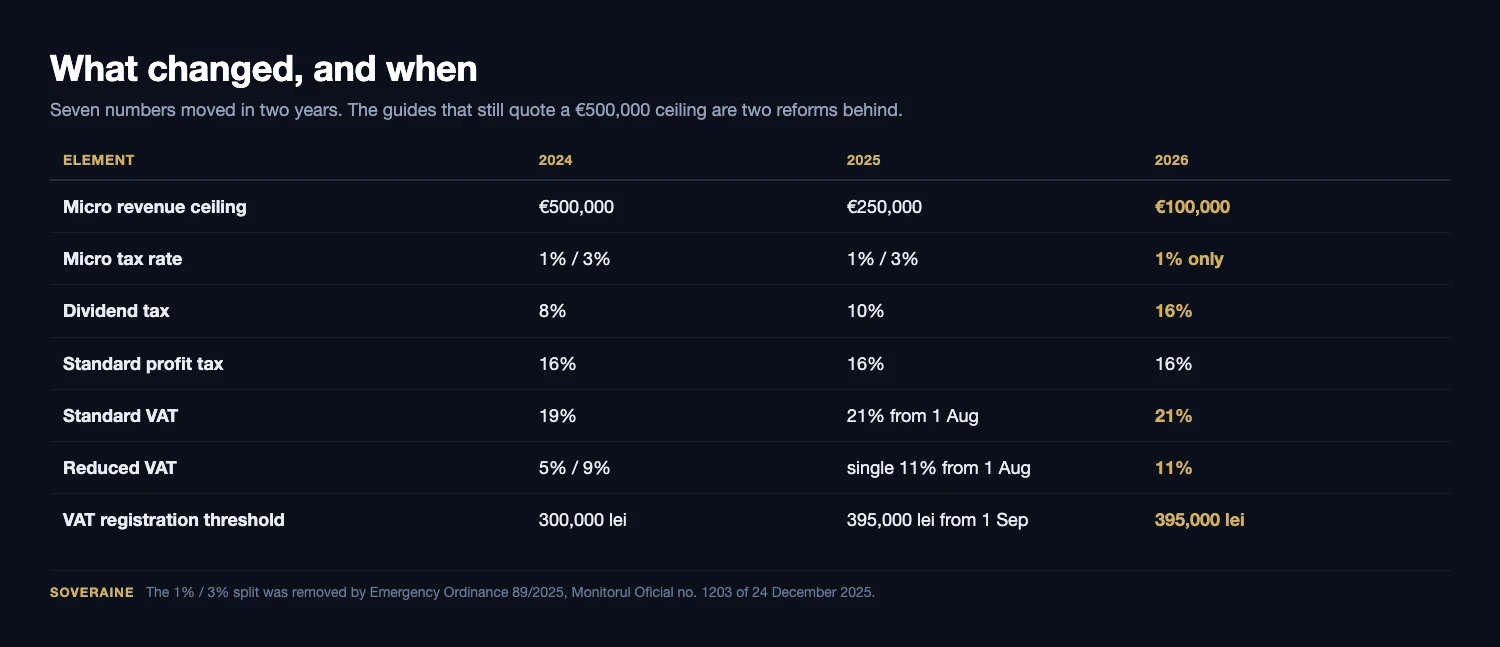
Three things moved at once, and they pull in different directions. The revenue ceiling fell to €100,000. The 3% rate disappeared, leaving a single 1%. And the dividend rate went from 10% to 16%, which is where most of the money is.
The dividend increase did not arrive with the 2026 ordinance at all — it was enacted in July 2025 by Law 141/2025, published in Monitorul Oficial on 25 July 2025, and timed to bite on distributions from 1 January 2026. That is why guides updated in mid-2025 can look current and still be wrong: the law was already on the books, waiting.
| Element | 2024 | 2025 | 2026 |
|---|---|---|---|
| Micro revenue ceiling | €500,000 | €250,000 | €100,000 |
| Micro tax rate | 1% / 3% | 1% / 3% | 1% only |
| Dividend tax | 8% | 10% | 16% |
| Standard profit tax | 16% | 16% | 16% |
| Standard VAT | 19% | 21% from 1 Aug | 21% |
| Reduced VAT | 5% / 9% | single 11% from 1 Aug | 11% |
| VAT registration threshold | 300,000 lei | 395,000 lei from 1 Sep | 395,000 lei |
Read that as one policy: Romania kept the headline 1% that gets it onto every low-tax list, then narrowed who can reach it while raising the cost of taking the money out. The 1% is still real — it is just attached to a much smaller box.
The €100,000 ceiling, and how it is measured
The threshold is not a running total you watch during the year for the current year's eligibility. For 2026 it is tested against your revenue as at 31 December 2025, so the question of whether you are a micro-company this year was settled before the year began.
The conversion matters and is easy to get wrong, because the ceiling is set in euro and your accounts are in lei. The BNR reference rate on 31 December 2025 was 5.0985 lei to the euro, which puts the ceiling at about 509,850 lei — our arithmetic, not a published figure, so treat it as the approximate line rather than the statute.
| How the ceiling works | The rule |
|---|---|
| Amount | €100,000 (was €250,000 for 2025, €500,000 before) |
| Date tested | Revenue as at 31 December 2025 |
| Conversion | Rate in force at the close of the 2025 financial year |
| Approximate lei equivalent | ~509,850 lei at 5.0985 (our calculation) |
| Whose revenue counts | The company plus its related enterprises |
| Whose revenue counts (again) | Combined with related enterprises, so a second SRL buys no second allowance |
| If exceeded during the year | Profit tax from that quarter, with no return to the regime |
The related-enterprise rule is the one that catches founders. The test looks at the combined revenue of your company and its affiliates, so incorporating a second SRL and splitting invoices between them does not buy you a second €100,000. The staged reduction from €500,000 was set by Emergency Ordinance 156/2024, published at the very end of December 2024, which is why the €250,000 year surprised people too.
One rate now: what happened to the 3%
From 2025, Romania taxed some micro-companies at 3% rather than 1% based on their activity code — 6210 and 6290 for custom software development and other IT services, and 5611, 5612 and 5622 for restaurants, mobile food service and catering. Emergency Ordinance 89/2025, published in Monitorul Oficial no. 1203 of 24 December 2025, removed that band.
So the Romania micro company tax is now a flat 1% of revenue for everyone who qualifies, and a Romanian software company inside the ceiling has had its rate cut by two-thirds. It is the only change in this round favouring the taxpayer, and the one stale guides get right by accident — they were describing a 1% rate before the 3% band existed.
| Activity | 2025 rate | 2026 rate |
|---|---|---|
| General trades and services | 1% | 1% |
| Software development, IT services (6210, 6290) | 3% | 1% |
| Restaurants, catering (5611, 5612, 5622) | 3% | 1% |
One more condition quietly went the other way in 2025 and is worth knowing because old guides still warn about it: the rule disqualifying companies that earned more than 20% of revenue from consultancy and management was removed with effect from 1 January 2025. Consultants are no longer shut out of the regime by the nature of their work. They are shut out, increasingly, by the size of it.
The conditions you have to keep meeting
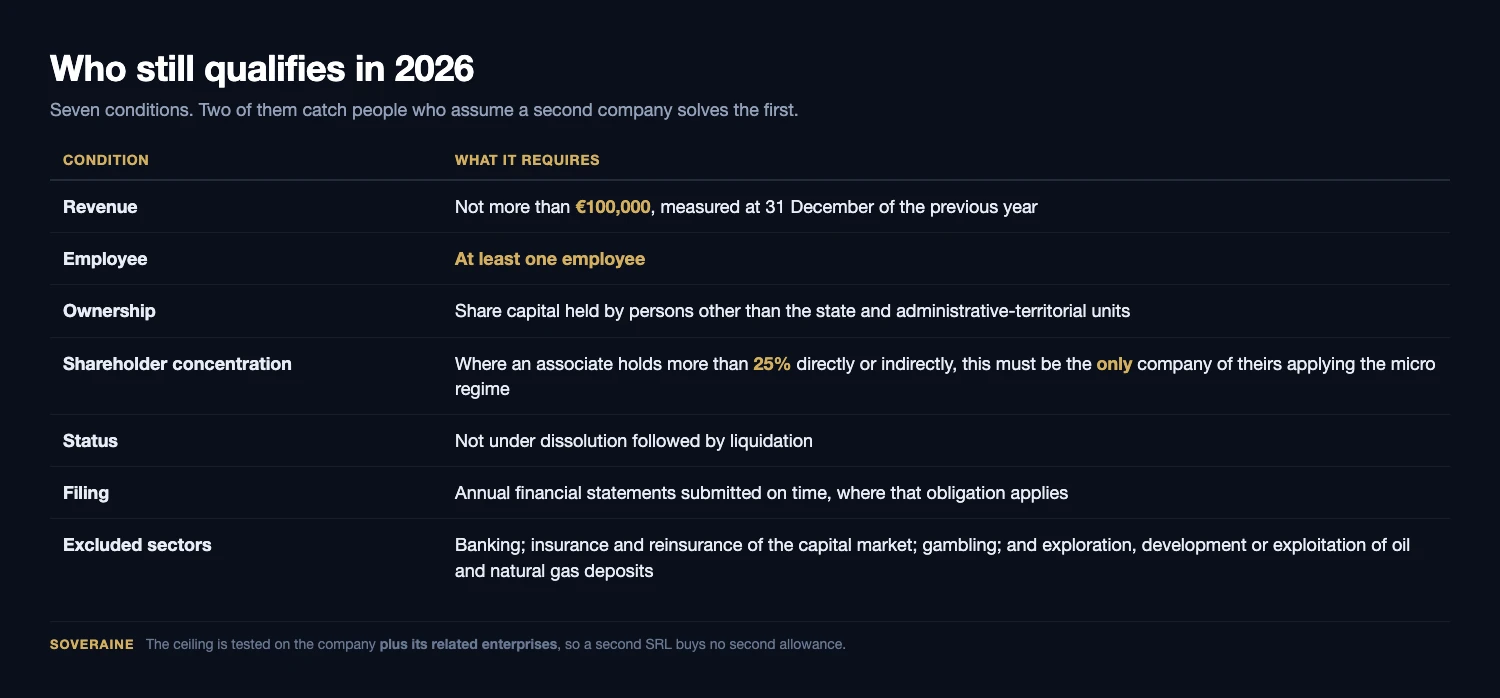
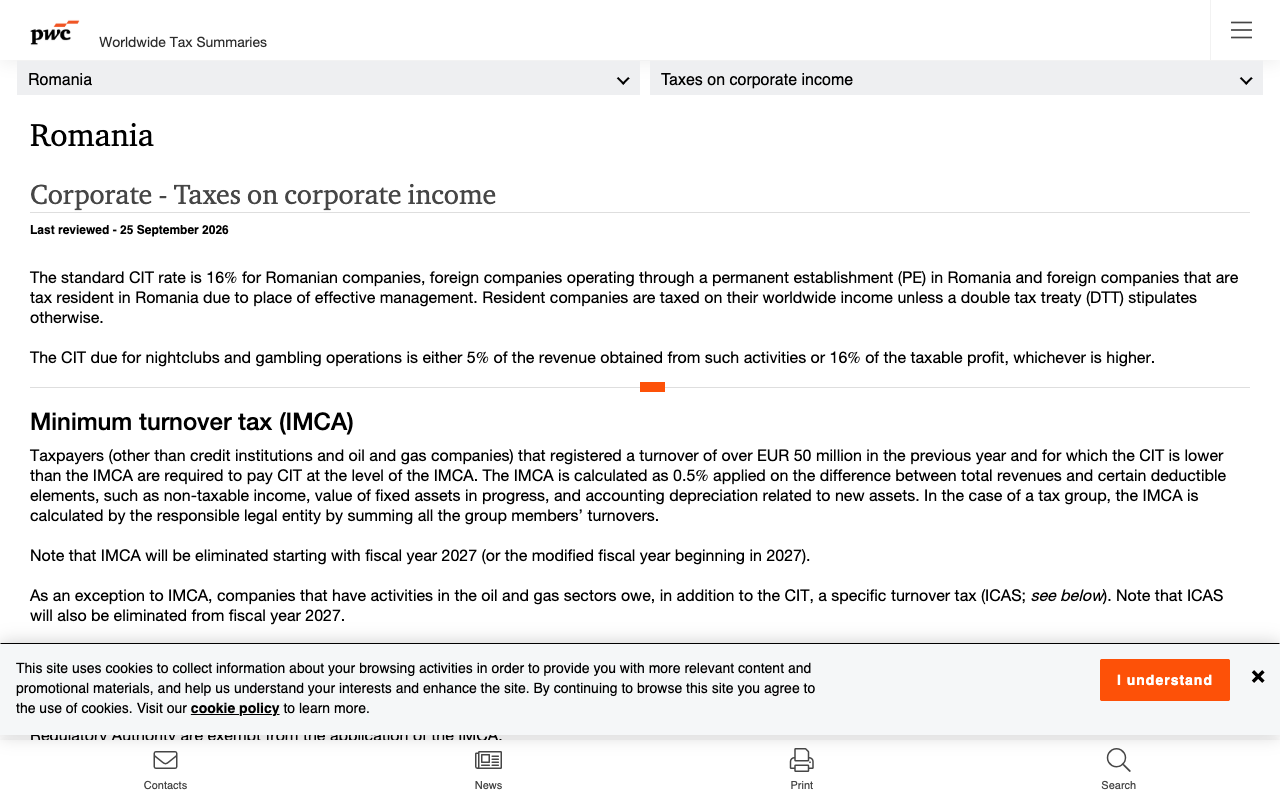
Qualifying is not only about revenue. PwC's summary sets out the conditions a company must meet cumulatively as at 31 December of the previous year, and breaching the revenue limit moves you to profit tax from that quarter.
| Condition | What it requires |
|---|---|
| Revenue | Not more than €100,000, measured at 31 December of the previous year |
| Employee | At least one employee |
| Ownership | Share capital held by persons other than the state and administrative-territorial units |
| Shareholder concentration | Where an associate holds more than 25% directly or indirectly, this must be the only company of theirs applying the micro regime |
| Status | Not under dissolution followed by liquidation |
| Filing | Annual financial statements submitted on time, where that obligation applies |
| Excluded sectors | Banking; insurance and reinsurance of the capital market; gambling; and exploration, development or exploitation of oil and natural gas deposits |
The employee condition is the one with a cash cost attached, and it is the reason a Romanian SRL is not a zero-overhead structure in the way a US LLC can be. Exactly how it can be satisfied — whether an administrator's mandate contract counts, and what happens in a gap between employees — is the detail where the English-language guides diverge most, and it is in the "could not verify" list below rather than in this table.
Dividends at 16%, and the health contribution nobody mentions
The company-level tax is the part everyone quotes and the smaller half of the bill. Getting money from the company to you costs 16% of the gross dividend from 1 January 2026, and for companies with a non-calendar financial year it applies from the first day of the modified tax year beginning in 2026 — EY gives the worked example of a year ending 30 June 2026, where the new rate starts on 1 July 2026.
There is a transitional rule worth knowing if you distributed early: dividends paid on interim 2025 financial statements stay at 10%, and there is no later adjustment once the annual statements are finalised.
On top of the 16% sits a health insurance contribution, CASS, which neither of the guides ranking for this term mentions at all. It applies to a combined pool of non-salary income — dividends, interest, rent, securities gains — and it is tiered rather than proportional. For 2026 the thresholds are built on the January minimum gross salary of 4,050 lei:
| Non-salary income in the year | Contribution base | CASS at 10% |
|---|---|---|
| Below 6 minimum salaries (24,300 lei) | None | 0 lei |
| 6 to 12 minimum salaries (24,300–48,600 lei) | 24,300 lei | 2,430 lei |
| 12 to 24 minimum salaries (48,600–97,200 lei) | 48,600 lei | 4,860 lei |
| 24 minimum salaries or more (97,200 lei+) | 97,200 lei | 9,720 lei |
Because the base is capped at 24 minimum salaries, CASS behaves as a flat charge for most founders rather than a percentage. 97,200 lei is about €19,064, so anyone distributing more than roughly €19,100 in a year pays the top figure of 9,720 lei — about €1,906 — and pays exactly the same whether they distribute €20,000 or €200,000. It is regressive in effect: a small distribution carries it as a real percentage, a large one barely notices it.
One caveat on the minimum wage, because it moved mid-year. The gross minimum rose from 4,050 lei to 4,325 lei on 1 July 2026, but the CASS thresholds for the 2026 income year are set on the January figure, which is why PwC's summary — reviewed in September 2026, after the increase — still gives 24,300 lei.
The all-in arithmetic
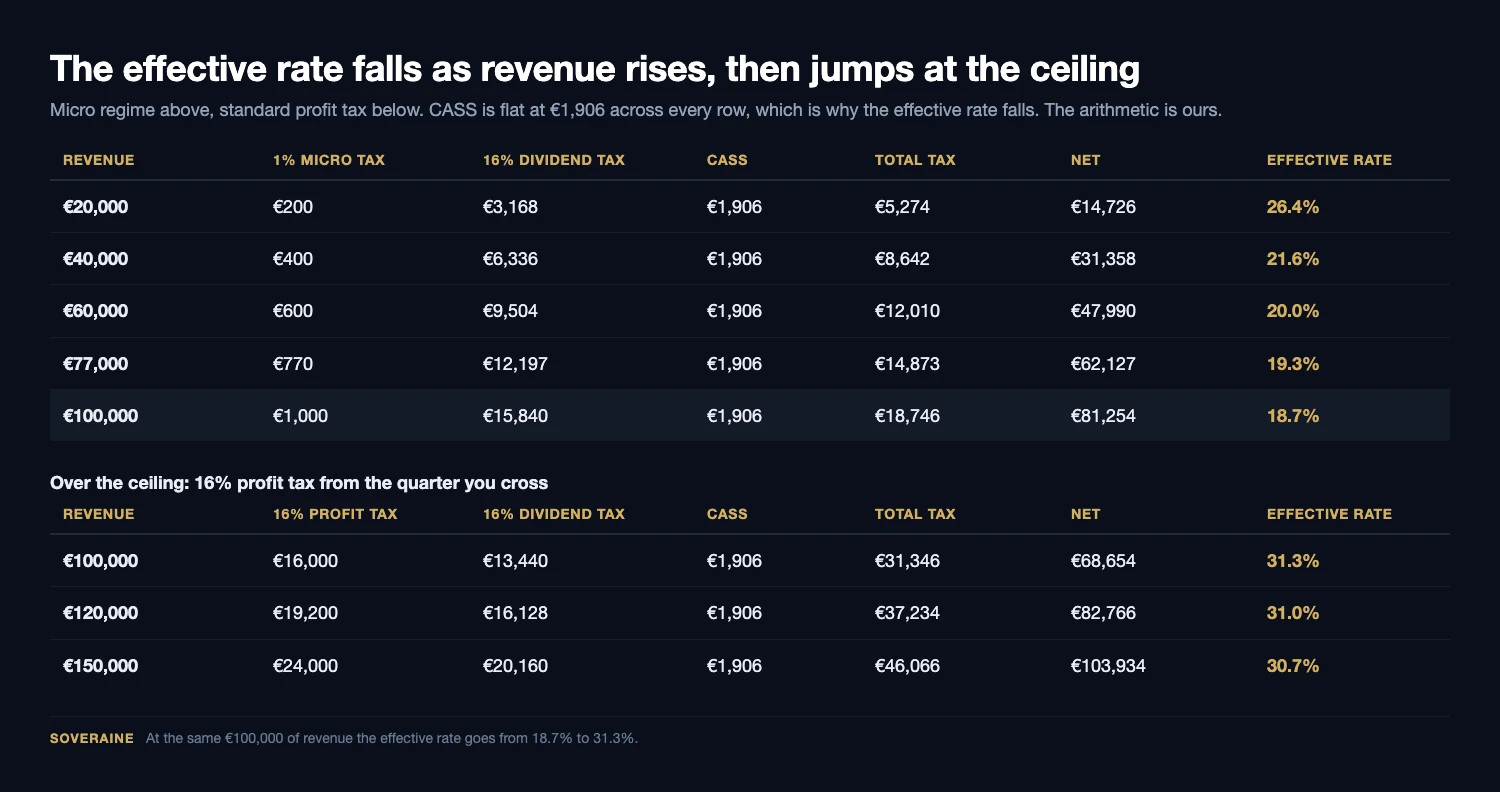
Here is what the three layers come to together. The assumptions are deliberately simple and stated so you can disagree with them: a high-margin service company with negligible deductible costs, every euro of post-tax revenue distributed as a dividend, conversions at 5.0985 lei, and the cost of meeting the employee condition excluded because 2026 payroll rates are outside what we verified for this piece. These are our calculations, not published figures.
| Revenue | 1% micro tax | 16% dividend tax | CASS | Total tax | Net | Effective rate |
|---|---|---|---|---|---|---|
| €20,000 | €200 | €3,168 | €1,906 | €5,274 | €14,726 | 26.4% |
| €40,000 | €400 | €6,336 | €1,906 | €8,642 | €31,358 | 21.6% |
| €60,000 | €600 | €9,504 | €1,906 | €12,010 | €47,990 | 20.0% |
| €77,000 | €770 | €12,197 | €1,906 | €14,873 | €62,127 | 19.3% |
| €100,000 | €1,000 | €15,840 | €1,906 | €18,746 | €81,254 | 18.7% |
Two things fall out of that table. The all-in rate is roughly 19%, not the 1% of the headline or the 14.7% of the best-ranked guide — the dividend layer is where the tax actually is, and at 16% it is now larger than the company-level tax by a factor of fifteen. And the effective rate falls as revenue rises, from 26.4% at €20,000 to 18.7% at €100,000, because the flat CASS charge is spread over more income. Romania's regime is cheapest exactly at the ceiling, which is what makes the ceiling so sharp.
For comparison, the same company on the standard 16% profit tax:
| Revenue | 16% profit tax | 16% dividend tax | CASS | Total tax | Net | Effective rate |
|---|---|---|---|---|---|---|
| €100,000 | €16,000 | €13,440 | €1,906 | €31,346 | €68,654 | 31.3% |
| €120,000 | €19,200 | €16,128 | €1,906 | €37,234 | €82,766 | 31.0% |
| €150,000 | €24,000 | €20,160 | €1,906 | €46,066 | €103,934 | 30.7% |
The cliff at the ceiling
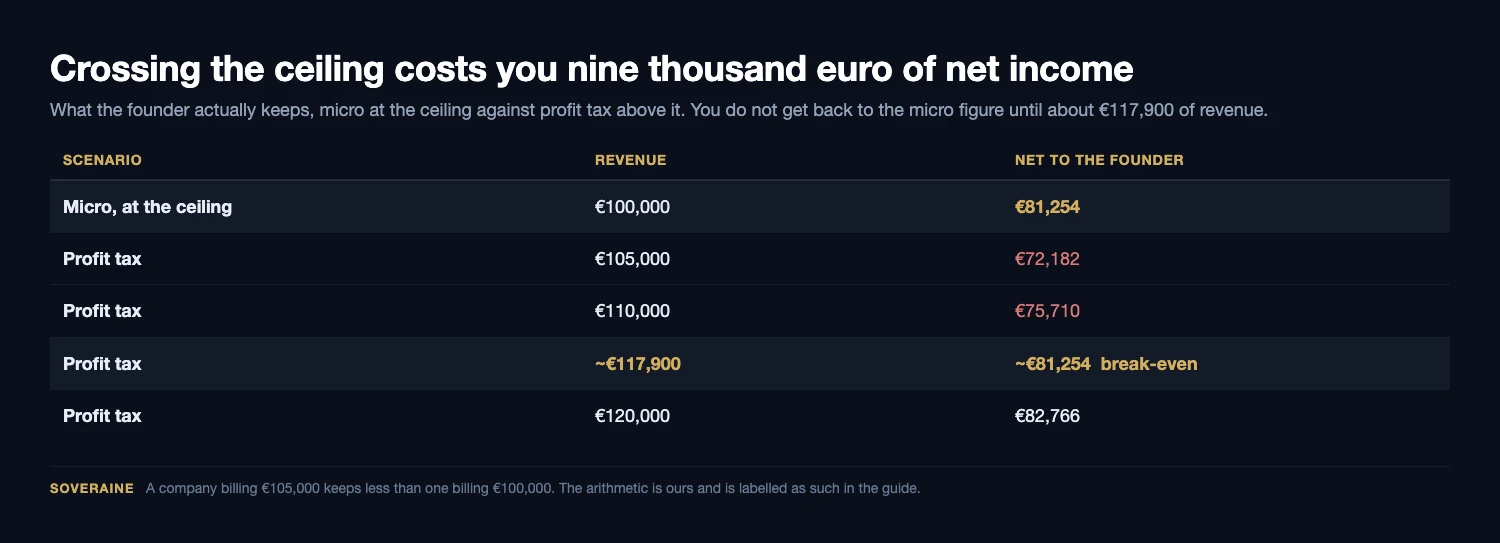
Those two tables are the argument for watching the €100,000 line closely, because the gap between them is not marginal. A €100,000 micro-company keeps about €81,254. A company on profit tax has to bill about €117,900 to keep the same amount — nearly 18% more revenue to stand still.
Put the other way: growing from €100,000 to €120,000 of revenue, and losing the regime in the process, adds €20,000 of turnover and about €1,512 of net income. That is a marginal effective rate of roughly 92% on the extra work.
| Scenario | Revenue | Net to the founder |
|---|---|---|
| Micro, at the ceiling | €100,000 | €81,254 |
| Profit tax | €105,000 | €72,182 |
| Profit tax | €110,000 | €75,710 |
| Profit tax | ~€117,900 | ~€81,254 — break-even |
| Profit tax | €120,000 | €82,766 |
Two qualifications keep this honest. The switch takes effect from the quarter in which you cross, not for the whole year, so the first year's damage is smaller than the table implies. And the exclusion is lasting — Accace's reading of the ordinances is that there is no return to the regime in later periods — so the recurring cost is the one that matters, and the table is the right picture of year two onward.
The practical reading is that the regime rewards staying small deliberately and punishes drifting over the line by accident: if you are heading for €110,000, you are better off at €100,000 or at €130,000 and worst off in between. EU flat-rate regimes behave the same way at their own boundaries — the Czech zivno visa runs the same arithmetic, where cost jumps from 12.0% to 20.1% of revenue across one threshold.
The VAT line nobody draws
Here is an interaction both reachable competitors miss, and it is now unavoidable. Romania's VAT registration threshold is 395,000 lei, raised from 300,000 lei with effect from 1 September 2025 and confirmed on the European Commission's own SME VAT portal. At 5.0985 lei that is about €77,474.
That figure is below the €100,000 micro ceiling. So there is a band — roughly €77,500 to €100,000 of revenue — in which you are simultaneously a 1% micro-company and a VAT-registered business charging 21%. Before 2026 the two thresholds were far apart and the overlap was a detail. Now the top fifth of the micro band is VAT territory by definition.
| VAT item | Before | Now |
|---|---|---|
| Registration threshold | 300,000 lei | 395,000 lei (from 1 Sep 2025) |
| Approximate euro equivalent | ~€58,800 | ~€77,474 |
| Standard rate | 19% | 21% (from 1 Aug 2025) |
| Reduced rates | 5% and 9% | single 11% (from 1 Aug 2025) |
| Non-established businesses | No threshold | No threshold |
| EU distance selling | €10,000 | €10,000 |
Selling services to VAT-registered business customers elsewhere in the EU, this is mostly administrative, since those supplies are typically reverse-charged. Selling to consumers, it is a 21% change in gross price or a 21% cut in margin. Either way it is not optional at the top of the micro band.
Do you have to live in Romania?
No — and this is the distinction that does the most damage when it is blurred. Owning a Romanian SRL and being tax resident in Romania are two different things, and the 1% applies to the company, not to you.
A non-resident shareholder is taxed on the dividend where they are resident, with the Romanian 16% withholding reduced or credited under the applicable treaty. Own a Romanian company while living elsewhere and your country of residence may also have a claim on its profits through place-of-effective-management or controlled-foreign-company rules — covered in company structures and zero tax. That is the ordinary consequence of running a company from a country it is not registered in.
If you do intend to move, three things on the Romanian side are worth knowing, and all three are recent. Romania is now a full Schengen member, including land borders, so time spent there counts against the Schengen 90/180 rule rather than sitting outside it. Romania's US totalization agreement came into force on 1 September 2026, making it the thirty-first country on the SSA's list — relevant to any American weighing self-employment tax, and covered in our totalization agreement guide. And for comparison within the region, Bulgaria's 10% flat tax reaches a similar place by a completely different route, with no revenue ceiling to fall off.
What we could not verify
Four things are deliberately absent from the tables above, and a guide that gives you confident numbers for them is guessing.
The cash cost of the employee condition. A real, recurring cost that scales with the minimum wage, which moved twice in 2026. We did not verify 2026 Romanian payroll contribution rates against a primary schedule, so there is no payroll line in our arithmetic and the effective rates above are floors, not totals.
The fine print of the employee condition. "At least one employee" is clear; whether an administrator's mandate contract satisfies it, and how long a vacancy is tolerated, is not. The English-language guides contradict each other and we reached no primary schedule, so it is absent from the conditions table above.
An official lei figure for the ceiling. The euro ceiling is the one that is legislated. The ~509,850 lei above is our own multiplication at the BNR year-end rate of 5.0985.
Accounting and formation fees. Widely quoted at a few hundred euros a month, with no primary schedule behind the figures. Ask two Romanian accountants and use their quotes.
Whether any of this survives 2027. Romania has changed this regime in each of the last three years, in ordinances published in the last days of December. Check the current Fiscal Code before acting on any number here, including ours.
Related reading
- Czech zivno visa — the closest comparison: a flat-rate regime with the same band-edge arithmetic.
- Bulgaria digital nomad visa — 10% flat, no revenue ceiling, and the obvious regional alternative.
- Estonian e-residency — the other EU route founders compare this with, and a different answer to the distribution question.
- Company structures and zero tax — where a Romanian SRL sits among the structures, and the CFC rules that constrain all of them.
- Totalization agreement — Romania joined the list on 1 September 2026, which changes the social security maths for Americans.
- Cyprus non-dom — the comparison for anyone whose plan depends on dividends rather than salary.
FAQ
What is the micro-company tax rate in Romania in 2026?
A single 1% of revenue. The 1%/3% split that ran through 2025 was removed by Emergency Ordinance 89/2025, published in Monitorul Oficial no. 1203 of 24 December 2025, so from 1 January 2026 there is one rate for every qualifying company regardless of its CAEN code. PwC's Romania summary, last reviewed 25 September 2026, states it plainly: the tax rate on micro-company revenues is 1%.
What is the revenue threshold for a Romanian micro-company in 2026?
EUR 100,000, tested against revenue as at 31 December 2025. It was EUR 250,000 for 2025 and EUR 500,000 before that, and the staged reduction was set by Emergency Ordinance 156/2024. Accace notes the threshold is checked on the combined revenue of the company and its related enterprises, so a founder with two Romanian companies cannot split revenue across them to stay under the line.
Did Romania abolish the 3% micro-company rate?
Yes, from 1 January 2026. The 3% rate had applied from 2025 to companies in specific CAEN codes — 6210 and 6290 for software and IT services, and 5611, 5612 and 5622 for restaurants and catering. Emergency Ordinance 89/2025 removed it, which means a Romanian software company that qualifies now pays 1% rather than 3%. That is the one change in this round that moves in the taxpayer's favour.
How much tax do you pay on dividends from a Romanian SRL in 2026?
16% withholding on the gross dividend, up from 10%, under Law 141/2025 published in Monitorul Oficial on 25 July 2025. It applies to dividends distributed from 1 January 2026 and to residents and non-residents alike, subject to treaty relief and the Parent-Subsidiary Directive. Dividends distributed on interim 2025 financial statements stay at 10% with no later adjustment. A tiered health contribution can apply on top.
Do you need an employee to qualify as a micro-company?
Yes — PwC's Romania summary lists 'has at least one employee' among the conditions a company must meet cumulatively as at 31 December of the previous year. That is the condition we can state with confidence. How it can be satisfied in practice — whether an administrator's mandate contract counts, and how long a gap between employees is tolerated — is described differently by different English-language guides, and we did not reach a primary schedule for it, so confirm it with a Romanian accountant before relying on either answer.
What happens if you exceed the €100,000 threshold mid-year?
You move to the 16% profit tax from the quarter in which you exceeded it, not from the following January. PwC puts it directly: a micro-company deriving revenues of more than EUR 100,000 owes corporate income tax as of the quarter in which it exceeded the limit. Accace's reading of the ordinances adds that there is no return to the micro regime in later periods, so the exclusion is lasting rather than a one-year penalty.
Do you have to live in Romania to own a Romanian SRL?
No. Owning the company and being tax resident in Romania are separate questions, and the second one is the expensive one to get wrong. A non-resident shareholder is taxed on the dividend where they are resident, subject to the treaty, and running the company from another country can give that country a claim over its profits through place-of-effective-management or permanent-establishment rules. Take advice before assuming the 1% is the end of the story.
Is this legal or tax advice?
No. This is editorial research read from PwC's Romania tax summaries, EY's note on Law 141/2025, Accace's summary of the 2026 changes and the European Commission's SME VAT portal, and Soveraine sells no tax or company-formation services. The arithmetic here is ours and is clearly labelled as such. Eligibility, VAT status and residence all turn on your own facts, so take advice from a Romanian tax adviser before you file.
Sources
- Romania — Corporate — Taxes on corporate income — PwC, reviewed 25 September 2026: the 1% micro rate, the EUR 100,000 threshold, the one-employee condition and the 16% standard CIT rate.
- Romania — Individual — Other taxes — PwC: the CASS tiers for 2026 — the 6-minimum-salary trigger at 24,300 lei and the 6/12/24 contribution bases at 10%.
- Romanian tax changes introduced by new fiscal and budgetary measures — EY on Law 141/2025 (Monitorul Oficial, 25 July 2025): dividends from 10% to 16%, the modified-fiscal-year rule, the interim-2025 transition, VAT to 21% and the single 11% reduced rate.
- New legislative changes introduced in Romania starting 2026 — Accace: the staged ceiling under GEO 156/2024, the single 1% rate under EO 89/2025, and the removal of the 20% consultancy condition.
- Romania SME VAT rules — European Commission: the national VAT registration threshold of 395,000 lei.