
Every English guide to the Czech zivno visa budgets 156,500 CZK for the bank test and then goes quiet on the number that decides what you keep. A freelancer in the Czech flat-rate regime pays 9,984 CZK a month in 2026 and that single payment settles income tax, pension and health insurance on revenue up to a million crowns — and of the two highest-ranking English guides we read, neither mentions the regime at all, while one still quotes a 7% solidarity surcharge that was replaced by the 23% rate back in 2021. That gap is the whole article: the Czech zivno visa (zivnostenske opravneni, the trade-licence route) is a cheap permit attached to one of the cheapest tax regimes in the EU, and almost nobody writes the second half.
We built this from the primary documents rather than the guides — the Financni sprava, the Ministry of Labour and Social Affairs, a Czech consular document list and the Ministry of Foreign Affairs fee schedule. Where they disagree with each other or with the guides, we say so.
Key takeaways
- 156,500 CZK is a calculation, not a fixed fee. It is 50 x the existential minimum of 3,130 CZK, which survived the October 2026 changes unchanged even though the zivotni minimum rose to 5,500 CZK. Guides quoting 149,000 CZK are quoting an older base.
- The flat-rate regime is the actual prize. Band one is 9,984 CZK a month for 2026 — 3,306 health, 6,578 pension and 100 CZK of income tax. That is 1,200 CZK of income tax for the year.
- The band is set by your expense rate, not just your income. Ordinary trades carry a 60% rate, which stretches band one to 1.5m CZK of income instead of 1m.
- The regime rewards the top of a band. All-in cost runs 12.0% of revenue at the top of band one but 20.1% just inside band two — the same money, a different band.
- The visa is not the permit that reaches PR. The long-term visa runs up to a year; permanent residence generally needs five years of continuous residence plus Czech at A2.
Wise — a zivno freelancer invoices in EUR or USD and files in CZK, so the conversion spread is a real line in the budget above
What the zivno visa actually is, and what it is not
There is no Czech visa called a digital nomad visa. The permit freelancers use is a long-term visa for the purpose of business (podnikani), and the thing that qualifies you for it is a Czech trade licence. The consular document lists are explicit about this: the accepted proof of purpose is an extract from the Trade Register (vypis z zivnostenskeho rejstriku) or the Commercial Register (vypis z obchodniho rejstriku). A remote-work contract with a foreign employer is not on the list.
That distinction changes what you become. You are admitted as a Czech sole trader — an osoba samostatne vydelecne cinna, OSVC — with Czech registration, insurance and filing obligations from the start. Many nomad visas keep you outside the local system; this one puts you inside it deliberately, which is why the tax regime below is available to you at all.
| Route | What qualifies you | Where you sit in the tax system |
|---|---|---|
| Czech long-term visa for business (zivno) | Czech trade licence, via a Trade or Commercial Register extract | Inside it: a Czech sole trader from day one |
| A typical nomad visa elsewhere | Foreign employment or client contracts | Often deliberately outside the local regime |
| Czech employee card | A Czech employer and a registered vacancy | Inside it, but as an employee, not a trader |
So the useful comparison is not against other nomad visas but against Europe's other freelance-residency routes — the Netherlands DAFT visa and the German freelance visa.
The 156,500 CZK funds test, and where that number comes from
The bank test for a business-purpose application is CZK 156,500. The reason guides disagree about it — 149,000 is the figure you will see most often — is that it is not a fixed sum. It is 50 times the existential minimum, and the Czech Consulate General in Los Angeles states it as "CZK 156,500" off a monthly minimum of "CZK 3,130".
We checked the base rather than trusting the arithmetic. The Ministry of Labour and Social Affairs puts the existencni minimum at 3,130 CZK a month, and 50 x 3,130 = 156,500. That mattered in 2026: the government reworked the minima from 1 October and the zivotni minimum for a single person rose from 4,860 to 5,500 CZK, while the existential minimum did not move. A guide assuming both rose would have the bank test wrong today.
| Element of the funds test | What the consular list says |
|---|---|
| Amount required (business purpose) | CZK 156,500 |
| How it is derived | 50 x the existential minimum of CZK 3,130/month |
| Account types accepted | Current or savings accounts |
| Account types refused | Credit accounts |
| Accepted evidence | Notarised copy of an international debit card in your name plus a matching statement, or the notarised card copy plus an original bank letter confirming you can use the funds, with a certified Czech translation |
| Language exemption | Proof of funds is the one document that need not be in Czech |
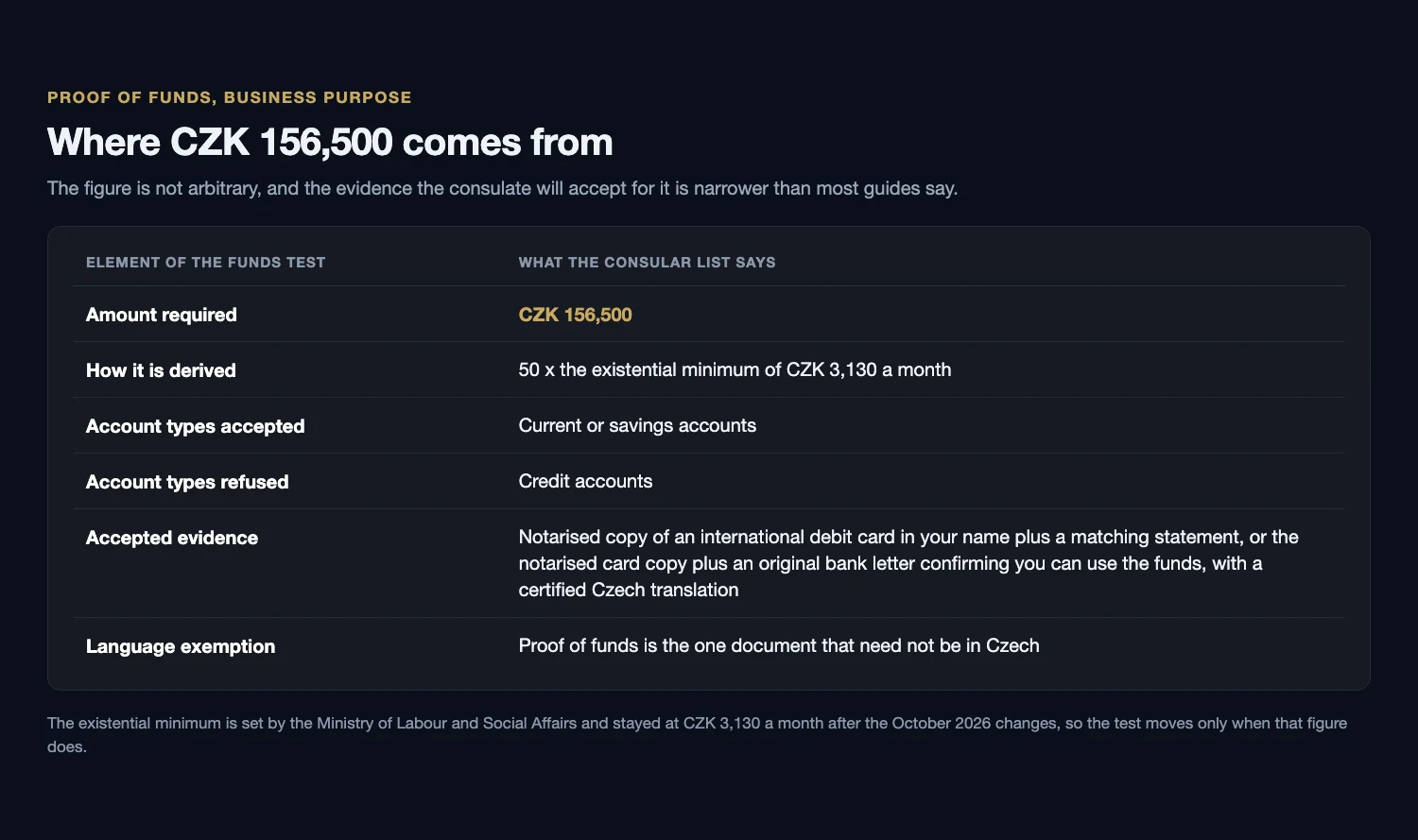
Two things follow. The amount moves whenever the existential minimum is re-set, so check any figure — including this one — against the current regulation. And this is a balance test, not an income test: there is no monthly salary threshold in the business category, which is why the "€2,710 a month" figure circulating on nomad sites matches nothing in the consular list.
The document set, and the 180-day trap
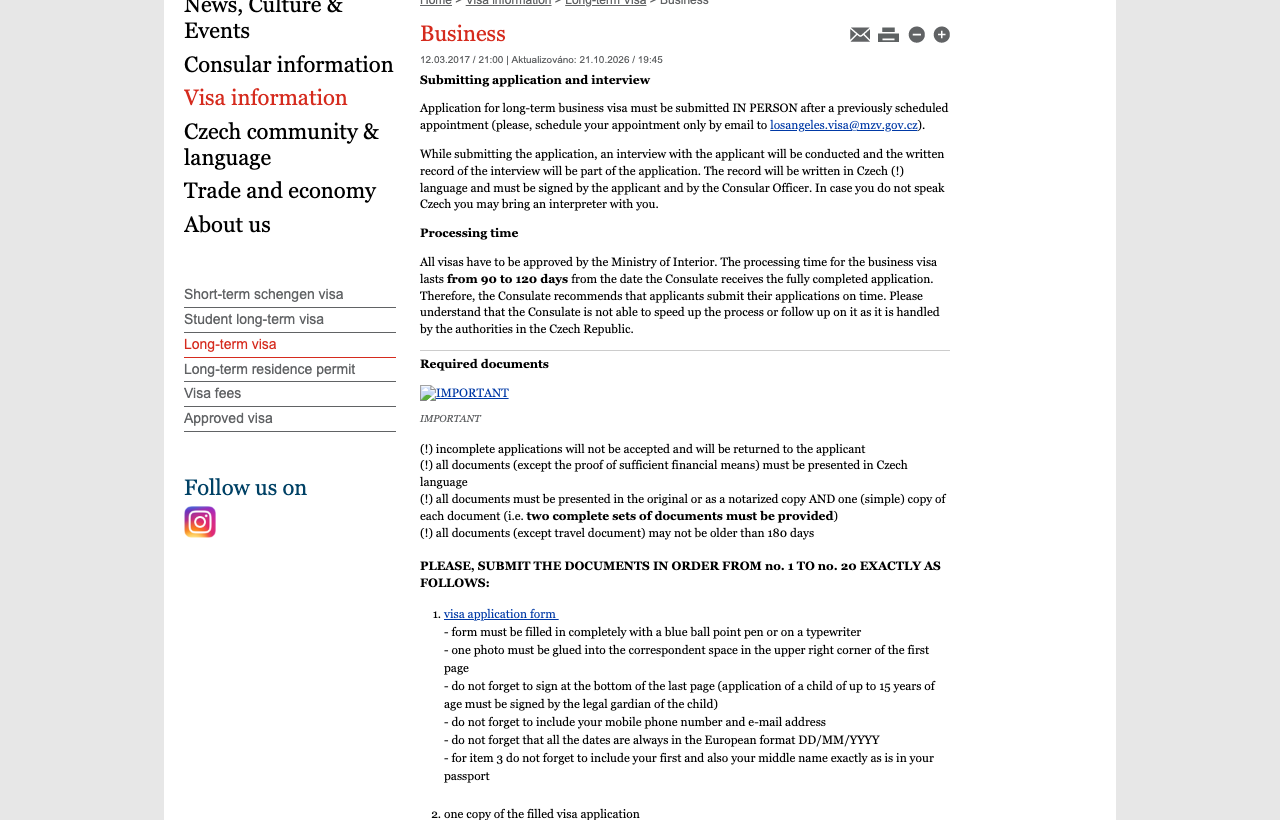
The consular lists are unusually prescriptive, and the single most expensive detail is a deadline nobody flags. Every document except your passport must be no more than 180 days old. Police certificates and bank letters bite hardest: get the criminal record check first, spend ten weeks on translation and legalisation, and you can arrive at the appointment with an expired certificate.
Three further rules shape the pack. Documents must be in Czech, with proof of funds the stated exception. You must bring originals or notarised copies plus one simple copy of each — two complete sets. And incomplete applications are returned, not held open for you to supplement.
The accommodation document is where most self-prepared applications fail. It has to be a notarised confirmation from the owner, or a lease or sub-letting agreement, in Czech — which means securing Czech housing from abroad before you have any right to live there. The criminal-record requirement has a second limb that catches long-term nomads specifically: if you have lived abroad for six months or more in the past three years, you need a criminal record extract from that country too, legalised or apostilled, with a certified Czech translation. For anyone who has been moving on tourist entries under the Schengen 90/180 rule, that can mean certificates from two or three jurisdictions at once.
Comprehensive travel medical insurance valid in the Czech Republic is required for stays over 90 days, and proof of it is demanded before the visa is affixed rather than at submission — so it is the last item, not the first.
Fees and the 90-to-120-day clock
The fee is small and the wait is not. The Czech government's service page puts the long-term visa fee at CZK 2,500, payable in EUR, USD or local currency, carried in the Ministry of Foreign Affairs schedule as item 144A. One caveat: that schedule also shows a higher business-category item at CZK 5,000, which is probably why guides quote "2,500 to 5,000" — confirm the amount with the post you apply to.
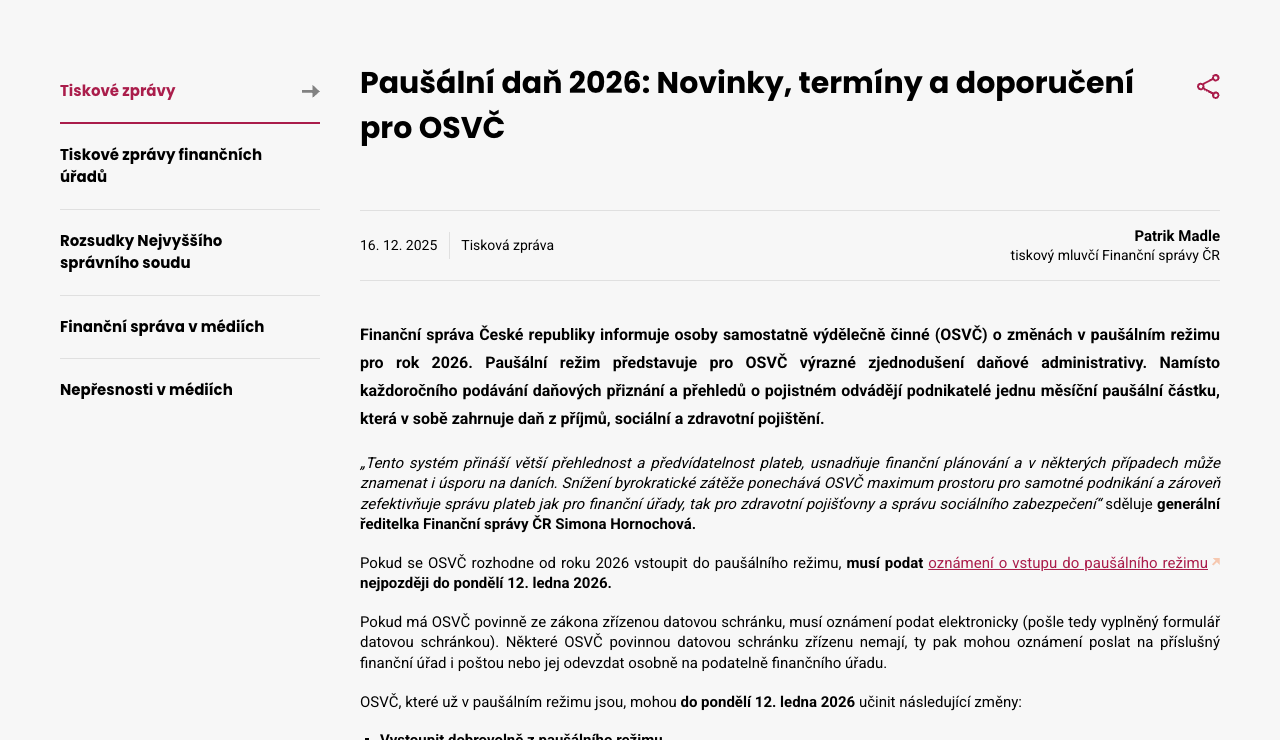
On timing, the Ministry of the Interior decides business applications within 90 days, and consulates quote 90 to 120 days from receipt of a complete application. The fee is not refunded if the visa is refused.
| Line item | Amount / duration | Source quality |
|---|---|---|
| Long-term visa application fee | CZK 2,500 | Official (government service page, item 144A) |
| Business-category fee item | CZK 5,000 | Appears in the MFA schedule; reconcile with your consulate |
| Statutory decision period (business) | 90 days | Official |
| Consular quote, complete file to decision | 90–120 days | Official (consular page) |
| Funds that must sit in the account | CZK 156,500 | Official |
| Refund on refusal | None | Official |
Translation, legalisation, the trade-licence fee and insurance premiums are real costs that the guides price confidently, but we reached no primary schedule for any of them — so they sit in the "not verified" section below rather than in a budget table sourced from nothing.
Pausalni dan 2026: the number both competitors skip
Here is the regime that makes the whole route worth the paperwork, and that neither of the two best-ranking English guides mentions. The flat-rate regime lets a sole trader replace income tax, pension insurance and health insurance with a single monthly payment. No annual tax return, no insurance statements, no expense records to defend.
The Financni sprava set the 2026 payments as follows. Band one rose this year because the minimum insurance advances rose; bands two and three are unchanged from 2025.
| Band (pasmo) | Total per month | Income tax | Pension insurance | Health insurance | Annual total |
|---|---|---|---|---|---|
| Band I | CZK 9,984 | CZK 100 | CZK 6,578 | CZK 3,306 | CZK 119,808 |
| Band II | CZK 16,745 | CZK 4,963 | CZK 8,191 | CZK 3,591 | CZK 200,940 |
| Band III | CZK 27,139 | CZK 9,320 | CZK 12,527 | CZK 5,292 | CZK 325,668 |
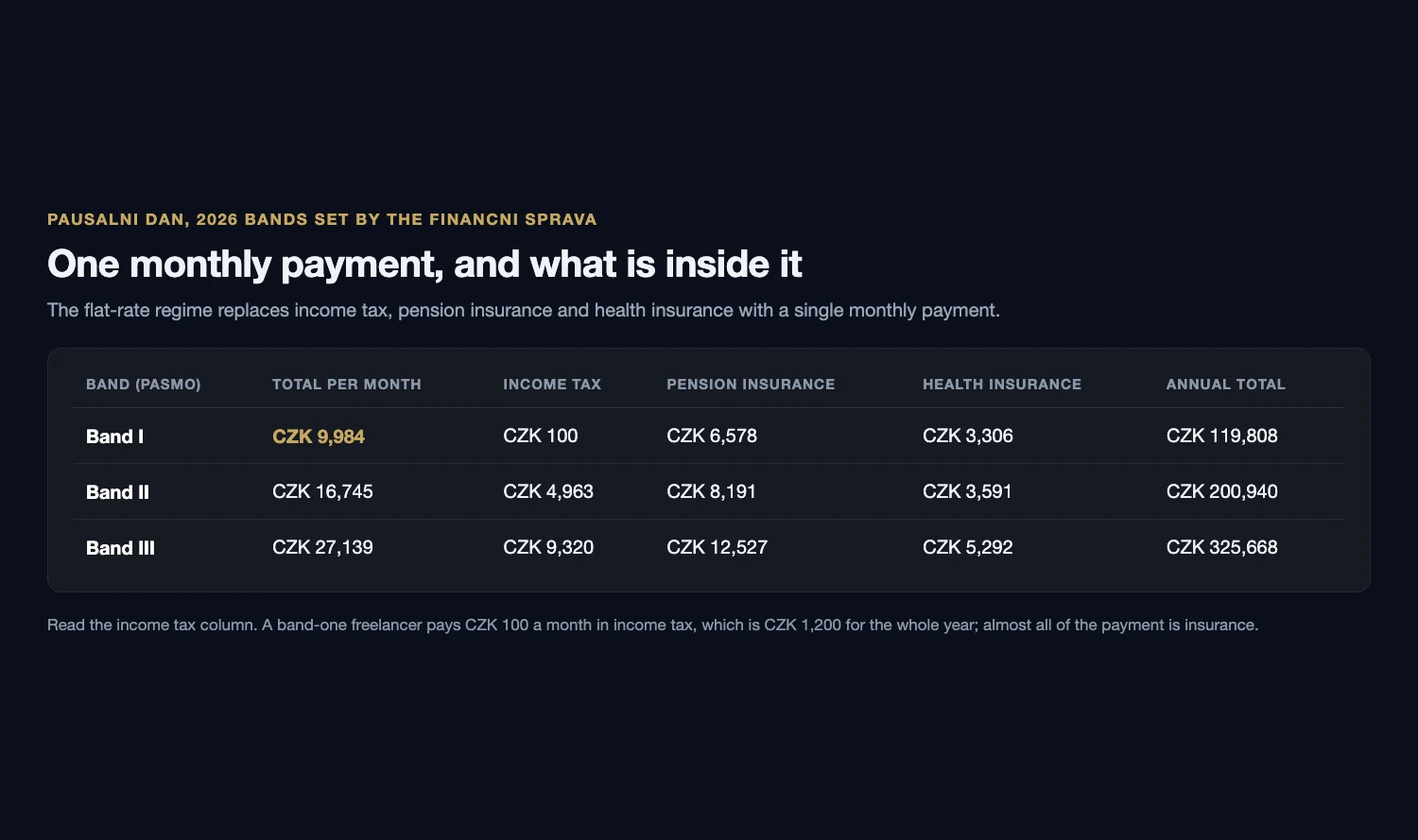
Read the income tax column again. A band-one freelancer pays CZK 100 a month of income tax — 1,200 CZK for the entire year. Effectively the whole payment is insurance: health insurance at exactly the statutory minimum of 3,306 CZK, and pension insurance at the minimum uplifted by 15%, which is where the 6,578 comes from. The cross-check holds: 6,578 / 1.15 = 5,720, the minimum monthly pension advance reported for 2026.
The entry conditions are narrow and worth reading before you plan around any of it. Income from self-employment up to CZK 2 million. You must not be a VAT payer and must have no obligation to register, with identified persons as the exception. Employment income disqualifies you unless it is taxed by withholding at source. The notification for the 2026 period was due by 12 January 2026 — so a trade licence opened this month is aiming at the 2027 period, not this one. If you become a VAT payer mid-year you leave the regime from the month registration takes effect, and you have 15 days to tell the tax office if you stop meeting any condition.
Which band you land in — the 60% expense rate decides
This is the counter-intuitive part, and it is why a consultant earning 1.4m CZK can sit in the cheapest band while someone earning less does not. Band placement is not an income ladder: the Financni sprava sets only upper limits, and they stretch depending on the lump-sum expense rate attached to your activity.
| Band | Income limit, any activity | Stretches to | On what condition |
|---|---|---|---|
| Band I | CZK 1m | CZK 1.5m | ≥75% of income from activities at the 80% or 60% expense rate |
| Band I | — | CZK 2m | ≥75% of income from activities at the 80% rate |
| Band II | CZK 1.5m | CZK 2m | ≥75% of income from activities at the 80% or 60% rate |
| Band III | CZK 2m | — | No condition; this is the catch-all |
The expense rates themselves decide everything: 80% for crafts, agriculture, forestry and water management; 60% for other trades; 30% for rent of business property; 40% for other self-employment income. Most of the people reading this — developers, designers, consultants, marketers operating on an ordinary trade licence — sit at 60%, which means band one runs to 1.5m CZK, not 1m.
Now the arithmetic the official tables skip. Because each band is a flat annual sum, all-in cost as a share of revenue depends on where in the band you sit:
| Revenue | Band | Annual payment | All-in cost |
|---|---|---|---|
| CZK 1,000,000 | I | CZK 119,808 | 12.0% |
| CZK 1,500,000 | I (at 60% rate) | CZK 119,808 | 8.0% |
| CZK 1,000,001 | II | CZK 200,940 | 20.1% |
| CZK 1,500,000 | II | CZK 200,940 | 13.4% |
| CZK 2,000,000 | III | CZK 325,668 | 16.3% |
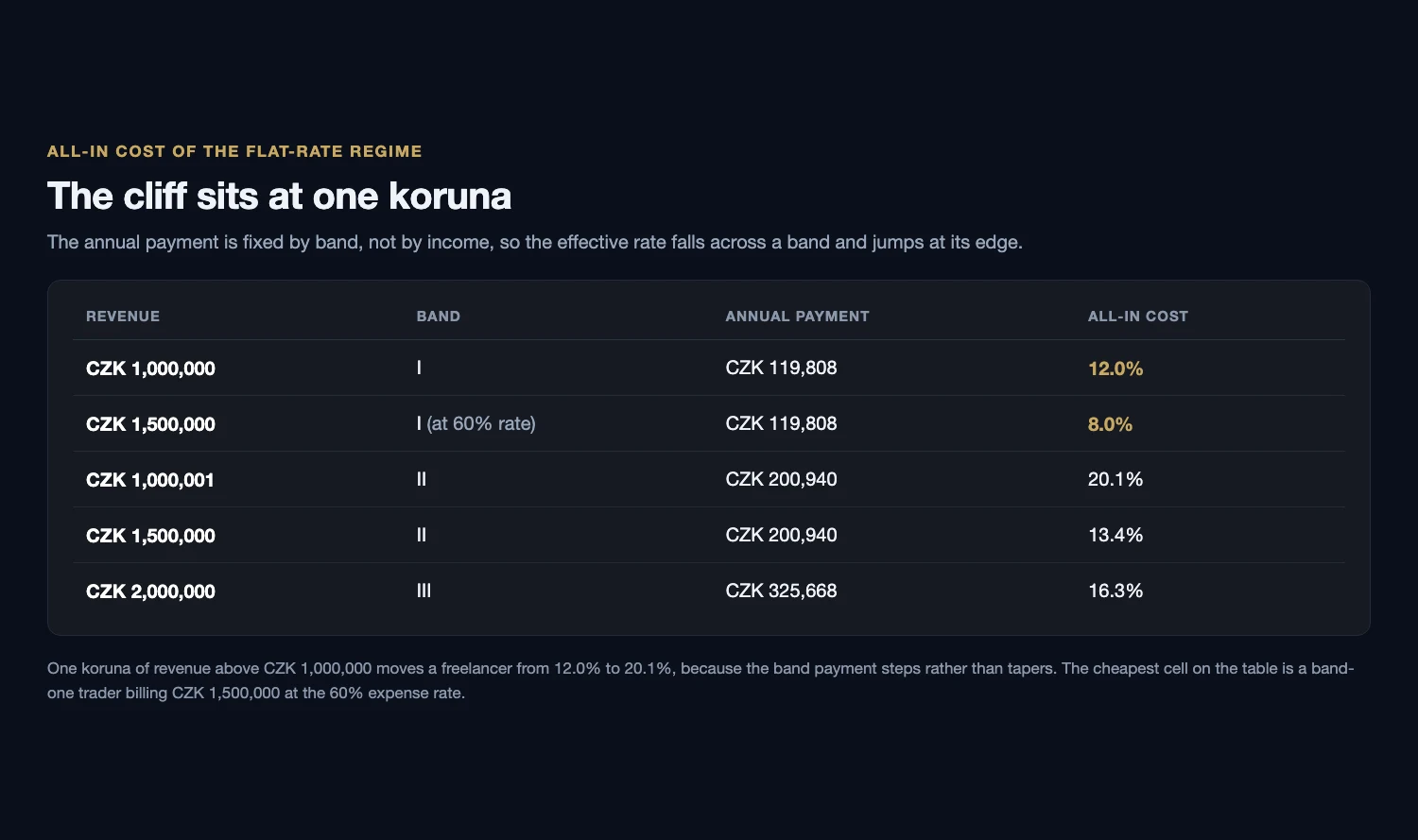
A freelancer at the top of band one on the 60% rate is paying 8.0% of revenue to settle tax, pension and health entirely. The same person one crown into band two pays 20.1%. The regime rewards the top of a band and punishes the bottom, so the band condition above is worth more than most tax planning.
Where the flat rate stops winning
Two ceilings end this. The hard one is the 2 million CZK income limit: above it the regime is closed and you are back to filing normally. The softer one is VAT, which forces you out mid-year the moment registration takes effect.
The progressive rate is less of a factor than guides imply, and this is where the outdated competitor claim matters. The Czech 7% solidarity surcharge has not existed since 2021; it was replaced by a second income tax band. For 2026 the 23% rate applies above 36 times the average wage — CZK 1,762,812 a year, or about CZK 146,901 a month — with 15% below it, the average wage for these purposes being CZK 48,967.
| 2026 figure | Amount |
|---|---|
| Average wage (Income Taxes Act) | CZK 48,967/month |
| 23% rate threshold (36 x average wage) | CZK 1,762,812/year |
| Rate below the threshold | 15% |
| Flat-rate regime income ceiling | CZK 2,000,000/year |
| Minimum health insurance advance | CZK 3,306/month |
Run those together and something useful falls out. A trader at the regime's 2m ceiling on the 60% expense rate has a tax base of 800,000 CZK — well under 1,762,812 — so for anyone eligible for the flat-rate regime, the 23% band is effectively unreachable via the lump-sum route. It concerns high earners who have outgrown the regime, not the freelancer choosing between bands.
Where the flat rate genuinely loses is on real expenses: it forfeits every deduction and credit, so a trader with heavy genuine costs, or one who would use the spouse and child credits, can do better filing normally. That needs a Czech adviser and your actual numbers.
From visa to long-term residence to permanent residence
The visa is a starting document, not the thing that reaches permanent residence. A long-term visa is issued for up to one year; the onward step is a long-term residence permit for the same business purpose, applied for from inside the country, and it is the one you keep renewing.
Permanent residence is generally available after five years of continuous residence. The published conditions are Czech at A2 level — raised from A1 on 1 September 2021 — plus stable income and accommodation, and you must hold a valid long-term residence permit for the whole time your PR application is being processed.
| Stage | Typical duration | What it needs |
|---|---|---|
| Long-term visa (business) | Up to 1 year | Trade licence, CZK 156,500, Czech accommodation, insurance |
| Long-term residence permit | Renewable | Continuing trade, insurance, accommodation; applied for in-country |
| Permanent residence | After 5 years' continuous residence | Czech at A2, stable income, accommodation, valid permit throughout |
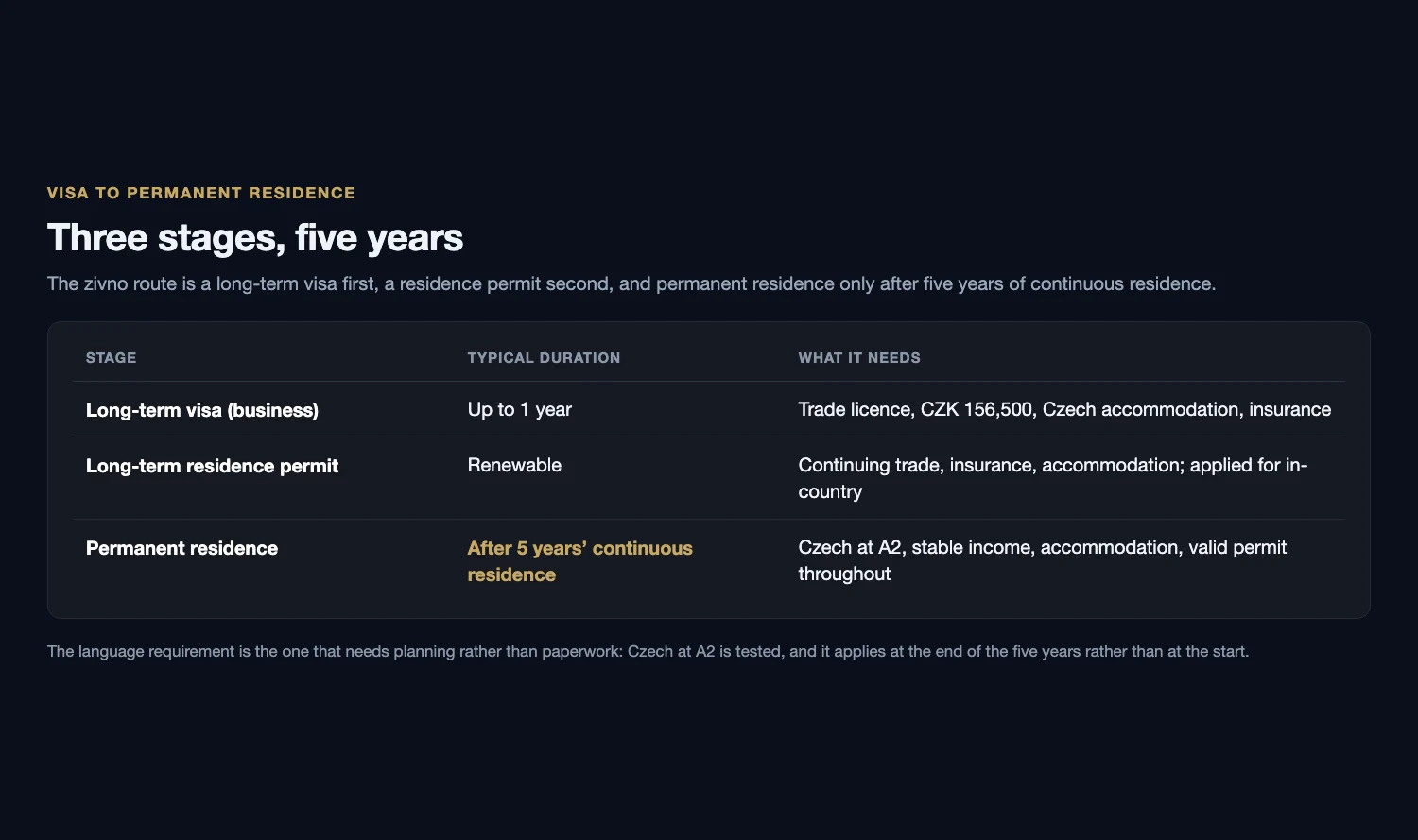
One warning, because it is where self-prepared timelines go wrong: not every period counts at full weight. Time as a student is reported to count at half its length, and the rules on absences are strict. We reached no authoritative page setting out how each category is counted, so if your history mixes study, employment and self-employment, confirm the count with the Ministry of the Interior before booking a language exam. For how this compares elsewhere, see our ranking of second residency options and which nomad visas lead to permanent residency.
What we could not verify
Four numbers that appear confidently in competing guides are not in this article, because we could not reach a primary source for them:
- The trade-licence registration fee. Widely quoted at 1,000 CZK; not found on any government schedule, so left out.
- Translation, legalisation and insurance costs. The ranges quoted elsewhere (€200–500 translation, €500–900 a year insurance) may be realistic, but they are secondary-source estimates.
- The current VAT registration threshold. It decides flat-rate eligibility, but the only source we reached was a historic Ministry of Finance proposal — confirm with the Financni sprava.
- The renewal limit on a long-term visa. Guides variously say 1 year, 2 years and "24 months maximum". The sources conflict and we are not picking a winner.
One more: the minimum monthly pension advance for 2026 is reported as 5,720 CZK by some sources and 5,005 CZK by others. We used 5,720 because it is consistent with the official band-one pension component of 6,578 being the minimum plus 15% — showing the working rather than asserting it.
Czech law changes at the turn of the tax year and the minima were re-set in October 2026. Every figure here is dated to 2026 — re-check it against the sources below before acting.
Related reading
- Germany freelance visa — the closest European analogue, and the other route that admits you as a self-employed person.
- DAFT visa, Netherlands — the treaty route with the lowest capital bar in the EU.
- Bulgaria digital nomad visa — the other low-cost EU option, with a flat 10% rate for comparison.
- Second residency ranked — where a Czech trade licence sits against cost, speed and days required.
- Digital nomad visas that lead to permanent residency — the permit-type rule that predicts whether years count.
- Schengen 90/180 rule — the clock you are on while the 90-to-120-day decision runs.
FAQ
Is there actually a Czech digital nomad visa?
Not under that name, and this is where most English-language guides mislead. The route freelancers use is a long-term visa for the purpose of business (podnikani), granted on the strength of a Czech trade licence — the zivnostenske opravneni, shortened to zivno. The Czech Consulate General in Los Angeles lists the accepted proof of purpose as an extract from the Trade Register or the Commercial Register, not a remote-work contract.
How much money do you need in the bank for a Czech zivno visa?
CZK 156,500 for a business-purpose application. The figure is not arbitrary: it is 50 times the existential minimum, which the Ministry of Labour and Social Affairs still sets at CZK 3,130 a month after the October 2026 changes, and 50 x 3,130 = 156,500. Consulates accept current or savings accounts but not credit accounts, and the proof is normally a notarised copy of a debit card in your name plus a matching statement or a bank letter.
What is pausalni dan and what does it cost in 2026?
It is the Czech flat-rate regime, and it replaces income tax, pension insurance and health insurance with one monthly payment. For 2026 the Financni sprava set the three bands at CZK 9,984, CZK 16,745 and CZK 27,139 a month. In band one that payment is composed of CZK 3,306 health insurance, CZK 6,578 pension insurance and CZK 100 income tax — so the income tax a band-one freelancer pays is CZK 1,200 for the whole year.
Who can enter the flat-rate regime?
A sole trader with self-employment income up to CZK 2 million who is not a VAT payer and has no obligation to register for VAT, with identified persons as the exception. Employment income disqualifies you unless it is taxed by withholding at source. The notification for the 2026 tax period was due by 12 January 2026, so a trade licence started now points at the 2027 period, and you must tell the tax office within 15 days if you stop meeting the conditions.
Which flat-rate band will a freelance developer or consultant land in?
Almost always band one, and the reason is the expense rate attached to the activity rather than the income itself. Ordinary trades carry a 60% lump-sum expense rate, and the Financni sprava lets band one stretch to CZK 1.5 million of income when at least 75% of it comes from activities at the 80% or 60% rate. So a consultant billing CZK 1.3 million stays in the cheapest band, while the same income from an activity at the 40% rate would not.
Does the zivno visa lead to permanent residence?
It is one of the routes that counts, but the visa itself is not the permit that gets you there. A long-term visa is issued for up to a year and the onward step is a long-term residence permit for the same business purpose, with permanent residence generally available after five years of continuous residence. The published conditions are Czech at A2 level, raised from A1 on 1 September 2021, plus stable income and accommodation.
How long does a Czech business long-term visa take?
Budget on four months and do not plan around less. The Ministry of the Interior decides business applications within 90 days, and consulates quote 90 to 120 days from the moment they receive a complete application.
Is this legal or tax advice?
No. This is editorial research read from the Financni sprava, the Ministry of Foreign Affairs fee schedule, Czech consular document lists and the Ministry of Labour and Social Affairs, and Soveraine sells no immigration or tax services. Band placement, VAT status and residence counting all turn on your own facts, so take advice from a Czech tax adviser and check the current consular list before you file.
Sources
- Pausalni dan 2026: novinky, terminy — Financni sprava press release: the 2026 band amounts and the income tax, pension and health split for each.
- Informace k institutu pausalni dane — Financni sprava: the band income limits, the 75% condition and the 80/60/40/30% expense rates.
- Long-term visa and residence permit: business — Czech Consulate General Los Angeles: the CZK 156,500 funds test, accepted evidence, the 180-day document rule and the 90–120 day quote.
- Application for a long-term visa — Czech government service page: the CZK 2,500 fee and where applications are submitted.
- Zivotni a existencni minimum — Ministry of Labour and Social Affairs: the existential minimum the funds test is a multiple of.