
Key takeaways
- The ceiling is 500 permits, and it has filled before. The government's own February 2024 strategy document says that after the increase from 100 to 500, "this limit has already been exhausted."
- The €3,500 test is net, not gross. The Department's wording is net income "after the deduction of contributions and taxes". Holding €3,500 net once Cyprus is taxing you takes roughly €50,300 gross a year.
- There is no 0% nomad regime. Past 183 days you are a Cyprus tax resident on worldwide income, at rates reaching 35%. Non-dom status covers dividends and interest, not the salary a nomad lives on.
- You sign away Cypriot clients. An affirmation binding you and your family not to serve any employer or client established in Cyprus is a required document, at first application and again at renewal.
- Fees are trivial: €70 + €70. Examination takes 5–7 weeks, and the permit runs one year, then a renewal of up to two more.
SafetyWing — a Plan A health insurance certificate covering inpatient care, outpatient care and repatriation is a required document, not an optional extra
What Cyprus is actually offering
Cyprus will let a non-EU remote worker live on the island for up to three years, charges €140 in government fees, and decides in five to seven weeks. That is a genuinely good offer, and it is not the part that should decide your application.
The part that should decide it is a number the marketing pages mention in passing and never examine: the Cyprus digital nomad visa is capped at 500 permits, and the Cypriot government has already written down, in its own strategy document, that the cap was exhausted once. I went to the Migration Department's published scheme text, its March 2025 document checklist and the Council of Ministers decisions behind both, rather than paraphrasing the law firms, because on this programme the secondary sources disagree with each other about the single most important fact.
One framing governs everything below. The government's own strategy paper puts it plainly: "This measure relates to a residence permit in the Republic, not a work permit." Cyprus is giving you somewhere to live while you work for people elsewhere, and most of the scheme's sharper edges follow from that single distinction.
| What the scheme provides | Source | |
|---|---|---|
| Legal basis | Council of Ministers Decision, 15 October 2021 | Scheme document, January 2022 |
| Who it is for | Non-EU and non-EEA nationals working remotely | Scheme document |
| Ceiling | 500 residence permits | Migration Dept page, 31 Dec 2025 |
| Income test | €3,500/month net, after contributions and taxes | Accompanying documents, v.19.03.2025 |
| First permit | One year | Migration Dept page |
| Renewal | Maximum two years | Migration Dept page |
| Fees | €70 issuance + €70 Aliens' Registry registration | Migration Dept page |
| Examination | 5–7 weeks | Migration Dept page |
| Cyprus clients | Prohibited, by signed affirmation | Accompanying documents, item 9 |
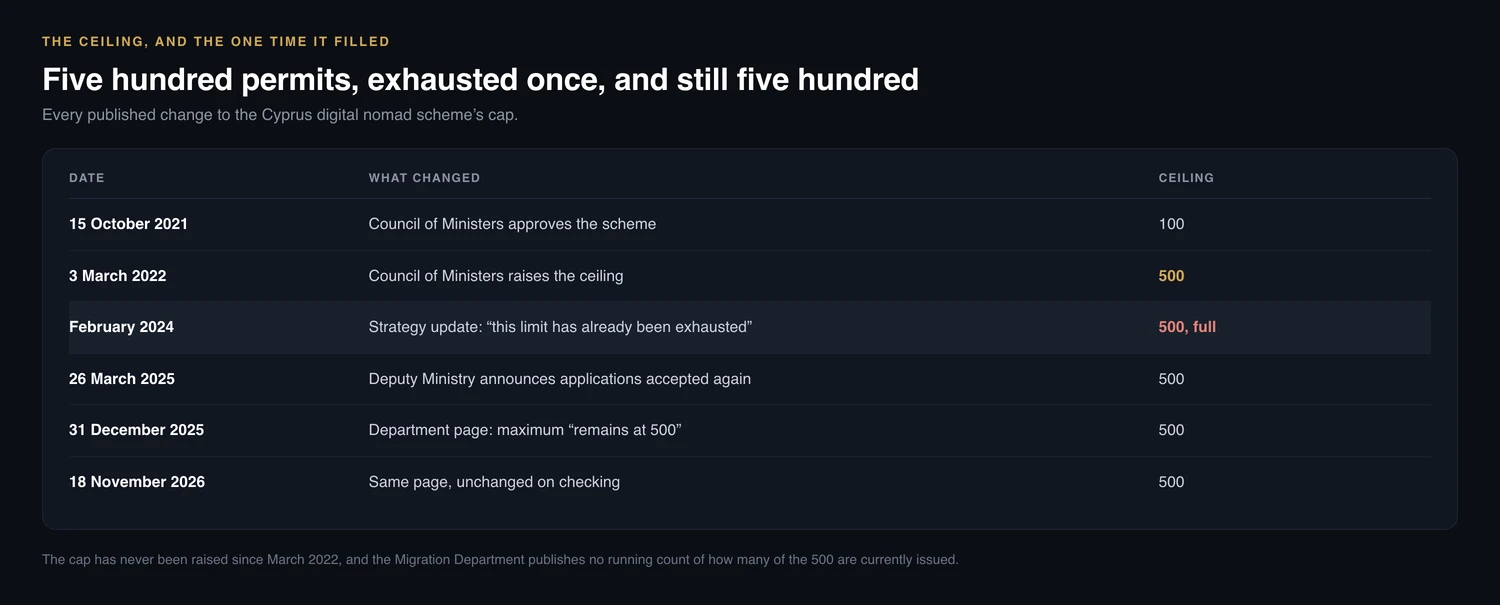
The 500-permit ceiling that already filled once
Here is the sequence, which no guide I read sets out in full.
The Council of Ministers approved the scheme on 15 October 2021 with a ceiling of 100 permits. On 3 March 2022 it raised that ceiling to 500. Then, in the February 2024 update of the government's Strategy for Attracting Businesses and Talent, the entry for the digital nomad visa records the increase to 500 and adds one flat sentence: "This limit has already been exhausted."
The same entry lists, as work still to be done, a "review of the criteria for issuing Digital Nomad Visa licences and possible extension of the maximum number of beneficiaries." On 26 March 2025 the Deputy Ministry of Migration and International Protection announced that the Migration Department was accepting applications again. The Department's own scheme page, posted 31 December 2025 and still live when I checked it on 18 November 2026, says the maximum "remains at 500."
So the extension that the 2024 strategy contemplated does not appear to have happened. You are applying into the same 500 that was full two years ago.
| Date | What changed | Ceiling |
|---|---|---|
| 15 October 2021 | Council of Ministers approves the scheme | 100 |
| 3 March 2022 | Council of Ministers raises the ceiling | 500 |
| February 2024 | Strategy update: "this limit has already been exhausted" | 500, full |
| 26 March 2025 | Deputy Ministry announces applications accepted again | 500 |
| 31 December 2025 | Department page: maximum "remains at 500" | 500 |
| 18 November 2026 | Same page, unchanged on checking | 500 |
How can a ceiling that was exhausted in 2024 be open in 2026 without being raised? The reading that fits is that the 500 counts permits in force rather than permits ever issued, so places free up as holders reach the end of their three years and leave. Reported figures point the same way: Cypriot press, citing the Ministry of Migration and the Chamber of Commerce, put issuance at 518 permits plus 389 family permits from launch to 30 June 2025 — already past 500 cumulatively. Those figures are secondhand, so treat them as indicative. The Department publishes no running count of places left, and that absence is the practical problem: there is no way to check your odds before you spend money on documents.
Treat the quota as the binding constraint and apply early in the year rather than late. And be sceptical of the numbers circulating in 2026 — several sites currently state a quota of 1,000, and at least one states 1,500. Neither figure appears anywhere on the Migration Department's page.
Who qualifies, and the €3,500 that is net
The eligibility test is short. You must be a non-EU and non-EEA national, able to work location-independently through telecommunications technology, and either employed by a company registered abroad or self-employed serving clients abroad.
Then the money. The Department asks for "sufficient and stable monthly living resources amounting to at least €3,500, after the deduction of contributions and taxes" — evidenced by proof of salary showing net income and six months of bank statements showing stable income from outside the Republic. That phrase, after the deduction of contributions and taxes, is the one that competitors drop. €3,500 is what lands in your account, not what your contract says.
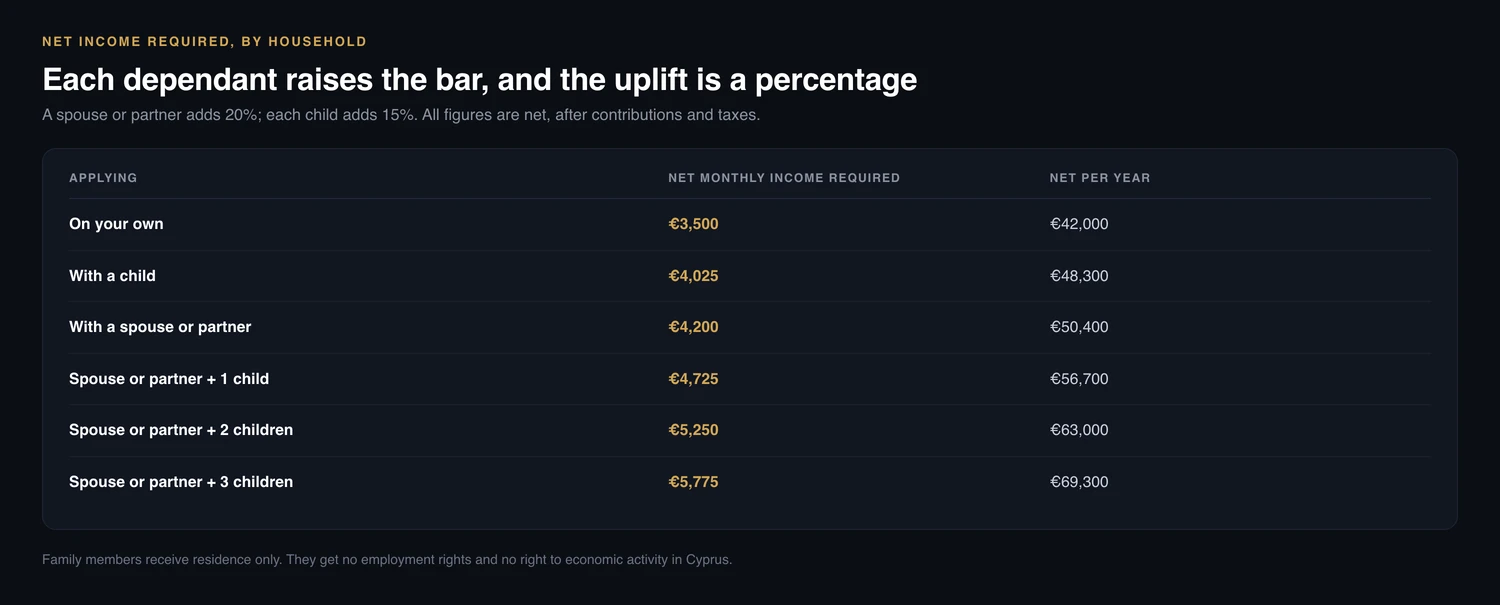
The uplifts are mechanical: +20% for a spouse or partner, +15% for each child, applied to the €3,500 base.
| Applying | Net monthly income required | Net per year |
|---|---|---|
| On your own | €3,500 | €42,000 |
| With a child | €4,025 | €48,300 |
| With a spouse or partner | €4,200 | €50,400 |
| Spouse or partner + 1 child | €4,725 | €56,700 |
| Spouse or partner + 2 children | €5,250 | €63,000 |
| Spouse or partner + 3 children | €5,775 | €69,300 |
There is a useful escape hatch in the small print for freelancers whose income does not arrive as a payslip. Where there is no proof of net income, the Department accepts an affirmation in which you certify that your net income, after contributions and taxes on the income shown in your documents, is not below the required minimum. Self-employed applicants also need contracts of project or services running at least as long as the permit requested — a twelve-month engagement for a twelve-month permit, not a rolling month-to-month arrangement.
The affirmation: no Cyprus clients, for you or your family
Item 9 on the Department's document list is an affirmation in which the applicant commits that they "or his/her family members will not provide work or services or project in any way to an employer or clients established in Cyprus." It appears again, unchanged, on the renewal list.
Read that twice if you have a spouse. Family members get residence for the same period as you and no right to be employed or to perform economic activity in Cyprus — and the affirmation you sign binds them as well. A partner who picks up a few local clients is not committing their own small breach; they are breaking the undertaking that your permit rests on.
The employed and self-employed routes differ mainly in what proves the work is genuinely offshore.
| Employed by a foreign company | Self-employed | |
|---|---|---|
| Core document | Employment contract, indefinite or at least as long as the permit | Project or service contracts, at least as long as the permit |
| Confirmation needed | From the employer: duties performed remotely, no activity or services to an employer registered in Cyprus | From you: duties performed remotely, no services to a client established in Cyprus |
| Company proof | Stamped registration certificate of the foreign company, its contact details, your status in it | Not specified |
| At renewal | Employer documents only required again if the employer has changed | Contract confirmation again if the project contract has changed |
That last row is a small mercy worth planning around: a stable employer means a much lighter renewal file, while changing jobs mid-permit pulls the full set of company documents back in.
Why "0% tax in Cyprus" is wrong for nomads
Cyprus has no nomad-specific tax regime. It has a general tax system, and the visa drops you into it.
The scheme's own text says that if you reside in the Republic for periods totalling more than 183 days in a tax year, "then they are considered tax residents of Cyprus, provided they are not tax residents in any other country." That proviso is doing more work on the page than it does in the law: the 183-day test in Cyprus's income tax rules is unconditional, and the "not tax resident elsewhere" condition belongs to the separate 60-day route — where, from 1 January 2026, it no longer applies either. Do not plan around that sentence. Plan around the statute and a treaty tiebreaker.
Because once you are Cyprus tax resident, Cyprus taxes your worldwide income, and your remote salary is income like any other.
| Chargeable income (2026) | Rate |
|---|---|
| €0 – €22,000 | 0% |
| €22,001 – €32,000 | 20% |
| €32,001 – €42,000 | 25% |
| €42,001 – €72,000 | 30% |
| Above €72,000 | 35% |
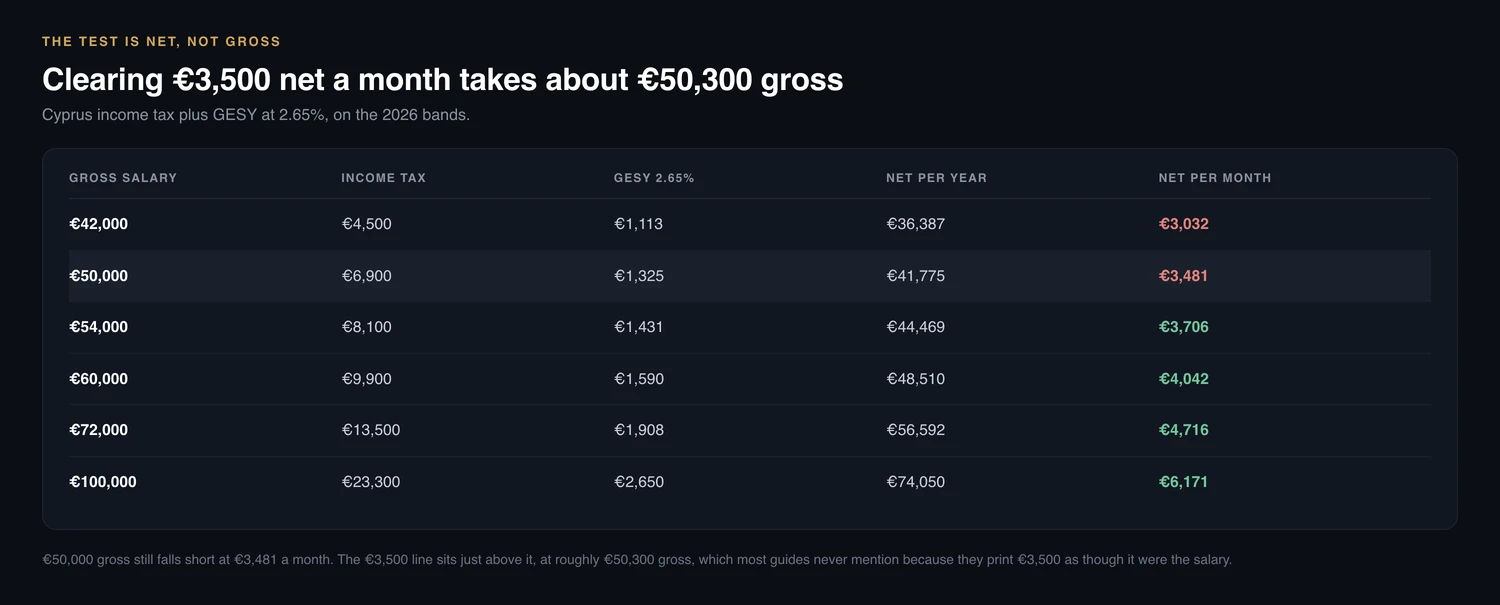
Now put the visa threshold and the tax table in the same room, which is the calculation nobody publishes. The permit wants €3,500 net per month. If Cyprus is the country taxing you, here is what gross income produces, after income tax and the 2.65% General Healthcare System contribution:
| Gross salary | Income tax | GESY 2.65% | Net per year | Net per month |
|---|---|---|---|---|
| €42,000 | €4,500 | €1,113 | €36,387 | €3,032 |
| €50,000 | €6,900 | €1,325 | €41,775 | €3,481 |
| €54,000 | €8,100 | €1,431 | €44,469 | €3,706 |
| €60,000 | €9,900 | €1,590 | €48,510 | €4,042 |
| €72,000 | €13,500 | €1,908 | €56,592 | €4,716 |
| €100,000 | €23,300 | €2,650 | €74,050 | €6,171 |
The crossing point is about €50,300 gross a year — roughly €4,195 a month — to keep €3,500 net once Cyprus takes its share. A nomad who scrapes over the threshold on foreign-taxed income at application, then becomes Cyprus tax resident, can find the same salary no longer clears the bar at renewal.
Two caveats I will not paper over. Social insurance treatment for a non-EU national employed by a foreign company while living in Cyprus depends on that employer's country and any agreement with Cyprus; I did not verify it and have left it out of the table rather than guess. And non-dom status does not help here — it exempts dividends and interest from the Special Defence Contribution, which is a structure for people taking profits out of a company, not for people drawing a salary. The mechanics are in our guide to Cyprus non-dom status, and the distinction between earned and investment income is the whole of it.
The 60-day rule does not rescue you
The obvious counter is Cyprus's famous 60-day rule, which grants tax residency on a much lighter presence. It is real, and for the right person it is excellent. It is also, as far as I can tell, closed to a digital nomad permit holder.
The 60-day route requires all of the following together: no more than 183 days in any other single state, at least 60 days in Cyprus, a permanent home owned or rented in Cyprus — and that you carry on a business in Cyprus, be employed in Cyprus, or hold an office with a company tax resident in Cyprus, with that role not terminated during the year.
That last condition runs straight into the affirmation you signed, which commits you not to provide work or services to any employer or client established in Cyprus. A Cyprus business, a Cyprus job or a directorship of a Cyprus company is the thing you have undertaken not to have. I am not aware of a published Department position reconciling the two, and I will not invent one. If your plan depends on holding a Cyprus directorship on this permit, get it cleared in writing by a Cypriot lawyer first — the downside is a breach of the permit, not a tax reassessment.
Fees, documents and the five-to-seven week clock
The money is the easy part. The paperwork is not.
| Item | Amount or period |
|---|---|
| Issuance or renewal of the permit | €70 |
| Registration in the Aliens' Registry (first time only) | €70 |
| Examination time | 5–7 weeks |
| Deadline to apply after arrival | Within 3 months |
| Deadline to apply for renewal | At least 1 month before expiry |
| First permit validity | 1 year |
| Renewal validity | Maximum 2 years |
You enter on a tourist visa where one is needed, then file in person — or through an authorised representative — at the Department's central offices in Nicosia within three months of arrival. Biometrics and signature are captured at submission or afterwards, in Nicosia or at the district Aliens and Immigration Service office where you live.
Two document requirements catch people out, and neither is a formality. You need original blood analysis results showing you do not carry HIV, syphilis or hepatitis B and C, plus chest X-rays for tuberculosis, certified by a specialist doctor. And you need a title deed or rental agreement, duly stamped if valued over €5,000, with a matching utility bill — which means securing housing before you can complete the file, in a market where rents have been climbing hard.
The Department is explicit that applications not accompanied by all required documents will not be accepted for consideration. There is no partial filing and no placeholder.
SafetyWing — cover you hold continuously while abroad, rather than a trip-length travel policy
Item 7 on the Department's list is a certificate of health insurance covering inpatient care, outpatient care and transportation of remains — described as Plan A. A holiday travel policy does not have that shape. Check any policy's limits and term against the Department's current checklist before you file. Our SafetyWing review sets out what it does and does not pay for.
What it does not get you
This is where expectations and the scheme part company.
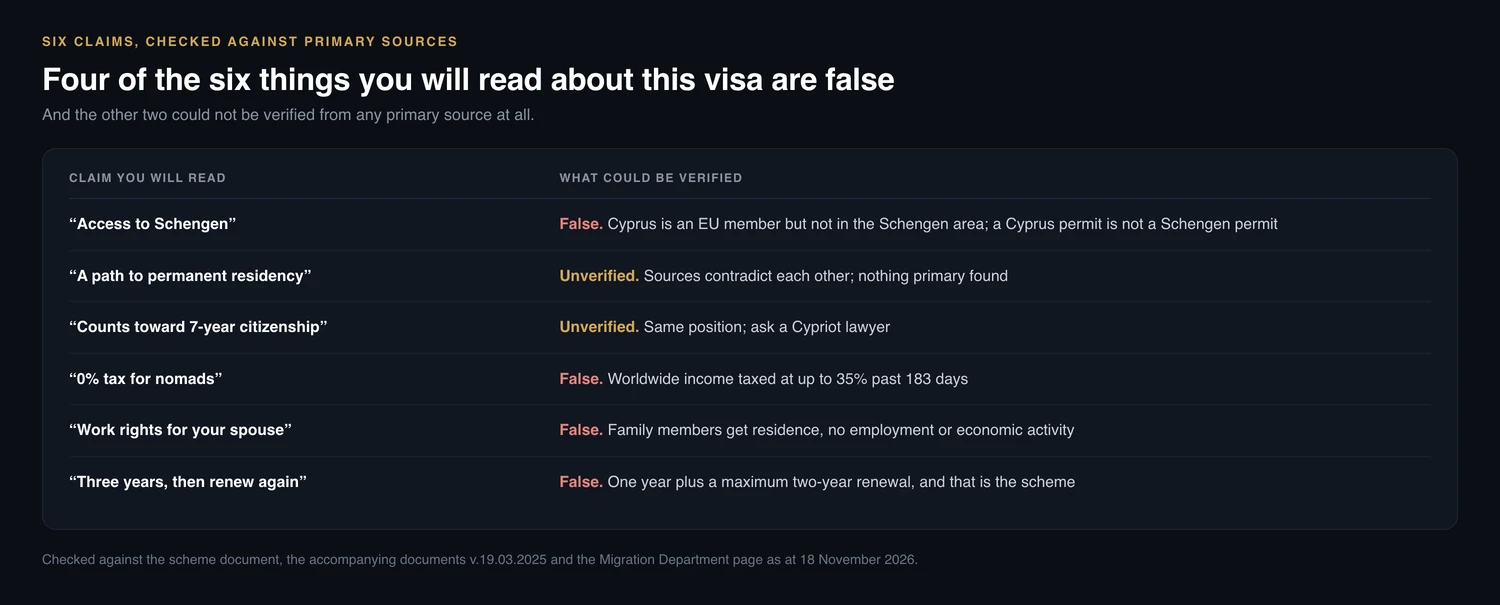
| Claim you will read | What I could verify |
|---|---|
| "Access to Schengen" | False. Cyprus is an EU member but not in the Schengen area; a Cyprus permit is not a Schengen permit |
| "A path to permanent residency" | Unverified. Sources contradict each other; nothing primary found |
| "Counts toward 7-year citizenship" | Unverified. Same — ask a Cypriot lawyer |
| "0% tax for nomads" | False. Worldwide income taxed at up to 35% past 183 days |
| "Work rights for your spouse" | False. Family members get residence, no employment or economic activity |
| "Three years, then renew again" | False. One year plus a maximum two-year renewal, and that is the scheme |
The Schengen point matters for anyone treating Cyprus as a European base. Trips to Spain, Greece or Germany are still governed by the ordinary visa-free allowance for your nationality, counted independently of your Cyprus time — the mechanics are in our Schengen 90/180 rule guide.
On permanent residency and citizenship I will disappoint you deliberately. The commercial guides split roughly down the middle on whether nomad years count toward the seven-year naturalisation test, and no primary Cypriot source resolved it either way. On a question this consequential, an honest "unverified" beats a confident sentence copied from a competitor. If an adviser tells you the years count, ask them to show you the provision.
What I would actually do
If I wanted two or three years in an English-speaking EU country with low friction and a fast decision, I would take this visa, file early because of the quota, and treat the tax position as a separate project from the immigration one.
If I were going for the tax, I would stop and reconsider the shape. Cyprus's genuinely strong offer is for someone who runs profits through a Cyprus company and takes them as dividends under non-dom status — and that person is carrying on business in Cyprus, which this permit's affirmation forbids. The nomad permit and the famous Cyprus tax structure are, as far as I can tell, pointed at different people. Reading our Cyprus non-dom guide next to this one makes that clearer than any comparison table.
And if I needed a route that accumulates toward something permanent, I would look elsewhere, because this one is capped at three years with no published onward path. Our second residency rankings and the list of nomad visas with a residency path both start from that requirement rather than treating it as a bonus.
Related guides
- Cyprus non-dom in 2026 — the dividend regime, the 60-day rule and what the 2026 reform changed.
- Digital nomad visas: the full comparison — every programme worth the application, ranked.
- Nomad visas with a permanent residency path — the ones that actually accrue.
- The Schengen 90/180 rule — why a Cyprus permit does not buy you European travel.
- Malta digital nomad visa — the other small-island EU route, on different terms.
- Nomad travel insurance — what a Plan A certificate has to cover.
FAQ
What is the income requirement for the Cyprus digital nomad visa?
At least €3,500 a month, and the Migration Department's own wording is that this is monthly net income after the deduction of contributions and taxes. The figure rises by 20% for a spouse or partner and by 15% for each child, so a couple needs €4,200 a month and a couple with one child €4,725. Most guides print €3,500 without saying it is net, which understates the gross salary you actually need by a wide margin.
How many Cyprus digital nomad permits are available in 2026?
The Migration Department's page, posted 31 December 2025 and still live in November 2026, says the maximum number of permits that can be granted remains at 500. The Council of Ministers set the original ceiling at 100 on 15 October 2021 and raised it to 500 on 3 March 2022. Several sites currently print a quota of 1,000 or 1,500; neither figure appears on the Department's own page, so treat them as unconfirmed.
Has the Cyprus digital nomad visa quota been used up?
It was once. The government's own Strategy for Attracting Businesses and Talent, in its February 2024 update, states that after the increase to 500 "this limit has already been exhausted." The Department reopened applications by announcement on 26 March 2025 with the ceiling unchanged, which suggests the 500 counts permits in force rather than permits ever issued — but the Department does not say so, and I could not verify it from a primary source.
Do Cyprus digital nomad visa holders pay 0% tax?
No. There is no nomad-specific tax regime in Cyprus. Cross 183 days in a calendar year and you are a Cyprus tax resident taxed on worldwide income, including the salary you earn remotely. The 2026 bands run 0% to €22,000, then 20%, 25%, 30% and 35% above €72,000, plus a 2.65% General Healthcare System contribution. Non-dom status exempts dividends and interest, not earned income.
Can I work for Cypriot clients on the digital nomad visa?
No, and you sign a document saying so. The Migration Department's accompanying-documents list requires an affirmation committing that neither you nor your family members will provide work, services or any project to an employer or clients established in Cyprus. The same affirmation is required again at renewal, and it binds your family even though they hold no work rights of their own.
How long does the Cyprus digital nomad visa last?
The first temporary residence permit is issued for one year. A renewal is issued for a maximum of two years, giving three years in total. You must apply to renew at least one month before the permit expires, and the Department states an examination time of five to seven weeks for applications.
Does the Cyprus digital nomad visa lead to permanent residency or citizenship?
I could not establish this from a primary source, and the commercial guides contradict each other — some say the years count toward the seven-year naturalisation test, others say the permit leads nowhere. The scheme is a temporary residence permit capped at three years, and the government's own strategy document describes the measure as a residence permit and not a work permit. Get this answered by a Cypriot immigration lawyer before planning around it.
Does the Cyprus digital nomad visa give access to Schengen?
No. Cyprus is an EU member state but is not in the Schengen area, so a Cyprus residence permit is not a Schengen residence permit and does not let you move freely through it. Your Schengen travel is governed by the ordinary 90-days-in-180 limit for your nationality, counted separately from your time in Cyprus.
The document that is easiest to get wrong
Item 7 on the Migration Department's list is a certificate of health insurance covering inpatient care, outpatient care and transportation of remains, and it is required again at renewal. A trip-length travel policy is the wrong shape for a permit measured in years. SafetyWing is built to be held continuously while you are living abroad. Check the cover limits and term against the Department's current checklist before you file.
Sources
- Migration Department — Digital nomads and family members (posted 31 December 2025; retrieved 18 November 2026). The ceiling "remains at 500", the Council of Ministers decisions of 15 October 2021 and 3 March 2022, the €3,500 net test, the €70 + €70 fees, the 5–7 week examination, and the permit durations.
- Migration Department — Digital Nomads: List of Accompanying Documents (MVIS v.19.03.2025). The "after the deduction of contributions and taxes" wording, the 20%/15% uplifts, the net-income affirmation, the medical tests, the Plan A certificate, the stamped rental agreement, and the item 9 affirmation — for first permits and renewals.
- Republic of Cyprus — Cyprus Digital Nomad Visa Scheme (January 2022). The original 100-permit ceiling and the 183-day tax sentence. This published document still states the superseded ceiling of 100.
- Government of Cyprus — Strategy for Attracting Businesses and Talent (February 2024 update): "By Decision of the Council of Ministers dated 03/03/2022 the maximum number of Digital Nomad Visa beneficiaries was increased to 500. This limit has already been exhausted." Also the pending "possible extension of the maximum number of beneficiaries", and the measure as a residence permit and not a work permit.
- PwC Worldwide Tax Summaries — Cyprus individual taxes and individual residence. The 2026 bands, worldwide taxation of residents, the 183-day rule, the 60-day rule's cumulative conditions and termination trap, and the removal of its "not tax resident in any other state" condition from 1 January 2026.
The issuance figures (518 permits and 389 family permits to 30 June 2025, 306 extension applications) are Cypriot press reporting attributed to the Ministry of Migration and the Chamber of Commerce, not traced to a government release. Whether nomad years count toward permanent residency or naturalisation is unverified. Social insurance treatment for a non-EU national employed by a foreign company in Cyprus is also unverified and deliberately left out of the tax table. The reading that the 500 counts permits in force is my inference, not a Department statement.
Rules and figures are as published in 2026 and change without notice. Take advice from a Cypriot immigration lawyer and a cross-border tax adviser before acting. Nothing here is legal or tax advice.