
"Sole prop vs LLC" is the first real decision almost every new business owner faces, and most of the advice online overstates the tax angle and understates the legal one. The honest framing is simple: by default the two are taxed identically, so the question is really about liability protection, credibility and structure, not about saving tax. This guide compares them across the dimensions that actually matter, explains the one situation where an LLC genuinely cuts your tax bill, and covers the non-resident angle that most US-centric articles ignore. It is written for US persons and for non-US founders using a US entity.
Northwest Registered Agent — privacy-first US LLC formation with registered agent included, from $39 + state fee.
The core difference: legal separation
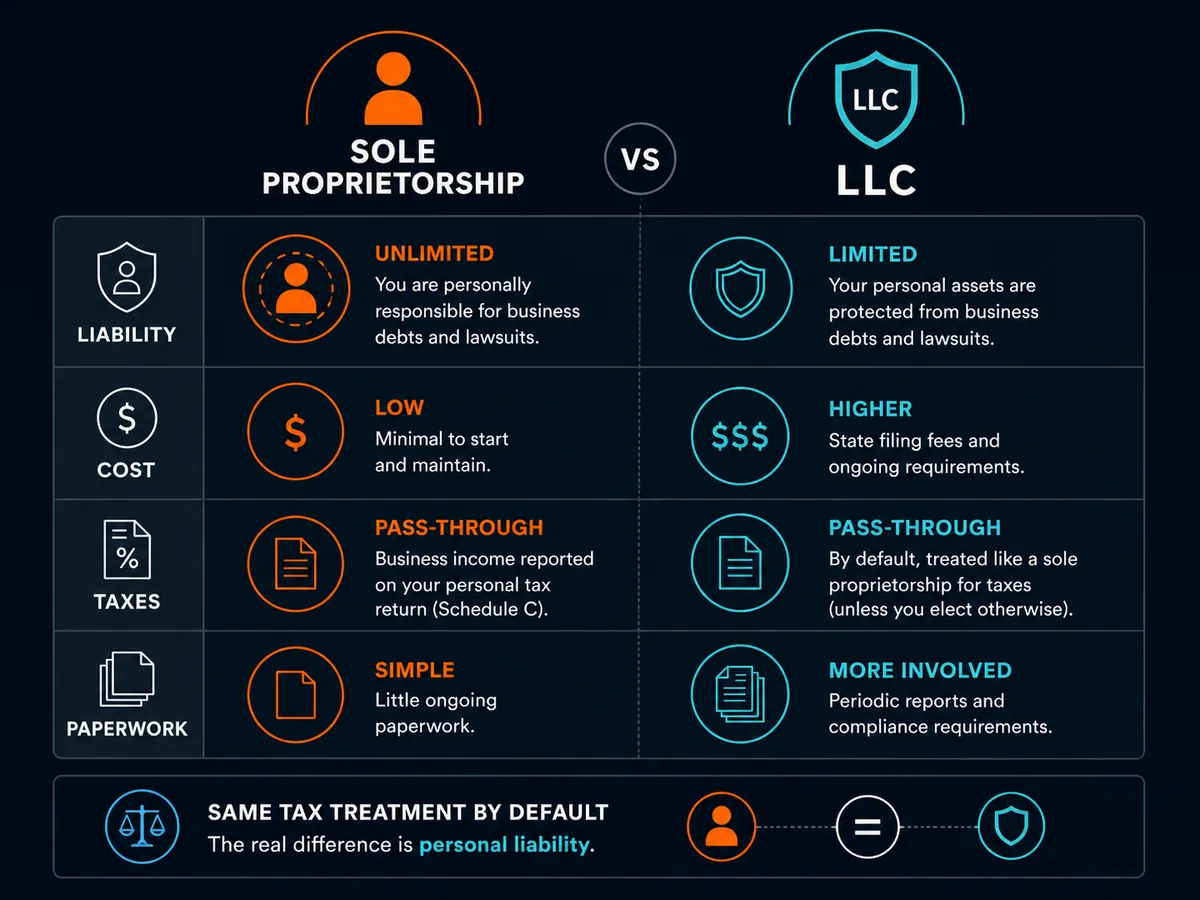
A sole proprietorship is the default. The moment you start doing business under your own name without registering an entity, you are a sole proprietor. There is no separation between you and the business — in the eyes of the law, they are the same person. That has one large consequence: unlimited personal liability. If the business is sued or cannot pay its debts, your personal assets — savings, car, in some cases your home — are exposed.
An LLC (limited liability company) is a separate legal entity created by filing with a state. Properly maintained, it creates a liability shield: business debts and lawsuits generally stop at the company and do not reach your personal assets. That shield is the entire point of the structure, and it is the main reason to form one.
Everything else — taxes, credibility, paperwork — flows from that single distinction.
Taxes: identical by default
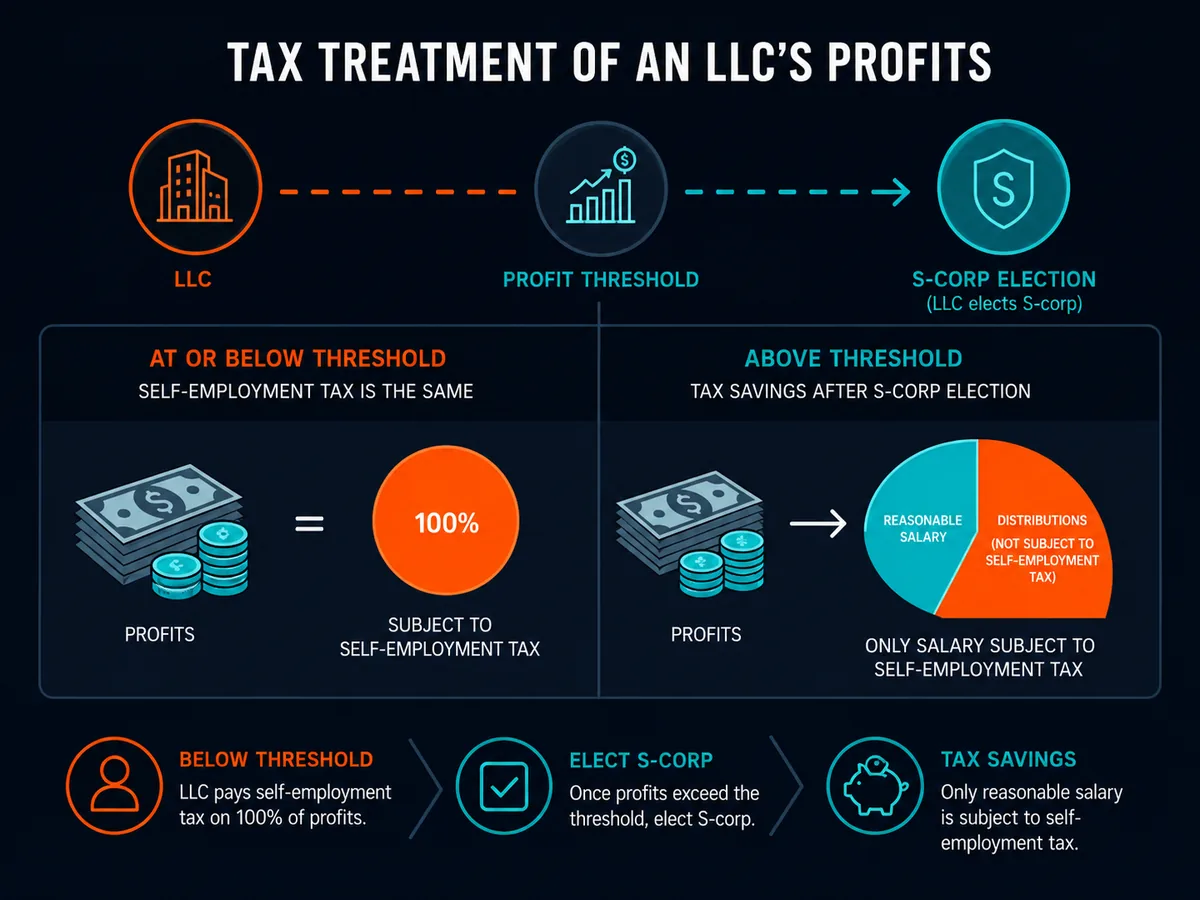
This is where most articles mislead. A single-member LLC is, by default, a disregarded entity for federal tax. Its profit lands on your personal return on Schedule C — exactly the same form a sole proprietor uses — and you pay the same federal income tax and the same 15.3% self-employment tax on net profit. Forming an LLC does not, by itself, lower your tax bill by a single dollar.
The one real exception is the S-corporation election. An LLC can elect to be taxed as an S-corp, after which you pay yourself a "reasonable salary" (subject to payroll tax) and take the remaining profit as distributions (not subject to self-employment tax). Once net profit is high enough — commonly cited in the $40,000–$80,000 range — the self-employment-tax saving can outweigh the added cost of payroll, a separate return and bookkeeping. Below that, the S-corp usually costs more than it saves.
A sole proprietor cannot make this election. So the tax case for an LLC is really a tax case for the S-corp election that an LLC unlocks — not for the LLC itself.
Cost and paperwork
- Sole proprietorship: $0 to start. You may need a local business licence and, if you trade under a name other than your own, a DBA registration. No annual filings beyond your personal tax return.
- LLC: a one-time state filing fee (roughly $35–$500 depending on the state), an annual report or franchise fee (from $0 in states like New Mexico up to $800 in California), and usually a registered agent ($0–$200/year). You keep the company's finances separate, file the appropriate return, and maintain the formalities that preserve the liability shield.
If you mix personal and business money in one account, a court can "pierce the corporate veil" and the LLC's protection evaporates. The single most important habit after forming an LLC is a dedicated business bank account.
When an LLC is worth it
Form an LLC when one or more of these is true:
- You have real liability exposure — clients who could sue, physical products, premises, employees, contractors, or anything that could cause harm.
- You have partners — a multi-member LLC with an operating agreement sets out ownership, profit splits and exit terms.
- You are signing larger contracts — many agencies and enterprise clients prefer to contract with an entity.
- Profit is high enough for the S-corp election to save meaningful self-employment tax.
- You want privacy — some states let an LLC shield the owner's name from public filings.
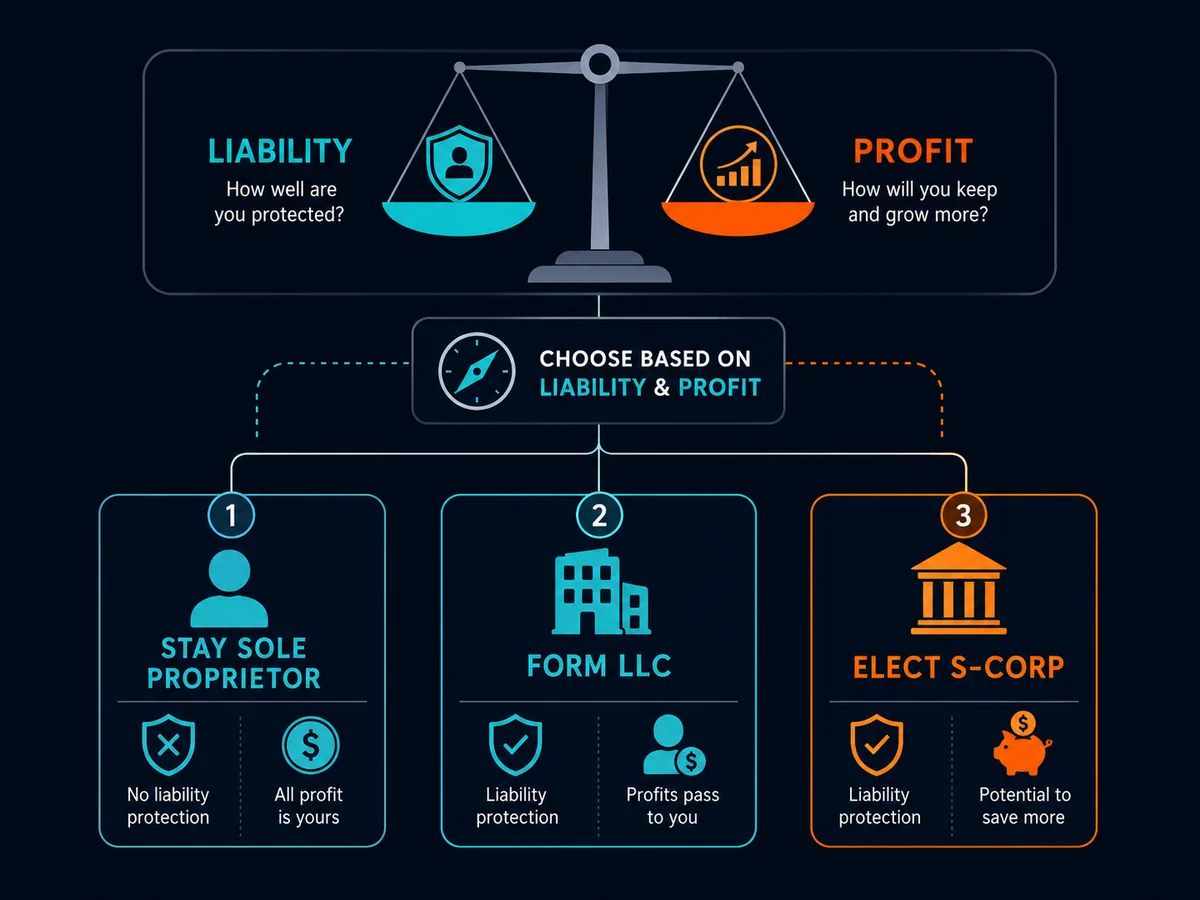
If none of these apply — you are a solo freelancer with low liability and modest profit — a sole proprietorship plus good insurance is often the right, cheaper answer. Form the LLC when the facts change.
The non-resident angle
For Soveraine's non-US readers, the comparison looks different. A non-US resident generally cannot operate as a US sole proprietor, but can form a US LLC, get an EIN, and open US banking. A single-member US LLC owned by a non-resident, with no US employees and no income "effectively connected" to a US trade or business, is typically not liable for US federal income tax — but it must file Form 5472 with a pro-forma 1120 every year, and the penalty for missing it is $25,000.
Which state? For most non-resident online businesses the realistic shortlist is Wyoming, Delaware and New Mexico — compared in our guides to Wyoming LLC benefits, Delaware LLC benefits and which state is best for a non-resident LLC.
Doola handles US LLC formation, EIN and compliance — built for founders inside and outside the US.
Common mistakes
Forming an LLC for the "tax savings." There are none by default. The saving comes from the S-corp election at higher profit, not from the LLC.
Forming an LLC and then commingling funds. Mixing personal and business money can void the liability shield you paid for.
Staying a sole proprietor too long. The cost of an LLC is small; the cost of a personal lawsuit while unprotected is not.
Forming in a "tax-free" state while living elsewhere. A US resident generally owes tax and registration in their home state regardless of where the LLC is formed. See which state is best.
When to consult a qualified professional
Talk to a CPA or business attorney before deciding if: your profit is approaching the S-corp threshold; you have partners or outside investors; you operate across state lines or borders; you carry meaningful liability; or you are a non-resident and need the Form 5472 and banking set up correctly.
Soveraine is an editorial publication, not a law or accounting firm. Read our editorial policy and disclaimer before acting on anything in this article.