
South Africa did something in October 2024 that almost every guide describes incorrectly: it did not create a digital nomad visa. It added one line to the list of things you are allowed to do on an ordinary visitor's visa, and that line came with an income number and two sentences about tax.
The number is R650 976,00 a year. A large share of the pages ranking for this search print R650,796 instead, which is a real number from a real government notice published the same month — just not this one. The difference is R180 a year and matters not at all to your bank balance, but it is a reliable tell for whether a page was written from the gazette or from other pages.
I went to the South Africa digital nomad visa rules in the Government Gazette itself, read the amendment it makes to the 2014 Immigration Regulations, and checked the tax half against SARS's own residence tests rather than against the travel press. The immigration side is simpler than it looks. The tax side is where the published guidance is genuinely misleading, and it is misleading in a direction that could cost you a filing.
Key takeaways
- The gazetted threshold is R650 976,00 per annum, in regulation 11(4)(b)(i). It replaced the R1,000,000 figure announced in May 2024.
- R650,796 is a different instrument's number — the middle salary band of the points-based system for work visas. EY's own alert prints both figures on one page.
- It is not a visa category. It is remote work added as an authorised activity on a visitor's visa, described in the regulation as work "contemplated in section 11(2) of the Act", not the section 11(1)(b)(iv) most guides cite.
- SARS registration turns on your treaty position, not your day count. Treaty-country residents register after 183 days; everyone else registers regardless of how long they stay.
- Registering is not the same as being taxed. South Africa's physical presence test is 91 days in the current year, 91 in each of the five before it, and 915 across those five — a much slower trap than 183 days.
SafetyWing — a visitor's visa puts you outside South Africa's public health system for up to three years, and a trip-length travel policy is the wrong shape for that
What South Africa actually created
On 9 October 2024 the Minister of Home Affairs, Dr L.A. Schreiber, gazetted the Third Amendment of the Immigration Regulations, 2014 as Government Notice 5398 in Government Gazette 51366. It is four pages long, it commences on the date of publication, and the signature on it is dated 8 October — which is where the "gazetted on 8 October" you see in some write-ups comes from.
The amendment does three things. It inserts a definition of the Income Tax Act into regulation 1. It rewrites regulation 11(4)(b), which is the list of work a visitor's visa holder may be authorised to do. And it rewrites regulation 18(12) to introduce the points-based system for a different set of visas entirely.
Only the middle one is yours. That framing governs everything below: you are applying for a visitor's visa with an authorised activity attached, not for a nomad permit with its own rulebook.
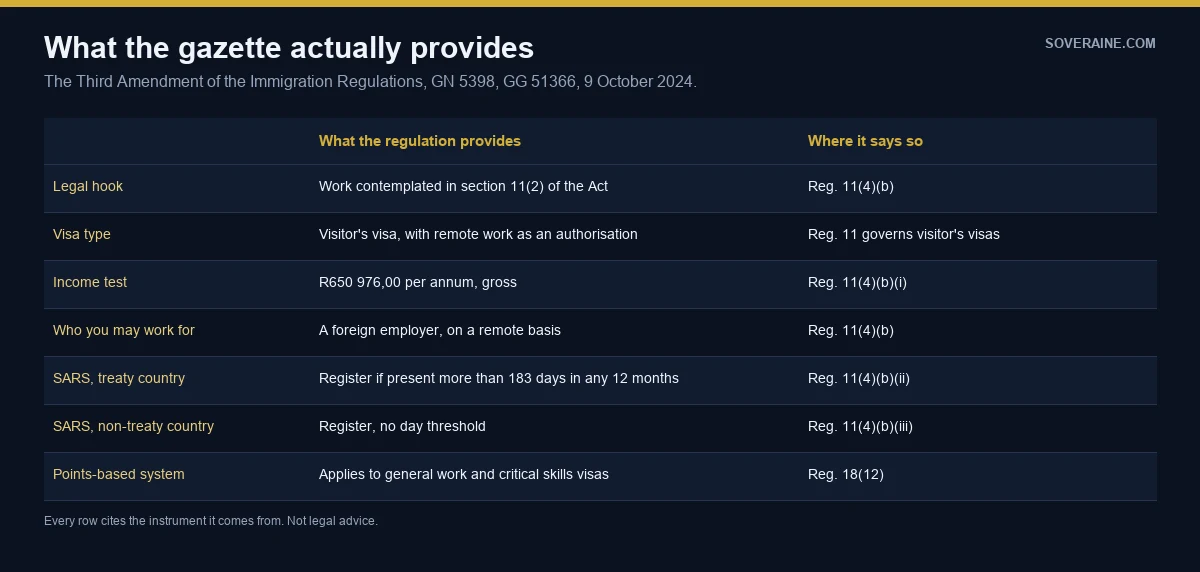
| What the regulation provides | Where it says so | |
|---|---|---|
| Instrument | Third Amendment of the Immigration Regulations, 2014 | GN 5398, GG 51366, 9 Oct 2024 |
| Legal hook | Work "contemplated in section 11(2) of the Act" | Reg. 11(4)(b) |
| Visa type | Visitor's visa, with remote work as an authorised activity | Reg. 11 governs visitor's visas |
| Income test | R650 976,00 per annum, gross | Reg. 11(4)(b)(i) |
| Who you may work for | A foreign employer, on a remote basis | Reg. 11(4)(b) |
| SARS, treaty country | Register if present > 183 days in any 12 months | Reg. 11(4)(b)(ii) |
| SARS, non-treaty country | Register, no day threshold | Reg. 11(4)(b)(iii) |
| Points-based system | Applies to general work and critical skills visas only | Reg. 18(12) |
| Commencement | Date of publication | Para. 5 |
The number half the internet gets wrong
Here is the sequence, which I have not seen set out anywhere else.
In May 2024 the department announced a remote work threshold of R1,000,000 a year. In October 2024 it replaced that with R650 976,00, and that is the figure printed in the gazette, in words I have read directly: "such foreigner earns no less than the equivalent of R650 976,00 per annum."
Separately, in the same month, Home Affairs published the points-based system for general work and critical skills visas. Its salary criterion awards 50 points above R976,194 and 20 points between R650,796 and R976,194. Two different regimes, two different numbers, four digits apart, published days apart.
EY's October 2024 immigration alert settles it beyond argument, because it prints both on a single page: remote workers must show "a gross annual income of at least ZAR 650,976", while the points income band runs from "ZAR 650,796". The guides quoting R650,796 for the nomad route have lifted the work-visa band and attached it to the wrong visa.
There is a further wrinkle I will not pretend to have resolved. The points notice was itself reportedly withdrawn over a typographical error and reissued on 18 October 2024, and a Home Affairs application checklist and an April 2026 parliamentary reply are both reported to carry R650,796. For the remote work route the gazette is unambiguous, and the gazette is what binds. Budget against R650,976 and the R180 question never arises.
What the regulation says, word for word
This is the whole of the remote work provision, as substituted into regulation 11(4)(b):
"(b) work conducted, as contemplated in section 11(2) of the Act, for a foreign employer on a remote basis: Provided that— (i) such foreigner earns no less than the equivalent of R650 976,00 per annum; (ii) if the foreigner is a tax resident in a country that the Republic has an agreement in force with for the prevention of or relief from double taxation under section 108(2) of the Income Tax Act, 1962, such foreigner will be required to register with the South African Revenue Service if he or she is present in the Republic for longer than an aggregate period of 183 days during any 12-months period; and (iii) if the foreigner is not a tax resident in a country referred to in sub-paragraph (ii), such foreigner will be required to register with the South African Revenue Service; and"
Three things are worth pulling out. "The equivalent of" means foreign-currency earnings are converted, not disqualified. "Gross" is not in the text, though every secondary source and EY's alert read it as gross annual income, and the department's checklist is reported to ask for three months of bank statements. And the tax conditions are conditions of the immigration regulation, which is why they bind you as a visa holder whatever your accountant concludes about residence.
Note also what is absent: no duration, no fee, no document list, no mention of family members. Those live in other instruments and in departmental practice, which is why the published guidance on them varies so much.
Registering with SARS is not the same as being taxed
This is the distinction the coverage flattens, and flattening it produces advice that is wrong in both directions.
Sub-paragraphs (ii) and (iii) impose a registration obligation. Registration gives SARS a taxpayer record for you. It does not decide what, if anything, is taxable. The question of whether South Africa taxes your worldwide income is answered by the Income Tax Act's residence tests, which the immigration regulation does not touch.
Read them side by side and the asymmetry is obvious. A German tax resident — Germany has a treaty with South Africa — crosses the registration line at 183 days. A resident of a country with no South African treaty must register from day one, even for a three-week stay. That second rule only makes sense if SARS considers there may be something to look at, and the obvious candidate is that employment income is generally sourced where the work is physically done. That reading is my inference from the structure of the rule, not a statement by SARS, and it is exactly the point on which to take advice rather than a blog's word.
The practical consequence is this: the treaty position of your home country changes your South African paperwork before you have spent a single extra day in the country. Check it before you book.
When South Africa actually taxes you
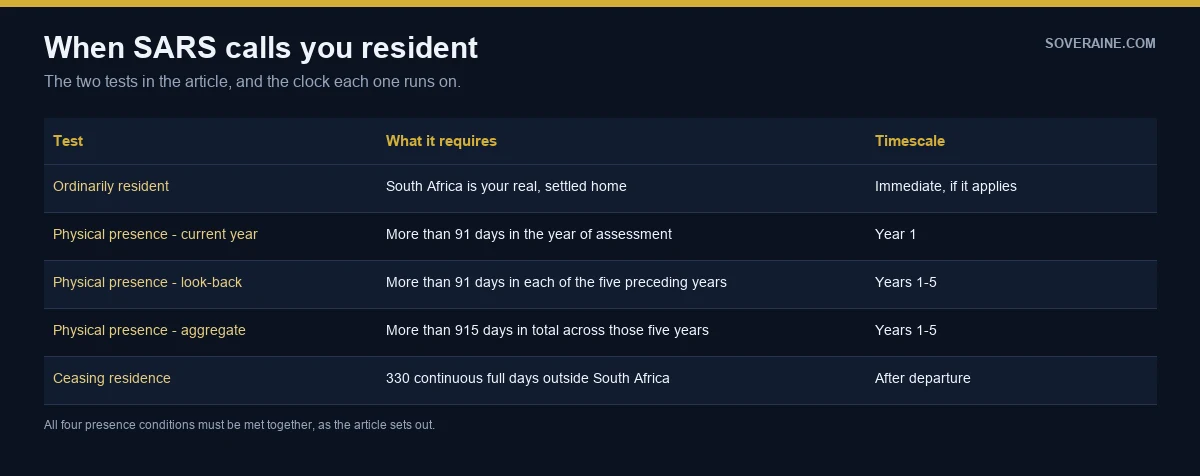
South Africa has two residence tests, and neither is the 183-day rule the visa paperwork made you think about. If you are not ordinarily resident — a facts-based test of where your real home is — you fall to the physical presence test, which is cumulative and slow.
| Test | What it requires | Timescale |
|---|---|---|
| Ordinarily resident | South Africa is your real, settled home, on the facts | Immediate, if it applies |
| Physical presence — current year | More than 91 days in the year of assessment | Year 1 |
| Physical presence — look-back | More than 91 days in each of the five preceding years | Years 1–5 |
| Physical presence — aggregate | More than 915 days in total across those five years | Years 1–5 |
| Ceasing residence | 330 continuous full days outside South Africa | After departure |
All three physical-presence conditions must be met. A nomad on a three-year visitor's visa who spends eight months a year in Cape Town will clear the 91-day bars easily but cannot satisfy the five-year look-back inside a three-year permit. On its own terms, this visa is too short to make you a South African tax resident by day count — which does not help at all with the separate question of source, and does not apply if the ordinarily resident test catches you first.
South Africa's tax year runs 1 March to 28 February, and the year in progress as this is published is the 2027 year of assessment, which began 1 March 2026. Guides quoting the "2026 tax tables" in late 2026 are usually a year behind.
What the tax would cost at the threshold
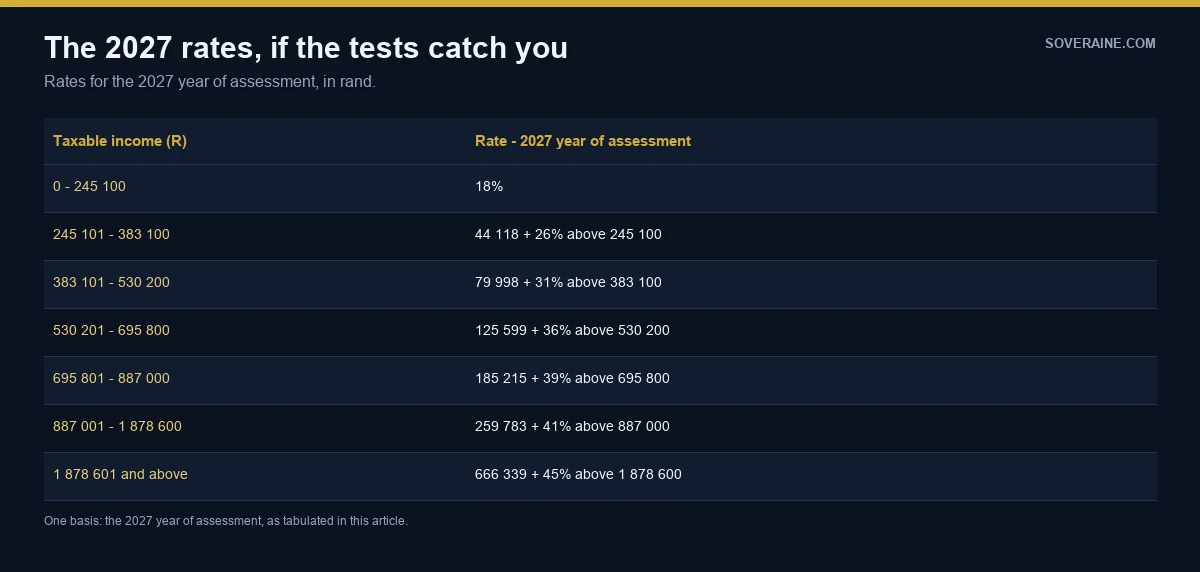
If you were taxed as a resident on exactly the threshold income, here is the arithmetic at SARS's 2027 rates, before any treaty relief.
| Taxable income (R) | Rate — 2027 year of assessment |
|---|---|
| 0 – 245 100 | 18% |
| 245 101 – 383 100 | 44 118 + 26% above 245 100 |
| 383 101 – 530 200 | 79 998 + 31% above 383 100 |
| 530 201 – 695 800 | 125 599 + 36% above 530 200 |
| 695 801 – 887 000 | 185 215 + 39% above 695 800 |
| 887 001 – 1 878 600 | 259 783 + 41% above 887 000 |
| 1 878 601 and above | 666 339 + 45% above 1 878 600 |
At R650,976 you land in the 36% band. Tax before rebates is R125,599 plus 36% of R120,776, or R169,078. Subtract the primary rebate of R17,820 and the liability is roughly R151,258 — an effective rate of about 23.2%, leaving around R41,600 a month.
That is the worst case, not the expected case, and the gap between them is the treaty. It is also why the threshold is less generous than it looks next to European programmes: R650,976 is roughly US$39,000 at late-2026 rates, which is a comfortable income in Johannesburg and a thin one if you are still servicing obligations in euros. If a low headline tax rate is what you are shopping for, the zero-tax residency routes are a different conversation entirely.
The points-based system does not apply to you
This causes real anxiety, because the points system was gazetted alongside the remote work rule and the coverage runs the two together.
The same amendment rewrote regulation 18(12) to read that an application "for a general work visa or critical skills work visa, contemplated in section 19(2) and (4) of the Act, must be adjudicated in accordance with the points-based system." Remote work is in regulation 11. It is not a work visa under section 19.
So the 100-point threshold, the 50 points for an NQF level 9 or 10 qualification, the 30 points for ten years' experience, the 20 points for a Trusted Employer offer, the 10 points for speaking an official language — none of it is scored on this route. Your qualifications are irrelevant. Your income is tested as a pass-or-fail threshold, not as a points band.
Fees, documents and the parts I could not verify
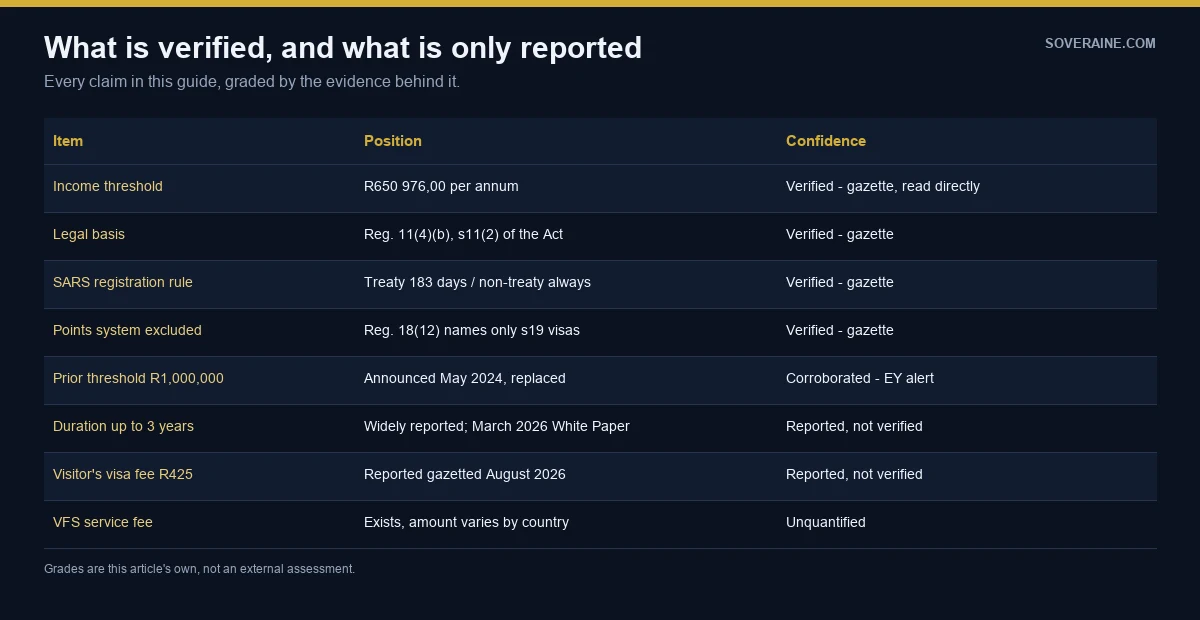
I will be explicit about the line between what I read and what I am relaying, because this is where the guides quietly stop sourcing.
| Item | Position | Confidence |
|---|---|---|
| Income threshold | R650 976,00 per annum | Verified — gazette, read directly |
| Legal basis | Reg. 11(4)(b), s11(2) of the Act | Verified — gazette |
| SARS registration rule | Treaty 183 days / non-treaty always | Verified — gazette |
| Points system excluded | Reg. 18(12) names only s19 visas | Verified — gazette |
| Prior threshold R1,000,000 | Announced May 2024, replaced | Corroborated — EY alert |
| Prior SARS rule | 6 months in any 36 months, superseded | Corroborated — EY alert |
| Duration up to 3 years / 36 months | Widely reported; March 2026 White Paper | Reported, not verified |
| Visitor's visa fee R425 | Reported gazetted August 2026 | Reported, not verified |
| VFS service fee | Exists, amount varies by country | Unquantified |
| Family members | Not addressed in this amendment | Unverified |
Applications are made at a South African mission or a VFS Global centre, and processing is reported at six to eight weeks. I could not reach an official consolidated fee schedule or an official remote-work checklist, so I am not going to print a document list as though it were law. Ask the mission you will actually file at for its current checklist, and treat anything you read online — including this table's bottom half — as a prompt to verify rather than an answer.
What it does not get you
A visitor's visa is a visitor's visa, and the ceiling is low by design.
It does not authorise South African employment or South African clients. The Minister's April 2026 parliamentary reply reportedly described the route as strictly limited to foreign-employed people, and billing a Cape Town company from a Cape Town flat is not remote work for a foreign employer.
It is not a residence route. Nothing in the amendment connects it to permanent residency, and a temporary visitor's status is a poor foundation for one — if accruing time toward a permit is the point, the programmes that actually count toward permanent residency work very differently. It is also not a travel document: it governs your status in South Africa and does nothing for your Schengen day count, which keeps running on its own rules.
And it does not come with a tax regime. There is no reduced rate, no exemption, no nomad carve-out — only the ordinary Income Tax Act and whichever treaty you bring with you.
What I would actually do
If your income clears R650,976 comfortably and your home country has a South African treaty, this is a straightforward and genuinely cheap way to spend a year or two somewhere excellent, and the 183-day registration line is easy to plan around.
If your country has no treaty with South Africa, go in knowing you are registering with SARS whatever you do, and price an accountant into the first year.
If you are shopping for a tax outcome rather than a place to live, this is the wrong instrument — and if you are shopping for a route that compounds into something permanent, compare it against the second residency options that rank on cost and speed before you commit three years to a permit that ends where it started.
Related guides
- Digital nomad visas: the full comparison — every programme worth the application, ranked.
- Nomad visas with a permanent residency path — the ones whose years actually accrue.
- Second residency ranked 2026 — cost, speed and days on the ground.
- The Schengen 90/180 rule — why a South African permit buys you nothing in Europe.
- Zero-tax residencies — what you are really comparing this against.
- Nomad travel insurance — cover shaped for years abroad, not trips.
FAQ
What is the income requirement for the South Africa digital nomad visa?
The gazetted figure is R650 976,00 per annum, written exactly that way in regulation 11(4)(b)(i) of the Immigration Regulations, 2014 as substituted on 9 October 2024. It replaced the R1,000,000 threshold announced in May 2024. The regulation says 'earns no less than the equivalent of', so foreign-currency income is converted rather than excluded.
Is the threshold R650,976 or R650,796?
R650,976 is the remote work figure. R650,796 is a different instrument's number: the floor of the middle salary band in the points-based system for general work and critical skills visas, gazetted the same month. EY's October 2024 immigration alert prints both on one page. Guides quoting R650,796 for the nomad route have imported the wrong gazette's number.
What visa is the South Africa digital nomad visa, legally?
There is no visa called a digital nomad visa in South African law. The October 2024 amendment added remote work for a foreign employer to the activities allowed on a visitor's visa, describing it as work 'contemplated in section 11(2) of the Act'. Many guides cite section 11(1)(b)(iv) instead; the gazette says section 11(2), and EY calls them 'Section 11(2) Visas'.
Do I have to register with the South African Revenue Service?
It turns on one thing: whether you are a tax resident of a country with a double taxation agreement in force with South Africa under section 108(2) of the Income Tax Act, 1962. If you are, you register only once you are present for more than an aggregate 183 days in any 12-month period. If you are not, you must register regardless of how long you stay. This replaced an earlier announced rule of six months in any 36-month period.
Does registering with SARS mean South Africa will tax me?
No, and conflating the two is the most common error in this visa's coverage. Registration is a condition of the immigration regulation. Whether you are taxed as a South African resident is decided by the Income Tax Act's own tests, the ordinarily resident test and the physical presence test, and the physical presence test is not a 183-day test. Registration can create a filing obligation without making you a resident taxpayer.
How long does the South Africa remote work visa last?
It is reported consistently as covering stays longer than three months and up to three years, and a revised immigration White Paper of March 2026 is reported to describe periods of up to 36 months. I could not confirm the maximum from the gazette, which sets the income and tax conditions rather than the duration. Treat three years as a reported ceiling, not a guaranteed grant.
Does the points-based system apply to the remote work visa?
No. The same gazette rewrote regulation 18(12), which applies the points-based system to 'a general work visa or critical skills work visa, contemplated in section 19(2) and (4) of the Act'. Remote work sits in regulation 11, which governs visitor's visas. You do not need 100 points and your NQF level is irrelevant.
Can I work for South African clients on this visa?
No. The authorised activity is work for a foreign employer on a remote basis, and the Minister of Home Affairs described the route in an April 2026 parliamentary reply as strictly limited to foreign-employed people. Billing South African clients is outside what the visa authorises, which makes it a poor fit for a freelancer who wants local work.
The gap a visitor's visa leaves open
A visitor's visa does not put you into South Africa's public health system, and it can run for up to three years. That is the wrong shape for a trip-length travel policy that assumes you are going home in a few weeks. SafetyWing is built to be held continuously while you live abroad. Check the cover limits and the term against whatever checklist the mission you file at is using before you buy.
Sources
- Department of Home Affairs — Third Amendment of the Immigration Regulations, 2014 (Government Notice 5398, Government Gazette 51366, Regulation Gazette 10177, Vol. 712, 9 October 2024; signed 8 October 2024; retrieved 20 November 2026). Read directly for the regulation 11(4)(b) text quoted above, the R650 976,00 threshold, the section 11(2) reference, the two SARS registration conditions, the regulation 18(12) points-based provision and the commencement clause.
- EY — South Africa introduces new points-based system for certain work visas, amends requirements for remote workers (Global Immigration alert, October 2024). The ZAR 650,976 remote-worker figure and the ZAR 650,796–976,194 points band printed on the same page, the superseded ZAR 1,000,000 May 2024 threshold, the superseded "six months in any 36-month period" SARS rule, the full points table, and the description of these as "Section 11(2) Visas".
- SARS — Rates of tax for individuals. The 2027 year of assessment bands (1 March 2026 to 28 February 2027) used in the worked example, the R17,820 primary rebate and the R99,000 threshold for taxpayers under 65.
- KPMG — South Africa: Points-Based System and Remote Work Visa Introduced (GMS Flash Alert 2024-207, October 2024). Independent confirmation of the gazette and notice numbers and the three SARS registration criteria, and it notes in its own words that the points band figure "differs from the remote working threshold of ZAR 650,976.00".
The physical presence test figures (91 days, 91 days in each of five preceding years, 915 days aggregate, and the 330-day cessation rule) are the long-standing Income Tax Act tests, reported consistently across South African tax practices; I did not reach a SARS interpretation note directly, so confirm them with one before relying on them. The three-year duration, the March 2026 White Paper's reported 36-month wording, the R425 fee, the six-to-eight week processing time, the bank statements and the April 2026 parliamentary reply are reported figures from secondary sources, not read by me in a primary document, and each is flagged as such above. The suggestion that the non-treaty registration rule reflects a source-of-income concern is my inference, not a SARS position. Family-member treatment is unverified and deliberately left out.
Rules and figures are as published in 2026 and change without notice. Take advice from a South African immigration practitioner and a cross-border tax adviser before acting. Nothing here is legal or tax advice.