Most pages about Amazon FBA non-resident tax will tell you confidently that inventory in a US warehouse makes your profit taxable in the United States. A few say the opposite, just as confidently. I read the five pages currently ranking for this query and not one cites a statute, regulation, case or IRS publication for the claim it makes.
The money is real. Effectively connected income is taxed at graduated rates up to 37% before state tax, the Form 5472 penalty for a non-resident-owned US LLC is $25,000 a year whether or not a cent of tax was due, and erring on the cautious side means paying US tax a treaty says you never owed.
So this guide answers the question the way the law does: in three steps, in order, each one sourced. It also covers the provision that decides most real cases and that none of the ranking pages so much as names — Article 5(4) of the US model treaty, which says a stock of goods kept solely for storage, display or delivery is not a permanent establishment.
Key takeaways
- No rule says FBA inventory creates a US trade or business. IRC §864(b) gives no inventory test; the "considerable, continuous and regular" standard comes from case law and IRS guidance, not statute.
- Source is the hinge, not the warehouse. Goods you buy abroad and sell in the US are sourced where title passes, so generally US-source. Goods you produce are sourced solely by production activity since the 2017 Act — pointing abroad.
- In a treaty country, Article 5(4) probably protects you. A stock of goods held solely for storage, display or delivery is expressly not a permanent establishment, and the US declined the OECD's BEPS narrowing of that exclusion.
- The UAE, Singapore, Hong Kong, Saudi Arabia and Brazil have no US treaty. Hungary's was terminated and stopped applying to taxable periods from 1 January 2024.
- Amazon already collects your sales tax in all 45 statewide-sales-tax states plus DC. The stories about registering in 30 states are years out of date.
- A treaty does not bind US states. Public Law 86-272 protects only order solicitation filled from outside the state, so in-state inventory forfeits it.
Doola — if you already run a US LLC for your Amazon account, the annual Form 5472 is the filing that carries the $25,000 penalty
Why nobody gives you a straight yes or no
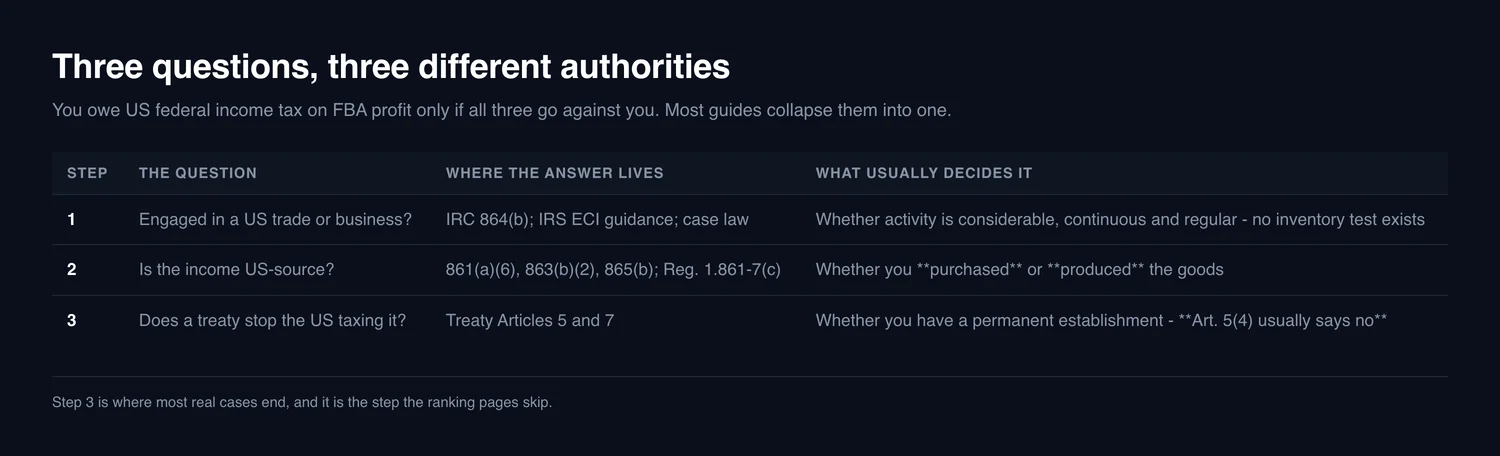
The advice conflicts because three separate questions get collapsed into one. Each has its own authority, and you owe US federal income tax on FBA profit only if all three go against you.
| Step | The question | Where the answer lives | What usually decides it |
|---|---|---|---|
| 1 | Engaged in a US trade or business? | IRC §864(b); IRS ECI guidance; case law | Whether activity is "considerable, continuous and regular" — no inventory test exists |
| 2 | Is the income US-source? | §861(a)(6), §863(b)(2), §865(b); Reg. §1.861-7(c) | Whether you purchased or produced the goods |
| 3 | Does a treaty stop the US taxing it? | Treaty Articles 5 and 7 | Whether you have a permanent establishment — Art. 5(4) usually says no |
Step 3 is where most real cases end, and it is the step the ranking pages skip. A seller in Manchester or Madrid can lose steps 1 and 2 and still owe nothing; a seller in Dubai who loses them has nothing left to argue. Note what the table does not contain: sales tax, which is a separate tax levied by states on the buyer's purchase rather than your profit, and has its own section below.
Step one: does FBA make you engaged in a US trade or business?
Here is the uncomfortable part. "Trade or business within the United States" is one of the most consequential phrases in the Code, and the Code barely defines it. IRC §864(b) says the term "includes the performance of personal services within the United States", then carves out small amounts of employee compensation and trading in securities and commodities. On inventory, warehouses or e-commerce it says nothing at all.
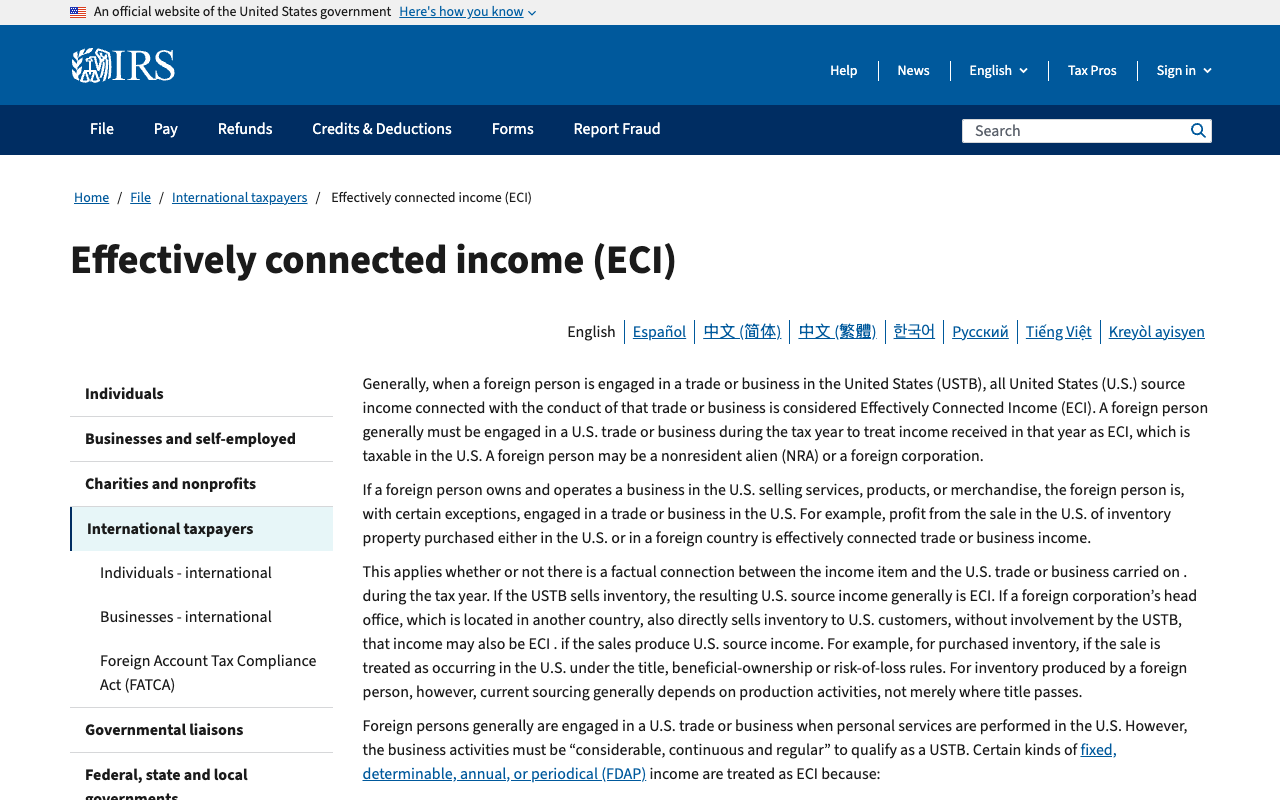
The working standard comes instead from the IRS's guidance on effectively connected income, which requires activity that is "considerable, continuous and regular", and from case law applying that idea. The same page gives a useful negative example: trading stocks through a US resident broker is not, on its own, a US trade or business.
Applied to a typical FBA operation — stock in US fulfilment centres all year, thousands of orders to US addresses, returns handled in the US — most practitioners conclude the threshold is met. That is a reasonable reading, not a certainty, and the IRS has issued no guidance addressed to FBA at all.
What moves the needle: continuous US inventory, US employees or contractors, a US office, or anyone in the US with authority to conclude contracts all point toward a trade or business. Sporadic inventory, with purchasing, listing, pricing, support and management performed abroad and Amazon as your only US presence, points away. Because step one is genuinely uncertain, it is a weak foundation for a plan — steps two and three are far more tractable.
Step two: where the sale happens, and why buying and making diverge
If you are engaged in a US trade or business, §864(c)(3) sweeps essentially all of your US-source income into the effectively connected bucket. So sourcing does the real work.
For inventory, §865(b) steps aside and routes you to §§861(a)(6), 862(a)(6) and 863 — and this is where the two commonest FBA models part company.
| Your model | Governing rule | How income is sourced | Typical result |
|---|---|---|---|
| You buy finished goods from a third-party factory abroad and sell in the US | §861(a)(6) | By place of sale — bought outside the US, sold inside it | US-source; ECI if step 1 is met |
| You produce the goods yourself abroad and sell in the US | §863(b)(2) | Solely on production activities (2017 Act, years after 31 Dec 2017) | Points to foreign-source |
| Either model, but title passes to the buyer outside the US | Reg. §1.861-7(c) | Where "rights, title, and interest pass to the buyer" | Foreign-source — subject to the anti-abuse rule |
Where does a sale happen? The regulation is specific: at the time and place the seller's rights, title and interest pass to the buyer, and where only bare legal title is retained, where beneficial ownership and risk of loss pass. An FBA order picked in Kentucky and delivered in Ohio is hard to call a sale concluded abroad.
Two warnings. The regulation carries an anti-abuse rule: a transaction arranged a particular way primarily to avoid tax has title passage ignored, and the sale is placed where its substance occurred. Drafting "title passes in Hong Kong" while the goods sit in Memphis is what that rule exists for. Second, the purchased-versus-produced line is blurrier than my table — whether goods from a contract manufacturer working to your specification are "produced by the taxpayer" is a real grey area turning on who owns the inputs and bears production risk.
Step three: the treaty article almost no FBA guide mentions
This is the section that should change what you do. Even with a US trade or business earning US-source income, a treaty can remove the US taxing right entirely. Article 7(1) of the 2016 US Model Income Tax Convention sets the rule: profits of an enterprise of one state "shall be taxable only in that Contracting State unless the enterprise carries on business in the other Contracting State through a permanent establishment situated therein". Everything turns on whether you have a US permanent establishment — and Article 5(4) answers that for warehoused stock in almost exactly those words.
| Provision | What it says | Effect on an FBA seller |
|---|---|---|
| Art. 5(1) | A PE is "a fixed place of business through which the business of an enterprise is wholly or partly carried on" | The general test |
| Art. 5(4)(a) | PE "shall be deemed not to include" facilities used solely for storage, display or delivery of the enterprise's goods | A fulfilment centre is such a facility |
| Art. 5(4)(b) | Nor maintaining a stock of goods belonging to the enterprise solely for storage, display or delivery | This is FBA inventory, described almost exactly |
| Art. 5(5) | A dependent agent habitually exercising authority to conclude binding contracts does create a PE | Amazon does not conclude contracts as your agent in this sense |
| Art. 5(6) | No PE merely from trading through "a broker, general commission agent, or any other agent of an independent status" in its ordinary course | A second, independent line of defence |
Two features make this stronger than it looks. The exclusion opens with "notwithstanding the preceding provisions of this Article", so it overrides the general fixed-place test rather than competing with it. And the United States deliberately did not adopt the OECD's BEPS-era narrowing of the preparatory-and-auxiliary exceptions, which elsewhere made warehouse exclusions harder to rely on.
The limits matter. "Solely" is doing real work: add a US office, US staff or someone negotiating deals in the US and you are outside Art. 5(4), arguing Art. 5(5) instead. Your own treaty governs, not the model, so read the actual article. And relief is claimed, not assumed — §6114 requires disclosure on Form 8833, and §6712 penalises failure to disclose at $1,000 per failure for an individual, $10,000 for a C corporation.
No treaty, no shelter: the residence that decides your exposure
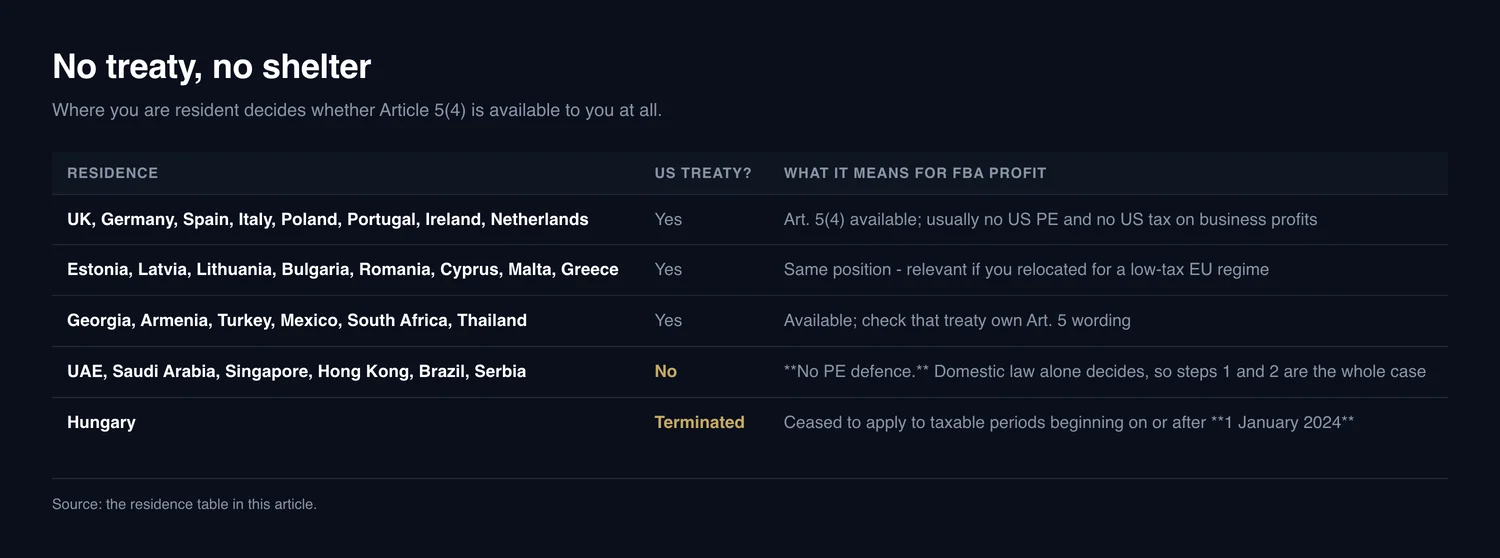
Because step three does most of the work, your country of tax residence matters more than anything about your Amazon account. The IRS publishes the list of US income tax treaties, and the absences are conspicuous for this audience.
| Residence | US treaty? | What it means for FBA profit |
|---|---|---|
| UK, Germany, Spain, Italy, Poland, Portugal, Ireland, Netherlands | Yes | Art. 5(4) available; usually no US PE and no US tax on business profits |
| Estonia, Latvia, Lithuania, Bulgaria, Romania, Cyprus, Malta, Greece | Yes | Same position — relevant if you relocated for a low-tax EU regime |
| Georgia, Armenia, Turkey, Mexico, South Africa, Thailand | Yes | Available; check that treaty's own Art. 5 wording |
| UAE, Saudi Arabia, Singapore, Hong Kong, Brazil, Serbia | No | No PE defence. Domestic law alone decides, so steps 1 and 2 are the whole case |
| Hungary | Terminated | Ceased to apply to taxable periods beginning on or after 1 January 2024 |
Hungary is the trap, because many location-independent founders moved there while the treaty existed. Termination took effect on 8 January 2023 and the convention stopped applying to taxable periods beginning on or after 1 January 2024, so a Hungarian-resident seller now sits where a Dubai-resident one does.
The UAE case is both the most common structure in this niche and the most exposed. A Dubai-resident seller with FBA inventory in the US has no permanent-establishment article to invoke: if steps one and two go against them the income is effectively connected and taxable at US graduated rates, and the 0% rate where they live is irrelevant to the US claim. Our guide to US LLC permanent establishment risk runs the same analysis in the opposite direction.
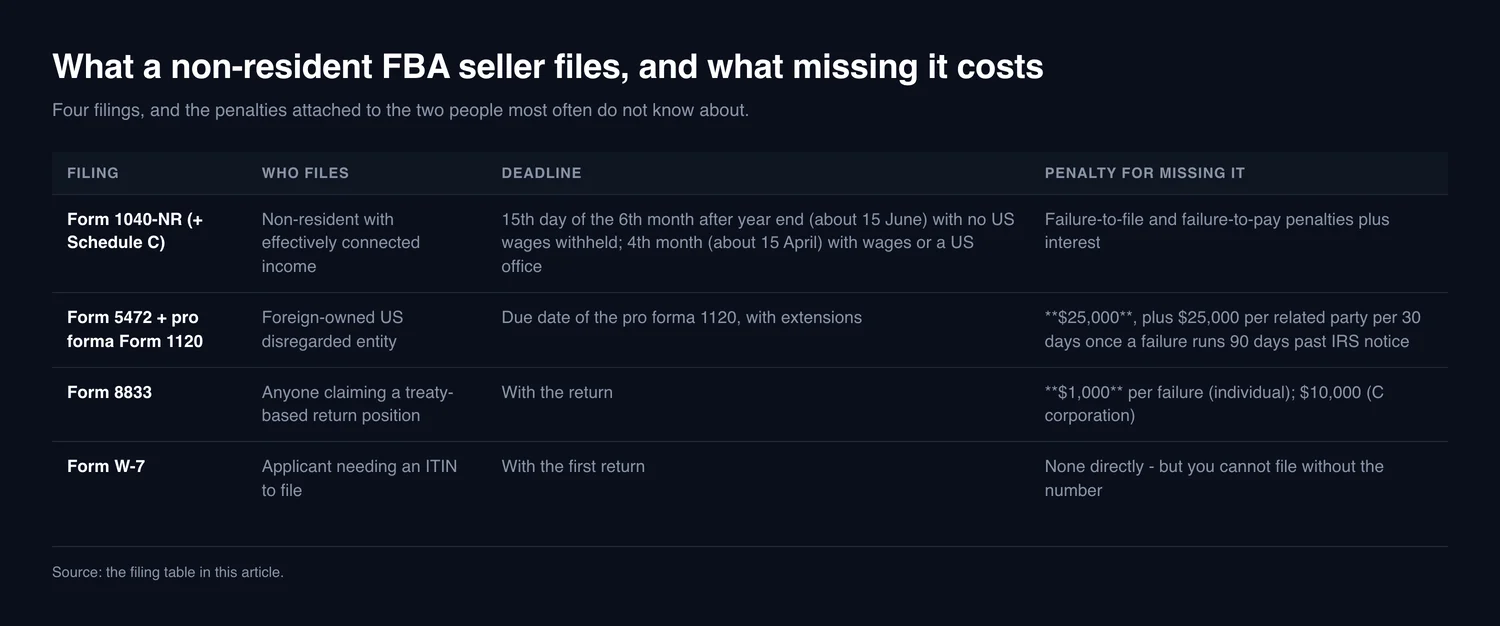
What a non-resident FBA seller actually files, and when
Filing obligations are not the same question as tax liability, and the deadlines are not the ones you would guess.
| Filing | Who files | Deadline | Penalty for missing it |
|---|---|---|---|
| Form 1040-NR (+ Schedule C) | Non-resident with effectively connected income | 15th day of the 6th month after year end (≈15 June) with no US wages withheld; 4th month (≈15 April) with wages or a US office | Failure-to-file and failure-to-pay penalties plus interest |
| Form 5472 + pro forma Form 1120 | Foreign-owned US disregarded entity | Due date of the pro forma 1120, with extensions | $25,000, plus $25,000 per related party per 30 days once a failure runs 90 days past IRS notice |
| Form 8833 | Anyone claiming a treaty-based return position | With the return | $1,000 per failure (individual); $10,000 (C corporation) |
| Form W-7 | Applicant needing an ITIN to file | With the first return | None directly — but you cannot file without the number |
Two details trip people up. The 1040-NR deadline for a seller with no US wages is June, not April, per the IRS guidance on taxation of non-resident aliens. And Form 5472 bites hardest because it is unrelated to whether you owe tax: the IRS instructions confirm a foreign-owned US disregarded entity has no regular income tax return requirement but must still file a pro forma Form 1120 with Form 5472 attached, completing only the name, address and items B and E. It cannot be e-filed — fax at 300 DPI or higher to 855-887-7737, or mail the PIN Unit in Ogden, Utah, with "Foreign-owned U.S. DE" across the top. Our Form 5472 guide walks the form itself.
Entity choice carries a consequence nobody mentions until too late: a US C corporation puts a US-resident taxpayer between you and your profit, and cannot invoke your treaty's Article 5 to exempt its own income. The shelter above belongs to you, which is why it works only while the LLC is disregarded. We compare them in US C corp for non-residents.
Sales tax: Amazon already handles the part you were worried about
A lot of FBA tax content still describes a world where inventory in a fulfilment centre obliges you to register, collect and remit sales tax in every state holding it. Marketplace facilitator legislation ended that world.
| Who sells | Who collects the sales tax | Where |
|---|---|---|
| Third-party seller on Amazon | Amazon calculates, collects and remits | All 45 states with a statewide sales tax, plus DC |
| Any seller | Nobody — no statewide sales tax exists | Alaska, Delaware, Montana, New Hampshire, Oregon |
| You, via your own store, wholesale or in person | You | Wherever you have nexus |
Two caveats stop this being a clean exit. Collection moving to Amazon does not automatically cancel a state's registration and filing requirements, and several states still count marketplace sales toward economic nexus thresholds even though the platform remits. Anything sold off Amazon — a Shopify store, wholesale invoices, trade shows — is yours. Our page on US sales tax for a foreign-owned LLC covers nexus in detail. For a pure FBA seller in 2026, sales tax is a reporting question, not a collection one.
State income tax: where the treaty cannot reach
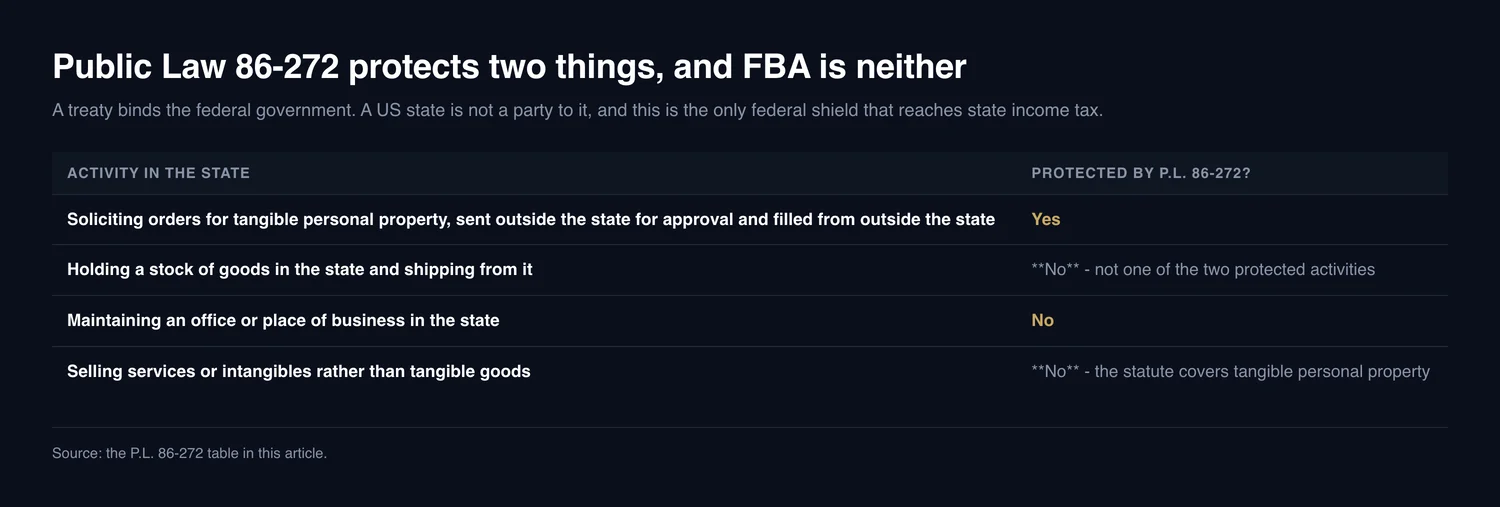
Here is the exposure that survives even a perfect treaty position, and I could not find it addressed on any page ranking for this query. US income tax treaties are agreements between the federal government and another country. Individual states are not parties to them, and most do not conform their nexus rules to treaty permanent-establishment concepts. Article 5(4) can therefore exempt you from federal tax on FBA profit and leave a state free to tax it anyway. The only federal shield is Public Law 86-272, and it is narrow by design.
| Activity in the state | Protected by P.L. 86-272? |
|---|---|
| Soliciting orders for tangible personal property, sent outside the state for approval and filled from outside the state | Yes |
| Holding a stock of goods in the state and shipping from it | No — not one of the two protected activities |
| Maintaining an office or place of business in the state | No |
| Selling services or intangibles rather than tangible goods | No — the statute covers tangible personal property |
An FBA seller fails on the second row: the whole point of the programme is that goods are stored in-state and shipped from there. Whether that becomes a bill depends on the state, its thresholds and your volume, and many small sellers fall under them. But it is a live risk your treaty does not touch, and nobody will raise it for you. The state you form the LLC in has little to do with it — nexus follows the inventory, not the certificate of formation.
What I would actually do
As a treaty-country resident selling on FBA, I would file. Not because tax is likely owed, but because the treaty position is something you claim on a return, and an unfiled return leaves the statute of limitations open indefinitely while the Art. 5(4) argument gets no weaker for being made on time. That means Form 1040-NR with Form 8833, plus the Form 5472 package if a US LLC is involved.
Resident somewhere with no US treaty — the UAE, Singapore, Hong Kong — I would treat this as a priority, get the purchased-versus-produced analysis done against my actual supply contracts, and price US federal tax in until an adviser says otherwise. That is the one configuration where the aggressive and cautious readings of the ranking pages arrive at the same uncomfortable place. And I would stop treating the US LLC as a tax decision: it is operational — the Amazon account, the banking, the payment rails — and it brings a $25,000-penalty filing with it. The tax outcome is set by where you are resident and what your treaty says.
Related guides
- Single-member LLC for non-residents — the disregarded entity, and the filing you cannot skip.
- Form 5472 and the $25,000 penalty — who must file, and how to submit it.
- US LLC permanent establishment risk — the same treaty analysis, opposite direction.
- US sales tax for a foreign-owned LLC — nexus, thresholds and marketplace rules.
- W-8BEN or W-9 for a foreign-owned LLC — which certificate your LLC gives Amazon.
- Best state for a non-resident LLC — why formation state is a cost question, not a tax one.
FAQ
Do non-US Amazon FBA sellers pay US tax?
Sometimes, and the deciding factor is usually your tax treaty rather than your inventory. A seller resident in a treaty country is usually protected by Article 5(4), which says a stock of goods held solely for storage, display or delivery is not a permanent establishment. A seller resident where there is no US treaty — the UAE, Singapore, Hong Kong — has no such shelter, and is the genuinely exposed case.
Does Amazon FBA inventory create a US trade or business?
There is no statutory or regulatory test that says so. IRC §864(b) defines "trade or business within the United States" mainly by reference to personal services and gives no rule for inventory. The working standard comes from case law and the IRS's own ECI guidance, which requires activity that is "considerable, continuous and regular". Year-round US inventory plausibly meets it, but anyone calling the answer settled is overstating the authority.
What is the difference between inventory you buy and inventory you make?
It changes the source of the income, which is the hinge of the analysis. Goods you purchase abroad and sell in the US are sourced under §861(a)(6) by place of sale, and the regulations put the sale where title and risk of loss pass — so an order shipped from a US warehouse is generally US-source. Goods you produce yourself fall under §863(b)(2), sourced solely on production activities since the 2017 Act, pointing to a factory abroad.
Do I have to collect US sales tax as an FBA seller?
On your Amazon orders, generally no — Amazon does it. Under marketplace facilitator laws it calculates, collects and remits sales tax on third-party seller transactions in all 45 states with a statewide sales tax plus DC; the five without one are Alaska, Delaware, Montana, New Hampshire and Oregon. That does not remove registration duties where a state imposes them, nor cover sales made off Amazon.
Can a US state tax my FBA profit even if my treaty protects me?
Yes, and this exposure is left out of most guides. US income tax treaties bind the federal government; individual states are not parties to them and most do not conform to treaty permanent-establishment rules. Public Law 86-272 protects only solicitation of orders approved and filled from outside the state, so in-state stock shipped from in-state falls outside it. Whether it becomes a bill depends on the state and your volume.
What happens if I claim treaty protection but do not disclose it?
Section 6114 requires disclosure of a treaty-based return position, and Form 8833 is how it is done. Section 6712 sets the penalty at $1,000 per failure for an individual, $10,000 for a C corporation. Relief is claimed on a filed return — not automatic, and not a reason to skip filing. A seller who never files has not claimed the treaty; they have an unfiled return and an open statute of limitations.
The filing that costs $25,000 to forget
Whatever the treaty analysis concludes about your profit, a non-resident-owned US LLC owes Form 5472 with a pro forma Form 1120 every year — no e-filing, a fax to Ogden, and a $25,000 penalty even when no tax is due. Doola forms the LLC, obtains the EIN and files the annual 5472, which is the part most FBA sellers discover a year late.
Sources
- IRS — Effectively Connected Income (ECI) ("considerable, continuous and regular"; graduated rates after deductions; the US-resident-broker example)
- IRS — Taxation of Nonresident Aliens (1040-NR due the 15th day of the 6th month with no wages withheld, the 4th with wages or a US office)
- IRS — Instructions for Form 5472 (pro forma 1120 with 5472 attached, items B and E only; $25,000 plus $25,000 per related party per 30 days after 90 days' notice; no e-filing; fax 855-887-7737; PIN Unit, Ogden UT)
- IRS — United States income tax treaties A to Z (treaty partner list; Hungary marked treaty terminated; no UAE, Saudi Arabia, Singapore, Hong Kong, Brazil or Serbia treaty). Hungary's termination took effect 8 January 2023 and the convention ceased to apply to taxable periods beginning on or after 1 January 2024 per IRS Announcement 2024-5.
- US Treasury — 2016 US Model Income Tax Convention (Art. 5(1); Art. 5(4)(a)-(b) storage/display/delivery and stock-of-goods exclusions; Art. 5(5) dependent agent; Art. 5(6) independent agent; Art. 7(1) business profits)
- Cornell LII — 26 U.S.C. §864 (§864(b) definition and exclusions; §864(c)(3)), §865 (inventory exception routing to §§861(a)(6), 862(a)(6), 863), §861 (bought outside, sold inside the US is US-source), §863 (self-produced inventory sourced solely on production activities, years after 31 December 2017), Reg. §1.861-7(c) (place of sale; bare legal title; anti-abuse) and 26 U.S.C. §6712 (the disclosure penalty)
- Cornell LII — 15 U.S.C. §381 (Public Law 86-272) (state net income tax barred only where in-state activity is limited to soliciting orders approved and filled from outside the state)
Marketplace facilitator coverage (45 statewide-sales-tax states plus DC, and the five without one) is as reported consistently by sales-tax practitioners in 2026; Amazon's own Seller Central page is the primary source and sits behind a seller login, so it could not be fetched. State income tax exposure turns on each state's own nexus rules, which are not centrally published.
Rules and figures are as published in 2026 and change without notice. How §864 and any treaty apply to your facts depends on your supply contracts, your residence and your other US activity — and on the purchased-versus-produced question, genuinely unsettled for contract manufacturing. Take advice from a cross-border tax adviser before acting. Nothing here is legal or tax advice.